Wednesday, April 01, 2026

Italy delays coal phase-out by over a decade


By AFP
March 31, 2026


Italy's delay to its phase-out of coal runs contrary to EU climate goals. - Copyright AFP Shammi MEHRA


Ella IDE

Italy’s parliament voted Tuesday to delay the closure of the country’s coal-fired power stations by over a decade, a move experts slammed as “worrying” political propaganda.

In a fresh challenge to the EU’s green transition, Giorgia Meloni’s hard-right coalition government pushed the shutdown back from 2026 to 2038 on “energy security” grounds.

Italy is heavily reliant on imported gas and Rome is under pressure from industry and consumers over the rise in already sky-high energy costs due to the Middle East war.

While Brussels insists that phasing out coal is key to achieving the EU’s climate goals, Rome says it may be forced to use its coal-fired power stations if gas prices continue upwards.

But experts who spoke to AFP said that reactivating the plants would not lower electricity prices.

Italy’s move comes as others including Germany, South Korea, the Philippines and Japan, have similarly signalled that coal-fired plants could ease energy woes caused by the war.

The Italian government’s bill extending the phase-out was approved by the lower house of parliament Tuesday, and now goes to the Senate, where the ruling coalition has a majority.

The delay is “a worryingly backward-looking political signal”, while “any security gain is far from guaranteed”, Beatrice Petrovich, senior energy analyst at energy think tank Ember, told AFP.

Only Germany, Poland, and Bulgaria share a coal phase-out date as unambitious as Italy’s new one, she said.

The EU’s climate commissioner, Wopke Hoekstra, who was in Rome Tuesday for a hearing with senators on Italy’s energy mix, declined to comment on Rome’s decision.


– ‘Old fleet’ –


Climate think tank ECCO said Rome’s postponement was “symbolically damaging, but low-impact in practice — at least for now”.

“The government is deliberately maintaining ambiguity between ‘not dismantling’ and ‘actually using’ coal plants for political gains”, it said.

Italy currently has four coal-fired power stations. Two of them are on the mainland, are dormant and lost their authorisation to burn coal in January, ECCO said.

Restarting them would mean applying for new permits, a process that takes years and would be subject to significant legal and community opposition, it said.

The other two are in Sardinia, and are earmarked for closure in 2028-2029, once the island is electrically linked to the mainland via a new submarine cable.

ECCO’s Executive Director Luca Bergamaschi told AFP Italy’s “old and largely non-operational coal fleet would be very expensive to restart”.

Petrovich agreed that “coal plays a minor role in Italy’s power mix and this won’t change going forward”.

Italy’s total coal generation in 2025 was approximately 2,975 GWh, and less than 1 percent of national electricity output, according to state-controlled power grid operator Terna.

There is no financial incentive for operators to return to coal, and the price of coal imported to Europe has recently surged, the experts said.

Coal is also uncompetitive against gas under the EU’s carbon tax scheme.

Including it in the energy security tool-kit “risks being an additional burden on Italy’s electricity consumers, who already pay some of the highest electricity prices in the EU”, Petrovich said.
The reality of restarting North Sea oil drilling


By AFP
March 31, 2026


The Total Culzean platform in the North Sea, about 45 miles (70 kilometres) east of the Aberdeen, pictured on Scotland's northeast coast in April 2019 - Copyright AFP/File ANDY BUCHANAN, ANDY BUCHANAN


Ali Bekhtaoui

As the Middle East war drives up oil prices, the UK’s main opposition Conservative party is urging the government to restart drilling in the North Sea — echoing repeated calls from US President Donald Trump.

Experts warn, however, that the proposal runs up against geological and economic realities.


– Why call for North Sea drilling? –


The Conservatives, who are heavily outnumbered in parliament, are preparing legislation aimed at removing barriers to oil and gas drilling in the North Sea, in order to facilitate access to domestic fossil fuel resources.

They echo Trump’s repeated criticism of Britain’s Labour government for failing to sufficiently exploit offshore reserves, even as the UK faces some of the highest energy prices in Europe.

“Go get your own oil!” Trump again urged on Tuesday in a post on Truth Social, without explicitly naming any country.

“Drilling in the North Sea and expanding other sources of generation” is the “only way we can protect families from rising bills, keep the cost of energy down for business, and control inflation,” Conservative leader Kemi Badenoch wrote in a blog post.

The Labour government, meanwhile, has pledged to halt new exploration licences in the North Sea for environmental reasons, although it slightly softened its policy in November.


– What would be the impact? –


While supporters argue that restarting drilling would strengthen security and energy independence, experts interviewed by AFP emphasised major constraints for both oil and gas.

The area that “the UK has access to is a very mature, depleted basin,” Tessa Khan, an environmental lawyer, told AFP.

“The productivity of that — in terms of how much you could extract from it — peaked in the late 1990s and it’s been in decline ever since,” she added.

Structural limits also apply, as production cannot immediately be redirected to domestic consumption.

“The UK is part of oil and gas international markets, and we have to remain part of these markets because we need to import,” said Simon Cran-McGreehin, an analyst at the Energy and Climate Intelligence Unit, a non-profit research group.

Prices are set on these markets according to supply and demand, and the UK’s low level of production has little, if any, impact on them.

“Bringing in new production takes years, which means that any new oil and gas would arrive long after the crisis has passed,” the UK Energy Research Centre said in a recent briefing.


– What are the other solutions? –


The quest for energy independence has returned to the forefront since the start of the Middle East war, as it did after Russia invaded Ukraine in 2022, which sent gas prices soaring.

Two options are often put forward by experts: reducing fossil fuel consumption and significantly expanding renewables.

“The UK has one of the biggest offshore wind markets in the world,” Khan said.

“We already have a backlog of renewable energy projects that are waiting for grid connections,” and the timelines are potentially “much shorter” than for fossil fuel projects.

Renewables also offer stronger job creation prospects.

According to a study by Robert Gordon University in Aberdeen released last year, the workforce in the oil and gas sector could be cut in half by the early 2030s, while jobs in renewables are projected to nearly triple by 2035.
Greenpeace accuses oil companies of reaping Mideast ‘war profits’


By AFP
April 1, 2026


The US-Israeli war on Iran has caused global oil and gas prices to surge - Copyright AFP Philippe LOPEZ

A study commissioned by Greenpeace said on Wednesday that oil companies have been making more than 80 million euros a day in “war profits” in the European Union since the start of the war in the Middle East.

“If this level persists, the oil companies can expect additional operating profits of approximately 2.5 billion euros ($2.9 billion) for the month of March alone,” the study said.

The study examined the difference between the price of crude oil and the price of fuel at the pump between January and February 2026, and the first three weeks of the war in March.

“The report shows that the rise in prices at the pump is far greater than that of underlying crude oil prices,” Greenpeace said in a statement.

The increase in margins was much greater for diesel fuel than for petrol.

“Compared with the pre-war months, the oil companies earned a daily excess profit of 75.3 million euros from the sale of diesel fuel to cars and trucks,” the report said.

“Petrol sales contributed 6.1 million euros per day.”

Margins were expanded predominantly in countries with high purchasing power such as the Netherlands, Sweden, Denmark, Austria and Germany, the report said.

In Germany, excess profits stood at 23.8 million euros per day, followed by France, at 11.6 million euros per day.

“Greenpeace France is calling on European governments to introduce permanent additional taxes on the profits of oil and gas companies, the proceeds of which would be used to reduce energy bills and accelerate European energy independence,” the environmental group said.

The United States and Israel launched strikes against Iran on February 28, triggering a regional conflict that has caused global oil and gas prices to surge and sparked fears of fuel shortages, especially in import-reliant Asia.

Last week, the price of diesel in France hit its highest level since 1985, surpassing the peaks reached after Russia’s invasion of Ukraine in 2022.

Under increasing pressure, many governments have rolled out measures to limit the impact of supply difficulties and soaring energy prices.
German whale saga continues as struggling animal beached again


By AFP
March 31, 2026


Aerial photo from March 30, released by Greenpeace, showing the whale in Wismar Bay - Copyright Greenpeace Germany/AFP Daniel Müller

A humpback whale that experts have been trying to coax out of shallow waters off the German coast has become trapped on a sandbank for the fourth time, rescuers said Tuesday.

After initially freeing itself from a beach close to the city of Wismar on Monday, the animal became stuck in shallow waters again on Tuesday.

The 13.5-metre (44-foot) animal has been struggling in the area for more than a week, having first been spotted in the early hours of March 23 near the city of Luebeck.

The latest developments demonstrate “just how weakened” and “in need of rest” the whale is, Thilo Maack from Greenpeace told journalists in Wismar.

But the environment minister for the state of Mecklenburg-Western Pomerania, Till Backhaus, said rescuers were not ready to give up as long as the whale was still showing signs of wanting to swim.

“I’m keeping my fingers crossed and I hope we’ll still get a happy ending,” he said.

After the whale initially became stuck near the city of Luebeck last week, rescuers tried to free it by making waves and digging a channel with excavators.

The creature eventually managed to free itself from the sandbank but ran into further difficulty after swimming eastwards.

It became stuck on sandbanks near Wismar twice over the weekend, and experts warned that its breathing rate had reduced.

Since the Baltic is not its natural habitat, experts are hoping it will make its way back to the North Sea and then on to the Atlantic.

The whale is believed to be suffering from skin problems due to the lower level of salt content in the Baltic Sea compared to the open ocean.

It is possible the whale came into the Baltic Sea following a shoal of fish or having been distracted by the noise of a submarine.
Archaeologists forced by Mideast war to cut short Iraq digs


ByAFP
March 31, 2026


Iraq is home to archaeological sites thousands of years old - Copyright AFP/File Issouf SANOGO

Rose TROUP BUCHANAN

Iraq is home to ruins from some of the world’s earliest civilisations, but teams led by international archaeologists have been forced by drone and rocket attacks in the Middle East war to cut short their expeditions.

Archaeologists told AFP that some of the projects interrupted by the war had been planned for years, but their teams have had to evacuate ancient sites since the United States and Israel attacked Iraq’s neighbour, Iran.

Like other countries around the region, Iraq has become engulfed in the war, bringing to an abrupt end a period of nascent stability.

Iraq’s precious archaeological sites, some dating back thousands of years, had for years faced threats ranging from climate change to successive conflicts.

Under normal circumstances, around 60 international teams would have been working on digs, a government official told AFP, but “all of these missions have left Iraq”.


– ‘Like a musician’ –


Adelheid Otto of Germany’s Ludwig-Maximilians-University started a long-planned dig at ancient Shuruppak, modern-day Tell Fara, on February 28.

That same day, Israel and the US launched strikes against Iran, sparking a war that has dragged Iraqi armed groups into the fray — and cutting short Otto’s work.

“We are Near Eastern archaeologists. So that is our work. That is like a musician who can no longer play an instrument,” she told AFP.

Her team — 18 German archaeologists, geologists, geophysical experts and students and seven Iraqi archaeologists — initially stayed, reasoning travelling the 750 kilometres (460 miles) overland to Turkey was more dangerous.

“After some days we got kind of used to the rockets and drones above our heads,” she said.

But Iraqi officials repeatedly urged them to depart, despite their discovery of ancient cuneiform tablets.

“It is impossible” to leave, she told authorities, insisting on staying extra days. “We have to document it. We have to take photos of everything.”

“I told the students you have to work on all the small finds that we have,” said Otto, 59, who boasts four decades of experience.

“You never know in any of these countries if you will ever return,” she said.


– ‘Guarantors’ –


Many German institutions had just started relaxing travel restrictions to Iraq after a succession of conflicts, including the 2003 US-led invasion and the extremist Islamic State group.

Now, said Otto, archaeologists once again face being shut out.

Iraq’s State Board of Antiquities and Heritage head Ali Obeid Shalgham told AFP Iraqi security forces were the sites’ “true guarantors”, especially as many are in remote rural areas.

He said the country is installing so-called protective “blue shields” — nicknamed “the Red Cross of heritage” — at archaeological sites.

The presence of foreign teams is “crucial”, said Aqeel al-Mansrawi, an Iraqi landscape archaeologist.

“They work to protect heritage through conservation,” he said.

He also emphasised the training Iraqi experts receive from foreigners, vital after years of isolation and war.

“We are always training a lot of Iraqi archaeologists and colleagues,” said Otto, of the German institute.

“If it would be cut again, it would be terrible,” she said.

Foreign digs must work with Iraqi archaeologists, bringing their international expertise.

Shalgham said the arrangement allows Iraqis “to keep up with global advancements in new technologies and state-of-the-art equipment”.


– ‘Can’t catch a break’ –


Chicago University professor Augusta McMahon was in southern Iraq, working at the 6,000-year-old Nippur site, when the war began.

Having worked in the Middle East for almost four decades, this was her third evacuation.

In 2024, she had to leave Iraq, while in 2011, she left Syria.

“We had pressure from a lot of different directions in terms of having to leave,” she said, with her eight-person team departing under an Iraqi escort on March 10.

“It is quite frustrating, along with everything else, I feel terribly bad for [my] Iraqi colleagues,” she said.

The war has also rippled beyond the immediate: an initiative to finally return the preeminent Rencontre Assyriologique Internationale (RAI) conference to Iraq was cancelled by the University of Baghdad.

The city last attempted to host the event in 1990, according to the university, but it was scrapped with the Gulf War.

“Now 36 years later, they finally pulled themselves together… and its cancelled again,” said McMahon, who was due to be presenting.

“It’s like they can’t catch a break.”
Op-Ed: TACO strikes again — ‘Get your own oil’ followed by ‘US will exit in 2-3 weeks’


By Paul Wallis
EDITOR AT LARGE
DIGITAL JOURNAL
March 31, 2026


Asian labourers working in the United Arab Emirates have been caufght up in the Middle East war triggered by the US-Israeli assault on Iran - Copyright AFP Karim SAHIB

You have to wonder how much ego-fodder is involved in this situation. All of a sudden, King Donald the Pointless doesn’t want to play war anymore.

I ran out of scatology for this meaningless, nauseating, useless anti-President during the first “administration”.

So, with due apologies to the English language:

The behavioral pattern is the same again: get into a situation he doesn’t begin to understand, spend billions, put a lot of people at risk, screw up the global economy, and run away. This may be without reopening Hormuz or achieving anything at all. As usual, the problem remains after he’s gone.

Just about everybody on Earth was wondering what the point of the Iran war could possibly be from day one.

US rapid deployment ground forces were on their way to Hormuz yesterday.

Threats to destroy desalination plants were the news yesterday.

Now it’s all over?

No party bags?

Broadway not interested?

No smiling happy snaps with those dead Iranian schoolgirls who’d otherwise be alive right now?

No merch?

Apparently. The “Get your own oil” line came out of the mystic PR sewer that has replaced formal US government announcements a couple of hours ago.

Real governments don’t do business on social media.

Neither does anyone else.

Antagonizing allies is pretty much normal while telling them to open Hormuz themselves. Nobody cares. Relations will get back to something like normal after this obscene idiocy departs. The GOP’s global credibility may now be worth much less than an empty KFC bucket, but they’re going extinct anyway.

Nobody will ever forget or forgive this barrage of BS. Crossing one line may be overlooked. Not crossing all of the lines at the same time.

Militarily, absolutely nothing has been achieved, except maybe forcing Iran to drastically update its military museum. The strikes mainly destroyed most of Iran’s non-combat-viable, non-deployable garage sale of a military inventory. A modernized, rearmed Iran could be a much more serious threat.

Happy now?

The really exciting bit is that there are two more years of idiocy to come.

__________________________________________________________

Disclaimer
The opinions expressed in this Op-Ed are those of the author. They do not purport to reflect the opinions or views of the Digital Journal or its members.
‘Is it Kafka?’ US judge baffled by new Pentagon press policy


By AFP
March 30, 2026


The New York Times sued after the Defense Department stripped journalists of press credentials who refused to agree to the more restrictive access policy - Copyright AFP ANGELA WEISS

The New York Times and Trump administration clashed in a federal court on Monday over restrictions imposed by the Pentagon on journalists covering the Defense Department.

Judge Paul Friedman, in response to a lawsuit filed by the newspaper, ruled this month that new Pentagon policies regarding media access were unconstitutional and Times reporters should have their credentials restored.

The Trump administration has said it will appeal the ruling and the Defense Department responded with even tighter rules, closing a press area in the Pentagon called Correspondents’ Corridor and moving reporters to an annex in a separate building.

In addition, under the new policy, “all journalist access to the Pentagon will require escort by authorized Department personnel.”

Theodore Boutrous, a Times lawyer, accused the administration at a hearing before Friedman in a Washington court on Monday of “gaslighting” and “bad faith.”

“We’ve seen this movie before,” Boutrous said. “They made the press credentials that we fought so hard to get back meaningless.”

Julian Barnes, a Times reporter, in a sworn declaration, noted that reporters were unable to access the new press facility on foot and were also not allowed to use a Pentagon shuttle bus.

“How weird is that?” Friedman responded. “Is it Catch 22? Is it Kafka?”

Barnes said Pentagon press accreditation pass holders were ultimately told they would be given permission to ride on the shuttle bus.

The judge, after hearing arguments from the Times and Sarah Welch, a lawyer representing the Justice Department, did not issue an immediate ruling.

US media and a host of other news outlets including AFP declined to sign the new access policy in mid-October, resulting in the loss of their Pentagon credentials.

The restrictions were the latest in a series of measures by President Donald Trump and top officials against journalists and outlets that are often derided as “fake news” when their reporting displeases the administration.
Air Canada CEO to retire after row over English-only condolence message


By AFP
March 30, 2026


Air Canada says its chief executive will retire by the end of the third quarter, after backlash over his failure to issue condolences in both French and English for a fatal airport disaster - Copyright AFP/File TIMOTHY A. CLARY


Beiyi SEOW

Air Canada said Monday that CEO Michael Rousseau will retire later this year, an announcement following controversy over his failure to issue condolences both in English and French for a fatal airport disaster.

Rousseau had sparked controversy by issuing an English-only video message to express condolences after a deadly collision late on March 22 between an Air Canada jet and a fire truck at New York’s LaGuardia Airport.

Canada has two official languages — English and French — and media reports noted that one of the pilots killed in the accident was from French-speaking Quebec.

Rousseau has informed the company’s board that he will retire by the end of the third quarter, the airline said, adding that work is underway to choose his successor.

“The Board will consider a number of performance criteria in assessing candidates including the ability to communicate in French,” Air Canada said in the statement.

Until he steps down, Rousseau is set to continue leading the company and serving on its board.

Air Canada is the country’s largest airline and is headquartered in Montreal, Quebec — Canada’s traditionally French-speaking region. The company is required to offer services in both languages.


– ‘Lack of judgement’ –


Rousseau had earlier issued an apology over his English-only message, saying he was saddened that his limited French “has diverted attention from the profound grief of the families.”

“Despite many lessons over several years, unfortunately, I am still unable to express myself adequately in French,” he said in a statement.

He added: “I sincerely apologize for this, but I am continuing my efforts to improve.”

Canadian Prime Minister Mark Carney has also criticized the CEO’s conduct, saying he was “very disappointed, as others are, rightly so, in this unilingual message.”

Carney added that the message showed a “lack of judgement and a lack of compassion.”

Similarly, Canadian Foreign Minister Anita Anand told AFP on the sidelines of the G7 foreign ministers meeting in France that all Canadian leaders, including corporate bosses, should speak both official languages.

“Canada is a bilingual country,” she said.

In 2021, Rousseau also issued an apology over his lack of French proficiency.

At the time, he apologized for causing offense by giving a speech almost entirely in English, pledging to improve his French.

After remarks to business groups and comments to journalists that he had managed to get by without French for years, Rousseau faced backlash from politicians.

Quebec is the only Canadian province that is primarily Francophone.
Op-Ed: No Kings goes global, FOX says it’s communist-backed, while America goes down the drain


By Paul Wallis
EDITOR AT LARGE
DIGITAL JOURNAL
March 29, 2026


Demonstrators are seen rallying in Los Angeles at a 'No Kings' protest in June 2025 -- and they will hit the streets again on October 18, 2025 - Copyright AFP/File ETIENNE LAURENT

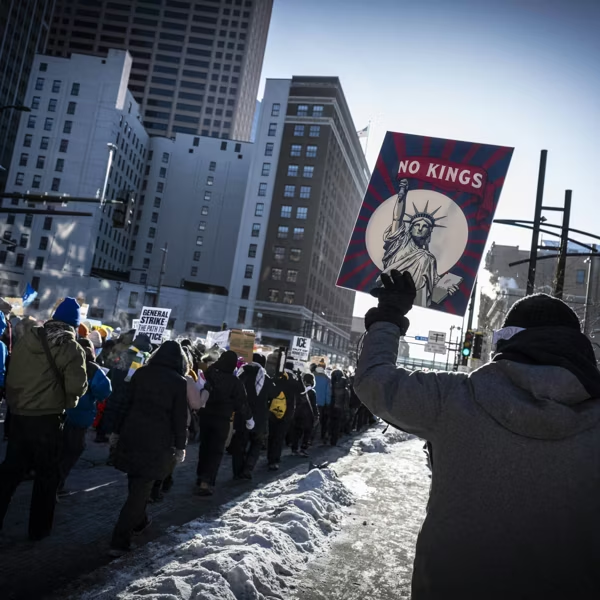
The third No Kings rally in 14 months is bigger than ever.

The world agrees. There are even protests in Italy, France, Germany, the UK, and Portugal.

There’s even a No Kings in Puerto Rico, which someone called a “trash island” during the 2024 election.

There’s a reason for this, and it’s much deeper than just today or the last 10 years.

Americans in general don’t like American politics, and historically they rarely have. They don’t trust it. They all truly hate the ongoing horror story that the country has become. That’s getting on people’s nerves to an intolerable level. The one thing they don’t want to see is the absolute, total failure to address all issues.

This isn’t about ideology.

It’s about reality.

America isn’t yet a true has-been country, but you can see echoes from other former top dog countries. You also can’t avoid American nostalgia for a second. It’s everywhere. It condenses into “Things used to be great”. There’s a very sour, multi-generational taste in people’s mouths. America simply doesn’t like total failure, particularly in large doses.

The Trump administration is also pretty unpopular for a so-called “grassroots populist movement” even at the scripted-hicks level.

In no sense of the word is this administration anything like a real government. It’s a mess.

The purpose of government is to run countries, not destroy them.

A chronically sick, 95% broke, hyper overstressed country can’t be “great”.

Things are now definitely not “great” for those wondering, and they’re getting worse.

Failure can’t hide. Neither this administration nor the previous Trump administration can pretend to have delivered on any of its platforms. More priority is given to tax cuts for the rich than to any other issue. DOGE effectively gutted the Federal government. Tariffs have been a disaster, cranking up domestic prices while Americans struggle with daily expenses.

ICE is far less effective and far more expensive in its role than any other administration’s anti-illegal immigrant initiatives. Check any stats you can find. The FCC is a political muppet. The FAA is looking like an old theme park. Foreign affairs now consist of wars and very deeply offended trading partners and allies. Even food and water are big daily issues.

No Kings is simply calling it like it is.

America’s previously influential, now ridiculous mass media aren’t helping. Everything is downplayed. From mass layoffs to the sheer absurdity of replacing trained people with unreliable technologies, there’s a buzzword for everything, but no substance.

The No Kings rally got a response from FOX, which somehow managed to glue together some sad little coverage, calling it a communist plot. This recycled 1950s kitsch is pure McCarthyism, finding Reds Under Beds on a routine basis.

American media believes itself. Nobody else does. But if someone in American media says there are Reds Under Beds, there must be Reds Under Beds just because it says so.

As a matter of fact, the American socialist reaction would be called mainstream in any country on Earth but America. Definitely not “socialism” in any form.

The Constitution, when it was written, was one of the most advanced constitutions in history, and it still is in so many ways. Nobody else even thought of the pursuit of life, liberty, and happiness. They didn’t put it in their constitutions, either. America did. It was a sort of 1776 version of socialism before even the word socialism really existed. Inalienable rights were something new and truly revolutionary then.

The No Kings rallies are simply the Constitution at work.

_____________________________________________________________

Disclaimer
The opinions expressed in this Op-Ed are those of the author. They do not purport to reflect the opinions or views of the Digital Journal or its members.


Critics Blast ‘Clueless’ New York Times for Dismissive Coverage of Historic No Kings Protests

“The NY Times saves its harshest skepticism for progressives,” said one critic.


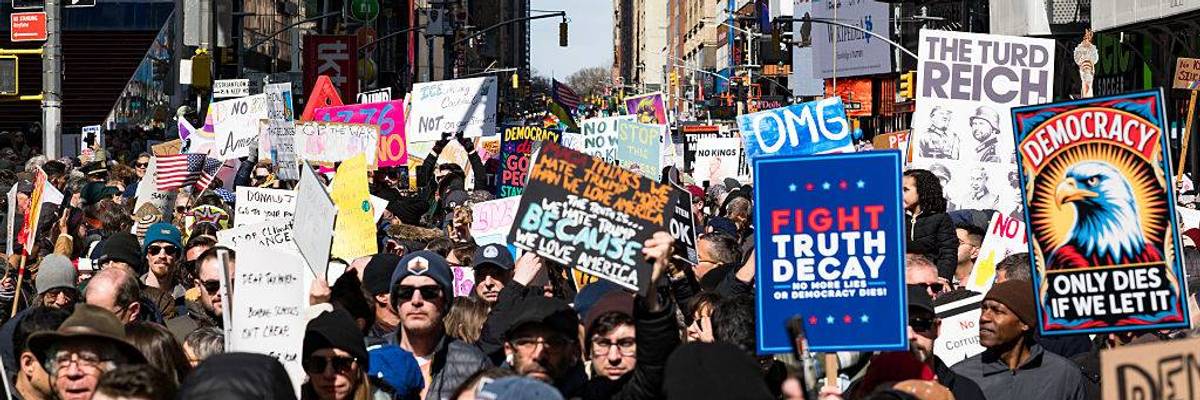
Protesters gather in Times Square during the ‘’No Kings’’ national day of protest in New York, United States, on March 28, 2026.
(Photo by Jerome Gilles/NurPhoto via Getty Images)


Brad Reed
Mar 29, 2026
COMMON DREAMS

The New York Times is drawing criticism for publishing articles that downplayed the significance of Saturday’s No Kings protests, which initial estimates suggest was the largest protest event in US history.

In a Times article that drew particular ire, reporter Jeremy Peters questioned whether nationwide events that drew an estimated 8 million people to the streets “would be enough to influence the course of the nation’s politics.”
RECOMMENDED...


“Can the protests harness that energy and turn it into victories in the November midterm elections?” Peters asked rhetorically. “How can they avoid a primal scream that fades into a whimper?”

Journalist and author Mark Harris called Peters’ take on the protests “predictable” and said it was framed so that the protests would appear insignificant no matter how many people turned out.

“There’s a long, bad journalistic tradition,” noted Harris. “All conservative grass-roots political movements are fascinating heartland phenomena, all progressive grass-roots political movements are ineffectual bleating. This one is written off as powered by white female college grads—the wine-moms slur, basically.”

Media critic Dan Froomkin was event blunter in his criticism of the Peters piece.

“Putting anti-woke hack Jeremy Peters on this story is an act of war by the NYT against No Kings,” he wrote.

Mark Jacob, former metro editor at the Chicago Tribune, also took a hatchet to Peters’ analysis.

“The NY Times saves its harshest skepticism for progressives,” he wrote. “Instead of being impressed by 3,000-plus coordinated protests, NYT dismisses the value of ‘hitting a number’ and asks if No Kings will be ‘a primal scream that fades into a whimper.’ F off, NY Times. We’ll defeat fascism without you.”

The Media and Democracy Project slammed the Times for putting Peters’ analysis of the protests on its front page while burying straight news coverage of the events on page A18.

“NYT editors CHOSE that Jeremy Peters’s opinions would frame the No Kings demonstrations and pro-democracy movement to millions of NYT readers,” the group commented.

Joe Adalian, west coast editor for New York Mag’s Vulture, criticized a Times report on the No Kings demonstrations that quoted a “skeptic” of the protests without noting that said skeptic was the chairman of the Ole Miss College Republicans.

“Of course, the Times doesn’t ID him as such,” remarked Adalian. “He’s just a Concerned Youth.”

Jeff Jarvis, professor emeritus at the CUNY Graduate School of Journalism, took issue with a Times piece that offered five “takeaways” from the No Kings events that somehow managed to miss their broader significance.

“I despise the five-takeaways journalistic trope the Broken Times loves so,” Jarvis wrote. “It is reductionist, hubristic in its claim to summarize any complex event. This one leaves out much, like the defense of democracy against fascism.”

Journalist Miranda Spencer took stock of the Times’ entire coverage of the No Kings demonstrations and declared it “clueless,” while noting that USA Today did a far better job of communicating their significance to readers.

Harper’s Magazine contributing editor Scott Horton similarly argued that international news organizations were giving the No Kings events more substantive coverage than the Times.

“In Le Monde and dozens of serious newspapers around the world, prominent coverage of No Kings 3, which brought millions of Americans on to the streets to protest Trump,” Horton observed. “In NYT, an illiterate rant from Jeremy W Peters and no meaningful coverage of the protests. Something very strange going on here.”

APRIL FOOLS 2026


https://plawiuk.blogspot.com/search?q=april+fool

https://plawiuk.blogspot.com/search?q=april+fools