Sunday, April 05, 2026

Britain

Together against the far right march breaks records


Friday 3 April 2026, by Echo Fortune, Terry Conway
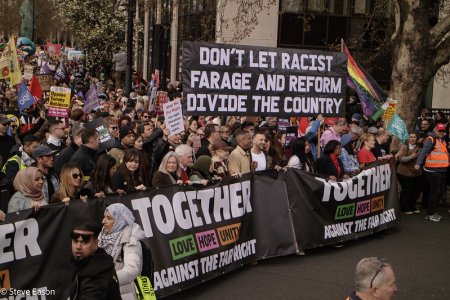


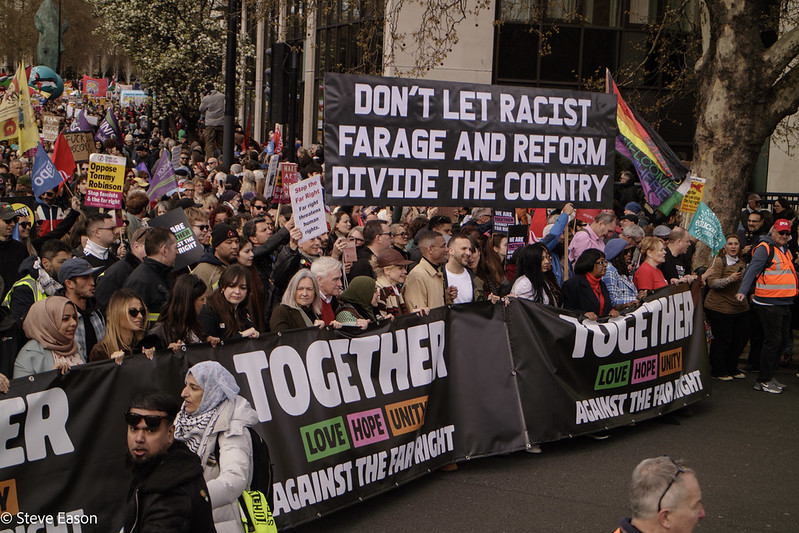
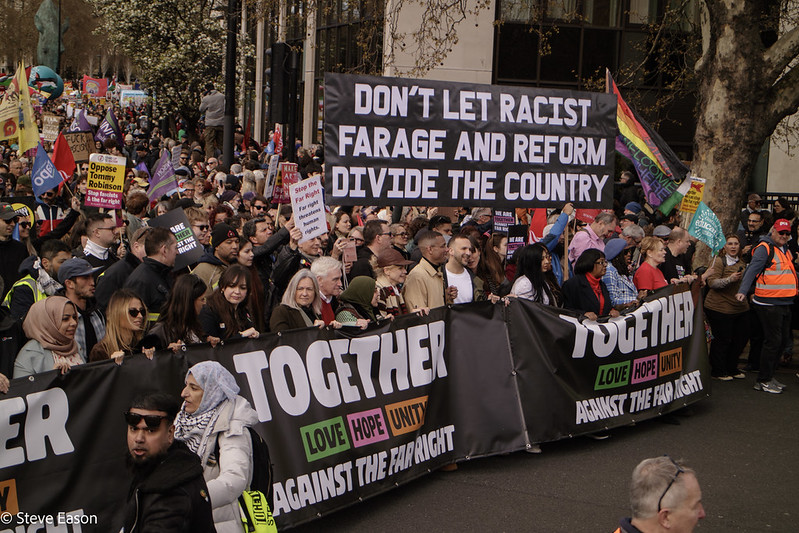
The Together Alliance march against the far right on Saturday, 28 March, was probably the biggest anti-fascist protest in British history. It was comparable to some of the early Palestine solidarity demonstrations.

Organisers claim it was half a million people – it’s difficult to be certain with such a mammoth crowd, but it was over two and a half hours after the front banners left Park Lane before the back did so. Just getting anywhere through the crowd was like swimming in treacle!

This was a crucial demonstration after 100,000 people turned out for far-right activist Tommy Robinson’s Unite the Kingdom protest last September, with a small and demoralising counter-demo.

While Anti Capitalist Resistance (ACR) has criticisms of the Together Alliance organisers for their emphasis on soft slogans against the far right, as well as the inclusion of prominent transphobes amongst its key spokespersons, this historic display of solidarity on London’s streets is a moment to celebrate and seize as an opportunity to build resistance in our communities.

Migrants and asylum seekers are on the front lines in this struggle, and our support must be unwavering. They are joined by disabled, trans, Black, and other racialised people, as well as women in general, as targets of the new far right, who only augment the institutional and structural violence of the state.

Diverse

The mobilisation was enormously diverse. There was great publicity outreach – leafleting for weeks in many communities and workplaces, as well as coverage in the few days before in the Mirror, the Guardian, and the London Evening Standard. People heard about it and came with their mates. The music was an attraction. Others came through contact with Greenpeace, War on Want, and other NGOs, and charities.

There was a Palestine feeder march of several thousand, as well as many Palestine flags throughout the gathering. Democrats abroad brought No Kings papiermache masks marking the massive protests taking place in the United States against Trump, the same day. Again, anti-Trump messaging was common. A substantial Eastern European contingent made an impact on the demonstration. Their message was simple: you have to fight the far right not just in the West but also in the East of Europe. Many on the contingent were Ukrainian whose friends and families are on the front line resisting annexation by Putin or living under a regular bombardement. One of the slogans chanted was “from Ukraine to Palestine, Occupation is a crime”. The Ukraine Solidarity campaign was a very viisible part of this with their flags.

Many unions had worked to bring members and banners onto London’s streets, with NEU and UNISON having the strongest showing. Quite why the turnout for this section of the demonstration was so much more significant – looking like a respectably sized march of its own – than they have mobilised against the genocide of Palestinians is a question that many activists will undoubtedly be raising over the weeks ahead.

Parties

As for political parties, the situation was more complicated.

Rob Marsden reports on the Green Party presence:

I found small groups of Green Party members or individuals walking with friends and family, often with home-made signs referencing Zack Polanski, Hannah The Plumber, or riffing on the ‘Green Menace’ tag.

Many of these people were not only new to the Green Party and to organised politics; in many cases, they had never been on a demonstration before. Hopefully, the breathtaking size and spectacle of the Together March will be a lasting inspiration and a spur to ongoing activity.

Those of us who did make it to the ‘official’ Green Party bloc, way at the back of the march, behind a battalion of Extinction Rebellion samba drummers, still found that it numbered maybe a thousand people and was identifiable by a large number of local Green Party banners, including many of the upright teardrop or feather type. Green Parties from across Britain were represented, but many, maybe most, do not currently have their own banners.

And here lies a bit of a problem for the Greens. There were no centrally produced GP placards or leaflets of any type. This seems not to be a resource issue. Compared to a couple of years ago, the Green Party and its local branches are awash with cash.

Rather, it is a question of GP culture and an over-focus on local electoral campaigning rather than a more general approach to winning wide layers of people to the politics of the GP and building a solid base within social movements.

Your Party also had its own block, on which Dave Kellaway reports:

It was estimated at around 500 participants. Those organising the block have counted more than 50 groups of supporters from across Britain – from Glasgow to Devon, many with their own banners, some never making it to the block, which again was way back in the crowd. Your Party centrally did nothing to argue that members should be visible and organised at the event, sending a mere mention of the march in passing in an email from the chair on 23 March.

The fantastic lead banners and placards – ‘Hate yachts not dingies’, ‘ Capitalism divides, Socialism unites’, and ‘Our solution = socialism’ – were organised by comrades from the All London delegate assembly rather than the elected leadership, which abrogated responsibility. New connections were made with activists from different places, and solidarity was built. A positive experience in the face of leadership abstention.

Meanwhile, Labour had no official role in mobilising for the day. The leadership could have easily pivoted to the demo and sent somebody from the front bench, Starmer could have made some bland anti-Reform message, but nada, nothing.

Even the left, the Mainstream/Momentum alliance, was not prominent. Three or four Labour Party banners did make it – the bureaucracy could not easily repeat the blocking of activists who wanted to take them on Palestine solidarity marches. Labour should be worried – many who turned out are people who used to vote for you, who are no longer doing so, and who are getting more organised.

ACR was present in force, with members from all over England and Cymru/Wales attending on the day, and many of us went on to Croydon afterwards to protest Nigel Farage’s appearance there, making it clear that he is unwelcome on our streets. We handed out our new anti-fascist broadsheet, talked to other protesters, and celebrated solidarity.

As with our popular Palestine broadsheets, many took the broadsheet to carry with them as a placard – some repurposing those they were previously carrying to do so. Our contingent had written its own chants, many of which were taken up by others around us,

What next? We need lots of lively local events, particularly targeted around the local elections in areas where Reform is strong. This requires some organised outreach, as often the left itself is weak in those areas.

One problem for the left is that Reform is often strong where the left is weak, so this would require organised outreach. We need to build on the great vibes on this demonstration – a real boost to people’s confidence and morale – and for another mammoth turn-out by the left against Tommy Robinson on 16 May.

The interlocking crises of capitalism, termed the polycrisis, encompassing social reproduction, economy, and ecology, demand an ecosocialist future. Fascism represents a direct challenge to that future that we must defeat. That means more than demonstrations; it means resistance in our communities and, in the medium term, building a mass party that can take political power from the hands of fascists and their enablers.

With thanks to Dave Kellaway and Rob Marsden for their input.

Anticapitalist Resistance

Portfolio

  •  

First International Anti-Fascist Conference: A political victory

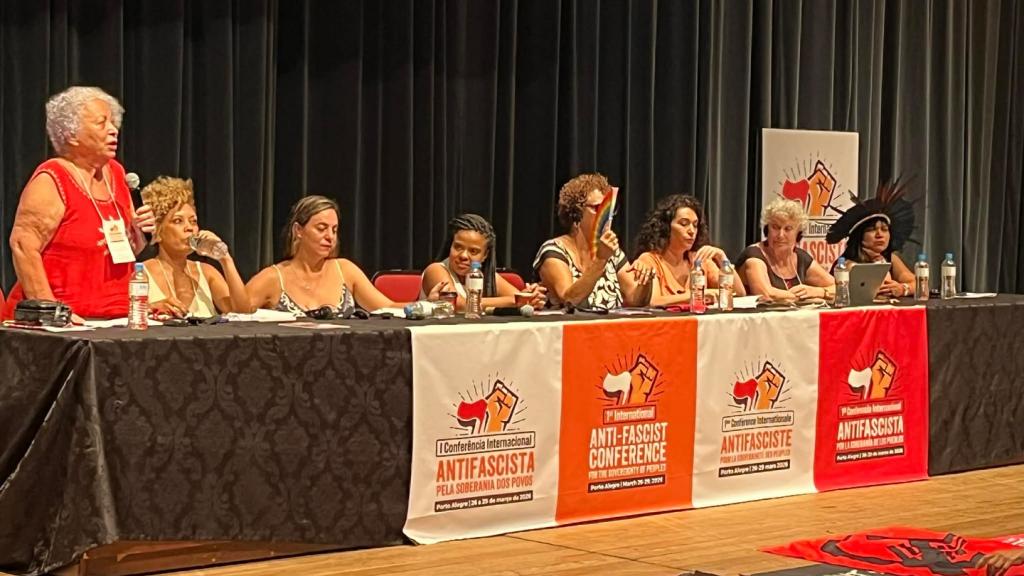
Antifascist conference panel

The 1st International Anti-Fascist Conference, held in Porto Alegre between March 26–29, has just concluded. This is not a complete assessment, but some initial thoughts on the enormous success of the conference.

The figures speak for themselves. The opening march drew about 7000 people, evoking Porto Alegre’s tradition of struggle, and in particular its connection to the alter-globalization movement and the World Social Forum. It was an initiative that cut against the still-dominant paralysis on the left, demonstrating that mobilisation is possible. It also laid the groundwork for building upon this process.

There were 4000 registered participants, 11 thematic panels, a forum featuring government representatives and parliamentarians, and an impressive 150 self-organised activities. This effort was only possible thanks to international coordination, the urgency of the global situation, the unified mood of the local committee, and organisational commitment, with several comrades playing a decisive role. We had the presence of about 40 countries and an impressive representation from all five continents.

A leap forward in international coordination

The genesis of this triumph, beyond persisting with the activity even after its suspension due to the 2024 climate tragedy, lies in the unity between the Socialism and Freedom Party (PSOL) in Rio Grande do Sul and the Workers’ Party (PT) in Porto Alegre, which then expanded to included the Communist Party of Brazil (PCdoB), the Landless Workers’ Movement (MST), and Andes, the latter responsible, along with the Lauro Campos and Marielle Franco Foundation, the Rosa Luxemburg Foundation, and the Socialist Left Movement (MES)-PSOL, for being organisational guarantors of the meeting. The international scope of participation was only possible thanks to the efforts of the Committee for the Abolition of Illegitimate Debts (CADTM), led by comrade Eric Toussaint, who is connected to the Fourth International (which was represented by dozens of sections and members) and other sectors that signed up to the appeal for an international anti-fascist front, which was launched to publicise the conference.

There was a qualitatively important presence of different international revolutionary and socialist organisations. Among them were: the Democratic Socialists of America (within which the Bread & Roses current play a central role); parliamentarians from the European left, including from France Unbowed (LFI); other French anti-fascist groups such as NPA (New Anti-Capitalist Party), Après, Attac, Le Digue and Jeune Guard (Young Guard); Workers’ Party of Turkey leaders and parliamentarians; a contingent of almost 200 people from Argentina, the largest from any country, involving Vientos del Pueblo (Peoples’ Winds), Libres del Sur (Free and from the South), MST (Workers’ Socialist Movement) from the International Socialist League, and Union por la Patria (Unity for the Homeland); a Uruguayan delegation with a bus load of delegates from the PIT/CNT (Intersyndical Plenary of Workers — National Convention of Workers), the PCU (Communist Party of Uruguay) and the People’s Victory Party.

There were also significant delegations from North America, with dozens of cadres and leaders, including from Puerto Rico (Socialist Democracy and the Citizen Victory Movement, among others) and Mexico (MSP [Socialist Movement for Popular Power], ONPP [National Organisation of Popular Power], PRT [Revolutionary Workers Party], as well as leaders of the electrical workers’ union). Comrades from Zabalaza for Socialism in South Africa, and from Socialist Alliance and Green Left in Australia also attended.

CADTM was represented by delegations from various countries, especially from Africa and Asia, including from South Africa, Mali, Congo, Kenya, Ivory Coast, Morocco, India, Pakistan and the Philippines. Two other very special delegations, which fought a decisive battle in defence of internationalist principles at the conference, were those of the Russian and Ukrainian comrades, linked to the European Solidarity Network with Ukraine and the Marxist opposition in Russia.

CPAC with Flávio Bolsonaro and Trump, Porto Alegre in the streets

The same weekend as the conference, there was a meeting of CPAC — the Conservative Political Action Conference, a rising neo-fascist international network based in Trump’s United States. Flávio Bolsonaro, the son of jailed far-right leader Jair Bolsonaro, spoke, establishing himself as the representative of Trumpism in Brazil.

Porto Alegre was, in practice, the immediate counterpoint to that forum. The conference also established a link with the March 24 demonstrations [against the former military dictatorship] in Argentina; with the Nuestra America convoy that carried solidarity and solar panels to Cuba (many of its members returned in time for the conference); with the enormous anti-fascist demonstration that took place in London (where some 500,000 people attended); and with the discussions over Iran, which has resisted and transformed Trump and Netanyahu’s offensive into a deep problem. Above all, it connected with the large No Kings demonstrations, the third unified day of action against Trump that mobilised millions of people in thousands of cities across the US.

As the conference manifesto states, Porto Alegre was where a response began to be prepared, one prioritising street protests against the actions of the far right:

Never has the struggle against imperialism and fascism been as urgent and necessary as it is today. This struggle must be organized internationally. The Antifascist Conference for the Sovereignty of Peoples commits to continuing the struggle without rest and to serving as a space for building unity against the rise of the far right and imperialist aggression. In the face of barbarism, we raise the banner of international solidarity, the struggle of peoples, and a socialist, ecological, democratic, feminist, and anti-racist future.

MES/PSOL activities

In addition to the large opening march, we were involved in both some of the main panels and self-organised activities. The launch of Retomada magazine brought together hundreds of comrades along with our collaborator, Vladimir Safatle, and many other significant figures. Our new magazine, a dossier named “The Name For This is Fascism” was launched, resuming the battle of ideas in service of a critical anti-capitalist reference in Brazil.

The launch of the Fourth International’s Ecosocialist Manifesto, attended by comrade Michael Löwy, was another point of participation.

We also built and supported significant activities such as the Ecosocialist Youth plenary, with the presence of Juntos, an organisation that stood out at various moments of the conference for its large and vibrant contingent; the launch of the Maré Negra (Black Tide) movement manifesto, with US Connecticut councillor Abdul Osmanu and political thinker Mireille Fannon; a meeting of delegations from the Emancipa Network of Popular Education; and union activities with the presence of SEPE, Andes, Fasubra, Metro Workers of Rio Grande do Sul and Sao Paulo, ASERGHC, and Municipal Workers. We also participated in activities on feminism, through Juntas and our public figures, and in a workshop on Big Tech, reflecting on the growing body of knowledge about the digital issue. In addition, we took in part in numerous international activities on topics such as Argentina, the US, Ukraine, Russia, France, Kurdistan, and Puerto Rico.

An example of the need to fight and win

The unity expressed in the activity, with the leading role played by MES-PSOL and various sectors of the Fourth International, without excluding or imposing on other sectors, is a step forward. The Porto Alegre conference leaves us better equipped, nationally and internationally, for the challenges ahead, including the Brazilian elections, which will be a key chapter in the confrontation with imperialism and Trump. We have three decisive, polarised elections, coming up, in which Big Tech is more than likely to interfere: Colombia’s presidential election, Brazil’s general election, and the US midterm elections.

We defend Iran’s military victory against Israel and Trump, without lending political support to the regime; Cuba’s campaign against the blockade; the struggle of immigrants throughout the planet; and the demand for the release of President Nicolás Maduro and National Assembly deputy Cília Flores, as well as denouncing Putin’s imperialism and standing with the resistance of Ukrainian workers against Russian aggression.

To win in Brazil, we must combine the key banners of struggle — shorten the workday, tax the rich, defend the Amazon and the environment, and fight against gender violence — with a broad mobilisation that affirms sovereignty. The next steps will involve new conferences and activities, such as those in the Porto Alegre Manifesto, especially considering the dynamics of the Argentine situation, which will host the next event of this kind: a defeat for Argentine President Javier Milei would be costly for the far right and could open a new political cycle in the country.

Porto Alegre has once again placed itself at the forefront of the international struggle. Let us take up the challenge and fight to defeat the far right.

Israel Dutra is a sociologist, PSOL Secretary of Social Movements, and MES/PSOL National Directorate member.


Anti-fascism

Three general characteristics of the new era of fascism


Saturday 4 April 2026, by Ivan Drury Zarin


Fascism has been, over the last decade, and especially more recently, an object of vigorous debate on the left. But, as a long editorial from the Salvage collective bemoaned about debates over what to make of Russia’s war on Ukraine, much of this debate has been stuck in the ditch of historical analogy. Is Trumpism more like Mussolini’s or Hitler’s fascism? When we stack up all the measures of rights violated and attacked, does the far right today pass the test of comparison with major fascist events of the 20th century?

Two thinkers in particular have tried to bypass this problem of analogy by arguing that what we face today is a “late fascism” (Alberto Toscano) or a “post-fascism” (Enzo Traverso): a phenomenon of the far right that depends on and mobilizes cultural memory about the fascism of old, but in forms particular to our historical moment. But part of this “second time farce” analysis includes that 21st century fascism has no particular form: no universal characteristics, no particular policies or modes of governance. The problem I’ve had with this approach is that, taken to its conclusions, we lose any useful apprehension of fascism as something distinct from bourgeois democracy, with all its exceptions and varieties of violence.

I’ve just finished attending the first day of the anti-fascist conference in Porto Alegre, Brazil — a gathering of thousands of anti-fascists from all around Latin America, with a smaller representation of delegates from other parts of the world. There were far too many simultaneous panels for me to be able to assess the dynamics of the conference as a whole, but from the panels I have attended, and the conversations I’ve had, one useful problem that has emerged is an answer to the question of the definite forms that fascism is taking today.

From the various perspectives of anti-fascists gathered here, there are emerging three general characteristics of 21st century fascism: war as a solution, tightening borders and citizenship, and the end of the universal human rights consensus. That does not mean that fascism has only three characteristics. It means that I noticed these three characteristics emerge out of the discussions I took part in on day one of this conference. But I do think it’s significant that such syntheses are emerging, and worth noting in order to discuss, debate, and improve our understanding together.

First characteristic: Fascism depends on war as a solution to national problems
Decades of neoliberal policy have produced a crisis of social reproduction for the working class and of productive growth for the world capitalist class. For the capitalist class in the US, this crisis takes the form of collapsing global hegemony, a problem for which, as Porto Alegre city councilor Giovani Culan said, “war is the only way out, and Trump is the personification of that violent solution.”

For the capitalist classes and governments in the Global South, the crisis is the dissolution of their sovereignty — a sovereignty that had been eroded during the decades of neoliberalism, but which now takes the form of empire’s overt threats of wars, coups, and assassinations. That’s why, Culan said, “we oppose the US kidnapping of Venezuelan president Maduro and Congresswoman Celia Flores and the strangling of Cuba.”

This form of imperialist domination means that, as Brazilian Workers Party (PT) representative Valter Pomar said, “the hearts of governments in Latin America are in Washington,” subordinated to their masters, not with the people’s “popular sovereignty.” This dynamic has the effect of increasing the rise of the far right in Latin America, as people’s needs are subordinated to empire, and poverty and despair grow.

So, to paraphrase Aimé Césaire, fascism rises in the body of empire and bursts out of the skin as a weeping sore, first in the neocolonies. It spreads, not like the waves or seeds of a peoples’ movement, but like a disease, along the channels of capital, circulating out into the world, and pumping back into the heart, stronger and more self-confident because of the infections it was able to spread elsewhere. War-as-solution is an outcome of this dynamic, and one that further subordinates capitalist national governments of the Global South, no matter whether progressive or reactionary in policy, to empire.

Second characteristic: Fascism arms borders against migrants

At a panel on the the far right’s uses and abuses of migrants, Bea Whitaker argued that imperialist domination has driven out migrants from the Global South, and fascists have responded with brutal state force to block their arrivals and police the presence of those who get over their walls.

The European Union’s first serious migration controls of the contemporary era, she said, were in the 1990s, in response to the arrival of people fleeing wars. Then, in the 2000s, especially after the uprising in Tahrir Square, millions of migrants arrived in the EU. “Countries created a wall out of laws to stop migrants from coming in, and to regulate those migrants who did arrive,” she said. Then “the EU created an agency called Frontex to police migrants,” chasing them with ships, airplanes, radars, cameras, and “every single kind of robot you can imagine.” The EU then outsourced the making of that tech, and the operation of it, to private companies. Whitaker said, “This is a paradise for those companies that make weapons and surveillance devices. We’re talking billions of euros. And it has become more profitable for these companies to sell their products to Frontex than on the private market.”

Veronica Carrillo, from the Mexican Committee for the Abolition of Illegitimate Detention, said that this dynamic described between the EU and African and West Asian countries is mirrored in the US treatment of Latin Americans. In the Trumpist world, outsourcing migrant policing includes mobilizing far-right governments in Latin America to take part in policing their own peoples. The strongest example is Trump’s commissioning of El Salvadoran prisons as hell sites where deported migrants can be disappeared. There are countless other examples of the US state funneling public resources into the pockets of private carceral corporations. Carrillo says that far-right states “are using our resources to build their fascist parties and politics, to mobilize public resources against workers, not against the capitalist system,” all by heaping blame on migrants as the cause of the world crisis, rather than its worst victims.

A critical contradiction of our moment is that neocolonialism and imperialism undermined and smashed the developmentalist goals of the anti-colonial and independence movements of the postwar period. And on top of the resulting, echoing, economic and social crisis in many countries in the Global South, more wars and climate disasters have driven more people into global migration than at any other point in human history. Fascism has an answer to this contradiction: build the wall. And privatize it.

Third Characteristic: Fascism is done with human rights

The border solution to the racist migrant panic produces the third characteristic as a necessary component. As Bea Whitaker said, the EU’s anti-migrant mobilization “is absolutely against every single convention of human rights, and they know it. They are breaking the principles of the EU about human rights.” And rather than create loopholes or justifications, the whole legal, political, and social body of Europe turns away from the bodies of migrants washing up on its shores.

There is a telling anecdote about this in David Scott Fitzgerald’s 2019 book, Refuge Beyond Reach. He says that after the border patrol sunk a boat of migrants, a body washed up near the shore of a Greek fishing village. A fisher, horrified, reported the person’s body, which he found from his boat and pulled out of the water. The Greek state responded by seizing his boat as part of its investigation, depriving this fisher of his income, punishing him for making the report. The fishers in his community got the message, and when they came across bodies after that, they pushed them back out to sea. It’s not that our sense of whose lives matter is dictated from above, but the state can show whose lives will officially be saved, and how disposable you are too.

Veronica Carillo said that in Trump’s anti-migrant terror, human rights are wholly absent. And by introducing a new language of brutality in place of the universal human rights story, fascist governments are turning social tensions back on workers to feel and navigate differently according to their legal citizenship status.

Human rights was always a rubric that referred back to a particular person’s relationship to a process of property valorization. But it was possible for socialists to speak back the language of human rights to further the freedom claims of workers and dispossessed people, or to interrogate human rights issues to reveal the craven hypocrisy of the capitalist class. As fraught and laden with capitalist power as they are, governments abandoning the rhetoric and formal legal frameworks of human rights is characteristic of the fascist turn.

The dynamics surrounding Putin’s selective use of human rights frameworks tell us something else about this trend. Mikail Lobanov said that Putin has always used repression as part of his particular model of governance, so playing fast and loose with human rights is nothing new to him. But Putin knows that, for the West, human rights claims can work as claims against the sovereignty of formerly colonized countries and work as an instrument of imperialist intervention, while identifying the West with human rights. So Putin has figured out how to use international human rights structures as a part of managing political repression: providing an extra-systemic way out if there is pressure for a particular prisoner, and also as evidence for Putin’s myth that foreign governments are intervening in Russia’s sovereignty.

Because he understands Putin’s maneuver, Kseniia Kagarlitskaya said that her father, Boris Kagarlitsky, refused to be added to a prisoner exchange list at the beginning of his ongoing five-year prison sentence for his journalism. He gave two reasons: first, that exile is also repression, so it’s no release. And second, that he believes political prisoner exchanges are part of a system that regularizes repression; that the detentions should be abolished, not manipulated.

A unitary problem

What these three characteristics have in common is that bourgeois governments led by politicians who are fascist or influenced by fascism, are abandoning the well-practiced routines of consent-building (amongst parts of their constituencies) and diplomacy (with certain countries) internationally. What’s taking the place of this hegemonic bloc-building strategy is a greater emphasis on violent force as governance and international relations.

It is possible to explain these as extreme or exceptional moments in policy development by a more or less normal bourgeois state. But understanding these three characteristics as parts of a 21st century fascism provides us with a unitary problem, which we can then strategize to confront, fight, and defeat, in a unified way. This has epistemological as well as strategic value.

Let’s keep an eye out for more constituent features of this contemporary fascist menace.

Source: Against the Current
28 March 2026

Environment: Cost of fuel, what ecosocialist responses?

Sunday 5 April 2026, by NPA-A Environment commission


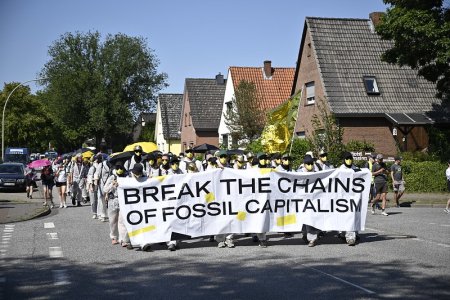
The war is fuelling the profits of fossil fuel companies while aggravating the ecological and social crisis. Faced with exploding prices and organized dependence on all oil, it is urgent to impose immediate measures while breaking with fossil capitalism.

To go to work, to take the children to school, to visit the doctor to do your shopping... For many, today, the car is not a luxury but a necessity, and each increase in fuel prices eats a little more into already tight budgets.

War, a jackpot for climate criminals

The instability inherent in the fossil economy offers magnificent opportunities for surplus profits to oil companies. When, as is the case today, supplies are severely disrupted or even interrupted, prices soar. But pre-existing reserves, acquired before the increase, are being sold at a high price. A golden opportunity (in dollars!) for fossil capitalists!

At the same time, the increase in fuel prices is hitting budgets hard, especially those of the poorest. To avoid this trap, there is an urgent need to impose immediate measures to alleviate the consequences, which are all the more serious as incomes are low, while wages are hardly increasing and have even fallen in real terms since 2020.

The best fuel is the one you don’t burn

First of all, an obvious one, but always good to remember, the cheapest and least polluting fuel is the one that is not burned.

In the immediate future, free public transport must be demanded everywhere, as at the time of pollution peaks. Impose, in companies and administrations, measures, such as the extension of teleworking, company shuttles... decided and implemented with and under the control of employees to meet their needs.

Other measures can reduce road transport, which is becoming increasingly important: speed reductions, particularly on motorways, targeted bans on lorry traffic and so on.

In addition to these immediate emergency measures, it is essential to reorient transport policy, with the aim of drastically reducing the circulation of cars and lorries: stopping all new road projects, the road network is sufficient, priority is given to public transport useful for daily travel and rail and river freight, relocation of production as close as possible to the places of consumption.

Freezing prices by taking profits

But there are many who cannot escape the petrol pump, whatever the price displayed, no matter how high it may be. The shaping and organization of the territory by the automobile and the lack of public transport force the use of the private car on a daily basis.

If the freezing of prices, by taking from the profits of oil groups, is necessary as an immediate measure, it must be associated with the demand for transparency on their accounts and control of distribution and stocks by employees and users.

Climate criminals, imperialist criminals

Fossil capitalism, which is the main culprit of the ecological crisis, is at the heart of imperialist wars of aggression, from Venezuela to Iran.

Against the oil companies Total and others... More than ever, what is on the agenda is to disarm them, to take away their power of life and death, to expropriate them. As long as they have the power, they will extract every last drop of oil, a crumb of coal, a molecule of gas, sowing war on peoples and living things! Only the socialization of this sector will make it possible to regain control, to leave the fossils in the ground.

Translated by International Viewpoint from : L’Anticapitaliste
Photo: Tim Wagner www.ti-wag.devTwitter: @ti_wag

Trump’s Tone-Deaf Sales Pitch for More War

by  | Apr 3, 2026 | 

Former Congressman Dennis J. Kucinich (1997 to 2013) challenged three administrations, Clinton (Serbia), Bush (Iraq), and Obama (Libya), over unauthorized military action under the War Powers Resolution, led Congressional opposition to the Iraq War, and delivered 155 speeches in Congress warning against war with Iran.

The President’s address to the nation was a tone-deaf sales pitch for more war, delivered on the first night of Passover.

Civilian and military casualties are mounting across the region. Lives are being extinguished while triumphalist and violent rhetoric is offered as justification. War is being escalated in the name of peace, a contradiction that demands moral clarity, not political acceptance.

Each life lost carries equal value. No nation’s suffering is expendable. No people exist as collateral.

Iran is not an abstraction, nor just a target on a map. It is one of the great cradles of civilization, a society whose cultural and intellectual contributions long predate the rise of the modern West. To speak casually of bombing such a nation ‘back to the Stone Age’ reveals a colonial mindset that dehumanizes others and diminishes our own humanity in the process.

The extensive bombing of Iran by the United States and Israel, along with Iran’s counterstrikes, is already taking innocent lives. The global economy is destabilizing as a result.

Energy markets are being disrupted. Oil and gas production is constrained. Fertilizer supply chains are impaired. Critical materials are being cut off.

These consequences will be felt worldwide. Yet the deeper crisis is not economic, it is moral.

We have seen this before. The repeated invocation of a nuclear threat echoes the false claims of ‘Weapons of Mass Destruction’ used to justify the invasion of Iraq. That war cost thousands of American lives, the lives of hundreds of thousands of Iraqis, and trillions of dollars, while leaving a legacy of instability and grief that endures to this day.

If the President truly sought to prevent a nuclear Iran, he would not have abandoned the JCPOA, an agreement that placed verifiable limits on Iran’s nuclear program. Instead, we are presented with a cycle of escalation that defies logic and invites catastrophe.

Political rhetoric is becoming increasingly radical and dangerous. This is not a question of partisan politics. It is a question of conscience with very real global and domestic consequences.

The American people are not called to accept this. They are called to stand against it.

Members of Congress must have the courage to exercise their constitutional authority and rein this in.

War framed as strength is destruction. Violence presented as necessity is gratuitous violence, with consequences already accelerating destabilizing shifts in the global order.

Congress must act. The Constitution vests in Congress the authority to bring this, and any war, to an end through the power of the purse.

The American people must immediately contact their representatives and demand a NO vote on any supplemental funding that would continue this war. Congress must VOTE NO.”

Dennis J. Kucinich served sixteen years in the United States Congress and twice ran for President of the United States on a platform of peace, truth, and constitutional integrity. He led the opposition to the Iraq War and introduced Articles of Impeachment against President George W. Bush and Vice President Dick Cheney for misleading the nation into war.