Tuesday, May 26, 2026

As US Drivers Suffer High Gas Prices, Big Oil Celebrates and Plans Big Payouts for Shareholders

“These companies want Americans to believe price spikes are simply the unavoidable result of global events, but their own executives are openly telling investors that volatility, conflict, and supply disruptions are good for business.”
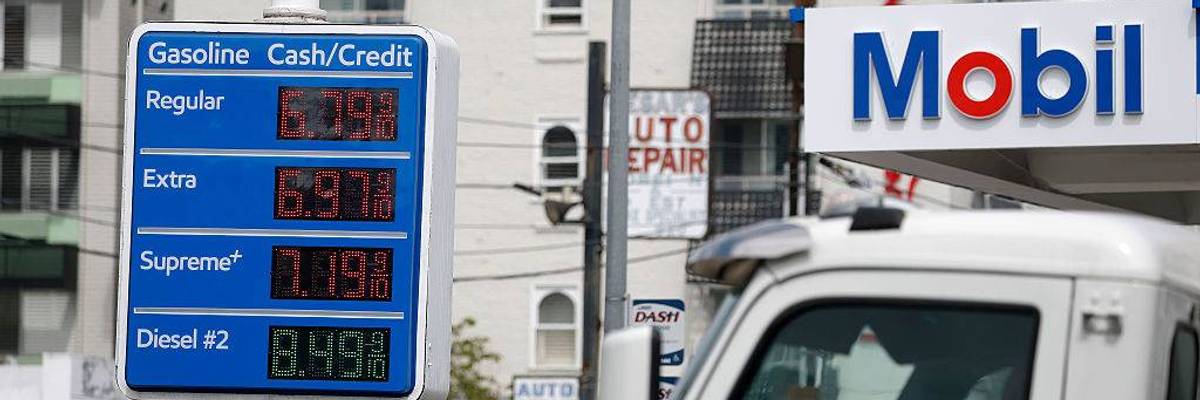

Gas prices at more than $6 a gallon are displayed at a Mobil station on May 4, 2026 in Los Angeles, California.
(Photo by Justin Sullivan/Getty Images)

Brad Reed
May 26, 2026
COMMON DREAMS


A Tuesday report from Groundwork Collaborative reveals how fossil fuel companies are not merely scoring windfall profits from President Donald Trump’s illegal war with Iran, but also using that money to reward shareholders rather than providing relief to consumers.

The price of gas has soared since Trump attacked Iran without any congressional authorization in late February, going from an average of under $3 per gallon at the start of the war to $4.49 per gallon as of Tuesday.

As US drivers have paid more at the pump, however, fossil fuel firms have been concerned with paying out dividends and conducting stock buybacks expanding production to lower prices, Groundwork Collaborative’s report finds.

Among other things, the report notes that ExxonMobil is on pace to deliver $20 billion worth of stock buybacks in 2026, even as CEO Darren Woods has insisted that the company’s decisions on production will be “grounded in value, not volume.”

Additionally, the report documents how Shell recently announced “another 5% dividend increase and more than $3 billion in buybacks,” with CEO Wael Sawan describing the company’s commitment to paying shareholders as “sacrosanct.”

Chevron has pledged roughly $3 billion in quarterly stock buybacks, while also saying increasing dividends for shareholders is its “first and foremost” priority.

Chevron CFO Eimear Bonner, the report adds, recently revealed that the company has no plans to boost output in response to high energy prices, stating that “capital spending and production outlooks are consistent with previous guidance.”

Lindsay Owens, executive director of Groundwork Collaborative, accused Big Oil of using Trump’s illegal war as cover to keep prices high without taking any steps to reduce pain at the pump.

“These companies want Americans to believe price spikes are simply the unavoidable result of global events,” said Owens, “but their own executives are openly telling investors that volatility, conflict, and supply disruptions are good for business. They are choosing buybacks over production, shareholder payouts over affordability, and corporate profiteering over the economic security of working families.”

The high fuel prices aren’t being felt just in the US, but across the world.

Karthik Sankaran, senior research fellow at the Quincy Institute for Responsible Statecraft, explained in a Tuesday analysis how oil prices are hitting nations in the Global South particularly hard.

“A recent story in The New York Times described how the price for transporting corn into refugee camps in Somalia had doubled or even tripled, as had the price of water at diesel-powered public tubewells,” Sankaran wrote. “Meanwhile, protests this week in Kenya against fuel price hikes have led to four deaths, and political and financial stresses are mounting across the continent.”

Sankaran also pointed to problems in India, where “sharp jumps in the price of liquid petroleum gas have hit urban households hard, particularly those whose breadwinners work in small-scale industrial establishments.”

Despite the actue global economic pain, energy experts who spoke with CNN on Tuesday expressed skepticism that the crisis would abate anytime soon, despite Trump’s regular hyping of a deal to end the conflict.

Rory Johnston, an oil market researcher and founder of Commodity Context, told CNN that he wasn’t buying optimism from commodities futures markets after Trump claimed to have made significant progress on an agreement with Iran.

“Nothing has fundamentally changed,” Johnston said. “The strait remains closed.”

Sultan Al Jaber, the CEO of Abu Dhabi National Oil Company, said that a deal to end the war wouldn’t instantly bring energy prices back to where they were before the war began, estimating it could take months just to get 80% of the pre-war oil supply flowing through the Strait of Hormuz.
Trump’s Lawless, Insidious Insurrection Continues

Creation of a $1.776 billion fund to compensate individuals who claim to have been victims of the government’s “weaponization” of law represents the culmination of the president’s six-year effort to claim that he won an election that he so clearly lost.


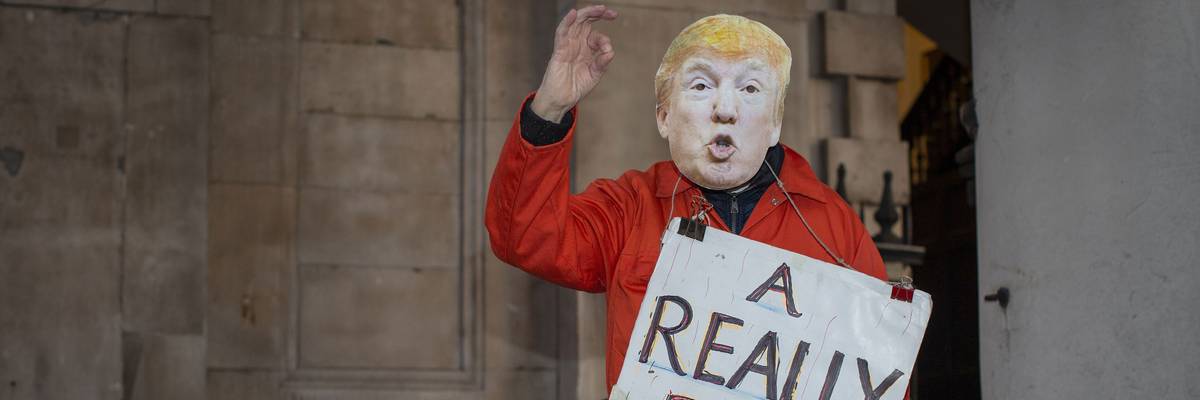
A man wearing an orange prison outfit and a Donald Trump mask during a protest against U.S. President Donald Trump UK visit to attend the NATO (North Atlantic Treaty Organisation) summit on the 3rd December 2019 in London in the United Kingdom.
(Photo by Sam Mellish / In Pictures via Getty Images)

James Zogby
May 26, 2026
Common Dreams

During the past week, the Trump administration announced three separate but connected decisions that are so outrageous they may lead to his comeuppance. Collectively, they reward lawlessness and undermine the very foundations of our democracy.

The first of these was the announcement by the Department of Justice that a $1,776,000,000 fund was being established to compensate “victims” of the previous administration’s “weaponization” of the law by “unfairly investigating and punishing them.” As a quid pro quo, Mr. Trump agreed to drop his questionable $10 billion lawsuit against the Internal Revenue Service for what he charged was their role in failing to stop a contractor from leaking one of his tax returns to the media in 2019. To cap off the president’s trifecta, the DOJ added an amendment to the “victims’ fund” stating: “The United States releases, waives, and forever discharges [Trump, his family, his business] and is hereby forever barred and precluded from prosecuting or pursuing, any and all claims [that] have been or could have been asserted [by the IRS against them or] related or affiliated individuals.”

As problematic as each of the three may be, it’s the ways they are connected that is most troubling. The Trump lawsuit against the IRS was set to be dismissed by the judge who was hearing the case. She had argued that it was improper for the White House to sue a federal agency it controlled, as this put the administration in the position of being both plaintiff and defendant. The decision was to be announced by May 20th, forcing the White House to act to drop their suit before it was dismissed. It was, therefore, no coincidence that the DOJ announced on May 18th and 19th both the “victims’ fund” and the ban on any future IRS action against the president.

But the story doesn’t end there as serious questions must be asked about the entire IRS affair. The contractor who leaked the document has already been arrested and convicted for his crime. There was no connection between his admittedly criminal act and the IRS as an institution. Therefore, the president’s lawsuit against the institution and the $10 billion award in damages he was seeking was both unwarranted and excessive. Like many of Mr. Trump’s previous suits against media outlets, it was meant to intimidate in order to seek some sort of settlement.

The DOJ’s handling of the matter validated the judge’s concern that the head of government couldn’t sue an agency he oversees (not to speak of trying to secure a massive payout from that agency). It simply didn’t pass the smell test. Finally, the DOJ addendum giving the president, his family, and business a free pass from any further tax audits, investigations, or prosecution for any claims against them raises the obvious question: What tax problems are they covering up?

The creation of the $1.776 billion fund to compensate individuals who claim to have been victims of the government’s “weaponization” of law represents the culmination of the president’s six-year effort to go beyond just defending the violent insurrectionists of January 6th, 2021. This is important to Mr. Trump, because by defending them he is defending his claim that he won the 2020 election and, therefore, the violent mobs that stormed the Congress weren’t lawbreakers. They were heroes and persecuted martyrs who deserve compensation.

In this regard, it’s important to examine what Trump has done.

Just over six years ago we witnessed the horrifying scenes of violent mobs storming the US Capitol in an effort to stop Congress from certifying outcome of the 2020 election. They struck out at Capitol police who were doing their jobs protecting the members of Congress and the building itself. Some were injured; a few died. The scenes of what these rioters did were broadcast to a shocked nation.

Because the president egged on the mob, he was impeached by Congress. Ten Republican members of Congress voted to impeach Trump and seven Republican senators voted to convict and remove him from office.

After Mr. Trump’s relentless campaign mobilizing his supporters to demand loyalty, most of the 17 senators and representatives who voted against him are gone. They either resigned because the heat was too great or were defeated by Trump loyalists.

And the polls tell this story. In 2021, most Republicans were outraged by the mob violence. A poll from January of 2021 found that 78% of Trump supporters disapproved of the insurrection. A more recent poll reveals a dramatic shift that has taken place. When asked to describe the events of January 6th, 2021, 60% of Republicans say they were “people participating in legitimate political discourse.” Only 18% said that it was “people participating in a violent insurrection.”

Believing that he had set the stage to allow for his complete rewriting of history, the president, who had already commuted the sentences and/or pardoned more than 2,000 of the insurrectionists, now felt emboldened to have the government reward them for their blind loyalty to him. But in doing so, he may have pushed too far. Republican senators who consider themselves law-and-order, fiscal conservatives recoiled in horror over what a few called “utterly stupid,” “morally wrong,” and an abuse of power. Instead of acting to pass some of Mr. Trump’s legislative priorities, they criticized the president’s actions and took an early recess.


Our work is licensed under Creative Commons (CC BY-NC-ND 3.0). Feel free to republish and share widely.


James Zogby
Dr. James J. Zogby is the author of Arab Voices (2010) and the founder and president of the Arab American Institute (AAI), a Washington, D.C.-based organization which serves as the political and policy research arm of the Arab American community. Since 1985, Dr. Zogby and AAI have led Arab American efforts to secure political empowerment in the U.S. Through voter registration, education and mobilization, AAI has moved Arab Americans into the political mainstream. Dr. Zogby has also been personally active in U.S. politics for many years; in 1984 and 1988 he served as Deputy Campaign manager and Senior Advisor to the Jesse Jackson Presidential campaign. In 1988, he led the first ever debate on Palestinian statehood at that year's Democratic convention in Atlanta, GA. In 2000, 2008, and 2016 he served as an advisor to the Gore, Obama, and Sanders presidential campaigns.
Full Bio >
KKKONFEDERATE STATES OF AMERIKA 
Trump and the Supreme Court Try to Return the US to the 19th Century

With the Supreme Court’s rulings against the Voting Rights Act and the Trump administration’s refusal to enforce the Civil Rights Act, they are trying to repeal the legacy of the civil rights movement.


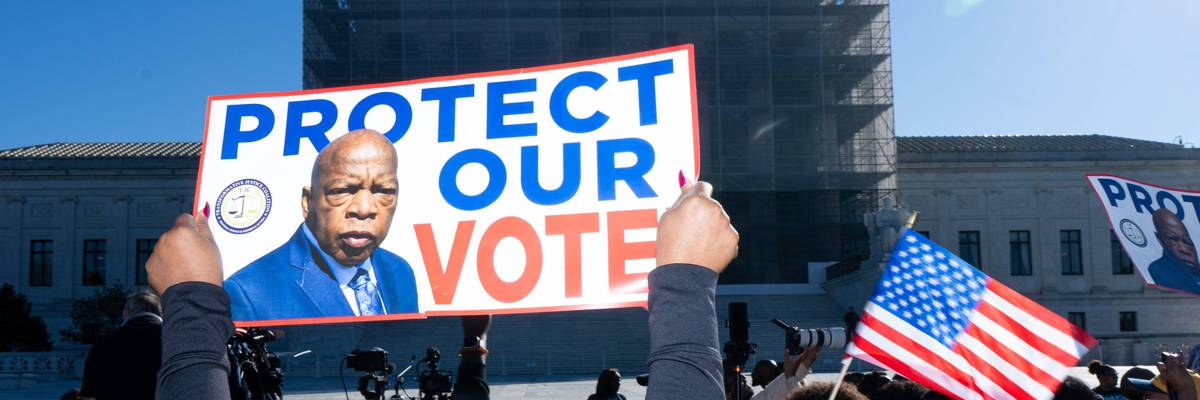
Voting rights activists protest outside the US Supreme Court as the court prepares to hear arguments in a case challenging Louisiana’s congressional map in Washington on Wednesday, October 15, 2025.
(Photo by Bill Clark/CQ-Roll Call, Inc via Getty Images)

Alan Singer
May 26, 2026
Common Dreams

On December 18 1865, Congressman Thaddeus Stevens, Republican from Pennsylvania, during debate on how to treat the traitorous Confederate states and on support for newly freed people who had been enslaved in the United States and in British North America for almost 250 years, warned, “If we fail in this great duty now, when we have the power, we shall deserve and receive the execration of history and of all future ages.” The United States failed to rectify injustice in the past, and it is failing once again.

Nikole Hannah-Jones, a key contributor to The New York Times’ award winning The 1619 Project, recently wrote that “The Civil Rights Era Is Collapsing Before Our Eyes.” In Tennessee, the white-dominated Republican controlled state legislature eliminated the state’s only Black majority congressional district after the MAGA-dominated Supreme Court ruled that congressional maps that ensured political representation for African Americans and other racial minorities now violated the Constitution. Other white-dominated, Republican-controlled states are racing to make similar changes. It is as if the Republican Party, with the aid of the Supreme Court, is trying to return the United States to the level of racism that dominated the country in the 19th and first half of the 20th century.


After the Civil War, Congress passed and the states ratified the 13th, 14th, and 15th Reconstruction Amendments to the United States Constitution. The 13th Amendment ended chattel slavery in the United States. The 14th Amendment defined citizenship to include people born in the United States with very limited exceptions and ensured that all persons, whether citizens or not, were entitled to legal due process. The 15th Amendment prevented states and localities from denying Black men the right to vote. Each amendment included a clause that “Congress shall have the power to enforce, by appropriate legislation, the provisions of this article.” Rebelling Confederate states were required to approve the 14th and 15th Amendments to fully reenter the Union.

A right-wing dominated Supreme Court then proceeded to systematically emasculate the amendments and supporting legislation including the Civil Rights Act of 1866, the Reconstruction Acts of 1867, the Enforcement Acts of 1870 and 1871, and the Civil Rights Act of 1875. The first Civil Rights Act enforced the 13th Amendment after a number of Southern states passed “Black Codes” to limit the rights of freedmen, and the Reconstruction Acts required the former Confederate states to accept the 14th Amendment. The Enforcement Acts provided federal protection for voting rights that were being interfered with by organizations like the Ku Klux Klan. The Civil Rights Act of 1875 targeted racial segregation and guaranteed African Americans equal treatment in public accommodations including hotels and theaters and transportation and prohibited attempts to exclude them from juries. To put teeth in enforcement, violations were tried in federal, not state courts.

The Trump administration has launched a systematic campaign to undermine civil rights protections passed into law and approved by the Supreme Court in the 1950s and I960s.

In 1873, in the Slaughter-House Cases, the Supreme Court limited the ability of African Americans to sue in federal courts against discriminatory state laws. In 1876, in the United States v. Cruikshank, the court ruled that the 14th Amendment did not apply to private acts of violence, preventing federal authorities from prosecuting hate crimes, and in the 1883 United States v. Harris case the Court threw out the Enforcement Acts because Congress did not have the authority to punish private groups like the Ku Klux Klan for conspiring to violate the civil rights of African Americans.

The most damaging court decision was in a consolidated case known as the Civil Rights Cases. In 1883, by an 8-to-1 majority, the Supreme Court declared the Civil Rights Act of 1875 unconstitutional. The majority ruled that the 14th Amendment only applied to discrimination by state or local governments and did not permit the federal government to prohibit discrimination by private individuals. The only dissenting justice was John Harlan, who argued that government and individual actions often overlapped and the court was interpreting the 14th Amendment too narrowly. Harlan was also the only justice to vote against the majority decision in Plessy v. Ferguson (1896) that established that the Constitution permitted racially segregated “separate-but-equal” facilities.

It was not until the 1950s and 1960s, in what has been called the Second Reconstruction, that Supreme Court decisions and federal legislation, under intense pressure from the African-American civil rights movement, restored civil rights for African Americans stolen by a conservative Supreme Court in the 1870s, 1880s, and 1890s. The best known Supreme Court decision was in Brown v. Board of Education of Topeka in 1954. Brown combined five cases challenging the legality of school segregation pursued by the NAACP and the legal team headed by Thurgood Marshall. In a unanimous decision, the Supreme Court under the leadership of Chief Justice Earl Warren ruled that segregated schools established a racial caste system and violated the equal protection clause of the 14th Amendment. In other decisions, the Warren Court ruled that Mexican Americans and all other racial groups had equal protection under the 14th Amendment (Hernandez v.Texas, 1954); that segregation in facilities serving interstate transport was illegal (Boynton v. Virginia, 1960); that election districts intended to prevent the election of Black representatives violated the 15th Amendment by disenfranchising Black voters (Gomillion v. Lightfoot, 1960); against segregation in public accommodations overturning the 1883 Civil Rights Cases decision (Heart of Atlanta Motel, Inc. v. United States, 1964); the federal government had the authority to abolish discriminatory literacy testing for voter registration (South Carolina v. Katzenbach, 1966); state laws banning interracial marriages were unconstitutional (Loving v. Virginia, 1967); and that the Fair Housing Act of 1968 banning discrimination in the sale of rent of housing was constitutional (Jones v. Alfred H. Mayer Co., 1968).

Federal civil rights legislation passed in the Second Reconstruction included the Civil Rights Act of 1957. It was the first federal civil rights law passed by Congress since 1875. This law established the United States Commission on Civil Rights and a Justice Department Civil Rights division to investigate charges of racial discrimination. A 1960 law established federal penalties for interfering with someone’s ability to vote. Federal courts were authorized to appoint officials to assist African Americans in registering to vote in states and localities with a documented history of discrimination, and the 24th Amendment, ratified in 1964, outlawed poll taxes.

The two most important pieces of federal legislation during this period were the Civil Rights Act of 1964 and the Voting Rights Act of 1965. The Civil Rights Act outlawed segregation in public accommodations including hotels, restaurants, and theaters; ended discrimination in employment based on race, color, religion, sex, or national origin; and created the Equal Employment Opportunity Commission to enforce these regulations. Title VII of the Civil Rights Act established the “disparate impact” legal standard which was upheld by the Supreme Court in Griggs v. Duke Power Co. (1971). The disparate impact standard prohibits policies that disproportionately impact protected groups and does not require proof of discriminatory intent. It was later codified in the Civil Rights Act of 1991.

The Voting Rights Act included a number of key provisions. It allowed people to sue to overturn discriminatory laws and voter registration and candidate nomination procedures and provided for federal legal assistance. It also required states and localities with histories of discrimination to obtain prior approval from the Department of Justice or a federal court before changing voting rules. As a result of the Voting Rights Act, the racial disparity in voting registration rates declined from about 30% to 8% 10 years later. As a result of the Voting Right Acts, In addition, the number of Blacks serving in Congress increased from four in 1960 to 62 in 2023. In 2006, the Voting Rights Act was reauthorized by Congress with wide bipartisan support.

However, since 2013, the Supreme Court has whittled away at voter protection for minority groups. In a 2013 decision in Shelby County v. Holder, the court eliminated the pre-clearance requirement of the Voting Rights Act of 1965. In 2021 the Supreme Court made it more difficult to bring lawsuits challenging discriminatory voting rules, and in 2026, in Louisiana v. Callais, the court further gutted the Voting Rights Act, allowing state governments to redraw election districts dividing up Black communities so it would be more difficult to elect Black officials.

The Trump administration has launched a systematic campaign to undermine civil rights protections passed into law and approved by the Supreme Court in the 1950s and I960s. In an attack on the Civil Rights Act of 1964, President Donald Trump issued an executive order in April 2025 ordering federal agencies not to support or enforce disparate impact claims, arguing that it was discrimination against white people and violated its interpretation of the equal protection of the law. The administration has cut funding for enforcement of fair housing laws, equal employment opportunities, and environmental justice for minority communities disprotortionately impacted by climate change and pollution.

With the Supreme Court’s rulings against the Voting Rights Act and the Trump administration’s refusal to enforce the Civil Rights Act, they are trying to repeal the legacy of the Second Reconstruction and return the United States to the era of Jim Crow segregation and racism institutionalized in the 19th century.


Our work is licensed under Creative Commons (CC BY-NC-ND 3.0). Feel free to republish and share widely.


Alan Singer
Alan J. Singer is a historian and a professor of teaching, learning, and technology at Hofstra University.
Full Bio >


Federal judges block Alabama GOP's 'intentionally discriminatory' redistricting again

David Edwards
May 26, 2026 
RAW STORY


Judge with Gavel (Shutterstock)

A federal three-judge panel has once again blocked Alabama from using its 2023 congressional map, ordering the state to use a race-blind court-drawn plan for its 2026 elections — and pulling no punches about why.

In a 102-page ruling filed Tuesday, Judges Stanley Marcus, Anna Manasco, and Terry Moorer found that the Alabama Legislature "doubled down on racially discriminatory vote dilution" when it passed its 2023 redistricting plan — and did so deliberately.

"We again cannot understand the 2023 Plan as anything other than intentionally discriminatory," the judges wrote.

The court ordered Secretary of State Wes Allen to administer Alabama's remaining 2026 congressional elections — including August special primaries — using the "Special Master Plan," a race-blind map previously imposed by the court that created a second district where Black voters have an opportunity to elect a candidate of their choice.

The ruling comes after the U.S. Supreme Court vacated the court's earlier permanent injunction and ordered the panel to reconsider in light of Louisiana v. Callais, an April 2026 decision that raised the bar for Voting Rights Act claims. The three-judge panel concluded that Alabama still loses under the new standard — both on constitutional and statutory grounds.

The judges found zero evidence that the legislature acted for partisan reasons and rejected the state's attempt to use Callais as a shield. "Alabama cannot use Callais to legitimize its pre-Callais decision to double down on the discriminatory vote dilution that we and the Supreme Court found," they wrote.

The court also cited the chaos that would result from forcing a map switch now. Alabama's elections director testified it would take a "Herculean effort" to redistrict voters in just seven days — a process that normally takes months.

Senate Minority Leader Bobby Singleton, a Greensboro Democrat and plaintiff in the case, had warned the legislature it was on the wrong side of the law.

"We're definitely going to be filing actions in the state constitution," Singleton said after the legislature passed its special primary election law last month.

The court denied a stay, but Alabama was expected to appeal immediately to the Supreme Court.
Rights Groups Warn of Disaster as Trump-GOP Work Requirements Risk Mass Medicaid Loss

“These work requirements address a problem that doesn’t exist,” said one researcher. “They just strip healthcare from millions of low-income people by making it harder for them to prove they qualify.”


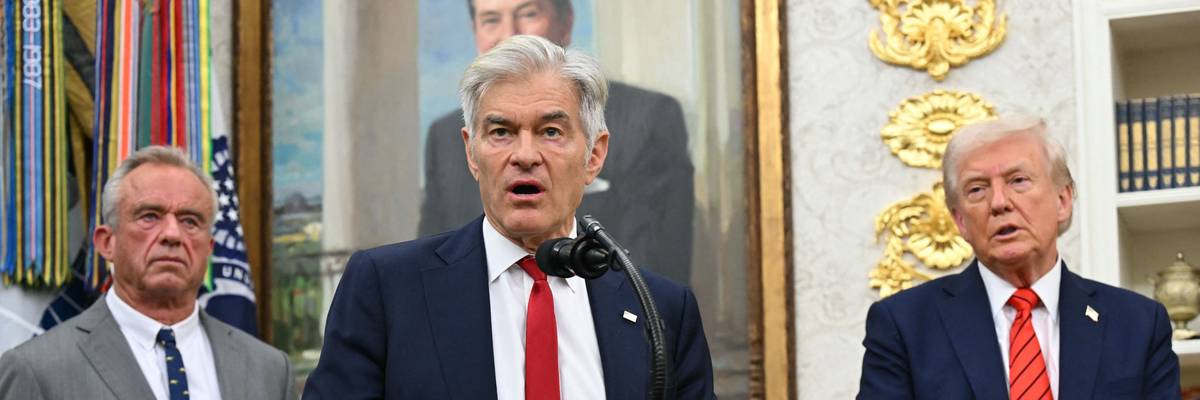
Center for Medicare and Medicaid Services Administrator Mehmet Oz speaks at the White House on October 10, 2025.
(Photo by Saul Loeb/AFP via Getty Images)

Jake Johnson
May 26, 2026
COMMON DREAMS


A pair of leading humanitarian groups warned Tuesday that millions of people will soon be “at risk of an avoidable loss of healthcare coverage” as states move to implement new Medicaid work requirements, which were at the center of the reconciliation package enacted by congressional Republicans and President Donald Trump last year.

Oxfam America and Human Rights Watch (HRW) warned in a joint letter to top federal health officials that the work requirements—which mostly target adults in states that expanded Medicaid under the Affordable Care Act—will result in a massive surge in the uninsured population if concrete steps aren’t taken to mitigate coverage losses.


900 Health Facilities Shutting Down or at Risk of Collapse as Trump-GOP Cuts ‘Ripple Across the Country’


Trump-GOP Law Spurs Largest Loss of Food Aid in Decades

The groups point to a Congressional Budget Office analysis projecting the Trump-GOP budget law “will cause roughly 10 million people to lose health insurance coverage by 2034,” increasing “the number of uninsured people in the US by nearly 50%, exposing millions of people to high drug and hospital costs, and forcing many to forgo or ration healthcare.”

Under the 2025 law, people subject to the work requirements must document 80 hours per month of work or another qualifying activity.

“Work requirements are sold as sensible, pragmatic reforms, but the lived reality couldn’t be more different.”

Analysts have warned that the new work reporting mandates—which account for around $326 billion of the Trump-GOP law’s total cuts to Medicaid—will create massive administrative hurdles and burdens for Medicaid recipients and for states. Given that most Medicaid recipients already work, experts say coverage loss from the new mandates will largely be attributable to enrollees’ failure to comply with byzantine reporting procedures.

“Work requirements are sold as sensible, pragmatic reforms, but the lived reality couldn’t be more different,” said Jackson Gandour, senior policy advisor for economic justice at Oxfam America. “In practice, evidence shows they can create unfair and effectively insurmountable barriers for people who need coverage and are making every effort to meet the requirements.”

The federal work requirements are set to formally take effect in most states by January 2027—though some states are rushing forward with the mandates ahead of schedule, heightening fears of chaos and large-scale coverage loss. By June 1, federal agencies must issue guidance to states on how to implement the new Medicaid work requirements.

Oxfam and HRW urged the Trump administration to do all it can to mitigate coverage loss, including by “reducing documentation requirements, broadly interpreting exemptions, and recognizing a wide range of qualifying activities that reflect real labor conditions, including gig work, unpaid caregiving, and seasonal employment.”

A 36-year-old woman in Atlanta, Georgia—which has state-level work requirements that predate the Trump-GOP mandates—told the humanitarian groups that she lost Medicaid and nutrition assistance after her child was born late last year, despite working sufficient hours to comply with Georgia’s requirements.

“After I had the baby, my Medicaid and food stamps were turned off,” she said. “[They] said that I failed to report that I was working.”

The woman said she’s spent months trying to restore her coverage, encountering chaos and administrative barriers.

“It’s hectic,” she said. “You’re not able to reach anybody.”

The Urban Institute has estimated that even if strong mitigation measures are put in place, around 3 million people could lose Medicaid coverage due to the new federal work requirements.

“These work requirements address a problem that doesn’t exist since most Medicaid recipients are already working,” said Matt McConnell, economic justice and rights researcher at Human Rights Watch. “They won’t fix the budget. They just strip healthcare from millions of low-income people by making it harder for them to prove they qualify.”


GRIFT

Trump's 'golden phone' scandal is an ongoing massive mess


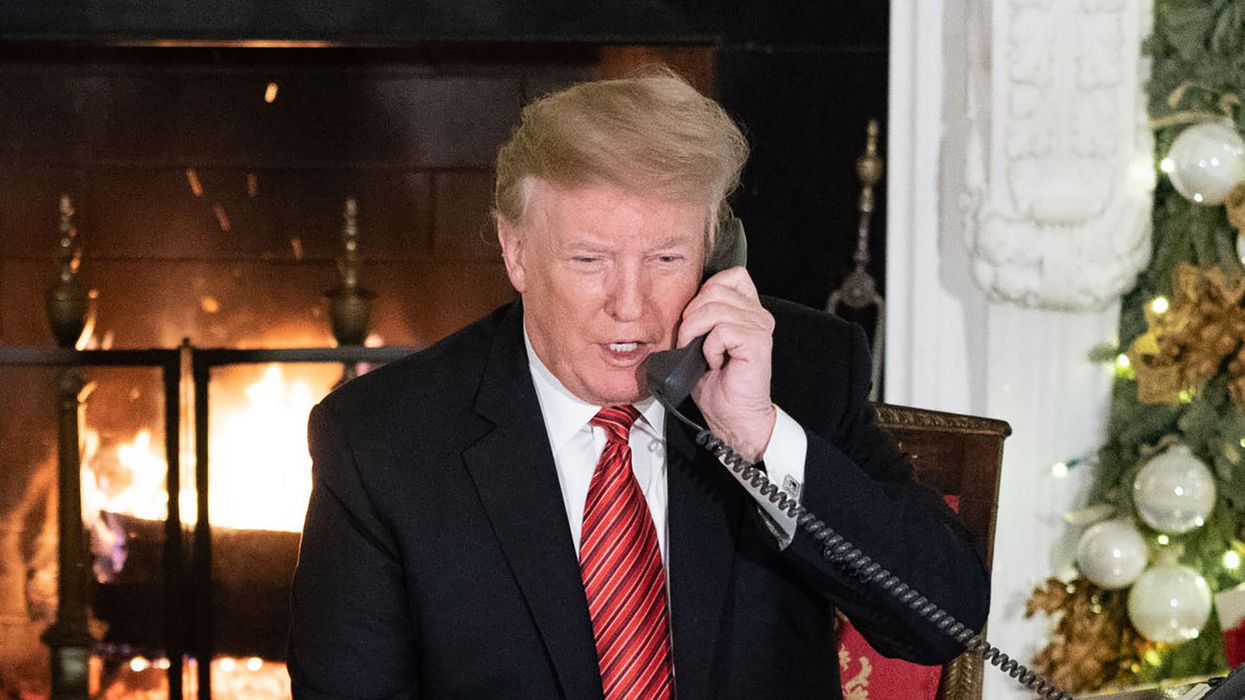
President Donald J. Trump, joined by First Lady Melania Trump, participates in NORAD Santa Tracker phone calls Monday, December 24, 2018, in the State Dining Room of the White House—a Christmas Eve tradition for over 60 years to keep track of Santa’s travels around the world. (Official White House Photo by Shealah Craighead)

May 26, 2026 
ALTERNET

President Donald Trump’s family has pitched a $500 phone to their supporters, arguing that the ostensibly Made in America product would be extremely high quality.

“The long-delayed golden Trump Mobile phone looks nothing like the advertised image, has a smaller screen than promised, and its color leaves a lot to be desired, according to one of the few people to lay eyes on a real one,” reported The Daily Beast's Cameron Adams on Tuesday. He added that “the $500 Trump phone has now been delivered to tech media for review, one year after it was announced and nine months after its hard launch to cash-rich MAGA diehards.”

Patrick Holland, the managing editor of the tech site CNET, told CNN that the phone does not appear to be made in America as promised. The packaging instead claims the phone is “designed with American values in mind.” Furthermore, instead of looking like the sophisticated gold phone promised in the original image, Holland says the Trump phone looks like “an altered iPhone 16 Pro.”

Holland added that, visually, “sometimes it looks like those gold coins that Scrooge McDuck would jump into for DuckTales. Other times, it’s got a mustard vibe to it, and yet other times, it kind of looks like a urine sample.”

Holland even speculated that the Trump team tried to get around manufacturing the phone outside the country (he speculated Taiwan because the processor and graphics card perform similar to the HTC U24 Pro 5G, which is made there) by being hyper-literal. The box, after all, says “Made in the USA.”

“They could be being literal here, and it could be that they put the phone in the box and that the box was assembled in the USA,” Holland pointed out. Regardless of the phone’s quality, though, he criticized the Trump team for delaying sending people their phones.

“If you did order this phone, it doesn‘t matter what your political persuasion is, you shouldn‘t be ripped off,” Holland said.

“A separate NBC review last week found that the phone was also being sold with a major blunder emblazoned on it,” The Daily Beast added. “The American flag printed on the back of the phone appears to contain only 11 stripes instead of the standard 13.”

Problems with the Trump phone, which are Trump’s latest attempt to monetize the presidency, have been evident since last year. The Guardian's Joanna Partridge reported in December that the phone's release would be delayed, saying there is a “strong possibility” the handset would not be delivered as promised that month, blaming the government shutdown for the issue. Described even then as “proudly American,” Partridge wrote that it was to be “etched with an American flag. The T1 was initially promised in August — and the website still states it will be released 'later this year.' Customers are required to pay a $100 payment to pre-order the device. The T1 launch came shortly after Trump criticized Apple over its plans to move the production of iPhones destined for the U.S. market from China to India."

Partridge added, though, that considering the "low levels of domestic smartphone production in the U.S.," it "remains unclear who could manufacture the T1 handset."
SPACE X IPO

Major Trump funder's company now a 'trainwreck'


Nick Hilden
May 26, 2026
ALTERNET

Last week, Elon Musk’s SpaceX released its IPO prospectus in preparation for going public in June, and now that experts have had a chance to pore through its 277 pages, one analyst has bad news for interested investors: the company is a “trainwreck.”

This is according to Ed Elson, a prominent financial and tech analyst who is particularly well known among Gen-Z, who posted on Tuesday, “I read all 277 pages of SpaceX's IPO filing so you don't have to.” His nutshell assessment was not optimistic: “Losses up 700 percent. Revenue decelerating. 107x price-to-sales multiple. It's a trainwreck.” When you dig into its claims, he says, it’s “unserious, empty, hallucinatory, and borderline dishonest.”

Elson says that the fantastical elements of the filing are clear from the start.


“After eighteen images of rockets in space, we learn that the company’s mission is ‘to extend the light of consciousness to the stars,’” writes Elson. “To accomplish this, the company plans to advance humanity ‘to Kardashev Type II status,’ which is defined in the document as ‘a civilization that harnesses the full energy output of its local star.’ Only a few pages in and it’s already starting to feel like an ayahuasca trip.”

This “psychedelic language,” notes Elson, is peppered throughout the pitch, with “The light of consciousness” mentioned ten different times, “human augmentation” mentioned eleven times, and “first principles” twenty-seven times. “AI gets a mind-boggling 1,251 mentions — more features than the word ‘Jesus’ gets in the Bible.”


“Once you arrive at the financials,” he says, “you start to realize what the language is overcompensating for: awful numbers. The company generated $4.7 billion in Q1 2026, up only 15 percent from the year before (very low for an ‘AI company’). It also lost $4.3 billion, up 700 percent from the year before. That means the company is spending roughly twice as much as it makes (and on pace to explode those losses even more), while growing its topline six times slower than Nvidia and two times slower than my own podcast. There’s no getting around it — these numbers are terrible.”

The numbers look even worse when you compare them to 2025. The company’s revenue grew by 33 percent last year, meaning its business is actually decelerating.

“Meanwhile,” notes Elson, “net losses came in at $4.9 billion, so the company is on track to lose four times more money than it did last year. I’ll put it simply: slowing revenue + skyrocketing expenses = not good.”


All of this is even more farcical in the context of the company’s $2 trillion valuation, which Elson says does not reflect the actual financials. The stock will be priced at 107 times sales, making it one of the most expensive ever. As Elson notes, “It will be twice as valuable than Walmart while generating less revenue than Macy’s,” and when compared against other tech megacompanies that went public, the SpaceX valuation is “insane.” As Elson explains, “Meta went public at 28 times sales with 88 percent revenue growth. Google went public at 10 times sales with 234 percent growth. Put another way, SpaceX is growing seven times slower while asking for a multiple ten times higher.”

According to Elson, a closer analysis of the company’s actual position places its valuation closer to $500 billion. Still a lot, but still 75 percent less than the suggested number.

Other experts have raised their own concerns about the company’s IPO. According to the New York Times, SpaceX appears to be structured in a way that favors owner Elon Musk “at the expense of other shareholders.” And Barron’s warns that stock shoppers should invest at their “own risk,” noting that these types of high-profile IPOs tend to “underperform” and deliver "volatility" resulting in “negative returns."

Musk — who donated at $288 million to elect President Donald Trump — has faced accusations that his appointment as a “special government employee” at the head of DOGE allowed him to act with conflicts of interest regarding SpaceX’s government contracts. Government watchdogs note that since taking office, more and more of NASA’s funding has been diverted to Musk’s company.

Now, Musk is inviting the public to buy into that company, which Elson warns is more fantasy than business.

“The only way to get yourself mentally to $2 trillion is to believe that every possible sci-fi objective will be achieved, from data centers in space to asteroid mining to building cities on Mars,” he concludes. “Once you’ve done that, you then have to convince yourself that each of those endeavors will also make money. There’s optimism, and then there’s delusion.”

Wall Street Says That a Company That Loses Billions is Worth Trillions


 May 26, 2026

Photograph Source: Alexander Hatley – CC BY 2.0

On Wednesday, the Washington Post ran a short piece with the headline, “Musk’s SpaceX Discloses Massive Losses Ahead of Expected Record-Breaking IPO.” The first sentence told readers:

SpaceX, the rocket company led by Elon Musk set to debut on the stock market in coming weeks, has recorded $13 billion worth of losses since the beginning of 2023, according to a financial filing made public Wednesday by the Securities and Exchange Commission.

Later in the article, we learn that the implied market capitalization, based on the SpaceX IPO, is $1 trillion. Maybe it’s old-fashioned, but when I learned economics, a stock’s price was supposed to be related to its profits. A company that loses $13 billion would not ordinarily warrant a market capitalization in the trillions.

Of course, this is the same story with Musk’s other big company, Tesla. It has a market capitalization of almost $1.6 trillion, nearly 400 times its $4 billion earnings. I suppose its stock price is a bet on Tesla’s earnings growth, but that doesn’t seem very promising with the company rapidly losing market share to Chinese competitors.

Furthermore, almost 80 percent of the earnings Tesla does have is coming from carbon credits it gets as part of what his friend Donald Trump calls “the green scam.” Tesla’s money train, even at 1/400th of its share price, may not be long-lived if Trump gets his say, so its profit growth looks to be headed in the wrong direction.

But Musk gave us a bit more guidance in the registration statement for SpaceX’s IPO. According to the WaPo article:

In its registration statement, SpaceX estimated its total addressable market — the ceiling for its business ambitions — at $28.5 trillion, an amount nearly equal to the gross domestic product of the United States.

All but $2 trillion of that opportunity comes from AI services, SpaceX’s filing said.

This means Musk is betting on getting a substantial portion of a $27 trillion annual market, 90 percent of current US GDP from his AI.

Since Musk provides no time-horizon for this projection, it’s not clear whether this is projected as an annual figure at some future point, 10, 20, or 30 years out, or perhaps even a cumulative total over this indeterminate time period. But hey, we’re just talking about a trillion-dollar stock valuation, why nickel and dime the projections?

When it comes to big boasts on future AI sales, it is probably worth noting that Musk and his Silicon Valley buddies don’t appear to be doing so well today. Chinese AI makers are beating them in sales in the rest of the world and seem to be gaining ground even in Silicon Valley.

Apparently, Airbnb is going with Chinese AI over the domestically produced stuff. The US stuff sells for five to ten times as much as what the Chinese producers charge. It’s like having the option of buying a car for $4,000 rather than $40,000. You need a pretty good story to get people to go with the $40,000 car. The market (the AI buyers’ market, not the stock market) doesn’t seem to think the Silicon Valley boys have the story.

Anyhow, it seems pretty clear that the valuation of SpaceX is really nothing more than a vote of confidence that Elon Musk will turn it into an incredibly profitable company at some time in the not-too- distant future, or at least a bet that other investors will believe that Elon Musk will turn it into an incredibly profitable company at some time in the not-too-distant future.

I have not followed Musk’s business career closely but Grok did tell me that in 2015 he promised Tesla would have full self-driving cars in two years. I did pay more attention to what Musk said about politics and government finances, especially around the time he was running DOGE. And here I can say with great confidence that Musk was not just a little bit wrong; the things he was saying were batshit crazy.

Musk repeatedly claimed that there was at least $2 trillion in waste in the federal government budget. This would put the amount of waste at more than a quarter of the budget. Since almost three-quarters of the $7 trillion budget goes to Social Security, Medicare, the military, and interest on the debt — programs Musk’s boss said he didn’t want to touch — it was pretty hard to claim there was $2 trillion in waste.

But these numbers did not stop Elon Musk. He suggested that he might give us all a $5,000 DOGE dividend check, a sum that would come to $1.3 trillion if it went to every adult in the country. Oh yeah, he also said that DOGE could balance the budget, eliminating a $1.7 trillion deficit.

Musk made other absurd claims. He said there were 20 million dead people getting Social Security checks, apparently misunderstanding the program’s procedures. Perhaps even more disturbing, even when people who understood the program explained Musk’s mistake, he never corrected himself.

Returning to SpaceX’s IPO, we’re looking at a company that loses billions of dollars. It is run entirely by a person who routinely makes promises that he can’t make good on and says things about the world that are totally crazy. That doesn’t sound like a trillion-dollar company to me, but what do I know about business?

This first appeared on Dean Baker’s Beat the Press blog.

Dean Baker is the senior economist at the Center for Economic and Policy Research in Washington, DC.