Friday, May 29, 2026

Notes on the Political Situation in South America

Thursday 28 May 2026, by Ana C. Carvalhaes, Israel Dutra
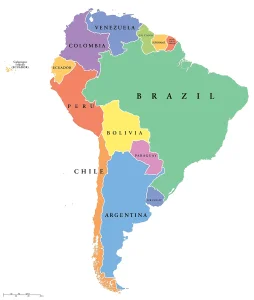


“In these notes, we address South America, where the complexity of societies, scandalous socioeconomic inequality, the presence of a so-called “middle” economy with its own influence in the region (Brazil), a tradition of struggle and organization on the left, and governments less subservient than the liberal right (such as those of Colombia, Brazil, and Uruguay), imperialist interventionism faces more obstacles and has to moderate its attacks. In light of important electoral processes and tests in the class struggle posed by far-right and right-wing governments, such as those in Chile, Argentina, Bolivia, and Ecuador, it is worth considering the commonalities across national contexts in the region in the coming months.”

1/ Under Trump’s leadership, the US empire—in its phase of decline, increasingly aggressive and unpredictable—views the entire continent as its area of direct control, rather than merely influence. “Western Hemisphere”, defined countless times in the National Security Strategy (NSS) of the neo-fascist administration, provocatively includes Canada, a traditional imperialist partner, and, above all, all of Latin America. It is collectively considered the backyard from which the still-hegemonic imperialism asserts itself politically and militarily to better compete with China for technological, economic, and geopolitical primacy. The unprecedented deployment of maritime, naval, and ground forces to the Caribbean, the blockade of Cuba, the pressure and blackmail against Mexico and Colombia (not a coincidence that they are governed by “progressive” administrations), under the pretext of drug trafficking, and the de facto seizure of power in Venezuela, through the kidnapping of the presidential couple and a strategic oil agreement with the former “Maduroist” government, highlight the colonialist and bellicose, blatantly interventionist nature of imperialism under the Trump administration.

In these notes, we address South America, where the complexity of societies, scandalous socioeconomic inequality, the presence of a so-called “middle” economy with its own influence in the region (Brazil), a tradition of struggle and organization on the left, and governments less subservient than the liberal right (such as those of Colombia, Brazil, and Uruguay), imperialist interventionism faces more obstacles and has to moderate its attacks. In light of important electoral processes and tests in the class struggle posed by far-right and right-wing governments, such as those in Chile, Argentina, Bolivia, and Ecuador, it is worth considering the commonalities across national contexts in the region in the coming months.

2/The current global situation of the US creates difficulties for its strategy. On the Middle Eastern front (which the NSS does not consider a priority but was the target of its strongest military offensive outside the Americas), it has not yet easily achieved, as it had imagined, the goal of overthrowing the Iranian regime. This stalemate (for now), which feels like a defeat for Trump, adds to the growing wave of opposition and anti-democratic plans within the United States itself, creating a dangerous combination for Trump’s continued rule. Further US interventions in electoral processes (as occurred in Argentina and Honduras), support for coups, invasions, and new rebellions—with sudden reversals—cannot be ruled out. Today, Cuba is the most immediate target: the ideal scenario for the US is an agreement with the Díaz-Canel government (which would mean sidelining Raúl Castro), to present it to the domestic electorate as an international victory. Would the Cuban government do so, in the face of the shortages and hunger imposed by the US? The answer remains open. The elections in Colombia and Brazil this year, following the runoff in Peru, will also point to the balance of power.

3/ The South American political landscape is one of a growing (and, by all indications, enduring) clash between far-right governments and movements allied with the US—in power in Argentina, Chile, Paraguay, and Ecuador, and strong in Peru, Venezuela, Colombia, and Brazil—and their mass movements and liberal-democratic and left-wing political forces. Beyond their authoritarian ambitions and submission to Uncle Sam’s dictates, the neo-fascists in the South are the most consistent proponents of an ultraliberal and predatory agenda of pro-financial counter-reforms in labor, agrarian, health, environmental, and social security policies. Thus, it is inevitable that they will clash with the general interests of working people, women, Black communities, peasants, Indigenous peoples, and the LGBTQIAP+ community. Even with advantages in the culture wars, thanks to Big Tech’s and its networks’ support, it is most likely that the far right will fail to stabilize the region. The subcontinent is likely to remain in a state of chronic instability, with neo-fascism failing to establish a new cycle of lasting hegemony, and “progressivism” unable to revive its “golden years”. In the current phase of the global economic crisis, the major gains made by the bourgeoisie and states through raw material exports—which formed the basis of the success of the “pink tide” of the 2000s and 2010s, with Lula and the PT seeking to coordinate a heterogeneous bloc of South American countries during their first terms—will not repeat. On the contrary, tremendous battles lie ahead, with an open-ended outcome, significant polarization, and a tendency toward rapid shifts in the political landscape.

4/ In the Andean region, with its long history of social struggles, the trend toward worsening political and social contradictions persists. For now, the balance of power is heavily in favor of the right and imperialism. With Venezuela turned into a US colony, Peru in an electoral process led by Fujimorism, Ecuador under the right-wing Noboa, and Chile under a Pinochetist government, the rebellions of workers and peasants in Bolivia against the government of Rodrigo Paz represented a significant counterforce to the neo-fascist wave, despite the recent electoral defeat of MAS (2025). In Chile, despite the political strength of the Kast government, students have already staged major protests. The opposition is regrouping to challenge the austerity plan and the consolidation of the neo-fascist government’s regime, which is beginning to lose ground, according to recent opinion polls.

5/Just a few months after taking office, Bolivian President Rodrigo Paz found himself on the defensive in May, with the coalition divided and part of the workers’ and peasants’ movement demanding the fall of his government. (Contrary to the view of part of the left, which saw the electoral defeat of the MAS as a historic defeat for the mass movement, the social movements were not historically defeated at that moment—although the fragmentation of the MAS party-movement, which led the so-called “process of change” for 16 years, was a major setback for those at the bottom.)

The masses did not give Paz a “honeymoon”: in a first wave, there was an uprising against decrees that raised gasoline prices, removed subsidies, eliminated taxes on large fortunes, cut health and education, and expanded the plundering of natural resources. But the measures enacted by the hated “superminister” Branko Marinkovic did not pass. In the current and second wave of popular uprising, a decree from late April played a decisive role; it sought to reverse the agrarian reform inherited from the 1952 revolution (!) — which outraged the peasants. Added to this was the dissatisfaction of wage earners with the government’s refusal to negotiate a wage increase. The brutal repression of the May 16 protests, which left four dead, only fueled the anger of workers and the peasants. There were more than 70 roadblocks and the takeover of La Paz by a march organized by COB (Bolivian Workers’ Union) and the peasant union.

The combination of the peasant riot with the urban struggle, mobilizing farmers, teachers, drivers, miners (wage earners and cooperative members), students, and sanitation workers, echoed the characteristics of the great uprisings of the last century—from the 1952 revolution to the gas uprising in the early 2000s, through the popular assemblies of 1970–71, the struggles against the dictatorships in the 1980s, the dual power government-COB in the Siles Suazo’s years (1982 to 1985), the 1985 miners’ insurrection, and the struggles to defend the Constituent Assembly that established the Plurinational State in Evo’s early years (2006-2010). Imperialism and the local bourgeoisie know this history, which is why they were concerned about the movement’s breadth and radicalism. The reaction was swift: Marco Rubio spoke of a coup against Paz, the right-wing in Santa Cruz called for the Civic March and pressured the OAS to state defense of the democratic rule of law (read: Paz’s government), and the government severed ties with Petro’s Colombia, which had offered to mediate the conflict. The outcome of the process is still unfolding, with a violent crackdown on leaders in the search for a reactionary solution at the cost of bloodshed. In any case, the country’s history advises against hastily declaring “historic” defeats.

5/ In Peru, the bourgeois political system is experiencing yet another chapter of the “national crisis” (in the Leninist sense) that has been dragging on for at least 30 years, despite recent relative economic stability. The second round of this year’s presidential election, scheduled for June 7, will be polarized: early polls indicate a virtual tie between Keiko Fujimori, daughter of the former dictator and the strongest voice of the Peruvian right, and Roberto Sánchez, linked to former President Castillo and of a center-left tradition. Both probably have around 38% of the vote. The first-round results were not certified until a month after the ballot count. The classic far-right candidate, Rafael Aliaga, contested the vote count, which dragged on for weeks, alleging fraud in light of the extremely close second-place result. Combined abstentions, blank votes, and invalid votes accounted for 39% of the electorate, far surpassing any single party’s share. Keiko reached the second round with 17% of the valid votes. Sánchez had about 12%. The fragmentation of the parties (37 presidential candidates!) reflects the difficulty of establishing political hegemony following Castillo’s downfall and imprisonment.

Economic growth, relatively higher than the region’s recent average, is insufficient to stabilize the country, given a deeply corrupt capitalist administration and seven former presidents who have been sentenced to prison (four of whom remain incarcerated), including the late Alberto Fujimori and Alan García, who committed suicide. The 2023 rebellion was "resolved" through repression by the Boluarte government (leader of the coup operation against Pedro Castillo), without, however, guaranteeing an end to the turmoil. In this context, the second round of the election will take on a highly plebiscitary character, dividing the country even regionally. At stake will be the memory of Fujimorism, in a scenario where the strength of Castillo—representative of "deep" Peru and the struggles for education—has not dissipated, despite the persecution he has suffered. It will be necessary to observe whether democratic forces, especially among the youth, will mobilize sufficiently to prevent a victory for Keiko. The outcome of this chapter is part of a larger battle between the popular resistance of the country and the region and a regime that has not fully overcome Fujimorism, enshrined in the discredited 1993 constitution.

6/ The presidential elections in Colombia, taking place between May 31 and June 21, are decisive for the country and the region. Polls show candidate Iván Cepeda, representing the Historic Pact—the local expression of progressivism—in the lead; he intends to continue the process begun with Petro’s election. Cepeda has about 40% of the vote and would thus face a tight runoff against one of the two right-wing opposition candidates. The frontrunner is Abelardo de Espriella, with 24%, a lawyer and admirer of Trump and Netanyahu who aims to be the Colombian version of Milei. Leaning toward the traditional right, Senator Paloma Valencia is running with 19%, proclaiming herself the heir to former President Álvaro Uribe. A leader of the Democratic Center, Valencia seeks to renew the structure of Colombian conservatism, or "Uribism," and is therefore the more dangerous opponent in a potential runoff against Cepeda.

The Historic Pact’s strategy is to campaign and govern “on the ground”, that is, by mobilizing. Pact adopts a different stance from Lula, the Uruguayan Broad Front, and Kirchnerism, which managed conflicts more through conciliation, demobilization, and striking deals with the political oligarchies. Petro calls for rallies periodically, as he did on May 1. He raised the minimum wage by 23% and proposed new labor legislation that guaranteed rights and reduced the workweek without cutting wages. Furthermore, his environmental vision, which challenges the extractivism of the right and the center-left, sets Petro apart globally. His defense of the Gaza Flotilla, his stance against extradition to the United States, and his independent position of solidarity with Cuba have projected him beyond mere rhetoric as a leftist contesting the project of power.

It was a political general strike, with insurrectionary traits, that completely transformed the regime and Colombian politics in May 2021. Indeed, it was by threatening a general strike that Petro responded to the oligarchy when the Senate recently rejected a referendum to approve the new labor legislation. “Petro’s secret”, says Luís Leiria in an article for esquerda.net, “was to combine negotiations with street mobilization and popular pressure. And to relentlessly insist on the main causes announced at the beginning of his term, even when the right-wing majority in the Senate blocked his initiatives.”

7 /Fundamental for the Southern Cone of South America is the challenge facing Argentines: to defeat Javier Milei at the polls and in the streets. Milei is the regional leader most faithful to Trump’s program and strategy, and to his "international," the CPAC. He is at the forefront of support for Zionism in the region, of the "carnal" relationship with Trump, and of the ultraliberal project to destroy the environment and social rights, symbolized by the chainsaw. With the help of a blackmail attempt by boss Trump, Milei scored an important victory in last year’s legislative elections. Afterward, however, his popularity eroded significantly due to a series of corruption scandals—including the 3% kickback his sister and right-hand woman received on government contracts and recent revelations about the illicit enrichment of his chief of staff, Manuel Adorni. All of this occurred alongside the refusal of workers and the people to accept the austerity measures, despite the repression. Coinciding with Milei’s decline—also due to the deterioration of living conditions—and beginning with the massive rally on March 24, in memory of the 50th anniversary of the murderous 1976 military coup, there was a significant shift in the country’s situation. The influence of the left has grown, with FIT-U national deputy Myriam Bregman polling between 9% and 14% as the most respected political figure in opinion polls. A historic opportunity has arisen for the revolutionary left to compete for mass influence. The situation may evolve into an intense process of combining radicalized struggles with the qualitative growth of a political-programmatic pole on the left, culminating in the hegemony of the anti-capitalists. To this end, it will be essential for the actors within the FIT-U to act responsibly, rise to the challenge of this historic task, and set aside fratricidal sectarianism.

8/ Long gone are the days of Bolivarian and progressive dreams of regional integration, of ALBA and UNASUR, and of the never-implemented idea of a trans-South American oil company. Even during the Lula and Dilma administrations (between 2003 and 2015), the PT’s strategy was to discourage its Bolivarian “partners” from undertaking initiatives it considered—and continues to consider—“too radical”, even though these were limited measures—popular and independent initiatives against imperialism, such as constituent assemblies, debt audits, and nationalizations, which, in their time, were seen in Chávez’s Venezuela, but also in Ecuador and Bolivia. Bolsonaro, for his part, proved to lack the stature and political skill necessary to serve as a regional benchmark for neo-fascism, one that would ensure the opening of a far-right Latin American cycle. Marked by 700,000 dead in the pandemic and constant internal crises, the Bolsonaro administration was unable to organize a South American right-wing bloc. On the contrary, during those years (2019–2022), there were major uprisings in Chile, Colombia, Ecuador, and Bolivia.

9/Trump’s foreign policy, with its tariff war, threats, and interventionist rhetoric, clashes directly with the interests of the state and broad sectors of the internationalized bourgeoisie of sub-imperialist Brazil. Seeking reelection, Lula 3 is trying to balance on an increasingly narrow tightrope. On the one hand, he is autonomously distancing himself from the US when it comes to tariffs, trade in general—not least because Brazilian agribusiness and extractive industries have no intention of falling out with China—and police-military issues (refusing to accept the designation of “terrorists” for Brazilian drug trafficking factions). On the other hand, he tries to show domestically, particularly to the country’s large corporations and the anti-PT middle class, that he knows how to reconcile with the genocidal figure currently in the White House.

To avoid displeasing Trump, the Brazilian government remains in shameful silence in the face of the de facto intervention in Venezuela, the blockade of Cuba, and even Trump’s scandalous military agreements with the Paraguayan government, which strengthen the presence of US troops and modern weapons in the Triple Frontier (Brazil, Paraguay, Argentina). In this effort to “de-escalate” the wave of friction with the US and present himself as trustworthy, Lula traveled to the United States, swore friendship to Trump, and agreed to hand over Brazil’s rare earth minerals, as well as territory for US Big Tech data centers, in addition to tactically stalling parliamentary initiatives for general regulation of platforms.

The far-right opposition shows the strength to return to power, despite the recent erosion and drop in Bolsonaro’s heir’s poll numbers due to his proven ties to the owner of Banco Master. Favoring the right-wing opposition are: (1) the system of distributing public funds via amendments, which fills the coffers of the owners of Bolsonarism and Centrão electoral fiefdoms with millions; (2) the popular influence of reactionary neo-Pentecostal pastors, with whom Lula attempted reconciliation in the recent past; (3) the Bolsonarism and Centrão majority in parliament—through which they stifle government initiatives and impose setbacks, often perceived by the population as “the government’s doing”; (4) the unprecedented erosion of the judiciary as a whole, whose millionaire privileges are the target of justified popular anger, and whose image—associated with the government in the fight against the 2023 coup attempt—was tarnished in the Master case.

Nor do the government’s own missteps help its cause, notably (4) the refusal of Lula and the PT to mobilize the people and workers, turning the trade unions and popular organizations linked to the governing coalition into instruments of permanent demobilization; (5) the fact that the worn-out political system is identified by those under 40 with the long cycle of conciliatory PT governments, particularly with the figure of Lula; and (6) the general absence, and in the last three and a half years in particular, of initiatives with social and economic impact for income redistribution, capable of mobilizing sectors of the masses against the parliamentary opposition.

Even within this framework, it is theoretically possible to make the presidential campaign a moment to reaffirm the left’s path. The fundamental struggle, beyond the crucial issue of democracy versus military coup-mongering, involves national sovereignty in the age of Trump and the necessary battle against the global capitalist sector that controls data and social media management—the so-called “techno-fascism”, largely headquartered in Silicon Valley. This imperialist bourgeois faction is ultimately responsible for the unchecked spread of pro-fascist electoral propaganda (via fake news), for the growing addiction and ill health of children and adolescents, for the indebtedness of working-class families through online gambling, for the rise in misogyny and femicides, as well as other atrocities.

This year’s electoral process in Brazil has all the makings of becoming the main Latin American battleground against Big Tech-driven colonization. It remains to be seen, through action, whether most of the broad front supporting Lula against neo-fascism will be able to rise to the challenge, both in program and in practice.

10/ With the end of the commodities boom and the widespread “progressive” wave—fueled by popular struggles against neoliberalism at the turn of the century—South America has found itself “overrun” over the past fifteen years by the global trend toward the rise and electoral victories of neo-fascist forces. Trump’s rise was a major setback, and his administration—as well as those of his local allies—constitutes the main threat to the sovereignty and well-being of the peoples and workers of South America. US barely disguised “military invasion” of the Caribbean Sea, the takeover of Venezuela at the beginning of the year, and the ongoing advance against Cuba. These elements are exacerbating the situation in favor of imperialism and reaction, making the regional balance of power more unfavorable to the peoples. However, the neo-fascists face fierce opposition and resistance from the peoples, organized sectors of the mass movements, and reformist and revolutionary left-wing political forces—including “late-stage progressive” governments, such as Colombia’s in the region (and Mexico’s to the north).

The game is not over. The antifascist struggle is underway, and it can win and advance, mainly because it relies on a de facto alliance with the growing mobilization and politicization of the American people and workers against Trump. Today’s major regional battles in this struggle are taking place in the streets of Argentina against Milei, in the Peruvian countryside and peripheries against the return of Fujimori’s heir in the electoral showdown in Colombia, as well as in Brazil where it is already beginning; in the nascent resistance to Kast in Chile and to the colonial government of Venezuela by workers demanding a raise in their starvation wages. The place of revolutionaries is in these battles, with the utmost spirit of unity in popular action and organization against the fascist enemy, while maintaining autonomy to propose measures that advance the movements in confronting the social, economic, and environmental inequalities imposed by capitalism.

24 May 2026

Celebrate Our Namesake’s Birthday: The Brilliance of Randolph Bourne


'WAR IS THE HEALTH OF THE STATE'


by | May 29, 2026Antiwar.com


Saturday is the 140th anniversary of Randolph Bourne’s birthday. Antiwar.com named its parent institute for this early 20th century antiwar activist. Read Jeff Riggenbach’s biography of Bourne.

[Transcribed from the Libertarian Tradition podcast episode “Randolph Bourne (1886–1918)”]

Randolph Bourne was an American intellectual journalist who flourished for a few years in the second decade of the 20th century – in the Teens, the decade that ran from 1910 to 1920. Bourne wrote mostly for magazines during this period. His byline was particularly familiar to readers of The New Republic – until his radically antiwar views on the eve of the US government’s intervention in World War I got him fired.

He moved over to The Seven Arts, a newly launched magazine with a smaller circulation than The New Republic and one less well suited to Bourne’s particular talents and interests, since its primary focus was the arts, rather than social and political issues. He was able to publish only six antiwar articles in The Seven Arts before its doors were closed by an owner fearful of the Wilson administration and its Sedition Act of 1918, which made it a crime to criticize the Constitution, the government, the military, or the flag.

Only a few months after The Seven Arts ceased publication, Randolph Bourne died, a victim of the flu epidemic that killed more than 25 million people in 1918 and 1919, nearly a million of them in the United States. That was 1 percent of the population 90 years ago. One percent of the present US population would be more than 3 million Americans. Imagine what it would be like to live through a flu epidemic that killed more than 3 million people in the space of little more than a year. That’s what it was like for Americans living 90 years ago, at the end of World War I.

Most of the people that flu virus killed have long been forgotten – except, of course, by members of their own families. But Randolph Bourne has not been forgotten, not completely. People are still reading his work. They’re still talking about his ideas and about his memorable phrases. The most famous of these has gradually become so widely quoted in our culture that millions of people have heard it, even heard it repeatedly, without ever learning who originally wrote or said it: “War is the health of the State.”

Randolph Silliman Bourne first emerged into the light of day on May 30, 1886 in Bloomfield, New Jersey, a small town fewer than 20 miles from Manhattan. His family was comfortably middle-class, and he was the grandson of a respected Congregational minister. But he seems to have been born unlucky all the same. First, his head and face were deformed at birth in a bungled forceps delivery. Then, at the age of four, after a battle with spinal tuberculosis, he became a hunchback. Then, when he was seven, his parents lost everything in the Panic of 1893, and he and his mother were abandoned by his father and left to live in genteel poverty on the charity of his mother’s prosperous (if somewhat tightfisted) brother. Meanwhile, his growth had been permanently stunted by the spinal tuberculosis of a few years before, so that by the time he graduated from high school at the age of 17, in 1903, he had attained his full adult height of five feet.

Bourne was an exemplary student. His academic record in high school earned him a place in the class of 1907 at Princeton, but by the time he was supposed to appear on campus to register for classes in the fall of 1903, it was evident that he couldn’t afford to attend. He could barely afford books. He was flat broke. And his mother needed his financial help if she was going to go on living the decent, middle-class lifestyle to which she had become accustomed. So Bourne postponed college and went to work. He knew his way around a piano, so for the next six years he worked as a piano teacher, a piano tuner, and a piano player (accompanying singers in a recording studio in Carnegie Hall). He also cut piano rolls. On the side he freelanced for book publishers as a proofreader. Now and then, when musical work was harder to find, he did secretarial work.

By 1909, when he was 23 years old, Bourne had saved enough to cut back on his working hours and try to catch up on the college experience he’d been putting off. He enrolled at Columbia, where he fell under the sway of historian and political scientist Charles Beard and philosopher John Dewey, and began publishing essays in the Dial, the Atlantic Monthly, and other magazines. His first book, Youth and Life, a collection of his magazine essays, was published the year he graduated from Columbia, 1913. And that fall, the now 27-year-old Bourne set out for Europe. In his senior year he had been awarded the Gilder Fellowship for travel abroad, which the historian Louis Filler has called “Columbia’s most distinguished honor” during that period. Bourne spent a year travelling around Europe and pursuing such independent study as interested him.

Then, in August 1914, he returned to America, took up residence in Greenwich Village, and resumed writing for the Dial and the Atlantic Monthly, along with a new, upstart weekly called The New Republic. Actually, it might be more accurate to say that Bourne fled Europe in August 1914 than to say that he merely “returned to America” at that time. For it was in late July and early August of 1914 that Europe – virtually all of Europe – embarked upon the conflict we know today as World War I. Bourne opposed this conflict, and he was especially worried that his own country, the United States, would choose to enter it before long.

Bourne wrote about many subjects over the next four years; he wrote enough about education, for example, that he was able to fill two books with his magazine pieces on the subject – The Gary Schools in 1916 and Education and Living in 1917. But his main subject during the last four years of his life was the new world war and the urgent need that the United States stay out of it.

Bourne made few friends by adopting this stance. It brought him, as the journalist Ben Reiner later put it, “into sharp conflict with the rising pro-war hysteria that preceded America’s entry into World War I.” In the view of yet another journalistic commentator, Christopher Phelps,

few 20th-century American dissenters have… suffered the wrath of their targets as greatly as Bourne did. By 1917, The New Republic stopped publishing his political pieces. The Seven Arts … collapsed when its financial angel refused further support because of Bourne’s antiwar articles.

According to Reiner, the problem was that once Bourne’s “biting attacks on government repression began to appear in The Seven Arts,” this gave “birth to rumors that the publisher… was supporting a pro-German magazine. She… withdrew her support, which closed the magazine down.”

Nor was the demise of The Seven Arts the end of the punishment Bourne had to bear for speaking his mind. Phelps notes that “even at the Dial… he was stripped from editorial power in 1918 – the result of an uncharacteristically underhanded intervention by his former mentor John Dewey, one of the objects of Bourne’s disillusioned antiwar pen.” Phelps quotes a letter Bourne sent to a friend shortly thereafter, in which he laments that “I feel very much secluded from the world, very much out of touch with my times. … The magazines I write for die violent deaths, and all my thoughts are unprintable.” The historian Robert Westbrook put the matter as memorably and eloquently as anyone when he said in 2004 that “Bourne disturbed the peace of John Dewey and other intellectuals supporting Woodrow Wilson’s crusade to make the world safe for democracy, and they made him pay for it.”

Yet the ruination of his career was far from the only price he had to pay. Westbrook quotes John Dos Passos’s claim, from his novel 1919, that, in addition to his professional setbacks, “friends didn’t like to be seen with Bourne,” and that “his father” – who had walked out of his life a quarter-century before – “wrote him begging him not to disgrace the family name.” A few weeks later, he was dead. Several friends, going through his apartment after his death, found an unpublished manuscript in the wastebasket next to his desk. It was entitled “The State.”

“War is the health of the State,” Randolph Bourne wrote in that discarded essay, which he probably died believing would never see print, “and it is during war that one best understands the nature of that institution.” For

it cannot be too firmly realized that war is … the chief function of States. … War cannot exist without a military establishment, and a military establishment cannot exist without a State organization. War has an immemorial tradition and heredity only because the State has a long tradition and heredity. But they are inseparably and functionally joined.

Moreover, Bourne argued,

it is not too much to say that the normal relation of States is war. Diplomacy is a disguised war, in which States seek to gain by barter and intrigue, by the cleverness of wits, the objectives which they would have to gain more clumsily by means of war. Diplomacy is used while the States are recuperating from conflicts in which they have exhausted themselves. It is the wheedling and the bargaining of the worn-out bullies as they rise from the ground and slowly restore their strength to begin fighting again.

Randolph Bourne believed that informed citizens needed to realize the implications of what he was saying. For

if the State’s chief function is war, then the State must suck out of the nation a large part of its energy for its purely sterile purposes of defense and aggression. It devotes to waste or to actual destruction as much as it can of the vitality of the nation. No one will deny that war is a vast complex of life-destroying and life-crippling forces. If the State’s chief function is war, then it is chiefly concerned with coordinating and developing the powers and techniques which make for destruction. And this means not only the actual and potential destruction of the enemy, but of the nation at home as well. For the … calling away of energy into military pursuits means a crippling of the productive and life-enhancing processes of the national life.

Randolph Bourne believed that “we cannot crusade against war without crusading implicitly against the State. And we cannot expect … to end war, unless at the same time we take measures to end the State in its traditional form.” Bourne had reason to be wary when writing sentences like those in 1918. People were being imprisoned and, in some cases, deported for writing things like that. There was a particular prejudice against anarchists and against people who sounded as though they might be anarchists. Perhaps this is why Bourne added the following caveat to his call for ending the State: “The State is not the nation, and the State can be modified and even abolished in its present form, without harming the nation. On the contrary, with the passing of the dominance of the State, the genuine life-enhancing forces of the nation will be liberated.”

Randolph Bourne was an idealist. He hoped for a world free of war, a world in which what he called “the productive and life-enhancing processes” were the dominant processes in our national life. It is appropriate, then, that in the Internet age, he is perhaps best known to the general public, not only for his immortal phrase “War is the health of the State,” but also as the namesake of a nonprofit foundation that runs a popular website. The nonprofit foundation is the Randolph Bourne Institute. And the website is Antiwar.com. The folks who run Antiwar.com would have us believe that their site should not be construed as libertarian in its essence. As Executive Director Angela Keaton put it recently, “Antiwar.com is not a libertarian site. Antiwar.com is a foreign policy site operated by libertarians which seeks a broad based coalition in educating about the dangers of Empire.”

I’m inclined to think Randolph Bourne cut through to the heart of the matter more effectively, however, when he wrote that “we cannot crusade against war without crusading implicitly against the State.” In effect, you can’t be consistently and intelligently antiwar, unless you’re libertarian. The folks at Antiwar.com are, of course, aware of this. They quote that very same sentence of Bourne’s on the “Who We Are” page on their website and state further that their own “dedication to libertarian principles” is “inspired in large part by the works and example of the late Murray N. Rothbard.” The work that’s being done 24/7 at Antiwar.com not only honors Randolph Bourne’s contribution to the libertarian tradition; it also helps to assure that that tradition will continue and grow.

This article is transcribed from the Libertarian Tradition podcast episode “Randolph Bourne (1886–1918).”

Jeff Riggenbach (1947-2020) was a journalist, author, editor, broadcaster, and educator. A member of the Organization of American Historians and a senior fellow at the Randolph Bourne Institute, he wrote for such newspapers as the New York Times, USA Today, the Los Angeles Times, and the San Francisco Chronicle; such magazines as Reason, Inquiry, and Liberty; and such websites as LewRockwell.com, AntiWar.com, and RationalReview.com. His books include In Praise of Decadence (1998), Why American History Is Not What They Say: An Introduction to Revisionism (2009), and Persuaded by Reason: Joan Kennedy Taylor & the Rebirth of American Individualism (2014).

Trump’s Pottery Barn War

How a president elected to end endless wars found himself selling diplomacy as victory after stepping into a crisis he did not have to own.


by | May 27, 2026Antiwar.com

When Donald Trump wrote on Truth Social that any agreement with Iran must be “great and meaningful,” or there would be no agreement at all, he appeared to be drawing a wall between himself and Barack Obama’s nuclear deal. He wanted to make clear that even if negotiations were underway, they would be Trumpian negotiations: tougher, more forceful, and the “exact opposite” of an agreement he had spent years denouncing as a symbol of weakness. But that statement revealed less strength than contradiction. A president who once treated Obama’s diplomacy with Iran as appeasement now has to sell his own diplomacy as victory.

The issue is not how different Trump’s possible agreement would be from the JCPOA. The issue is why things reached the point where a president elected on an America First platform dragged the United States into a crisis from which he now needs the very tool he once called weakness: diplomacy. Trump was not supposed to pull America into other people’s wars. A large part of his political appeal was built on that promise: ending endless wars, not repeating the same road under new packaging. Yet the Iran war showed that even a president who came to power under the banner of America First can quickly fall into the same pit as his predecessors when he is trapped by Washington’s old logic, lobby pressure, neoconservative temptation, and Israel’s security agenda.

Exactly who placed what on Trump’s table behind closed doors cannot be proven with certainty until some members of his administration begin to speak openly. But politics is not made only behind closed doors. Outside those rooms, the signs are clear enough: hawkish senators, anti-Iran media commentators, figures close to pro-Israel networks, and the remnants of a worldview that sees every Middle Eastern crisis as an opportunity to display American power. We may not be able to say with certainty who pulled the trigger inside the administration’s mind, but we can see who helped create a political atmosphere in which any retreat from war looks like a betrayal of victory.

Ted Cruz’s behavior is a clear example of this pattern. The terms of a possible agreement have not even been made clear, yet he is already speaking of “deep concern,” as if the real issue were not the text of the agreement but Trump’s attempt to leave the path of war. Mark Levin and figures such as Laura Loomer reproduce the same psychological pressure through cheap media theatrics: either chase the enemy to some imaginary point of total defeat, or be accused of selling out victory. These are not merely political reactions; they are part of the same agenda-setting process trying to claim Trump’s movement for itself.

But the reality is simpler and more bitter. America entered a confrontation it had no vital need to enter directly. War with Iran was supposed to be a show of resolve. It was supposed to prove that Trump, unlike Obama and Biden, was not interested in appeasement. But now that same war has become a test of exit. Striking was easy; explaining the consequences is harder. Slogans were easy; managing energy markets, the Strait of Hormuz, allied reactions, divisions inside the Republican Party, and the political cost of continuing the crisis is not.

This is why Trump’s recent Truth Social post matters. He wants to say that his possible agreement with Iran will not be Obama’s agreement. He says that if there is to be a deal, it must be “great and meaningful.” But the central question is not how the text of his agreement would differ from the JCPOA. The central question is this: why does a president who treated Obama’s negotiations with Iran as weakness now need negotiations of his own to manage a crisis intensified by a military decision?

Trump wants to register the war as strength and the negotiations as victory. But foreign policy is not that generous. In the Middle East, whoever opens the door to crisis sooner or later owns the consequences. This is the famous Pottery Barn rule of American foreign policy: You break it, you own it. Trump wanted the military strike, but not ownership of the crisis. He wanted distance from the JCPOA, but now he faces the same truth: no major crisis ends with bombs alone. Eventually, someone has to return to the negotiating table.

The irony is that Trump, better than anyone, should have known this road. Did Obama’s mistakes during the Arab Spring not show that intervention in regional crises often produces new disorder instead of a new order? Did the Biden-Harris approach to Ukraine and endless support for foreign wars not show how the White House can become a spending office for taxpayers’ money in the name of other people’s security? So why did an administration that was supposed to move beyond this logic place itself back on the same pothole-ridden road?

This crisis is not only about Iran. It is about whether Trump’s movement can truly break from Washington’s old logic or whether it will ultimately be swallowed by the same forces that are always ready to drag any president into a new war in the name of security, freedom, deterrence, or defending allies. Today, that same network is telling Trump that if he fights, he is a strong leader; if he negotiates, he must prove he has not sold out victory.

But Trump has to decide whether he is the president of America First or the executive manager of someone else’s agenda. Negotiating with Iran is not inherently a defeat. The defeat comes when you first enter an unnecessary war and then have to sell negotiation not as rational statecraft, but as victory.

This is Trump’s Pottery Barn war. He did not inherit it; he stepped into it. And whatever agreement may eventually be signed, one truth will remain: the president who was supposed to pull America out of other people’s wars must now explain why he brought America so close to one of them.

Travis Lynch is an international relations graduate and independent journalist.

 A Nation of Suspects

by | May 29, 2026 Antiwar.com

Some of the recent legal challenges to the use of surveillance by the Department of Homeland Security upon Americans have resulted in the revelation of truly terrifying behavior by the government, in direct defiance of the Fourth Amendment to the Constitution. We now know that the federal government spies on innocent Americans without suspicion and without warrants.

The spying seems to fall into several categories. The National Security Agency, which is in the Department of Defense, employs about 60,000 domestic spies. These are the folks who want us to believe that they go through the trouble of making applications to the Foreign Intelligence Surveillance Court for warrants to spy on foreigners.

Actually, from time to time they do go to this court, but their travels there — where judges are frisked upon entering and leaving the courthouse by the NSA agents who appear before them — serve as fig leaves for their massive warrantless spying on Americans. The FISA Court is unconstitutional because it issues warrants based on probable cause of communicating with a foreign person, rather than on probable cause of crime as the Fourth Amendment requires.

The courts have ruled consistently since the 1960s that spying — surveillance, as the feds call it — is a search, and the capture of data from a surveillance is a seizure.

The Fourth Amendment protects all persons in America — not just Americans — from warrantless searches and seizures of their “persons, houses, papers, and effects.” There are some well-recognized exceptions to this constitutional baseline, such as evidence that will quickly vanish or be seriously degraded, but those exceptions do not apply here as the NSA captures in real time all keystrokes on all digital devices and all fiber optic data transmitted into, out of and within the United States.

The judges of the FISA Court surely know that the Department of Justice lawyers and NSA agents who appear before them are going through a charade, and the court has been made a part of it. The charade is the pretense that all spying is done pursuant to the warrants that FISA Court judges issue. Former NSA agents have revealed publicly that this is hardly the case.

Nevertheless, the lowered standard from probable cause of crime to probable cause of communicating to a foreign person was crafted by Congress — in another of its many moments heedless of the Constitution. After a few years of this, the FISA Court began to issue warrants for spying on the Americans who communicate with foreigners, out to the sixth degree. A sixth grader can do the math, as this leads to hundreds of millions of Americans whose communications are captured.

A second category of spying is employed by the DHS. The DHS — now a 250,000-person strong federal police department nowhere countenanced by the Constitution — has sophisticated software that can read fingerprints at 15 feet and irises at 15 inches. So, if you wave goodbye or good riddance to an ICE agent, and he holds up his mobile phone, and you are in the federal system for any benign reason, he has captured your bank, health, legal and commercial records on the spot. If he talks to you in your car and is within 15 inches of your face, he can capture the same data.

As if all this were not enough, the feds and local police use a device called a Stingray, which mimics the signal sent to all mobile devices as if the device were being used to communicate. But the communication is just one way, as the Stingray will tell the government where the person possessing the mobile device is at any given moment. This, too, is a seizure of private personal information — the contents of the computer chip in your mobile device — which the Fourth Amendment characterizes as an “effect.”

And then there is the FBI, which now uses zero-click software. This permits agents without warrants or even approval of their superiors to engage in computer hacking without having to trick the hacked victim into clicking on a link. Computer hacking is a felony.

All of this surveillance is unconstitutional, dangerous and commonplace. It consists in the use of surveillance and law enforcement tools without articulable suspicion.

For 600 years, articulable suspicion — the lowest evidentiary standard we have — has been the baseline for all government behavior that targets an individual. Articulable suspicion is the fact-based ability to state why a person — not a group — should be targeted and for what crime. This is the same standard that must be met when police stop someone in public.

Anything less than articulable suspicion is a fishing expedition; stated differently, a general warrant. General warrants — which were used by British agents on American colonists — permitted the agents to stop anyone, to search anywhere and to seize anything without articulable suspicion. The Fourth Amendment outlawed them.

How did we get from a Constitution that assumes that the individual is sovereign, our rights are natural and inalienable, and the government may only legally do what the governed have affirmatively authorized it to do to where we are today? The answer is fear. Fear is the great tool for authoritarians — fear of foreigners, fear of war, fear of crime, fear of drugs, fear of terror. When people are afraid, they will allow the government to take liberty in return for a promise of safety.

Of course, liberty once surrendered is never returned. But liberty is individual, not collective. You can surrender your liberty and your neighbors can surrender theirs, but none of you can surrender mine. These values are what animated Thomas Jefferson in the Declaration and James Madison in the Bill of Rights. Those animations seem like ancient history today. On the eve of America’s 250th anniversary, the Founders would not recognize this country of no values where everyone is a suspect.

Andrew P. Napolitano, a former judge of the Superior Court of New Jersey, is the senior judicial analyst at Fox News Channel. Judge Napolitano has written seven books on the US Constitution. The most recent is Suicide Pact: The Radical Expansion of Presidential Powers and the Lethal Threat to American Liberty. To find out more about Judge Napolitano and to read features by other Creators Syndicate writers and cartoonists, visit www.creators.com. COPYRIGHT 2025 ANDREW P. NAPOLITANO – DISTRIBUTED BY CREATORS.COM


Thursday, May 28, 2026


Italians and Dutch share the same gestural instinct for teaching


Teaching with the hands


Max Planck Institute for Psycholinguistics


Nijmegen, The Netherlands, May 27, 2026 - Italians are famous for speaking with their hands. But a new international study suggests that when it comes to teaching children, adults everywhere instinctively become more expressive with their gestures — even in cultures known for gesturing less. This study by Emanuela Campisi (University of Catania) and Anita Slominska and Asli Ozyurek (Max Planck Institute for Psycholinguistics) reveals that Italian and Dutch adults adapt their hand gestures in remarkably similar ways when explaining new concepts to children.

When adults teach children something new, words are only part of the story. A new cross-cultural study shows that adults from different cultures instinctively modify their gestures in similar ways to help children learn, suggesting that spontaneous human teaching may rely on a shared, deeply rooted communicative strategy.

Researchers found that although Italian adults used more gestures overall than Dutch adults, both groups increased the use of visually rich, two-handed gestures when demonstrating unfamiliar logic puzzles to children. The findings highlight how humans naturally adapt communication to support young learners, regardless of cultural background.


Teaching with the hands

Human communication is fundamentally multimodal, combining speech with gestures, facial expressions, gaze, and body movements. Among these, representational gestures (gestures that visually depict meaning) play a crucial role in teaching and explanation.

These gestures can show how an action works, illustrate the shape of an object, or recreate a movement in space. For example, someone explaining how to crack an egg might mime the action with their hands while speaking. The new study explored how adults use these gestures when teaching children compared to adults, and whether those strategies differ across cultures.

[insert figure 1]

FIGURE 1. The figure shows an overview of the study design. After an initial introduction, the speaker interacts with the toys and then demonstrates their use to the two different audiences: an adult and a child.
 

Comparing Italian and Dutch communication styles

The researchers asked 16 Italian and 16 Dutch adults to demonstrate two novel logic puzzles to two different audiences: 9-10-year-old children and other adults. The two groups were chosen because previous research suggests Italians come from a more ‘gesture-rich’ culture, while Dutch speakers tend to use fewer representational gestures overall.

As expected, Italian participants produced more representational gestures than Dutch participants across the demonstrations. However, neither group simply increased the total number of gestures when speaking to children. Instead, both groups changed the type of gestures they used.


A shared strategy for helping children learn

Across both cultures, adults used significantly more two-handed representational gestures when teaching children. Researchers believe these gestures increase iconicity, making explanations more visually informative and easier for children to understand.

The findings suggest that adults instinctively adapt demonstrations to make abstract or unfamiliar information clearer for younger audiences. “Humans are natural teachers, and our bodies are part of the lesson,” researcher Emanuela Campisi notes. “Even when cultures differ in how much people gesture overall, adults seem to share intuitive strategies for making demonstrations clearer and more engaging for children.”

The study also examined ‘bracketed gestures’, in which one hand remains still while the other moves. Dutch adults used these gestures more frequently when explaining puzzles to other adults, possibly to help organize and anchor information during communication. Italians used them less often in adult-directed demonstrations.

However, when speaking to children, both groups converged on similar rates of bracketed gestures: another sign that adults across cultures may rely on common pedagogical instincts when teaching young learners.


Understanding folk pedagogy

The findings support theories of ‘folk pedagogy’, the idea that humans possess intuitive teaching strategies based on assumptions about what learners need to understand. Importantly, the study examined spontaneous, semi-naturalistic teaching interactions rather than formal classroom instruction. Participants were ordinary adults communicating with real, naïve listeners, allowing researchers to capture how teaching unfolds in everyday life.

The work also expands cross-cultural research in developmental psychology by moving beyond broad comparisons between Western and non-Western societies and examining subtle differences within Europe itself.


A window into human cultural transmission

Researchers say the findings help illuminate how humans pass knowledge across generations: a process considered central to cultural evolution. By combining speech with gestures and other visual signals, adults create what researchers describe as ‘multimodal scaffolding’, a flexible communication system tailored to learners’ needs.

The team hopes future studies will explore a wider range of cultures and teaching situations, while also examining how different gestural strategies affect children’s actual learning and comprehension. On top, the study suggests that while cultures may differ in how expressive people are, the instinct to physically shape communication for children may be something humans everywhere share.


Publication

Campisi E, Slonimska A, Ozyurek A. 2026 Showing how: adults across cultures use similar representational gestural strategies in demonstrations for children. R. Soc. Open Sci. 13: 251813. https://doi.org/10.1098/rsos.251813