Saturday, May 30, 2026

AU

Illegal miners extract billions in Amazon gold despite Brazil crackdown, Greenpeace finds
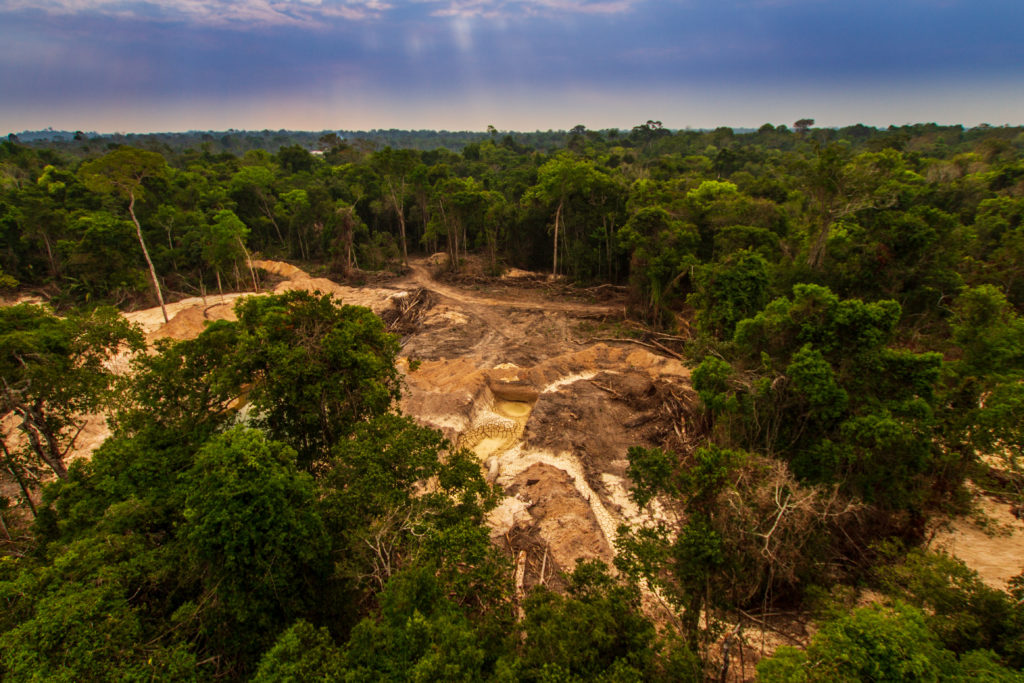

Illegal mining causing deforestation and river pollution in the Amazon rainforest near Menkragnoti Indigenous Land – ParĂ¡, Brazil. Stock image.

Billions of dollars worth of gold is still being extracted illegally from Brazil’s Amazon rainforest, a study by nonprofit watchdog Greenpeace found, despite efforts by President Luiz Inacio Lula da Silva to crack down on wildcat mining.

Lula pledged upon taking office in 2023 to eliminate illegal gold mining from Indigenous lands and protected areas after years of expansion encouraged by far-right former President Jair Bolsonaro. Last year, Brazil’s Federal Police seized a record 447 kg (985 pounds) of illegally mined gold.

But as gold prices hit record highs amid intense geopolitical instability, the Greenpeace study found that miners have adapted by using permits from places with no mining activity to falsify the origin of illegally mined gold.

Greenpeace analyzed 187 forest areas with gold mining permits issued by Brazilian mining agency ANM near Indigenous lands and protected areas in the Amazon and found that 98 of them showed no signs of mining.

Still, so-called “ghost permits” from those areas were used to justify the sale of 26.8 metric tons of gold worth an estimated $3.88 billion between 2018 and March 2026.

Reuters flew over two of the permitted areas in the dataset and verified that, despite paperwork for huge output from surface mining, there was no activity to be seen. Six minutes away by air, journalists spotted a large active illegal operation in a protected area.

It was not clear where all the gold backed by so-called “ghost permits” originated, but researchers and investigators believe much of it is extracted from protected areas and Indigenous lands, such as the Kayapo people’s territory in Para state.

Kayapo chief Megaron Txucarramae expressed frustration at the government’s failure to act.

“I don’t know what else is needed to solve illegal mining on Indigenous land,” he said. “It destroys the land, pollutes the rivers, and Indigenous people, without realizing it, end up eating poisoned fish.”

ANM said in a statement that it was monitoring the permits that Greenpeace denounced for any irregularities and added that, with thousands of permits issued, the Amazon region imposes “large-scale logistical and oversight challenges.”

“As long as it is possible to launder gold using mining permits, there will be an expansion of the activity in the Amazon,” said Greenpeace Brasil spokesperson Danicley Aguiar.

(By Ricardo Brito; Editing by Manuela Andreoni and Jamie Freed)


China’s April net gold imports via Hong Kong rise 81.2% from March

Stock image.

China’s net gold imports via Hong Kong rose 81.2% in April from the previous month, Hong Kong Census and Statistics Department data showed on Thursday.

The world’s top gold consumer imported a net 86.715 metric tons in April, up from 47.866 tons in March, and marked its 13th straight monthly increase, the data showed.

The Hong Kong data may not provide a complete picture of Chinese purchases because gold is also imported via Shanghai and Beijing. China’s bullion buying patterns can influence global trends and markets.

China’s total gold imports via Hong Kong stood at 99.327 tons in April, up around 24.8% from March’s 79.576 tons.

Earlier this month, data from the People’s Bank of China showed the central bank loaded up on gold for an 18th straight month in April.

The country’s gold reserves have added up to 74.64 million fine troy ounces by the end of April, versus the previous month’s 74.38 million.

Spot gold prices have been under pressure since the start of the US-Israeli war with Iran in late February. The effective closure of the Strait of Hormuz has prompted a surge in Brent crude prices, fanning inflation woes and propelling rate hike expectations.

(By Anjana Anil; Editing by Alison Williams and Ronojoy Mazumdar)

Hong Kong to get edge in Asia gold-hub push with clearing system


Hong Kong Victoria harbor at sunset time. Stock image.

By launching a gold-clearing system in the next couple of months, Hong Kong is set to secure first-mover advantage in a push to become Asia’s preeminent hub for bullion trading.

The clearing mechanism, expected to debut by July, is an important step in building the liquidity needed to influence pricing in the region. It would also take Hong Kong further down the road to creating a gold-trading center than longtime rival Singapore, which has announced similar plans without committing publicly to a timeline.

“If Hong Kong and Singapore are in a race to build clearing, it looks like Hong Kong authorities are very eager to win,” said Adrian Ash, head of research at BullionVault, an online platform that allows users to trade and store precious metals.
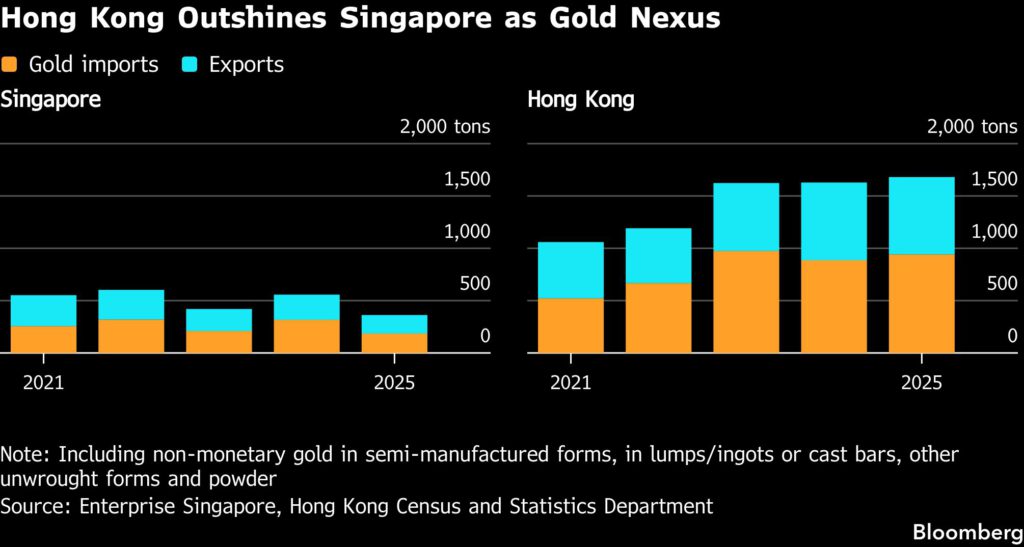
In recent months, both cities have advanced plans to capitalize on strong demand and challenge London’s long-held dominance as the global center of bullion trade. Gold’s protracted rally might have stalled since the war began in the Middle East, but many banks remain bullish about the long-term prospects for a metal coveted by investors as an alternative store of wealth.

In Hong Kong, the infrastructure is already being laid for a significant expansion of trading, refining and storage. China’s biggest express-delivery firm, SF Holding Co., plans to open a vault near the city’s airport this year, while precious metals traders are commanding bigger pay packages as established banks compete for talent with fintech and securities firms.

The timing for launching a clearing system is good, as a seasonal lull in demand over the summer will leave ample room to accumulate stockpiles of the metal, Ash said. The government-owned mechanism will also be underpinned by the large volumes of gold that move in and out of Hong Kong due to demand from China, the world’s biggest consumer.

These flows are supported by an existing lineup of refiners that includes Heraeus Ltd. and Metalor Precious Metals Hong Kong Ltd., among others. Point Gold International Ltd., a major Chinese refiner, said it was investing $150 million to expand its offices in Hong Kong and add a facility that’s scheduled to begin production this year. Singapore, by contrast, has only a single refinery that produces bullion with the industry-standard London Good Delivery accreditation.

“Hong Kong has refineries, jewelry manufacturers, factories, mining companies,” said Bernard Sin, regional director for Greater China at MKS PAMP SA, a trader and refiner that has also recently expanded its operations in the city. “It’s a gateway to North Asia: mainland China, Japan, Korea,” he said.

For a clearing system to thrive, the involvement of the world’s major bullion banks is key — and both Hong Kong and Singapore have taken significant steps in this direction. JPMorgan Chase & Co, UBS Group AG and Citigroup Inc. are supporting plans in both cities, while local banks are also participating in their respective locations. In Hong Kong, Chinese lenders have either grown their bullion desks, or are in the process of adding to them.

Interest in gold also extends beyond established banks. HGNH International Futures Co. is setting up a precious metals trading team in Hong Kong, the company said, amid similar moves from other Chinese brokerages. Digital newcomers such as Matrixdock are also looking to hire in the region.

London’s role as a gold hub is underpinned by the large stocks of bullion that it holds, much of it owned by central banks around the world. Though Hong Kong and Singapore are far behind in this regard, both are aiming to attract more of this official-sector business. In its search for client nations, China has prioritized countries participating in the Belt and Road Initiative, with Hong Kong presenting itself as an offshore option able to move gold in and out of mainland China with relative ease.

“People have been talking about China challenging London’s dominance of wholesale bullion trading for well over a decade,” Ash said. “Clearing is a vital step towards building the bullion-banking services which the No. 1 mining and consumer nation still lacks.”

Hong Kong’s large and active equity market, as well as recent efforts to strengthen two-way financial flows with the mainland, also gives the special administrative region an edge when it comes to developing a gold futures market that will be essential for any financial center aspiring to genuine price-setting power. Futures are important because they enable market participants to hedge price risk, establish real-time benchmarks and attract speculative capital — all of which create additional liquidity.

Carving a niche

While clear parallels exist in their ambitions, Hong Kong and Singapore may eventually carve out distinct niches in their efforts to develop regional influence in the gold business.

“Singapore is likely to focus on storage, whereas Hong Kong will promote trading” and refining, supported by logistics, said Doris Bao, founder of China-based consultancy Gold Harvest Management and an industry veteran.

Singapore can store at least 2,200 tons of gold in two privately operated, high-security vaults, according to data from the operators. That includes 500 tons at The Reserve and at least 1,700 tons at Le Freeport, a repository sometimes known as Asia’s Fort Knox. Hong Kong has around 150 tons of storage at its airport, which is owned by the government, although the city’s commercial vault capacity is not publicly known.

In Singapore, existing capacity is filling up fast. Demand for gold storage at Le Freeport has “risen steadily” in recent years, driven by existing logistics providers and new players, said Lincoln Ng, the company’s chief executive officer. The basement vaulting space, typically the preferred location for bullion storage due to enhanced security and higher load-bearing capacity, is near “full utilization,” he said.

In recent months, Singapore has taken custody of some of the gold moved out of Dubai as a result of the Iran war. Official data show the city-state imported record amounts from the United Arab Emirates in March and April. Singapore is also a favored location for gold owners wary of Chinese influence in Hong Kong.

“Investors increasingly view Singapore as a preferred location for wealth storage,” Ng said, adding that the Southeast Asian city-state’s popularity is underpinned by political stability, a robust financial system and strong rule of law.

(By Yihui Xie)


Pulsar Helium acquires 1,360 acres for $2.4M at Topaz project in Minnesota 


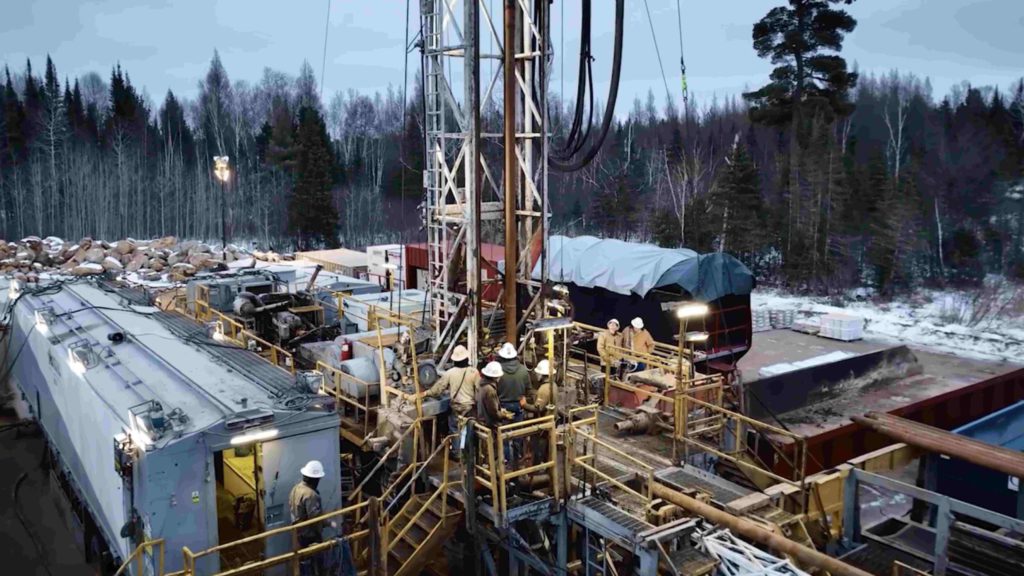
Topaz project in Minnesota. Image: Pulsar.

Pulsar Helium (TSXV: PLSR) (OTCQB: PSRHF) announced Friday that it has acquired approximately 1,360 acres of surface land in Lake County, Minnesota, within its flagship Topaz project. 

Topaz, located in Lake County near Babbitt in northern Minnesota, is Pulsar’s 100%-owned flagship project and one of the leading primary helium discoveries in the US, it said.  

The surface land was purchased in an arm’s length transaction from Wolf Lands Inc. for total cash consideration of $2.48 million. The newly acquired land lies within the mineral rights that the company holds under lease from a separate private owner, and the area includes the location of its Jetstream #7 well, Pulsar said.  

Securing direct surface ownership across a key area of the Topaz project, including the JS#7 well site, further strengthens long-term operational control as Pulsar advances toward production readiness, the company said, adding that control of the surface land provides greater certainty for future infrastructure siting, development planning and operational flexibility. 

Concentration of acreage footprint provides optimal scalability of the initial and overall resource development. 

This Acquisition, driven by our intention to develop Topaz into a significant primary helium producer, builds on growing momentum at the project as we move decisively toward production readiness, Pulsar CEO Thomas Abraham-James said in a news release.  

“It also follows recent legislative progress updating Minnesota’s permitting framework for helium extraction,” Abraham-James said. “With a clearer pathway now emerging toward future production, securing ownership of the surface land overlying our leased mineral rights…provides Pulsar with increased operational control and long-term development certainty as we continue advancing Topaz toward production.” 

The company recently concluded its Jetstream exploration and appraisal program, with all wells drilled to date having encountered gas under high pressure and is now obtaining quotes for the drilling of up to four new production wells to supplement two production-ready wells already drilled, it said.  

The news follows significant regulatory progress in Minnesota, where on May 26, Governor Tim Walz signed into law new legislation establishing a helium-specific framework for gas resource development in northeastern Minnesota, and the Minnesota Department of Natural Resources issued proposed expedited permanent rules for permitting gas resource development on May 18. 

These developments come amid a sharp tightening of global helium supply, driven by disruption to the Strait of Hormuz, attacks on QatarEnergy’s Ras Laffan facilities, Qatar supplies approximately 35% of the world’s helium, and new Russian export controls in place through the end of 2027, the company said. 

Sb

Military Metals sinks on revoked Slovak antimony project licence


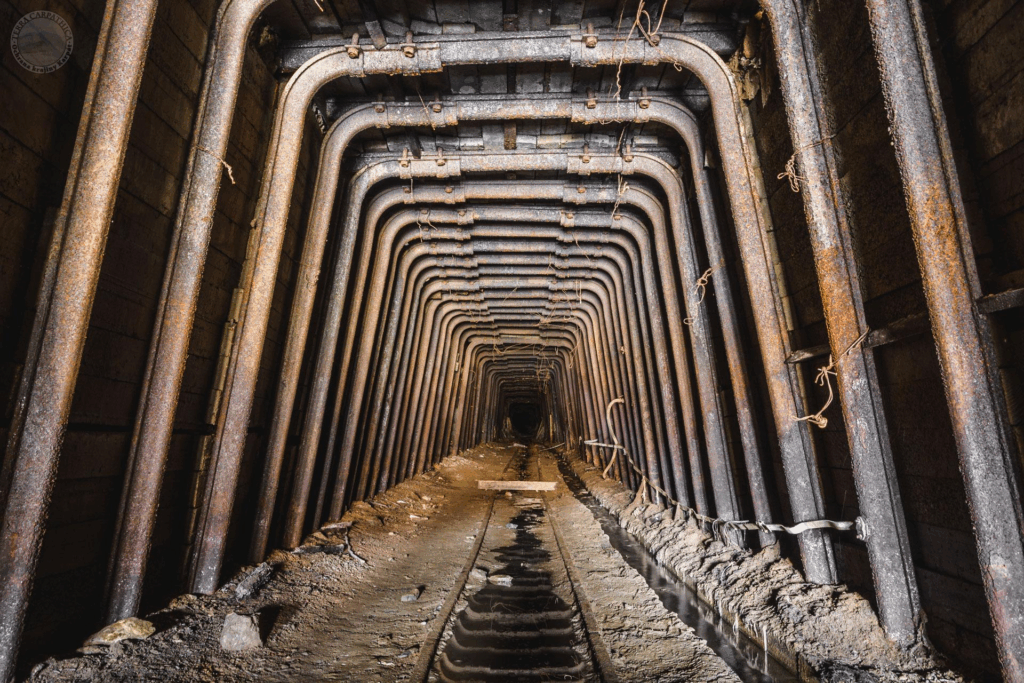
The underground workings at Trojarova. Credit: Molten Metals

Military Metals (CSE: MILI) is contesting a decision by Slovakian environmental authorities to revoke the company’s exploration licence on the Trojarova antimony-gold project.

In a statement this week, the Canadian explorer said the Ministry of the Environment of the Slovak Republic had cancelled the Trojarova licence “without appropriate justification”, and that it will “pursue all legal avenues” to fight the decision.

Shares of Military Metals sank on the news, falling as much as 60% to a 52-week low of C$0.16. By Friday afternoon, it had recovered some losses, trading at a market capitalization of C$21.6 million ($15.7 million).

Soviet-era project

Trojarova, located near the capital city Bratislava, represents an advanced exploration stage project with considerable mining history. According to company website, the project is likely a continuation of the former Pezinok mine, one of Europe’s most significant antimony producers with a history going back over 200 years.

Military Metals acquired the project in late 2024, acting on the growing significance of antimony supply across the globe in light of export restrictions by top producer China. At the time, the company said it saw opportunity in the project for its potential for fast advancement, citing its past history as a key supplier to the Soviet Union as well as Slovakia’s strong mining infrastructure.

The Trojarova project currently has a historic resource defined during the Soviet Era, totalling 415,000 tonnes grading 0.162% antimony as well as 1.148 g/t gold based on underground exploration data.

‘Unexpected’ decision

In its press release dated May 28, Military Metals noted that the Slovak environmental ministry had previously included the Trojarova project as one of the country’s designated exploration areas under the European Commission’s critical raw materials framework.

As such, the company said it regards the decision to cancel the permit in respect “as unexpected and inconsistent with the goals of protecting the supply of critical minerals in Europe.”

In addition to Trojarova, Military Metals also acquired two other projects in the country: the earlier-stage Tiennesgrund antimony project and the Medvedi tin project. Both projects have extensive development/exploration history dating back to the Soviet era.


CHARTS: How the sulphuric acid crunch is driving up critical minerals costs


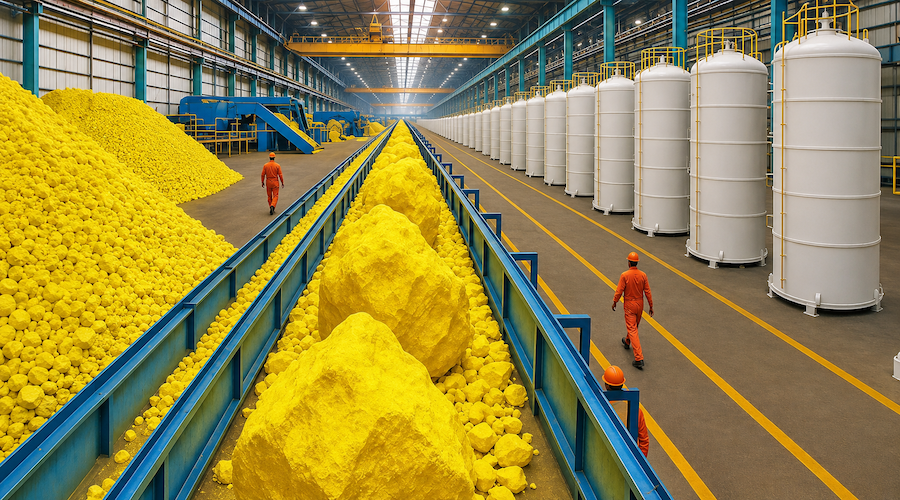
Toxic hydrogen sulfide, a byproduct of oil and gas refining, is turned into pure yellow sulfur.(Screenshot of The Factoran video.)

Conflict in the Middle East and the closure of the Strait of Hormuz have sent sulphuric acid prices soaring, sharply increasing production costs for lithium, nickel and other critical minerals essential to the energy transition.

Benchmark Mineral Intelligence said sulphur prices have climbed more than 50% since the start of the Iran war, while sulphuric acid prices have more than doubled in some regions, disrupting supply chains for battery metals and forcing some refiners to curb production amid shortages of physical sulphur supply.

“Sulphuric acid is a vital feedstock for many critical minerals, and the disruption to the sulphur market from the ongoing Middle East conflict has had knock-on effects across key markets,” Benchmark raw materials research manager Will Talbot said. “The outstanding risk is that more critical minerals players cut production or even shut down operations entirely.”

Lithium squeeze

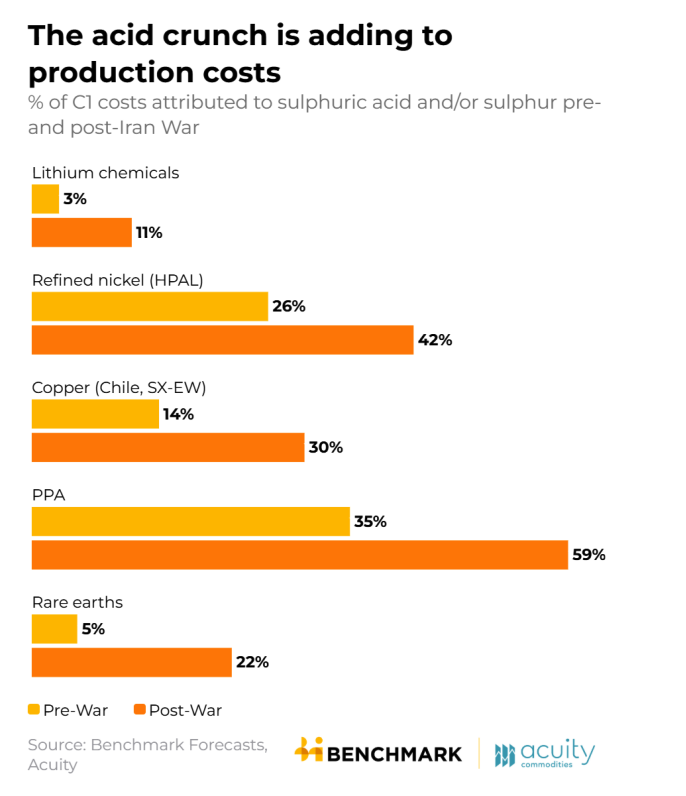
The supply shock is reshaping the economics of battery materials production. Benchmark said sulphuric acid previously represented about 3% of the cost of producing lithium chemicals from hard rock sources but now accounts for 11%, overtaking energy as the largest individual C1 cost component. The consultancy’s special report said sulphuric acid now contributes 22% of total hard-rock lithium conversion costs and has become “the single most volatile and material input” in lithium processing.

Nickel production via high-pressure acid leaching has also become heavily exposed to sulphur markets. Benchmark said sulphur now represents 42% of HPAL nickel costs, up from 26% before the conflict. Indonesia, the world’s largest nickel producer, sourced 76% of its sulphur imports from the Middle East last year, while more than 10 tonnes of sulphur are required to produce one tonne of nickel through HPAL processing.

Supply risks

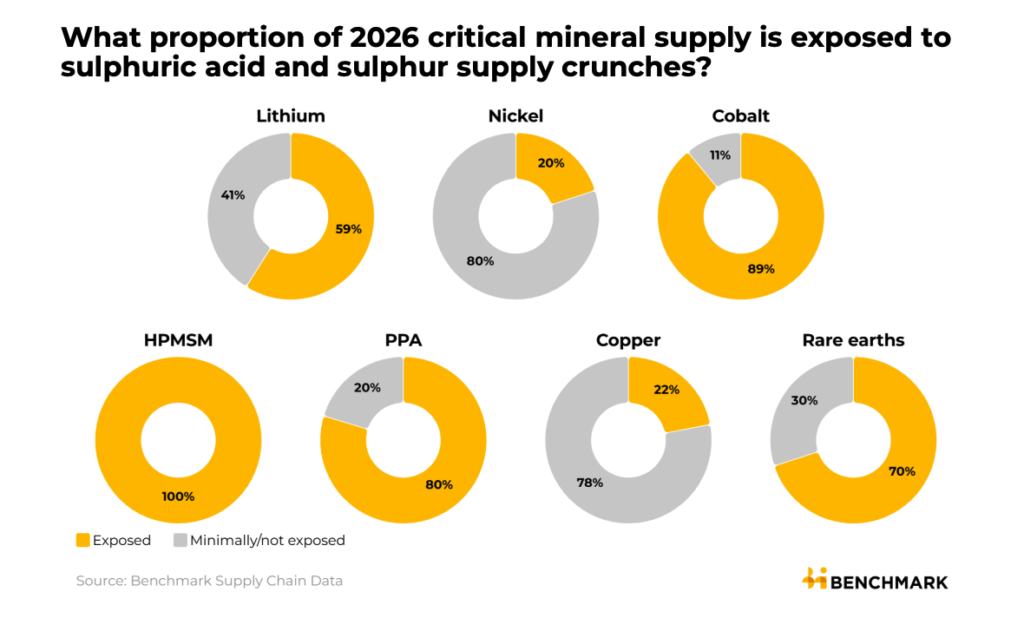
The report warned that physical availability, not just pricing, has become the industry’s biggest risk because at least half of global seaborne sulphur trade passes through the Strait of Hormuz. More than half of global lithium, cobalt, rare earth and purified phosphoric acid production expected in 2026 is exposed to sulphur and sulphuric acid disruptions, according to Benchmark. High-purity manganese sulphate monohydrate, used in EV batteries, is entirely dependent on sulphuric acid supply.

China’s unofficial restriction on sulphuric acid exports has compounded the pressure on refiners outside the country. Benchmark said spot acid prices in Indonesia and Chile have climbed above $380 and $440 per tonne respectively as converters scramble for alternative supplies. Battery-grade lithium carbonate prices in China have already risen about 65% this year in US dollar terms.

Wider fallout

Copper producers are feeling the impact unevenly. While solvent extraction and electrowinning operations that account for 22% of global mined copper output require large volumes of acid, copper smelters are benefiting because sulphuric acid is a profitable byproduct of the smelting process. Benchmark said treatment and refining charges for copper concentrate have dropped sharply since strikes on Iran as rising acid prices improve smelter economics.

The supply squeeze highlights how geopolitical conflict is increasingly colliding with energy transition supply chains. Benchmark said countries with domestic sulphur and acid production capacity, such as the US, are likely to be more insulated than import-reliant jurisdictions including Australia.

Even if the Strait of Hormuz reopens quickly, the firm warned damaged Gulf refining infrastructure could take significant time and investment to restore, prolonging pressure across global critical minerals markets.

CU


Column: Copper braces for another round of US tariff roulette


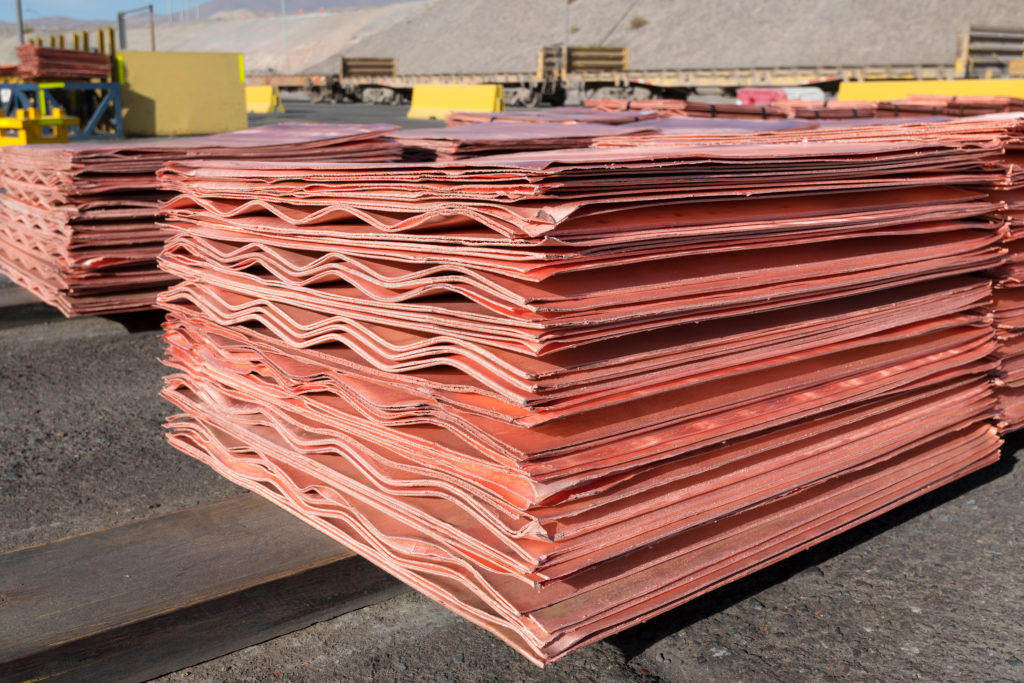
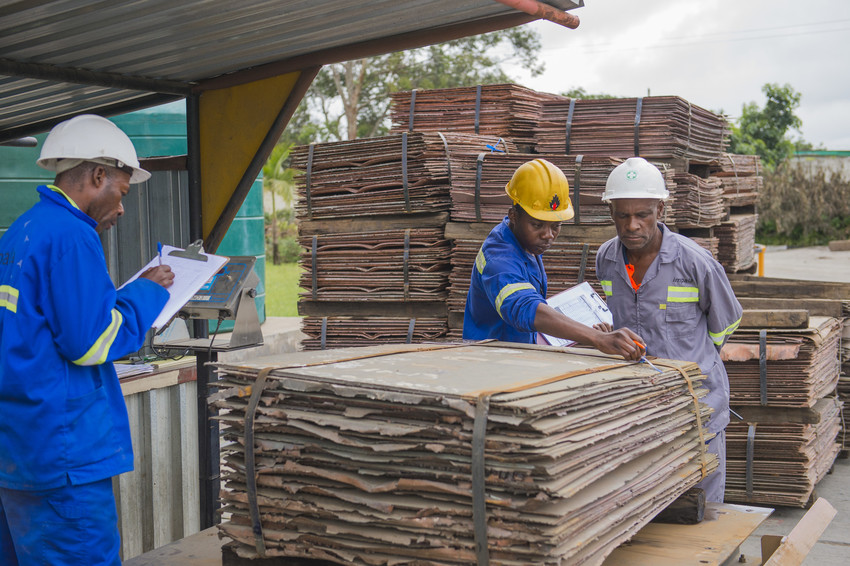
Stacks of refined copper cathodes. Stock image.

(The opinions expressed here are those of Andy Home, a columnist for Reuters.)

Here we go again.

The deadline for a US decision on whether to impose tariffs on refined copper imports is looming at the end of next month.

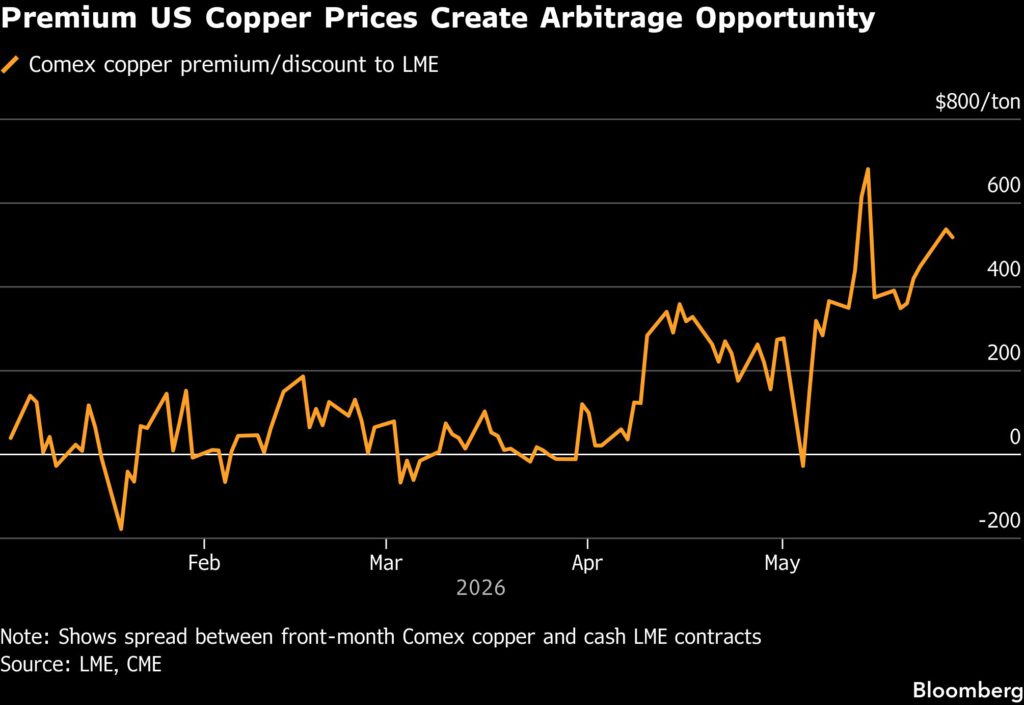
The market reaction is a widening in the arbitrage ​between the CME’s US duty-paid copper contract and the London Metal Exchange’s (LME) international price .

The rising premium for US delivery is drawing more metal into ‌the United States, tightening up availability everywhere else.

If all this sounds familiar, it’s because the copper market was in exactly the same state of nervous anticipation this time last year.

US President Donald Trump ended up confounding expectations by imposing tariffs on copper products but not on refined metal.

Left on the table was the option of phasing in refined copper tariffs from next year. A decision is due by the ​end of June.

CME premium to LME copper price

Minding the volatile gap

The CME premium over the LME price is smaller than this time last year, because back then traders were pricing in ​import tariffs of 50% to match those already imposed on aluminum and steel.

Trump’s July decision to exempt refined metal upended the trade. The CME premium ⁠imploded and the arbitrage eventually inverted, with LME even commanding a premium in the early months of 2026.

Now, the CME premium is back and widening once again.

The spot premium is a modest ​3% of the LME price. But the March 2027 forward premium is close to $1,000 per metric ton, equivalent to 7% of the LME price.

Given the US administration has flagged the potential for phased tariffs ​of 15% from the start of 2027 and 30% from the start of 2028, there is clearly further upside to the CME premium.

US imports of refined copper

Renewed tariff pull

Not that it matters too much for physical traders. The differential on the forward months is more than enough to cover the costs of shipping to the United States.

US imports dropped sharply in the closing months of 2025 as the tariff trade ​unwound.

But they’ve bounced back strongly so far in 2026. Inbound shipments more than doubled year-on-year to 533,000 tons in the first quarter, according to the World Bureau of Metal ​Statistics, which collects data from official customs figures.

More is on its way, judging by the renewed upward momentum in CME stocks, which now total 577,385 tons, accounting for 44% of global exchange ‌inventory.

Even that ⁠tells only part of the story. LME copper stocks have also been migrating to the United States with 222,000 tons sitting at US ports in a combination of registered and off-warrant inventory.

Last week’s cancellation of 33,275 tons at New Orleans suggests metal is being prepared for customs clearance as the arbitrage yawns wider again.

Global exchange copper stocks

Strategics stockpile

The US has over the last year or so built up its own strategic copper reserve thanks to the on-again, off-again threat of tariffs.

Including metal that is being stored off exchange, the stockpile is now ​likely over 1 million tons, not as ​large as that held by China’s ⁠state stockpile manager but bigger than any other country’s reserves.

Does the US need any more?

Probably not, but it’s not clear how the stock build will figure in Commerce Secretary Howard Lutnick’s thinking when he reports back to Trump at the end of June.

As with other ​metals tariffs, the stated aim is to reinvigorate US production capacity and in that regard the country still has only two ​primary copper smelters with ⁠no signs of that changing any time soon.

Thanks to last year’s import surge, the country’s import dependency rose to 57% from 45% in 2024, according to the United States Geological Survey.

On those metrics the case for tariffs looks strong given the parameters of the Section 232 national security investigation.

But as the copper market has found out to its cost, second-guessing the Trump ⁠administration is ​a hazardous business.

(Editing by Marguerita Choy)


Copper’s giant tariff trade is back and squeezing global market


Stock image.

Copper traders are once again scouring the world for metal to send to the US, as renewed speculation about import tariffs revives a trade that’s upended the $300 billion-a-year market.

The on-off threat of import tariffs from President Donald Trump has dominated the copper market over the past year, often driving prices on New York’s Comex above global benchmarks and creating a massive opportunity for traders to profit by shipping metal to the US.

In recent months, US copper imports had slowed after softer Comex prices made shipments unprofitable. But a pick-up in the spread between Comex and the London Metal Exchange in the past few weeks means that traders are now shipping every spare ton to the US, according to several executives, who predicted that imports could bounce back to historically elevated rates of 150,000 to 200,000 tons a month.

“There’s a bit of dĂ©jĂ  vu. We’re in the same situation as last year, where all tons are being directed to the US,” said Henry Van, head of industrial metals analysis at Trafigura Group. “It’s very conceivable that we go back to imports of 200,000 tons a month in the near future.”

Front-month Comex contracts have risen to more than $500 a ton above cash prices on the LME for the first time since last autumn.

The outperformance is being driven by renewed investor enthusiasm for copper as well as speculation that the Trump administration will impose import tariffs on refined metal as part of its effort to protect US industry. The commerce secretary has a June 30 deadline to deliver an update on the US copper market that could pave the way for duties starting January 2027.

Trafigura last week moved to withdraw hundreds of millions of dollars of copper from LME warehouses, which was at least in part an attempt to capture premium prices on Comex, according to people familiar with the matter. The orders to withdraw were the largest the LME has seen since 2013.

The renewed rush to ship to the US is adding to a bullish cocktail of factors that traders say could drive prices to fresh highs, after copper climbed to a record above $14,500 a ton in late-January.

While the copper tariff trade is reviving, getting metal into the US is becoming harder. Shipping South American copper to major US ports is taking much longer than usual as disruptions tied to the Iran war ripple through global freight markets and intensify congestion at the Panama Canal.

The mere threat of future duties is enough to sustain inflows, said Gerardo Tarricone, managing director of London-based Arion Investment Management Ltd. “We are going to see momentum heading into the US, which is going to make the copper story even more interesting.”

Copper is already trading at historically elevated levels. It reached as high as $13,746 a ton in London on Wednesday, up about 43% in the past year. Enthusiasm about artificial intelligence has helped lift investor positioning on Comex to the most bullish since December 2020. And buyers in China, which had stepped back from the market when prices rallied earlier this year, have returned since the Chinese New Year holiday.

Should Trump decide to impose tariffs on refined copper, the impact could be to squeeze supplies on the LME, traders said. That would be reinforced if the US follows through on the Commerce Department’s recommendation last year that a tariff of 15% should be imposed from January 2027. That could potentially open a window in the second half of the year when there would be a huge incentive for traders to ship copper to the US.

The copper market outside of the US is in deficit, with inventories already starting to be drawn down in China, said Nicholas Snowdon, chief metals economist at Mercuria Energy Group.

“The focal point of that deficit should move to the LME. It’s a matter of time,” he said. “If you get a decision for tariffs from the start of next year, the drawdown of LME stocks would be very strong in the third and fourth quarter.”

(By James Attwood, Yvonne Yue Li, Jack Ryan, Annie Lee and Jack Farchy)


Codelco’s profit surges as strong copper prices offset output drop


Image from Codelco.

Strong global copper prices helped Chile’s Codelco nearly quadruple its pre-tax profit in the first quarter of 2026, even as output declined at most of the state-run mining company’s operations.

Codelco, one of the world’s largest copper producers, on Friday reported a pre-tax profit of $825 million compared with $213 million in the same quarter last year. The company’s own copper production totaled 272,000 metric tons in the January-March period, down 8% from the year-earlier period.

The company benefited from higher global prices for copper and by-products like molybdenum, CEO Ruben Alvarado said.

Output, however, was weak at its major El Teniente and Chuquicamata mines, as well as at the smaller Ministro Hales, Gabriela Mistral and Andina operations.

Operations at El Teniente, where output fell 26%, remain limited after a collapse last year that killed six workers. Chuquicamata, where production was down 18% in the most recent quarter, experienced lower ore availability.

“These results reflect an operationally demanding quarter, in which the company had to face production constraints, lower ore grades and higher costs,” Alvarado said in a statement.

Production, however, increased at Codelco’s Radomiro Tomic mine due to better grades in oxidized ores and higher sulphide shipments. Output also grew in the company’s Salvador division due to the ramp-up of the Rajo Inca project.

Codelco did not announce any adjustments to its 2026 output forecast, which stands at 1.33 million to 1.36 million tons.

Fallout from 2025 production irregularities

Codelco also continues to deal with the fallout from production irregularities last year that were discovered by an internal audit. The matter led to the dismissal of one executive, other internal disciplinary actions, and a review by Chilean prosecutors.

Reuters reported in March that industry insiders raised concerns about discrepancies in the production figures Codelco reported at the end of last year and whether inventories had been used to help support performance targets.

The controversy has raised political pressure on Codelco as Chile’s new government reshapes the company’s leadership.

Earlier this month, President Jose Antonio Kast appointed Bernardo Fontaine, an economist and business executive, to replace Maximo Pacheco as head of Codelco, while ordering a broader investigation and external audit of the recent production problems.

Codelco is trying to rebound from its poor performance in 2022 and 2023, when copper production fell to two-decade lows. It hopes to produce 1.7 million metric tons per year by 2030.

(By Fabian Cambrero, Iñigo Alexander, Daina Beth Solomon and Kylie Madry; Editing by Natalia Siniawski and Paul Simao)


Fresh leadership at Codelco orders audit of 2024-2025 production figures


Credit: Codelco

Chilean state copper miner Codelco will order an external audit of production figures for 2024 and 2025, the firm said on Thursday, as its new chairman opened his first board meeting by pledging to restore trust and maximize returns without increasing debt.

The move marks an early attempt by chairman Bernardo Fontaine to tighten oversight at one of the world’s largest copper producers as it faces mounting scrutiny over production reporting and spending.

An internal audit, first reported by local media, found irregularities in production recorded in 2025. The matter led to the dismissal of one executive and internal disciplinary actions, and is also being reviewed by Chilean prosecutors.

Reuters reported in March that industry insiders had raised concerns about discrepancies in Codelco’s production figures and whether inventories had been used to help support performance targets.

Codelco’s audit, compensation and ethics committee will order an external audit of the 2024 and 2025 numbers, as well as costs tied to the renovation of the company’s headquarters, the firm said in a statement on Thursday.

Fontaine said he aimed to help Codelco “recover trust” and said the company’s priorities would be safety, maximizing contributions to the state without adding more debt and restoring order with transparency.

The firm has long relied on debt to fund much of its investment program, as the state miner turns over substantial profits to the treasury and has limited ability to retain earnings.

Codelco also created a safety committee to oversee issues related to the deadly collapse at its El Teniente mine last year.

The miner is set to report first-quarter results on Friday.

(By Kylie Madry; Editing by Jacqueline Wong and Jamie Freed)


Trafigura awarded $92 million in arbitration with Zambia’s ZCCM

Image: Trafigura

A London arbitration tribunal ordered Zambia’s majority state-owned investment company, ZCCM Investments Holdings Plc, to pay Trafigura about $92 million in a long-running dispute over a prepayment agreement between the commodity trader and Konkola Copper Mines.

The award comprises $69.3 million in principal and $19.7 million in interest, plus arbitration costs and Trafigura’s legal fees, ZCCM said in a statement published on the Lusaka Securities Exchange.

ZCCM is evaluating its legal options regarding the final award, it said.

Trafigura initiated the case two years ago over a prepayment agreement with Konkola Copper Mines, which was operated at the time by ZCCM-IH.

(By Matthew Hill)


Copper startup in IPO talks ahead of Peru mining expansion


Copper startup Quilla Resources Inc. is in discussions with prospective advisers about listing shares in Toronto as it weighs expansion plans in Peru.

The company led by veteran Peruvian mining executive Victor Gobitz is considering an initial public offering next year after restarting the idled Chapi mine in southern Peru, Gobitz said.

“In Toronto there is an ecosystem specialized in mining,” he said, referring to the preference for a Canadian listing. “If Quilla continues growing, hopefully we will graduate to New York in a few years.”

Gobitz, the former boss of a mine owned by BHP Group and Glencore Plc, is pitching investors on a project that builds on an existing operation rather than a greenfield development. That means it can be expanded faster and at lower cost as miners struggle to bring on new supply for the energy transition and data centers. His team is also watching for other opportunities that may arise in Peru.

For now, the focus remains on restarting Chapi and advancing exploration across the broader land package near a major Freeport-McMoRan Inc. mine to determine whether a much larger deposit lies beneath the current operation. Quilla is arranging a new capital raise ahead of its anticipated IPO.

Chapi began ramping up in February and is expected to reach full capacity in the fourth quarter. Eventually, Gobitz wants to raise annual output to 30,000 metric tons, a plan that would require an investment of $200 million to $300 million. Tapping the deposit’s full potential could mean a new owner with deeper pockets, he said.

(By James Attwood and Carla Samon Ros)


Carney pitches US on closer ties in autos, aluminum and minerals

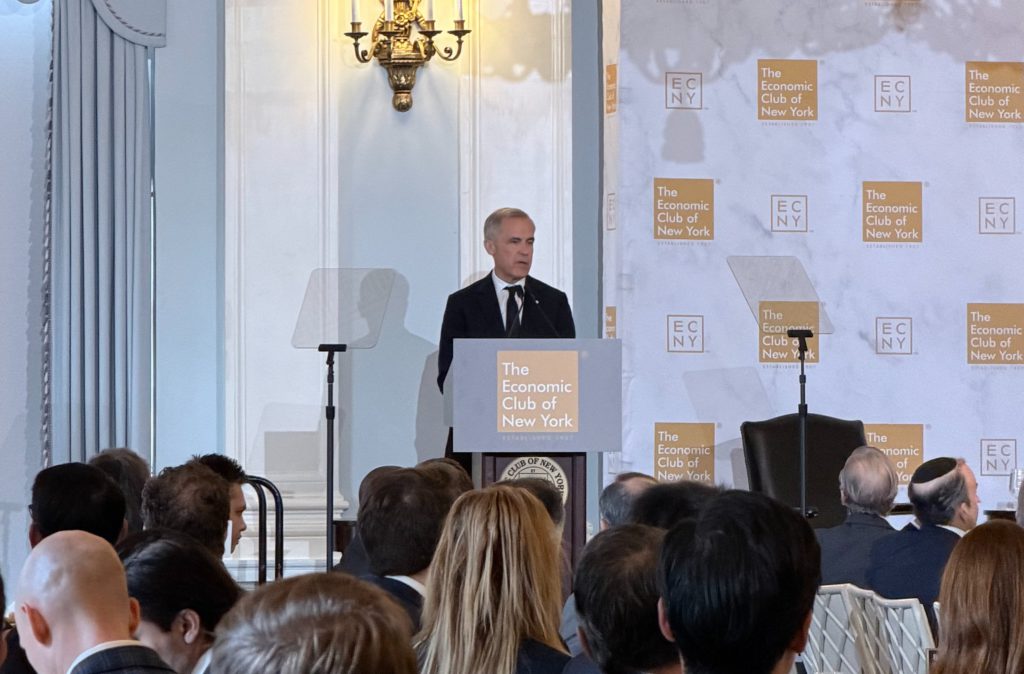
Mark Carney speaking to the Economic Club of New York. Credit: Economic Club of New York | X

Canadian Prime Minister Mark Carney used a speech in New York to make the case to the Trump administration for closer cooperation on aluminum, auto manufacturing and critical minerals.

The trip comes as pressure builds on Carney to show Canada is still engaged with the US on trade. American and Mexican negotiators began formal talks this week on potential changes to the continental trade pact known as the US-Mexico-Canada Agreement, but Canada is not at that table and there is no schedule yet for its own bilateral discussions.

Carney has lately begun pushing a “Fortress North America” message in his public remarks, including in another recent speech which he said Canada is “open to deeper integration” with the US.

“Let’s be absolutely clear, Canada Strong will help make America great again,” Carney told the Economic Club of New York on Thursday, combining slogans both leaders use for their own countries.

“Examples of where that’s true are legion, where we should work together and compete with the world together. And to those ends, we have made specific practical proposals to the US administration.”

It’s a more conciliatory tone compared to earlier this year, when he declared that Canada’s close integration with American supply chains was once a strength but has become a weakness.

On Thursday, Carney said aluminum is one clear example where it makes sense for the longstanding allies to cooperate, given the huge amount of production in Quebec using relatively cheap hydro electricity.

Canadian exports of aluminum to the US “are the energy equivalent of 10 Hoover Dams,” Carney said. “With America’s growing energy needs because of the incredible transformation here, does it make sense to build the gigawatts here needed to replace Canada?”

On autos, he noted that Canada is the biggest customer of American-built cars, and said an integrated North American market is still the best way to compete with the automotive sectors in other regions.

The auto sector is expected to be a difficult element of trade discussions with the US, as Trump imposed tariffs of 25% on Canadian-built cars, with an exemption for the percentage of US-made parts inside the car.

Carney has sought to alleviate this with counter-tariffs on US cars and a remission scheme for companies that build cars in Canada.

More controversially, he’s also slashed tariffs on a limited number of Chinese-made electric vehicles, a change from Canada’s previous policy of fully matching the 100% tariff on Chinese EVs that the US has in place.

Carney defended that move, noting the tariff break for Chinese EVs is initially capped at 49,000 annually, a small portion of the 1.8 million cars sold in Canada each year. He told the New York crowd that over time a broad range of cheaper Chinese cars are expected to come in under that system, “but in a controlled way.”

Meanwhile, Canada’s reserves of potash, nickel, copper and uranium can also be a major economic advantage for the US, Carney said. “Canada can be the most reliable supplier that America needs to put affordable food on the table, strengthen its national defense and meet the exploding demand to power AI.”

Much of Carney’s speech was spent outlining his government’s efforts to grow Canada’s energy exports and rapidly expand its military capabilities.

He ended by urging the US to forge a closer partnership with what he described as “a different Canada, a stronger Canada, a more confident Canada.”

(By Brian Platt)

Aluminum facts - Natural Resources Canada