Saturday, May 30, 2026


Secretive Azerbaijan Deal Raises Energy Security Concerns in Georgia

  • Georgia and Azerbaijan signed long-term energy and transport agreements after a May 18 meeting in Baku.

  • Critics warn the undisclosed terms could weaken Georgia’s energy independence and increase reliance on older infrastructure.

  • Regional transit competition is intensifying as Armenia, Azerbaijan, and Turkey move to open new trade routes.

Recently signed deals between Georgia and Azerbaijan are raising fresh questions about Tbilisi’s strategic direction and energy security.

The deals flowed out of a May 18 meeting in Baku between Georgian Dream Prime Minister Irakli Kobakhidze and Azerbaijani President Ilham Aliyev. Those talks occurred just weeks after Aliyev’s visit to Tbilisi, where he also met Georgia’s de facto ruler, Bidzina Ivanishvili. Despite their political significance, the full texts of the agreements signed while Kobakhidze was in Baku remain undisclosed, fueling criticism that the Georgian government is making decisions without sufficient transparency or regard for the country’s long-term energy independence.

According to official statements, the sides agreed to a 20-year inter-governmental framework governing electricity supply and transit, along with a 20-year extension of a 2003 gas-purchase agreement. The Georgian government emphasized that the purchase deal “guarantees the security of social gas supply.”

The agreements also restored daily passenger rail service between Tbilisi and Baku after a six-year gap. A separate protocol, cited by the Georgian government, also claimed “the new section of the Baku-Tbilisi-Kars (BTK) railway will become fully operational.”

With Azerbaijan and Armenia moving to normalize relations and new transit routes like the Trump Route for International Peace and Prosperity (TRIPP) corridor threatening to bypass Georgia, Tbilisi needed a deal to stay relevant in trade discussions.

Georgian Dream officials hope the agreements signed in Baku will ensure Tbilisi remains a factor in the Caucasus’ trade equation. Baku appears to have taken full advantage of Georgia’s desperation, securing very favorable energy deals. 

Aliyev’s administration welcomed the agreements, stressing their “importance” and highlighting Kobakhidze’s positive tone during the visit. It noted that the Georgian prime minister had expressed appreciation for Aliyev’s recent trip to Georgia, saying it left “a profound impression.”

However, the lack of transparency, combined with shifting energy trends, continues to fuel concerns about Tbilisi’s energy-supply vulnerability and the country’s growing dependency on Russia. Over the past year, Georgia’s reliance on Azerbaijani gas has declined, while imports from Russia have surged. In 2025, gas purchases from Azerbaijan fell by around 6 percent, while imports from Russia increased by roughly 23 percent. Russia’s state-owned Gazprom reported supplying 40.4 percent more gas to Georgia in 2025 compared to the previous year, despite Russian gas being significantly more expensive.

For some analysts, this trend is not accidental. Economist and former National Bank president Roman Gotsiridze argued that the recent gas-supply agreement runs counter to Georgia’s national interest. “It appears that Georgia has given up its share of transit capacity in the Baku-Tbilisi-Erzurum gas pipeline to Azerbaijan for the next 20 years,” he said. “Georgia will receive gas only through the old, worn-out Soviet-era Gazakh-Saguramo pipeline.”

Gotsiridze also believes the recent increase in Russian imports may be part of a longer-term shift. “In the future, as gas consumption increases, the only alternative will be to import gas from Russia, since bringing additional supplies from Azerbaijan will become physically impossible,” he warned. “Signs of this are already visible: for the third consecutive year, Azerbaijan has been using Georgia’s allocated capacity in the Baku-Tbilisi-Erzurum pipeline to boost gas deliveries to Europe, while imports of Russian gas into Georgia have been rising in parallel.”

For some critics, the pattern reflects a calculated trade-off by Ivanishvili and his Georgian Dream government – securing for Georgia a role in trade routes connecting Europe and Asia while trying to claw back leverage with Western partners alienated by the government’s authoritarian turn. Higher-priced Russian gas may hit consumers, but it poses little threat to the government’s grip on power.

Kobakhidze’s remarks after the signing confirmed the government’s strategic thinking. Framing the agreements in terms of “connecting the Caspian Sea with the Black Sea” and linking “Europe with Asia,” he pointed to transit and geopolitics, not energy security, as the government’s priority.

Georgia is not alone in trying to reposition itself. Armenia is also moving to expand its regional connectivity. Prime Minister Nikol Pashinyan just announced that a railway route linking Armenia through Georgia’s Akhalkalaki to Turkey is now open for export and import, opening a connection for the country to EU markets.

By Eurasianet

Colombia’s Oil Industry Faces a Defining Election in 2026

  • Colombia’s oil and natural gas production has fallen sharply under Petro-era policies that halted new exploration contracts and discouraged investment.

  • Left-wing candidate Iván Cepeda supports a continued energy transition, while right-wing candidates Abelardo de la Espriella and Paloma Valencia advocate expanding hydrocarbon production and allowing fracking.

  • The election outcome could determine whether Colombia deepens its shift away from fossil fuels or seeks to revive domestic energy production to strengthen energy security and economic growth.

Colombia’s rapidly approaching 2026 presidential election is generating considerable concern about the economy, notably the country’s oil industry. Gustavo Petro, a former guerrilla who won the 2022 election to become Colombia’s first left-wing president, introduced policies aimed at reducing the country’s reliance on fossil fuels. While this spurred the development of renewable energy, it is responsible for sparking an energy crisis in Colombia. There is hope that a new president will revive Colombia’s economically vital oil industry by delivering a more sustainable energy policy.

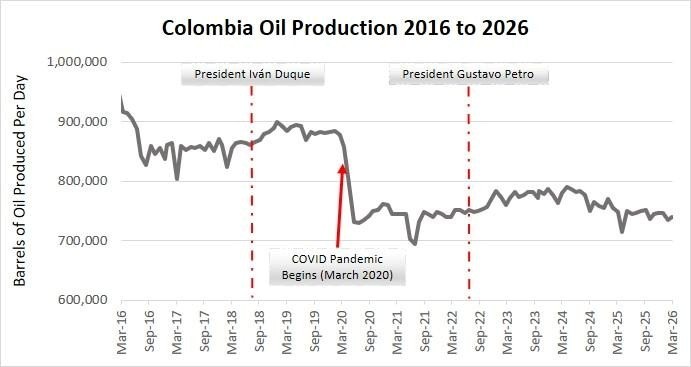
Key among the policies implemented by Petro was a ban on issuing new exploration and production contracts, significantly hiking taxes, and attempting to legally prohibit hydraulic fracturing in Colombia. Those decisions are responsible for a sharp decline in the Andean country’s hydrocarbon output. As data from Colombia’s regulatory authority, the National Hydrocarbon Agency (ANH), shows, oil and natural gas output is at or close to historical lows. By March 2026, the country was lifting 740,497 barrels per day, well below the 917,210 barrels produced daily for the same period a decade earlier.

ANH
Source: ANH and author’s own work.

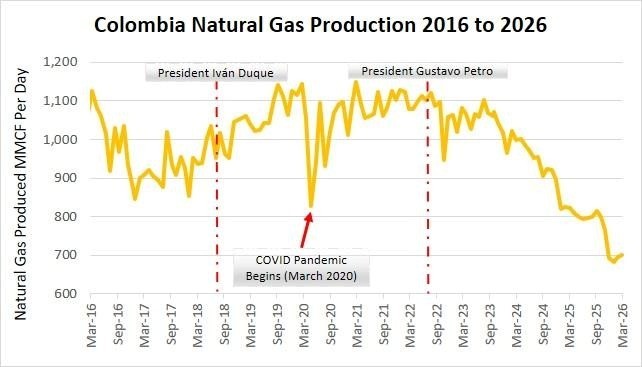
The marked decline of Colombia’s single largest export, which government data shows earned $12.5 billion during 2025, is endemic of the headwinds impacting a fiscally fragile, debt-laden economy.  Among the hardest hit by the marked long-term decline of Colombia’s hydrocarbon sector, and Petro’s policies, is natural gas. ANH data shows that the March 2026 output of 700 million cubic feet per day, despite climbing nearly 1% month over month, is at the lowest levels in decades.

ANH
Source: ANH and author’s own work.

This is behind the growing risk of a serious energy crisis emerging in Colombia, especially with the country increasingly dependent on liquified natural gas (LNG) imports, which exposes it to global geopolitical headwinds. Indeed, only a decade ago, Colombia was largely self-sufficient when it came to natural gas, with domestic production generally keeping up with demand. That, however, began to worsen as domestic supply plummeted, forcing Bogota to begin importing LNG in December 2016.

Today, natural gas shipments supply over a fifth of the fuel consumed in the Andean nation. This will only worsen as domestic natural gas production and reserves, which are at a trillion cubic feet, continue to decline. There are fears Ivan Cepeda, the continuation candidate for President Petro and his Pacto Historico, will continue with current government policies that are sharply impacting Colombia’s energy patch.

At an April 2026 campaign rally in Barrancabermeja, the capital of Colombia’s energy patch, Cepeda said

"The country requires a comprehensive energy policy that diversifies the economy and avoids dependence on hydrocarbons,"  

He did, however, temper that statement by pointing out that it will involve a gradual transition to renewable sources of energy rather than an immediate dismantling of the hydrocarbon sector.

During early May 2025, Cepeda rounded out his position, stating he will work to transition the agricultural sector into Colombia’s main economic engine while moving the country away from its historical dependence on extractive industries. Cepeda went on to say mining and energy exploitation is an exhausted economic model and that "Colombia will not be a country of commodities."

With the senator leading in the polls, his economic policy is weighing heavily on Colombia’s economy and the Andean country’s oil patch. If Cepeda emerges victorious, then oil and natural gas production will continue its downward decline, with foreign energy investment set to fall further. Indeed, there are concerns that the few remaining drillers operating in Colombia will not only dial down investment but also exit the country in a manner like Big Oil exiting after Petro’s victory.

Behind Cepeda in the polls is wildcard far-right candidate Abelardo de la Espriella, a high-profile criminal attorney who usually resides in Miami. A tremendous part of his platform is focused on security and public order. Initially, this will be achieved by militarizing Colombia while simultaneously ending Petro’s failed policy of total peace, which left illegal armed groups in a stronger position. Greater security in the country bodes well for the energy patch, with upstream facilities located in many remote regions where illegal armed groups pose a hazard to operations.

De la Espriella intends to reinvigorate Colombia’s hydrocarbon sector, prioritizing energy sovereignty over the clean energy transition. He supports hydraulic fracturing, known as fracking, which has long been a controversial hydrocarbon extraction technique in the Andean country. Colombia’s highest court rejected the operation of fracking in Colombia and placed a moratorium on its use.

De la Espriella also proposes the awarding of new hydrocarbon exploration and production contracts, the banning of which is a key driver of the recent collapse in production. This will reinvigorate Colombia’s oil patch to the point where it will once again become a key contributor to the economy and De la Espriella’s goal of 7% annual growth of gross domestic product (GDP).

At third place in the polls is right-wing candidate Paloma Valencia, the protégé of President Alvaro Uribe and a long-time senator who is a member of his Democratic Center party. It was during Uribe’s eight years in office, from 2002 to 2010, that Colombia’s oil industry was transformed into a major economic driver with the restructuring of national oil company Ecopetrol and its listing on the New York Stock Exchange.

Valencia’s energy policy resembles that which existed during the presidency of her mentor Uribe and then under Juan Manuel Santos Calderón and Iván Duque Márquez. Valencia supports the exploitation of fossil fuels with plans to lift oil production to one million barrels per day, the volume long targeted by Bogota to balance the budget. The candidate believes fracking, conducted in an environmentally responsible manner, is a solution for Colombia’s dwindling hydrocarbon reserves and production.

Under Valencia’s leadership, Colombia will see a reinvigorated hydrocarbon sector with oil and natural gas production rising from recent lows if she wins office. Valencia’s vice-presidential candidate, Juan Daniel Oviedo, in an interview with El País, said;

“We will reactivate the exploitation of fossil fuels, and we will promote fracking with environmental responsibility, but also with a lot of innovation".

Reactivating the exploitation of fossil fuels in Colombia will boost the country’s energy security and the stability of the electricity grid. That will support a planned foray into energy-intensive data centers, which support the development of artificial intelligence.

Valencia, like De la Espriella, will end Petro’s policy of total peace, which failed dramatically, leading to an escalation of internal conflict. She will instead focus on bolstering security by recruiting 30,000 additional police and adding 30,000 new military personnel, which will be used to secure remote regions where the government’s presence is weak.

A Cepeda victory bodes poorly for Colombia’s beaten-down hydrocarbon sector, with the presidential hopeful set to continue with energy policies like those implemented by the current president, Gustavo Petro. While much of the rhetoric around promoting the development of renewables and weaning Colombia off a deep dependence on fossil fuels makes sense in a global context, it creates considerable economic and geopolitical risks.

There are fears that Colombia is on the cusp of an energy crisis, with plunging natural gas production impacting the economy and threatening the stability of the electricity grid. With imported natural gas comprising an ever-greater proportion of supply, there will be a sharp impact on an already fragile economy, where annualized inflation spiked to a worrying 5.68% for April 2026. A victory by either right-wing candidate will benefit Colombia’s oil industry and business in general. It will lead to greater security, notably in remote rural regions where the petroleum industry operates, while forging a more industry-friendly regulatory environment.

By Matthew Smith for Oilprice.com

How a Regional Gulf Coast Port Became America's Crude Oil Export Capital


  • The Port of Corpus Christi has become the largest crude oil export hub in the United States, moving more than 2 million barrels per day after Congress lifted the export ban in 2015.

  • Pipeline capacity is re-emerging as a constraint on growth, with Port CEO Kent Britton warning that significantly expanding exports will require additional takeaway infrastructure.

  • Natural gas is the next frontier — the U.S. is the world's largest LNG exporter, and Corpus Christi already hosts a major LNG facility with more projects in development.

Three decades ago, I had just graduated from Texas A&M University and taken my first job as a chemical engineer in Corpus Christi, Texas. At the time, few people would have expected that this Gulf Coast city would one day sit at the center of the global energy system. Corpus was an important regional hub—refineries, chemical plants, steady industrial activity—but it wasn't viewed as a strategic asset on the world stage.

Today, it is exactly that.

The Port of Corpus Christi has become the largest crude oil export hub in the United States, moving massive volumes of oil to customers around the world. Tankers leaving its docks now help supply Europe, Asia, and beyond. What happened here isn't just a local success story. It's a case study in how quickly energy systems can change when the right pieces fall into place.

From Import Dependence to Export Dominance

The turning point was the shale revolution. Advances in horizontal drilling and hydraulic fracturing unlocked enormous oil and gas resources in formations like the Permian Basin and the Eagle Ford. U.S. production surged, reversing decades of decline and forcing a complete rethink of the country's energy outlook.

But production alone wasn't enough. For years, U.S. policy effectively prohibited crude exports, so the entire system, from pipelines to refineries, was built around domestic consumption. When Congress lifted the export ban in 2015, it set off a rapid transformation. Suddenly, the United States needed to move millions of barrels per day to global markets.

Corpus Christi was in the right place at the right time to make that happen.

Geography Meets Infrastructure

Corpus Christi's location gave it a natural advantage. It sits closer to the Permian Basin than Houston and has direct access to the Eagle Ford. As production surged and pipeline capacity expanded, crude began flowing toward the Gulf Coast in volumes that few had anticipated.

"There was far more oil coming out of the ground than anyone expected," Port CEO Kent Britton recently told me. "Once exports were allowed, the system had to adapt quickly."

Adapting meant building at scale. Over the past decade, the port has deepened and widened its ship channel, improved vessel traffic flow, and enhanced maneuverability throughout the system. Those changes are central to competitiveness. Every hour saved in transit or loading reduces costs and improves margins for exporters.

The result is a system designed for throughput. What started as a regional port has evolved into a high-efficiency export platform moving more than 2 million barrels per day.

A Fully Integrated Export System

What makes Corpus Christi particularly effective is how tightly integrated the system has become. Pipelines bring crude from inland basins. Storage facilities manage flows. Marine terminals handle loading. Offshore operations transfer cargo onto the largest vessels in the global fleet.

Each piece depends on the others. If one part slows down, the impact ripples across the entire chain. When it works well, the system moves enormous volumes with surprising efficiency.

That integration didn't happen by accident. It required coordinated investment across midstream operators, terminal companies, and port authorities—all responding to the same signal: global demand for U.S. energy.

The Permian Still Drives the Story

Despite all the infrastructure along the coast, the real engine behind Corpus Christi's rise remains the Permian Basin. Production continues to grow, but the nature of that growth has changed. The early shale years were defined by aggressive expansion. Today, capital discipline and consolidation dominate, with larger operators focusing on efficiency and long-term returns.

That shift has increased the importance of reliable export capacity. These companies are planning further out, and they need confidence that their barrels can reach global markets without disruption.

At the same time, constraints are beginning to re-emerge. Pipeline capacity is once again becoming a limiting factor. As Britton noted, significantly expanding exports from current levels will require additional takeaway infrastructure.

That point was echoed in a recent conversation I had with LNG pioneer Charif Souki, who put it more bluntly: "Production isn't the issue. Bandwidth is."

LNG: The Next Phase of Growth

While crude exports put Corpus Christi on the map, natural gas may define its next chapter. Global demand for liquefied natural gas has surged, particularly in Europe, where energy security concerns have reshaped supply chains.

The United States is now the world's largest LNG exporter, and the Gulf Coast is at the center of that expansion. Corpus Christi already hosts a major LNG facility, with additional projects under development.

"The next major wave of growth is LNG," Britton said.

That growth has the potential to further cement the region's role in global energy markets, but it will also depend on the same factors that enabled the crude export boom: infrastructure, permitting, and execution.

The Constraints That Come Next

Success brings its own challenges. In South Texas, one of the most pressing issues is water. Industrial operations—refining, petrochemicals, LNG, and emerging hydrogen projects—all require substantial water resources. As development accelerates, pressure on local water systems is increasing.

Efforts are underway to address the issue through groundwater development, reuse systems, and desalination, but the broader point is clear. Energy systems don't operate in isolation. They depend on a full ecosystem of supporting infrastructure.

As projects scale, those supporting systems become just as important as the resource itself.

A Transformation Few Saw Coming

When I first arrived in Corpus Christi, I never imagined it would become one of the most important energy gateways in the world. Yet that is exactly what has happened.

The shale revolution unlocked the resource base. Policy changes opened global markets. Private capital built the infrastructure. And good leadership and growing global demand pulled it all together.

Corpus Christi is the result of that alignment.

The United States still has the resource base to remain a dominant energy exporter for decades. But as Souki pointed out, the challenge isn't production—it's building the systems needed to move that energy efficiently.

Corpus Christi shows what's possible when those systems come together. It also serves as a reminder that they don't build themselves.

By Robert Rapier


Defence-driven demand powers surge in US listings by mining firms


The Pentagon, headquarters of the US Department of Defense. Credit: Wikipedia under public domain licence

There has been a surge in mining companies seeking US listings this year, but even more striking is the change in language as firms explicitly target defence-related demand for critical minerals.

At least 18 companies, mostly Canadian and Australian but ​also some US startups, have completed or are pursuing dual US listings this year, versus just three in 2025, according to exchange filings and company disclosures reviewed by Reuters.

They span ‌in value from about $25 million to $7.5 billion and mark a shift in how critical mineral producers seek access to capital markets as listings explicitly pitch for defence end-use applications.

Defence focus

This year’s transactions have brought producers of antimony, rare earths, tungsten and uranium to the NYSE and Nasdaq – all minerals designated strategic by the Pentagon and used in fighter jets, missiles and radar systems.

The firms are positioning themselves as suppliers of munitions, armour-piercing materials and of inputs for US weapons systems, ​their public filings show, departing from traditional mining IPO language focused on supply-demand fundamentals and long-term price cycles.

“Our goal is to cover direct defence demand for tungsten,” Guardian Metal Resources , CEO ​Oliver Friesen told Reuters, estimating US military annual demand at 2,000 to 3,000 metric tons.

Guardian aims to help the US rebuild its domestic tungsten supply ⁠chain, citing uses in armour-piercing ammunition. It has received $6.2 million from the Pentagon and has applied for additional funding from the US military that would be worth at least $100 million, Reuters reported in March.

United States ​Antimony secured a $245 million Defense Logistics Agency contract to supply antimony for the defence stockpile, where the metal is used in munitions and other military applications.

Rare earth developers are also emphasising defence uses. REalloy Inc ​said its project contains dysprosium and terbium used in magnets for advanced weapons systems, while Rare Earth Americas, backed by Australia’s Gina Rinehart, partly focused its IPO on “defence applications”.

Most companies have raised modest sums so far. Guardian secured $68.3 million, Rare Earth Americas $63.3 million, and Atlas Critical Minerals about $11 million, according to filings.

But several have secured government funding through Pentagon-linked programs, suggesting the listings are as much about unlocking strategic financing and investor access as upfront capital raising, analysts and lawyers said.

CompanyUS ListingPrevious / ​ConcurrentDate
Atlas Critical MineralsNasdaq: ATCXOTCQB (Jupiter Gold)Jan. 13
Blue Moon MetalsNasdaq: BMMTSXV, Frankfurt, OTCQXJan. 26
Santacruz SilverNasdaqTSX-VJan. 21
Mayfair GoldNYSE American/ NYSETSX-V → TSXJan. 27
Aris MiningNYSE: ARMNTSXFeb. 19
Versamet RoyaltiesNasdaqTSXV / private precursorMar. 6
Highlander SilverNYSE American: HSLVCSE / TSXVMar. 11
U.S. Antimony CorpNYSE (uplist)NYSE ​AmericanMar. 11
Guardian Metal ResourcesNYSE AmericanLSEMar. 20
OceanaGoldNYSE: OGCTSX, ASXApr. 7
The Metals RoyaltyNasdaq: TMCRTSX-VApr. 8
Nicola MiningNasdaq ADSs: NICMTSX-VApr. 13
Compiled by Clara Denina

Equity stakes, project funding

Some Canadian-listed miners, including Lithium Americas and Trilogy Metals, are tapping US defence-linked financing through equity ‌stakes and ⁠project funding as part of Washington’s push to secure key minerals.

That push follows a series of crises that left the United States and other Western nations racing to rebuild domestic mineral supply chains and reduce their dependence on China’s dominant production and processing.

China imposed export controls on antimony in August 2024, tightening global supply of a mineral used in military equipment and raising concerns about US defence supply chains.

By December 2025, the US military had begun testing small-scale refineries for critical minerals, shifting from funding projects to building processing capacity itself.

A 2025 Chinese export ban on tungsten has limited feedstock for US refineries built in ​the 1950s for filament light bulbs, which have production ​capacity of about 18,000 tons but are ⁠operating significantly below that, Guardian’s Friesen said.

In November 2025, China issued a one-year suspension of its export ban on antimony, gallium, germanium, and super-hard materials to the US, but kept restrictions on military users, easing commercial supply but leaving the Pentagon reliant on domestic sources.

In addition to China’s export curbs, Washington has faced restrictions on cobalt exports ​from the Democratic Republic of Congo and other risks.

CompanyUS Plan
Resolution MineralsNasdaq
Am. Rare EarthsNasdaq H2’26
Sunshine SilverNYSE (SSMR)
McEwen CopperIPO Q4’26
Jindalee / USENasdaq SPAC H2’26
Barrick / NA BarrickNYSE/TSX vehicle
Compiled by ​Clara Denina

Capital follows policy

Private capital ⁠has also responded. JPMorgan, for example, said in October it could invest up to $10 billion in sectors tied to national economic security, including critical minerals.

In February, US President Donald Trump launched “Project Vault”, a $12 billion strategic minerals stockpile initiative backed largely by the US Export-Import Bank.

The administration has also taken equity stakes in mining firms including MP Materials, USA Rare Earth and Korea Zinc.

Investors say US government equity offers more than capital, giving companies access ⁠to defence-linked contracts, ​subsidies and policy backing, and helping protect them from price cyclicality.

Still, caution remains.

“There’s absolutely a lot of money going into ​defence-driven exploration, but a lot of it is also very speculative right now,” said Rick Werner, co-chair of the capital markets and securities practice at law firm Haynes Boone.

“As long as you can gain access to the mines and the resources, I ​don’t see why they can’t break China’s chokehold over it,” Werner said, “but it’ll take time and money.”

($1 = 1.3754 Canadian dollars)

(By Clara Denina and Ernest Scheyder; Editing by Veronica Brown and Jason Neely)