Tuesday, June 02, 2026

How Consciousness Shapes Culture, Communication, And Shared Meaning – Analysis


June 2, 2026 
By Josh Fisher

Research suggests that human consciousness evolved as a cognitive filter, privileging and amplifying human-communicative inputs as a foundation for transmissive teaching and learning, language development, and, ultimately, cultural evolution and culture itself.

This piece explores human consciousness as the foundational engine of culture, tracing its evolution from early social learning in infants to the sophisticated shared meanings of prehistoric human communities. It examines how social consciousness—joint attention and reciprocal mirroring—enabled humans to transmit knowledge, develop language, and coordinate culturally, creating a feedback loop between individual and collective consciousness. The article draws on biology, anthropology, and linguistics, including case studies like Nicaraguan Sign Language, to illustrate how shared meaning emerges. Its central argument: consciousness facilitates transmissive teaching and learning, which underpins human cultural evolution and the cumulative growth of knowledge across generations.

Consciousness as Cognitive Filter

Research suggests that human consciousness evolved as a cognitive filter, privileging and amplifying human-communicative inputs as a foundation for language development, transmissive teaching and learning, and, ultimately, culture.

Fortunately, humans do not wait for a full understanding of things before they converse about them. Love is a good example, perhaps the best one. We have been talking about, singing about, painting, and dancing around “love” almost certainly from the beginning of our species’s communicative existence, and yet, what exactly love is, is a real question we could take up in earnest at any time without embarrassment. The same goes for concepts like maturity, character, respect, common sense, trust, leadership, normalcy, and, of course, consciousness. We can often do no better than to say merely that we know these things when we see them.


When humans do recognize consciousness, they tend to agree on a set of similar intuitive descriptions: it is like an inner self capable of observing our mental activity, an inner witness, or a piece of cerebral machinery that equips its owner with the sense that “I am” and “what it’s like to be me.”

We tend to speak of consciousness as something uniquely human, even after accounting for our scientific ignorance and allowing for the possibility of consciousness in “lower” animals, individual cells, or the entire universe.

Biological science furnishes us with its own constraining assumptions and intuitions about human consciousness: it likely evolved in some way across vast expanses of time; its roots likely stretch far back into prehistory; and it likely served, and perhaps continues to serve, an important purpose or set of purposes for the human species that possesses it, purposes that remain a mystery.

To this array of conversational and scientific intuitions, let us add those of archaeologists and anthropologists. The appearance of sophisticated tool refinement, the creation of art, the rise of elaborate burials, and the evolution of organized communities in the archaeological record are physical marks that are quintessentially human, indicators of consciousness, and as mysterious as they are.


It is likely that our various intuitions about consciousness are mostly true and that the mysteries connect. That is, human consciousness not only supplies us with a seemingly dualistic sense of “inner self” but also the one that represents the first click of the ratchet effect—the process responsible for cultural evolution and believed to be behind organized settlements, tool refinement, and art.

An infant sticks out its tongue, and their parent sticks out theirs. This phenomenon is known as human reciprocal mirroring. It is how social learning occurs. The infant imitates, then, crucially, pauses to monitor the parent’s reaction. Although non-human apes can occasionally manage this kind of behavioral imitation, they do not engage in reciprocal mirroring. In human infant-parent communication, each is aware that the other is aware that they are aware, a recursive process that represents an alignment of consciousness that goes back to the start of life. The infant is ready to be both observer and participant, actor and audience. It just needs the content of human social life (the scenes, experience, and knowledge) to start putting meat on the bones of this “inner self,” which is shaped by a rapidly changing social world. This same process of experience and learning from others is what gives social learning its footing. Nearly everything the infant will learn in its life will occur through this process.

What this exchange shows is that human consciousness, both social and individual, is what makes cumulative human culture possible. From the start, the mind is built to align with other minds, allowing knowledge to move between people and persist across time. Meaning is not merely passed along but stabilized and carried forward through this recursive awareness, so that what is learned does not vanish with the learner but becomes part of a shared, revisitable world.

How did our species arrive at this moment where all of its newest members are ready to learn, quickly and accurately, how to communicate?


Social Consciousness

Our story is generally thought to have started around 300,000 to 400,000 years ago with the consolidation of human social consciousness. This capacity can be described as “the spontaneous adoption of another person’s perspective,” as in the relationship between a parent and their infant. The increasing strength of this mutual attention in humans—especially, among groups of humans—gradually allowed for the generation of joint representations, or ‘objectified,’ agreed-upon percepts from the surrounding natural and social environments.


Human social consciousness—a term used here as an alternative to joint attention—forms both a literal and a figurative breeding ground for the consciousness we experience now. In simple terms, it can be understood as a communication channel. We witnessed this when the parent and infant were sticking out their tongues; joint attention automatically opens a channel, and the participants, parent and infant, communicatively imitate each other within it. Opening of communication channels also happens in larger groups, even with strangers. Each channel internally represents shared meanings, called joint representations, and participants can now point, imitate, use gestures and movements, vocal pitch, and other, even unintended, signals to coordinate within and across these social situations and explore them. The unconscious, automatic nature of this process is something we very much take for granted. For example, we will follow others across the street at a crosswalk, against the light, even though we are total strangers who have never spoken a word to each other, and never will again. We know without trying that everyone has the same joint representation.

The stage is now set for the gradual evolution of individual consciousness in humans, with tools of social consciousness becoming available to individuals at birth. This evolution allows communities to grow across vast spaces while remaining close-knit. Maybe it began in the Middle Paleolithic era (the Paleolithic era, characterized by the development of stone tools, extended between 3.3 million to 11,700 years ago) when little bands of humans begin to make some cultural progress, but only when they are together physically—a condition that fits well with Merlin Donald’s (1993) view that early human cognition remained heavily dependent on socially enacted forms of representation. This need for proximity makes cultural progress very slow because the necessity of staying together limits the sheer numbers, territorial reach, and outside cultural contacts of these human tribes. Even with a developing language and other signs of modern human sophistication, once a group’s culture became complex beyond a certain limit, generational change under social consciousness, without a robust individual consciousness, could only sustain it, not grow it further.


Shared Meaning: Gestures, Signs, and Grammars

It is reasonably likely that human tribes that were most successful at creating joint representations (i.e., shared meanings) across time and distance—quickly learning them, remembering them, and, importantly, coordinating themselves to them—were much better at adapting to the rapidly changing climates of the Pleistocene Epoch (from 3 million to 12,000 years ago).

Although they may not have had words at first, their emerging communication channels were by no means empty of content. A fairly sophisticated “folk physics” did not have to be effortfully shared and developed. For example, each member of the “superorganism” (groups of humans) automatically brings with them the intuition that “what goes up must come down,” which becomes part of objective joint representations. Similarly, humans experience shared emotions and shared inferences without words. Thus, humans started this process of developing shared meanings across time and space already equipped with several joint-representational hooks on which they could hang new vocabulary and new evidence of shared meaning. The shared landscape and environment also provided physical hooks: the stars are in relatively fixed positions, the mountains in the distance do not move, a nearby tree appears human-like, deviations from routine are noticeable, and certain animals predictably appear at specific locations at specific times. These stable representations become, for creatures with social and then individual consciousness, objects around which shared meaning becomes centered.


How did humans use these hooks to build language, constructing shared meanings outside immediate experience? As Israeli linguistic theorist Daniel Dor explains in his book The Instruction of Imagination, language was not a ready-made code inside individual minds but a public technology, one which groups of humans gradually invented to instruct one another’s imaginations. Speakers turned subjective experiences into compact, conventional instructions that helped listeners construct similar scenes in their minds. This process involves a mutually agreed-upon sign and its use in various situations. In this view, language (not just words, but a shared emotional, conceptual, and coordinative meaning) exists between people as a network of norms and conventions.

Functionally, the process, which follows the usage-based, joint-attention model of language development articulated by Michael Tomasello in Origins of Human Communication, can be summarized in a few steps:

1. Anchor

A speaker points or otherwise recruits joint attention to a salient, shared experience and pairs it with a form, for example, a gesture or sound. Gesture is often the most effective starting point, with pantomime and pointing supplying the first instructions, and vocalizations or hand signs becoming more useful as conventions accumulate.

2. Mutual identification

Others agree that this experience counts as the anchor for that form.

3. Generalization

Over repeated use, the group decides, often implicitly, what meanings the form can cover and where new distinctions deserve new signs.

4. Linkage

Signs (shared meanings) acquire relations to one another (e.g., exclusions, where the part can stand for the whole, causal links), building the basis of a language.

5. Procedural streamlining

Recurrent instruction patterns harden into grammar—negotiated constraints and sequencing routines that make the “instructions to imagine” faster and more reliable.

Dor emphasizes that this technology is negotiated and prone to error and repair; this is what real-time technology looks like.

Real-world cases echo these dynamics. In Nicaraguan Sign Language, for example, beginning in the late 1970s, children built a new language across cohorts. Earlier cohorts established basic conventional signs, and later cohorts introduced grammatical devices that segment and recombine events more systematically. Similar development of the structure of sign language, for instance, is also documented for Al-Sayyid Bedouin Sign Language. And of course, sign language has rules just as spoken language does.

These cases show communal anchoring, cohort-by-cohort generalization, and the crystallization of grammatical procedures, just what Dor’s book (and title)—”Instruction of the Imagination“—would predict for a socially engineered signal system and communication technology.


Individual Consciousness

This work of language building, of building shared meaning with language as an important byproduct, was inevitable. A shared external code of some kind, a public semantic code linking private experiences to each other, was really the only solution to solitude.

It was in this selection environment that individual traits that make people “better” contributors to the communal technology of shared meaning were selected. Some of the implicit evaluation criteria include: effective anchors; sensitivity to others’ attention and intentions; memory for conventions; rapid learning and generalization of these conventions; and fluency in applying them.

The pressures on our prehistoric human ancestors to construct shared meanings converged in ecological (territorial reach, dietary variety, etc.), social (group maintenance, teaching and learning, etc.), and sexual selection(communicative display, listener selectivity, etc.). This merging produced generations of human individuals increasingly ready to participate in, extend, and stabilize the shared code, or, again, the set of shared meanings, of a community.

Infant brains show specialized responses to human voices; they can distinguish the structure of speech from other signals long before they have any vocabulary or comprehension. When it comes to sight, human faces, bodies, and body parts, human movements, and gait are all attentionally prioritized. Even scenes of people interacting are selectively highlighted in the brain. Touch (stroking, caressing, holding, etc.) also plays an important role in transmitting communication.

With both social consciousness and individual consciousness in place, humans inherit two selves: a “we + me” communicative social self and a private self. Subjective awareness is the result of the social self communicating about its private experiences internally, or, more often, simply being automatically ready to do so.


The Purpose of Consciousness

Research on shared human intentionality and gene-culture coevolution thus suggests that social and individual consciousness together enabled human cultural evolution to develop in tandem with the biological evolution of the species. Children could now rapidly learn their culture’s shared code, but, much more importantly, consciousness enabled them to more rapidly learn their culture’s shared meanings, which are only partially represented in the society’s language. These shared meanings become important knowledgethat supports the tribe’s ability to survive and flourish. The human child comes ready to communicate and, thus, ready to contribute to those shared meanings.

Although many factors contribute to the success of Homo sapiens, the capacity for transmissive cultural teaching and learning, especially enabled and catalyzed by human consciousness, is a uniquely powerful factor in that success story. Paul L. Harris shows that humans learn almost everything they know from what epistemologists call “testimony”—learning from other humans, explicitly and communicatively. This includes learning about yourself and teaching others about who you think you are.


Children today learn voraciously, from language to the unwritten rules of playground games to the rhythms of popular music. As they grow older, they learn the shifting trends of dress and slang that define peer groups, how to behave on first dates, how to work at a first job, how to manage different identities (such as online versus offline personas), and how to cope with the loss of a loved one. This kind of knowledge simply cannot be had or shared without the presence and action of others, and it comprises a good deal of what we consider crucial to our lives.

The evidence, compiled across the literature and detailed in Knowledge and Power in Prehistoric Societies by Lynne Kelly, The Secret of Our Success by Joseph Henrich, and The Prehistory of the Mind by Steven Mithen, suggests that knowledge transmission and storage were also very important in the lives of prehistoric humans. Transmissions (teachings) were crafted to be memorable. So they were represented in stories and couched in memorably fantastic myths, which were danced, sung, written, or drawn in various ways to ensure preservation from one generation to the next. Kelly also argues quite powerfully that neurodiversities such as autism, dyslexia, and ADHD have likely been with our species from the beginning of its cultural evolutionary journey, and provide significant benefits to variability in working with, maintaining, and transmitting verbal and spatial information within human culture.


Conclusion

Transmissive teaching and learning, which are the essence of cultural evolution, are our species’ superpower. And if that is the case, then human consciousness is the focus and form that this transmissive life inevitably takes. It is the capacity that allows meanings first exchanged between people to be carried forward, revisited, recombined, and answered for even in their absence.

There is very little mystery, in our view, as to why it emerges where meaning must be shared, preserved, and acted upon. When we understand these terms—teaching and learning—broadly, we see that they cover much more in our lives than “educating” narrowly defined. We transmit consolations and threats, and we offer congratulations and doubts; we explain, issue warnings, express commitments, and invite trust or resistance.


In doing so, we break out of our solitude. We come to know the world, ourselves, and others through meanings that did not originate with us, and we take action on that knowledge, for better or worse, within a web of shared expectations that long predates any single mind.


Author Bio: Josh Fisher is a writer and educational theorist whose work explores how human understanding emerges through shared practices and social coordination. Drawing on philosophy, psychology, cultural evolution theory, and the history of education, he examines a transmission-centered view of knowledge grounded in culture and collective meaning. He has more than three decades of experience developing curricula and has held senior roles in education publishing, where he helped design curriculum-integrated learning tools, including an AI tutor that improved student outcomes. He is a contributor to the Observatory.

Credit Line: This article was produced for the Observatory by the Independent Media Institute.
A Hard Offer To Refuse: Ukraine’s Strategic Pitch To A Middle East In Flux – Analysis

President of Ukraine Volodymyr Zelenskyy with the Crown Prince of Saudi Arabia, Mohammed bin Salman Al Saud. Photo Credit: Ukraine Presidential Press Service

June 2, 2026
 Geopolitical Monitor
By Arthur Michelino

The dominant reading of Ukraine’s offer to Gulf states facing Iranian drone campaigns casts it as a diplomatic by-product of the conflict, a contingent opportunity that circumstance created and Kyiv was sensible enough to take.

That reading does not reach what is analytically most significant about what is occurring. It is difficult not to read what Kyiv is doing as the execution of a strategy built on a structural contradiction that the Iran war has made visible. Russia’s most important military partner in Ukraine is the same actor now threatening the infrastructure, investment climate, and soft power assets of the states that spent three years accommodating Russian capital. Russia has shown no capacity to protect those states from its own ally, and Ukraine, it turns out, is positioned to do precisely that. Ukraine is offering to do so without asking those states to account for the accommodation they extended. The Middle East has become a new front in the war between Kyiv and Moscow, and the current evidence suggests Ukraine is gaining ground on terms Moscow finds difficult to contest.

Iran is not a peripheral partner in Russia’s prosecution of the Ukraine war. The Shahed-136 loitering munition, developed in Iran, transferred to Moscow, and deployed at scale against Ukrainian cities and energy infrastructure across thousands of documented strikes, has been one of the defining weapons of the conflict. Beyond receiving the weapon, Russia upgrades it, mass-produces its own Geran-2 variant incorporating jam-resistant navigation systems, and shares tactical improvements back with Iran. Open-source examination of drone debris recovered in the UAE confirmed the likely presence of Russian-manufactured Geran-2 units during Iran’s March 2026 campaign. Russian military satellites imaged Gulf military bases, including Prince Sultan Air Base in Saudi Arabia, in the days before Iranian strikes hit them. The available evidence suggests Russia was not neutral between its Gulf partners and its Iranian ally, and may have been actively helping Iran identify the infrastructure of states whose capital it had spent three years cultivating.

That same weapon system is what Ukraine has spent four years learning to defeat. No military on earth has accumulated more operationally validated experience against the Shahed. That experience, built at the cost of Ukrainian lives against the precise threat Gulf states are currently absorbing, is what is on the table, offered, notably, without asking those states to account for how they got here.


The Gulf Neutrality That Made Sense


Gulf neutrality was a coherent position, and the force of what Ukraine is now offering cannot be grasped without understanding why.

The UAE, Saudi Arabia, and Qatar declined alignment with the post-February 2022 Western sanctions regime for reasons that, at the time, held together analytically. Multipolarity was arriving regardless of the Ukraine conflict’s outcome. Early positioning as neutral commercial and diplomatic hubs within the emerging architecture offered long-term dividends in capital flows and optionality that alignment with either bloc would have foreclosed. Western pressure was itself a form of coercion that Gulf states had structural and historical reasons to resist. Russia offered something with genuine value. The suggestion that declining to join the Western punitive coalition would purchase insulation from great power disruption was credible. Gulf states took it.

The UAE expressed this calculation most completely. Russian capital flight found its primary destination in Dubai. Its financial system provided liquidity to Russian entities excluded from Western banking. Its sovereign investment architecture maintained simultaneous relationships across both Western and Russian-aligned networks. Active, profitable multipolarity is what it amounted to, and for a period it was precisely what it appeared to be.

Qatar expressed the same logic through a different instrument, leveraging LNG export relationships with European buyers as protection against Western political pressure. Saudi Arabia managed oil pricing in ways that frustrated Washington without formally rupturing the alliance architecture. The shared premise across all three postures was that the Russia-West confrontation was a European problem, that Gulf interests lay in remaining indispensable to both sides, and that Iranian behavior, while a persistent concern, was manageable through existing deterrence frameworks.

Iran’s escalatory campaign does more than complicate that premise. It has the effect of dismantling its structural foundations.


The Iranian Ally That Cannot Be Managed

What Iran’s campaign attacks is not the periphery of Gulf strategy but its operating premises. The investment thesis underpinning Gulf modernization, the soft power infrastructure through which Gulf states project global relevance, and the financial confidence that sovereign wealth accumulation requires are all targets of a sustained coercive effort. More than 2,000 Shahed-type drones entered the Gulf region in the first weeks of the campaign alone. A significant share of strikes on the UAE hit civilian infrastructure, including residential areas, airports, and the Government Media Office in Umm Al Quwain. Iranian drone and missile campaigns targeting data centers, energy installations, and logistics corridors are introducing a level of systemic uncertainty that investment prospectuses are not built to absorb indefinitely.

Gulf states have spent the past decade converting sovereign wealth into global cultural legitimacy through mega-events, infrastructure investment, and the cultivation of reputations as stable destinations for mobile capital and talent. Iranian coercive capacity directed at that infrastructure places the entire project under what looks, for now, like permanent uncertainty. Gulf monarchies under sustained Iranian fire want Iran’s capacity to launch such campaigns permanently reduced before accepting any end to the conflict. States that believed their current security arrangements were adequate would not be making such demands.

Against any of these pressures, Russia has no protection to offer. The structural dependency that the Ukraine warhas created between Moscow and Tehran precludes any positioning as a counterweight to Iranian pressure in the Gulf. When the United Nations Security Council voted on a Bahrain-led resolution condemning Iranian attacks on Gulf states, Moscow abstained rather than block it outright. When a second Gulf-submitted resolution aimed at reopening the Strait of Hormuz came to a vote on April 7, Russia vetoed it. The move from abstention to active veto follows the deepening of the Russia-Iran dependency as the conflict developed. To protect the shipping lanes that Gulf states themselves had asked the Council to reopen was a step Moscow would not take. The call Putin made to Gulf leaders on March 2, seeking to position himself as a mediator, elicited from Mohammed bin Salman the assessment, recorded in the Kremlin’s official readout, that Russia could play a positive, stabilizing role. That is, one might note, the diplomatic language reserved for interlocutors regarded as useful for communication and irrelevant for protection. The implicit guarantee that underpinned Gulf neutrality has, in practice, proven structurally hollow, produced by the logic of the Russia-Iran axis itself and deepened by four years of Ukraine war dependency.

The Non-Judgmental Offer


Since 2022, Western offers of security assistance to Gulf states have arrived with conditions attached, and in this they have fared no better than Russia’s own engagement. Gulf states are asked to align on Ukraine, meet democratic governance standards, accept human rights conditionality, and divest from Russian assets. The pattern has been resisted successfully and repeatedly, not because Gulf states lack the capacity to understand what is being asked, but because the framing activates a defensive response that forecloses the engagement before it can begin. External moral pressure in Gulf capitals produces defensive nationalism, not receptive recalibration.

In Riyadh, Abu Dhabi, and Doha, the Ukrainian offer for assistance arrived without political conditions. Zelenskyy’s framing was consistent across all three stops, centered on readiness to share expertise and systems, readiness to work together to strengthen the protection of lives. There was no demand that Gulf states account for their Russian accommodation, no invocation of moral debt, no hierarchy in which Ukraine’s suffering establishes a claim on Gulf political behavior. The more explicit framing Zelenskyy reserved for his address to the UK Parliament in London never appeared in Riyadh or Doha. There, in his Westminster address to MPs on March 17, he told them directly that the regimes in Russia and Iran were ‘brothers in hatred’, and that this was why they were brothers in weapons. The register shifted depending on the audience. The offer to the Gulf was capability without judgment. That calibration was deliberate.

That the offer generated a coordinated Russia-Iran disinformation campaign, including fabricated claims that Iranian missiles had destroyed Ukrainian military bases in Dubai and that Ukraine constituted a legitimate target for Iranian strikes, is itself evidence of how it was perceived. A security offer that no one took seriously would not have required a counteroperation. Ukraine’s foreign ministry spokesperson subsequently refuted the campaign officially. The operation’s existence is, among other things, a measure of the offer’s perceived reach.

What Ukraine is offering is an ecosystem spanning every layer of the defense problem Gulf states face. Counter-drone interceptors costing between three and five thousand dollars each, electronic warfare systems, maritime drones, software, mesh sensor networks, AI-assisted targeting, and the training and co-production infrastructure to build indigenous capability over time form the core of what is being transferred. The 10-year timeframe reflects that scope, built on the calculation that the Iranian threat is more structural than episodic, and that the defense partnership being constructed is designed to outlast the current conflict. “Simple sales do not interest us,”Zelenskyy said. The offer amounts, in practice, to the transfer of a system.

228 Ukrainian anti-drone experts are already deployed across five countries, the UAE, Saudi Arabia, Qatar, Kuwait, and Jordan, operating against live Iranian attacks. Bahrain has since entered the same track, with Zelenskyy’s May 5 visit to Manama producing proposals to open reciprocal embassies and conclude a Drone Deal with King Hamad, with both delegations agreed to work out the details. Interest from at least 11 additional countries has been confirmed. Patriot and THAAD systems were designed for ballistic missile threats and are firing multimillion-dollar interceptors at drones costing tens of thousands. Ukraine’s layered approach, using truck-mounted guns, cheap interceptor drones, jamming, and constantly iterated tactics, addresses the cost asymmetry that makes Iranian drone campaigns strategically sustainable. When Zelenskyy said “in terms of expertise, no one today can help the way Ukraine can,” Ukraine remains the only government with a mass-produced, combat-proven system specifically designed to counter Iranian and Russian mass-drone attacks. The operational record suggests he was not overstating the case.


The UAE: Capital, Infrastructure, and the Limits of Neutrality


No Gulf state sits more awkwardly in this picture than the United Arab Emirates.

More Russian capital flowed into the UAE post-2022 than into any other Gulf state. Dubai’s real estate market, its financial intermediary infrastructure, and its jurisdictional positioning as a sanctions-resistant hub absorbed Russian wealth seeking insulation from Western enforcement. Russians were the largest single group of non-resident property buyers by mid-2022. The accommodation was commercially profitable and, within the framework of Gulf neutrality, strategically rational. The network of relationships it created has, in the event, offered no protection.

The UAE has simultaneously staked its long-horizon development strategy on becoming a global hub for AI infrastructure and digital capital. That bet requires above all a security environment in which long-horizon investors can place assets with confidence. Targeting the UAE is what a significant share of Iranian drone strikes in the opening days of the campaign did, including strikes on data centers and critical infrastructure, despite Abu Dhabi’s refusal to allow its territory to be used as a launchpad for the US-Israeli operations. The neutrality that was supposed to purchase protection has, in practice, purchased nothing of the kind. Russian satellites reportedly identified the targets. Russian tactical advice appears to have contributed to the precision of the strikes.

Among the actors capable of addressing these pressures, the distinctions are sharp. Washington can, but at a political price Abu Dhabi has consistently declined to pay. Russia has shown no capacity to address any dimension of them. Ukraine can address the specific operational dimension, without conditions, at the precise moment when the political cost of accepting is lowest because the offer arrives without the judgment that would make acceptance feel like realignment. The UAE defense cooperation agreement is currently being finalized.

Saudi Arabia: Where Every Vulnerability Converges

Saudi Arabia is where the full range of Gulf vulnerabilities converges.

The oil pricing posture that frustrated Washington throughout the Ukraine war reflected the same multipolarity calculation as the UAE’s capital accommodation. Riyadh managed OPEC+ output in ways that benefited Russian revenues, declined to join the Western sanctions architecture, and positioned the Kingdom as an indispensable node in both Western and Russian-aligned energy systems. That posture bought optionality, though protection from the ally whose weapons Saudi Arabia now faces appears not to have been part of what it purchased.

What that posture did not insulate is the soft power project layered on top of it. The 2034 FIFA World Cup is the temporal anchor of Saudi Arabia’s Vision 2030 soft power strategy. Confirmed by FIFA in December 2024, it is the capstone of a years-long effort to convert sovereign wealth into global cultural legitimacy and to establish the Kingdom as a destination for talent, investment, and international institutional presence. The tournament requires a stable, internationally legible security environment for another eight years. Iranian coercive capacity directed at Saudi infrastructure places that project under permanent uncertainty. Zelenskyy stated on March 28 that Russian satellites had imaged Prince Sultan Air Base in the days before Iranian strikes hit it. Formula One cancelled its Bahrain and Saudi Arabian Grand Prix races in April 2026 on safety grounds, creating a five-week gap in the season calendar. These are not peripheral disruptions. For a country betting its long-horizon legitimacy on projecting stability, they are close to the center.

It is hard to see how the state whose satellite data reportedly helped Iran identify Saudi targets can position itself as a security partner for the Kingdom’s most consequential long-horizon project. Saudi Arabia signed an Arrangement on Defense Cooperation with Ukraine on March 27, providing the foundation for future contracts, technological cooperation, and investment. Zelenskyy described the cooperation as mutually beneficial, and the reciprocity is specific. Ukraine is seeking PAC-3 interceptor missiles for its Patriot air defense systems, a year-long diesel supplyagreement for its military and agricultural operations, and financial support for its defense industry. Saudi Arabia is acquiring combat-tested drone expertise and systems it cannot obtain elsewhere without political conditions attached. The exchange appears clean on both sides, with no moral conditions visibly attached on either end.

The relationship is not without its tensions. Ukraine is simultaneously offering air defense expertise to Gulf states and competing with them for scarce Patriot interceptor stocks. Zelenskyy noted the point directly: every PAC-3 firedin the Middle East is one fewer Ukraine can acquire. That both sides proceed despite this competition is, if anything, further evidence that the exchange is a genuine transaction and not a diplomatic gesture.

Qatar and the Mediation Pivot

European dependence on Qatari gas has long produced diplomatic insulation, with buyers structurally disinclined to pressure Doha on political questions. That insulation protected Doha’s neutrality throughout the Ukraine warmore effectively than any formal security guarantee could have provided, and it generated a specific role as mediator and back-channel in multiple regional conflicts, one that depends on all parties perceiving Doha as genuinely neutral and genuinely indispensable.

The progressive development of American LNG export capacity and West African LNG supply as credible alternatives erodes this protection. As European buyers acquire alternatives, the leverage Doha exercises over its principal diplomatic cover diminishes, and the need for alternative instruments of strategic autonomy increases precisely as the most reliable one weakens.

A state under sustained drone and missile attack struggles to project the stable, balanced neutrality that effective mediation requires. Years of quiet diplomatic work have built Doha a reputation that Iranian strikes now threaten most directly. The physical and the diplomatic are not separate dimensions here. Qatar’s mediation capacity depends on the perception of Doha as a stable, insulated space. Every strike on Gulf infrastructure, every cancelled international event, every upward revision of the regional risk premium erodes precisely that perception.

What Ukraine is offering Qatar is the protection of the operational precondition for Qatar’s most distinctive strategic asset, a function that exceeds what conventional air defense arrangements are designed to deliver. A defense cooperation agreement with Ukraine was signed on March 28, providing for joint defense industry projects, co-production facilities, and technological partnerships, with discussions also covering the possible acquisition of Mirage fighter jets. The agreement is, among other things, an admission about what the existing arrangements do not cover. Qatar’s Foreign Ministry confirmed that Iranian missile attacks targeted Hamad International Airport on March 2, with Qatari air defenses engaging the incoming threats, and the Ministry of Defense reported the interception of an Iranian aerial attack involving two Su-24 aircraft, seven ballistic missiles, and five drones on the same day. The strategic position this produces is structurally costly: a state whose mediation identity depends on projecting stable neutrality has been drawn into direct engagement against the actor its neutrality was supposed to manage.

Syria: Decoupling Without Ambiguity

In Syria, the surface has already broken. The Gulf cases involve decoupling that is incremental, deniable, and expressed through the reorientation of security relationships beneath a maintained surface of multipolarity. Syria offers something the Gulf cases cannot. The same mechanism operates here without disguise, at a more advanced stage, in a country where Russian presence was not financial but military and political.

For over a decade the country hosted Russian military bases, aircraft, and naval assets while its previous government openly supported Moscow’s framing of the Ukraine war, a posture rather different from the quiet hedging of Gulf states. Russian and Iranian military intervention kept Assad in power through the civil war years. His fall in December 2024 cost Moscow its most significant military foothold in the Middle East, lost not through Western pressure but through the collapse of the political structure it had sustained at considerable cost. The pattern that produced this outcome is consistent enough to be worth naming. When partners need protection, Moscow issues statements. Armenia, Syria, Venezuela, Iran all appear to have tested that pattern and found it held.

Into that space Ukraine arrived, through Turkish facilitation. Ankara’s access and credibility were what Zelenskyy needed to reach al-Sharaa, and the trilateral format that resulted, Ukraine, Syria, and Turkey, reflects that dependency. What Damascus brings to the exchange is different from what Riyadh or Doha brought. Syria has no advanced air defenses capable of dealing with Iranian drones or missiles, and its weapons are all Russian. The offer being extended reads as an offer to help Syria progressively replace that military dependency with partnerships that do not carry Moscow’s political weight. Speaking at Chatham House on March 31, al-Sharaa announced that Russia’s bases at Tartus and Khmeimim are to be transformed into Syrian army training centers. What fills that vacancy, in doctrine, equipment, and expertise, is the question Ukraine is now positioned to help answer.

Russia lost Syria politically when Assad fell and is at risk of losing it militarily not through confrontation but through the patient substitution of its presence by actors, Ukraine among them, who arrived when Moscow’s position became untenable. The offer in Damascus operates on the same terms as the offer in Riyadh and Abu Dhabi. No recrimination for the past, only capability for the present. That the logic holds across contexts as different as Gulf financial hubs and a post-civil war state rebuilding its military from scratch suggests a structural pattern, not contingent on circumstance.

What the Decoupling Looks Like

That offer, repeated across the Gulf and now in Damascus, is the mechanism through which Russia’s position across the Middle East is being weakened. The weakening does not take a uniform form. In the Gulf it is quiet, incremental, and deniable at every stage, expressed through the reorientation of security relationships beneath a maintained surface of multipolarity. In Syria the process is already more explicit, driven by the structural collapse of the political architecture Russian intervention had sustained. In both cases what is shifting is the underlying calculus of which external actors regional states regard as capable of delivering meaningful protection.

The downgrading coexists with a short-term financial windfall. Higher oil prices from the Strait of Hormuz closure doubled Russian oil revenues in the first three weeks of the campaign, providing Moscow with short-term financial relief from a budget crisis that had been deepening since 2024. The windfall and the erosion of Russia’s regional network coexist without contradiction. Extracting revenue from a situation one cannot shape is, historically, the profile of a declining power managing its descent. The current Russian position in the Middle East fits that description.

What declining power looks like in Gulf behavior is correspondingly modest. Gulf states will not expel Russian capital or join Western sanctions regimes. Condemnations of Moscow’s conduct in Ukraine will not be forthcoming. What will shift, quietly and over time, is the direction of new security partnerships, the source of defense technology co-production, and the underlying calculus of protection.

The diplomatic state of play reinforces the calculation. The Pakistan-brokered ceasefire of early April has since produced no resolution, only a prolonged dual blockade stalemate, with the US Navy imposing a counter-blockade on Iranian ports from April 13 and Iran keeping the Strait of Hormuz closed to US allies. Iranian drone attacks on Gulf infrastructure continued during the nominal ceasefire period, with the UAE reporting strikes as recently as May 4. On May 25, a senior US administration official confirmed that a framework had been agreed extending the ceasefire by 60 days and reopening the Strait of Hormuz while a final settlement is negotiated. Iran has not dismantled the coercive capacity that produced the campaign. A deal that contains rather than eliminates that capacity is precisely the structural condition the security partnerships being built are designed to outlast.

Russia’s position in that calculus is being downgraded across the region, by accumulation rather than persuasion. Gulf states have not been convinced that Moscow is wrong. They have simply watched a sequence of events that makes the question of conviction increasingly beside the point. The reliable partner brand appears to have rested on a single structural premise, that partnership with Moscow offered insulation from external disruption without political conditions. Satellite data reportedly provided by Russia helped Iran identify targets in Gulf states, and Russian vetoes at the Security Council protected Tehran from resolutions that Gulf states themselves had submitted. When Iran’s foreign minister Araghchi flew to St. Petersburg on April 27, after failing to secure US talks, Putin met him alongside Lavrov and the GRU chief and pledged to do everything that serves Iran’s interests “and the interests of all the people of the region.” When diplomacy stalls for Iran, the next stop is Moscow. What that sequence of facts has destroyed is unlikely to be repaired through diplomacy. The same mechanism, working in reverse, is upgrading Ukraine’s position in the regional security calculus.

Gulf states have not been persuaded that Kyiv is right. They have identified something they urgently need and found it available without the conditions that would make acceptance costly. The 10-year agreements with Saudi Arabia and Qatar, the finalizing agreement with the UAE, the 228 experts already in the field across five countries, the ecosystem of doctrine and co-production being constructed, all of it has the structure of security relationships designed to outlast the current conflict. Gulf states are building a broader multi-alignment procurement model across multiple partners. Ukraine’s position within that model rests on a specific and non-replicable advantage: no other partner has spent four years learning to defeat the precise weapon now threatening Gulf infrastructure.


Conclusion

The connection between these facts is the one Ukraine has chosen not to name. Four years of operationally validated knowledge against the weapon that Russia’s ally built and Russia’s satellites reportedly helped aim is being offered to the states that Russia’s diplomacy cultivated and the country that Russia’s military sustained, without asking any of them to acknowledge it.

Russia cannot make an equivalent offer. Its own military partner is the threat it cannot protect Gulf states from, its satellites reportedly helped identify their targets, and it vetoed the Security Council resolutions Gulf states themselves had submitted. Washington can make an equivalent offer, but not without the compliance conditions Gulf states have spent years resisting. Ukraine’s offer arrives without any of that, grounded in operational experience no other actor possesses, extended without judgment to states and governments whose prior relationships with Moscow Ukraine has chosen not to name.

That choice, whatever its ultimate design, is hard to read as accidental. A country fighting for its survival appears to be using the internal contradictions of its adversary’s alliance architecture to progressively loosen the network of relationships that Moscow spent years building across the Middle East. The process is incremental in the Gulf and already more structurally advanced in Syria. In both cases it is the same offer, calibrated to what each recipient can accept. Whether it constitutes a deliberate strategy or an opportunistic reading of circumstances that others created, the direction of the movement is identifiable from the pattern of agreements already in place.


This article was published by Geopolitical Monitor.com
After The Fanfare: Beijing’s Reading Of The Trump-Xi Summit – Analysis

President Donald J. Trump participates in a bilateral tea with President Xi Jinping of the People’s Republic of China, Thursday, Friday, May 15, 2026, at Zhongnanhai in Beijing, China. (Official White House Photo by Daniel Torok)

June 2, 2026 
Observer Research Foundation
By Kalpit A. Mankikar

With the pomp and pageantry surrounding United States President Donald Trump’s meeting with his Chinese counterpart now receding in the public imagination, the brass tacks of their bilateral relationship are coming into sharper focus.

The two nations have resolved to pursue a “constructive relationship of strategic stability.” A Xinhua commentary deciphers the construct as “cooperation being the mainstay,” with competition kept in check, differences moderated, and lasting stability with peace charting the new direction of the Sino-American relationship. While Trump has billed his summit in Beijing with Chinese President Xi Jinping as “historic,” the tenor of the language in Chinese reportage suggests that Beijing sees it as a work in progress, noting that both sides are “consulting” on the details.

The Trump administration grounds the “historic” nature of the summit with China in Beijing’s commitment to purchase 200 Boeing aircraft — the first such deal since 2017 — which is expected to generate skilled jobs in American manufacturing, along with China’s resumption of poultry imports, pledges to purchase farm products worth $17 billion annually over the next two years, and the honouring of previous soybean purchase commitments made in October 2025. On agricultural purchases, China stated that an agreement was reached to promote the “expansion” of two-way trade across sectors, including agricultural products, through the “mutual reduction of tariffs” on a range of goods, and to actively “push to resolve” US concerns regarding Chinese poultry imports.


On official bilateral mechanisms for managing economic engagement, the White House envisages a US-China Board of Trade to manage trade across non-sensitive products, and a US-China Board of Investment as a government-to-government platform for capital flows. Beijing envisions the trade body as a framework for reciprocal tariff reductions, with goods worth US$30 billion identified for trading at relatively lower tariff rates. The mechanism is also being framed as a platform for addressing mutual concerns in trade and investment, shifting bilateral dynamics from “crisis response” to “institutionalised management,” and providing effective institutional safeguards for economic cooperation. Huang Jing of Shanghai International Studies University argues that such institutional mechanisms effectively lay to rest the campaign to minimise China’s participation in international supply chains — an effort initiated during the Trump 1.0 and Biden administrations — with the US tacitly conceding that this approach is unsustainable. In the pivot from decoupling to renewed economic engagement, the Chinese sense a victory.

On the issue of rare earths, China unveiled sweeping rules in October 2025 that tightened controls on components integral to technology supply chains — including artificial diamonds with industrial uses — and placed rare earths such as holmium, erbium, thulium, europium, and ytterbium on an export-control list, along with equipment used in the production and processing of these materials and in the manufacture of magnets. At Xi’s meeting with Trump in South Korea in October 2025, the White House announced that China had committed to eliminating both “current” and “proposed” export controls on rare earth elements and other critical minerals. Following that summit, Beijing pledged to suspend for one year the export restrictions instituted in October 2025. Following the Beijing summit, while the White House stated that China would “address US concerns” regarding both supply chain shortages related to rare earths — specifically yttrium, scandium, neodymium, and indium — and curbs on the sale of rare earth production and processing equipment, China’s Ministry of Commerce has committed only to working with the US to ensure the security and stability of global supply chains.


Meanwhile, Beijing’s strategists have been assessing the factors behind the rapprochement and the evolving nature of Sino-American relations. Huang Jing notes that the current period has been the most challenging for Trump: his military strike against Venezuela has eroded America’s moral standing in international affairs, and his war against Iran has lacked international legitimacy and support even from US allies, deepening America’s isolation. Huang thus concludes that Washington has “acknowledged” power parity with Beijing — a development that marks a turning point in the dynamics between the two nations — giving rise to the notion of competitive coexistence under the framework of constructive strategic stability.

Ding Yifan from Renmin University’s Institute of Global Governance and Development argues that the US has beenhumbled” by a comparatively weaker power in Iran, and that Trump has been unable to resolve the stalemate of the Strait of Hormuz blockade — which has led him to “swallow his pride” and engage with China to “boost his ratings ahead of the US midterm elections”. Incidentally, the minutes of the Trump-Xi summit released by the White House highlight agreement on keeping the Strait of Hormuz open for energy trade, China’s opposition to the militarisation of the Strait and to attempts to charge a toll for passage, and opposition to Iran acquiring a nuclear weapon. However, the Chinese readout of the summit merely notes that the two leaders “exchanged views” on issues including the Middle East situation, the Ukraine crisis, and the Korean Peninsula.

A common sentiment among Chinese strategic thinkers is that the diplomatic history of the US and China can be divided into two phases: from 1972 to 2017, marked by a mix of cooperation and competition, and from 2018 onwards, characterised by “comprehensive strategic competition.” Towards the end of 2017, the first Trump administration released its National Security Strategy, which categorised Beijing as challenging Washington’s power and interests and undermining its security — developments that necessitated a revision of US engagement policy towards its rival. The Chinese establishment later complained that relations had deteriorated since the US had begun hyping the “China threat theory“, imposing technology curbs, and allegedly interfering in China’s internal affairs. There is a belief that the US sought to exploitissues related to Xinjiang, Tibet, Taiwan, and Hong Kong, in addition to forging blocs such as AUKUS with Australia and the UK, and the Quadrilateral Security Dialogue with Australia, India, and Japan.


Professor Jin Canrong from Renmin University — a seasoned scholar of US-China relations — posits that the current construct of a “constructive relationship of strategic stability” is the foundation of equalitybetween the two nations, and has ushered in a phase of relative equilibrium. Jin argues that China has pushed back against the US across the spheres of tariffs, industry, technology, and the military on the basis of its intrinsic strength, yielding tangible results in 2026 — an allusion to the Trump-Xi Beijing summit. He notes that the US tariff war against China led to shortages of goods in America that hurt consumers; that technology curbs spurred a campaign for self-reliance and home-grown innovation in China, exemplified by DeepSeek, developed at a fraction of the cost of US alternatives; and that China’s “success” in military modernisation was showcased at the People’s Liberation Army parade in September 2025. These “accomplishments” are seen by Beijing as the factors that compelled Trump to “respect” China.

To conclude, it is becoming increasingly clear that despite sustained negotiations, Beijing’s export-control regime remains firmly in its arsenal, and that it can weaponise economic resources at will to achieve its geopolitical aims. Second, Beijing’s strategists perceive Trump as bogged down by myriad conflicts in Europe and West Asia and enfeebled by a rupture in his alliance system; China, by contrast, has withstood tariffs, technology curbs, and sustained geopolitical pressure. This buoyant outlook in Beijing has led Xi to underline that Taiwan is the “most important issue” in the bilateral relationship. Xi has cautioned Trump that any mishandling of Taiwan carries the risk of conflict, with the potential to jeopardise the broader bilateral relationship. Whether China’s confident self-image will unsettle the Asian security architecture is a question that will only be answered in time.

About the author: Kalpit A. Mankikar is a Fellow with the Strategic Studies Programme at the Observer Research Foundation.

Source: This article was published by the Observer Research Foundation.
Navigating The Maritime Gray Zone – Analysis


File photo of China's Yuan Wang 2 ship, used for tracking and support of satellite and intercontinental ballistic missiles.

 Photo Credit: Gadfium, Wikipedia Commons


June 2, 2026
By Indo-Pacific Defense Forum

China’s posture in the Indo-Pacific includes the deployment of research vessels under civilian guise but designed for military exploitation. Increasingly, these vessels collect marine data in the region’s disputed waters. Although Beijing calls the survey trips scientific research, the excursions often mask intelligence gathering of military value — particularly near the United States territory of Guam, the Philippines and self-governed Taiwan.

Understanding this dual-use phenomenon is crucial for anticipating operational challenges, advising policy, and supporting deterrence and resilience for the U.S. and its Allies and Partners. This is true especially for those along the so-called first island chain, a string of major Pacific archipelagos that runs from Japan south through Taiwan, the Philippines and on to Borneo, forming a strategic barrier off China’s mainland. China, however, also increasingly collects extensive data farther from its shores, stretching from the Indian Ocean to the South Pacific.

“In truth, all maritime data collection is dual use — it could have useful oceanographic, climate, scientific uses; but it can also have military uses. I’m overall suspicious about China’s intent in the region,” Bruce Jones, a senior fellow at the Washington, D.C.-based Brookings Institution, told FORUM. He is studying China’s ocean research effort.

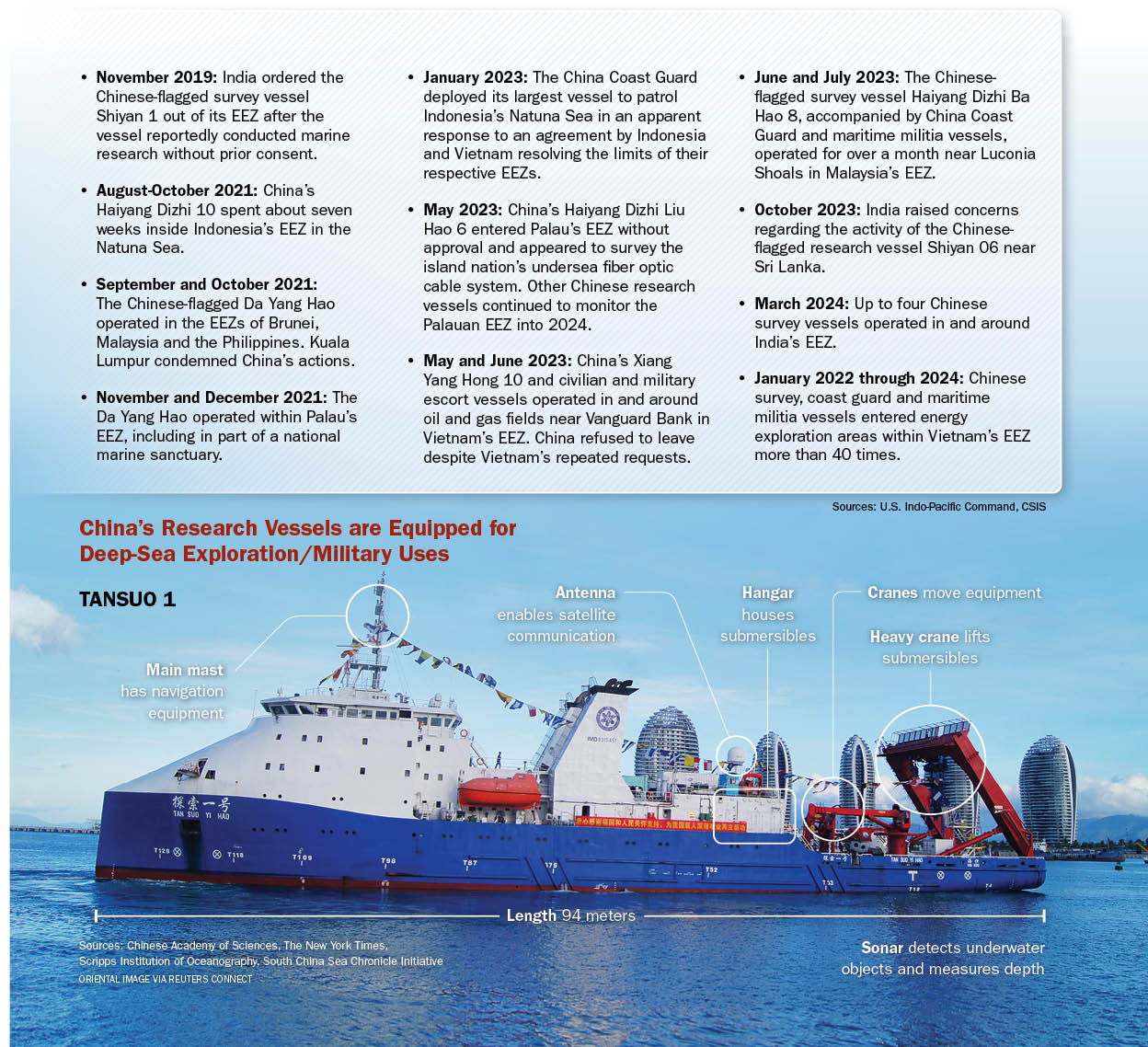
China operates one of the world’s largest fleets of civilian oceanographic research vessels, analysts say. The Center for Strategic and International Studies (CSIS) reported in 2024 that “of the 64 active vessels, over 80% have demonstrated suspect behavior or possess organizational links suggesting their involvement in advancing Beijing’s geopolitical agenda,” indicating dual-use capabilities at scale.


The strategic opaqueness of China’s research ship operations challenges monitoring, complicates defensive postures and advances excessive maritime claims, analysts say. The vessels frequently operate in contested waters, gathering data on bathymetry (water depth), seafloor structure and oceanographic conditions — information that the People’s Liberation Army (PLA) can leverage for submarine operations, amphibious planning, and mine and antisurface warfare.

In November 2025, for instance, China deployed three dual-use research vessels in the Indian Ocean. India’s maritime surveillance agencies monitored the ships, which included the Shi Yan 6, Shen Hai Yi Hao and Lan Hai 201. “Such deployments typically prompt diplomatic caution and potential denial of port calls at Indian facilities, as seen in earlier instances involving similar Chinese missions,” Indian Defence News reported. The Indian Coast Guard and Navy reported the constant presence of Chinese research vessels in recent years near India’s waters.

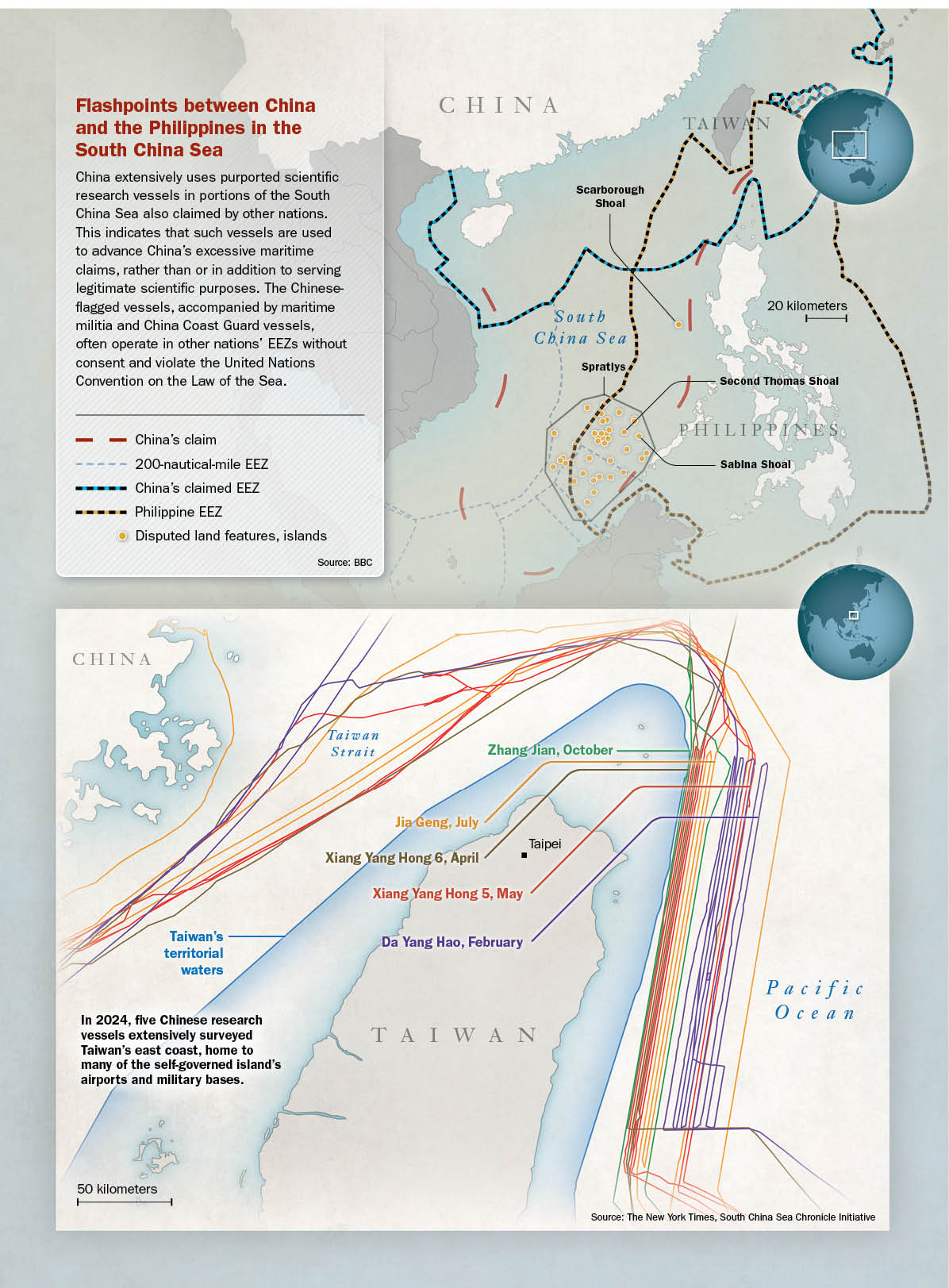
The Haiyang Dizhi 8, as another example, conducted oil and gas surveys off Vietnam’s coast for four months without authorization, highlighting how the vessels can penetrate contested maritime zones under the cover of scientific legitimacy, according to the CSIS’s Asia Maritime Transparency Initiative. The Xiang Yang Hong 6 also exemplifies China’s dual purposes. The vessel and five others made 25 passes in parallel lines off Taiwan’s east coast in 2024, conducting systematic seabed surveys, according to Starboard Maritime Intelligence data cited by The New York Times newspaper in July 2025.


“It’s hard for us to view this situation as normal,” Kuan Bi-ling, the minister of Taiwan’s Ocean Affairs Council, told The New York Times.

The same ships have been active around Guam — home to vital U.S. military installations — collecting data relevant to submarine operations. “It appears that China is trying to collect bathymetric data on that part of the ocean without appearing like it is conducting a bathymetric survey,” Ryan D. Martinson, an assistant professor and expert on Chinese research ships at the U.S. Naval War College, told the newspaper.

Such activities are emblematic of China’s gray-zone tactics, coercive state actions that fall short of open warfare. China views such activity as “a natural extension of how countries exercise power [to] pressure countries to act according to Beijing’s interests [and] without triggering backlash or conflict,” according to a 2022 Rand Corp. report, “A New Framework for Understanding and Countering China’s Gray Zone Tactics.”

Similarly, a June 2023 article published by the SeaLight research initiative noted that “China’s deployment of research and survey vessels in contested waters is a key component of its maritime gray-zone strategy. These vessels, often presented as civilian or scientific, are frequently state-owned or operated by entities with close military ties.” For example, the Chinese Academy of Sciences and China’s Natural Resources Ministry operate research vessels and have PLA cooperation agreements, CSIS reported. The U.S.-based SeaLight uses commercially available technology to expose maritime gray-zone activities.

China has increased marine data collection throughout key Indo-Pacific waters, sometimes disregarding international law that requires coastal state consent for research inside that nation’s exclusive economic zone (EEZ), the U.S. Indo-Pacific Command (USINDOPACOM) reported in July 2025. This pattern reflects a wider lawfare campaign designed to normalize excessive maritime claims while undermining the sovereign rights of coastal states, the report said.

“There are both legal and illegal and aggressive/nonaggressive ways to enter other countries’ EEZs. China is doing a lot of all of the above,” Jones said. “Their behavior is aggressive because it’s aggressive, not because it is/isn’t a violation of the law of the sea.”


South China Sea Surveillance

China’s survey vessels, operating within the EEZs of nations such as the Philippines, obtain maritime domain awareness in contested areas. They reinforce Beijing’s ability to map and exploit the seabed, with implications for mining, anti-submarine warfare and undersea infrastructure monitoring, among other ventures.

Moreover, these activities are part of a convergence of maritime coercion. China’s gray-zone campaigns often establish localized “advantages [for China] that can be sustained over time without precipitating acute crisis,” Isaac Kardon, a senior fellow at the Carnegie Endowment’s Asia Program, testified in June 2024 before the U.S. Congress.

This sustained presence in waters near the Philippines, Taiwan and other areas seeks to normalize China’s maritime coercion and erode the strategic threshold for escalation. “If you look at China’s coast guard and its maritime militia over the last three years — you would see a dramatic increase in the number of ships and the depth of the penetration,” SeaLight Director Ray Powell told The Wall Street Journal newspaper in March 2025. “It’s taken on the character of a maritime occupation.”

For example, China’s ships have made multiple incursions at the contested Sabina Shoal within Manila’s EEZ. In April 2024, the Philippines raised its flag at the shoal to assert sovereignty, prompting China’s deployment of a massive 12,000-ton Coast Guard vessel. Such events typify the pattern: China’s civilian or paramilitary-type vessels enter other nations’ claimed waters to consolidate their presence, gather environmental or hydrographic data, or prepare a pretext for sustained operations.

In May 2025, the Philippines deployed a Coast Guard vessel and aircraft to track a Chinese research ship operating illegally in its EEZ. Manila declared China’s activity a sovereignty violation. The incident reflects China’s strategy of ignoring its obligations as a signatory to the United Nations Convention on the Law of the Sea while pressing its arbitrary and excessive claims.


By pairing scientific vessels with China Coast Guard and maritime militia escorts, Beijing multiplies the coercive effect. The actions show the PLA’s growing use of undersea terrain data to support operations that threaten a free, secure and prosperous Indo-Pacific, analysts say.

China’s alarming gray-zone maritime strategy leverages civilian, paramilitary and military assets, including research and fishing vessels, to exert control over contested zones. This multilayered coercion erodes norms and reinforces China’s maritime claims incrementally. Such operations allow the Chinese Communist Party (CCP) to coerce “while avoiding a conventional military response from the United States and its allies,” notes the November 2024 Rand Corp. report “Understanding and Countering China’s Maritime Gray Zone Operations.” The report recommends enhanced presence, transparency initiatives and allied coordination as deterrent measures.


Masked Intent Near Taiwan

The Taiwan Strait and its eastern approaches are at the heart of China’s coercion campaign. China’s parallel survey patterns east of Taiwan suggest mapping for submarine deployment or interdiction zones. Equally concerning are China’s surveys near Guam — a hub for U.S. power projection in the Western Pacific. Chinese research vessels resumed operations east of Guam as recently as June 2025, according to data cited by The New York Times.

Taiwan’s military intelligence noted a dramatic uptick in China’s maritime and aerial activity across the Indo-Pacific in 2024: nearly 12,000 flights and more than 86,000 missions at sea — military exercises that totaled an estimated $21 billion in operational costs and a nearly 40% increase over 2023 spending, the Reuters news service reported.

Such overt actions distract from less-visible activities such as marine data collection, which accumulates military advantage without risking immediate escalation. The extent of the drills underscores the potential scale and normalization of PLA maritime activities — an environment in which research ships can mix, gather environmental and electromagnetic data, and facilitate PLA submarine or amphibious operations near Taiwan under technical pretexts. “They are trying to normalize their military power projection and intimidation around the first island chain,” a Taiwan military official told Reuters.

Legal Double Standards

China’s marine data collection is a tool for “preparing the battlespace,” particularly when survey tracks are along likely submarine routes or amphibious approach corridors, according to USINDOPACOM. China is moving toward a more conventional approach, indicating a rising threshold of risk tolerance, including in the Pacific, The Heritage Foundation reported in September 2024. Further, PLA modernization is sharpening strategic pressures, making encounters — including those involving ostensibly benign vessels — more fraught and dangerous, according to a May 2024 report by the U.S.-based National Bureau of Asian Research.

China’s rapid expansion and deployment of its research and survey fleet, and the systematic surveys it conducts near Guam, the Philippines and Taiwan, are not merely to advance science. They signal and enable coercion and are part of a strategy to collect data of military utility, normalize excessive claims and undermine the sovereign rights of Indo-Pacific states. Vessels such as the Xiang Yang Hong 6 embody this duality — flying the flag of science but sailing as military scouts. Their data collection should be understood for what it is, analysts say: a gray-zone operation, reinforced by lawfare, to ready the battlespace for potential conflict.
Strengthening Countermeasures

To ensure a free, secure and prosperous Indo-Pacific, the U.S. and its Allies and Partners must remain vigilant about China’s maritime activities — exposing Beijing’s duplicity and countering its attempts to redraw the physical and legal maps that define the maritime domain.

Regional resilience requires recognition of this threat and promotion of cooperative mechanisms to challenge China’s opaqueness and normalization of dual-use maritime activity, defense experts say.

“The U.S. is the most important oceanographic power in the world — but China is catching up and several of our Allies and Partners have very important capacity, skills, local knowledge and geography,” said Jones, the Brookings senior fellow. Countermeasures should integrate intelligence, law enforcement and economic tracking mechanisms, according to Benjamin Jensen, director of CSIS’s Futures Lab, and his colleagues. In commentary published on the CSIS website, they recommended interagency campaigns to counter China’s gray-zone incursions. A joint interagency task force or similar entity could integrate mechanisms to identify CCP influence channels in real time, they wrote.

“The goal isn’t just to shut down documented incursions — it’s to shape the environment so that China loses its ability to leverage migration, illicit finance, and cyber operations as tools of competition,” the CSIS team wrote. That means “deploying targeted counterintelligence and economic measures across the Pacific. It means leveraging the [U.S.] Department of the Treasury’s tools to disrupt illicit Chinese financial networks. It means expanding the use of contracted intelligence, surveillance, and reconnaissance assets to avoid straining existing military collection capabilities. And it means crafting an influence campaign to expose and undermine CCP operations in the information space before they gain traction.”

They cited Jade Spear, an interagency initiative that targeted illegal, unreported and unregulated fishing by China’s fleet. The operation coordinated 15 U.S. agencies to target labor violations and human trafficking, impose sanctions, revoke visas and licenses, inspect vessels, and investigate fishing companies. “Jade Spear [reimagined] the spectrum of engagement with the CCP — it’s not just about use of kinetic action, but the entire arsenal of U.S. bureaucracy can be called to action,” they wrote.


“The private sector plays a critical role —
financial institutions, tech companies and media platforms must be mobilized to prevent CCP actors from exploiting digital spaces and economic systems.”

The U.S. and its Allies and Partners require a sustained, proactive approach to prevent China from exploiting gaps in governance, security and perception management, they concluded. “The real shift must come from embracing competition as a continuous condition, not a crisis-driven response. … It’s not just about blocking Chinese influence — it’s about making the Indo-Pacific a space where U.S. alliances, institutions, and economic frameworks make CCP subversion infeasible.”
China is Mapping the Region’s Seabed for Geopolitical, Military Advantage

Chinese-flagged survey vessels are collecting marine data on an unprecedented scale. Between 2020 and 2024, 64 vessels engaged in hundreds of thousands of hours of operations worldwide, with more than 80% exhibiting dual-use behavior or ties to China’s geopolitical agenda, according to the Center for Strategic and International Studies (CSIS), a U.S.-based think tank.

China also has deployed research vessels to strengthen its presence in geopolitical hotspots. Commercial and scientific research ships, such as those operated by the state-owned China Oilfield Services Ltd., have helped the Chinese Communist Party assert its illegal claims of sovereignty over large swaths of the South China Sea and obstruct coastal states from finding and extracting natural resources, a study by CSIS found.

Chinese ships have conducted survey operations within the exclusive economic zones (EEZ) of other countries without prior approval, which is prohibited under international law. This also constitutes a double standard given China heavily restricts foreign activities in its EEZ.

China appears to use marine data to bolster its excessive claims and prevent other states from exercising their sovereign rights.


Concealed Mission

China’s dual-use research fleet offers strategic advantages for potential military operations:Environmental intelligence: Hydrographic and oceanographic data supports planning for submarine routing, mine deployment, undersea sensor placement and amphibious landing.
Sensor development: Data on sound propagation and currents aid in passive acoustic detection and sensor optimization.
Access creep: Regular presence of civilian vessels normalizes operations inside a nation’s exclusive economic zone (EEZ), making detection and interdiction politically complex.
Infrastructure placement: Data can support undersea infrastructure such as communication cables, sensors and uncrewed vehicles.

Deterrence Measures

To counter China’s maritime gray-zone activities, Allies and Partners should focus on:Transparency: Enhance intelligence sharing and public transparency on research ship movements, flagging dual-use indicators.
Policy coordination: Support interagency initiatives that combine maritime enforcement, sanctions, licensing and public-private cooperation.
Capacity building: Strengthen regional domain awareness via cooperative deployments, hydrographic surveys and shared sensor networks.
Legal frameworks: Clarify norms regarding scientific vessel activity in nations’ EEZs and clearly define boundaries for data collection.
Strategic messaging: Identify China’s dual-use research vessel surveys as part of its coercive strategy.


Sources: Center for Strategic and International Studies, Daniel K. Inouye Asia-Pacific Center for Security Studies, Heritage Foundation, Rand Corp.

This article was published by Indo-Pacific Defense FORUM