Wednesday, June 03, 2026


2026 World Cup fuels tourism boom in North America with Canada in the lead
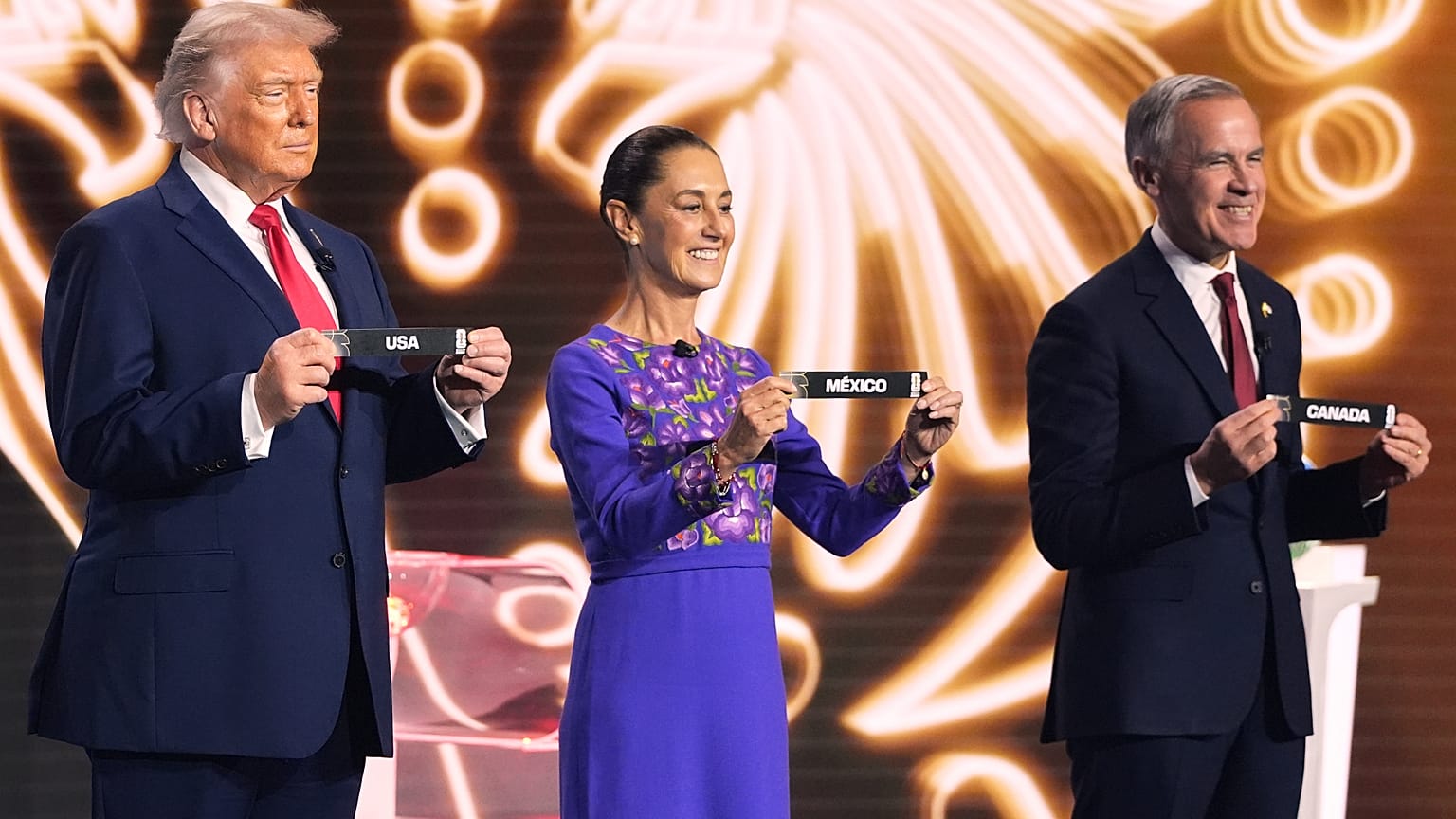
Donald Trump, Claudia Sheinbaum and Mark Carney hold the cards of their respective countries during the World Cup draw
Copyright AP Photo

By David Del Valle
Published on

This month’s football World Cup puts North America at the heart of global tourism and is set to trigger an economic boom across the region, with Canada leading the way, ahead of Mexico and the United States, according to the World Travel & Tourism Council.

The FIFA World Cup 2026 is shaping up to be one of the biggest drivers of tourism in North America. The World Travel & Tourism Council (WTTC) expects the tournament to give a significant boost to the tourism GDP of Canada, Mexico and the United States, cementing the region’s status as one of the world’s leading tourism hubs.

According to the council’s estimates, Canada will see the strongest tourism growth, with a 6.4% increase in sector GDP, while Mexico is set to expand by 2.4% and the US by 2.1%.

The WTTC sees the World Cup as a “strategic opportunity” to reinforce long-term tourism growth through greater air connectivity, more integrated experiences for travellers and closer cross-border cooperation between the three host countries.

“It is a unique opportunity for North America to accelerate tourism growth, strengthen connectivity and showcase the region to millions of travellers around the world,” says Gloria Guevara, President and CEO of the WTTC.

The WTTC warns of the need to maintain investment in aviation, tourism infrastructure, digital innovation and more streamlined entry processes to sustain the region’s international competitiveness.

Mexico, the region’s tourism leader

Of the three countries in the region, Mexico led North America’s tourism growth in 2025, according to data from the recent 2026 Economic Impact Report (EIR) produced by the WTTC. It outperformed the US and Canada on the main sector indicators, with tourism GDP expanding by 1.8%, compared with 0.9% in the US and 1.2% in Canada.

Mexico also recorded the highest international visitor spending, with an increase of 3.5%, while in the US and Canada it fell by 4.6% and 3.5% respectively.

International arrivals also rose sharply in Mexico, increasing by 6.1%, in contrast with declines of 5.5% in the US and 0.6% in Canada.

The WTTC further estimates that the travel and tourism sector will support 30.9 million jobs in North America in 2026, equivalent to 12.7% of total employment in the region.

At global level, the council expects tourism to contribute 12 trillion dollars to the world economy in 2026, close to 10% of global GDP, and to sustain 376 million jobs.


Africa Races For Ebola Vaccine As Outbreak Outpaces Response

Members of a decontamination team wearing safety suits during the West Africa Ebola epidemic in 2015. The World Health Organization has declared the latest Ebola outbreak in the Democratic Republic of Congo a public health emergency of international concern. Photo Credit: Corporal Paul Shaw/MOD (CC BY 2.0)


June 3, 2026 
By John Musenze


Researchers racing to develop a vaccine to fight the growing Ebola outbreak centred in the Democratic Republic of Congo (DRC) say doses could be ready for human testing within “two to three months”, while the more promising candidate could take up to nine months.

International aid agencies have warned that response efforts are failing to keep pace with the spread of the outbreak, which the World Health Organization (WHO) declared a public health emergency of international concern.

The Coalition for Epidemic Preparedness Innovations (CEPI), a global body dedicated to vaccine development, on Monday (1 June) pledged US$62 million to fast-track three investigational vaccine candidates for trials to fight the Bundibugyo virus, for which there are no approved vaccines or treatments.

“With Bundibugyo virus spreading rapidly and no licensed vaccines, every day counts in the race against this deadly disease,” said CEPI chief executive Richard Hatchett.


“CEPI’s urgent funding and support for these three promising candidates aims to advance safe, effective vaccines to help control this epidemic.”

The three candidates are being developed by the International AIDS Vaccine Initiative (IAVI), US biotech firm Moderna, and the University of Oxford, with the Oxford vaccine to be manufactured at the Serum Institute of India.

Teresa Lambe, head of vaccine immunology at the Oxford Vaccine Group, says scientists are attempting to fast-track production using lessons learned during COVID-19.

“Animal studies for the Oxford vaccine candidate are already under way and will be progressing with partners around the world,” said Lambe.

“We are hoping to have clinical-grade vaccine doses ready within two to three months.”

WHO’s Technical Advisory Group has identified IAVI’s single-dose rVSV candidate, developed with the University of Texas Medical Branch with US$3.2 million from CEPI, as the most promising in the pipeline. However, the WHO says it will be seven to nine months before the candidate is ready for human testing.

“We are acting with urgency to advance this candidate quickly and responsibly,” said IAVI CEO Mark Feinberg.

“While significant work remains, including definition of accelerated pathways for clinical evaluation and regulatory review, we believe it is important to expedite development of this vaccine candidate to explore its potential to help address a pathogen for which no countermeasures currently exist and that is causing a tragically increasing number of deaths, serious illness, and grave disruption across a wide region.”

As of May 29, the outbreak had caused 223 suspected deaths in DRC and one in Uganda. On Tuesday (2 June) Uganda confirmed six new cases, bringing the total confirmed in the country to 15.

Gavi, the Vaccine Alliance has committed US$50 million to the Ebola outbreak through its First Response Fund, including up to US$40 million to accelerate access.

“While we are some way off having a safe and effective vaccine against Bundibugyo virus, we need to act now to ensure that, once one or more vaccine candidates are ready, manufacturers are in a position to start producing doses at scale,” said Gavi chief executive Sania Nishtar.

Jean Kaseya, head of Africa Centres for Disease Control and Prevention (Africa CDC) promised that Africa would have a vaccine and treatment “by the end of this year”.

The African Union health agency has forged a continent-wide response plan to strengthen outbreak control in at least 11 high-risk countries—a plan it says will require US$319 million in the next six months.

Kaseya warned that South Sudan, Somalia, Rwanda, Kenya, Tanzania, Ethiopia, Republic of Congo, Burundi, Angola, Central African Republic, and Zambia are at high risk of Ebola spread—in addition to DRC and Uganda—due to cross-border population movement.


Speaking at a press briefing last week (28 May), Kaseya said the continent can no longer afford to respond to recurring outbreaks without medical countermeasures.

“This is the third time we are seeing Bundibugyo in Africa. If this was happening in Western countries, they would have a vaccine by now.”

The rare Bundibugyo species of Ebola has caused just three outbreaks in nearly two decades, the first in Uganda in 2007, with a second in DRC in 2012. It has no approved vaccine and no licensed treatment, and existing medical tools developed for the more common Zaire strain are largely unsuitable for the current outbreak.

Kaseya also disclosed that he had received a direct message from Russia’s Minister of Health, informing him that the Gamaleya National Research Centre had developed an Ebola vaccine.

“My team is working with the Russian team and with all other partners to understand,” Kaseya told the briefing.

Africa CDC officials confirmed the Russian vaccine was originally developed following the 2014–2016 West Africa Ebola outbreak and targets the Zaire strain. Technical teams were this week assessing whether the platform could offer protection or be adapted for the Bundibugyo species.

WHO experts have also recommended several experimental therapeutics for evaluation in clinical trials among confirmed Ebola patients. These include the monoclonal antibodies MBP134 and Maftivimab, the antiviral remdesivir, and combination therapies involving both antibody treatment and antivirals.

WHO is also studying the use of obeldesivir tablets as post-exposure protection for confirmed contacts. These are oral antivirals administered before symptoms develop in an attempt to prevent infection.


This piece was produced by SciDev.Net’s Sub-Saharan Africa English desk.

Archbishop Wester At Arms Control conference: ‘There Is No Such Thing As A Just Nuclear War’


By Tyler Arnold

Archbishop John Charles Wester urged continued international efforts toward nuclear disarmament in a speech Tuesday to a nonpartisan policy organization of arms control proponents.

“There is no such thing as a ‘just’ nuclear war,” Wester of Santa Fe, New Mexico, said in a live video address to those gathered for the annual meeting of the Arms Control Association on June 2 at the National Press Club in Washington, D.C.

The Arms Control Association, founded in 1971, encourages nonproliferation and disarmament efforts for nuclear, chemical, biological, and other weapons the organization says pose dangers to humanity. Wester has been one of the most outspoken bishops on this topic in recent years.

In his address, Wester quoted extensively from papal writings and speeches from recent popes, including Pope Leo XIV, who encouraged disarmament efforts from nuclear powers in his papal encyclical Magnifica Humanitas last month.

Leo called the 2021 Treaty on the Prohibition of Nuclear Weapons a step in the right direction but warned it’s “largely symbolic since the major nuclear powers have not agreed to it.” He also voiced concern for “a new arms race,” the development of miniaturized nuclear weapons, and the potential use of artificial intelligence (AI) to make combat decisions.

Wester quoted from the text in which Leo said it is erroneous to believe nuclear deterrence is an “indispensable prerequisite for security.” The archbishop noted “there had been progress” in the past with U.S. and Russian disarmament, but “whatever momentum we had is completely gone.”

“We’re now in a nuclear arms race that’s even more dangerous than the first,” Wester said in reference to efforts in the U.S., Russia, and China to modernize nuclear arsenals.

Wester said “we’ve got to take a sober look at what’s going on today” and take the “momentum of the past and harness it and move it forward” toward nuclear weapon abolition.

“We’ve done this in the past and we can do it again,” he said.

Wester also referenced Leo’s encyclical comments on fears that AI could be used in weapons of war, with the Holy Father urging leaders to “avoid a race to develop such arms.” The archbishop referenced research that found that AI models would choose to use nuclear weapons in 95% of the researchers’ simulated crisis situations.

The possibility that AI could hypothetically choose to “wipe out human civilization overnight is rather scary,” the archbishop said, echoing the Holy Father’s warnings.

In addition to citing Leo, Wester also cited Leoʼs predecessor Pope Francis, who also gave strong warnings against nuclear weapons, going so far as to say “the use of nuclear weapons, as well as their mere possession, is immoral.” Wester called this “a huge, huge statement” that goes further than other popes.

“The pope has said it’s immoral,” he said, and added that his question to Catholics who do not focus on the issue is: “What are you going to do about that?”

The archbishop penned a 51-page pastoral letter on nuclear weapons in 2022 and said most of the feedback he received from fellow bishops was favorable, but “there’s not a huge urgency” from most clergy because there are “so many other issues to deal with these days.”

“How do we get people to look at an issue that, for many, it just doesn’t seem that urgent?” he said.

Wester said he hopes for a stronger focus on nuclear disarmament from the U.S. bishops and intends to ask Leo to write an encyclical specifically about the threat.

EU Leaders To Step Up Pressure On Israel With New Sanctions Threat


By icoletta Ionta

(EurActiv) — The EU will step up pressure on Israel by preparing sanctions against ministers accused of “inciting and promoting human rights abuses” against Gaza aid flotilla activists, according to draft summit conclusions.

This month’s European Council summit will order the beginning of work on sanctions understood to apply to far-right members of Benjamin Netanyahu’s governing coalition, including the sitting national security minister Itamar Ben-Gvir.

The draft text “condemns the mistreatment of detainees following the interception of the Global Sumud Flotilla in international waters” and urges EU foreign ministers “to take work forward on restrictive measures against extremist ministers inciting and promoting such human rights abuses”.

Anger across EU capitals has intensified following Ben-Gvir’s handling of activists detained after Israel intercepted a Gaza-bound aid flotilla.

Momentum for the initiative grew after Antonio Tajani, Italy’s foreign minister, wrote to Kaja Kallas, EU foreign policy chief, last month, requesting that the issue be formally placed on the EU’s agenda.

Speaking last week, Tajani said the matter would be discussed at the next Foreign Affairs Council meeting, scheduled for 15 June.

Any sanctions regime would require unanimous support from EU member states setting a threshold that remains far from certain. Opposition from the Czech Republic and Bulgaria means there is currently no consensus.

The sanctions proposal appears alongside an increasingly critical and detailed assessment of Israeli policy, including its military action in Lebanon.

The draft text rejects Israel’s reported plans to take control of 70% of Gaza, condemns the expansion of settlements in the West Bank, while warning of the legal and reputational risks facing companies involved in settlement construction.

EU leaders are also expected to call on Israel to allow immediate and unhindered humanitarian access to Gaza, reopen border crossings, and reverse measures affecting international NGOs operating in the territory.

As with all European Council conclusions, the text remains under negotiation among countries and could be revised before leaders meet later this month. Any eventual sanctions package would still require the approval of all EU governments.

Netanyahu Now More Dangerous Than Ever – OpEd

June 3, 2026 
By Arab News
By Yossi Mekelberg

If elections are normally times of celebration, either for retaining successful governments or for renewing politics with new faces and ideas, the forthcoming general election in Israel instead inspires a mixture of hope and dread. Hope that the country may rid itself of the most disastrous government in its history; dread over what further damage this coalition government might inflict before voters finally go to the polls. In the meantime, the Knesset is slowly proceeding with votes on a bill to dissolve itself.

The exact date of the only opinion poll that truly matters — the one in which citizens cast their votes — has not yet been decided, though by law the election must take place no later than Oct. 27. That may seem a short time away, but with Prime Minister Benjamin Netanyahu, his Likud Party and their coalition partners unlikely, at least according to opinion polls, to be able to form the next government, they may feel they are living on borrowed time.

Consequently, they might be increasingly tempted to “complete” their assault on the foundations of the democratic system, making any future reversal more difficult. They may also seek to provoke, or at least exacerbate, one of the fronts on which Israel is already in a state of war or conflict, either as a demonstration of strength or even as a pretext to postpone the election.


This may sound alarmist, but the behavior of the PM and most of his coalition partners since this government came to power — the sixth, and hopefully final, Netanyahu government — has provided every reason to suspect its ill intentions, both domestically and beyond Israel’s borders, including in the Occupied Territories.

First and foremost, Netanyahu is motivated by the desire to delay, obstruct and possibly ultimately cancel his trial on three counts of corruption. Regrettably, he has so far enjoyed considerable success. He has repeatedly used the wars of the past two and a half years to postpone his court testimony. Last week, the District Court in Jerusalem, where the trial is taking place, was forced to cancel an entire day’s hearing after the prime minister’s lawyers informed the judges that he was too exhausted because he had been dealing with “security and diplomacy matters until the late hours of the night.”

It would be foolish to suggest that governing the country is not enormously demanding. However, that cannot justify Netanyahu continuously receiving special treatment from the courts that no ordinary citizen would ever enjoy. The danger is that he appears to believe that, if he forms the next government and remains in office, he will eventually be able to marginalize the legal system altogether and terminate his trial. That alone should serve as an additional incentive to remove him through the ballot box, because such an outcome would mark the collapse of equality before the law and drive public trust in politics to an even lower point.

Israel enters this election campaign while negotiations to end the war with Iran continue between Washington and Tehran — talks in which Israel remains largely sidelined. While Israeli troops are becoming increasingly entrenched in Lebanon and continue to suffer losses from Hezbollah attacks. While more than half of Gaza remains occupied by Israel without any clear exit strategy. And while the security situation in the West Bank steadily deteriorates. Under such circumstances, what exactly does Netanyahu have with which to convince the electorate that he deserves another term in office?

This may offer grounds for cautious optimism, but it also makes Netanyahu potentially more dangerous than ever. His desperation to win the forthcoming election, or at least ensure that the opposition cannot form a coalition government, means that either victory or political stalemate represents his best chance of remaining in power. That desperation carries the risk that he may stop at nothing, whether by deepening internal divisions — as we already see verbal and even physical attacks on political opponents — or escalating confrontations abroad. Netanyahu will remain cynical until the bitter political end, supported by a government dominated by extremists.

Distrust in Netanyahu extends far beyond the opposition and its supporters. Many within his own coalition also no longer trust him. He has become the archetype of the politician who promises the world but delivers an atlas.

To the Israeli public, he promised security, yet they received Oct. 7 with all its devastating losses, prolonged wars, and endless duty for reservists and extended compulsory service for conscripts. There has been no “total victory” over Hamas or Hezbollah, while Israel must watch as the US negotiates with Iran on terms over which Netanyahu has little influence. Yet he continues to project defiance and explain why the objectives he set for these wars remain achievable.


The ultra-Orthodox parties also no longer fully trust Netanyahu. Their leaders have openly said that the PM let them down through his inability to fulfill his promise to preserve exemptions from military service for their communities. At the same time, he has angered many Israelis who do serve in the military by making such promises in the first place. Even within his coalition, some lawmakers have proven to possess less “flexible” ethics than Netanyahu himself and have resisted supporting these arrangements.

Moreover, this election will inevitably revolve around Oct. 7 and its aftermath, while the government unscrupulously continues to block an independent inquiry into what happened. A leader with so much to hide, who wields enormous power yet refuses to relinquish it, inevitably becomes dangerous, firstly to his own people but also to the wider region.

Netanyahu is also an avid reader of opinion polls — a skill that has helped him navigate and, unfortunately, manipulate both the political system and the electorate. Without that political instinct, he would never have become the longest-serving prime minister in Israel’s history. This will make the coming weeks and months particularly volatile. An opportunistic politician such as Netanyahu could either manufacture a crisis himself or allow some of his predictably unpredictable coalition partners to behave irresponsibly.

This has already been evident in the conduct of National Security Minister Itamar Ben-Gvir, whose behavior toward the detained Gaza flotilla peace activists was thuggish in the name of national chauvinism of the lowest kind. This occurred alongside the daily harassment of government opponents by Netanyahu’s supporters, while the police appear unwilling to intervene meaningfully or bring perpetrators to justice.

All of this sounds worrying because it is. To a significant extent, the forthcoming election is not merely about its eventual result, important though that is, but about the resilience of Israeli society, the survival of its democratic institutions and the restoration of rationality in the country’s foreign policy after years during which this government has severely tarnished all three.


Yossi Mekelberg is a professor of international relations and an associate fellow of the MENA Program at Chatham House. X: @YMekelberg
UN General Assembly Elects Bangladesh’s Rahman As Next President

Khalilur Rahman, newly-elected President of the eighty-first session of the General Assembly addresses the 85th plenary meeting of General Assembly. Photo Credit: UN Photo/Eskinder Debebe

June 3, 2026 
By UN News
By Vibhu Mishra

Bangladeshi Foreign Minister Khalilur Rahman was elected President of the UN General Assembly’s 81st session on Tuesday after defeating Andreas Kakouris of Cyprus in a closely contested vote, positioning himself to steer the world body through a pivotal year marked by intensifying global crises, UN reform efforts and major leadership transitions.

In a secret-ballot election, Mr. Rahman secured 99 votes to Mr. Kakouris’s 91. A total of 190 ballots were cast, with no invalid votes or abstentions.

The presidency rotates among the UN’s five regional groups, and the 81st session falls to the Asia-Pacific group. Mr. Rahman will serve a one-year term starting on 8 September.


His presidency will coincide with one of the most consequential processes on the UN calendar: the selection of Secretary-General António Guterres’s successor, whose term ends on 31 December 2026.

Mr. Rahman brings more than four decades of diplomatic and multilateral experience to the role. Bangladesh’s Foreign Minister since February, he previously served as National Security Adviser and High Representative on the Rohingya Issue.

A career diplomat, he joined Bangladesh’s foreign service in 1979. He also held senior UN positions in New York and Geneva.
‘With humility and respect’

Accepting the position, Mr. Rahman said he was taking on the role “with humility and respect” at a moment when confidence in the international system was under strain.

“The UN will commence its ninth decade at a time when trust in our organization is being tested on multiple fronts,” he told Member States.

“Taken together, these challenges tend to undermine the public trust and confidence in the ability of our organization to deliver its promises.”
A world under pressure

The election comes amid what the current General Assembly President Annalena Baerbock described as an exceptionally difficult period for multilateral diplomacy.

Addressing Member States after the vote, Ms. Baerbock said the UN was facing “not only headwinds, but immense pressure,” with consensus increasingly difficult to achieve and defence of the UN Charter becoming “a daily necessity.”

“The role of the president of the General Assembly is no longer simply procedural,” she said.
Challenges ahead

She warned that the international environment was unlikely to become easier during the coming year, as the Assembly continues work on implementing the Pact for the Future, advancing reform efforts through the UN80 initiative and navigating broader geopolitical divisions.

Secretary-General António Guterres echoed those concerns, describing a world confronting “conflicts, divisions, rising inequality and climate chaos.”

He also pointed to slowing progress on the Sustainable Development Goals (SDGs), declining funding for humanitarian action and development, and international institutions that remain “stuck in the world as it was in 1945, not the world of today.”
Six priorities for the 81st session

Mr. Rahman said his presidency would focus on six broad priorities: peace and security; accelerating progress on the SDGs; climate action and environmental protection; human rights; governance of emerging technologies, including artificial intelligence, and UN reform.


Drawing on Bangladesh’s experience in peacekeeping, he pledged to support preventive diplomacy, peacebuilding and civilian protection.

He also highlighted the need to address development financing gaps, advance implementation of the Global Digital Compact and strengthen the UN’s effectiveness at a time of growing pressure on multilateral institutions.
‘Restoring trust’

Mr. Rahman’s overarching theme for the session is “Restoring Trust, Managing Transformation: A United Nations that Delivers for All.”

Secretary-General Guterres described the theme as “an inspiring call to action for the multilateral system” and said it reflected a commitment to strengthening global cooperation.

The President-elect said he intends to act as a bridge-builder, promising to engage all Member States and seek common ground despite growing divisions.

“As your president, I will dedicate myself to rebuilding trust, nurturing consensus, and opening space for good faith negotiations that will lead to outcomes for all that are owned by all,” he said.

He also pledged to uphold the UN Charter, maintain geographical and gender balance within his office and support the needs of smaller delegations.
The world parliament

The General Assembly is the UN’s most representative body, bringing together all 193 Member States, each with one vote.


While its resolutions are generally not legally binding, the Assembly serves as the principal forum for international deliberation on peace and security, development, human rights and international law.

The 81st session will open on 8 September, with world leaders gathering two weeks later for the annual high-level debate at UN Headquarters, in New York.
Russian Perspectives On The Trump-Xi Summit – Analysis


Observer Research Foundation
By Aleksei Zakharov

Before US President Donald Trump’s visit to China, Russian experts unanimously predicted that his summit with the Chinese leader Xi Jinping would not alter the US-China equation. This view was grounded in the belief that the US-China confrontation has taken on a systemic nature, compounded by the broader shift in the world order, which has been set in motion “in earnest and for the long haul.” In this context, the odds of a ‘big deal’ between Washington and Beijing, let alone the establishment of a ‘G2’ condominium, seemed slim.

The summit outcomes have reinforced this view, indicating that the bilateral competition, albeit carefully managed by both sides, resembles a long-term strategic deadlock that is unlikely to give way to any significant rapprochement.
Readings of the US-China Summit

Moscow is increasingly convinced that Beijing, seriously affected by the global geopolitical churn, may be reconsidering its foreign policy approach. China no longer harbours any illusions about reaching compromises with the US that could deliver mutually beneficial solutions. Therefore, the Trump-Xi meeting was less about a rapprochement and more about a ‘truce’ between the two closely intertwined yet distrustful states.


Recognising this, Xi urged the US to continue the dialogue to prevent relations from descending into deeper crises. On economic issues, he stated that consultation “on an equal footing” is the only option going forward. Whether the new formula revolving around “constructive and strategic stability,” as suggested by China, will become a mainstay for bilateral relations remains to be seen.

As Fyodor Lukyanov, Editor-in-Chief of the journal, Russia in Global Affairs, argues, the outcome of the US-China talks is the consolidation of interdependence amid diverging interests. He believes that the interdependence between the two will weaken, and the divergences will further intensify. Rather than being temporary, this shift appears to be a permanent feature of the relationship. However, it will be a gradual process, as neither side has any interest in ending ties.

Vasily Kashin, Director at the Center for Comprehensive European and International Studies, HSE University, and one of Russia’s foremost China scholars, observes that China’s strategy is to delay a full-scale confrontation with the US. If the US remains in a deep political and economic crisis, as the Chinese leadership seems to believe, the future will only bring improved circumstances for China and the US “may retreat from certain positions without a fight.”

Ivan Zuenko, another prominent Russian expert on China and Associate Professor at MGIMO University, points out that the Summit underscored China’s elevated status in world affairs, reflecting Washington’s realisation that Beijing cannot be pressurised. The talks could lead to the relaxation of US tariffs and can bring new trade deals, including China’s imports of US oil. However, despite securing some economic concessions, the US will not abandon its containment policy since the China threat is a matter of bipartisan consensus in the US Congress. As such, the summit has given an impetus for the two countries to move ahead with the talks on critical topics, without bringing in any significant breakthroughs.

Russian observers are confident that the US-China talks will not affect Russia-China cooperation. They estimate that American oil cannot compete with Russian oil and that the spike in energy prices may push Russia-China bilateral trade to a new record by the end of 2026.

US-China-Russia Triangular Dynamics

Back-to-back visits to Beijing by the US and Russian presidents have revived conversations about the US-China-Russia strategic triangle. According to Lowell Dittmer’s classification, this triangle is a ‘stable marriage’, featuring amicable relations between two of the players and antagonistic ties between each of them and the third player.

Trump’s attempts to employ the ‘Reverse Kissinger’ strategy in the first months of its presidency have not visibly altered the trilateral equations. The US-Russia rapprochement has not delivered any tangible results, not even on technical issues such as visas and frozen diplomatic property. This has prompted growing disillusionment among Russian officials who are losing hope of improving ties with Washington. US and China remain locked in a strategic competition, while Russia and China have considerably expanded their strategic partnership. These types of relationships within the triangle are set to endure for years to come.

Some Russian experts have argued that in certain cases, Russia and China may refrain from providing direct support to each other if doing so would cause undue complications; however, they will never act to the detriment of their counterpart. Conversely, when it comes to its relations with the US, China now seems to realise that the policy shift is not a reflection of presidential preference, but rather of how the US fundamentally understands its goals and objectives. This could mean that periodic escalations and de-escalations have become a tacitly accepted norm of US-China relations.

A Shift to Coalition?

The inability of major powers to negotiate with Trump and the US, in Russian eyes, might prompt them, including China, to shift gears. Firstly, Beijing is expected to double its military capabilities to withstand any external pressure. Secondly, a deadlock with the US could encourage China to join forces with Russia to build an alternative financial infrastructure immune to US encroachment–something that Beijing has been lukewarm about despite Moscow’s proposals. From this perspective, the absence of a ‘big deal’ between the US and China plays into Russia’s hands.

Despite appearing battered after four years of war, Moscow has not lost its great power ambitions. Russian experts firmly believe that the US-Russia-China triangle will be pivotal in shaping an equilibrium-based new world order. However, these great power aspirations are often met with a harsh reality check, forcing Russia to build its capabilities without leaning heavily on China.

With a growing realisation that the transition to a new world order will not be peaceful, there is a greater argument in Russia for a coalition with China, beyond military engagement, including closer coordination on financial, economic, and technological issues. Even as these musings might, at some point, strike a chord with China, convincing it to consider such a coalition, which, as the logic goes, could shield the two from Western sanctions and potential naval blockades, Russia, in a more desperate condition, will seemingly have to play second fiddle to Beijing.

The notable shift in Russian narratives from positioning as a guarantor of a ‘New Non-Alignment’ alongside India–a popular idea before the war in Ukraine–to embracing the prospect of a coalition with Beijing against the US, colours Russia’s engagement with China more definitively and provides New Delhi with food for thought. It is probably not so much the US-China ‘G2’ but rather the trajectory of Moscow’s ever-closer alignment with Beijing that could pit India against a new geopolitical reality in the not-too-distant future.


About the author: Aleksei Zakharov is Fellow, Russia & Eurasia, with the Strategic Studies Programme at the Observer Research Foundation.


Source: This article was published by the Observer Research Foundation.
LONGER THAN WWII

On Springtime Battlefield In War’s Fifth Year, Ukraine Claws Back Territory – Analysis

June 3, 2026 
RFE RL
By Yehor Lohinov and Mike Eckel

(RFE/RL) — The spring fields and rutted forest roads north of Pokrovsk are still muddy, caking boots, wheels, weapons, and ammunition boxes with waterlogged earth that makes everything heavier and slows everything down.

For Ukrainians and Russians alike.

If you’re racing to get bottled water and gasoline to soldiers hunkered down in foxholes and trenches, you have to use all-terrain vehicles.


“The quad bike is more maneuverable; it has a better all-around view, and you can dismount faster if necessary. It’ll go where regular cars just skid out,”said a soldier with the 152nd Separate Jaeger Brigade, a Ukrainian light infantry unit. He gave only his call sign, “Bars,” in accordance with military restrictions.

“We tried to deliver parcels with [armored vehicles], but you can’t always reach the deployment site. You might run into a mine or a [drone] will hit you,” the soldier told RFE/RL’s Donbas.Realities.

This is the advent of the fifth fighting season for Ukraine in its defense against a bigger, better armed Russian military.

This spring is different, however.

“Right now the general situation for the Ukrainians seems to be better than it has been in several years, though several significant dangers remain,” said Pasi Paroinen, a military analyst with Black Bird Group, a Finnish research organization.

In mid-May, Ukrainian forces clawed back more territory from Russian troops than they lost, according to battlefield experts and military analysts — for the second time this year, in fact.

The gains are incremental and far from a tipping point for the war. Some of them can be attributed how the shifts are calculated; due to changes in tactics and technology, analysts say it’s nearly impossible to identify a clear front line where you can measure territory gained or lost.

Overall, however, according to DeepState, Russian advances have all but stalled as of mid-May — in fact, they’ve lost ground, a net loss of territory, according to the monitoring group, which has ties to Ukraine’s military. The findings echo that of the US-based Institute for the Study of War.

“The tide has not yet fully shifted in favor of Ukraine, nor is it likely that Ukrainians will be able to launch any sort of major counteroffensives any time soon,” Paroinen said. “But Russia is struggling to advance, and the war is currently likely trending toward a — temporary? — stalemate.”

“This month has changed the dynamics in our favor, in favor of Ukraine,” President Volodymyr Zelenskyy claimed on May 19. “We are holding our positions more, inflicting more damage.”
‘The Trend Lines Are Bad For Ukraine’

As the weather improves, the ground hardens and foliage expands — giving soldiers cover from drones — the tempo of fighting ticks upward. Ukrainian, Russian, and Western observers say this year is turning out no different in that regard.


The proliferation of drones, drone defense, and new drone innovations means there is no front line anymore, experts say. Instead there is something called the “kill zone,” a gray-area swath of territory stretching to the rear where soldiers and supply lines are constantly at risk.

During counterattacks reported in late January and February, Ukrainian forces netted about 37 square kilometers, mainly near the town of Hulyaypolye. Russian troops partially reversed those gains.

In the beginning of May, meanwhile, Ukrainian troops eked out battlefield gains in the eastern Kharkiv region, near Kupyansk, a city Ukraine took back from Russia initially in late 2022, then lost control of, and recaptured last year. On May 15, Ukrainian forces captured Odradne, a Kharkiv region village north of Kupyansk, according to Ukrainian and Russian war bloggers.

The last time Ukraine saw any substantial recapture of territory came in late 2022, in two counteroffensives in the Kharkiv and Kherson regions.

“In reality, the initiative is still largely on the Russians’ side, even though they are struggling to move forward,” Paroinen said. “The following summer months will likely show more clearly if the Russian forces are truly bogged down for good or if they are able to restore at least some level of momentum.”

For much of the war, Russia has powered forward by brute force with a conveyer-belt of men drawn from a far larger population sent to the front. Many of those recruits end up in frontal infantry “meat-grinder” attacks, rushing Ukraine’s defensive lines, trying to overwhelm them.

The result has been eye-watering casualty rates.

The Economist magazine estimated between 280,000 and 518,000 Russian soldiers have been killed and total casualties between 1.1 million and 1.5 million. A joint estimate by Mediazona and Meduza put the Russian military dead at around 352,000 as of the end of 2025.
‘Extremely Costly’

In its annual report released last month, the Dutch military intelligence agency put Russia’s death toll at more than 500,000, with permanent losses — dead and seriously wounded — at 1.2 million.

Also in April, Ukraine’s defense minister said the goal was to kill or maim more Russian troops than are being currently recruited: about 35,000 a month.

“We are making every meter of Ukrainian land extremely costly for the enemy,”Mykhaylo Fedorov said.

Ukraine, which has a population about one-third the size of Russia’s, hasn’t fared better, however.


The Dutch agency estimated about 500,000 permanent losses for Ukraine, which echoes that of the Washington-based Center for Strategic and International Studies: 500,000 to 600,000 total Ukrainian casualties — killed, wounded, and missing — and as many as 140,000 dead as of the end of 2025.

The trend lines are bad for Ukraine, Dutch officials said, “because, unlike Russia, it is unable or barely able to replenish the losses.”
From Kupyansk South

While Kupyansk has been a bright spot for Ukraine along the nearly 1,100-kilometer line of contact, the area around the Donetsk region cities of Kramatorsk and Slovyansk — known to Ukrainians as the fortress belt — has been more problematic.

Russian officials have made clear that capturing the two cities is a priority, either by force or by diplomacy. Since the start of the year, Russian forces have inched toward Kostyantynivka, a city along a railway spur about 30 kilometers south of Kramatorsk.

Kostyantynivka is likely to be “the battle” of this summer, Paroinen said, and he predicted Russia would capture it by the summer’s end. The city’s capture, however, “is unlikely to result in any sort of local collapse for the Ukrainians.”

Lyman, which was the target of a failed Russian effort in March, is also at risk, mainly due to exhausted Ukrainian units defending the city, he said.

To the southwest of Lyman, about 200 kilometers, Russians troops have pushed toward Hulyaypole, moving west toward the larger junction of Orikhiv, albeit at a glacial pace.
Is Diplomacy Dead?

The inability of Russian forces to achieve one of the Kremlin’s main strategic goals, namely capturing the entirety of Ukraine’s Donetsk region, means the Kremlin has hedged its bets with diplomacy.

Russian envoys have met repeatedly with White House counterparts over the 16 months since US President Donald Trump took office for a second time. The lead US envoy, Steve Witkoff, has met Putin eight times.

But the US-backed efforts are dormant, for the moment, if not on life support. The Trump administration is distracted by the Iran war, as both Russian and Ukrainian officials have complained, a conflict in its third month with a shaky cease-fire in place and no real end in sight.


Ukraine has also pressed its advantage off the battlefield, using its drone arsenal to hit Russian oil refineries, export terminals, and other targets deep inside of Russia. The effort appears to have rattled the Kremlin, which was forced to scale back the annual Victory Day parade as a result.

The war is increasingly unpopular in Russia, and Russia is likely to face increasing challenges with financing the war and keeping the flow of manpower steady,” Paroinen said. “Ukraine, on the other hand, is intensifying its strikes against Russian energy infrastructure and battlefield logistics while constructing seemingly endless kilometers of obstacle belts behind the front lines.”

“It’s about showing ordinary residents of Moscow that the war is not just something on YouTube, not just something on television,” Ivan Stupak, a former Ukrainian intelligence officer who is now an expert at the Kyiv-based Institute for the Future, told Current Time. “And now Moscow is truly beginning to feel all the realities of war.”


RFE/RL Ukrainian Service correspondent Yehor Lohinov reported from near Dobropillya. Senior International Correspondent Mike Eckel reported from Prague.Yehor Lohinov is a freelance journalist with RFE/RL’s Ukrainian Service. A 2005 journalism graduate from Karazin Kharkiv National University, he has previously worked for Kharkiv television, as a correspondent on the Inter TV channel, and from 2016-22 was a special correspondent for the Ukraine TV channel. Lohinov has been working in the Donbas since 2016 and spent more than a year on the front lines.

Mike Eckel is a senior international correspondent reporting on political and economic developments in Russia, Ukraine, and around the former Soviet Union, as well as news involving cybercrime and espionage. He’s reported on the ground on Russia’s invasion of Ukraine, the wars in Chechnya and Georgia, and the 2004 Beslan hostage crisis, as well as the annexation of Crimea in 2014.


NATO chief Rutte arrives in Kyiv on unannounced visit, Ukrainian officials say

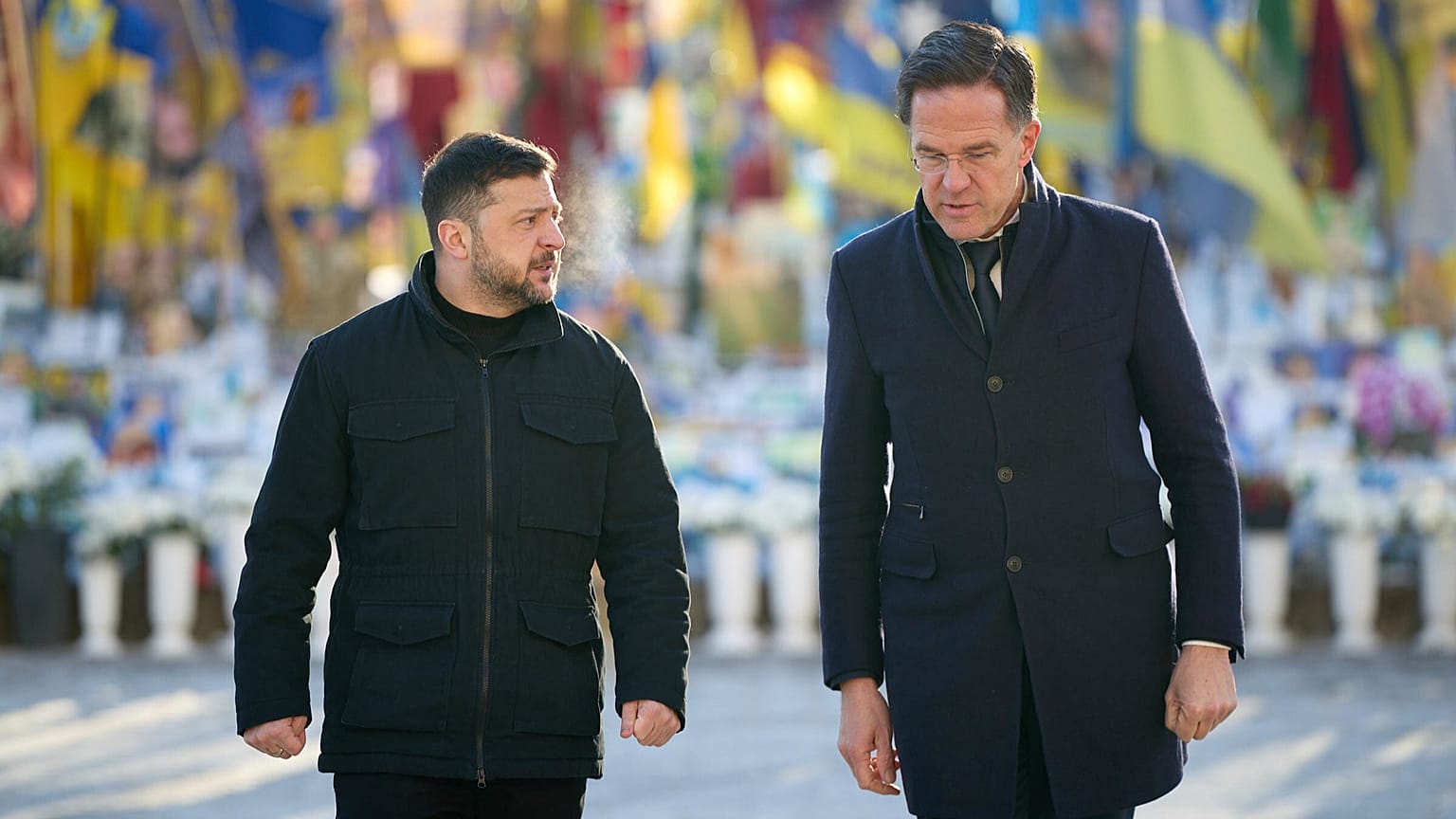
Ukrainian President Volodymyr Zelenskyy and NATO Secretary General Mark Rutte at the memorial of fallen Ukrainian soldiers at Independence Square in Kyiv, Feb. 3, 2026.
Copyright AP/Ukrainian Presidential Press Office

By Emma De Ruiter
Published on

President Volodymyr Zelenskyy, who is expected to meet with Rutte, has been appealing to members of the defence bloc for help protecting Ukraine from Russian ballistic missile attacks.

NATO chief Mark Rutte arrived in Kyiv on Wednesday for an unannounced trip, Ukraine's national railway operator said in a later deleted social media post.

It comes after a series of large-scale fatal Russian attacks on the Ukrainian capital in recent weeks.

Ukrainian President Volodymyr Zelenskyy, who is expected to meet with Rutte, has been appealing to NATO members for help protecting Ukraine from Russian ballistic missile attacks.

"Today at the Kyiv railway station, we are gladly welcoming NATO Secretary General Mark Rutte," Ukrzaliznytsia wrote in the now deleted post, alongside images of the NATO chief on the platform.

"This visit is extremely important, just like all the previous ones, because it is a gesture of solidarity and support from the Alliance for our country," Ukrzaliznytsia added.

His visit comes hours after Ukrainian drones hit energy and military sites in the northern Russian city of Saint Petersburg where officials and visiting dignitaries were gathering for a flagship economic forum.

Russian missile and drone attacks a day earlier killed 23 people in strikes on Kyiv and the eastern city of Dnipro.