Friday, June 05, 2026


U.S. Oil Shocks Don't Hit Like They Used To, Fed Study Finds

The United States still feels oil shocks. It just doesn't feel them the way it did when America was dancing to disco and waiting in gas lines. If the Fed is right, the idea that every oil shock leads to recession is outdated.

A new study from the Federal Reserve Bank of Boston finds that rising domestic oil production has fundamentally changed how higher crude prices ripple through the U.S. economy. The result is a country that remains vulnerable to energy inflation but is far less likely to suffer the kind of employment damage that accompanied the oil crises of the 1970s.

Researchers estimate that the current oil shock tied to the Iran war—a roughly 33% price shock under the Fed's methodology—would add about 1.5 percentage points to inflation over the following year. In the 1970s, a comparable shock would have pushed inflation up by roughly 2.2 percentage points.

The bigger change shows up in jobs.

According to the study, a shock of that magnitude would have reduced employment growth by about 1.8 percentage points in the 1970s. Today, that effect has largely vanished.

The reason sits beneath the shale fields of Texas, New Mexico, North Dakota, and Oklahoma.

Before the shale boom, higher oil prices mostly acted as a tax on the broader economy. Today, some regions lose while others win. The Fed found that Texas could see employment growth rise by roughly 1.7 percentage points after an oil shock, while states with little oil production, such as Massachusetts, would likely experience job losses.

The study argues that these regional offsets have become large enough to cushion the national labor market.

Another finding may be even more important for policymakers. The United States now uses less than one-third as much oil per unit of economic output as it did during the 1970s, while becoming a net exporter of petroleum products thanks largely to the shale revolution.

That has reduced the economy's overall oil dependence. It has not eliminated inflation risk.

In fact, the Fed suggests the employment side of the equation has weakened so much that future oil shocks may increasingly look like an inflation problem rather than a recession problem.

For the Federal Reserve, that's a very different headache than the one policymakers faced fifty years ago.

By Julianne Geiger for Oilprice.com


SPR Borrowers Owe Uncle Sam 40 Million Extra Barrels

The US Strategic Petroleum Reserve has taken a beating during the Iran war, but Energy Secretary Chris Wright says the government's emergency oil stash is headed for a surprisingly lucrative refill.

Companies that borrowed crude from the SPR during the conflict will return those barrels with premiums attached, leaving the reserve about 40 million barrels larger than it would have been otherwise once the war ends, Wright said Friday.

For an oil market accustomed to hearing about SPR drawdowns, emergency releases, and politically motivated sales, this is the rare case where Washington expects to get back more barrels than it handed out.

"We're not selling any barrels of oil," Wright said on Fox Business. "We're flowing oil to the marketplace in the short term when it needs it, and we're trading those barrels."

The Department of Energy has loaned roughly 133 million barrels from the reserve since the Middle East crisis erupted. Under the agreements, borrowers will return the crude plus premiums of up to 24%.

The SPR stood at 357.1 million barrels for the week ending May 29, according to weekly data published by the Energy Information Administration. That's down from roughly 415 million barrels at the beginning of March, before emergency releases accelerated as Middle East supply disruptions intensified.

Wright isn't worried.

His argument is that the SPR is doing exactly what it was built to do: move barrels when the market needs them and replenish later.

The more interesting question is whether "later" arrives before inventories become uncomfortably tight.

Commercial crude inventories remain relatively healthy at about 441 million barrels, but they have been trending lower with a quickness as global stockpiles continue to shrink. Exxon and Chevron executives have spent the past two weeks warning that inventories are approaching levels where prices can move sharply higher.

For now, Washington is betting that lending out barrels today and collecting 1.25 barrels tomorrow is a trade worth making.

It's not often the SPR earns interest.

By Julianne Geiger for Oilprice.com


India Launches 85% Ethanol Fuel to Cut Oil Import Dependence

India is launching on Friday a new fuel blend with an 85% ethanol component as part of the fuel flex mobility program of the world's third-largest crude importer to reduce dependence on imported oil.

The E85 fuel was officially launched at a ceremony in New Delhi in the presence of India's Minister of Petroleum and Natural Gas, Hardeep Singh Puri.

On Thursday, Puri launched India's first flex-fuel passenger vehicle by Maruti Suzuki in New Delhi. Flex-fuel vehicles can operate on a range of ethanol–petrol blends, from E20 up to E100.

India now has the capability to produce ethanol from multiple feedstock sources such as broken grains, agricultural waste, bamboo, and sea weed, the oil minister said.

NITI Aayog, the government's think tank, officially classifies ethanol-based Flex-Fuel Vehicles (FFVs), including vehicles running on high ethanol blends such as E85, as Zero-Emission Vehicles.

E85 fuel also produces near-zero particulate matter (PM) emissions, making flex-fuel vehicles a promising solution for addressing the country's growing air pollution challenge, the government said on Thursday.

“Flex Fuel Vehicles offer India a practical solution to reduce crude oil imports, strengthen the rural economy through ethanol demand, and advance low-carbon mobility,” Puri said during the Launch of Hero MotoCorp’s First Flex-Fuel Motorcycle in New Delhi this week.

India, which depends on Middle East’s oil supply for nearly 50% of its crude imports, has scrambled to diversify its purchases in recent months, including by boosting Russian imports to record highs amid U.S. waivers for Russian oil loaded on tankers.

The world’s most populous country has been suffering from the crisis, which has crippled not only its crude supplies, but also those of the main cooking fuel, liquefied petroleum gas (LPG). Oil marketing companies in India have raised fuel prices for the fourth time in less than a month, after holding off on price hikes for two months after the war began.

India’s economic pains are intensifying every day that the Strait of Hormuz remains closed. One of the highest-performing emerging markets in recent years is scrambling to contain the oil shock that is spreading to consumer prices, foreign exchange reserves, current accounts, and economic growth.

By Charles Kennedy for Oilprice.com

Norway Averts Offshore Strike as Workers and Industry Reach Deal

Norway has narrowly avoided a strike at offshore oil platforms after trade unions and oil companies reached an agreement on wages in the early hours on Friday.

The potential strike over wages could have threatened smooth operations offshore Norway, Western Europe's top oil and gas producer, at a time when the world is scrambling for oil and gas supply amid the Middle East crisis.

Almost 8% of oil and gas workers offshore Norway early this week threatened to go on a strike from June 5 if trade union negotiations with industry fail to reach an agreement in a government-brokered mediation process. More than 600 workers out of about 8,100 in total offshore Norway were ready to call a strike on Friday.

But a last-minute deal with the unions Styrke, Safe, and Lederne in the early hours on June 5 averts the strike following an agreement over offshore pay settlement for 8,000 offshore employees, Offshore Norway, which represented the oil industry in the wage talks, said today.

The negotiations were demanding, but "I am pleased that we have reached an agreement and avoided a strike," said Elisabeth Brattebø Fenne, Director of Industrial Relations and chief negotiator for Offshore Norge.

The industry and trade unions agreed on a general annual pay increase of $4,500 (42,000 Norwegian crowns), including offshore compensation and holiday allowance. In addition, shift and night supplements will also increase.

"By standing together, we have achieved a better result than we would have managed individually," leaders from the three trade unions said in a separate statement.

Norway produces more than 4 million barrels of oil equivalent per day, with oil and gas nearly equally divided at 2 million boepd each. Norway is shipping crude as far as Asia, which struggles without a large part of the Middle Eastern supply. Norway is also Europe's single biggest gas supplier, having replaced Russia in 2022 when Putin invaded Ukraine.

By Tsvetana Paraskova for Oilprice.com

US Presses Canada for Deeper Critical Minerals Cooperation With Ultimatum Over Slow Progress


Published on: Jun 5, 2026

U.S. Ambassador to Canada Pete Hoekstra has put forward an all-round cooperation initiative centered on critical minerals during a mining investment summit in Quebec City. In a panel discussion with Anthony Vaccaro, president of The Northern Miner Group, Hoekstra proposed deepening bilateral collaboration across critical mineral exploration, deep processing, energy infrastructure, advanced manufacturing, defence industry and Arctic resource development. He stressed that the two countries should leverage Canada’s unique resource advantages to build an integrated North American “economic fortress” and consolidate the region’s defence industrial foundation.

Hoekstra cited the decades-long successful operation of the North American Aerospace Defense Command (NORAD) as a mature template for bilateral strategic cooperation. He noted that the U.S. and Canada have built solid industrial cooperation foundations in automotive, steel and traditional energy sectors. Endowed with 34 categories of domestic critical minerals, Canada boasts top-five global reserves of niobium, potash, tellurium, titanium and uranium. Its exclusive experience in developing resource projects with Indigenous communities further cements its status as Washington’s preferred critical mineral supplier.

Alongside the cooperation proposal, Hoekstra delivered an assertive, high-pressure stance targeting Canada’s passive attitude. He revealed that Canada absented itself from the U.S.-hosted global ministerial-level critical minerals meeting and submitted few cooperation project proposals. In stark contrast, U.S. allies including Australia actively rolled out numerous feasible cooperation plans. The ambassador made it clear that though the U.S. plans to fund and launch Canadian mining projects via Defense Production Act programs, it will not wait indefinitely for Canada to align with U.S.-led strategic frameworks. He warned that the U.S. will promptly turn to Australia, South American countries and other partners to diversify its mineral supply chain if Canada fails to accelerate cooperation progress.

The bilateral cooperation has long been underpinned by complete institutional arrangements. As early as 2020, the two countries signed the Joint Action Plan on Critical Minerals Collaboration, laying a systematic foundation for cross-border industrial investment. To boost supply chain security, the U.S. has allocated over $250 million in special funds for allied mineral projects for 2024–2025 under the Defense Production Act. Meanwhile, Canada has launched its national Critical Minerals Strategy, supported by C$3.8 billion in dedicated funding to drive domestic resource industrialization.

Progress, Bottlenecks and Strategic Dynamics of US-Canada Critical Minerals Partnership

Driven by bilateral institutional mechanisms, the U.S. and Canada have achieved tangible progress in substantive investment cooperation. The two sides have jointly injected approximately $32.5 million into Canada’s strategic mineral projects, covering high-value resources such as bismuth, cobalt and graphite that serve new energy and defence industrial needs. Representative projects include Fortune Minerals’ bismuth and cobalt development scheme and Lomiko Metals’ graphite project, marking the steady landing of cross-border industrial collaboration.

Canada possesses enormous development potential in the critical minerals sector, with 67 lithium, nickel, rare earth and graphite projects currently under planning or construction, requiring a total investment of $72.4 billion by 2034. The country has also signed more than 30 international mineral cooperation agreements, unlocking $12.1 billion in mining project capital. Nevertheless, the sector faces prominent implementation bottlenecks. Most institutional agreements cannot be efficiently translated into operational mines and refining capacity, leading to slow project delivery and sluggish industrial transformation.

The U.S.-Canada critical minerals partnership features distinct strategic complementarity. For Canada, the cooperation is a key opportunity to absorb U.S. capital and tap into international markets, activating idle mineral resources and striving to become a core critical mineral supplier for Western economies. For the United States, deepening cooperation with Canada helps build a localized North American mineral supply chain, effectively hedging geopolitical risks arising from overreliance on overseas mineral sources and safeguarding domestic industrial and resource security.

Despite solid cooperation foundations and clear strategic value, bilateral interest contradictions have brought great uncertainty to future collaboration. The U.S. focuses on quickly obtaining stable mineral supplies and advancing regional industrial localization, with sufficient alternative global cooperation resources in reserve. In comparison, Canada aims to cultivate independent domestic deep-processing industries through cross-border cooperation, rather than becoming a mere raw material exporter. The conflicting core interests, coupled with the U.S.’s tough and opportunistic stance, mean that the follow-up advancement of US-Canada critical minerals cooperation will continue to face challenges and volatility.


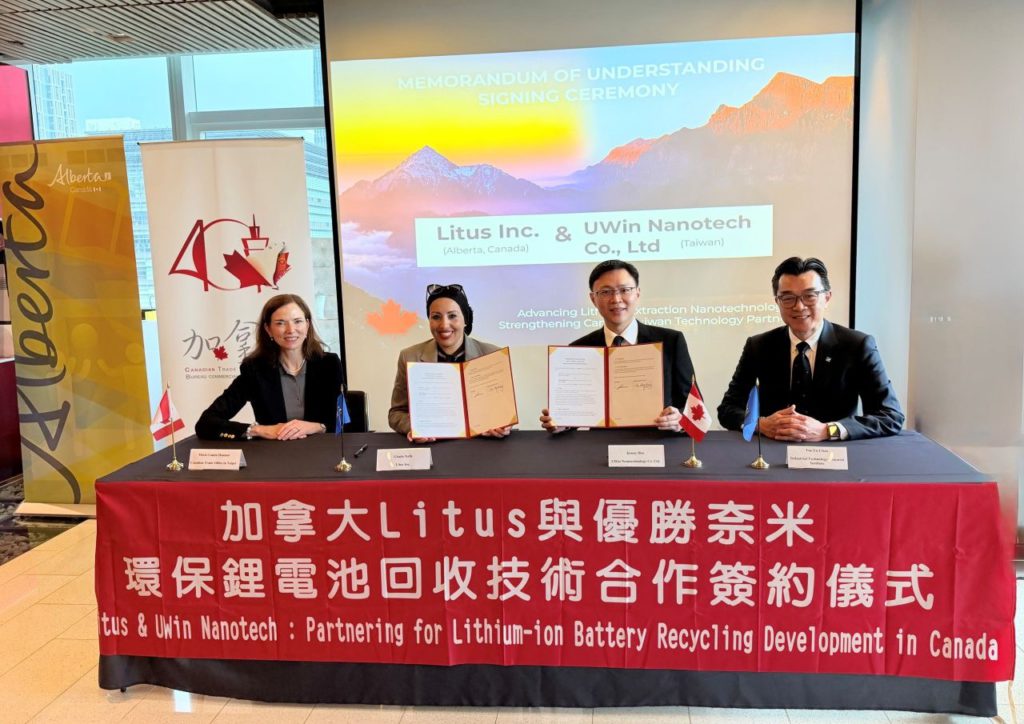
Litus, Uwin Nanotech to collaborate on critical minerals recovery tech


Litus and UWin representatives at the MOU signing. Image supplied.

Calgary-based critical minerals extraction company Litus has partnered with Taiwan’s UWin Nanotech Co. to explore battery metals recovery solutions incorporating both companies’ technologies.

Under a memorandum of understanding signed on May 25, the companies will collaborate on the selective extraction, separation, recovery and purification of cobalt, lithium, nickel, and other valuable elements from recycling sources.

The partners will explore the use of Litus’ proprietary nanomaterial composite and advanced separation processes, including applications in battery recycling, and the potential recovery of additional critical minerals and rare earth elements.

Litus’ flagship technology, Litus LiNC, is a patented, one-step direct lithium extraction platform designed to economically recover lithium from both low and high-concentration brines, including brines that have previously been considered uneconomical.

The MOU also supports Litus’ broader strategy to integrate lithium extraction and lithium recycling through advanced materials science. For this, it has developed a ReLiGN recycling platform designed to transform discarded batteries from waste into a renewable domestic source of critical minerals.

These technologies will be integrated with UWin’s advanced hydrometallurgy technologies for precious metals recovery, e-waste recycling, Li-ion battery recycling, air pollution treatment and industrial applications with environmental-friendly chemicals. UWin has been a certified Apple supplier for recycling since 2020.

“This MOU reflects the growing global demand for advanced processing technologies that can recover lithium and other valuable materials efficiently, selectively and with lower environmental impact. By combining Litus’ nanotechnology platforms with UWin’s hydrometallurgy technology expertise, we see strong potential to accelerate the development of scalable, circular critical mineral supply chains,” Dr. Ghada Nafie, founder and CEO of Litus, said in the May press release.


Botswana turns to UAE, Oman in De Beers power play


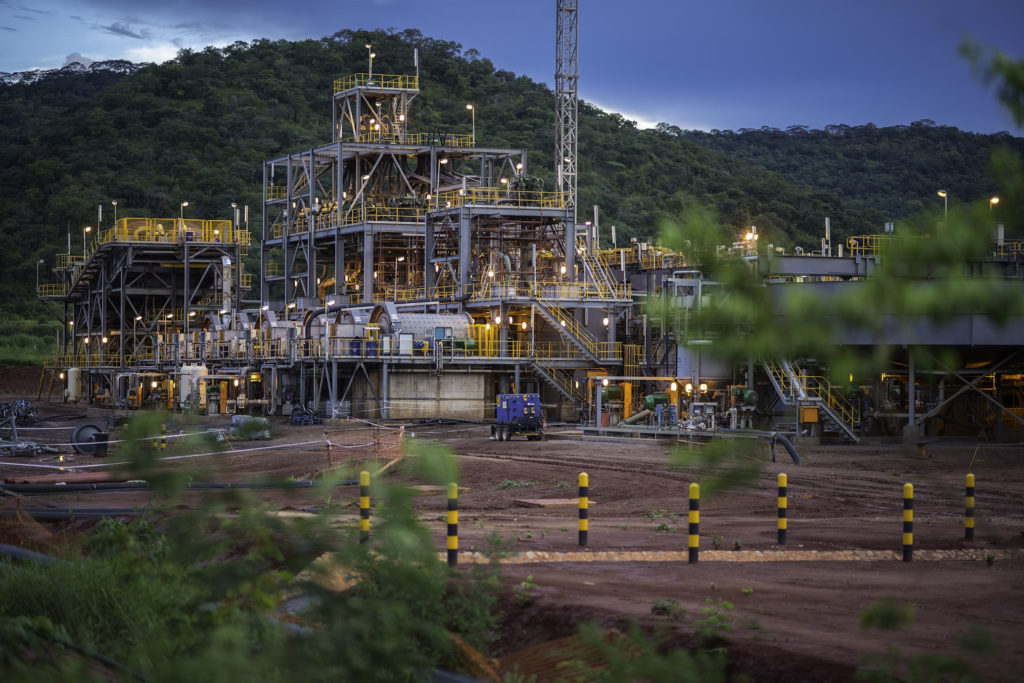
Orapa, meaning “resting place for lions”, has been operating since 1971. (Image courtesy of Debswana.)

Botswana is courting the United Arab Emirates and Oman as potential partners in a bid to acquire a strategic stake in De Beers from Anglo American (LON:AAL), a move that could give the diamond-dependent nation greater influence over the industry’s future.

President Duma Boko said on Friday that Botswana was seeking dependable, reputable partners as Anglo American advances the sale of its 85% stake in the 138-year-old diamond producer. Boko travelled to Oman earlier this year after revealing discussions with a sovereign wealth fund there about financing a purchase of a controlling interest in De Beers.


“We are looking at reliable, trusted partners,” Boko told Bloomberg News. “The Omanis and the UAE have now claimed that spot. So any opportunity that comes whether in the diamond space or other, we will now be looking to engage with them.”

Botswana has also held discussions with neighbouring Namibia and Angola as it explores ways to increase its influence over De Beers.

Diamond slump

The push comes as Botswana seeks a greater role in managing an industry that remains central to its economy. Diamonds generate about 80% of the country’s exports and roughly one-quarter of gross domestic product. Botswana is also the world’s largest producer of rough diamonds.

The sector has been severely hit by falling prices, weaker Chinese demand, competition from lab-grown stones and uncertainty linked to US tariffs. The downturn has strained Botswana’s finances and contributed to a credit-rating downgrade by S&P Global Ratings this year.

Botswana already owns 15% of De Beers and holds pre-emptive rights over Anglo’s stake. However, analysts say the size of any future holding will depend on regulatory approvals, antitrust reviews and negotiations with competing bidders.

Anglo exit

Anglo is selling De Beers as part of a sweeping restructuring after fending off a $49-billion takeover attempt by BHP (ASX, LON: BHP) in 2024. The mining giant has since refocused on copper and iron ore and is shedding businesses outside those priorities.

Earlier this year, Anglo reduced De Beers’ book value to $2.3 billion, reflecting the prolonged weakness in diamond markets. The company mines most of its diamonds in Botswana, making the sale one of the most consequential transactions in the industry’s history.

Mozambique tightens grip on mining with 15% state stake rule, local processing


Balama graphite operation in Mozambique. Credit: Syrah Resources

Mozambique’s President Daniel Chapo has signed a new law requiring 15% state ownership in all mining ventures and local processing of minerals, tightening control over its resources as demand for battery materials grows.

Mozambique is the world’s third-largest graphite producer, a key material used in batteries for electric vehicles and energy storage.

The mining law, approved by Parliament in May, aims to strengthen Mozambique’s “management of strategic resources in defence of the national interest,” according to a government notice dated June 3.


“The state, through the National Mining Company (ENM), shall have a minimum, free‑carried and non‑dilutable participation of 15% in all mining projects, at any stage of the value chain,” reads part of the new law seen by Reuters on Thursday.

It was not immediately clear whether the new rules would apply to existing mines, which are mostly covered by long-term agreements.

The mines ministry was not immediately available to comment.

The move places Mozambique among a growing number of African countries, including top continental lithium producer Zimbabwe and the Democratic Republic of Congo, the world’s leading cobalt producer and major global copper supplier, which are tightening control over raw exports for greater economic benefit from their resources.


Mozambique has one of the largest graphite deposits in the world at Syrah Resources’ Balama operations in the north of the country. According to the US Geological Survey, China and Madagascar are the top two producers.

The world’s largest ruby mine, Montepuez, owned by Gemfields, is also located in northern Mozambique and the country also has significant coal assets previously owned by Rio Tinto and Brazil’s Vale.


The new regulations prohibit the export of unprocessed or semi‑processed mineral products, except where they are covered by a specific ministerial authorization, based on approved plans to eventually process locally.

(By Custodio Cossa, Manuel Mucari and Nelson Banya; Editing by Elaine Hardcastle)

Zn

Ivanhoe sets new monthly zinc record at Congo mine


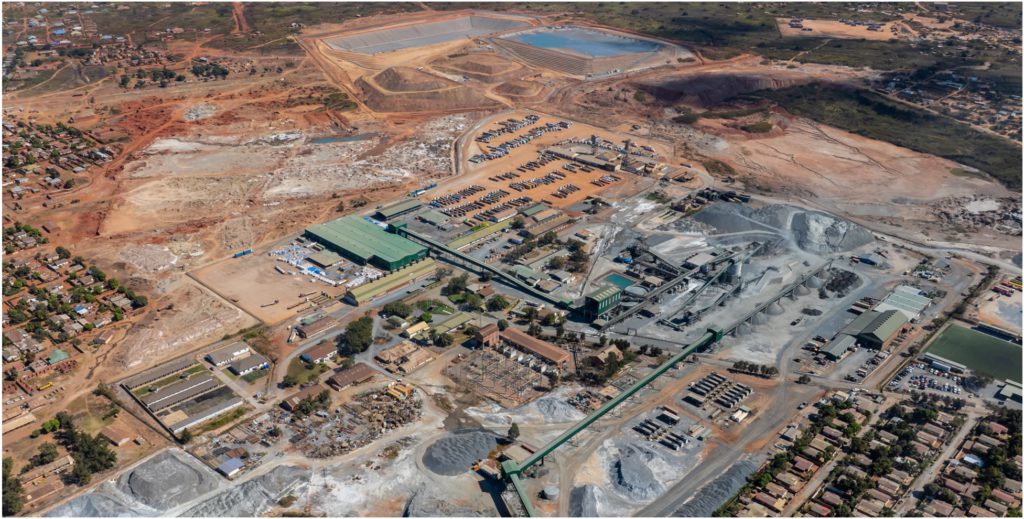
Aerial view over the Kipushi mine. Credit: Ivanhoe Mines

Ivanhoe Mines (TSX: IVN) says its Kipushi zinc mine in the Democratic Republic of the Congo has set a new monthly production record and is on track to meet its full-year guidance.

The mine, located 30 km southwest of Lubumbashi, produced 25,677 tonnes of zinc concentrates last month, beating its previous monthly record of 22,968 tonnes from January by 12%, the Vancouver-based miner said in a press release on Thursday.

During May, the Kipushi concentrators milled a record 72,003 tonnes of ore at an average recovery of 93%, with an average plant feed grade of 36.2% zinc.

With the May results, Kipushi’s year-to-date zinc production is now estimated at 110,000 tonnes, which, if annualized, would be near the midpoint of the company’s 2026 guidance range of 240,000-290,000 tonnes.

‘Fourth-largest’ producer

At this production rate, the Kipushi mine would elevate its status and become the world’s fourth-largest zinc producer this year, Ivanhoe said in the release.

The company also updated its progress on the mine’s tailings storage expansion, noting that construction of the second tailings storage facility is now 90% complete, with the first deposit of tailings expected from October 2026.

Ivanhoe Mines’ shares gained 2.8% by midday Thursday on the announcement, giving it a market capitalization of C$18.2 billion ($13.1 billion).

The results come amid a surprisingly strong zinc market, with prices hovering near four-year highs despite analysts projecting a significant supply surplus following a surge in global mine production in 2025. In London, the base metal is trading close to $3,630/t, a level last seen in June 2022.

The Kipushi mine, owned 62% by Ivanhoe and 38% by Congo’s state mining company GĂ©camines, returned to production in 2024, exactly 100 years since the operation first started. Before Ivanhoe entered the project in 2011, the Kipushi mine had been sitting idle for nearly two decades.

Pt

China-backed South African platinum project to cut 70% of workforce


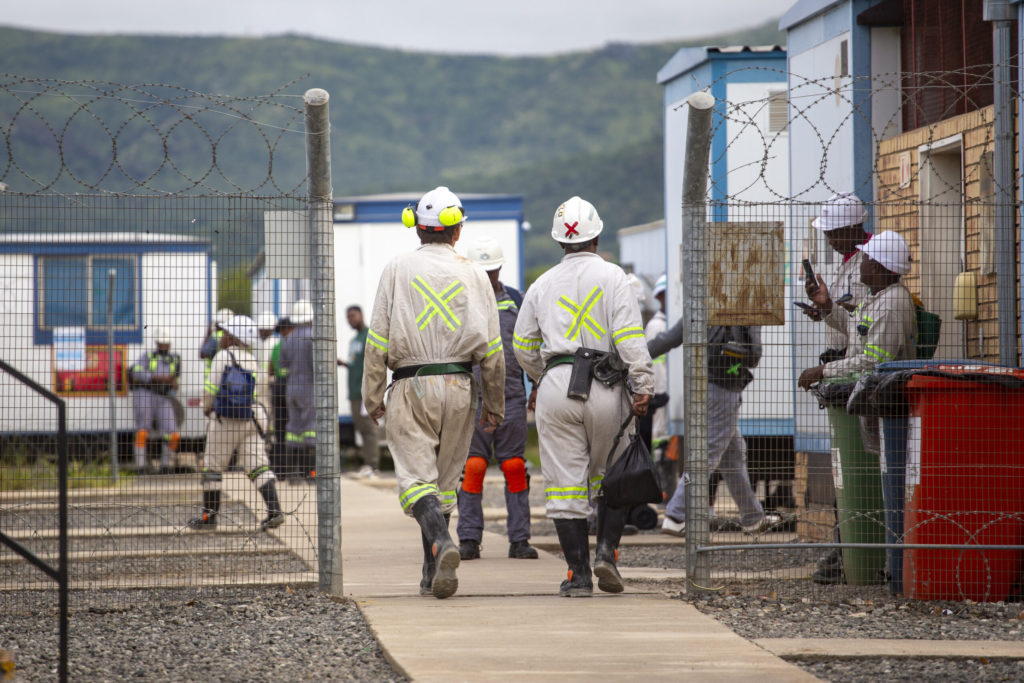
Credit: Wesizwe Platinum

Wesizwe Platinum will lay off nearly 500 workers, or around 70% of the workforce, at its Bakubung mine in South Africa, it said on Thursday, as it shifts from phased development of the delayed project to a single-stage ramp up.

While South Africa accounts for more than 70% of the global supply of the metal used in autocatalysts that reduce vehicle exhaust emissions, new platinum projects like Bakubung are increasingly rare.

Platinum miners are apprehensive about expanding production as the industry faces a long-term threat from electric vehicles, which do not require autocatalyst metals.

Chinese-backed Wesizwe is abandoning its original plan for a phased ramp-up for Bakubung that would have started with 1  million metric tons of annual production.

The project, which has been in development for around 15 years, will now follow a single-stage ramp-up to 3.5 million tons per year, Wesizwe said in a statement.

“This revised strategy will necessitate a reduction in the number of employees required to establish and sustain the production profile contemplated in the updated business plan,” the company said.

“The proposed restructuring is expected to affect approximately 497 employees across various staff levels and disciplines throughout the business,” it added.

Wesizwe, whose anchor shareholder is China-Africa Jinchuan Investment, said maintaining the current headcount of 706 employees would not be sustainable.

The Bakubung platinum project is running behind its production schedule due to a combination of factors including funding delays, Covid-19 disruptions, labour unrest, community protests and a cyberattack.

Wesizwe did not offer a timeframe for when the project might enter production under the new plan.

(By Nelson Banya; Editing by Joe Bavier)


Russian Platinum plans November launch of Arctic mine

The Chernogorskoye platinum group metals deposit in Siberia (Credit: Russian Platinum)

Russian Platinum plans to start production at its Arctic polymetallic project in November, the company’s owner said on Thursday.

Currently only metals giant Nornickel produces platinum group metals in Russia.

Russian Platinum had planned to launch the first stage of the project in 2024, but postponed it due to difficulties accessing equipment amid Western sanctions.

“We expect to obtain our first output in November this year,” Musa Bazhaev said at the St Petersburg Economic Forum.

The company has licences for the Chernogorskoye deposit and the southern part of the Norilsk‑1 deposit, which contain copper‑nickel ores with high platinum group metal content mainly used in emissions‑control catalysts and electronics.

These deposits are located near Nornickel’s core assets and the companies agreed in 2018 to create a PGM alliance, but it collapsed in 2020 due to opposition from Rusal, one of Nornickel’s biggest shareholders. After that, the parties signed five‑year offtake agreements in 2021 for concentrate supplies from the Chernogorsky plant to Nornickel’s Global Palladium Fund.

Nornickel, the world’s largest palladium producer with around a 40% market share, said in a market review late last year that Russian Platinum’s project could add about 0.5 million ounces of palladium and 0.2 million oz of platinum to Russia’s output annually.

Capital expenditure on Russian Platinum’s project has already reached 500 billion roubles ($6.72 billion), Interfax reported, citing Bazhaev.

Bazhaev said a second phase of the project is expected to bring on stream the southern part of Norilsk‑1, with output reaching 15 million tons of ore and 55 tons of PGMs annually.

That would make Russian Platinum a major global supplier, Bazhaev said, but did not give a timeframe for when the second phase would start operations.

He also said Russian Platinum could return to partnership discussions with Nornickel.

($1 = 74.3500 roubles)

(By Anastasia Lyrchikova; Editing by Susan Fenton)