'Whoo!' Data guru warns 'rural revolt' is turning 'field of dreams' into Trump nightmare
Travis Gettys
June 5, 2026
RAW STORY
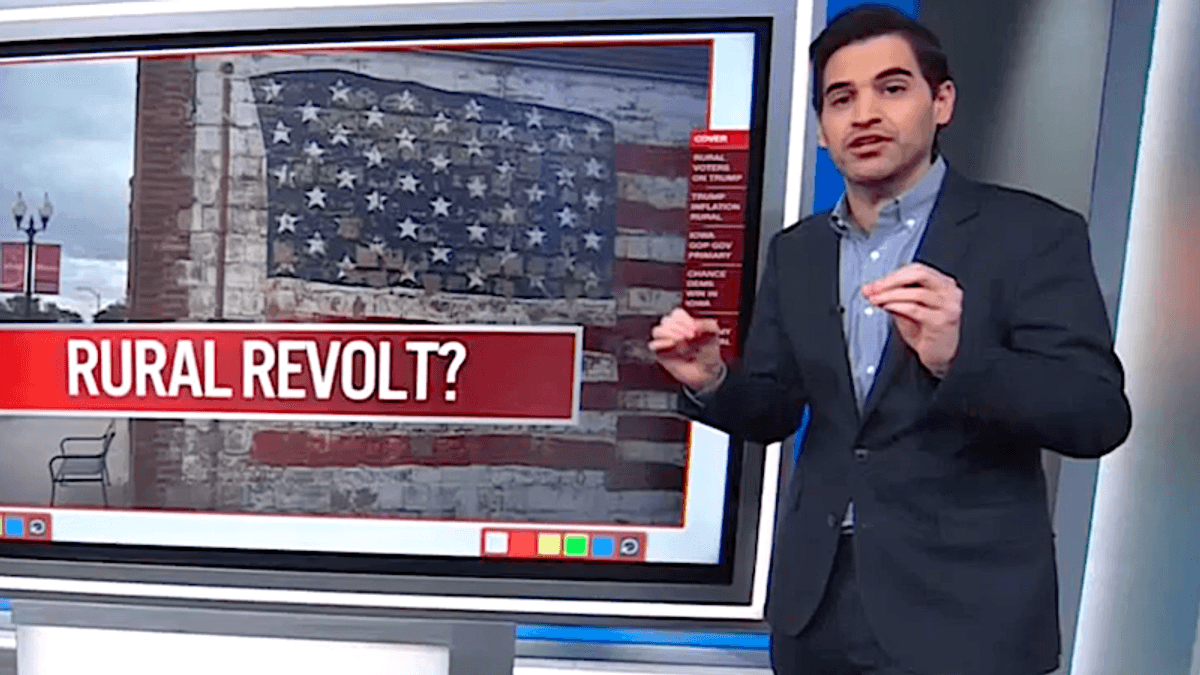
Harry Enten/CNN
President Donald Trump is facing a "rural revolt" as a result of his policies, according to a new data analysis.
The soon-to-be-80-year-old president was re-elected in 2024 on his promise to improve the economy, but voters aren't happy with the job he's done so far, and many of his policies are directly hurting farmers and voters in the rural areas that have backed him in all three elections.
"Iowa has been traditionally a field of dreams for the president of United States," said CNN's Harry Enten. "But it's quickly turning into potentially a field of nightmares. There seems to be a rural revolt going on in this country against Donald Trump. Take a look here: Rural voters and Trump, look, according to Fox News, he was easily winning them back in October of 2024 versus Kamala Harris, 18 points ahead. The exit poll even had it a bigger margin."
"But look at where he is now – whoo!" Enten exclaimed. "Down there underwater, underneath the cornfields. He's now 14 points underwater. That's over a 30-point switcheroo against the president."
The explanation for that reversal is fairly simple, according to Enten.
"Simply put, it's the economy, it's inflation," he said. "Take a look at this: You thought that that switcheroo was big, how about this one? Rural voters on Trump and inflation versus Kamala Harris. He was more trusted by 37 points. Now he is 19 points underwater with rural voters on inflation. That is an over 50-point switcheroo against the president of the United States. Rural voters, like the rest of the country, turning against Trump on the key issue that got him elected to a second term back in 2024."
Anger at the president has flowed down ballot to Republican congressional candidates and gubernatorial races, Enten said.
"You know, Donald Trump went and he has won all of these primaries," he said. "The candidates he endorsed have won all of these primaries, did not happen in Iowa. Well, just talk about Iowa Republicans here. The gubernatorial primary he endorsed Randy Feenstra, congressman from Iowa, and Feenstra actually won the absentee vote in that state by 15 points. Trump endorsed late, but the other candidate, Zach Lahn, look at this, he actually won those who voted on Election Day who knew about Trump's endorsement. In fact, they were considerably more favorable to Lahn than they were in a Feenstra, even after knowing that Trump had, in fact, backed Feenstra."
"It seemed to me that Iowa Republicans said, 'You know what, we hear you, Donald Trump, but you know what? We're dismissing that message,' again, part of a larger picture in my mind of rural voters not tuning in to what Donald Trump is telling him at this point," Enten added.
That shift against Trump is boosting Democratic chances in the midterm elections, Enten said.
"The last Democrat to win a Senate race in Iowa was all the way back in 2008," Enten said. "It was Tom Harkin. But what do we see here in terms of the Democrats' chances in Iowa and the governor's race and the Senate race? They have gone up like a rocket. We're now talking about Rob Sands running for governor with a greater than 50 percent chance, and it turns out that Josh Turek, who the Democratic establishment wanted, his chances have also been considerably rising at this point."
"If all of a sudden you're able to put Iowa on the board, if you're a Democrat hoping to win back control of the United States Senate, that would be a massive piece of the puzzle, and the last time Iowa elected a Democratic governor was all the way back in 2006, and that looks like a more likely possibility than not," Enten added.
Travis Gettys
June 5, 2026
RAW STORY
Harry Enten/CNN
President Donald Trump is facing a "rural revolt" as a result of his policies, according to a new data analysis.
The soon-to-be-80-year-old president was re-elected in 2024 on his promise to improve the economy, but voters aren't happy with the job he's done so far, and many of his policies are directly hurting farmers and voters in the rural areas that have backed him in all three elections.
"Iowa has been traditionally a field of dreams for the president of United States," said CNN's Harry Enten. "But it's quickly turning into potentially a field of nightmares. There seems to be a rural revolt going on in this country against Donald Trump. Take a look here: Rural voters and Trump, look, according to Fox News, he was easily winning them back in October of 2024 versus Kamala Harris, 18 points ahead. The exit poll even had it a bigger margin."
"But look at where he is now – whoo!" Enten exclaimed. "Down there underwater, underneath the cornfields. He's now 14 points underwater. That's over a 30-point switcheroo against the president."
The explanation for that reversal is fairly simple, according to Enten.
"Simply put, it's the economy, it's inflation," he said. "Take a look at this: You thought that that switcheroo was big, how about this one? Rural voters on Trump and inflation versus Kamala Harris. He was more trusted by 37 points. Now he is 19 points underwater with rural voters on inflation. That is an over 50-point switcheroo against the president of the United States. Rural voters, like the rest of the country, turning against Trump on the key issue that got him elected to a second term back in 2024."
Anger at the president has flowed down ballot to Republican congressional candidates and gubernatorial races, Enten said.
"You know, Donald Trump went and he has won all of these primaries," he said. "The candidates he endorsed have won all of these primaries, did not happen in Iowa. Well, just talk about Iowa Republicans here. The gubernatorial primary he endorsed Randy Feenstra, congressman from Iowa, and Feenstra actually won the absentee vote in that state by 15 points. Trump endorsed late, but the other candidate, Zach Lahn, look at this, he actually won those who voted on Election Day who knew about Trump's endorsement. In fact, they were considerably more favorable to Lahn than they were in a Feenstra, even after knowing that Trump had, in fact, backed Feenstra."
"It seemed to me that Iowa Republicans said, 'You know what, we hear you, Donald Trump, but you know what? We're dismissing that message,' again, part of a larger picture in my mind of rural voters not tuning in to what Donald Trump is telling him at this point," Enten added.
That shift against Trump is boosting Democratic chances in the midterm elections, Enten said.
"The last Democrat to win a Senate race in Iowa was all the way back in 2008," Enten said. "It was Tom Harkin. But what do we see here in terms of the Democrats' chances in Iowa and the governor's race and the Senate race? They have gone up like a rocket. We're now talking about Rob Sands running for governor with a greater than 50 percent chance, and it turns out that Josh Turek, who the Democratic establishment wanted, his chances have also been considerably rising at this point."
"If all of a sudden you're able to put Iowa on the board, if you're a Democrat hoping to win back control of the United States Senate, that would be a massive piece of the puzzle, and the last time Iowa elected a Democratic governor was all the way back in 2006, and that looks like a more likely possibility than not," Enten added.
Trump got a 'flashing red sign' with new Fox News poll: 'Big, big problem'
Nicole Charky-Chami
June 4, 2026
RAW STORY
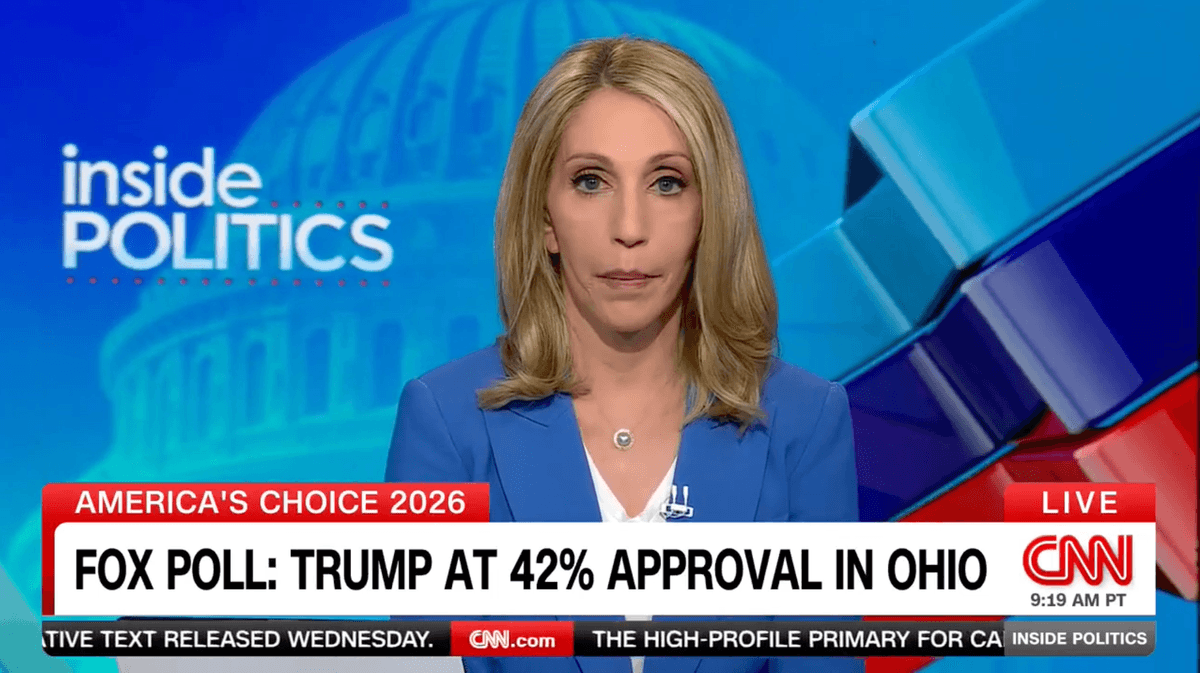
CNN anchor Dana Bash reported on Thursday that President Donald Trump's approval rating in Ohio had slipped as midterms were approaching. (CNN/Screenshot)
A new Fox News poll could signal a serious problem for President Donald Trump, CNN anchor Dana Bash reported on Thursday.
Bash referred to new polling from Fox News showing Ohio's Senate race could put Republicans in a tough position ahead of the midterm elections after Trump's approval rating has appeared to drop.
"That is a big flashing red sign for the president and for the Republicans on the ballot in this very red state of Ohio," Bash said. "This is the president's approval rating in Ohio right now. It is 42 percent, 42 percent approval. And the disapproval is 57 percent."
That's now a 15-point deficit, Bash explained.
"And then in November, the disapproval was 57 and 46 percent. And that is a 6 percent. So this is really a big, big problem potentially for the president," Bash said.
Republican incumbent Senator Jon Husted was reportedly viewed less favorably by voters compared to his Democratic challenger, former Ohio Senator Sherrod Brown, according to the poll.
Nicole Charky-Chami
June 4, 2026
RAW STORY
CNN anchor Dana Bash reported on Thursday that President Donald Trump's approval rating in Ohio had slipped as midterms were approaching. (CNN/Screenshot)
A new Fox News poll could signal a serious problem for President Donald Trump, CNN anchor Dana Bash reported on Thursday.
Bash referred to new polling from Fox News showing Ohio's Senate race could put Republicans in a tough position ahead of the midterm elections after Trump's approval rating has appeared to drop.
"That is a big flashing red sign for the president and for the Republicans on the ballot in this very red state of Ohio," Bash said. "This is the president's approval rating in Ohio right now. It is 42 percent, 42 percent approval. And the disapproval is 57 percent."
That's now a 15-point deficit, Bash explained.
"And then in November, the disapproval was 57 and 46 percent. And that is a 6 percent. So this is really a big, big problem potentially for the president," Bash said.
Republican incumbent Senator Jon Husted was reportedly viewed less favorably by voters compared to his Democratic challenger, former Ohio Senator Sherrod Brown, according to the poll.
Trump cuts interview short as rain pounds metal barn roof and he clashes with host
Bennito L. Kelty
June 5, 2026
Bennito L. Kelty
June 5, 2026
RAW STORY
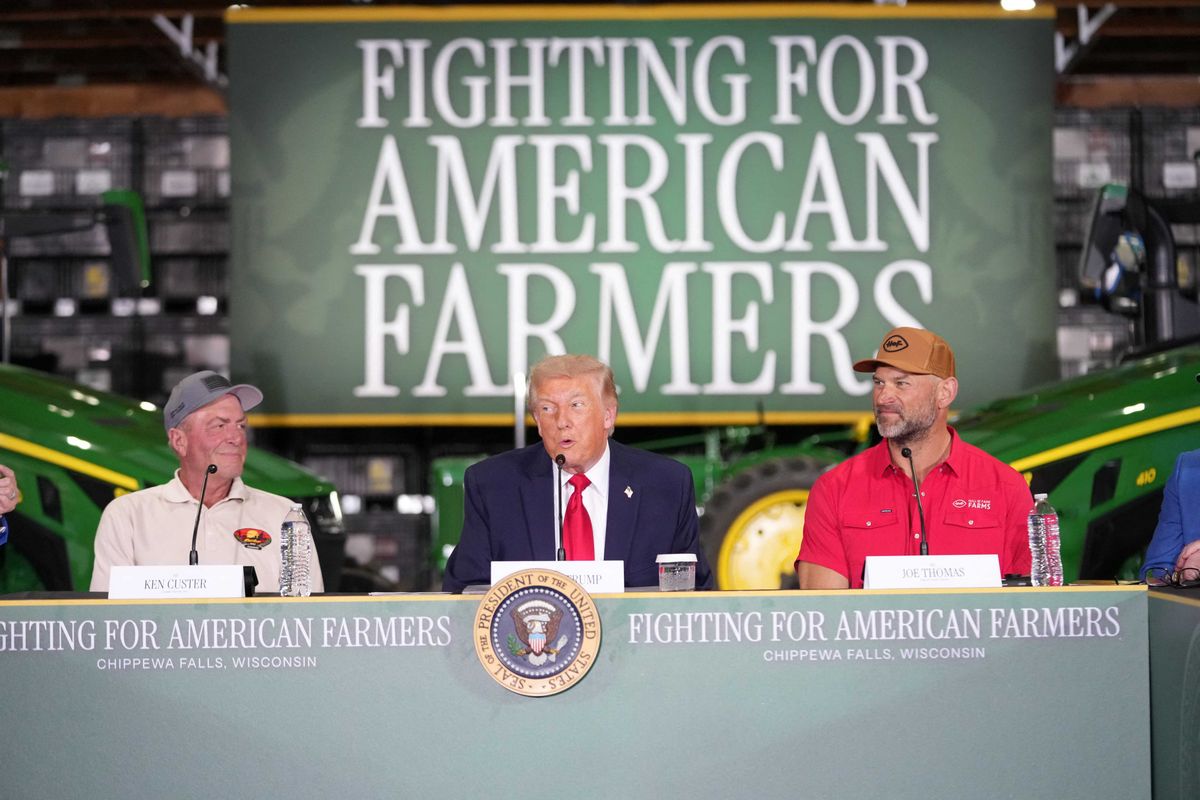
U.S. President Donald Trump speaks during an event at Custer Farms in Chippewa Falls, Wisconsin, U.S., June 5, 2026. REUTERS/Nathan Howard
Trump cut short an interview with NBC News as the sound of rain on a barn's metal roof kept interrupting, journalists shared.
Gabe Gutierrez, a senior White House correspondent for NBC News, revealed that the interview took place inside a Wisconsin barn "at the request of the White House," Gutierrez noted, but "rain repeatedly was hitting the metal roof of the barn."
Kristen Welker and others from the NBC News' Meet the Press team were conducting the interview with Trump, Gutierrez said.
"Trump ended an interview about fifty minutes after it began," following "multiple interruptions" from the rain. He also "disagreed" with questions during a "back and forth about election integrity" before ending the interview.
Trump reportedly showed up to planned events in Wisconsin in a bad mood.
U.S. President Donald Trump speaks during an event at Custer Farms in Chippewa Falls, Wisconsin, U.S., June 5, 2026. REUTERS/Nathan Howard
Trump cut short an interview with NBC News as the sound of rain on a barn's metal roof kept interrupting, journalists shared.
Gabe Gutierrez, a senior White House correspondent for NBC News, revealed that the interview took place inside a Wisconsin barn "at the request of the White House," Gutierrez noted, but "rain repeatedly was hitting the metal roof of the barn."
Kristen Welker and others from the NBC News' Meet the Press team were conducting the interview with Trump, Gutierrez said.
"Trump ended an interview about fifty minutes after it began," following "multiple interruptions" from the rain. He also "disagreed" with questions during a "back and forth about election integrity" before ending the interview.
Trump reportedly showed up to planned events in Wisconsin in a bad mood.
Hardcore Trump backer sweats as farmers threaten to flip his seat blue
Travis Gettys
June 5, 2026
Travis Gettys
June 5, 2026
RAW STORY
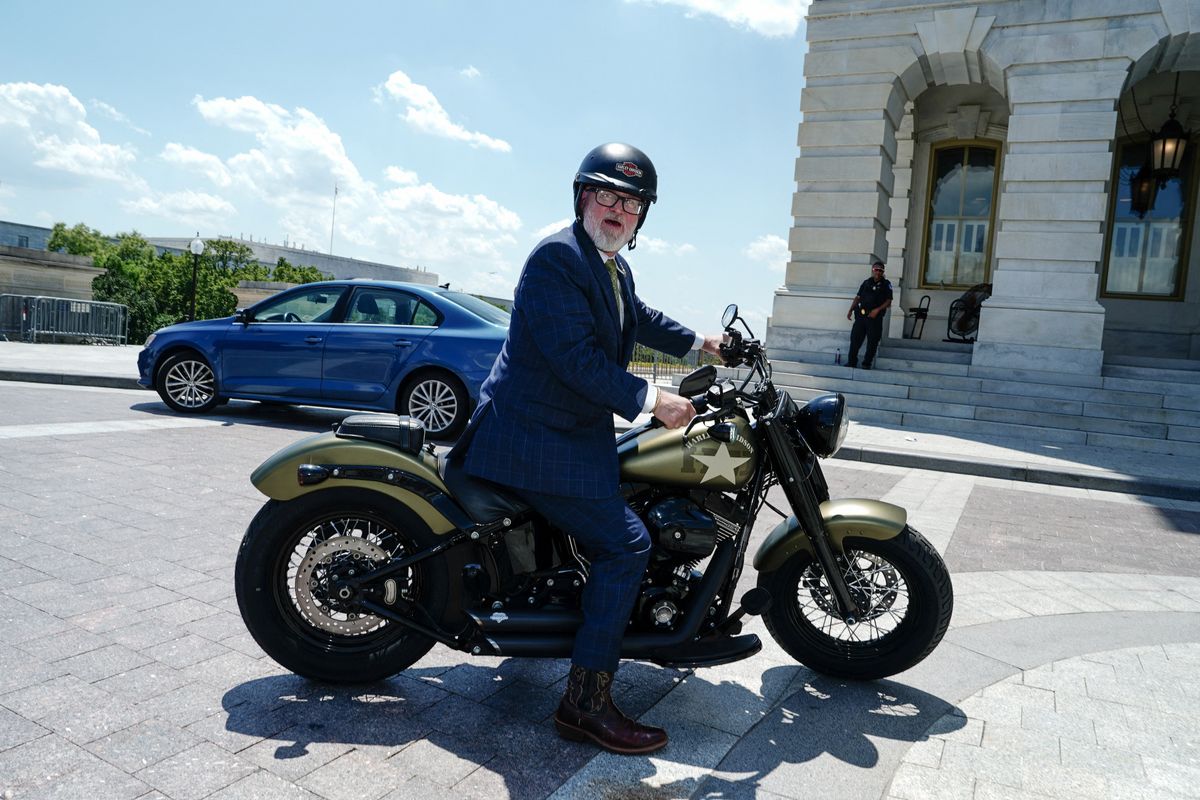
U.S. Representative Derrick Van Orden (R-WI) sits on a motorcycle outside the U.S. Capitol after the U.S. House of Representatives voted to pass U.S. President Donald Trump's sweeping spending and tax bill, on Capitol Hill in Washington, D.C., U.S., July 3, 2025. REUTERS/Ken Cedeno
President Donald Trump is heading to Wisconsin to campaign for Rep. Derrick Van Orden, a third-term incumbent whose rural district is being squeezed by the policies he has spent two years defending.
Van Orden represents Wisconsin's 3rd Congressional District, a stretch of farm country that produces more milk than most states and depends on roughly 17,000 farms to drive its broader economy. Politico reported that the region is directly impacted by Trump's tariff regime, rising fuel and fertilizer costs and trade disruptions caused by the war with Iran.
“I think [farmers] are growing frustrated with Trump’s administration for which Van Orden is a huge cheerleader,” said beef producer Max Hart. "They probably can't bear to vote for a Democrat. But they probably don't support Trump or Van Orden's policies."
The Cook Political Report recently moved the race from lean-Republican to a tossup. Van Orden's likely Democratic opponent, Rebecca Cooke, has outraised him and secured a spot in the Democratic Congressional Campaign Committee's Red to Blue program, which channels money and organizational support to candidates positioned to flip GOP-held seats.
The White House has responded with an unusual level of intervention. Agriculture Secretary Brooke Rollins is making her second appearance alongside Van Orden in less than six weeks, and Robert F. Kennedy Jr. held a press conference inside a machine shed earlier this week. Trump's visit Friday will be framed around his administration's support for farmers, with the White House touting lower input costs, new trade markets and expanded rural opportunity zones.
Whether any of it will be enough is an open question. A Marquette Law School poll conducted in March found that 60 percent of Wisconsin voters believe Trump's tariffs are hurting farmers. In the western part of the state, which includes Van Orden's district, that figure rose to 67 percent.
"If farmers are struggling, it just boils down to everybody else," said Darin Von Ruden, president of the Wisconsin Farmers Union. "The bankers, the vets, the supply stores — all are impacted by what's happening at the farm level."
Van Orden has defended the administration's record and voiced support for the Iran war, arguing that prices will stabilize once the conflict concludes, but Cooke senses that the agricultural community is losing patience.
“When I’m talking to people at a dairy breakfast or at a county fair, I don’t usually lead with ‘I’m Rebecca Cooke and I’m a Democrat,’ because they walk right by me,” she said. “But if I introduce myself and I say, ‘I’m Rebecca Cooke, I grew up on a dairy farm … we need more folks in the middle willing to get things done, avoiding the chaos,’ [then] most people nod their head.”
U.S. Representative Derrick Van Orden (R-WI) sits on a motorcycle outside the U.S. Capitol after the U.S. House of Representatives voted to pass U.S. President Donald Trump's sweeping spending and tax bill, on Capitol Hill in Washington, D.C., U.S., July 3, 2025. REUTERS/Ken Cedeno
President Donald Trump is heading to Wisconsin to campaign for Rep. Derrick Van Orden, a third-term incumbent whose rural district is being squeezed by the policies he has spent two years defending.
Van Orden represents Wisconsin's 3rd Congressional District, a stretch of farm country that produces more milk than most states and depends on roughly 17,000 farms to drive its broader economy. Politico reported that the region is directly impacted by Trump's tariff regime, rising fuel and fertilizer costs and trade disruptions caused by the war with Iran.
“I think [farmers] are growing frustrated with Trump’s administration for which Van Orden is a huge cheerleader,” said beef producer Max Hart. "They probably can't bear to vote for a Democrat. But they probably don't support Trump or Van Orden's policies."
The Cook Political Report recently moved the race from lean-Republican to a tossup. Van Orden's likely Democratic opponent, Rebecca Cooke, has outraised him and secured a spot in the Democratic Congressional Campaign Committee's Red to Blue program, which channels money and organizational support to candidates positioned to flip GOP-held seats.
The White House has responded with an unusual level of intervention. Agriculture Secretary Brooke Rollins is making her second appearance alongside Van Orden in less than six weeks, and Robert F. Kennedy Jr. held a press conference inside a machine shed earlier this week. Trump's visit Friday will be framed around his administration's support for farmers, with the White House touting lower input costs, new trade markets and expanded rural opportunity zones.
Whether any of it will be enough is an open question. A Marquette Law School poll conducted in March found that 60 percent of Wisconsin voters believe Trump's tariffs are hurting farmers. In the western part of the state, which includes Van Orden's district, that figure rose to 67 percent.
"If farmers are struggling, it just boils down to everybody else," said Darin Von Ruden, president of the Wisconsin Farmers Union. "The bankers, the vets, the supply stores — all are impacted by what's happening at the farm level."
Van Orden has defended the administration's record and voiced support for the Iran war, arguing that prices will stabilize once the conflict concludes, but Cooke senses that the agricultural community is losing patience.
“When I’m talking to people at a dairy breakfast or at a county fair, I don’t usually lead with ‘I’m Rebecca Cooke and I’m a Democrat,’ because they walk right by me,” she said. “But if I introduce myself and I say, ‘I’m Rebecca Cooke, I grew up on a dairy farm … we need more folks in the middle willing to get things done, avoiding the chaos,’ [then] most people nod their head.”
Trump agriculture secretary shocked by her agency’s own data at live hearing

U.S. Secretary of Agriculture Brooke Rollins testifies before the House Committee on Agriculture on Capitol Hill in Washington, D.C., U.S., June 4, 2026. REUTERS/Evan Vucci
U.S. Secretary of Agriculture Brooke Rollins testifies before the House Committee on Agriculture on Capitol Hill in Washington, D.C., U.S., June 4, 2026. REUTERS/Evan Vucci
June 04, 2026
ALTERNET
Secretary of Agriculture Brooke Rollins struggled on Thursday during a House Agriculture Committee hearing when asked basic questions about her department's own data.
Rep. Angie Craig, a member of the Democratic–Farmer–Labor Party in Minnesota, probed Rollins about allegations of fraud involving recipients of SNAP benefits, formerly known as food stamps. Rollins tried to parrot conservative talking points, but got a little mixed up with the data coming from her own department.
Craig hammered Rollins on how many farms have failed in the past year
She then moved on to ask whether Rollins knows that "farmers say they can't afford fertilizer as a result of the president's war in Iran?"
Rollins claimed that it differed by geographic region, implying that some farmers have one demand while others have another.
A frustrated Craig asserted, "Oh, my gosh! Seventy percent is the answer."
Then she pivoted to SNAP benefits, with the committee's top Democrat asking whether Rollins knew the fraud rate among SNAP recipients.
Rollins said that the data is based on information that is "missing from the states that we can't verify. That's the whole point of this is with no ability to verify California, Minnesota—"
Craig cut in, "1.6 percent according to USDA."
Rollins claimed that Minnesota is reporting a low fraud rate, which she considers "an absolute joke."
"I'll say it again. The USDA's own data found 1.6 percent," Craig said.
Rollins tried to cut in and claim that Craig's data showed that. In fact, a 2025 fact sheet from the USDA confirms the data.
The release goes so far as to say that fraud "occurs relatively infrequently."
"I don't think you understand the difference between an error rate and a fraud rate. I honestly don't. It is one of the lowest programs — the lowest fraud rate in any program in America, is the SNAP program," Craig explained.
"You can't be serious," Rollins responded.
"Your own data says 1.6 percent," Craig said.
Rollins claimed that the reason it's so low is that states don't allow the federal government to "confirm" the information, presumably with their own investigations. That same 2025 fact sheet from Rollins' own office brags about the department's efforts to reduce "infrequent" fraud.
After a back and forth, Craig cut in, "Look, Madam Secretary, I'm asking you these questions because these issues are personal," Craig said.
Rollins accused her of not asking for legitimate answers.
Secretary of Agriculture Brooke Rollins struggled on Thursday during a House Agriculture Committee hearing when asked basic questions about her department's own data.
Rep. Angie Craig, a member of the Democratic–Farmer–Labor Party in Minnesota, probed Rollins about allegations of fraud involving recipients of SNAP benefits, formerly known as food stamps. Rollins tried to parrot conservative talking points, but got a little mixed up with the data coming from her own department.
Craig hammered Rollins on how many farms have failed in the past year
She then moved on to ask whether Rollins knows that "farmers say they can't afford fertilizer as a result of the president's war in Iran?"
Rollins claimed that it differed by geographic region, implying that some farmers have one demand while others have another.
A frustrated Craig asserted, "Oh, my gosh! Seventy percent is the answer."
Then she pivoted to SNAP benefits, with the committee's top Democrat asking whether Rollins knew the fraud rate among SNAP recipients.
Rollins said that the data is based on information that is "missing from the states that we can't verify. That's the whole point of this is with no ability to verify California, Minnesota—"
Craig cut in, "1.6 percent according to USDA."
Rollins claimed that Minnesota is reporting a low fraud rate, which she considers "an absolute joke."
"I'll say it again. The USDA's own data found 1.6 percent," Craig said.
Rollins tried to cut in and claim that Craig's data showed that. In fact, a 2025 fact sheet from the USDA confirms the data.
The release goes so far as to say that fraud "occurs relatively infrequently."
"I don't think you understand the difference between an error rate and a fraud rate. I honestly don't. It is one of the lowest programs — the lowest fraud rate in any program in America, is the SNAP program," Craig explained.
"You can't be serious," Rollins responded.
"Your own data says 1.6 percent," Craig said.
Rollins claimed that the reason it's so low is that states don't allow the federal government to "confirm" the information, presumably with their own investigations. That same 2025 fact sheet from Rollins' own office brags about the department's efforts to reduce "infrequent" fraud.
After a back and forth, Craig cut in, "Look, Madam Secretary, I'm asking you these questions because these issues are personal," Craig said.
Rollins accused her of not asking for legitimate answers.