Thursday, June 11, 2026

SPACE/COSMOS

NASA head defends Artemis 3 crew of all men

AFP
June 10, 2026 

(L/R) NASA astronaut commander Randy Bresnik, ESA (European Space Agency) astronaut pilot Luca Parmitano, NASA astronaut mission specialist Frank Rubio, and NASA astronaut mission specialist Andre Douglas, the Artemis 3 crew – Copyright AFP SAUL LOEB

NASA’s administrator Jared Isaacman on Wednesday defended the makeup of the space agency’s latest Artemis crew, an all-male group.

The nominations have earned criticism that NASA may have acted in accordance with President Donald Trump’s direction to eliminate diversity and inclusion efforts.

Isaacman insisted in a lengthy social media post that the “crew selection does not involve any political appointees.”

“The Astronaut Office assigns the crew that gives the mission the best chance of meeting its objectives, taking into account many factors, including the background and expertise of the astronauts, such as test pilot experience, development work on specific programs, and availability.”

The third phase of Artemis will involve testing the Orion spacecraft and conducting rendezvous and docking tests with lunar landers. It will not include a Moon voyage.

NASA had previously committed to put both a woman and a person of color on the lunar surface.

Last year, however, NASA removed language regarding that commitment and diversity more broadly from some of its web pages, as Trump directed federal agencies to eliminate Diversity, Equity and Inclusion (DEI) programs and references.

That doesn’t necessarily mean NASA’s pledge has been scrapped, but it’s no longer explicit.

Isaacman said “those raising this concern may not be aware of the pipeline of crews,” including those “undergoing lunar-specific training that would be a better fit for a future surface mission.”

“We have an extraordinary astronaut corps, and every mission and every crew is part of a larger campaign to get America back to the Moon and to build the future we all dreamed about as children.”

The third Artemis crew includes NASA astronauts Randy Bresnik, who will serve as commander, and mission specialists Andre Douglas and Frank Rubio.

Italian astronaut Luca Parmitano will represent the European Space Agency as the voyage’s pilot, becoming the first European to join one of the program’s missions.

The crew of the Artemis 2 journey conducted this past spring was named prior to Trump’s return to the White House.

It included the first Black man, Victor Glover, and the first woman, Christina Koch, to fly around the Moon.

Jeremy Hansen became the first Canadian to carry out such a mission, while Reid Wiseman was the commander.

From Dusk Till Dawn


By

Astronomers have revealed distinct differences in atmospheric conditions between the morning and evening transition zones of the ultra-hot gas planet WASP-121 b, which separate day from night, commonly called terminators. This achievement was only possible due to the unmatched sensitivity of the James Webb Space Telescope (JWST). Led by Cyril Gapp, a PhD student at the Max Planck Institute for Astronomy (MPIA) in Heidelberg, Germany, a team of researchers detected this phenomenon, which had previously been predicted by theoretical computations.

Confirmation of variations between dusk and dawn

The discovery corresponds to an asymmetry in the absorption of infrared light received from the host star, which is partially filtered through the planet’s atmosphere during its transit. The researchers interpret this as the result of non-uniform temperatures and chemical compositions in the exoplanet’s atmosphere.

“With its unprecedented observational quality, JWST gives us the most detailed glimpses into distant planets to date: By measuring how star light absorption changes as WASP-121 b rotates, we probe its atmosphere longitude by longitude,” said Cyril Gapp, MPIA.

The data indicate that the evening terminator absorbs more light than the morning side, consistent with the commonly accepted picture of powerful winds that transport intense heat from the day to the night side. Hot winds follow the planet’s rotation eastward, which heats the evening zone. With rising temperatures, this region is bound to expand, increasing the planet’s cross-section and allowing it to absorb stellar radiation more efficiently.

Besides a general slight reduction in brightness towards the end of the transit, the data obtained by JWST’s NIRSpec (Near-infrared spectrograph) instrument also reveal an increase in the carbon monoxide (CO) signal. However, this appears to be a temperature effect, not related to an increase in carbon monoxide molecules.

In contrast, the amount of water (H2O) in the atmosphere appears to drop, which the astronomers interpret as a real decrease in water molecules. The temperatures in the upper atmosphere are high enough to break water molecules into their constituents. This result again corroborates the existence of hot winds heating the evening terminator region.

Two extreme sides of an ultra-hot planet

To detect these minute variations, the astronomers exploited a peculiar behaviour of hot gas planets. The proximity to their host stars slowly synchronizes their spin and orbital motion via tidal forces, such that eventually one rotation takes as long as one revolution. Finally, these planets exhibit two distinct hemispheres: a hot side constantly facing the star and an opposite, darker and cooler side.

“WASP-121b is particularly extreme, with average temperatures on the dayside hemisphere being around 2770 Kelvin, while those on the nightside are closer to about 1000 Kelvin,” co-author Tom Evans-Soma from the University of Newcastle, Australia, explains. He previously determined the planet’s temperature range and is also affiliated with MPIA. These values translate to almost 2500 degrees Celsius, or about 4525 degrees Fahrenheit, on the dayside, and approximately 725 degrees Celsius, or 1340 degrees Fahrenheit, at night.

When astronomers observe such a planet transiting in front of a star, the planet rotates slightly between the points of ingress and egress, revealing different fractions of its atmosphere. While the planet mostly presents its night side, our point of view permits glimpses beyond the dusk and dawn towards the bright dayside, depending on the transit’s progress. The zone leading the planet’s orbit corresponds to the morning side, and the one trailing is the evening side.

Apart from recording the measured brightness variation over time, spectrographs break light into smaller components, which physicists call a spectrum, much as a prism produces a rainbow-like distribution of colours. Since atmospheric gases absorb light at distinct colours or wavelengths, a detailed analysis reveals their chemical composition.

Elapsed time converts to longitude

Hence, the variation along the direction of rotation translates into a time-dependent change of the filtered signal. In the case of WASP-121 b, the rotation angle during a full transit amounts to about 30 degrees, which is sufficient to probe the morning (dawn) and evening (dusk) terminators with high precision in longitude.

Astronomers usually average the measurements over the entire transit to achieve a clearer signal. However, to determine how the signal changes during the planet’s trajectory across the star, Gapp and his colleagues allowed for a temporal variation while the planet rotates. By applying statistical methods, they found that their procedure provides a significantly better fit to the data, indicating that they indeed detected a significant variation.

Notable gaps in atmospheric models

To verify the measured temperatures that would cause local expansion, the astronomers ran models simulating heat distribution in the upper layers of a gas planet, depending on the planet’s properties and the constellation of the planet and its host star. While these atmospheric models confirmed the asymmetric effect caused by spatial temperature variations, the data revealed a larger signal amplitude than the models predicted.

The astronomers suspected that cooling mechanisms at the morning terminator might be at work that the models didn’t account for. Previous studies have indicated that clouds may be present, albeit composed not of water droplets but of minerals such as silicates. Clouds can efficiently shield infrared light emitted from hot gaseous layers below, mimicking lower temperatures. Infamously, simulating the physics of clouds, condensation, and evaporation in a dynamic environment is hard. Therefore, physical models commonly applied to exoplanet atmospheres, such as the one used in this study, do not account for clouds, which can yield unrealistic results.

After tweaking the simulation to approximate the effect clouds have on infrared radiation from deeper layers, the results were more consistent with observations. However, only more sophisticated models will be able to confidently confirm the presence of clouds.

A blueprint for future studies

Model updates will also improve future investigations using this method. The astronomers have already identified additional suitable targets within the required temperature range and rotation speed to successfully probe the terminator regions. This will help them establish a sample of ultrahot gas planets, revealing their longitudinal structure, and potentially discover similarities and differences among these extreme worlds.


 

Where do deaths outnumber births? - OWID

Where do deaths outnumber births? - OWID
The difference between deaths and births is the natural change in population. An increasing number of countries are seeing deaths overtake births. / bne IntelliNewsFacebook
By Hannah Ritchie for Our World in Data June 11, 2026

For most of human history, more people were born each year than died. Populations grew very slowly for most of this history, then rapidly in recent centuries, as child mortality plummeted and people lived longer, Our World in Data reports. 

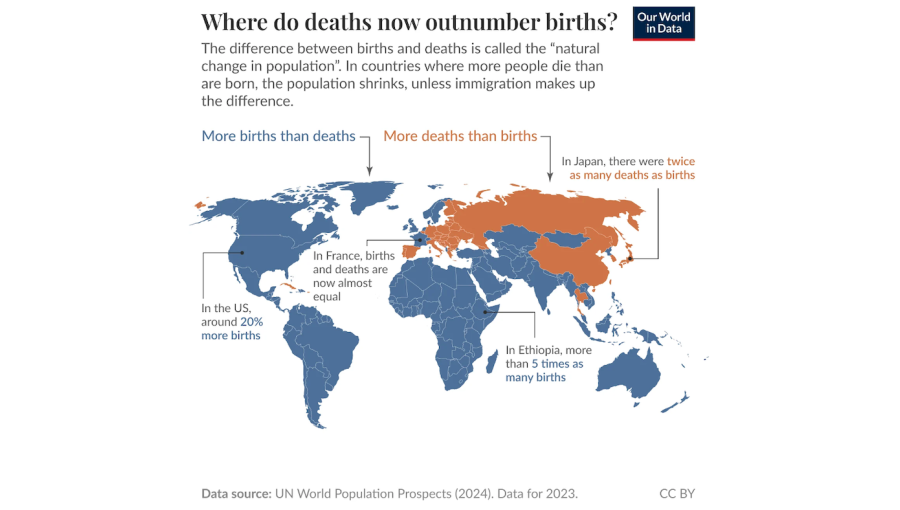
But this is changing. As the map shows, deaths now outnumber births in a growing number of countries across Europe and East Asia.

The balance of births and deaths tells us about a country’s “natural population change” — whether it would grow or shrink without any international migration. Where deaths outnumber births, the population will shrink unless enough people move in from abroad to make up the gap.

Explore how the number of deaths and births is changing in your own country


The demographic point of no return: the world is running out of mothers

The demographic point of no return: the world is running out of mothers
Demographics are collapsing around the world as fertility rates fall. But the trend is reaching a critical point where there are simply not enough women of childbearing age in many countries to keep populations stable even if fertility rates are boosted. / bne IntelliNewsFacebook
By Ben Aris in Berlin June 11, 2026

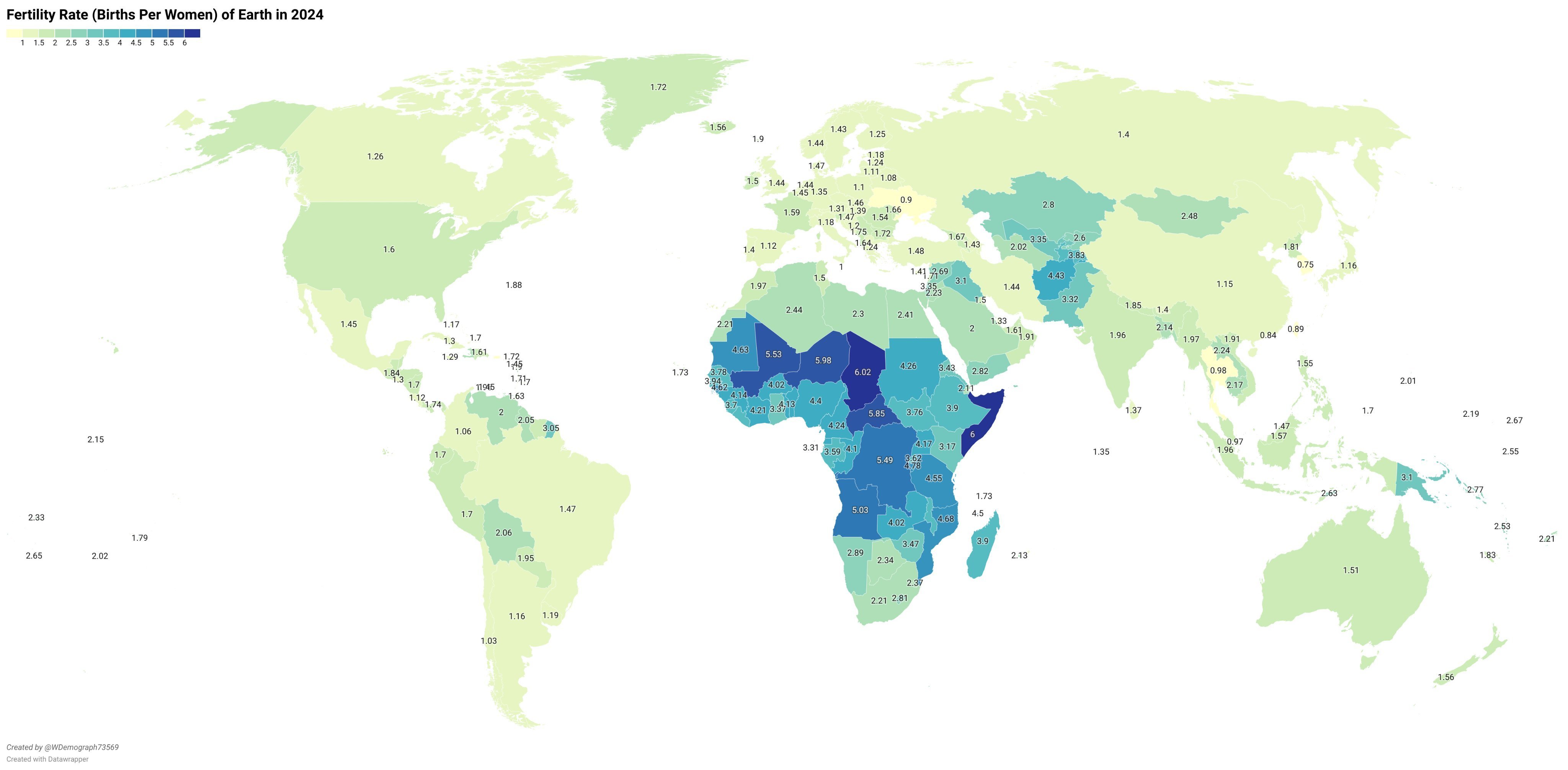
China and the EU have crossed the threshold beyond which population decline is mathematically irreversible — no matter what fertility policy is adopted. Now they simply don’t have enough women of childbearing age to produce enough children to keep the population stable, irrespective of what happens to the fertility rates.

There is a demographic tipping point that receives far less attention than the fertility rate: when the median age of a country's female population rises above approximately 40, the cohort of women in their prime childbearing years (20-35) becomes so small, relative to the total population, that even a miraculous return to replacement-level fertility of 2.1 children per woman cannot prevent absolute population decline for generations.

The age structure itself has become the constraint. China and most of the European Union countries have already crossed that line.

As IntelliNews reported, a global demographic crisis is accelerating. Three-quarters of the planet's countries will, by 2050, no longer be producing enough children to replace themselves.

Populations everywhere, with the notable exception of Africa and Central Asia, will see their populations fall dramatically, causing widespread economic and pension funding problems. Amongst the BRICS, China’s population is expected to halve to 600mn. The only country that will more or less hold its own is India. All of Europe is afflicted as no country is anywhere close to replacement rate fertility. And Ukraine has the worst demographics in the world.

By 2100, according to the projections of the Institute for Health Metrics and Evaluation at the University of Washington, that figure rises to 97% of countries, including India and the majority of burgeoning Africa. 

Female median age rising to the point of no return

China's median age was 39.1 in 2023 and has since risen toward 40 — but the median female age is already above that threshold given women's longer life expectancy. China's fertility rate stands at 0.93 children per woman, the lowest of any large economy. It needs to be 2.1 to keep the population constant.

The consequence is brutal in its arithmetic: even if China's fertility rate magically returned to replacement level tomorrow, the country would still lose more than 40% of its population by 2100, because the mothers required to produce the next generation are already a shrinking minority. China's population is projected to fall from its 2022 peak of 1.4bn to well below one billion  — possibly as low as 800mn — by the end of the century. "It's almost impossible to reverse a demographic decline," said Louise Loo, head of Asia economics at Oxford Economics. 

By 2100, populations in some major economies will fall by 20 to 50%, based on UN projections. Age structures are inverting — from pyramids to obelisks — as the number of older people grows and the number of younger people shrinks, Nature reports.  

The EU's situation is particularly bad. Europe is already the world's oldest region overall, with an average median age of around 43 years. Some regions of Germany and Italy already have median ages above 50. Oxford Economics expects the working-age population of the eurozone to start shrinking next year. 

The United States sits at the borderline — its overall median age of 39.5 keeps it marginally clear of the tipping zone for now, but its fertility rate of 1.6 means that without sustained immigration, it will cross the threshold within a decade. India remains the world's most significant demographic outlier among large economies, with a median age of around 29 and a fertility rate near replacement at 2.0 — the one major economy still on the right side of the line.

The policy implication is sobering. Faced with what is becoming an unsolvable problem, governments are debating pro-natalist policies — cash bonuses for babies, parental leave, housing subsidies — that may be largely irrelevant for countries that have already crossed the 40-year-old-women threshold. These policies can slow the decline but they can’t stop it. The population that will be alive in 2070 has already been born, or will never be born at all.

The table below shows where the world's major economies stand against the approximate 40-year median female age threshold. Median female age estimated at approximately 2-3 years above overall median, reflecting female longevity advantage.

CountryOverall Median AgeEst. Median Female AgeFertility RateBelow Tipping Point?
Japan50~531,13Yes — deep
Italy48,4~511,2Yes — deep
Germany46,8~491,3Yes
Spain46,8~491,19Yes
South Korea45,5~480,8Yes — extreme
EU average~44~461,46Yes
China~40~420,93Yes — at threshold
France42~441,56Yes
United States39,5~411,6Borderline
India~29~302No

Source: UN World Population Prospects, CIA World Factbook, Eurostat 2025. Median female age estimated ~2-3 years above overall median (female longevity advantage).


'Children are dying,' Cuba says as US blockade hampers delivery of UN aid

Photos of former President Raúl Castro and Fidel Castro decorate a front door in Havana, 3 June, 2026
Copyright AP Photo

By Gavin Blackburn
Published on

The blockade, coupled with expanded US sanctions that punish companies doing business with the Cuban state, has intensified the worst economic and energy crisis on the island in over a generation.

Cuba's government said on Wednesday that the US oil blockade that has crippled the island is preventing the United Nations from distributing 170 containers of humanitarian aid.

US President Donald Trump has set his sights on ending more than six decades of communist rule in Cuba.

In January, he cut off oil supplies to Washington's arch-foe from its main supplier Venezuela and threatened other countries with sanctions if they came to Cuba's rescue.

Since then, only one oil tanker, from Russia, has made it through.

Cuba's Foreign Minister Bruno Rodriguez said that 170 containers of UN aid worth $6.3 million (€5.4 million) "is not reaching beneficiaries due to the fuel shortage."

Writing on X, he stressed that the blockade was "not only hampering the performance of the Cuban economy" but also affecting the work of international organisations.

An electric tricycle transports customers during a blackout in Havana, 21 March, 2026 AP Photo


The blockade, coupled with expanded US sanctions that punish companies doing business with the Cuban state, has intensified the worst economic and energy crisis on the island in over a generation.

Parts of Havana have been without power for up to 30 hours at a time in recent days, and food, running water and medicine are in increasingly short supply.

Trump claims that Cuba, which lies 150 kilometres off Florida's coast, poses a major threat to US national security and floated the possibility of a "friendly takeover" of the island of 9.6 million people.

On Monday, the UN's High Commissioner for Human Rights Volker Türk called for the US sanctions to be "lifted immediately."

"Children are dying because doctors lack access to essential medical supplies and medicines. This is unacceptable," he said.

Pretext for military action

Recent US sanctions targeting Cuba’s leadership and the indictment of former President Raúl Castro are a “pretext” for the Trump administration to persuade the American people to support a military intervention, Cuba’s top diplomat to the United States said on Tuesday.

Ambassador Lianys Torres Rivera repeated accusations against the Trump administration made by other Cuban officials, including the foreign minister and the president, and complained that the US is targeting Cuban civilians with its decades-old embargo and new blockade of energy shipments to the island.

Chargé d'Affaires of the Embassy of Cuba Lianys Torres Rivera speaks in Washington, 9 June, 2026 AP Photo


“The sanctions against our leaders, we see as a pretext to make the American people think we are a threat,” she said at Cuba's embassy in Washington.

“We are not a threat to the US and we don’t want confrontation.”

Torres Rivera, who holds the formal title of chargé d’affaires, described the situation as “a war without bombs.”

She said efforts to change Cuba’s government by coercion or force would be met with fierce resistance.

“Raúl is sacred,” she said of the indictment by a federal grand jury last month of Castro.

The 95-year-old former president faces conspiracy and murder charges related to the 1996 downing of two unarmed civilian planes operated by the Miami-based exile group Brothers to the Rescue while he was serving as Cuba’s defence minister.

“Raúl is a sacred symbol of the revolution, and we will defend Raúl — as we will the country — until the end,” Torres Rivera said. “If we are attacked, we are going to respond and we are prepared for that. But we don’t want it.”

Trump, Secretary of State Marco Rubio and other administration officials have repeatedly denied that Cuba’s economic strife is America’s fault and repeatedly cast the blame on the government’s socialist policies.

They have not ruled out military action against the island but have said they are willing to give Cuban authorities time to make reforms.


Earthquake rattles Cuban capital Havana: 


AFP reporters

AFP
June 8, 2026

The 6.1-magnitude earthquake off the coast of Cuba forced people out of their homes
 – Copyright AFP YAMIL LAGE

A strong earthquake struck off the coast of western Cuba on Monday, with AFP journalists in Havana reporting 20 seconds of shaking that forced Cubans out of buildings and into the streets.

The US Geological Survey said that the quake was 6.1 magnitude and struck about 62 miles (100 kilometers) off the island’s western tip.

No injuries or significant damage were recorded.

People milled around Havana’s city center, checking their phones after the tremor which according to Cuban authorities was felt “throughout the entire west of the country.”

“At first I just felt dizzy — it didn’t occur to me it was an earthquake, I’d never experienced that before,” Carmel Delgado, a 47‑year‑old economist, told AFP.

“But once we realized what it could be, we got out quickly.”

AFP reporters as far away as Florida also felt the tremble.

The US Tsunami Warning Center ruled out a significant tsunami threat following the quake.

But there was a “very small possibility” of tsunami waves along the coasts located near the epicenter, it said.

Francis Ruiz, a 41-year-old actor, was recording a radio drama in a fifth-floor studio in Havana’s historic center when he felt the tremor.

“We were recording in an office and all of a sudden the table moved and we all looked at each other,” Ruiz told AFP.

“The building shook, and right then chaos broke out, everyone running down the stairs,” he added.


ANOTHER GRENFELL

Hong Kong charges seven people and two firms over massive fire that killed 168

Smoke rises after a fire broke out at Wang Fuk Court in Hong Kong, 26 November, 2025
Copyright AP Photo

By Gavin Blackburn
Published on

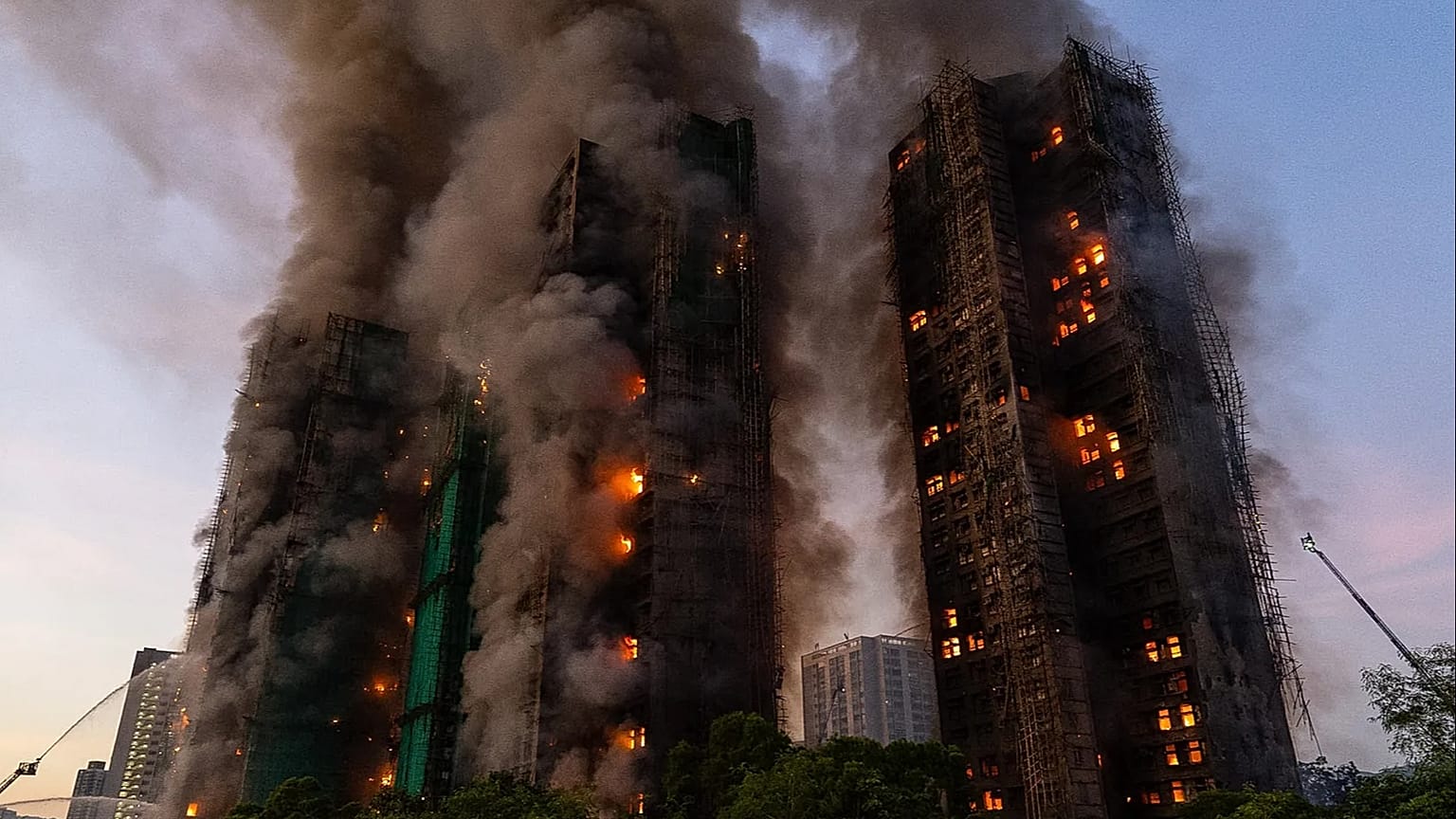
The massive blaze, which engulfed seven of the eight high-rise apartment blocks at the Wang Fuk Court estate in November, prompted a months-long investigation into the cause.

Hong Kong filed manslaughter charges against several people and companies on Wednesday over the world's deadliest residential building fire in decades, which killed 168 people at a public housing estate last year.

The massive blaze, which engulfed seven of the eight high-rise apartment blocks at the Wang Fuk Court estate in November, prompted a months-long investigation into the cause.

Public hearings were told that almost all life-saving fire safety measures had failed on the day of the blaze because of human errors.

The directors of the construction contractor and the consultant firm involved in Wang Fuk Court's renovation at the time of the fire, as well as an inspector, were accused of manslaughter along with their companies, according to charge sheets seen by the AFP news agency.

Seven individuals in total were charged with laundering money and evading tax.

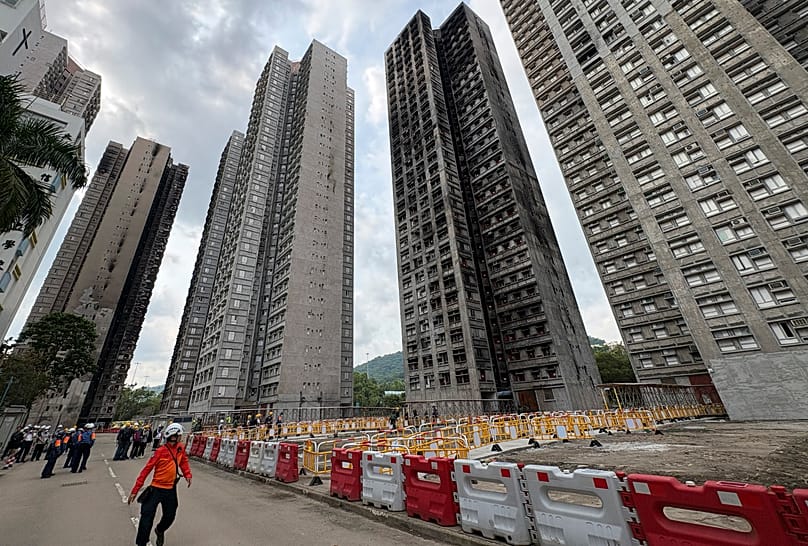
A worker walks by the remaining shell of the buildings of Wang Fuk Court in Hong Kong, 22 April, 2026
A worker walks by the remaining shell of the buildings of Wang Fuk Court in Hong Kong, 22 April, 2026 AP Photo

The defendants appeared in court on Wednesday and told the judge that they "understood" the charges.

The court heard those accused of manslaughter "unlawfully" killed 168 from the residential buildings in November, including residents and a firefighter.

The cases were adjourned until September.

A Hong Kong police representative said on Wednesday that the force had arrested 35 people in connection with the fire, working with Hong Kong's anti-graft watchdog, ICAC.

"We suspect that this unfortunate incident was caused by individuals acting in their own self-interest...with complete disregard for the safety of residents' lives and property," ICAC's principal investigator Hazel Law told reporters.

Substandard construction safety netting and cigarette butts were focal points of the probe into the causes and rapid spread of the deadliest residential building fire globally since 1980.

A man takes pictures of a charred family album found at their flat at Wang Fuk Court in Hong Kong, 20 April, 2026
A man takes pictures of a charred family album found at their flat at Wang Fuk Court in Hong Kong, 20 April, 2026 AP Photo

Fire alarm systems for seven of eight blocks had also been deactivated, which "greatly shortened the time for residents to evacuate," leading counsel Victor Dawes had told an independent committee conducting the probe.

Required fire-retardant nets were not used in many places and the windows were covered by foam boards, which may have contributed to the spread of fire into the flats, the panel heard earlier this year.

The Fire Investigation Task Force had maintained that an ignited cigarette caused combustible material to catch fire, sparking the blaze.

Thousands of residents lost their homes in the blaze and relocated into temporary housing.