It’s possible that I shall make an ass of myself. But in that case one can always get out of it with a little dialectic. I have, of course, so worded my proposition as to be right either way (K.Marx, Letter to F.Engels on the Indian Mutiny)
Thursday, June 11, 2026
Op-Ed: Royal Navy Operational Readiness Has Been Lost
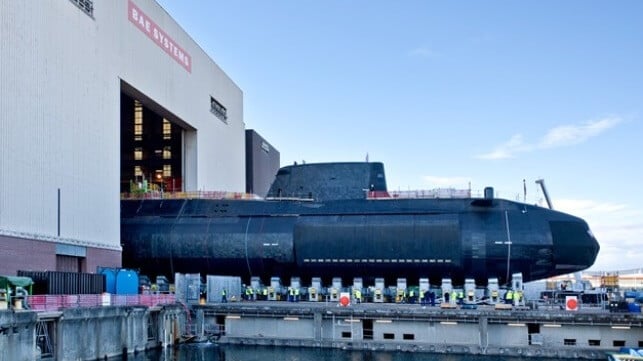
The Royal Navy's newer Astute-class attack subs are out of service (File image: Royal Navy / BAE Systems file image)
The Royal Navy is facing multiple operational readiness issues, which are impacting capability across what remains of a fleet much reduced in size. The issues are likely to be enduring, notwithstanding the imminent issue of a much delayed Defence Investment Plan, which when it is published later this month will allocate long-term funding to the procurement program.
The problems are not confined to one class of ship.
None of the Royal Navy’s Astute Class nuclear attack submarines are available for deployment. HMS Anson (S124), which left Faslane on January 10 for an extended duration deployment to HMAS Stirling in Western Australia, was seen docking back in Gibraltar on May 14, and is awaiting maintenance after its deployment. Of seven Astute Class submarines to be built, five are commissioned, with the sixth HMS Agamemnon (S124) on sea trials prior to handover. The last boat HMS Achilles (S125) is not due to be commissioned until 2029.
This presents major operational difficulties, as a nuclear attack submarine is normally needed to support the nuclear deterrent ballistic missile submarines as they deploy and recover to Faslane. The service is just about managing to maintain the continuous nuclear deterrent at sea, but the aging Vanguard Class submarines are also suffering major maintenance issues and cruises are having to be extended to ensure that there is always one boat at sea. The Royal Navy is keeping its fingers crossed and hoping that at least one Astute-class submarine is operational by the time of the next ballistic missile submarine rotation.
The availability of the six Daring-class Type 45 guided missile destroyers, the primary air defense capability in the fleet, is also in crisis. After a struggle, HMS Dragon (D35) finally set off for the Eastern Mediterranean weeks after it was needed to supplement the defenses of the British bases in Cyprus, and is now operationally deployed as part of the French Charles de Gaulle carrier strike group in the Arabian Sea. HMS Duncan (D37) is also operational, part of the HMS Prince of Wales (R09) carrier strike group. But the other ships of the class were not available, still queuing to undergo the long running Power Improvement Project to rectify the mechanical design fault in the hot climate conditions encountered in the Gulf; HMS Daring (D32) is now crewed but has still not returned to the fleet after a refit which has stretched to an incredible 3,300 days. Weaknesses in Daring Class availability still need to be overcome, particularly if there is a long gap before the successor Type 88 destroyers, still not programmed, come into service.
Of the two aircraft carriers, HMS Prince of Wales (R09) has recovered from a minor breakdown and is back at sea on exercise in the High North. The potential of the two carriers is restricted however by the paucity of the Royal Navy’s F-35B fleet, meaning that the carriers only deploy with about the same number of F-35Bs which are routinely deployed on the much smaller Italian carrier ITS Cavour (CVH 550).
The frigate fleet, made up of Type 23 frigates mostly 30 years old, is down to four ships, with HMS Kent (F78) undergoing refit and the remainder kept operational only with great difficulty. Numbers are likely to sink even further before the first Type 31 HMS Venturer (F12) enters service in 2027, followed by the first Type 26 HMS Glasgow (F88) in 2028.
To keep numbers up, Hunt Class minesweepers HMS Middleton (M34) and HMS Chiddingfold (M37), plus Sandown Class minesweeper HMS Bangor (M109), all of which have been withdrawn from Bahrain and were heading for retirement, will be retained for service with the Portsmouth-based 2nd Mine Countermeasures Squadron.
The two Landing Platform Dock ships to support amphibious operations, HMS Albion (L14) and HMS Bulwark (L15), have been mothballed prior to a potential sale to Brazil, despite their relative youth. The limited amphibious capability which the Royal Fleet Auxiliary can provide instead has been hobbled by a long-running labor dispute which is still affecting both recruitment and manpower availability. A bright note for the future is that Navantia’s construction of three Fleet Solid Support ships for the RFA is underway, not only delivering missing capability but reviving ship-building skills at Harland & Wolf in Belfast.
Even with a planned reduction in the size of the Royal Navy fleet, there are common problems which affect the availability of ships across all classes. These are apparent to a far greater degree than in other European navies, where for example the well-managed Italian Navy is on a lower budget but deployed globally in strength and with high levels of fleet readiness.
With the defense budget reduced over many years, service chiefs have placed emphasis on maintaining front-line capability, and neglected budgetary investment in second order capabilities such as training, maintenance facilities and manning, capabilities which have turned out not to be second order priorities but essential elements of operational readiness.
Service commanders, in post for relatively short periods, have tended to put a gloss on short-comings during their tenure rather than speak out or resign, leaving successors with a growing set of problems.
Politicians consistently have thought money could be saved in the short term by elongating procurement programs, leaving office and far from accountability when the medium to long term consequences of additional maintenance issues then begin to surface.
Although there is general acknowledgement that threat levels have risen substantially, this has not translated into recognition of the need to increase investment in defence. The Defence Investment Plan to be published this month will be a step in the right direction, but not nearly enough to overcome years of neglect any time soon. Critical to the Navy regaining its previously formidable capability is whether or not sufficient specialized skills and experience can be retained for long enough to still be passed on to the next generation of sailors – which can only be done if there are ships to sail in.
The opinions expressed herein are the author's and not necessarily those of The Maritime Executive.
EU Commences Mediterranean Dark Fleet Stop and Search Operations
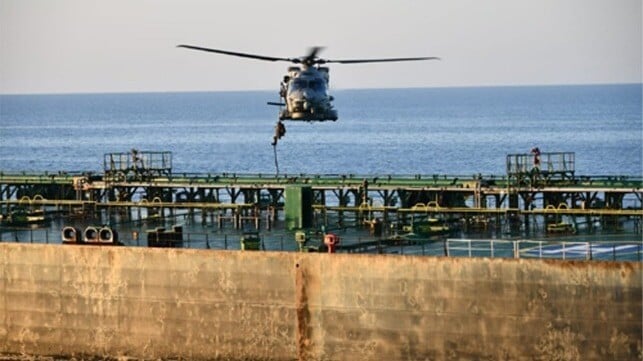
EU forces have begun inspections of tankers in the Mediterranean (EUNAVFOR Irini)
The European Union has launched a coordinated campaign to crack down on vessels that are false-flagged, fraudulently certified, or are in breach of maritime safety and labor laws.
The move, announced after an agreement between EU defense ministers at a meeting in Nicosia on June 8, utilizes the pre-existing mandate for Operation Irini, which was originally established in 2020 under a UN mandate to enforce an arms embargo on Libya in the Mediterranean. It is not clear how or whether the refreshed operation announced by EU Foreign Policy chief Kaja Kallas has also inherited the same UN mandate, but it has explicitly been relaunched with the aim of supporting Ukraine by cracking down on Russian dark fleet activities. It nonetheless gives member nations the authority of an EU mandate to board suspicious ships.
Operation Irini suffered initially in 2020 from a weak mandate. Tasked with monitoring and interdicting arms supplies to the different warring factions in Libya, whenever it sought to board and inspect a ship, it was initially required to secure the permission of the ship’s flag nation in accordance with UNCLOS. When the ship was Turkish, with arms destined for the faction it was supporting, permission was invariably refused. Operation Irini nonetheless has continued.
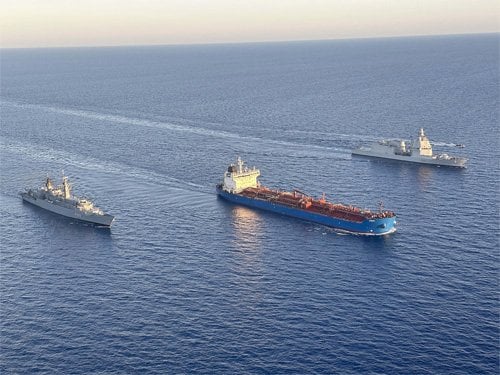
Irini reports stopping three tankers since the effort began in May (Irini)
Currently, the naval forces committed to Operation Irini are headquartered in Rome and under the command of Italian RAdm RADM (UH) Marco Casapieri. The force consists of the Italian Thaon di Revel Class offshore patrol vessel ITS Francesco Morosini (P431), the Greek Elli Class frigate HS Kanaris (F-464). The force is supported by a Beechcraft B300 King Air 350 maritime surveillance aircraft provided by Luxembourg, which is forward-based in Malta, and a PZL M28B Bryza maritime surveillance aircraft provided by Poland.
The new, expanded anti-dark fleet mandate does not appear to have gotten off to a good start, suffering as others have done from the limited justifications in UNCLOS for intercepting ships at sea, even if they are sanctioned, and there are registration irregularities.
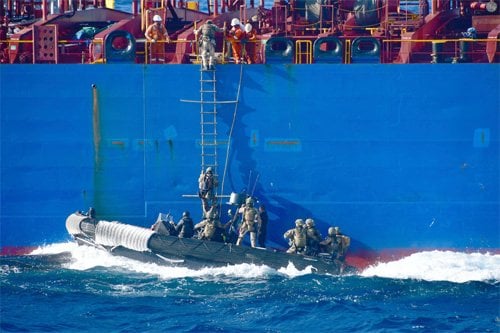
(Irini)
Since the launch of the expanded mission, Irini reports it has stopped three vessels. It conducted a flag verification boarding of EU and UK-sanctioned Sandhya (37,159 dwt), an Indian-owned, Cameroon-flagged product tanker, on June 7. According to its AIS signal, the vessel was coming from Brazil bound for Turkey.
On June 1, an inspection team boarded the Cameroon-flagged and EU-sanctioned Aframax Oneiroi (105,585 dwt) in international waters in the Mediterranean. The 244-meter (800-foot) Oneiroi has a capacity of about 100,000 barrels of oil. It had loaded at Primorsk on May 11. Notwithstanding the stop and search, the Oneiroi still managed to reach Port Said on June 5 and is expected to unload at Vadinar in Gujarat on June 16.
A second Cameroon-flagged Suezmax, Nelsa (156,760 dwt), reportedly owned by a company in Azerbaijan and sanctioned by the EU and UK, was the first vessel stopped by Irini on May 11. The 274-meter (899-foot) Nelsa loaded at Novorossiysk, came through the Bosporus on June 2. Notwithstanding its interception, it is also now through the Suez Canal and heading for India.
It is not clear what the Irini inspections found or why the vessels were allowed to proceed.
Ukraine Expands Campaign Including Targeting Mariupol and Shadow Tanker
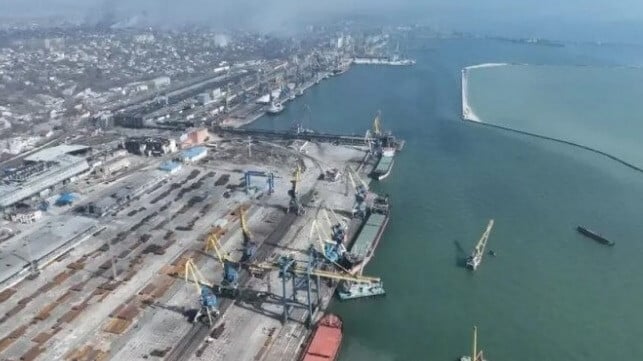
Ukraine heavily damaged the occupied port of Mariupol as it seeks to disrupt Russia's logistics operations (Mariupol City Council file photo)
Ukraine is accelerating its campaigns, focusing on Russia’s logistical operations in response to a series of heavy attacks launched by Russian forces. The occupied port of Mariupol was one of the key focuses, while other attacks continued to target the energy infrastructure and another shadow fleet tanker in the Black Sea.
These attacks came as Ukraine also celebrated its Unmanned Systems of the Armed Forces of Ukraine. President Volodymyr Zelensky declared June 11 an annual day of celebration for the unique unit that is greatly contributing to the war. According to media reports, the unit was formed in 2022 by a former grain trader and has become an elite drone unit responsible for the long-range attacks.
The unit was a key participant along with other units of the military in the overnight attacks on Mariupol, which has been occupied by the Russians since the first weeks of the war in 2022. Located on the Azov Sea, Ukraine contends Russia is using the port to support military operations as well as to export grain, coal, and metals from the occupied region.
The drones were used to strike the energy infrastructure, repair, and administrative structures in the port. According to the reports, the port was left without power and suffered significant damage, which is significantly limiting its operations. Russia is reported to have used the port to move personnel and resources across southern Ukraine. The reports indicate that transport routes through the city have also been restricted.
The port’s control tower, radar equipment, and electrical substations were all heavily damaged. The sanctioned cargo vessel Lady Augusta (6,830 dwt) that docked in the port was also damaged. The vessel is listed as laid up since August 2023 and registered in the Marshall Islands.
The strikes on Mariupol came after the General Staff reported other attacks carried out on June 5 that destroyed eight fuel storage tanks and damaged nine others in the same port area. It also struck a key bridge linking the port to the occupied regions of Crimea.
Other strikes in the campaign included the VNIR-Progress plan in the city of Cheboksary, which was reported to be a key manufacturer of navigation equipment, including satellite receivers for precision-guided weapons. The Kuibyshevsk oil refinery at Samara was also struck. Drones from the SBU destroyed warehouses with ammunition and engineering equipment in the Donetsk region.
The General Staff also said that it had struck a shadow fleet product tanker without providing details on the timing or location. The tanker West Horizon (50,548 dwt) was in the Black Sea when it was struck, with the General Staff saying the propeller and rudder were damaged. The vessel is listed as being managed from Turkey and is registered in Guinea-Bissau.
Ukraine's Ports Authority, however, was also reporting that two commercial vessels heading for its ports were damaged. In a posting on social media, the authority reported the vessels were a cargo ship under the flag of Panama and another registered in Barbados. One was inbound to load metals, and the other was outbound from the Desa area with a cargo of wheat. A fire broke out on board one of the vessels, which was quickly extinguished by the crew. There were no injuries and both ships were continuing their voyages.
Dutch Arrest Captain and Stop Containers Violating Russian Sanctions
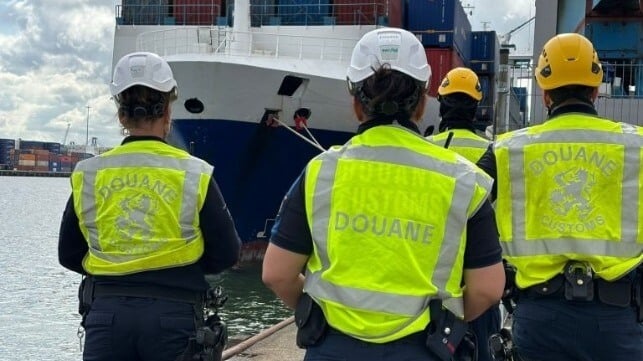
Dutch Customs launched an investigation in the Port of Rotterdam (Douane)
Dutch Customs reports it has started a crackdown, intercepting sanctioned goods bound for Russia through the Port of Rotterdam. Over the past few days, they reported that the captain of a containership was arrested, and multiple containers have been intercepted as part of a criminal investigation into organized sanction violations.
The captain of the unnamed vessel was arrested on June 5 on suspicion of involvement in criminal offenses related to the possible sanctions violations. The magistrate in the Rotterdam District Court ordered the captain’s detention on June 8 for two weeks as the investigation into the sanction violations continues.
Dutch Customs said it is working with Europol, the Rotterdam Port Police, and others, in the operation. They said that research indicated that 92 percent of sanctioned goods traveling via liner services are originating from other EU member states and being transshipped into Russia.
The targeted vessel was reported to be operating a regular service between Rotterdam and Saint Petersburg. The authorities said there were “strong indications” that this route was being misused to circumvent sanctions.
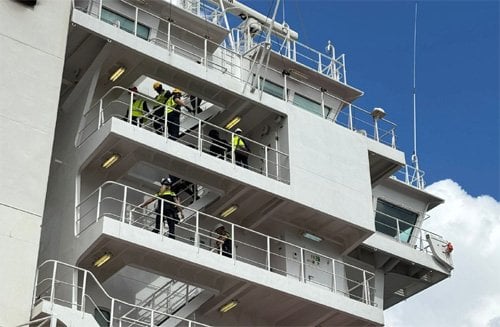
The unnamed vessel was searched and the captain has been arrested (Douane)
Several containers have been inspected, and an investigation was launched on board the ship and two unnamed companies, located in Amsterdam and Rotterdam. The containers were flagged for inspections because of their documentation, which included some goods under a transit ban and other irregularities.
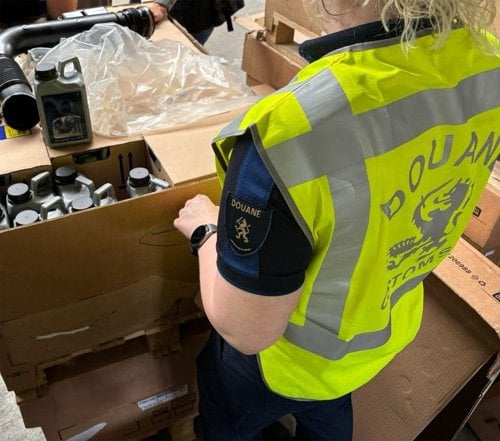
Several containers were moved to a control warehouse, where customs officers opened the containers and unpacked the cargo. According to the authorities, “It quickly became clear that something was not right with the shipment.” They said labels had been removed and pieces of cardboard had been glued to the tops of the boxes. “That’s not right,” said Dutch Customs. “Then you know that the contents have been tampered with.”
Boxes had been tampered with, and they found motor oil among other blocked goods (Douane)
The operation was specifically aimed at goods that are not permitted to be transported through Russia to other countries. The authorities said there is a risk that the goods could remain in Russia and be used to support military operations. They cited as examples aircraft parts, advanced technology, and machinery that could be used in military applications.
In one of the containers, Customs reports they found windshields, car doors, motor oil, and an entire vehicle air filter system.
“This could be used for passenger cars,” explained a customs officer. They noted, however, “It could be used for trucks headed to the battlefield.”
Dozens of containers were stopped during the inspections. Customs reports it encountered several shipments that were subject to the transit ban.
EU Calls for Sanctions on Bunker and Support Vessels in New Russian Package
EU plans to sanction bunkering and other vessels supporting the shadow tanker fleet (file photo)
Saying that the goal is to maintain the pressure from the West on Russia, the European Commission outlined its plans for the 21st sanction package since the start of the war in Ukraine. The European Union highlights the impact of its economic sanctions while saying, “Consistency with the sanctions packages is paying off.”
President of the European Commission Ursula von der Leyen, however, also highlighted the increased Russian attacks on civilian targets in Ukraine as well as the wayward attacks that have entered European airspace and hit Romania and others, supporting the effort to further deepen the economic sanctions. She asserted that Russia is cut off from the global capital markets, is experiencing high inflation and interest rates, and has lost two-thirds of the liquid assets of its sovereign wealth fund. Energy revenues, the EU reports, fell by around 40 percent in early 2026, while saying actions are needed to address the benefits Russia has gained with the interruption of energy supplies from the Middle East.
“Today, we are putting forward the 21st sanctions package. We focus on the sectors with the highest impact: energy, financial services and crypto, trade – including fisheries, for the first time – and we are banning the entry of former Russian combatants into the European Union,” reported von der Leyen.
To maintain the pressure on the shadow fleet and the energy revenues, the EU, for the first time, is targeting vessels that assist the tankers, including those providing bunkering and other services. They are also calling for listing another 30 tankers on top of the 632 that the EU has already sanctioned. They also want to extend the restrictions on the sale of oil tankers to Russia to include LNG tankers. Another element would be a ban on Russian fisheries as well as ports and other infrastructure.
To give the oil markets time to stabilize, the EU is proposing freezing the current built-in adjustment mechanism on the oil price cap. It would maintain the $44 price until January 2027 to continue the pressure on Russia while also taking into consideration the impact of the Middle East on the oil market.
Beyond the energy market, the EU is also calling for new export restrictions on items and technology that can be used by the Russian military. This would include more metals and alloys used in aerospace and defense sectors, as well as ground support equipment and jamming and launch systems for drones.
The European Commission is also planning more direct financial sanctions targeting 31 more Russian banks with transaction bans. They also want to add 20 banks and crypto platforms, as well as oil traders in third countries, to the sanctions.
Financial aid to Ukraine also continues with the EU delivering almost €3 billion in a new loan facility to Ukraine yesterday, June 8, and expects to release the first disbursement under the previously announced €90 billion loan. By the end of the month, the EU will have provided Ukraine with €6 billion for drones and more than €3 billion of macro-financial assistance.
One Killed, One Detained in Firearm Incident Aboard Carrier USS Kennedy
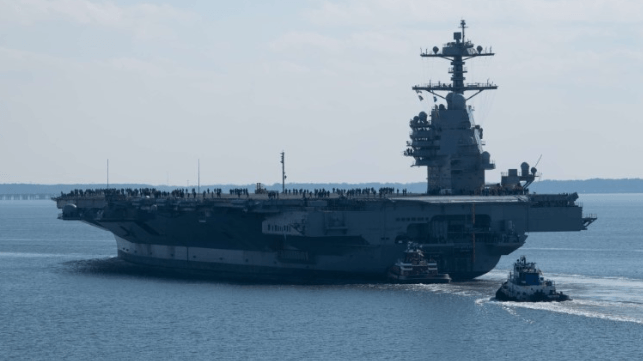
The future USS John F. Kennedy on builder's trials (USN file image)
The U.S. Navy is investigating a fatal shooting aboard the future USS John F. Kennedy, the second Ford-class supercarrier.
At about 0516 hours on Saturday morning, an unspecified incident involving a firearm occurred aboard Kennedy, which is alongside at Newport News Shipbuilding after builders' trials. The Navy said that Boatswain's Mate Seaman Jesse Dean Braswell was killed in the "situation" on board.
Braswell was a Colorado resident who had joined the Navy in 2024 and arrived aboard Kennedy in March 2025. He was promoted to E-3 earlier this year.
In a statement Sunday, the Naval Criminal Investigative Service (NCIS) said that it had detained one sailor in connection with the shooting and is keeping the individual in pretrial confinement. Charges have not yet been filed, and the investigation is still under way to determine the circumstances surrounding the death.
The Navy and Newport News are working hard to bring USS Kennedy into service by 2027; the vessel is behind schedule and is needed to relieve USS Nimitz ahead of her planned retirement. The aging Nimitz's time in service has been extended by 10 months in order to await Kennedy's completion.
Helmsman Charged with “Drunk Driving” After Hitting Sailboat and Pier
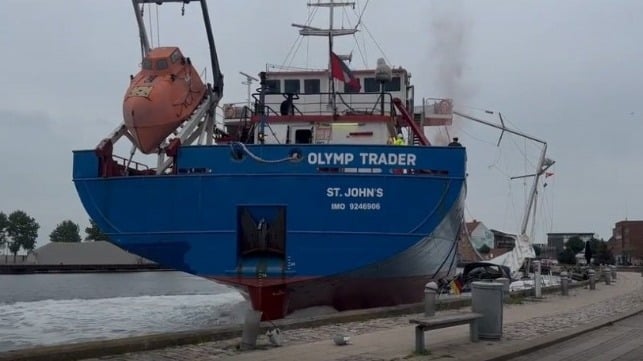
Cargo ship hitting a sailboat and dock with the police reporting the helmsman was over the legal limit for alcohol (TV2 News screen shot)
Danish authorities reported placing the helmsman of a general cargo ship under arrest on Monday evening after the vessel he was controlling hit a docked sailboat and then proceeded to knock down lampposts and bollards as it hit the dock in Korsør, Denmark. No one was injured in what one official described as a “parking accident.”
The general cargo ship Olymp Trader (4,684 dwt) was arriving in Denmark from Wismar, Germany, at around 2000 local time on June 8. The video appears to show the vessel attempting to back into the dock with a strong wake from its prop. It is also fitted with a bow thruster. The ship is 104 meters (341 feet).
As the ship was maneuvering into the berth, the German couple aboard the sailboat said it became evident it was heading for their boat, and they jumped to safety on the pier. They watched as their boat was crushed by the hull of the cargo ship and its mast bent over to a 45-degree angle.
The cargo ship kept going, knocking down the lights and a bollard and striking the dock before coming to a stop.
The police boarded the cargo ship and spoke with the chief officer, who was at the helm, and asked him to take a breathalyzer. The head of local police reports the crewmember, who is a 54-year-old Russian citizen, tested with a blood alcohol level of “one thousandth above” the legal limit
The officer was taken into custody, and the police administered a blood test at their headquarters. He was charged with a violation of the Maritime Act and released after about an hour in detention. Under Danish law, he is facing up to two years in jail for the violation and, depending on the circumstances, can lose his mariner’s license.
TV2 News posted the full video taken by the German couple as their sailboat was damaged. They reported they were taking a multi-week trip around Denmark as a farewell to sailing after 14 years of sailing on their boat. They told the TV station they were taking a train home and did not want to sail again. Furthermore, they believe their boat sustained more than €100,000 in damages.
The news channel reached the agents for the ship, Baltic Shipping, which reported that the vessel is owned by a company in Latvia. It appears from the databases that the ship, which was built in 2002, was just acquired in April 2026. The CEO of Baltic Shipping told TV2 News that a third-party staffing agency was responsible for crewing the ship and that the officer had either been dismissed or would be dismissed for violating their strict no alcohol rules.
The Danish Maritime Authority ordered the Olymp Trader detained for a full inspection of the ship. The Maritime Accident Investigation Board is conducting the investigation. The shipping company said they expected the ship would be released quickly and would continue to Rander, Denmark, with a new helmsman.
India Asserts Maintenance and Training Issues Caused MSC Elsa 3 Loss
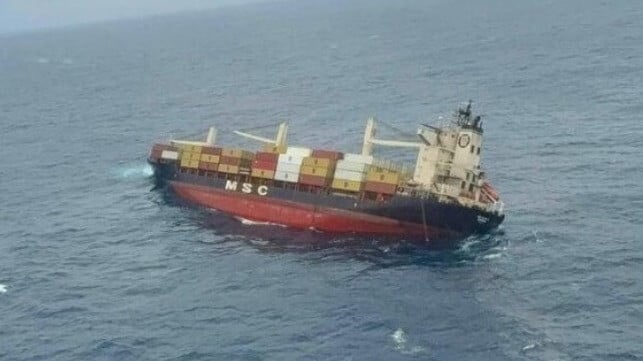
India assets the vessel had a starboard list on prior voyages and the ballast water system failed causing the loss (DGS photo)
A year after the MSC Elsa 3 containership sank off the coast of India, the Directorate General of Shipping filed its preliminary report on the casualty with the Kerala High Court, citing mechanical failures, maintenance and structural issues, and a lack of training, which it asserts caused the loss of the ship. The filing came as one of the magistrates in the case reported the investigation could be completed in the next two months, and as India continues to pursue large damage claims against MSC Mediterranean Shipping Company and its insurers.
The Directorate General of Shipping is saying, based on its findings, there were technical failures and serious safety lapses on the ship leading up to its sinking on May 24, 2025. It reports that the Vizhinjam International Seaport authorities had warned the ship’s management that the vessel was listing while containers were being loaded in the port. They reported a five-degree list, which they assert was ignored by management. They also contend the ship had an “inherent tilt” to starboard on previous voyages.
During the fatal trip, they assert the vessel’s ballast water system failed, resulting in flooding into the ballast tanks, which the crew could not control. The ship reached a 26-degree list to starboard, causing the container stacks to shift, and the instability increased due to the weight of the containers. Around midnight, they report that containers began to fall overboard. The ship went down on May 25, after the crew was evacuated.
They are also asserting that the vessel’s safety management system was deficient, especially regarding maintenance procedures and spare parts management. As the list increased and the situation became more desperate, it also exposed failures in the vessel’s safety management systems and the crew’s training.
The chief officer had joined the vessel one week before the incident, and the report says he was not given sufficient time for training and familiarization with the vessel. Other crewmembers, they contend, lacked practical training for emergency ballast operations. Many of the crew, DGS asserts, only had theoretical knowledge and no real-time experience in managing emergency situations.
The Directorate General of Shipping also asserts that the ship had suffered structural damage in a 2016 collision that was not fully repaired. It says there were structural failures aboard the ship and that it had relied on temporary fixes. Defects in previous inspection reports, it says, were not sufficiently repaired or replaced.
The ship, which was built in 1997, had gone through several owners before it was acquired by MSC in July 2015. It was 22,994 dwt with a container capacity of 1,728 TEU. It was registered in Liberia. It sank about 15 nautical miles off the Indian coast. The crew was all evacuated, but containers washed ashore, and there was oil pollution from the wreck.
The report came out as the Kerala High Court was also hearing a petition from seven crewmembers who have been detained in India for more than a year. They are calling their detention illegal and asking the court to return their passports and permit them to return to their home countries.
The court provided a conditional release for three of the crewmembers, including an “electro-technical officer,” a deck crewmember, and an engine room crewmember, so that they could return to their homes in Ukraine and the Philippines. However, each person is required to post a personal bond, a bank guarantee, and to agree to continue to fully cooperate in the investigation. They had to provide the court with their home address, cellphone numbers, email address, and agree to be available through online modes for the court or the investigating officers.
Four other crewmembers, including the master of the vessel and its chief engineer, however, have been ordered to remain in India. The court said they were specifically named in the investigation papers, and the court ordered them to appear on June 12 for their examinations. The court said it would consider their requests to leave India once their role in the investigation and their testimony were completed.
The government and the state are seeking large financial damages from the loss of the vessel and the clean-up efforts. In addition, the fishing community and others have also filed claims for financial losses due to the sinking of the ship. The courts have required MSC to provide large financial bonds and previously arrested other MSC vessels as collateral against the various claims.
MSC has asserted that the claims are excessive. It says it has been working with the authorities in the clean-up and recovery from the loss of the containership.
ECOCIDE
Cargo Ship Goes Aground and Spills Petroleum off Luzon
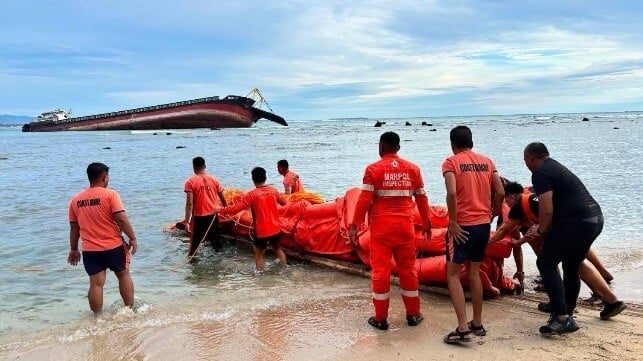
PCG responders deploy a spill control boom at the wreck site (PCG)
A bow-ramp deck cargo ship has gone aground off the northwest coast of Luzon, partially capsizing and releasing oil into the water.
On June 8, the Philippine Coast Guard received notice that the landing ship MSCI 1 had conducted an intentional grounding in bad weather off Badoc, Ilocos Norte province. The vessel (a type locally referred to as an LCT after the WWII-era Landing Craft Tank) was carrying a cargo of gravel, and 15 crewmembers were aboard. The master initially informed the PCG that most crewmembers would abandon ship and three officers would remain on board to tend to the vessel. Coast guard units were dispatched to the scene to monitor the casualty.
On June 9, the MSCI 1's port list had visibly worsened and water had flooded over the gunnels. The crew abandoned ship safely, and all were reported to be in good condition.
PCG officials confirmed that petroleum was leaking from the stricken vessel, and spill control booms were brought in to reduce the impact of the petroleum release. However, the conditions on scene shifted the booms out of position, and an oil slick was observed on a short stretch of the nearby shoreline. PCG responders and partners conducted oil recovery along the shore to abate the pollution using sorbent pads and booms.
Provincial natural resources officer Victor Dabalos has instructed the vessel operator to close off the source of the leak as quickly as possible. It is believed to be emanating from the engine room, not from the main fuel tanks.
MSCI 1 (ex name Lei Ye 666, IMO 1146655) is registered as a deck cargo ship and was built in 2011. She was last inspected by port state control officers in Taizhou, Zhejiang province in 2025, and 10 deficiencies were recorded, including issues with her watertight doors and her main engine.
Growing disorder is afflicting the maritime domain from the Pacific Ocean to the Indian Ocean and into the Arabian Gulf region. The crisis in the Strait of Hormuz has shifted the focus of strategic experts from a form of sea blindness, which gave more importance to land security over maritime security, to a deep interest and concern for maritime affairs.
One should view maritime security not just as a military matter but also in terms of economic disruption and human security. Indeed, the Gulf, particularly the Strait of Hormuz, represents one of the world’s most strategically sensitive maritime corridors. It is a transit route for more than a quarter of the global seaborne oil trade and for a significant portion of the world’s liquefied natural gas, fertilizer and essential commodities such as helium.
Since events escalated at the end of February 2026, the number of ships transiting the Strait of Hormuz has dropped by 90%. It is easy to take freedom of navigation at sea for granted, yet the prosperity of nations, the flow of global trade and the growth of the world economy all depend upon it. Maritime routes carry the great majority of international commerce, at a scale that no network of roads, railways or air transport could ever replace. This system connects producers to markets, delivers food and energy between continents and supports the daily lives of billions of people.
However, this transport system is not guaranteed. Disruption of critical sea lanes can quickly affect supply chains, prices, energy, security and economic stability far beyond any region. Protecting maritime routes is therefore not only a matter of national interest but a shared international responsibility.
Qatar firmly believes that maritime security cannot be achieved through military measures alone. It requires a comprehensive strategic approach based on three key pillars:The first is dialogue and de-escalation. Regional security is not sustainable without diplomatic engagement and channels of communication among all concerned actors. In this, Qatar, in full coordination with the regional partners, reaffirms its support for the Pakistani mediation efforts, which constitute the most credible and active channel of dialogue. The second pillar is respect for international law. The principles of the United Nations Charter and the United Nations Convention on the Law of the Sea (UNCLOS) must remain the foundation of maritime governance. Freedom of navigation and the protection of civilian shipping are essential principles we must preserve jointly. Therefore, Qatar firmly rejects the use of international waterways as a tool of political pressure. If we allow such a precedent, then what we have seen in the Strait of Hormuz can happen in the Indo-Pacific or elsewhere. Article 44 of the UNCLOS clearly says that states bordering straits shall not hamper transit passage. The third pillar is international and regional cooperation. No single state can secure maritime routes alone. The complexity of modern threats requires deeper coordination between regional partners and international allies. The situation in the Strait of Hormuz cannot be allowed to reoccur, and Qatar together with our partners will spare no effort to reach a sustainable political solution to keep this waterway safe and fully open.
The security of the Strait of Hormuz and the wider Arabian Gulf is intertwined with global security. What happens in our waters affects global markets and supply chains and international stability itself. The Gulf region is currently the point of impact, but the shock waves extend far beyond it, affecting countries remote from the actual military theater. Safeguarding freedom of navigation is not just a regional priority. It is also an international strategic imperative.
This article is based on a speech delivered on May 30, 2026 at the 23rd International Institute for Strategic Studies Shangri-La Dialogue, a defense and security summit held in Singapore
.About the author:
Sheikh Saoud bin Abdulrahman bin Hassan bin Ali Al Thani, Deputy Prime Minister and Minister of State for Defence Affairs, Qatar
Unipath is a professional military magazine published quarterly by the Commander of the United States Central Command as an international forum for military personnel in the Middle East and Central Asia region.
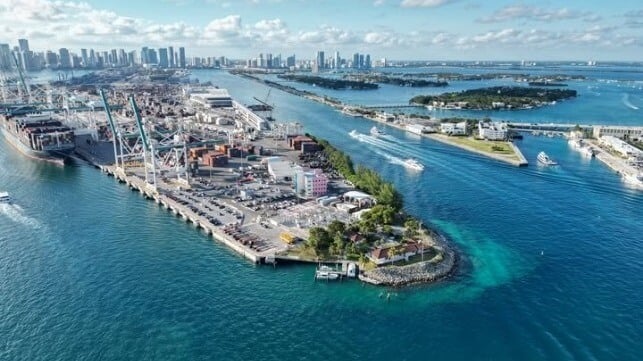
PortMiami to Seek New Director as Fuel Depot Turmoil Continues
PortMiami needs a new director after the Interim Director named palst week announced he will retire at the end of the month (PortMiami)
The newly named Interim Director for PortMiami has announced his retirement at the end of the month, just days after being named to the position by the mayor of Miami-Dade County. The Miami Herald reports Frederick Wong tendering his resignation on Tuesday, June 9, to the mayor’s office, saying that he planned to retire.
Wong had been with the port for four years after being recruited from Jacksonville, Florida, where he had been for the prior five years. He had previously been PortMiami’s Assistant Port Director of Operations, responsible for all cruise, cargo, and security operations. He has over 31 years of experience in all facets of port operations.
The mayor’s office told the Miami Herald that it respected his personal decision, but had hoped he would continue to serve. According to the report, there was no mention of the ongoing turmoil over the fuel terminal on Fisher Island in his resignation letter.
The government of Miami-Dade has been embroiled in the issue of the fuel terminal since it went up for sale, and the county failed to buy it. A private developer paid approximately $180 million for the property on the tony adjacent island to the port and said it would close the fuel depot and redevelop it as more luxury condominiums.
Residents of the luxury communities on Fisher Island welcomed the news, but it created a problem for PortMiami, which depends on the fuel terminal. A Deputy Mayor, Jimmy Morales, and then Seaport Director Hydi Webb spent more than a year negotiating with the developer and presented a plan for the port to pay $200 million up front and another $200 million over 20 years to take control of the terminal.
Mayor Daniella Levine Cava last Friday said the deal was too expensive and that the county would seek the property through eminent domain. She also announced the reorganization of the county government, with Morales, along with Seaport Director Webb, immediately leaving their roles, and that Wong would step in as Interim Director of PortMiami.
The shakeup comes as PortMiami continues its rapid growth. In the FY ended September 30, the port handled nearly 8.6 million passengers, a better than four percent annual increase and the highest annual passenger count in the seaport’s history. A new terminal is under construction with Royal Caribbean Group after opening the port’s largest terminal in the spring of 2025 with MSC Cruises. Royal Caribbean International and Norwegian Cruise Line each also recently developed new terminals.
The port was planning the arrival of 10 new cruise ships, including five newbuild vessels, during the 2025-2026 season on top of its large homeport fleet. It, however, lost the title of the busiest cruise port to Port Canaveral, which saw a better than 13 percent increase, pushing it above 8.6 million passengers for the FY year.
On the cargo side of PortMiami, it marked 11 consecutive years exceeding one million TEUs. In the FY, the port recorded a 2.35 percent increase in containers, exceeding 1.115 million TEU for the year.
Greek Ferry Breaks Concrete Jetty in Half and Comes Away Undamaged
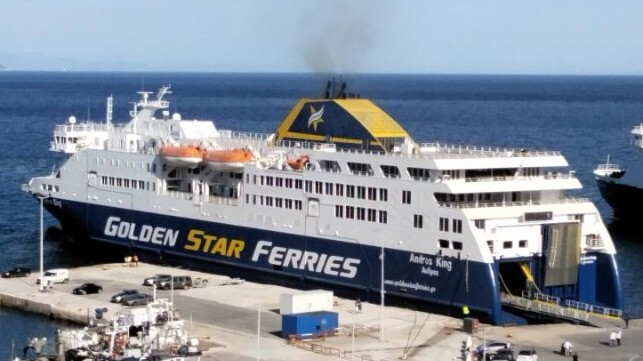
Andros King at Rafina (file image courtesy Konstantinos / VesselFinder)
[Brief] On Monday night, a car ferry hit a jetty at the entrance to the port of Rafina, Greece, damaging it so badly that the jetty was severed in two - but the vessel came away largely unscathed.
That evening, the ferry Andros King was arriving in Rafina from Mykonos. The vessel had about 280 passengers and 60 crewmembers aboard, plus cars and trucks. Winds were blowing at about Force 5 from the north.
Ro-ro ferries arriving at Rafina make a turn inside a concrete breakwater, allowing them to load and unload with their stern ramps, and Andros King appears to have encountered the concrete jetty while executing this turn. Photos from the scene appear to show portions of the jetty shifted out of position.
Remarkably, the passengers were unharmed and the Andros King was undamaged, save for some apparent scraped paint on the bulbous bow. The ferry was authorized to get under way, and it departed on its next commercial voyage at about 0750 hours the following morning.
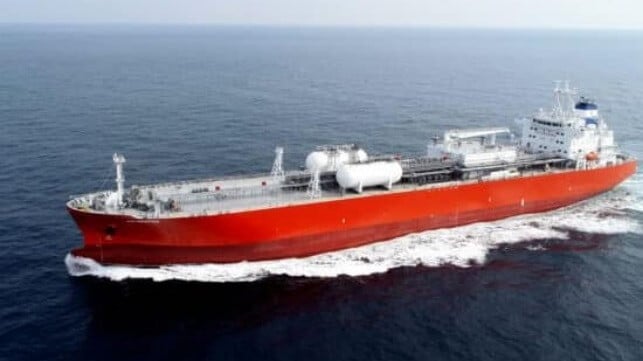
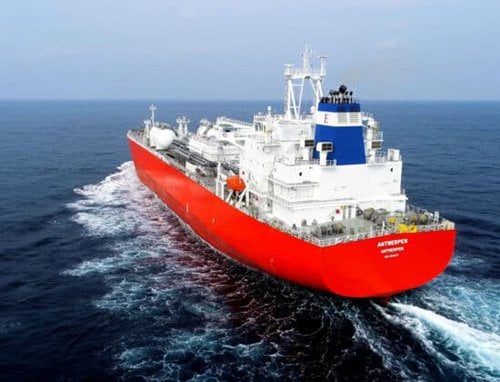
The first newly built dual-fuel ammonia-fueled vessel, Antwerpen, has been officially delivered and went into service today, June 10, for the French division of Exmar. The pioneering ship is the first of a coming wave of deliveries and is seen as a critical step to accelerate the adoption of ammonia as a marine fuel across the wider shipping industry.
Exmar, along with HD Hyundai, heralded the delivery of the vessel, the first of three due this year for Exmar, with a fourth to follow in early 2027. The ships have a total capacity of 46,000 cbm of ammonia, and they are pioneers as the first ammonia gas carriers also capable of using it as a fuel.
The project has been in the works for four years and has pioneered many phases. Exmar points out that it worked closely with the Belgian administration and Lloyd’s Register in establishing the international framework and regulations to allow ammonia’s use as a marine fuel on a gas carrier. While it follows the model of LNG and LPG carriers, regulations did not permit the use of toxic cargoes such as ammonia to be used as a fuel on gas carriers.
While LNG and LPG present challenges related to flammability, Exmar highlights that unique challenges for ammonia primarily center on the concerns over toxicity. It is also highly corrosive. The company reports it drew on its experience of transporting ammonia as a cargo. Ammonia is seen as a key contributor toward decarbonization, as it is the most efficient carrier of hydrogen, which will be used in onshore industrial and other large applications as an alternative fuel.
The development project for the ships began in 2022, working with Hyundai Mipo (which was recently merged with HD Hyundai Heavy Industries in Ulsan), along with WinGD, Nord Gas Solutions (formerly Wartsila Gas Solutions), and Lloyd’s Register.
WinGD developed the 52-bore engine, which was built by HD Hyundai Heavy Industries’ Engine and Machinery Business Unit. It reports the engine, which was installed in the summer of 2025, features high-pressure ammonia injection supplemented by a low, targeted pilot fuel dose of around five percent at full load. The engine delivers load handling, dynamic response, and fuel efficiency on par with WinGD’s equivalent diesel-fueled X Engines in both ammonia and diesel operating modes.
Antwerpen is underway with the experience expected to contribute to future ammonia-fueled vessels (Exmar)
The first two ships, which were named Antwerpen and Arlon in honor of two Belgian cities, each measure 190 meters (623 feet) in length and were specifically designed for the transport of liquefied gas cargoes, including ammonia and LPG. They are 27,000 dwt. Exmar highlights that the vessels were deliberately lengthened 10 meters (approximately 33 feet) in the design stage, along with a slight increase in beam to achieve a meaningfully higher cargo intake compared to the standard design. Hyundai developed the proprietary technology and the three tanks, which provide 45,000 cbm storage below deck, and two 500 cbm deck tanks.
HD Hyundai highlights that ammonia (NH3) can be stored in pressurized tanks at around 8 bar or in refrigerated tanks at -33°C without the need for cryogenic technology. In liquid form, it has about 1.7 times higher storage density than liquefied hydrogen (-253°C) at the same volume, making it suitable for large-scale, long-distance transport and storage of hydrogen. In operation as the vessel’s fuel, they project it will lower emissions by up to 90 percent versus conventional ships.
Exmar is confident that the knowledge, technology, and operational experience from these ships will help to accelerate ammonia as a marine fuel. It believes the lessons that will be learned will be applied to many other vessel types.
Antwerpen completed delivery and departed from Ulsan bound for Zhoushan, China. Her sister Arlon will be delivered in the coming months, and the third ship, which has not yet been named, will be delivered before the end of the year.
Data from DNV’s Alternative Fuels Insights database shows that there are only three small, converted vessels, two tugs and an offshore supply vessel, capable of ammonia-fueled operations. However, CMP.TECH’s Bocimar division will soon follow with the first ammonia-fueled bulker. DNV calculates that there are a total of 47 vessels on order for delivery by 2030 that will be capable of ammonia-fueled operations.