Thursday, June 11, 2026

Trump's birthday brawl derided as 'volcano of corruption' in court filing

Travis Gettys
June 11, 2026 
RAW STORY



Construction continues on a temporary arena that will host the UFC Freedom 250 fight event in June on the South Lawn of the White House in Washington, D.C., U.S., May 27, 2026. REUTERS/Jonathan Ernst

President Donald Trump's birthday celebration on the White House lawn was disparaged as a "volcano of corruption" in a new legal challenge.

Attorneys fighting to block this weekend's UFC matches at the White House told a federal judge Wednesday the president and his allies stand to profit from what they called "the first private, for-profit sporting event ever held on White House grounds" — and warned the country is approaching a historic moment of institutional corruption, reported MS NOW.

"Such a volcano of corruption, if allowed to go forward, will mark an inflection point in American history," argued plaintiffs Susan Douglas and Paul Romano in their final filing.

The plaintiffs, attorneys from the Public Integrity Project, painted a portrait of interlocking financial interests at the heart of the planned three-day spectacle, which is set to culminate Sunday — Trump's 80th birthday — with seven professional UFC bouts staged on the South Lawn inside a massive temporary structure known as "the Claw."

They pointed to million-dollar VIP packages, brand placement opportunities near the Lincoln Memorial, and an exclusive broadcast on Paramount Plus, a streaming service run by Trump allies Larry and David Ellison. No American, they noted, will be able to watch the self-described "celebration of America" without paying a subscription fee.

They further alleged Trump bought stock in the company that owns the UFC earlier this spring, giving him a direct financial stake in the event's success. UFC head Dana White, who has organized the spectacle alongside the White House, is a longtime personal friend and political ally of the president.

The Trump administration called the lawsuit meritless and said the plaintiffs were merely seeking "to complain about that which offends their sensibilities." Officials also argued the suit's last-minute timing alone should disqualify it, noting the event was publicly announced nearly a year ago.

U.S. District Judge Amit Mehta, an Obama appointee, must now decide whether the fights go on — or whether the volcano gets capped.

Growing rebellion exposed as Trump's Great American State Fair dealt another big blow

Daniel Hampton
June 11, 2026 
RAW STORY


People walk past a sign of the UFC Freedom 250 fight card, near the White House in Washington, D.C., U.S., June 9, 2026. REUTERS/Kevin Lamarque

President Donald Trump's birthday bash for America is hitting fresh trouble, with at least six states publicly saying they will not officially participate in his Great American State Fair, NOTUS reported Wednesday.

Officials from Connecticut, Illinois, Maine, Massachusetts, North Carolina and Oregon told the outlet they will not send official delegations to the 16-day fair on the National Mall, set to open June 25. Three other states — Maryland, Pennsylvania and Washington — remain uncommitted just two weeks out.

The state holdouts come days after a wave of musical acts abandoned the festival, with performers including Martina McBride and Bret Michaels saying they had been misled about the event's political ties. After the lineup collapse, Trump announced he would open the fair with "the Greatest Rally, EVER!"

NOTUS reported the fair is an example of a deeper rift between Freedom 250, the Trump-created entity producing the spectacles, and America 250, the bipartisan commission Congress created a decade ago. The Trump administration has withheld tens of millions from America 250, which now faces a $100 million shortfall, while funneling at least $68 million to Freedom 250, NOTUS found.

Freedom 250 spokesperson Rachel Reisner told NOTUS, "all 50 states and U.S. territories will be represented," adding: “The idea that a president’s presence at America’s 250th birthday is somehow a political act is not a serious argument — and frankly, it is not serious journalism to treat it as one."

Massachusetts Gov. Maura Healey delivered a withering assessment on the spectacle.

"This guy finds a way to try to get money into his own pocket any which way," she said.

North Carolina, the only Trump-voting state skipping so far, said preparing its space would cost at least $100,000, which it doesn't have. Officials in other states cited rushed timelines and concerns about staffing 11- to 13-hour days.

"This is not the hill we want to die on," one official told NOTUS anonymously.


Insiders fume as Trump blows up America 250: 'Straight out of It's A Wonderful Life'

Matthew Chapman
June 11, 2026 
RAW STORY
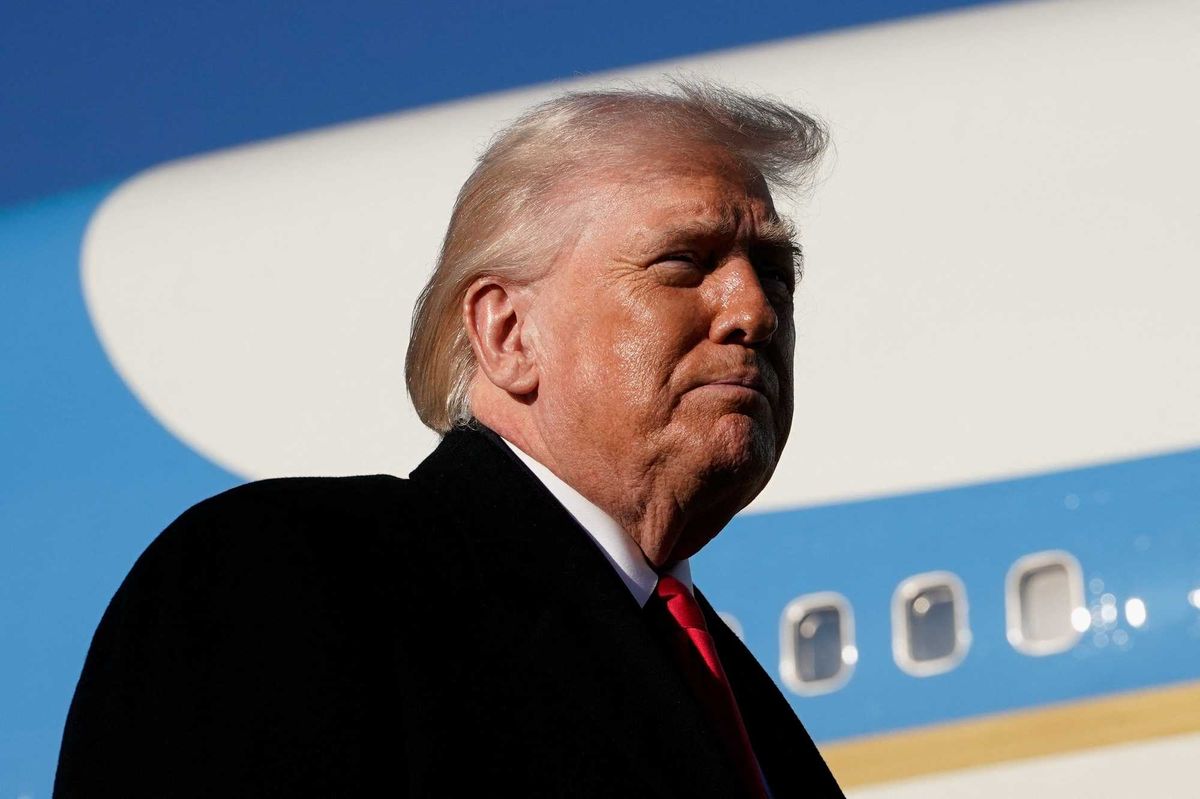

President Donald Trump looks on before boarding Air Force One en route to Florida, at Pope Army Airfield on Fort Bragg, North Carolina on Feb. 13, 2026. REUTERS/Elizabeth Frantz

Sordid new details are coming out about how President Donald Trump and his allies hijacked the bipartisan "America250" celebration approved by Congress and siphoned off its money to alternative celebration planning entities under his own control.

According to The Atlantic's Michael Scherer, newly obtained documents behind the scenes of Trump taking over the event "described frayed trust and growing conflict that has become so acrimonious that the Department of Interior is refusing to honor a December agreement with America250" to transfer $50 million in funding.

Officials in the Trump administration proclaimed they will not do so because “Spending taxpayer money on frivolous, poorly attended events and D.C. consultants who are trying to get rich off America’s 250th is the exact opposite of what was intended. This administration will not light taxpayer money on fire. Full stop,” according to the report

This has left lawmakers and event organizers in both parties frustrated, with one America250 commissioner telling Scherer, “This is straight out of It’s a Wonderful Life, when Henry Potter steals George Bailey’s money and tries to drive him to the brink."

Trump officials, for their part, see it as the president's rightful duty to put on the festivities and resent that America250 hasn't fully handed the reins to them, with longtime MAGA strategist Chris LaCivita saying the group “can’t get over the fact that Trump won.”

All of this comes amid a series of reports detailing how the events Trump is putting on are floundering — most notably, his "Freedom 250" music festival that featured a long list of performers either pulling out or clarifying they were never part of the event in the first place despite being advertised.

It also comes as Trump's prized project of hosting a UFC fight on the White House lawn is now facing litigation from veteran activists in Washington, D.C.
Trump handed a warning shot ahead of World Cup with troubling new poll


A woman of the Otomi Indigenous community holds a rubber head depicting U.S. President Donald Trump during anti-World Cup protests calling for social justice in Mexico City, Mexico, June 6, 2026. REUTERS/Quetzalli Nicte-Ha TPX IMAGES OF THE DAY

As soccer fans from across the world travel to the United States this month to cheer on their countries’ teams at the 2026 FIFA World Cup, a poll released Wednesday by Data for Progress suggests Americans don’t believe many visitors have warm feelings toward the host country after a year-and-a-half of President Donald Trump’s leadership.

Overall the poll found that 62% of American voters think the country’s reputation has deteriorated under Trump, with just 32% saying it’s gotten better.

Republicans were the only political faction to believe Trump has improved global views of the US, while Independents and Democrats overwhelmingly said the president has made them worse.

The poll also found 52% of US voters believed Trump’s mass deportation policies have hurt the country’s image in the world, with just 34% saying the deportations have helped.

Trump’s immigration policies collided with the World Cup earlier this week when Somali referee Omar Artan, who was selected by the International Federation of Association Football (FIFA) to work at the celebrated event, was barred from entering the US despite having a valid visa.

A Trump administration official claimed Artan had an “association with suspected members of terror organizations,” but provided no evidence for the allegation. US Rep. Rashida Tlaib (D-Mich.) called his treatment by the US “a disgrace.”

Polling data published last year by Pew suggests that Democrats and Independents are more accurately measuring global public sentiment of the US under Trump’s leadership than Republicans.

Specifically, Pew found that net positive perceptions of the US dropped by 10 percentage points or more among residents in a dozen countries between 2024 and 2025, including in key allies such as Canada, Mexico, Germany, and France.

What’s more, Pew found only five countries where the United States’ reputation has improved since Trump’s election: South Africa, India, Israel, Nigeria, and Turkey.

Trump during his second term has taken a number of actions that have sparked anger from foreign governments, including making repeated threats to seize Greenland as a US territory, invading Venezuela and abducting its president, imposing an oil blockade on and threatening to take over Cuba, launching a global trade war, and waging an illegal war of choice on Iran.


Far-right news sites see traffic crash as Trump support collapses: report

Tom Boggioni
June 11, 2026 
RAW STORY


Daily Wire Co-Founder & The Ben Shapiro Show Host Ben Shapiro takes part in the panel 'Future of news: How creators and influencers are reshaping journalism', at the Reuters NEXT conference, in New York City, New York, U.S., December 3, 2025. REUTERS/Brendan McDermid

As President Donald Trump's approval ratings hit record lows, far-right media outlets are experiencing a parallel collapse, with major conservative websites posting devastating traffic declines in May.

According to media watchdog Status, The Righting—which monitors website traffic—reported catastrophic numbers across the conservative media landscape. The top 20 right-wing news websites all posted year-over-year declines in May visits, with 90 percent experiencing double-digit drops.

The carnage was severe.

Among the biggest casualties were The Federalist (down 52 percent), Ben Shapiro's Daily Wire (down 47 percent), and The Blaze (down 46 percent). Only two sites managed single-digit declines: the Epoch Times (down 2 percent) and Truth Social (down 9 percent).

The decline wasn't limited to conservative outlets, however. Mainstream news organizations also experienced traffic losses, though notably not as steep as outlets like The Federalist and Daily Wire.

Howard Polskin of The Righting described the trend as accelerating.

"The trend in 2026 has definitely been downward, but it feels like the descent is accelerating despite major events like the war with Iran which should have attracted visits. May's numbers represent the first time this year that every site I track has shown negative year-over-year growth," he wrote.

News of the traffic collapse comes weeks after the Daily Wire announced layoffs.

According to Nashville Scene, "Once seen as a Digital Age successor to Fox News, The Daily Wire — which relocated from Los Angeles to Nashville in 2020 as it neared a market peak — has suffered layoffs and a failed attempt to build a right-wing Hollywood over the past 12 months. Its audience has been in free fall across platforms while competing against independent personalities like Tucker Carlson, Nick Fuentes and former DW principal Candace Owens.“

SCI-FI-TEK 70 YRS IN THE MAKING

DOE approval of Xcimer fusion power plant preconceptual design


The US Department of Energy has formally approved Xcimer Energy's preconceptual design and technology development roadmap milestone for Athena, the company's architecture for fusion power plants.
 
Athena (Image: Kilograph / Xcimer)

Athena is the reference architecture for Xcimer's planned fleet of fusion power plants. Designed for continuous operation, industrial scale, and a fuel cycle that renews itself, Athena integrates the company's proprietary excimer laser platform with target delivery, fusion chamber, tritium breeding, and power generation systems engineered from the outset for industrial scale.

Denver-based Xcimer's 724-page submission provided Department of Energy (DOE) reviewers with a detailed assessment of plant performance targets, economics, system-level engineering requirements, safety and environmental analyses, and technology development pathways required to achieve commercial fusion power.

"The question facing laser fusion is no longer whether the physics works," said Conner Galloway, CEO, Chief Science Officer, and co-founder of Xcimer Energy. "The question is how fast we can industrialise it. DOE's acceptance of Athena reflects both the strength of our technical approach and our ability to execute against an ambitious commercialisation roadmap."

Susana Reyes, Vice President for Chamber and Plant Design at Xcimer Energy, added: "A commercially attractive power plant looks very different from a scientific breakthrough facility. We are designing Athena to run continuously at a repetition rate of up to 1 Hz, and the use of a liquid wall chamber maximises availability by protecting the solid structures from the fusion reaction emissions over the entire plant lifetime.

"One reason other fusion chamber designs face a durability problem is that they put solid material where the fusion neutrons go. We don't. The molten salt curtain absorbs and moderates the flux, breeds fuel, and carries the heat - and it flows, so it renews itself continuously. We designed Athena around that property from day one, and it shapes everything: the materials choices, the thermal management, the maintenance philosophy, the economics. And Xcimer's laser architecture uniquely enables this design."

The DOE's acceptance of the Athena design follows Xcimer's completion of earlier programme milestones during the first 18-month budget period in the milestone programme. The company said its next phases of work include full-scale subsystem testing, engineering validation, and preparation for an integrated plant demonstration.

Xcimer published its roadmap to commercialising laser-inertial fusion in February this year.

"The milestone positions Xcimer among the front runners to commercialise fusion energy and marks one of the industry's most comprehensive government reviews of a privately developed fusion plant architecture," the company said. "The acceptance of both the design and roadmap also reflects continued progress under the DOE's Fusion Milestone Development Program and validates Xcimer's roadmap for translating laboratory fusion breakthroughs into a commercially deployable energy system."

Xcimer was one of eight companies selected by DOE in June 2023 to share USD46 million in funding from the Milestone-based Fusion Development Program, with the aim that "within five to 10 years" they "will resolve scientific and technological challenges to create designs for a fusion pilot plant". Xcimer said it had been awarded USD9 million.

Last week, Xcimer announced the launch of operations of its prototype laser system, code-named Phoenix – the largest privately owned laser system in the world and the company's prototype for commercialising laser fusion. Phoenix, housed in Xcimer's Denver laser facility, is a proof of concept for an unconventional fusion architecture: a krypton fluoride excimer laser using Stimulated Brillouin Scattering (SBS) to compress a microsecond-long pulse into the nanosecond timescales fusion requires. Phoenix is designed to demonstrate end-to-end integrated operation of excimer amplification and SBS pulse compression.

The World's Biggest Battery Maker Is Turning Away From EVs

  • CATL — which controls 38% of the global EV battery market — wants energy storage to account for half its sales by 2030, up from just 2% five years ago.

  • Trump administration policies have accelerated the pivot, pushing EV makers including GM and LG toward grid-scale storage as EV incentives dry up.

  • Waymo has partnered with B2U Storage Solutions to recycle used robotaxi batteries into solar and wind storage systems, signaling growing momentum for EV battery second-life applications.

As global energy markets change, companies along the electric vehicles manufacturing supply chain are rushing to expand and diversify. The Trump administration’s stance on clean energy and aggression in Iran, among other energy-related bombshells, have made waves through global energy markets and created a general air of uncertainty that is leading many energy firms to put their eggs in more baskets. As a result, many EV companies and battery makers are turning to the next obvious market for their products, both used and recycled: energy storage.

Chinese battery giant CATL has just announced that it aims to have energy storage represent half of its global sales by just 2030, marking a major shift in the company’s strategy with far-reaching implications for global markets. CATL is the largest maker of EV batteries in the world, representing half of China’s enormous battery market, and a whopping 38.1 percent stake of the global market.

The scale and reach of CATL’s operations mean that any decision they take will have massive implications for the rest of the world. CATL’s pivot away from EV battery manufacturing could lower global supplies and cause the price of EVs to rise worldwide, warns a recent report from CBT News.

The company’s decision to target 50 percent energy storage sales by the end of the decade is just the latest development in a yearslong shift away from EV batteries and toward energy storage. Five years ago, energy storage represented just 2 percent of CATL’s sales. Now it represents one-quarter of CATL’s sales, and 30.4 percent of the global energy storage market. In fact, CATL has already been the largest provider of batteries for energy storage in the world for five years running.

Many other EV producers and battery makers are following the same trend. When Trump took office for his second term and gutted many Biden-era supports for electric vehicles, among other clean energy sectors, EV makers like General Motors and LG started pivoting toward energy storage in droves. While the markets for clean cars were looking highly uncertain, the need for expanded energy storage driven by AI data centers seemed like a much better bet.

“The market for grid-scale batteries and backup power isn’t just expanding, it’s becoming essential infrastructure,” Kurt Kelty, General Motors’ vice president of batteries, propulsion, and sustainability, stated last year. “Electricity demand is climbing, and it’s only going to accelerate. To meet that challenge, the U.S. needs energy storage solutions that can be deployed quickly, economically, and made right here at home. GM batteries can play an integral role. We’re not just making better cars — we’re shaping the future of energy resilience.”

Energy storage also presents a highly promising secondary market for retired EV batteries, which still have a lot of life – not to mention a treasure trove of critical minerals – left in them when they reach the end of their utility powering vehicles. Diverting those batteries away from landfill and recycling them into energy storage applications therefore presents a win-win-win for EV companies, utilities, and environmentalists alike

Waymo, the autonomous rideshare company, has just inked a high-profile deal to recycle its used EV batteries into storage systems that can support grids powered by solar and wind energies. The company is partnering with the storage firm B2U Storage Solutions to pilot a recycling program in California and Texas, with each repurposed battery potentially creating thousands of dollars in additional energy value through its second life in storage.

However, the EV-battery recycling sector is still nascent, and up-front costs remain high. “Recycling companies are only now starting to see meaningful volumes of recyclable materials in circulation, which has made it challenging to operate plants at full scale and make the economics pencil out on recycling alone,” Latitude Media reported this week. But as the field becomes more crowded and high-profile firms like Waymo continue to get on board, we could see this burgeoning sector reach economies of scale in the near future – especially as energy storage becomes more lucrative and in-demand than ever as the oil crisis and AI energy crisis continue to drive up the need for alternative energy solutions.

By Haley Zaremba for Oilprice.com


Algeria’s Gas Advantage Is Real. So Are Its Production Problems.

  • Algeria’s 2026 upstream round puts 2.1 billion barrels of oil and 66.5 billion m3 of natural gas on the table just as Europe is desperately locking in non-Russian supply.

  • With Algeria already covering around 18% of EU gas imports, the tender could turn today’s geopolitical premium into longer-term export leverage.

  • The problem is deliverability: current fields are increasingly depleted and domestic demand is growing, leaving less spare gas for pipelines and LNG.

Algeria’s 2026 hydrocarbon bidding round is arriving at a moment when timing may matter as much as geology. Oil and gas prices have been lifted by the prolonged Middle Eastern crisis, Europe is still trying to hardwire non-Russian gas into its supply system, and former Middle Eastern investors are reassessing where long-cycle upstream capital can be redirected without excessive security risk. For Algiers, this creates a sudden opening to cement its position as Europe’s second-largest natural gas supplier but also exposes the scale of the challenges it must overcome.

In early June, the Algerian National Agency for the Valorisation of Hydrocarbon Resources (ALNAFT) has launched seven onshore conventional oil and gas blocks, with bids and ratification due in November. The offer is estimated to contain around 2.1 billion barrels of oil and 66.5 billion m3 of gas, spread across a mix of existing discoveries and exploration areas. Four of the seven blocks are in the Illizi-Ghadames basin near the Libyan and Tunisian borders, while the rest cover more oil-oriented potential in the Oued Mya and Sahara basins.

That geography matters. Algeria’s 2024 round (the first out of 5 planned) was more weighted toward gas-prone south-western acreage, where resources are attractive, but infrastructure is far less developed, thus exploration and production timelines are longer. The 2026 round shifts attention to the south-east, where the Berkine and Illizi-Ghadames basins are more mature, better connected and easier to bring to market. That makes this tender more commercially relevant in a high-price environment.

The previous round was not a failure, but it was not a roaring success either. Five of six licences were awarded, yet competition was moderate, reflecting the legacy of years in which Algeria’s upstream terms struggled to attract enough foreign capital. The 2014 round had exposed that problem clearly, with investors deterred by high taxes, heavy state control and limited commercial flexibility. The 2019 hydrocarbons law was meant to repair the damage by widening contract options and removing the previous requirement for Sonatrach to hold at least 51% in upstream projects.

The 2024 awards showed that the reset had begun. QatarEnergy entered Algeria alongside TotalEnergies in the Ahara licence, with Total as operator and each company holding 24.5%. Eni and Thailand’s PTTEP took the gas-oriented Reggane 2 project. Chinese companies also deepened their position, with Sinopec taking Hassi Berkane North and pursuing gas exploration at Guern El Guessa, while the lesser known Zhongman Petroleum (China) entered the Zerafa II gas block. Since then, Eni has signed a $1.35 billion production-sharing deal in the Zemoul El Kbar perimeter, expected to produce 415 million barrels of oil equivalent including 9.3 billion m3 of gas, while Saudi Arabia’s Midad Energy signed a $5.4 billion contract for Illizi South near the Libyan border.

This investor mix is important. Eni has been present in Algeria since 1981 and has been producing around 140,000 boe/day, making the country a core part of its portfolio. TotalEnergies is both an upstream investor and a major offtaker of Algerian LNG. QatarEnergy brings LNG expertise and strong financial backing. PTTEP, Sinopec and the Saudi entry shows that Algeria’s upstream opening is no longer just a European story. Talks with Chevron and ExxonMobil, focused largely on shale and unconventional gas potential, are still ongoing, but they point to another possible layer of interest if the commercial terms remain attractive.

The reason this matters is simple: Algeria’s export position is strong, but its production base is not. The country is Africa’s largest gas producer and natural gas accounts for roughly 49% of its hydrocarbon output. Total recoverable resources are estimated at 2.5 - 3.4 trillion m3 of gas and around 10.5 billion barrels of oil. But currently developed fields are mature, domestic demand is rising, and the export surplus is being squeezed. Production increased from around 278 million m3/day in 2021 to 287 million m3/day in 2023, but that 2023 number appear to have marked a peak rather than the start of a sustained growth cycle.

Algeria’s upstream backbone is Hassi R’Mel, the country’s largest gas field and still the main pillar of its production base after 65 years in operation. Having peaked in the mid-1990s, the field is now deeply mature, with its initial 3 trillion m3 resource base depleted to roughly 20% of its former volume (a trend mirrored by Algeria’s giant oil field Hassi Messaoud). Satellite fields and nearby tie-ins have helped slow down the decline, but Sonatrach’s room for manoeuvre is narrowing as the pool of readily available discoveries becomes narrower. Much of today’s pressure is the delayed consequence of Algeria’s 14-year ban on production-sharing and service contracts for natural gas fields between 2005 and 2019, which held back upstream momentum just as incremental supply from the discoveries of the 1980s and 1990s was beginning to fade.

Pipeline gas is still the backbone of Algeria’s export system. Around two-thirds of exports move by pipelines, mainly through the TransMed route via Tunisia and Sicily into Italy, and the Medgaz subsea link directly to Almeria in Spain. TransMed has capacity of about 32–35 billion m3/year and carried roughly 21 billion m3 in recent years. Medgaz can move around 10–10.5 billion m3/year. The third older Morocco-Spain route has been shut since 2021 after Algiers declined to renew the transit agreement amid political tensions with Rabat.

Italy is now Algeria’s central gas customer, taking roughly 20–23 billion m3/year and relying on Algerian supply for about 30% of its gas needs. Spain is more complicated politically but remains structurally important, with Algeria covering roughly 25% of its gas imports. Talks that began in March 2026 to expand Medgaz by up to 1 billion m3/year show that the appetite for Algerian pipeline gas is still there. The constraint is not demand, but deliverability.

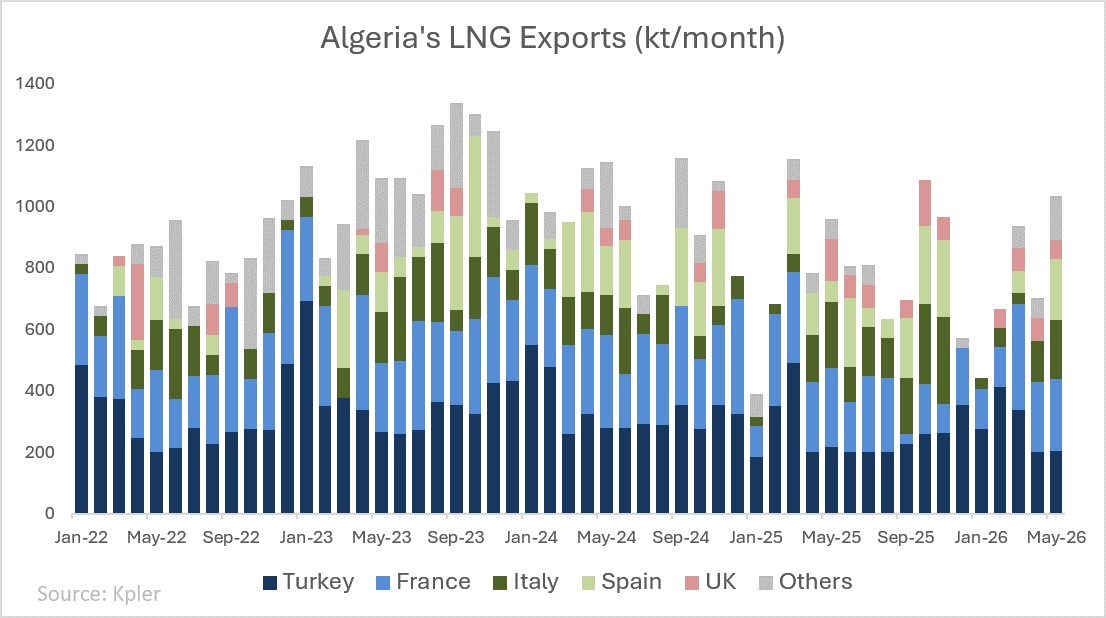
LNG tells the same story with more volatility. Algeria has two LNG export hubs: Arzew/Bethioua in the west, with about 20.8 million t/year of liquefaction capacity, and Skikda in the east, operating at around 4.5 million t/year. LNG exports surged after Europe’s break with Russian gas, rising from an average of around 900 kt/month of liquefied gas to a record 1.3 million kt in September 2023, a 60% year on year jump. France, Italy and Spain were the main European buyers, while Turkey took almost a quarter of shipments. By 2025, however, Algerian exports to Europe had slipped to around 9.5 million tonnes of LNG a year, or about 6% of the continent’s LNG imports, down roughly 2 million tonnes year-on-year. Adding the pipeline exports, by 2025 Algeria accounted for around 18% of EU natural gas imports, second only to Norway and ahead of Russia. That gives Algiers strategic leverage, especially with Italy and Spain. But it also raises the stakes: Europe needs Algeria to remain reliable, while Algeria needs new upstream investment to keep up the production.

However, the recent issue has become Algeria’s growing domestic demand. Algeria consumed around 57 billion m3/year of gas in 2025, absorbing more than half of the national output. That means every additional cubic metre must be fought over by power demand, industrial consumption, pipeline contracts and LNG cargoes. For a country where hydrocarbons account for around 10–12% of GDP and more than 90% of export revenues, the shrinking export cushion is not just an energy issue, but also a fiscal and external-balance problem

This is why the 2026 round matters more than the acreage map suggests. Oil remains useful, but Algeria’s OPEC+ membership puts a cap on crude investment for the upcoming years. Gas is the strategic prize. It can strengthen Algeria’s role in Europe’s supply security, preserve market share in Italy and Spain, and give Sonatrach more optionality through LNG. Yet none of that is possible without new field development and infrastructure investment in underdeveloped gas provinces.

Algeria has a rare opening. Europe wants nearby gas, investors want alternatives to the Gulf’s security risk, and the country has made its upstream terms more flexible than they were a decade ago. But the window is not permanent. Mature fields, rising domestic demand and infrastructure gaps will steadily erode export capacity unless new projects move quickly. If the 2026 bidding round brings in serious capital, Algeria can turn today’s geopolitical sudden chance into a longer-term gas advantage. If it disappoints, the country risks becoming a supplier that Europe needs badly, but one with too little spare gas to fully benefit from.

By Natalia Katona for Oilprice.com

WAIT, WHAT?!

Scientists Create Giant Fire Tornadoes To Clean Up Oil Spills


LAB CREATED FIRENADO BURNING OIL

  • Scientists have developed controlled “fire tornadoes” that can burn offshore oil spills up to 40% faster than conventional in-situ burning while reducing toxic soot emissions by about 40%.

  • The technology uses a specially designed structure to create a vortex that pulls in oxygen, allowing oil to burn hotter and more completely.

  • While promising, deploying fire tornadoes at sea remains challenging due to wind, waves, and equipment requirements.
ACTUAL FIRENADO

Oil spills are some of the most destructive forms of marine pollution known to man, thanks to their acute toxicity and ability to devastate marine habitats. The BP Plc. (NYSE:BP) Deepwater Horizon spill in 2010 ranks as one of the worst accidental oil spills in history, having released over 134 million gallons (~4.9 million barrels) of oil into the Gulf of Mexico over a period of 87 days. The spill is estimated to have caused $17.2 billion in natural resource damages; killed ~1 million birds, hundreds of thousands of sea turtles and billions of oysters. The fishing and tourism sectors suffered massive losses, including over 25,000 jobs and an estimated $2.3 billion in regional economic activity. BP was ultimately found grossly negligent and was fined more than $20 billion--the largest environmental damage settlement in U.S. history. But now scientists have discovered a fast and efficient way to burn up all that oil before it wreaks havoc on marine ecosystems: giant fire tornadoes.

When dealing with open-ocean oil slicks from major oil spills, emergency response teams frequently use "in-situ burning" to prevent oil from poisoning fragile coastlines. For a successful burn, the oil slick must be sufficiently thick, usually at least 2 to 3 millimeters, to sustain combustion and counteract the cooling effect of the water, according to researchers from Texas A&M University. Fire-resistant booms are towed by vessels to herd and thicken the oil. Once the oil is properly contained, an ignition source is deployed including gelled-fuel helitorches dropped from helicopters or handheld/boat-deployed igniters.

Unfortunately, these conventional pool fires burn slowly and frequently leave behind a layer of toxic sludge while releasing thick, black clouds of smoke into the atmosphere. Thankfully, scientists have now discovered that controlled giant fire tornadoes can burn through offshore oil spills 40% faster while cutting toxic soot emissions by a similar margin, offering a highly efficient and less polluting alternative to traditional cleanup methods.

LAND BASED FIRENADO

Led by Dr. Michael Gollner of the University of California, Berkeley, Dr. Elaine Oran and Dr. Qingsheng Wang of Texas A&M University and supported by the Bureau of Safety and Environmental Enforcement (BSEE), researchers engineered a 16-foot-tall, three-walled triangular chamber to intentionally manipulate airflow around an ignited crude oil pool floating on water. The gaps in the walls cause incoming air to spiral upward into a tight, roaring column, with the vortex continuously sucking in oxygen from all sides, stoking the fire. The injection of oxygen allows the flame to burn much hotter and more completely, mimicking an industrial incinerator rather than a standard open bonfire.

"This the first time anyone has conceived using fire whirls for oil spill remediation, and it's really just the beginning," said Oran, professor of aerospace engineering in the College of Engineering. "Our goal is to harness the chaotic nature of fire whirls as a powerful, precise restoration tool, to protect coastlines, marine ecosystems and the environment as a whole."

According to Texas A&M, the fire whirls successfully consumed up to 95% of the fuel, leaving far fewer toxic tar mats and residues floating on the water's surface. Emissions of dangerous PM2.5 particles dropped by 40%, dramatically reducing the massive smoke plumes typically associated with oil slick burns. PM2.5 particles are microscopic airborne pollutants measuring 2.5 micrometers or less in diameter--roughly 30 times smaller than the width of a human hair. Because they are so tiny, they can bypass the body's natural defenses, traveling deep into the lungs and even enter the bloodstream upon inhalation. Another major benefit: the fire whirls cleared crude oil nearly twice as fast as traditional fire pools, shortening the timeframe that a spill has to spread and devastate local wildlife.

That said, trying to create these tornadoes in real-life situations is likely to present some serious challenges.

While highly effective in a controlled training facility, deploying fire tornadoes safely on the open ocean presents engineering hurdles. First off, fire whirls are inherently temperamental; strong, unpredictable ocean winds can cause the flame column to collapse, while too little airflow prevents the vortex from organizing. Additionally, sustaining such controlled burning action in open moving water with heavy wave action will likely require much sturdier equipment than the triangular chamber fabricated by the scientists.

Thankfully, the researchers are moving ahead with their mission to make large oil spills more manageable and less destructive, and are looking to develop portable, automated, mobile structures that emergency crews can deploy on demand directly over an oil spill to safely contain, isolate and rapidly incinerate the oil before it hits marine habitats.

By Alex Kimani for Oilprice.com


Central Asia Emerges as a New Front in the Minerals Supply Chain Battle

  • U.S. officials and mining executives are gathering in Astana to convert previous C5+1 agreements into concrete critical minerals investments.

  • Kazakhstan is offering investor-friendly ownership structures as it seeks to attract Western capital and develop its vast mineral resources.

  • Washington views Central Asia as a strategic source of critical minerals needed to diversify supply chains away from China.

US and Central Asian officials will meet June 11-12 in the Kazakh capital Astana to explore deals concerning the mining and processing of critical minerals. The gathering marks a step forward for the C5+1 Dialogue, which strives to expand economic, educational, and political ties linking the United States and Central Asia.

The meeting, officially titled the Astana Mining & Metallurgy Congress (AMM-2026), seeks to catalyze “the transition from the framework agreements reached at the November [C5+1] 2025 summit in Washington to concrete investment decisions,” according to a Kazakh government statement.

The Trump administration is helping promote foreign investment in Central Asia’s mining sector, mobilizing government agencies, especially the Export-Import Bank of the United States and the US Development Finance Corp. (DFC), to help de-risk dealmaking. The US delegation at the Astana meeting will include the heads of the Ex-Im Bank and the DFC, along with top mining-sector executives, including the founder of Ivanhoe Mines, Robert Friedland, and former Anglo American CEO Mark Cutifani.

Meanwhile, Kazakhstan is taking steps to facilitate investment by allowing investors to retain a majority share in projects. Kazakh officials point to a recently finalized tungsten deal as a role model, in which an American consortium known as Kaz Resources Inc. will develop major deposits in Kazakhstan, with the American entity retaining 70 percent of the shares in the project, while the Kazakh government retains the remaining 30 percent. 

Since returning to power in early 2025, the Trump administration has made widening access to Central Asia’s mineral wealth a top diplomatic priority. China currently dominates the market for a wide array of critical minerals and rare earths. 

“Kazakhstan is transitioning from the category of a neutral transit territory in Central Asia to the status of an active participant in reliable and resilient critical minerals supply chains,” the Kazakh government statement said. 

“Kazakhstan’s trajectory in 2026 demonstrates a rare convergence: a structural crisis of the old export model, institutional realignment to international standards, and strong Western geopolitical demand for non-Chinese sources of critical minerals have aligned within the same time window,” it added.

By Eurasianet

MONOPOLY CAPITALI$M

Mining M&A value surges in Q1, but deal count plunges: S&P


Stock image. (By Gorodenkoff.)

The mining industry saw mixed mergers and acquisitions (M&A) activity in the first quarter of 2026, with a surge in deal value but a sizeable decrease in the number of transactions, according to S&P Global.

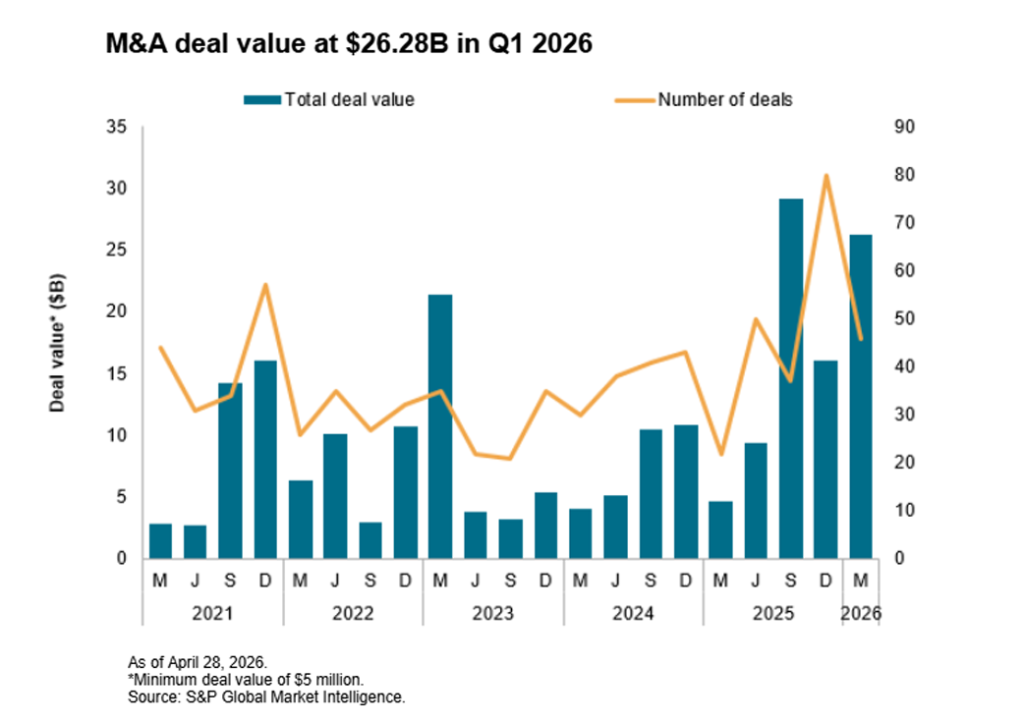
In its latest M&A trends report, the firm highlighted a strong resurgence in deals involving companies in the metals and mining sector during the January-March period, with the combined value of transactions rising 63% over the previous quarter.

At $26.28 billion, the total value of deals represents the second highest ever for a quarter since it began tracking the data in late 2013, S&P said, pointing to the industry’s strategic focus on securing long-term supply.

It also noted that companies in the mining sector are now seeking immediate scale, which explains the surge in corporate-level deals as opposed to asset acquisitions. In total, there were 30 company acquisitions recorded by S&P during the quarter, nearly double the number of asset purchases (16).

However, the report came with a caveat, as Q1 2026 was the first quarter that the firm included steel deals in its coverage. As such, the $10 billion acquisition of BlueScope Steel — the largest of the quarter — likely overstated the increased value of M&A deals compared to past years.

This was also evident in the number of M&A deals, which at 46 was nearly half of the December quarter totals.

Focus on copper-gold remains

Aside from the steel deal, the second and third largest deals centered on gold and copper respectively, an indication of the strong appetite for the two hottest commodities, S&P said. Several large players, including South Africa’s Gold Fields and China’s Zhaojin Mining, have indicated they are open to deals.

As for individual asset buys, the combined value ($3.35 billion) was well above the quarterly average, buoyed by the $1 billion sale of the Copler mine in Turkey, though it was 12% lower than the previous quarter. But compared to the same period last year, the value of asset purchases was a significant 221% higher.