It’s possible that I shall make an ass of myself. But in that case one can always get out of it with a little dialectic. I have, of course, so worded my proposition as to be right either way (K.Marx, Letter to F.Engels on the Indian Mutiny)
Saturday, June 13, 2026
EU's plastic garbage exports to Turkey reach all-time high
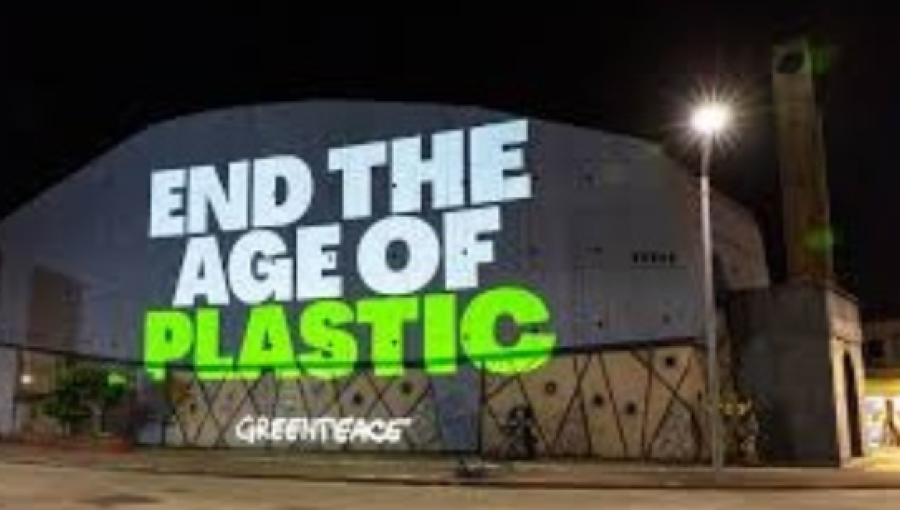
A projection shone on a plastics manufacturing facility by Greenpeace activists. The group says it wants action not words in ending the plastic garbage environmental shame. / GreenpeaceFacebook
European Union plastic waste exports to Turkey reached an all-time annual high of 503,000 tonnes in 2025, expanding by 19% year on year.
The scale of the growing problem is brought home by an assessment from Greenpeace Turkiye, "The Truth Behind the Rhetoric: The Invisible Face of Turkey's Zero Waste Policy", as cited by a bianetreport.
Turkey still has the unfortunate distinction of being the top destination for European plastic waste exports by a wide margin. The consequent environmental headache – and the profits enjoyed by Turkish companies involved in processing shipments of plastic waste, frequently found dumped in unofficial waste sites around Turkey – has grown hugely since China eight years ago introduced a ban on importing such consignments.
The volume of plastic waste coming into Turkey from the 27 EU member states has in fact leapt by a massive 435-fold since 2004, according to the Greenpeace policy brief.
The UK, which exited the EU in 2020, is also often accused of treating Turkey as a dumping ground for enormous volumes of its plastic waste, as it was by a Greenpeace analysis in late 2024, reported by IntelliNews.
“Zero waste” is a potentially highly embarrassing main agenda item for Turkey in relation to its co-hosting of the 31st United Nations Climate Change Conference of the Parties (COP31) with Australia, with the main event due to take place in the Turkish Mediterranean city of Antalya in November.
Berk Butan, the social and economic systems campaign lead for Greenpeace Turkiye, was reported as saying that hosting COP31 presents a "historic opportunity" for Turkey to move “zero waste” from rhetoric to actual policy transformation.
"Turkey became the largest destination for the EU's plastic garbage in 2025, the country's seas and coasts are being contaminated with microplastics, and EIA [environmental impact assessment] processes for new petrochemical complexes are being completed," Butan was quoted as saying, adding: "This gap between the rhetoric and the reality on the ground appears before us as a policy choice, a structural framing problem. We have a significant opportunity for policy change before us.
"Turkey, which will host COP31 in November 2026, aims to stand out by adding the zero waste theme to the action agenda of the summit. This is a historic moment where Turkey can show leadership and, by going beyond the narrative, initiate the changes that will make a real zero waste goal possible.
"Because a real zero waste goal is not possible by throwing plastic into a recycling bin or taking someone else's plastic waste, but by succeeding in not producing it at the source. The way to reach this goal begins with preventing waste imports, and in production decisions, investment choices, and the stance at the international negotiation table."
This week, a town north of Tokyo shut down nearly 100 schools following a spate of bear sightings. In another Japanese town last week, a bear attacked four people, opened a water tap and unlatched a window to escape a building it had been trapped in. So are bears becoming a bigger threat? FRANCE 24's Yuka Royer speaks with Kazuhiko Maita from the Institute for Asian Black Bear Research and Preservation, who has survived nine bear attacks himself, about what's behind the recent crisis in Japan.
Emerald Maxwell reports on how authorities caught a large bear this week after days of standoff in the Japanese town of Utsunomiya.
Plus, Charlotte Lam takes a closer look at how Japan's ageing population and disappearing hunters have led to increasingly frequent bear attacks, and how people in Japan still love the animal despite deadly incidents.
Bats pollinate wild agave plants, sustaining desert ecosystems and preserving the genetic diversity that supports tequila and mezcal production.
Bats move through desert night skies with a purpose that is easy to overlook and difficult to replace. As they travel from plant to plant, feeding on nectar, they are also performing one of the most important ecological services in arid landscapes: pollination. For agave plants—long-lived, slow-growing succulents that define much of Mexico’s desert ecology—bats are not just occasional visitors. They are essential partners in reproduction.
This relationship is a classic example of mutualism, in which two species depend on each other for survival. Nectar-feeding bats gain a high-energy food source in agave that sustains their long-distance movements. In contrast, agaves rely on those bats to transfer pollen between flowers, ensuring fertilization and genetic diversity. The consequences of this exchange extend well beyond the desert; it helps shape ecosystem resilience, influences the future of agriculture, and even affects the production of tequila and mezcal. The Interdependent Relationship Between Bats and Agave Plants
Agave plants are adapted to environments where water is scarce, and weather conditions can be extreme. Many species store energy in their thick, spiny leaves for years, sometimes decades. When the agave plants are ready to reproduce, they send up a single flowering stalk that can tower above the surrounding landscape. This bloom is both spectacular and final. After flowering and setting seed, the plant dies in most agave species.
Because each agave has only one opportunity to reproduce, successful pollination is critical. The flowers open at night, when temperatures are cooler, and there is less evaporation. They are large, pale, and highly visible in low light, and they release a strong, musky scent that can travel long distances. These traits are not random. They are signals evolved specifically to attract nocturnal pollinators—most importantly, bats. “Bats are one of the only ways wild agaves can reproduce—plants exposed to bats produce nearly 3,000 viable seeds for every seed made by a plant that wasn’t,” states a blog by FoodPrint.
Among the key species involved are the lesser long-nosed bat and the Mexican long-nosed bat, both of which migrate seasonally across Mexico and the southwestern United States. A bat approaches a flowering agave, guided by scent and visual cues. These bats have evolved physical traits that align closely with the structure of agave flowers. Their elongated snouts and tongues allow them to reach deep into the blooms, accessing nectar that other animals cannot easily reach. As they feed, their bodies come into contact with the flower’s reproductive structures, picking up pollen that will be carried to the next plant.
The mechanics of this process are straightforward but highly effective. When the bat brushes against the anthers where pollen is produced, it sticks to its fur, especially around the face and chest. When the bat moves on to another agave, some of that pollen is deposited onto the stigma of the next flower, completing the process of fertilization.
This repeated movement between plants enables cross-pollination, which is essential for maintaining genetic diversity. Genetic variation allows agave populations to adapt to changing environmental conditions, including drought, disease, and climate shifts. Without it, agave plants become more uniform and more vulnerable to stress.
In desert ecosystems, where resources are limited and environmental pressures are high, such resilience becomes especially important. The bats that pollinate agave are often described as keystone mutualists—species whose ecological roles disproportionately affect their environment. By supporting agave reproduction, bats help sustain a wide range of other organisms that depend on these plants for food and habitat. The Multifaceted Role of the Agave Plant in Ecosystem Support
Agaves are foundational species in many desert systems. Their flowers provide nectar not only for bats but also for insects and birds. Their leaves and structures offer shelter to small animals, and their presence helps stabilize soil and influence local microclimates. When agave populations are healthy and diverse, the surrounding ecosystems tend to be more stable as well.
The relationship between bats and agave is also directly connected to human economies and cultural traditions. Agave plants are the raw material for tequila and mezcal, spirits deeply embedded in Mexican heritage and increasingly popular worldwide. “Agave, which Native Americans call Maguey, has long been rooted in the culture and traditions of Mesoamerica and Mexico. … The Aztecs drank a form of fermented agave called “pulque” in their rituals. This was the first distilled drink produced in the Americas. Pulque, which is similar to kombucha, remains part of the Mexican culture and is popular even today,” states the Naples Botanical Garden.
Most commercial agave production, however, does not rely on natural pollination. Instead, farmers often propagate plants clonally, using cuttings to produce genetically identical crops. This approach offers consistency and predictability, which are valuable in large-scale agriculture. But it also reduces genetic diversity, making crops more susceptible to pests and disease. Historical examples of this in other crops—from the Irish potato famine to Panama disease in bananas—demonstrate how genetic uniformity can lead to widespread vulnerability.
Wild agave populations, maintained through bat pollination, serve as a critical reservoir of genetic diversity. They contain traits that may be essential for adapting to future challenges, such as changing climate conditions or emerging plant diseases. In this way, the work bats perform in the wild indirectly supports the long-term sustainability of agave agriculture.
There is growing recognition of this connection, and with it, a shift in how some producers approach cultivation. Conservationists and industry groups have promoted “bat-friendly” practices that allow a portion of agave plants to flower rather than being harvested prematurely. By leaving these plants in the ground to bloom, farmers provide food for bats and enable natural pollination. “[P]reserving enough agaves to feed the bats doesn’t take a huge shift: allowing just five percent of the agaves used in tequila production to fully mature and flower could support more than two million bats. A number of growers and distillers have signed on to do this through the Tequila Interchange Project, producing spirits under the Bat Friendly label. It’s been a success so far, with bats returning to the field and pollinated plants producing viable, genetically variable seedings,” according to FoodPrint.
These flowering agaves can form part of an “agave corridor” along migratory routes, supporting bats as they travel long distances in search of food. The availability of flowering plants at regular intervals can make the difference between successful migration and population decline, sustaining bat populations that, in turn, continue to pollinate wild agaves.
This approach reflects a broader shift toward integrating ecological knowledge into agricultural systems. Rather than treating wild and cultivated landscapes as separate, it recognizes their interdependence, in which healthy ecosystems and thoughtful agricultural practices can sustain one another. Safeguarding Bats and Agave Plants
Conservation efforts focused on bats and agave also address broader challenges. Many bat species face threats from habitat loss, climate change, and human disturbance. Misunderstandings about bats, often rooted in fear or misinformation, can further complicate conservation efforts. Highlighting the ecological and economic value of bats helps reframe them not as pests, but as essential contributors to both natural systems and human livelihoods.
Protecting this mutualistic relationship requires attention at multiple levels. It involves preserving habitats where wild agaves can grow and flower, supporting agricultural practices that allow for pollination, and maintaining migratory pathways for bats. It also requires continued research to better understand how these systems function and how they respond to future changes.
The story of bats and agave illustrates the interconnectedness of ecological relationships. A single nighttime interaction between a bat and a flower can ripple outward, influencing plant populations, animal communities, and human industries. These connections are not always visible, but they are fundamental to the operation of ecosystems.
As demand for agave-based spirits continues to grow, the pressures on both wild and cultivated agave populations are likely to increase. Balancing this demand with ecological sustainability will require approaches that value diversity, resilience, and long-term thinking. The role of bats in pollinating agave is a reminder that some of the most important processes in nature happen quietly, often out of sight, and depend on species that are easy to overlook.
Ensuring that these processes continue is not just a matter of conservation for its own sake. It is an investment in the stability of ecosystems and in cultural and economic systems shaped by the domestication and traditional management of agave in Mexico. In the case of agave and bats, the connection is clear: without bats, wild agaves struggle to reproduce and maintain genetic diversity; without that diversity, ecosystems weaken, and the long-term resilience of agave cultivation—central to sustaining the tequila and mezcal—becomes more uncertain.
What happens in the desert at night does not stay there. It shapes the landscapes we depend on, the foods and products we consume, and the systems that sustain life across regions. Recognizing and supporting these relationships is a step toward a more integrated understanding of how human activity and natural processes can coexist.
Credit Line: This article was produced by Earth | Food | Life, a project of the Independent Media Institute.
About Reynard Loki Reynard Loki is a co-founder of the Observatory, where he is the environment and animal rights editor. He is also a writing fellow at the Independent Media Institute, where he serves as the editor and chief correspondent for Earth | Food | Life. He previously served as the environment, food, and animal rights editor at AlterNet and as a reporter for Justmeans/3BL Media covering sustainability and corporate social responsibility. He was named one of FilterBuy's Top 50 Health and Environmental Journalists to Follow in 2016. His work has been published by Yes! Magazine, Salon, Truthout, BillMoyers.com, Asia Times, Pressenza, and EcoWatch, among others. View all posts by Reynard Loki →
Escaping Kabul: The secret operation to exfiltrate the Afghan women's cycling team
Nearly five years ago, the Taliban seized control of Kabul and imposed Sharia law in Afghanistan. The women's cycling team, which was due to take part in international competitions, found itself more threatened than ever before. An unprecedented plan was put in place to smuggle the professional cyclists out of the country in complete secrecy. Reporters Matteo Born and Alain Rimbert look back at this incredible operation.
In August 2021, the Taliban seized control of Afghanistan's capital Kabul after 20 years of war. Any hopes of emancipation for the Afghan people were abruptly dashed, giving way to a systemic crackdown. Women and athletes became particular targets, accused of embodying "deviant" practices.
Among them was the Afghan women's cycling team. Founded in 2010 and set to compete internationally, it found itself under threat. In a society governed by a strict interpretation of Islamic law, women's cycling was once again banned, considered a source of dishonour – with transgressions punishable by death.
Faced with the gravity and urgency of the situation, an Israeli-Canadian philanthropist and cycling enthusiast secretly put together an evacuation plan to help these professional cyclists flee the country. The Union Cycliste Internationale, world cycling's governing body, worked together with NGOs and activists across the globe for this dramatic and complex operation which brought the cyclists from Afghanistan to Europe via Tajikistan and Albania.
Journalists Matteo Born and Alain Rimbert followed this extraordinary journey. They met with the Afghan athletes who were exfiltrated as well as those who helped make the unprecedented operation possible.
A film co-produced by RTS and LCP with FRANCE 24. BY:
Naturally, the main event of America’s 250th anniversary celebrations will be the Fourth of July, in honor of the Declaration of Independence. But a little tailgate party would be appropriate for the Twelfth of June. For it was on that date, 250 years ago, that Virginia’s Declaration of Rights was adopted.
Written primarily by George Mason, Virginia’s declaration inspired Thomas Jefferson in writing the nation’s founding document. It set forth in plain language America’s first principles and provided guideposts for the establishment of a republican government.
It’s no accident that this seminal declaration originated in Virginia. Jamestown, founded in 1607, put many of those principles and structures into action well before 1776. As Lyon Gardiner Tyler—son of President John Tyler and himself president of William & Mary from 1888 to 1919—observed, “jury trial, courts for the administration of justice, popular elections in which all the ‘inhabitants’ took part, and a representative Assembly” were created in the Old Dominion “before any other English settlement was made on this continent.”
In the Declaration of Rights’s first section, Enlightenment thought and Christian principles intersect to affirm the equality of all men and their possession of rights such as “the enjoyment of life and liberty, with the means of acquiring and possessing property, and pursuing and obtaining happiness and safety.” If this language sounds familiar, it’s because another Virginian—Jefferson—borrowed from it when composing the second paragraph of the Declaration of Independence.
The Virginia declaration’s second section rejects the British idea that an artificial body such as Parliament could possess ultimate authority. In the commonwealth, “all power is vested in, and consequently derived from, the people,” the declaration states. Government officials are thus “trustees and servants and at all times amenable to” the people.
The third section proclaims that “government is, or ought to be, instituted for the common benefit, protection, and security of the people, nation, or community.” If a government fails to achieve these ends, “a majority of the community has an indubitable, inalienable, and indefeasible right to reform, alter, or abolish it, in such manner as shall be judged most conducive to the public weal.”
In the next four sections, the declaration rejects the hereditary offices found in the British system; asserts that power should be divided among three branches of government; commands frequent and free elections so the people can deliberate on the conduct of their magistrates; and prohibits the suspension of duly enacted laws without legislative consent.
After setting forth these principles of republican government, the Declaration of Rights turns to individual liberties necessary for a free society. Many of these provisions would later appear in the Bill of Rights—the first 10 amendments to the Constitution, ratified in 1791.
Section 8 deals with the rights of an accused person in criminal cases. A criminal defendant has a right to confront the government’s witnesses, present evidence in his own defense and demand a speedy trial by a jury of his peers. Prosecutors are prohibited from compelling the accused to give evidence against himself or hiding the nature of the charges from the defendant.
The ninth section, mirrored almost exactly by the Eighth Amendment to the Constitution, avers “that excessive bail ought not to be required, nor excessive fines imposed, nor cruel and unusual punishments inflicted.”
Section 10 outlaws the British colonial practice of using general warrants—a legal process that authorized searches and seizures without specifying the premises to be searched or the alleged contraband to be seized. No such fishing expeditions would be allowed in Virginia. Similar prohibitions in the Constitution’s Fourth Amendment are modeled on the Declaration of Rights.
The remaining sections protect civil jury trials, freedom of the press, freedom of religion and civil control of the military.
A society can remain free, the Virginia Declaration of Rights teaches, “but by a firm adherence to justice, moderation, temperance, frugality, and virtue and by frequent recurrence to fundamental principles.”
So, yes, on July Fourth, by all means heartily cheer the 250th anniversary of the Declaration of Independence. But to understand the principles behind the American Revolution and republican government, dust off George Mason’s Virginia Declaration of Rights and study its plain language. It is essential to discerning the pillars of America’s government and the purpose of the nation’s independence.
About William J. Watkins, Jr. William J. Watkins, Jr. is a Research Fellow at The Independent Institute and author of the Independent books, Crossroads for Liberty: Recovering the Anti-Federalist Values of America’s First Constitution, Reclaiming the American Revolution: The Kentucky and Virginia Resolutions and Their Legacy, and Patent Trolls: Predatory Litigation and the Smothering of Innovation. View all posts by William J. Watkins, Jr. →
Peru's leftist candidate Sanchez asks right-wing rival Fujimori to back vote recount
Peru's leftist presidential candidate Roberto Sanchez on Friday proposed a recount to his conservative rival Keiko Fujimori, citing alleged irregularities after votes coming in from abroad were tallied. Counting that continues at a sluggish pace has Fujimori ahead by a razor-thin margin.
Following a haphazard first round of voting in April, which took weeks to produce a concrete result, electoral authorities have counted 98.27 percent of ballots from Sunday's second round.
Fujimori's 50.005 percent puts her narrowly ahead of Sanchez, who has 49.995 percent of votes.
On Friday, Sanchez suggested that the pair jointly request a recount of run-off votes, citing alleged irregularities in Lima and voting from abroad.
"I propose that we jointly request an exhaustive review, a recount of the entire process, especially where there are alleged indications that transparency may not have been upheld as it should," he announced at a press conference.
The request, which would have to be submitted to electoral authorities, also followed a demand from Fujimori's party to "annul our votes from the south", Sanchez added.
Fujimori took the lead late on Wednesday after votes from abroad were tallied.
The count has now entered its final phase, with challenged and disputed tally sheets under review.
The standard procedure can take several days – something keenly felt in Peru this time given the first round's razor-thin results.
The final tally could take between two and three weeks, according to electoral authorities.
The race sees Fujimori make her fourth presidential bid.
The deadly Ebola outbreak in eastern Democratic Republic of the Congo (DRC) is continuing to spread with a spike in child infections an increasingly likely scenario in the days ahead, UN agencies said on Friday.
“Every day, cases are being identified in new health zones. And that reflects really the scale of this outbreak, a scale that is much bigger than what is being detected and the high mobility of the population in this part of the DRC,” said Dr Olivier le Polain, who heads up epidemiology and analytics at the World Health Organization (WHO).
In the approximately three weeks since the fast-moving outbreak was confirmed, the DRC health authorities have reported 676 cases and 136 deaths from the rare and deadly Bundibugyo species of Ebola virus.
Infections have been identified in a zone spanning from Aru in the north of Ituri province to Miti Murhesa in South Kivu, some 1,000 kilometres. “And we have 34 health zones affected as of yesterday, so, those health zones [with Ebola] continue to expand, with new areas in North Kivu which also reported [cases] yesterday,” Dr le Polain told journalists in Geneva, via videolink from Beni.
Those leading the response stressed that many youngsters in the region are malnourished and unvaccinated against preventable illness. T
his means that they are extremely vulnerable to disease in the resource-rich region where a humanitarian crisis is already playing out, caused by decades of fighting between government forces and armed militia.
Households the new target
To date, most infections have been among adults going about their daily lives, “but as the outbreak evolves, we must be prepared for increasing household transmission which means we may see more children affected in the days ahead”, warned Dr Douglas Noble, UNICEF Global Lead for Public Health Emergencies and Global Incident Manager for Ebola.
“These are already very vulnerable children, so the capacity for this community to absorb any additional stressors was already stretched to breaking point,” he said, noting that more than half of children under five in Ituri province are “chronically malnourished”. Zero dose
More than one in five are also “zero dose” children, meaning that they have never had their first dose of diphtheria, tetanus and pertussis vaccine.
Estimating the number of children who may be affected is problematic because sufficient surveillance tracking data is not yet available.
Nonetheless, past Ebola outbreaks in DRC have shown that children “made up a significant share of cases and an even greater share of deaths, with the youngest facing the highest fatality rates and many left orphaned or separated from caregivers”, Dr Noble explained.
As part of its six-month response to help 3.7 million people, the agency has dispatched eight transport flights with more than 100 tonnes of emergency humanitarian supplies to DRC, with support from the European Union.
The emergency cargo includes personal protective equipment for frontline health workers, medicines, hygiene materials and medical supplies to confront the virus in affected communities.
‘Schools can stay open’
Although Ebola can be lethal, it transmits very differently from COVID and commonly via body fluids, so children who can go to school should continue to do so, the UNICEF official stressed.
“There’s no reason for a school to close. Infection prevention and control measures do have to be taken and there does have to be education within the school, amongst the teachers and the staff and amongst the children.”
Unlike for Ebola-Zaire strains of the disease, there are currently no approved Bundibugyo virus-specific therapeutics or vaccines. This highlights the need for greater support for surveillance efforts to contain transmission, said Dr le Polain. “We’re now at just over 70 per cent in terms of the contacts that are being appropriately traced. That’s a huge improvement from where we were about a week or two ago, but it’s still too low to ensure appropriate control.”
Improving local testing capacity is another key factor in overcoming the health threat as the full scale of the outbreak is “not yet clear”, the WHO official explained. He noted that in Beni a testing laboratory processed 500 tests on Thursday alone. “That will really help get clarity about the scale of the outbreak in Beni as well,” he added.
For its part, UNICEF has also deployed more than 1,600 community health workers and mobilisers, and 24 decontamination teams, already reaching more than 160,000 households.
“We can spare children the worst of this outbreak. Fast detection, strong paediatric care, monitoring of contacts and communities that are informed and engaged can help bring this outbreak under control,” said Dr Noble. “What we now need are the resources, humanitarian access and the trusted communities to succeed.”
Ebola outbreak spreads in DRC as misinformation hampers response
Authorities in the Democratic Republic of Congo have launched an online campaign to tackle growing mistrust surrounding a deadly Ebola outbreak. The World Health Organization (WHO) says misinformation is hampering efforts to contain the haemorrhagic fever, which broke out in the eastern province of Ituri on 15 May.
The WHO has declared an international health emergency over the outbreak. Africa CDC said on 12 June that Congo's 17th Ebola outbreak remains far from under control and continues to spread.
The outbreak has now caused 676 confirmed infections and 136 confirmed deaths, up from 635 cases and 114 deaths reported earlier.
The epicentre is in Ituri province, where poor roads and insecurity linked to armed groups have made access difficult.
At the start of the outbreak, only three health zones were affected. Africa CDC says that figure has now risen to 27, and has doubled in the past week alone.
Neighbouring Uganda has also recorded 19 cases, including two deaths, in nearly a month, with almost all involving Congolese nationals who crossed the border.
Surge in misinformation
A wave of misinformation has spread online and in village squares, with some people blaming witchcraft for sudden deaths while others believe Ebola is a hoax designed to attract foreign aid.
Ebola, which spreads through close contact and bodily fluids, has killed more than 15,000 people in Africa over the past 50 years. There is no approved vaccine or specific treatment for the Bundibugyo strain behind the current outbreak.
Experts say misinformation accompanied earlier Ebola outbreaks but has grown in recent years with the rise of social media.
The NGO ActionAid estimates that in Ituri province, nearly one in three people does not believe Ebola is real.
The main challenge remains identifying and monitoring people who may have been exposed to the virus. Africa CDC estimates that more than 20,000 contacts may need monitoring, but only 4,955 have been identified so far.
Treatment is being delayed because many patients seek care only at a very late stage, said Saani Yakubu, ActionAid's country director.
The misinformation also makes it harder to trace contacts because families withhold information and health workers fear visiting homes.
To tackle the problem, the government has launched a social media campaign to debunk myths about transmission and encourage people to stay away from dead bodies despite traditional burial rituals.
The Congolese Health Ministry has announced a rapid-test centre through the RadiOne platform in Mongwalu, one of the health zones affected by the Bundibugyo strain, to quickly isolate infected people and prevent further transmission.
Trust crisis
False claims range from denying the disease exists to accusing authorities of inventing it for financial gain, epidemiologist Hemes Nkwa told AFP.
The problem goes beyond a lack of information and reflects a deeper crisis of trust, she said.
"In the DRC, several Ebola outbreaks have taken place in settings shaped by insecurity, political tensions, poverty, and sometimes longstanding distrust of institutions," Nkwa said.
Rumours often fill a gap, helping people make sense of fear or regain a sense of control over the narrative, she said.
WHO chief Tedros Adhanom Ghebreyesus has warned that "misinformation is almost as dangerous as the virus itself, and spreads just as fast".
Community response
The solution is to rebuild trust by working closely with communities, Yakubu said, including training ambassadors who can "share the information in their local languages".
Nkwa said community leaders, survivors and traditional healers, who have "strong social credibility", can also help.
"When they become allies, their influence can significantly boost the public health response," she said.
The WHO says the public health risk is very high in the Democratic Republic of Congo, high at the regional level and low globally.
Among the most recent deaths were two babies from an orphanage in Bunia, in Ituri province.
Buswaza was one of the youngest confirmed victims of the outbreak, dying at just two weeks old in May after losing her mother to Ebola.
The WHO said Ebola has been detected in amniotic fluid and the placenta, making them a likely source of transmission during Buswaza's birth.
Six other babies were identified as suspected Ebola cases at the orphanage, which cares for 69 children.
Another baby, an orphan nicknamed Cherie, was less than one year old when she died on 10 June.
Children account for nearly one fifth of confirmed Ebola cases since the outbreak began on 15 May, according to preliminary Unicef data.
The WHO says children make up a smaller share of cases than other age groups, but the current Bundibugyo strain, which is rare, has been less studied and is less understood in terms of its impact on children.
British artist David Hockney, one of the most influential and defining figures in contemporary art, whose paintings captured the world in brilliant colour, has died aged 88, his publicist announced Friday.
One of the leading artists involved in the Pop art movement in the 1960s, Hockney established himself as a globally renowned painter and master draughtsman and kept painting, experimenting and exhibiting right up until his death.
Lauding him as "one of the most important figures in contemporary art in both the 20th and 21st centuries", his publicist Erica Bolton said he died "peacefully at home" in London on Thursday, a month before his 89th birthday.
"His seven-decade career and prolific oeuvre was characterised by his multi-media approach in image making, an intellectual inquiry into the nature of depiction and perspective, and a sustained commitment to celebrating and portraying the world around him," her statement added.
Acclaimed around the world, Britain bestowed the Order of the Companions of Honour on Hockney in 1997, while earlier this year he became one of the few non-French citizens to be awarded France's highest civilian honour, the legion d'honneur.
Tributes began to emerge within minutes of the announcement.
"His huge achievement was to make serious painting look effortless," art historian Richard Morris said on X.
"He carried forward one of the most sustained investigations into vision, space and representation by any post-war artist. British art has lost a giant."
The famous Pompidou Centre in Paris -- with which he collaborated for two landmark exhibitions -- said he was "unquestionably one of the major figures of contemporary art". It added that the works he leaves behind remain "dazzling, alive and eternal".
“
Portrait of an Artist (Pool with two figures)”, by David Hockney. AFP - STEPHANE DE SAKUTIN
Born in 1937 in west Yorkshire, northern England, Hockney trained at the Bradford School of Art in the region and then at London's Royal College, from which he graduated with a Gold Medal distinction.
A conscientious objector who did his military service as a hospital orderly, Hockney went against the conventions of post-war Britain, realising at an early age that he was gay and that he wanted to be an artist.
He would soon emerge as one of the seminal talents in the new generation of British artists, capturing everything from carefree 1960s California -- where he moved in 1964 -- to the bucolic landscapes of his native Yorkshire.
In 2018, his iconic swimming pool picture, "Portrait of an Artist (Pool with Two Figures)" sold for $90.3 million in New York, setting a new auction record for a living artist. He was unseated by Jeff Koons' "Rabbit" a year later.
Known for experimenting in a range of media and techniques – including printmaking, photography and stage design, alongside painting and drawing – he embraced modern technology as it emerged.
He had used iPads since they first came out in 2010 and worked with developers to create custom-made apps, according to a National Portrait Gallery profile.
He also kept showcasing new work.
London's Serpentine Gallery is currently holding his first exhibition there, which was conceived in close collaboration with Hockney and features new paintings by him.
Future exhibitions at Tate, London and the Munch Museum in Oslo were in development.
His agent noted he is survived by his long-time partner and companion Jean-Pierre Goncalves de Lima, two brothers and "numerous nieces, nephews, great-nieces and great-nephews".
Andy Warhol, Henry Geldzahler, David Hockney and Jeff Goodman in 1963. Dennis Hopper
Hockney always retained his Yorkshire burr and was also a committed lifelong and defiant smoker, praising the pleasure it brought him, his publicist's statement noted.
"He smoked up to the end," it said.
‘I worked every day’: How David Hockney fell in love with France during the Covid lockdown
British artist David Hockney, who died at the age of 88 on Thursday, fell in love with the French countryside in the last few years of his life. He settled in Normandy in 2019, where he lived during the Covid-19 lockdown and was able to rededicate himself to nature over a year of solitude.
It featured a 91-metre-long frieze made from some of the 220 pictures he created during the strange year of solitude in 2020.
It is a clear nod to the 19th-century masters of landscape, particularly Claude Monet, occupying some of the neighbouring rooms in the museum.
"When the lockdown came I didn't mind at all," said Hockney, resplendent in his trademark round-rimmed glasses and a checked suit.
"We were in an isolated place and I worked every day because there were no visitors. Visitors put me off, get in the way."
All of the drawings were made on an iPad, which had become his preferred way to make art – much more than the photographs that used to be so central to his work.
He talked of how he loved drawing on the iPad, freeing him up from the paraphernalia of regular painting.
"It's a new technique," he said. " don't think there's many people doing it." 'Nature is the source'
The dazzling colours of the Normandy countryside were a perfect fit for Hockney, who made his name with sun-soaked scenes from California in the 1960s.
Though known for his jet-set lifestyle, sartorial elegance and large retinue of friends, he was always an industrious worker.
Farewell to David Hockney and Marilyn Monroe at 100
And he was delighted to have time to devote himself to nature, which he said had become his principal muse.
"The first day we came to Normandy, we watched a marvellous sunset over the Seine estuary. We had the clarity of Van Gogh."
He dismissed the idea that landscapes were no longer an interesting subject for art.
"Nature is the source of everything," he said.
"When I went to Yorkshire 16 years ago, people said 'You can't paint landscape today'. I said 'That's just because of the paintings – the landscape itself can't be boring'.
"The depictions of it have become boring, that's all. You've got to make them a bit different – and that's what I've tried to do."


.jpeg)


.jpg)


 “
“

 Late British painter David Hockney poses at the Orangerie museum in Paris, on October 7, 2021, in front of his painting "A year in Normandy". © Thomas Coex, AFP