Saturday, June 13, 2026

Belgium

The “chalk revolution”: when a society rises up to defend public education


Friday 12 June 2026, by Aphrodite Mara
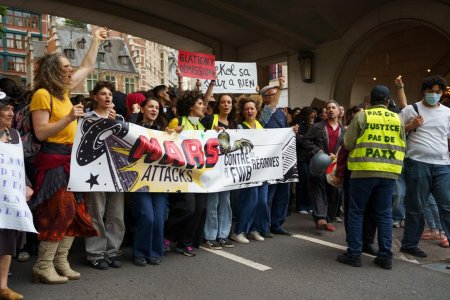


The month of June 2026 could, in retrospect, appear to be a decisive moment in Belgium’s contemporary social and political history. What is at stake there goes far beyond a simple sectoral reform. It is a profound confrontation between two irreconcilable visions of the school. [1]

On the one hand, a public institution conceived as a pillar of social justice and democracy; on the other, a system that is gradually aligned with the logic of the market, profitability and individual responsibility.

On the morning of Thursday, 4 June 2026, a mobilization of exceptional magnitude materialized this divide. Thousands of people – teachers, pupils, students, parents, education and social sector actors – converged on the capital, Brussels. Their objective was clear: to express a massive rejection of the policies implemented by a government perceived as increasingly authoritarian and deaf to the demands on the ground.

This day did not emerge from nowhere. It was the culmination of 18 months of growing tensions, major mobilizations and an accumulation of reforms experienced as a systemic attack on public education.

A government accused of undemocratic behaviour

Since coming to power, about a year and a half before the events of June 2026, the government of the Wallonia-Brussels Federation has embarked on a series of reforms aimed at thoroughly restructuring the education system. Very quickly, relations with teachers and their representative organisations deteriorated.

The criticisms converge: lack of consultation, decisions imposed without real negotiation, and a clear contempt for the actors on the ground. The unions denounce a top-down logic in which the professional expertise of teachers is systematically marginalised. The emerging collectives speak of an assumed political will to circumvent social resistance.

This tension reached a climax with the adoption of a central text: “decree-programme 2”. In order to ensure its adoption, the government has resorted to exceptional parliamentary procedures. On two occasions, the established rules were circumvented in order to reduce debate to a minimum and prevent the opposition from fully playing its role.

For the opposition parties and a large part of civil society, these decisions constitute genuine breaks with democracy. The vote of 4 June 2026 therefore appears not only as a legislative moment, but also as a revelation of broader institutional drifts.

“Decree-programme 2”: a systemic reform with cumulative effects

At the heart of the protest is the very content of “Decree-programme 2”. Presented as a measure of budgetary rationalization, this text introduces a series of profound transformations in the education system.

Among the most emblematic measures is the increase in the workload in higher secondary education, which goes from 20 to 22 weekly periods, without a salary increase. For teachers, this change is not a simple technical adjustment: it implies an intensification of work without improving pedagogical conditions, in a context already marked by overload and burnout.

The text also provides for a significant restriction of rights related to sick leave and absences without a medical certificate. End-of-career arrangements are being tightened, limiting the possibilities for the most experienced teachers to gradually reduce their workload.

At the same time, social measures were abolished. In particular, the budgets devoted to the free distribution of meals in institutions with a precarious public have been repealed. This decision is particularly outrageous, as it directly affects the most vulnerable students.

In higher education, the reform provides for a substantial increase in tuition fees (from €835 to €1,194 per year in universities – an increase of more than 40%; and up to five times higher in some institutions). This measure is combined with an extension of student work (they are allowed to work more hours) and a lowering of the age of access to this work (from 16 to 15 years old), creating a paradoxical situation: students have to work more to finance studies that have become more expensive, at the risk of compromising their academic success.

Other provisions complete this picture: the abolition of free art academies for children under 12 years old, the questioning of previous reforms aimed at strengthening the equality of the system, and the lack of salary recognition for the extension of studies (from 3 to 4 years) for future teachers.

Taken in isolation, each of these points could be the subject of a specific debate. Together, they are designing a structural transformation: a school that is less accessible, more unequal, and based more on individual resources than on collective solidarity.

Austerity as part of a broader framework

Educational reforms do not unfold in a vacuum. They are part of a broader set of policies adopted at the national level. These include the “double index jump”, which reduces the purchasing power of employees by suspending the automatic indexation of salaries to inflation, as well as the tightening of the conditions of access to sick leave and end-of-career arrangements.

The introduction of “negative bonus” pension mechanisms affecting the future retirement of part-time workers further reinforces this feeling of precariousness. For teachers, these measures come on top of sectoral reforms, producing a particularly severe cumulative effect.

In this context, the protest quickly went beyond the framework of education. It joins broader concerns about the future of public services, the deterioration of working conditions and the rise of inequalities.

The birth of an unprecedented social movement

The movement was not born on 4 June 2026. Its roots go back to the autumn of 2024, when the first cost-saving measures affected state schools. From October 2024, local mobilizations emerged. They remained initially limited, but laid the foundations for a dynamic that would gradually expand. Teachers then expressed their concern about the deterioration of working conditions and the questioning of certain recent advances.

A turning point took place after the 2026 spring holidays. On 12 May 2026, a large demonstration against the federal government — often referred to as the “Arizona government” — helped to unite previously dispersed anger. In this context, several general meetings at schools, particularly in Liège, decided to launch renewable strikes. In Brussels, schools organised to strengthen their coordination and their capacity for action. It was at this pivotal moment that the “Mars attacks” collective emerged, an inter-school coordination that played a central role in the structuring of the movement.

The eruption of collectives

One of the most striking features of this mobilization is the emergence of autonomous collectives. Alongside the unions, a new generation of actors is organizing. Among the most visible are “École en lutte [School in Struggle]” and “Université en colère [Angry University]”, which respectively bring together primary and secondary school teachers, and higher education actors. These collectives seek to revitalize a social movement that is considered too institutionalized and sometimes disconnected from the realities on the ground.

The “Mars attacks” coordination plays a particularly decisive role. It organizes inter-school assemblies, coordinates actions and helps produce alternative information to what activists perceive as misleading government communication.

Quickly, other initiatives emerged: “Parents attack” and “Élèves attack [Students attack]”. These collectives extend the mobilization to the entire educational community, transforming a professional protest into a societal movement.

Self-organization and grassroots democracy

From May 2026, the movement entered a phase of intensification. Inter-school general assemblies (GAs) are organized in several large cities. These General Assemblies become places for collective deliberation and decision-making. They discuss the renewal of strikes, the organization of pickets, student evaluation methods, and communication strategies.

This dynamic of self-organization is one of the most innovative aspects of the movement. It reflects a mistrust of traditional structures, but also a desire to regain control of decisions. For many participants, this experience gives a political meaning to the teaching profession and to collective commitment.

4 June 2026: a massive demonstration under high tension

On Thursday, 4 June 2026, the mobilization reached its peak. In the morning, processions from all over the country converged on the Parliament district. About five thousand teachers, joined by pupils, students and trade unionists, were faced with a police force of unusual size. Roadblocks, anti-riot units, massive presence of officers: everything indicated an anticipation of a high level of conflict.

Very quickly, the situation became tense. Clashes broke out near the FWB Parliament. Several witnesses report particularly violent interventions by the police. Teachers are trying to protect their students, most of whom are minors. Young people aged 14 to 15, often present for their first demonstration, were at the heart of a brutal police repression. The trap technique — consisting of encircling demonstrators to arrest or even repress them — was used. It was denounced by many organizations as a problematic, even illegal practice.

Repression and targeting of young people

Tensions did not end on 4 June. In the following days, on 5-6 June 2026, so-called “preventive” control and arrest operations multiplied, concentrated in particular around transit areas, such as the central station. Several testimonies mention stops targeting young people — in particular, black teenagers and teenagers of North African origin.

These practices fuel a sense of injustice and reinforce the political dimension of the movement. The issue of police violence and institutional discrimination is now at the heart of the mobilization.

An immediate response: the appeal of 8 June 2026

Faced with these events, the reaction was swift. On Monday 8 June 2026, a joint call was launched by school and university collectives, teachers’ unions and youth associations, for a broad and peaceful demonstration against all forms of violence against young people. It marked a convergence between the different components of the movement and underlines its ability to reorganise itself quickly.

A movement that is spreading

Beyond the one-off demonstrations, the movement is a long-term one. The strikes continue. The general assemblies continue to meet. Rotating events are organized in different cities. A new deadline has been set: 16 June 2026, a major interprofessional demonstration in Namur, the capital of the Walloon region. This event marks a possible expansion of the movement to other sectors.

Demands that are being structured

If, at first, the mobilization was built around the rejection of the reforms, it is gradually evolving towards a formulation of positive demands. These include reducing class sizes, increasing teaching resources, recognizing teachers’ pedagogical freedom, and harmonizing salary scales. More broadly, the movement defends a conception of school as a space of equality, emancipation and the fight against discrimination.

International reach

The “chalk revolution”, as the movement has been called, is not an isolated case. It is part of an international dynamic in which many countries are experiencing similar mobilizations. Everywhere, teachers, students and parents are mobilizing against policies perceived as attempts to commodify education. The issues are similar: access to education, working conditions, funding of public services. In this sense, the movement observed in June 2026 can be interpreted as a warning signal, but also as a laboratory for new forms of mobilization.

A struggle that has only just begun

Despite the adoption of “Decree-programme 2” at dawn on 5 June, the movement shows no signs of running out of steam. On the contrary, it seems to be entering a new phase. The mobilization has already produced effects: it has highlighted issues that are often invisible and has made it possible to build unprecedented alliances.

It remains to be seen whether this dynamic will be able to influence political choices. One thing is certain: the question of the future of public education is now being asked centrally.

And, well beyond the borders of Belgium, it challenges all societies confronted with the same fundamental question: how can we defend (and expand) the right to education and public and democratic schooling?

11 June 2026

Translated by International Viewpoint.

Footnotes

[1] © Sébastien Brulez / MOC Bruxelles / CC BY-NC-ND 4.0

NY City Electric: My Mayor Muslim, My Bagel Jewish


Miracle, Split-Second Tip-in Gives Knicks Win
Photo from Bluesky


Abby Zimet
Jun 12, 2026

Further
COMMON DREAMS


After the greatest comeback in NBA finals history - 29 points! - “the greatest shot in Knicks history” - Anunoby’s last-second tip-in - some divine intervention - a Pope Leo jersey - and a smudging to erase the vile Trump stench, the New York Knicks are in sight of their first title in over 50 years. “Bedlam at the Garden!” ESPN exclaimed. And across the city, now a jubilant, unified sea of orange and blue watch parties, viral chants, rare hope against hope. One fan: “The city feels alive. Thank God for the Knicks.”

The Knicks had won a remarkable 13 straight playoff games, last losing in April, before the seven-game finals against the San Antonio Spurs; of those, they won the first two, only to fall to Trump Disaster Syndrome - everything he touches dies - in the third. In Wednesday’s nail-biter of a Game 4, they began their historic rally in the second half, chipping away at a seemingly hopeless 29-point deficit, gaining ground in the 4th quarter and, with a stunning 1.2 seconds left, taking it 107-106 after OG Anunoby gently tipped in a Jalen Brunson shot that ricocheted short. The epic win leaves the Knicks within one game of a championship they haven’t won since 1973, when their city looked like this. Now, residents say, it’s “electric.”

The Knicks’ success has created frenzied joy in a city beset by high prices, traffic snafus and years of sports heartaches - amidst which long-suffering Knicks fans, says one, “have endured, a specific species of human that should be studied.” They also present a unified front in a city split between baseball’s Yankees and Mets and football’s Jets and Giants. New Jersey will host this year’s World Cup finals, but its tribute to “the beautiful game,” long plagued by scandal and corruption, is already marred by a racist regime hassling, interrogating or barring players, officials, journalists and fans from Somalia, Senegal, Haiti, Iraq, Iran and other dark-skinned locales, with a looming threat of ICE goons in attendance.

In contrast, the come-from-behind Knicks have done what sports at their best should: bring people together. New York’s rush hour has become a vast sweep of blue and orange caps, jerseys, hoodies, with a “Please win before I die” t-shirt from Old Jewish Men. Strangers on streets and subways do a peculiarly New York call-and- response: “Let’s go Knicks!” to “Knicks in five!” Bar and neighborhood watch parties pop up, some using bedsheet screens. One was just held at a Brooklyn funeral home - “If things go wrong, there’s room for grief” - with a poster board for fans to write the names of those they’re missing, “just like the the guy down the street and the lady in the bodega...so people know they’re not alone.

The finals have given a boost to legit pan-sports nerd - “New Yorkers can smell a phony” - Mayor Zohran Mamdani. A rabid Arsenals fan, he’s heavily promoted the World Cup - choosing Morocco to win in The Guardian’s Bracketology game - “The heart wants what it wants” - offering $50 tickets to 1,000 New Yorkers, celebrating the vision of Brazilian, German, Ecuadorians who will “watch together, celebrate together, shout at referees together - respectfully.” With the Knicks, he’s likewise praised how Knick fever has “lit this city up” and relished his role as head, albeit ambivalent, cheerleader against a common sports foe. Asked in April about a possible win, he said, “As a New Yorker, I can’t wait. As the mayor? Absolute chaos.”Again, he's all in. As a candidate, he interviewed Knicks fans and made Go-Knicks videos. During the finals, he's turned up at watch parties, put hand-painted cutouts of former Knicks greats at City Hall, visited a Knicks-hued subway stop, touted the $90 million in revenues from each home game, sported a Knicks jersey under his suit jacket and signed a symbolic executive order repealing bedtimes for kids during the finals. While resale ticket prices to home games have obscenely soared to over $8,000, and many courtside seats are reportedly gifted to local celebrities, Mamdani shelled out $1,000 for a standing room only ticket to the Monday game - unfortunately, the one hijacked by the Narcissist-In-Chief.

Like New Yorkers didn’t hate him enough already, Trump’s random, clueless attendance saw watch parties cancelled, hours-long lines, bags banned, fans and even players (understandable, given most are black) TSA-wanded, and a blocks-wide, NYPD-enforced “frozen zone” that turned the area outside Madison Square Gardens from “a showcase of unbridled humanity to a post-apocalyptic wasteland” - all for him to be thunderously booed as he smirked, saluted and promptly fell asleep until his granddaughter poked him awake. It probably didn’t help when those who’d waited in line for hours also got to see fucking Jared Kushner, “patron saint of failing upward,” respectfully, infuriatingly escorted in by police.

Before Wednesday’s game, a fan thoughtfully burned sage outside the Garden “to remove the sulfuric stench and bad vibes” from Pres. Poopy-Pants’ visit. The Knicks also reportedly got help from on high: From the three “Nova Knicks” - Brunson, Hart, Bridges - who graduated from Catholic Villanova, and Pope Leo XIV, who earned a math degree there in 1977. To ensure his blessing, die-hard Knicks fan Spike Lee had earlier worn a custom Knicks jersey - “Pope Leo #14” - he’d had “P🏀PE LE🏀” sign at the Vatican last year. Thus, the surreal 29-point comeback, and “the most iconic shot in the history of New York basketball” - per OG, “right hand from God.” The Nation‘s Dave Zirin: “With the Trump Stench Gone, the Knicks Make History.”


- YouTubewww.youtube.com

What Ben Stiller courtside called “the most insane comeback I’ve ever seen” left astounded fans and MSG staff roaring, leaping, open-mouthed with joy and shock. Within minutes of the buzzer, thousands of blue-and-orange-bedecked fans had surged into the city streets, chanting “Knicks in five!” and, in a few feral instances, “Fuck you Wemby!” A Knicks robot chased some Spurs fans, cops arrested a few rowdy fans, the Empire State Building glowed in orange and blue. The New Yorker‘s David Remnick couldn’t sleep after “the greatest Knicks win ever” and OG’s “most astonishing shot in franchise history”; he got up at 3 a.m. to grimly doomscroll on “the truth machine to see if this had really happened,” and finally “realize it was true.”

“Curb your enthusiasm,” he warned, and yes, Larry David was courtside, thrilled. “At least a little.” Remnick noted that Saturday is the fifth game, and anything can still happen. Fandom, he added, “is complicated, also mostly a matter of patience. Real fandom is about endurance and waiting.” Likely nothing that MD Ahnaf Hossain, a 23-year-old Knicks fan and TikToker with smart marketing skills, doesn’t know. Reveling in a moment of sportsmanship “bringing a type of love we haven’t seen in the city for a long, long time,” he created a hip-hop, Haiku-like anthem to celebrate its unity in toxic, racist, divisive times. “I grew up with Jews, Muslims, Haitians, Pakistanis, Bengalis,” Hossain said. “I just had to bring everyone together.”

His first “pure New York City poetry” came after the Knicks lost the third game. He wrote and recorded, “My mayor Muslim/My bagel’s Jewish/My Christian Dior/Knicks in four.” It got over 7 million views. After Wednesday’s impossible win, he filmed an updated version: “My mayor still Muslim/My bagel’s still Jewish/The pope’s on our side/Knicks in five.” Meanwhile, his mayor, Mamdani, posted his own response to the win: “SPEECHLESS. LFGK,” aka “Let’s fucking go Knicks.” He also made a brief, giddy video. “The energy in our city is incredible,” he said. “Time and again, people have doubted the Knicks. Time and again, the Knicks have proven the doubters wrong... I have just three words for my fellow New Yorkers. Knicks in 5.”

Trumpism, Mamdani and the revolutionary party we need

Zohran Mamdani

Anthony Teso has written a critique of my recent text on the situation in the United States. I will restrict my response to a few points.

Teso notes there is much common ground on how we view Donald Trump and Trumpism. There are also, of course, salient differences:

  • My focus was on providing a quick descriptive sketch (initially for a non-US audience) — which Teso largely accepts — discussing Trump and Trumpism, and outlining aspects of popular resistance to both.
  • Teso focused on presenting a specific theoretical perspective on the “state form” of Trumpism (something he tags as “patrimonial Bonapartism”), which he feels provides a more adequate position on the resistance to Trumpism than the one I provide. In particular, he seems dissatisfied with (1) my “inventory of protests” (which fails to pose “the organization problem … concretely”), and (2) my positive evaluation of the meaning of the Zohran Mamdani campaign in New York City (an evaluation he critically characterises as “celebrating Mamdani”).

Teso concludes: “Socialist analysis must identify both the structure it faces and the organization capable of acting on that knowledge...”

Limits of my presentation

The purpose of my presentation to German audiences (which the editors of LINKS and Communis titled “Defining Trumpism, defeating Trump”) was far more limited than Teso assumes. It was certainly meant to be more descriptive than theoretical. I am gratified that my critic finds little fault with the description, which he tells us provides useful raw material for his own theorising.

My presentation was meant to be part of a collective process (which includes Teso, myself and many others) of trying to make sense of “what is.” There are various questions I do not pretend to answer — including what should be the finished theoretical characterisation of Trumpism.

‘State form’ structure

In contrast, Teso seems satisfied he can provide such a characterisation, drawing from Karl Marx, Nicos Poulantzas and Max Weber. The result is the conceptualisation of “a patrimonial Bonapartism regime.” I find this theoretical venture quite interesting, but I am not confident I fully understand its meaning.

In particular, it is not clear to me that this conceptual contribution actually transforms my descriptive “inventory” into “a coherent explanation.” Nor am I convinced that it actually provides the strategic, tactical and organisational clarity Teso seeks. This is not meant to dismiss his theorising, but rather to view his theorising as part of a collective process yet to run its course.

Revolutionary party

Teso refers to “the organization capable of acting” on theoretical clarifications, which, of course, is the revolutionary party. Teso would surely agree, however, that we are far from such a party. While he offers nothing that would somehow bring this necessary entity into being, he criticises my presentation for offering nothing but, at best, vague generalities on this vital question.

The fact that this question is central to my thinking (and in my presentation should be understood as being assumed) finds corroboration in much that I have written over the years — including this year, for example, in “Lenin and Today’s Socialist Struggle in the United States.”

Pointing to the Communist International in Vladimir Lenin’s time, I noted that revolutionary activists were animated by aspirations relevant to our own time:

1. The deepening of democracy and the expansion of socialist consciousness;

2. The realisation of working-class capacities for mass action and united fronts;

3. The combined advance of winning life-giving reforms and of revolutionary liberation.

This led to the next point:

It makes sense for revolutionary socialists in the United States … to be actively engaged … in efforts to build class-conscious struggles of the actual, diverse working class in the United States — through mass movements and united front coalitions — geared to win victories beneficial to the working class and all oppressed people. … This should involve a blend of mass actions, socialist agitation and education, and socialist electoral work that will guide the efforts of an evolving network of revolutionary collectives stretching throughout our country.

On Mamdani

This ties in with Teso’s objections to my comments on Mamdani. These comments are grounded in the perspectives of a revolutionary socialist organisation to which Teso and I belong, Solidarity. Specifically, there is the October 2 statement, “The Zohran Mamdani Campaign: Solidarity with the Movement & Critical Notes on the Future”, and the December 2 statement, “The Struggle Continues…”.

The December 2 statement asserts:

A definite high point has been Zohran Mamdani’s victorious mayoral campaign in New York City, with a program that begins to speak to the needs of the great majority of people in a city they helped build but that has become increasingly unaffordable for them…

Revolutionary socialists — including members and supporters of Solidarity, as well as currents we are close to — should wholeheartedly support this victory and join with like-minded activists in and around DSA [Democratic Socialists of America], whose continued organizing will be absolutely essential to advancing the progressive and affordability agenda embodied in Mamdani’s electoral campaign.

Such activism — with positive and negative lessons learned — provides the basis for a mass socialist consciousness and movement, a precondition for the crystallisation of the revolutionary party we need. Or so it seems to me.

Trump's bumbling attempt to rob American taxpayers is backfiring


Former President Donald Trump speaking at a MAGA rally, hosted by Turning Point Action, at the Arizona Federal Theatre in Phoenix, Arizona on July 24, 2021, Gage Skidmore
June 11, 2026 

Whoever designed President Donald Trump's $10 billion lawsuit against the Internal Revenue Service and the Treasury Department must be a fan of the Ocean’s Eleven movie franchise. The multi-act plot lines are strikingly similar: Put together a motley crew of risk takers; pick a seemingly invincible target rich in treasure; infiltrate the target; exploit its weaknesses; and get away with an improbable heist while the guards are asleep, distracted, or otherwise occupied.

Act One of Trump’s story arc began on January 29, when he and his eldest sons and the Trump Organization filed the lawsuit in federal district court in Miami. If only briefly, it seemed like the plan just might work. In 2019, an IRS contractor named Charles Littlejohn leaked multiple years of the Trumps’ confidential tax records, along with those of over 7,000 other wealthy individuals, to The New York Times and ProPublica. The Trumps alleged in their complaint that the IRS and the Treasury Department had willfully failed to safeguard their tax information, and that each viewing of a news article mentioning the data constituted a separate $1,000 violation. The total—accounting for harm from embarrassment and reputational and financial injury—ran into the stratosphere.

There is no doubt that Littlejohn broke the law. In October 2023, he pleaded guilty to the unauthorized disclosures and was later sentenced to five years in prison.


But a few things stood in the way of a courtroom victory for Trump and his family: First and foremost, Trump filed his complaint in his individual capacity, placing himself, as the nation’s chief executive, on both sides of the litigation, with his former personal lawyer and now-acting Attorney General Todd Blanche representing the defense.

Neither Blanche nor Trump has backed away from the addendum to the settlement agreement reached in the Miami case that confers civil and criminal immunity on the president and his sons.


The arrangement came to the attention of various public watchdog groups that quickly filed amicus briefs in the case, decrying the litigation as collusive and riddled with irreconcilable conflicts of interest. Collusive litigation is illegal and, if proven, warrants dismissal and court-ordered sanctions. It could also conceivably lead to a future criminal prosecution for conspiracy to defraud the United States, in addition to other offenses. And, because Trump filed the case in his individual capacity, he would not be protected from future prosecutions by the immunity the Supreme Court accorded him two years ago for actions taken within the scope of his official duties.

Another problem for Trump: The case was assigned to Judge Kathleen Williams, a no-BS jurist appointed by Barack Obama. On April 24, Judge Williams ordered the parties to submit briefs on the collusion issue by May 20. The order specifically mentioned remarks made by Trump in press interviews that indicated he understood the nature of the case and that if the litigation were to be settled, he would be in the unique position of negotiating with himself, an admission that could prove critical in future investigations to establish criminal intent.

The order prompted Blanche, Trump, and the Department of Justice (DOJ) to open the second act of their Ocean’s Eleven ploy. Instead of filing the requested briefs, they submitted a request to voluntarily dismiss the case on May 18. Believing she no longer had jurisdiction over the case, Judge Williams granted the request.


Later that same day, Blanche announced that the lawsuit had been resolved with the DOJ entering into a “settlement agreement” that created a $1.776 billion “anti-weaponization” slush fund to be drawn from the Treasury Department’s general “judgment fund,“ created by Congress in 1956 as a permanent appropriation to pay litigation judgments entered against the United States. Under the agreement, Trump’s allies, including the January 6 insurrectionists, would be authorized to file claims for monetary compensation due to the alleged weaponization of President Joe Biden's Justice Department against them. The claims would be adjudicated by a committee, selected by the attorney general, that would operate in secrecy with no public reporting requirements and whose members could be fired at will by the president.

The following day, Blanche tacked on an “addendum” to the settlement that ordered the IRS and the DOJ to permanently end all current and possible future tax audits and investigations into the Trump family that were or could have been pending at the time of the settlement. The actual language of the addendum is so nebulous, according to some analysts, that it could be read to immunize the Trumps from any future investigations, civil or criminal, initiated by any and all federal agencies, including the Securities and Exchange Commission and the FBI.

The settlement prompted immediate and uncommon bipartisan criticism in Congress and outrage in the media. It also sparked additional litigation with new lawsuits aimed at blocking the anti-weaponization fund filed in Virginia and the District of Columbia. On May 29, District Court Judge Leonie Brinkema, sitting in Alexandria, Virginia, issued a temporary restraining order preventing the transfer of any money from the Treasury Department to the fund, and precluding the DOJ from taking any further action on the fund. The judge set a June 12 hearing date for oral arguments on the TRO.


Meanwhile, on May 27 in Miami, a group of 35 former federal judges filed a motion to reopen the case, urging Judge Williams to investigate whether the parties had perpetrated a fraud on the court. The judge responded swiftly with an order requiring Trump and his sons to submit a reply brief by June 12. This highly unusual step was necessary, she explained, in light of the “grievous allegations [raised by the 35 judges] that Plaintiffs voluntarily dismissed this litigation solely to avoid judicial scrutiny of a lawsuit that ‘was collusive from the start’ and was only filed to provide the imprimatur of legality for an unlawful settlement.”

We are now in Act 3 of the administration’s Ocean’s Eleven drama, the part where Trump and his minions back down and regroup. In a hearing before a House Appropriations subcommittee on June 2, Blanche said that the administration would not go forward with the anti-weaponization fund. On June 5, in filings in both the DC and Virginia cases, the DOJ put Blanche’s pledge in writing in motions requesting that both cases be dismissed as moot.

To date, however, neither Blanche nor Trump has backed away from the addendum to the settlement agreement reached in the Miami case that confers civil and criminal immunity on the president and his sons. That benefit, if implemented, would accord the Trumps even more protection than a presidential pardon. It may also have been the real goal of the litigation from the outset.

But the scheme is unlikely to succeed. Whether Judge Williams or her colleagues in DC and Virginia strike down the addendum, the granting of immunity remains an act of blatant corruption. There is no reason to believe a future Department of Justice in a Democratic administration will honor the grant. It may take a few years for the curtain to fall on the president’s Ocean’s Eleven heist, but in the end, he may emerge as the caper’s biggest loser.
'I’m afraid': Red state oil exec panics as $5 a gallon gas looms


Steve Crowder, president of Little River Energy Company in Cushing, Okla. (YouTube Screengrab)
June 12, 2026
COMMON DREAMS

CNN reports gas is currently at $4.11 a gallon, on average, in the U.S. But the nation is just one month away from gas pump devastation if President Donald Trump fails to reverse the damage he’s done to the pivotal international oil corridor in the Strait of Hormuz.

America has become the supplier of last resort for nations who used to get their oil from the Middle East, reports CNN correspondent Ed Lavandera. And this has caused the oil supply here to get dangerously low, almost to the point of sending gas prices soaring even higher.

“I'm afraid that it could be some difficult times coming,” said Steve Crowder, president of Little River Energy Company in Cushing, Okla. “If the conflict is resolved, the Strait is open, shipping resumes, we'll dodge a bullet and we'll avoid some real problems. And if it drags on, it could be really tough. Yeah, real tough.”


Cushing lies between Oklahoma City and Tulsa, where a vast spiderweb of underground pipelines feed into one of the world's largest privately owned storage hubs for U.S. crude oil.

“As far as the eye can see, dozens of massive storage tanks dot the landscape. Oil industry analysts closely monitor how much crude oil is in these tanks. And right now, alarm bells are ringing,” said Lavandera.


Generally, the Cushing tanks can hold about 75 million barrels of oil, but the levels now have dropped to below 22 million because of Trump’s voluntary Iraq war and the closing of the Strait of Hormuz. And analysts say that if these tanks are not replenished fast enough, in the weeks ahead Americans will be paying more for gas at the pump as international buyers and market forces price U.S. customers out of their own locally-produced oil.

Worse, when these tanks reach the 20 million mark, Lavandera said “it's like scraping the bottom of the barrel. The crude oil becomes an unusable sludge.”

From above, the ceilings of the tanks have dipped precariously.

“In the last 20 years. Anytime oil inventories at Cushing have reached levels this low, it's triggered historically high oil prices,” Lavandera added. “Energy executives at companies like Exxon and Chevron are warning that the United States is less than a month away from seeing gas prices shoot up.”

Lee Denny, a Cushing native and a former Oklahoma state representative, said she’s witnessed many oil booms and busts in Cushing. She only hopes Trump will end his war, open the Strait and allow oil producers to replenish inventories soon to prevent a price spike.

When asked, Denny could not say $5 a gallon gasoline could be avoided, however.

‘Straight-Up Intimidation Tactics’: Kash Patel’s FBI Raids Ohio Voting Rights Organization

“This is an unprecedented attack on democracy,” said US Rep. Shontel Brown.


FBI Director Kash Patel holds a news conference at Department of Justice headquarters in Washington, DC, on April 27, 2026.
(Photo by Kyle Mazza/Anadolu via Getty Images)

Brad Reed
Jun 12, 2026
COMMON DREAMS

A voting rights organization in Ohio is accusing the federal government of waging a large-scale intimidation campaign after the group was raided by the FBI on Thursday.

MS NOW reported on late Thursday that FBI agents searched the Cleveland offices of the Ohio Organizing Collaborative, an organization that helps register voters.

In addition to raiding the group’s offices, sources tell MS NOW that “agents also fanned out across the state, showing up at the homes of the group’s leaders and staff members, carrying some subpoenas and seeking information and electronic devices.”

MS NOW’s sources also expressed concern that the raid was not a legitimate law enforcement operation but “part of the Trump administration’s efforts to sow doubt and distrust in voting integrity in key swing states ahead of the midterm elections.”

In an interview with MS NOW, Ohio Organizing Collaborative board member Prentiss Haney accused the feds of using “straight-up intimidation tactics.”

“They had agents all across the state going to civil rights leaders and community leaders’ doors intimidating them, coming and demanding that they talk about literally anything they would ask,” said Haney, who added that agents asked leaders “if they’re committing voter fraud, just on their doors, in front of their houses with their children, and just following them to work and school.”

In a separate interview with local public radio station WVXU, Haney described the FBI raid as a “full-on assault.”

“This is not normal business,” Haney said. “I mean there’s no reason for over 100 agents to be knocking on the doors of everyday Ohioans, demanding and accusing people of voter fraud as if it was a witch hunt.”

Rep. Shontel Brown (D-Ohio) said she was “alarmed and outraged” by the FBI raid, which she alleged was part of an effort by President Donald Trump and FBI Director Kash Patel to disrupt the 2026 midterm elections.

“This is an unprecedented attack on democracy: These raids must end immediately,” Brown said. “Unfortunately, this appears to be part of a systematic effort by Trump and Kash Patel’s FBI to attack our elections and perpetuate more myths of voter fraud—all to undermine and challenge any election result that Trump does not agree with. It’s an attack on the people.”

The Trump administration has waged a multi-faceted attack on voting rights ahead of the midterm elections.

In March, Trump signed an executive order instructing the United States Postal Service (USPS) to not deliver ballots in any states that have not given the federal government access to its voter lists, which critics have warned could lead to the “virtual elimination of mail-in voting.”

A Tuesday court filing by the US Department of Justice, meanwhile, argued that states have the power to purge voter rolls at any time ahead of an election and do not have to abide by the 90-day “quiet period” established in the National Voter Registration Act (NVRA).

If adopted, this policy could result in states deeming voters ineligible without giving them sufficient time to challenge the decision.

Trump has also successfully lobbied Republicans in several states to engage in unprecedented mid-decade gerrymanders with the goal of creating more GOP seats in Congress.
‘Trillionaires Shouldn’t Exist’: Obscene Musk Milestone Spurs Calls for Aggressive Wealth Tax

“The level of wealth that Mr. Musk has reached requires human exploitation, wage theft, wage suppression, anti-competitive markets, monopolistic control, price collusion, inadequate tax systems, and corruption.”


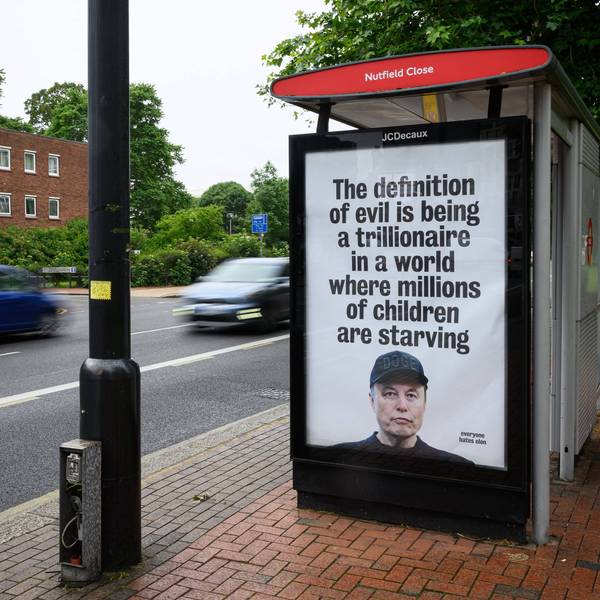
A poster attacking Elon Musk’s wealth in a world of large-scale hunger is displayed on a bus shelter on June 11, 2026 in Tottenham, England.
(Photo by Leon Neal/Getty Images)


Jake Johnson
Jun 12, 2026
COMMON DREAMS

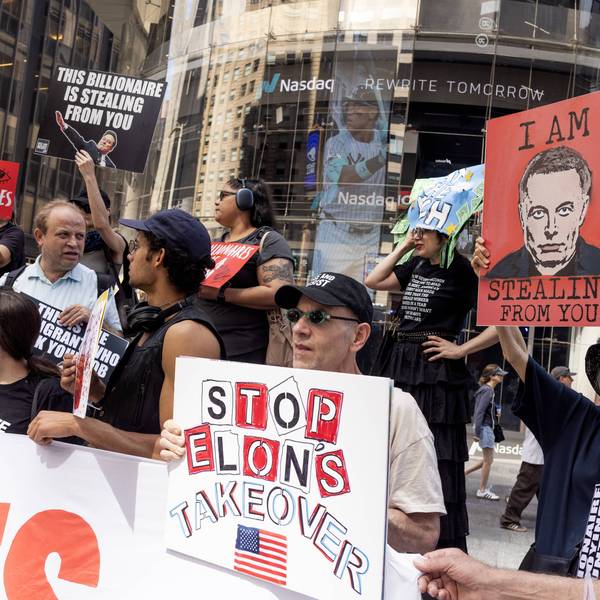
Elon Musk’s net worth surged past $1 trillion on Friday as SpaceX—the rocket company he founded and controls—made its debut on the public market, prompting global revulsion and calls for an aggressive wealth tax to rein in out-of-control inequality.

“Musk became the world’s first trillionaire because our tax system shields the wealth of the ultra-wealthy from taxation while requiring working to people pay taxes on every paycheck,” said Igor Volsky, director of the Tax the Greedy Billionaires Campaign. “Today’s milestone should serve as a wake-up call to us all.”

“Unless we plan to cede control and agency over our future to a handful of ultra-wealthy individuals, lawmakers must pursue bold tax policies that actually meet this moment—not just slowing the accumulation of extreme wealth, but reversing it,” Volsky added. “That means passing taxes on billionaire wealth ambitious enough to make the ultra-wealthy less wealthy, reduce the stranglehold they have over our economy and democracy, and restore the ideal that no one in America gets to buy their way to unchecked power.”

Reuters reported Friday that “most of Musk’s wealth now rests with SpaceX, where ⁠he holds a stake worth roughly $866 billion.”

“Along with Tesla and the rest of his properties, his net worth will exceed $1.1 trillion when the stock begins trading Friday,” Reuters noted. “The tally includes stock components that would vest over time.”

While Musk’s on-paper fortune could drop below the trillion-dollar mark if SpaceX’s stock price drops below $135 per share—which is highly possible, as experts argue the company’s valuation is absurd—campaigners said Friday that the milestone is an appalling product of a society that has allowed the mega-rich to dictate policy, funneling immense wealth to the very top while millions worldwide face hunger, violent displacement, and preventable disease. Oxfam has estimated that just a 10% tax on Musk’s fortune could lift 800 million people above the extreme poverty line.

“Eighty-six of Americans are worried about the price of food. Elon Musk is a trillionaire. These two things are deeply, inherently connected,” said Erica Payne, founder and president of the advocacy group Patriotic Millionaires. “The level of wealth that Mr. Musk has reached requires human exploitation, wage theft, wage suppression, anti-competitive markets, monopolistic control, price collusion, inadequate tax systems, and corruption. Mostly inadequate tax systems and corruption.”

Musk’s companies, including SpaceX, have relied heavily on and benefited massively from government contracts, subsidies, and research, while paying minimal taxes.

The New York Times reported last year that SpaceX “has most likely paid little to no federal income taxes since its founding in 2002 and has privately told investors that it may never have to pay any, according to internal company documents.” As for Tesla, the Institute on Taxation and Economic Policy found earlier this year that the company “avoided almost all federal income tax on over $12 billion of US income over the past three years.”

Musk, whose immense wealth is largely stock appreciation that is not taxed in the US unless shares are sold, paid nothing in federal income taxes in 2018, according to ProPublica. “Between 2014 and 2018, he had a true tax rate of 3.27%,” the investigative outlet noted.

Writer Elizabeth Spiers argued Friday that “trillionaires shouldn’t exist,” noting in a column for The Nation that “as Musk’s wealth multiplies, he continues to prosper on the public dime.”

“Musk’s cosmic-scale wealth-hoarding is particularly abhorrent when you place it against the backdrop of how much damage he’s done,” wrote Spiers. “It’s hard to quantify the scale of destruction and deprivation that he will never personally be held accountable for. How do you value the lives of the hundreds of thousands of people who have died since Musk, in his words, gleefully ‘fed [USAID] into the woodchipper’? How do you value the lives of people who will die because DOGE cut major biomedical research funding?”

“Musk has enriched himself via a rigged investment economy ensuring that those with the most contribute the least—or in many cases, nothing at all,” Spiers added.

As Elon Musk Becomes a Trillionaire, Report Highlights ‘Darker Realities’ of His Texas SpaceX Fiefdom


“Mr. Musk’s bid for planetary reach is about to be turbocharged with billions of dollars of rocket fuel. Who will suffer the fallout if it all blows up?”


A SpaceX facility where the company builds its Starship rocket is seen in Starbase, Texas, on Saturday, Aug. 23, 2025.
(Andrea Leinfelder/San Antonio Express-News via Getty Images)


Brad Reed
Jun 12, 2026
COMMON DREAMS

Elon Musk became the world’s first trillionaire on Friday, as his private space exploration firm SpaceX became a publicly traded company with a market cap of $2 trillion despite reporting negative net income for two of the last three years.

To mark this occasion, The New York Times published an essay by journalist Amy Gamerman, who has spent the last several months documenting life in Starbase, Texas, a city built by Musk to house SpaceX employees.


‘A New Pinnacle of Oligarchy’: Elon Musk Poised to Become World’s First Trillionaire


‘Trillionaires Shouldn’t Exist’: Obscene Musk Milestone Spurs Calls for Aggressive Wealth Tax

Gamerman wrote that it’s best to think of Starbase as a corporate fiefdom that has been granted extraordinary treatment by Texas’ state government.

“One new Texas law makes interfering with Starbase’s operations potentially punishable with jail time,” the journalist explained. “Another allows the company to shut down the highway into town and to the beach at the mayor’s discretion. Another shields SpaceX, and by extension Starbase, from lawsuits by neighbors over nuisance caused by its rockets.”

While the community of nearly 600 people appears idyllic, Gamerman found there are several “darker realities” lying beneath the surface, with one resident who wished to remain anonymous saying that Starbase is “like living in a dictatorship” where people fear raising concerns will lead to retaliation by the company.

Another disturbing aspect outlined in Gamerman’s essay is the way that Starbase seemingly operates outside the laws and norms of the rest of society.

For example, the city has now erected electronic gates on every single road leading to Starbase Village, the main center of the city where SpaceX employees live and that is cut off from other parts of the community.

“Those who live outside the gates of Starbase Village... often feel shut out,” wrote Gamerman. “Amber Pompa said her father, Homer Pompa, a disabled veteran who lives near Starbase Village, has no access to the restaurants or any other buildings there. And as Starbase expands, new gates have gone up in other parts of town.”

Gamerman also highlighted the story of Jose Luis Bautista Jr., a 25-year-old construction worker who died in an accident in Starbase last month. When the nearby city of Brownsville dispatched an ambulance to take Bautista to a hospital, Starbase officials denied it access and said their own emergency medical services were handling the situation.

The incident, noted Gamerman, is being investigated by the Occupational Safety and Health Administration.

Taking a look at the broader picture, Gamerman expressed concern that Musk becoming a trillionaire could allow him to expand his vision of billionaire-owned cities across the US.

“Mr. Musk’s bid for planetary reach is about to be turbocharged with billions of dollars of rocket fuel,” the journalist concluded. “Who will suffer the fallout if it all blows up?”


Under Healthcare ‘Dystopia’ Envisioned by Trump, Cash-Strapped Patients Would Take Out Loans From Insurers

“This could ruin people’s finances, while creating a financial incentive for insurers to deny coverage,” said one Democratic congresswoman.


A medical billing statement showing a past due amount.
(Photo by Getty Images)


Julia Conley
Jun 12, 2026
COMMON DREAMS

After the Republican Party’s decision to terminate subsidies that had significantly reduced healthcare costs under the Affordable Care Act for 22 million people, the White House is considering a new way to—officials claim—“help” Americans who face massive medical bills, either due to high-deductible plans that don’t cover routine costs or because of emergency expenses.

The proposal, though, could just shift “who [the patients] owe the debt to,” as one doctor and researcher told The New York Times, which reported Thursday on the Trump administration’s proposal to allow people to take out loans directly from their health insurance companies when they can’t afford to pay a hospital or doctor’s office out of pocket—and then pay the insurance company back, likely with interest.

“Hard to top this level of dystopia,” said one writer in response to the Times report. “Have health insurance through the ACA? The Trump administration is going to turn your health insurer into a loan shark you borrow money from if you can’t afford to pay your portion of medical procedures.”

As the newspaper was reported, the provision is buried in a 1,121-page final rule issued last month regarding how the ACA will be regulated next year.

The Trump administration is planning to significantly expand the number of Americans who are eligible for high-deductible “catastrophic” health insurance plans that provide no coverage for day-to-day medical expenses.

“We note that multiyear and 1-year catastrophic plans may be able to offer relief from the high deductible and maximum annual limitation on cost sharing through other mechanisms,” reads the final rule. “For example, issuers of catastrophic plans could consider financing the deductible by providing enrollees a loan.”

Currently, the average annual deductible for people insured under the ACA is nearly $4,000, and about 40% of enrollees this year have “Bronze” plans, which have an out-of-pocket maximum that’s over $10,000 for an individual, likely leaving many people having to pay thousands of dollars in medical expenses despite having coverage.

By 2028, as Common Dreams reported earlier this year, catastrophic plans with lower premiums could have deductibles as high as $31,000 for families.

The plan to shift more people onto expensive plans that provide less coverage for day-to-day medical care—and to push patients to take out loans from their insurers—comes as about one-third of Americans, even those with insurance, report skipping meals or cutting back on other expenses to afford their medical bills.

The Times reported that at least one major health insurer—UnitedHealthcare, the nation’s largest—is already equipped to start lending patients money to cover unexpected medical bills. The company operates a bank that administers loans to doctors and offers health savings accounts.

Rep. Shontel Brown (D-Ohio) said the latest proposal from the White House shows that President Donald Trump “is destroying healthcare from all sides.”


The advocacy group Protect Our Care said the “suggestion” buried in the Centers for Medicare & Medicaid Services’ final rule “is not only out of touch, it is cruel—accruing medical debt only adds to families’ financial burdens.”

“While working families drown in the high cost of living, the Trump administration’s answer to the healthcare affordability crisis they created is to throw people an anchor made of medical debt and call it relief,” said Leslie Dach, chair of Protect Our Care. “Trump and Republicans had a simple, popular fix sitting right in front of their faces—extending the ACA tax credits—but they killed it anyway, triggering premiums to double, triple, or even quadruple for millions of working families, all to make billionaires and big corporations even richer.”

“Americans are being bankrupted by crushing medical debt, and this administration isn’t lifting a finger to help—it’s busy shoveling more people into that hole,” said Dach. “Voters will remember this foolishness at the ballot box in November, just you wait.”

Melanie D’Arrigo, executive director of the Campaign for New York Health, which advocates for a universal, single-payer healthcare system for New York state, suggested the proposal makes the latest case for a federal, government-funded healthcare program similar to those in other wealthy countries, which would end the healthcare profit motive by expanding the existing Medicare system to the entire US population.

“Letting Americans take out loans to afford healthcare forces Americans deeper into debt and drives up profits for the health insurance industry,” said D’Arrigo. “Abolish the health insurance industry. Demand Medicare for All.”


Court Blocks ‘Illegal’ Trump Rule That Created Barriers to Affordable Care Act Coverage

With eligibility verification and fees, the rule was projected to force 2 million people to drop their insurance, said cities and advocacy groups that sued the administration.


A. Michael Khoury stands outside of his Leading Insurance Agency, which offers plans under the Affordable Care Act, on January 28, 2021 in Miami, Florida.
(Photo by Joe Raedle/Getty Images)


Julia Conley
Jun 12, 2026
COMMON DREAMS

Officials in several cities joined advocacy groups in celebrating a federal court ruling Friday that blocked the Trump administration’s rule which, they argued in a lawsuit, illegally imposed new fees and created barriers “that would make it harder—and in some cases impossible—for people to get and keep affordable health insurance.”

The cities of Columbus, Ohio; Baltimore; and Chicago were among the plaintiffs in a case filed last week in the US District Court of Maryland against Health and Human Services Secretary Robert F. Kennedy and other Trump officials, arguing that the so-called “Marketplace Integrity and Affordability” rule would destabilize the insurance market and penalize vulnerable families, “rather than promoting affordability.”

The rule was introduced in May, months after Affordable Care Act subsidies that had made ACA insurance premiums more affordable for millions of people were allowed to expire by Republicans in Congress. More than 1 million fewer Americans signed up for coverage in ACA exchanges after the tax credits expired, and the Trump administration claimed that the new rule’s provision of more “catastrophic” insurance plans would give more “choice” to people who couldn’t afford plans that cover more healthcare needs.

The rule also required additional verification for low-income households before they enroll in ACA plans, with Centers for Medicare and Medicaid Services Administrator Mehmet Oz claiming the new requirement “strengthens eligibility checks, cracks down on abuse, and gives insurers more flexibility to offer affordable, consumer-focused coverage options.”

“Cloaked in the pretense of government efficiency and fraud prevention, the 2026 rule creates numerous barriers to affordable insurance coverage.”

The verification requirements and new fees could cause as many as 2 million people to drop their coverage, said Democracy Forward, which represented the plaintiffs, as well as raising annual costs by about $700 for families.

“Cloaked in the pretense of government efficiency and fraud prevention, the 2026 rule creates numerous barriers to affordable insurance coverage, negating the ACA’s goal of extending affordable health coverage to all Americans, and instead increasing the population of underinsured and uninsured Americans,” the plaintiffs said in the lawsuit.

In the ruling on Friday, US District Judge Brendan Hurson vacated several provisions of the rule, including ones that revoked guaranteed insurance coverage for people with past-due premiums; required eligibility verification for the special ACA enrollment period; and imposed a $5 premium penalty on people who automatically reenrolled in their plans.

Columbus City Attorney Zach Klein said the rule’s provisions were among “the Trump-Vance administration’s illegal attempts to undermine the Affordable Care Act.”

“This ruling is a significant win for millions of Americans, including thousands in Ohio, who would have been denied coverage or seen their out-of-pocket costs skyrocket due to this president and his administration,” said Klein. “We will continue to fight to protect healthcare coverage for all Americans whenever it’s threatened.”

Richard Trent, executive director of Main Street Alliance, a small business advocacy group that also joined the lawsuit, said that “the Trump-Vance administration’s unlawful attempt to undermine the Affordable Care Act would have increased costs, created unnecessary barriers to coverage, and made it harder for entrepreneurs and workers to get the care they need.”

“Small business owners cannot grow their businesses when healthcare becomes more expensive and less accessible,” said Trent. “We are grateful that the court has protected these critical safeguards and reaffirmed that affordable healthcare remains essential to a strong economy and thriving Main Streets across the country.”

Baltimore Mayor Brandon Scott also applauded the ruling, but emphasized that healthcare advocates’ “work is not over.”

As Common Dreams reported Friday, tied up in the Trump administration’s push for more Americans to use high-deductible catastrophic insurance—which is likely to present families with high out-of-pocket costs—is a plan to push households into more medical debt by allowing them to take out loans directly from their health insurance companies.

“We will continue to fight back against any attempts by this administration to slash protections under the ACA,” said Scott, “and will not stop fighting until every person in this nation has access to the affordable, quality healthcare they deserve.”