Monday, May 25, 2026


Mexico and the EU rewrite their trade relationship with farms at the heart of it

Mexico and the EU rewrite their trade relationship with farms at the heart of it
At the 8th EU-Mexico Summit in Mexico City, both sides agreed to deepen their political and economic cooperation at a time of growing global uncertainty.Facebook
By bnl editorial staff May 25, 2026

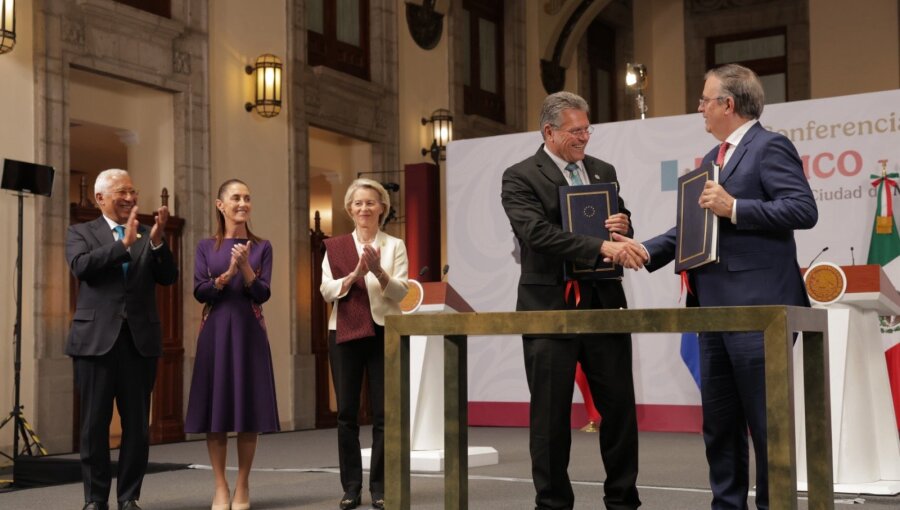
When Claudia Sheinbaum, Ursula von der Leyen and António Costa gathered at the National Palace in Mexico City on May 22 to sign the Modernised Global Agreement, the ceremony marked the end of a decade of negotiations and the beginning of what both sides are calling a new era in transatlantic commerce. But behind the diplomatic pageantry lies a deal that is, at its core, about food.

Industrial goods between Mexico and the EU have traded largely tariff-free since 2007. The unfinished business of the original 2000 agreement was always agriculture, the politically sensitive sector that took another 25 years to unlock. The new Interim Trade Agreement tackles that directly, eliminating nearly all remaining agricultural tariffs and opening Mexican markets to European dairy, meat, poultry and processed foods in a way that would have been unimaginable when the original accord was signed.

"The goal is simple: we want to create more jobs and generate more value on both sides of the Atlantic," von der Leyen said at the signing.

The timing is not accidental

Both Mexico and the EU are navigating a world reshaped by Donald Trump's tariff offensive. The EU was hit with sweeping new US duties in April 2025 and, earlier this week, agreed to a deal capping most European goods at a 15% US levy. Mexico, meanwhile, faces tariffs on automotive, steel and aluminium exports, with around 80% of its goods still flowing to the US, a dependency that Sheinbaum has been working to reduce.

"We are living through complex times on the international stage, but it is precisely at moments like these that we must act with greater cooperation," Sheinbaum said, describing the EU deal as "opening other horizons" while insisting it was "not contradictory" to Mexico's separate USMCA commitments.

Costa called it "a true geopolitical statement" and said the agreement left both sides "better prepared to face the challenges of our time." In a world of hardening blocs and transactional trade politics, a deal spanning 550mn people and more than €100bn in annual commerce carries weight beyond tariff schedules.

What actually changes

The practical benefits will arrive gradually, shaped by quotas and phase-in periods. The EU exported around €2.5bn in agri-food products to Mexico in 2025, making it the second-largest importer of European food in Latin America. Under the new deal, 95% of high Mexican tariffs on EU agri-food products will be removed, with 568 geographical indications protecting products such as Manchego cheese and Serrano ham from imitation in the Mexican market.

The dairy chapter is among the most detailed. Powdered milk gets a 50,000-tonne quota phased in over five years. Aged cheeses get 20,000 tonnes over five years; fresh cheeses 5,000 tonnes over the same period; blue cheeses are fully liberalised immediately. Current tariffs on cheese run as high as 45%, rates that have made European dairy a niche market in Mexico rather than a competitive one.

Meat follows a similar pattern. Pork tariffs, currently at 20%, disappear entirely over seven years, with a separate 10,000-tonne quota for loins. Beef tariffs phase to zero over seven years. Mechanically deboned chicken is liberalised on entry into force; chicken hindquarters get a 20,000-tonne quota. Apple tariffs disappear over 10 years; beans, potatoes, nectarines and tinned peaches over seven. Processed goods including pasta, chocolate, biscuits and lactose get rapid or immediate liberalisation.

Wine gets a simplified trade clause benefiting both sides, easing European access while also helping Mexico's growing wine industry into EU markets. On the Mexican export side, 83% of agri-food products will enter the EU tariff-free, with preferential treatment for orange juice, bananas, honey, tuna preparations and fresh produce.

Mexico's Economy Ministry projects the deal could lift its total EU exports from around $24bn annually to $36bn by 2030. The EU is currently Mexico's third-largest trading partner, far behind the US and China, but this deal adds meaningful diversification at a moment when USMCA renegotiation is proving slower and more fraught than Mexico had hoped.

The bigger picture

The Interim Trade Agreement enters into force through European Parliament ratification alone, without requiring sign-off from all 27 member states, meaning benefits could begin to materialise before the end of 2026. Beyond goods, the deal opens EU companies to government procurement in Mexico, removes barriers to digital trade and introduces legally binding environmental and labour commitments enforceable through independent dispute panels. It also addresses critical raw materials, banning export restrictions, monopolies and dual pricing.

Over 11,000 EU companies are already present in Mexico, collectively supporting 5.5mn jobs. EU investment in Mexico reached €207bn in 2024, representing 28% of total Mexican foreign investment. The new framework is designed to build on that base and to signal, at a moment of significant global trade uncertainty, that both sides are choosing deeper integration.

"Our modernised trade agreement will strengthen trusted supply chains, create new opportunities for businesses and investors and bring our economies even closer together. I particularly welcome our enhanced cooperation on critical minerals, as Mexico is a leading supplier of several essential raw materials," said EU trade commissioner Maroš Šefčovič.

TACO

US suspends Taiwan’s $14bn weapons deal as Trump buckles under Beijing pressure

US suspends Taiwan’s $14bn weapons deal as Trump buckles under Beijing pressure
When presidents Trump and Xi met in Beijing, the Chinese premier made it clear he was prepared to go to war over Taiwan. It seems that the White House took those threats to heart and has since backed off its support for Taipei, postponing a key weapons deal Beijing was unhappy with. / White HouseFacebook
By Ben Aris in Berlin May 26, 2026

The Trump administration has paused US arms sales to Taiwan after China’s president Xi Jinping threatened to go to war over the issue at a meeting in Beijing a week ago.

According to a senior US military official the controversial deal was suspended by US president Donald Trump, raising concerns in Taipei and among Washington’s allies that the White House is backing off its military commitment to protecting the island state from a possible Chinese invasion and forced reunification with the rest of the country – a policy never specifically enunciated, but the “strategic ambiguity” of the US position has been key to foreign policy for years. Trump appears to have moved towards accommodation with Beijing as tensions over China’s claim to the island intensify.

The suspension kills the mooted $14bn weapons package that had included coastal defence cruise missiles, air defence systems, naval surveillance equipment and advanced drones intended to strengthen Taiwan’s ability to resist a potential Chinese blockade or invasion, according to people familiar with the discussions the Washington Post reports. Several components of the package had been expected to move forward this year following congressional consultations begun under the previous administration.

The halt has fuelled fears among Taiwanese officials and lawmakers that President Donald Trump’s support for the democratically governed island was weakening amid broader efforts to stabilise relations with Beijing after months of escalating geopolitical tensions and a simmering trade war.

The issue reportedly featured prominently during Trump’s meeting with Xi in Beijing last week. According to officials briefed on the discussions, Xi told Trump that Taiwan remained a “red line” for Beijing and warned that China would not tolerate foreign interference in what it considers an internal matter.

Xi also reportedly invoked the “Thucydides Trap”, a theory in international relations suggesting that conflict becomes more likely when an established power attempts to contain a rising one – an overt threat of war, without using that word. Chinese officials have increasingly used the concept in recent years when warning Washington against military confrontation in the Indo-Pacific.

On returning home, Trump has dramatically shifted his rhetoric on Taiwan and suggested that the US commitment to supporting Taiwan militarily should China attack the island state is greatly reduced.

“I’m not looking to have somebody to go independent and, you know, we’re supposed to travel 9,500 miles to fight a war,” Trump said in an interview with Fox News on May 16. “I’m not looking for that. I want them to cool down. I want China to cool down.”

The Taiwan problem comes amid a debate inside the Pentagon about the sustainability of US overseas security guarantees. Secretary of War Pete Hegseth said last year that Washington would scale back many international military obligations to focus resources on strategic competition with China, which he described as America’s principal long-term rival.

In speeches and congressional testimony, Hegseth had argued that the US military could no longer act as “the security guarantor of first resort for every region simultaneously”.

The new National Security Strategy released in December spelled out in bitter detail how Europe is now largely on its own and expected to provide its own security, although Nato guarantees will remain in effect.  The document described Russia increasingly as “Europe’s problem”. The NSS also called on the Middle East to assume greater responsibility for their own defence. However, Hegseth maintained that China represented the central strategic challenge facing the US, but officials close to the administration say the Pentagon has become more cautious about the risks of direct confrontation following the Middle East conflict.

Taiwan’s international position has meanwhile become increasingly isolated under sustained Chinese diplomatic pressure. Only 12 states now formally recognise Taipei, down from more than 60 in the early 1970s.

While many analysts believe Xi would still prefer eventual reunification through political pressure and economic integration, Beijing has repeatedly indicated it is willing to use force if Taiwan formally declares independence or if outside powers intervene militarily in the dispute.

 China prepares for future Moon mission with new crew launch


Issued on: 25/05/2026 - FRANCE24


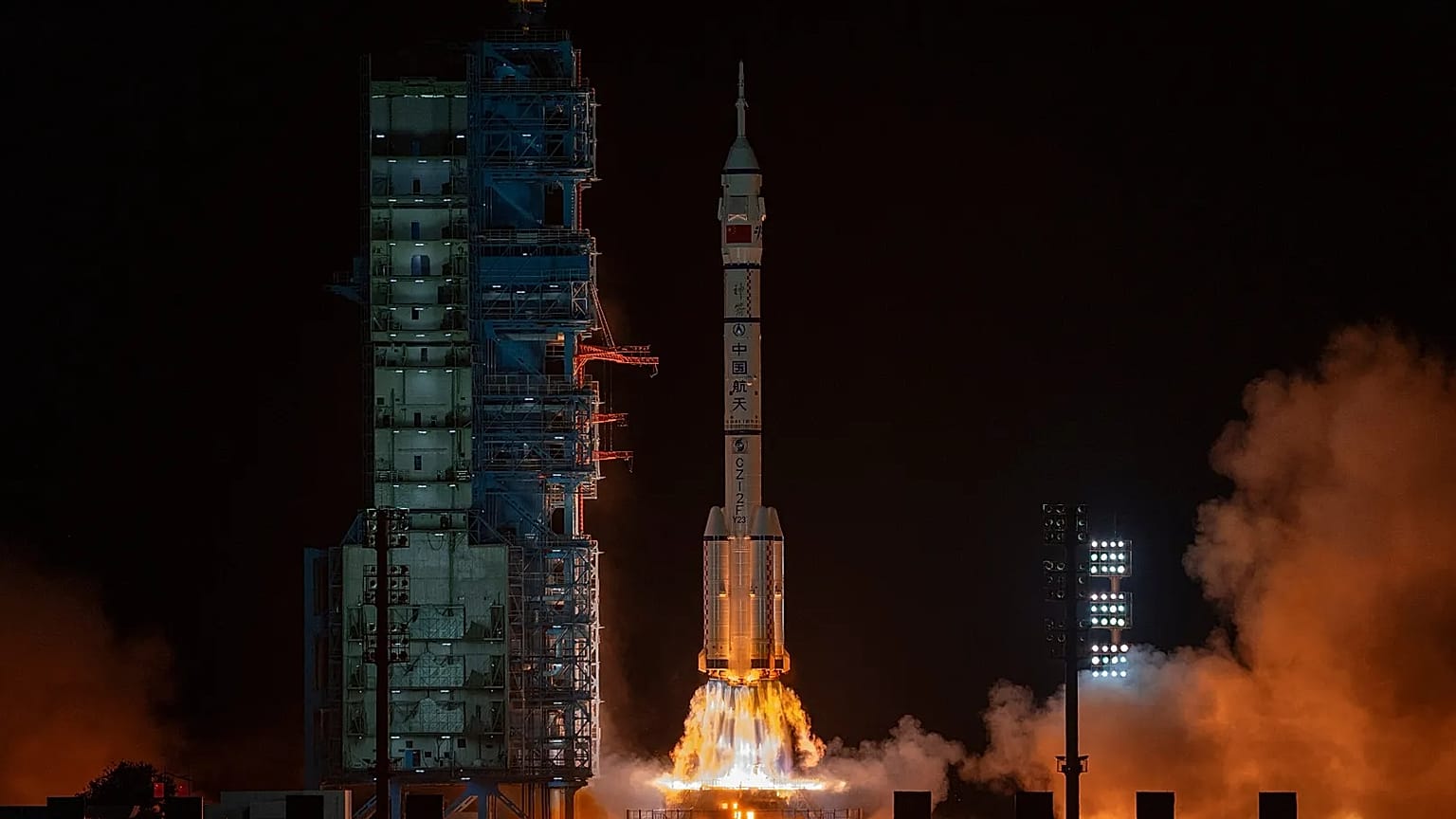
China has successfully launched and docked the Shenzhou 23 spacecraft with its Tiangong Space Station, marking a major step forward in the country’s space ambitions. The new crew will begin a mission that includes preparations for future lunar landings, advanced scientific experiments, and China’s first planned year-long stay in orbit.

Video by: Caitlin Brown


What is China’s Shenzhou-23 mission? Inside the year-long space experiment

Copyright AP Photo/Ng Han Guan

By Anna Desmarais
Published on

The astronauts will be testing how a year in space affects their body and will be conducting more than 100 experiments, like growing embryos and rice.

Over the weekend, China launched the Shenzhen-23 mission to its space station with three astronauts, including one who is set to stay in space for a year.

The spacecraft blasted off from the Jiuquan Satellite Launch Centre in China’s northwestern Gobi Desert with three astronauts onboard: commander Zhu Yangzhu, Zhang Zhiyuan, and Lai Ka-ying.

The astronauts will be conducting dozens of experiments while in space, including an in-orbit rotation with the crew of Shenzhou-21, the mission before them that has been at the Tiangong space station for more than 200 days.

This latest mission comes as China gears up for its first crewed lunar landing by 2030. Here’s what to expect from this latest mission.

Studying the impact of a year in space on the human body

One of the astronauts on the Shenzhou-23 crew will carry out a one-year in-orbit experiment, according to Chinese media.

The longest single mission to date by a Chinese astronaut was on the previous mission, the Shenzhou-21 crew, who have already spent 204 days in orbit. The world’s longest single space mission is 437 days, held by Russian astronaut Valeri Polyakov.

During the year-long mission, China is starting its first human body research programme, which will collect health data from the astronaut to prepare for future missions that will go further in space.

That data will be used to upgrade medical and protective systems within the spacecraft, officials said.

The astronaut’s mission is to “explore human adaptability and performance limits” in long-duration spaceflight environments, state media reported.

Growing embryos in space

While in orbit, the crew will conduct more than 100 scientific experiments, including an “artificial embryos” experiment to see whether new life can grow in space.

The astronauts will be using zebrafish and mouse embryos to establish what state media describes as an “space embryonic research system”, which will see whether different types of animals, such as those with no spines and mammals, can grow in space.

Chinese scientists are also sending rice seeds to the space station and growing them in orbit. The goal is to see how living in space affects plants over multiple generations.

For the first time, they plan to grow two generations of rice entirely in space. Scientists want to learn whether long-term exposure to microgravity changes the rice genetically or affects its stability.

The astronauts will also run biology experiments to study how microgravity affects the human body, especially how fat is processed in liver cells. State media reports that this research could help prevent fatty liver disease during longer space missions

Plant seeds will also be exposed to radiation outside the spacecraft for up to five months to see how radiation adapts their growth in space.

The crew will also be doing support work, such as moving cargo and conducting space walks during their time in space.

Heat dome over Europe scorches UK, Ireland, France and Spain

London (AFP) – Temperatures hit record highs for May in Britain, Ireland and France on Monday, as forecasters warned of a prolonged period of extreme heat across Europe throughout the week.


Issued on: 25/05/2026 - FRANCE24

Britain recorded its highest ever May temperature on Monday © Adrian DENNIS / AFP


A so-called "heat dome" of warm air from northern Africa trapped under a high-pressure system over western Europe is behind the high temperatures not usually seen until high summer.

Temperatures in Spain were expected to peak later this week at 38C, while parts of Italy imposed restrictions on working outdoors.

In the United Kingdom, the Met Office weather agency said it was the hottest May day on record, with temperatures hitting 34.8C at Kew Gardens, southwest London -- a full two degrees above the previous high.

"This heat would be exceptional in the UK even in mid-summer, let alone May," it said on X.

"The weather here, it's like a mini version of hell. It's boiling. It's like really hot," said 10-year-old Liza Nizari on a visit to London, where temperatures normally average about 17C or 18C at this time of year.

Lindy Brand-Daloze, a 66-year-old Australian living in London for 12 years, said: "It's warm, but it's climate change, isn't it? So, you know, (we have) probably got to get used to this."

Scientists say human-induced climate change is making extreme weather events like heatwaves, droughts and floods more intense, resulting in temperature records being broken more frequently.

Met Office meteorologist Greg Dewhurst told AFP the increase in extreme temperatures was "a good indication of climate change in action" and more likely to become "the new norm".

Climate advisers last week warned the UK government that the country was "built for a climate that no longer exists" and urged it to adapt infrastructure like schools and hospitals for a warming planet.

In 2022, temperatures in the UK soared above 40C for the first time since records began.

A record May temperature of 28.8C was recorded at two weather stations in Ireland: Killarney in the southwest and Clonmel in the south, Met Eireann data showed.

A grass fire broke out near Arthur's Seat hill near Edingburgh, sending smoke over the Scottish city that saw temperatures climbe to 25C, according to fire fighters and the BBC.
Heatwave alert

Across the Channel, weather agency Meteo-France said "dozens" of temperature records were broken in several French cities, as it placed eight western regions under a heatwave alert.

The exceptionally high temperatures were expected to last until the weekend.

On Monday, the western town of Bergerac recorded a high of 34.7C, with the cities of Nantes and Angers not far behind.

On Tuesday, heat of between 32C and 35C was expected across much of the western region of Brittany, "with peaks of 36C or even 37C expected in the south of the country", Meteo-France said.

French Prime Minister Sebastien Lecornu was to hold a meeting Thursday with key ministers to go over government preparations for the heatwave.

Brittany in northwest France is one of eight areas put under heatwave alert © Sebastien Salom-Gomis / AFP


The capital, Paris, on Saturday notched up its first temperature above 30C of the year, hitting 31.9C.

On Sunday, a man died during a 10-kilometre running race in Paris, civil defence services said, while 10 more had to be taken to hospital in critical condition after a race in the capital's suburb of Maisons-Alfort, the authorities said.

The sweltering heat on Monday melted tennis fans at Roland-Garros in Paris.

Loick Labrousse, whose nose was daubed with sunblock, took refuge in a coffee stand.

"The sun is brutal right on top of the centre court," he said. "After two hours, it starts to get really intense".


Outdoor work restricted

In Spain, the State Meteorological Agency (Aemet) warned the "extraordinarily high temperatures for this time of year" will continue across the country all week, except in the Canary Islands, in the Atlantic Ocean, off the northwest coast of Africa.

"Widespread tropical nights" are also forecast in southwestern Spain from Wednesday, with temperatures peaking from Wednesday to Friday at between 36C and 38C, it wrote on X.

Farther east, Italy's Lazio region, which includes Rome, on Monday approved rules limiting work in conditions "with prolonged exposure in the sun" between 12:30 pm and 4:00 pm.

Similar rules had been put in place last year but only from May 30.

burs-phz/ach-yad/

© 2026 AFP

France swelters as first-ever May heatwave alert issued


France experienced record high temperatures for May over the weekend, according to the country’s national weather service, with Paris recording this year's first temperature above 30C on Saturday. A spokesperson for Meteo France added that a yellow heatwave alert issued Sunday was the very first “to be issued in May since the system was created in 2004".


Issued on: 25/05/2026 -
By: FRANCE 24

A thermometer shows a very high temperature in Rennes on June 11, 2025. 
© Damien Meyer, AFP
02:06


France faced unusually hot weather on Monday, the national weather service said, after enduring record high temperatures for a month of May at the weekend.

In the northwestern city of Rennes, 74-year-old Daniele Dupont tried to stick to the shade as she walked her dog in 27C on Monday morning

"I'm going to close the shutters. I won't be going out this afternoon," she said in the capital of the Brittany region, across the Channel from the United Kingdom.

Parts of Brittany were under a so-called yellow heatwave alert, urging caution, for a second day on Monday.

A Meteo France spokeswoman said that the warning first issued for Sunday was "the first yellow heatwave alert to be issued in May since the system was created in 2004".

On Sunday "record high maximum temperatures for the month of May" were felt in at least 10 locations, including the northwestern seaside towns of Lorient and Noirmoutier, Meteo France said.

Paris on Saturday notched up its first temperature above 30C of the year, hitting 31.9C.

A man died during a 10km running race in Paris on Sunday, civil defence services said. Local newspaper Le Parisien reported he was 53 years old and suffered a heart attack.

Ten more runners had to be taken to hospital in critical condition after a race in the capital's suburb of Maisons-Alfort, the authorities said.

In Rennes, Bernard Siffert, 66, wasn't taking any chances.

"I went for a run yesterday and did 15km at 7am instead of 10am like I usually do," he said.

© France 24
01:56


Scientists say that recurring heatwaves are a clear marker of global warming and that these heatwaves are set to become more frequent, longer and more intense.

(FRANCE 24 with AFP)

Hottest May day ever recorded in UK as London hits 34.8 degrees

25.05.2026, 

Photo: Andrew Matthews/PA Wire/dpa

London (PA Media/dpa) -The UK has recorded its all-time hottest meteorological spring temperature as part of London hit 34.8 degrees Celcius.

The provisional reading at Kew Gardens, south-west London, broke the highest May temperature that, until Monday, stood at 32.8 degrees reached in 1922 and 1944, the Met Office said at around 5 pm (1600 GMT).

Temperature records are usually broken by just tenths of a degree.

It is also 10  to 15 degrees hotter than average for much of the UK, the forecasters’ senior meteorologist Greg Dewhurst reported.

If validated, the latest record means seven of the 12 monthly highs have been set since 2003, the Met Office said.

It listed 12 locations where the record was topped on Monday, ranging from Suffolk to Berkshire to Warwickshire.

A previous study by the forecasters found breaking that record “is around three times more likely now in our current climate than it would have been in a natural climate not impacted by greenhouse gas emissions.”

This means that the once one-in-a-hundred year event is now a one-in-33 event, it said.

Parts of central and southern England face further forecasts of up to 36 degrees on Tuesday as heatwaves continue.

It comes after last week saw lows of minus 5 degrees in Scotland and daytime temperatures more widely peaked at about 14 degrees to 15 degrees.

“We see these changes happening so much more dramatically,” Dewhurst said on Monday morning, adding that climate change is boosting the heat.

“In the past, heatwaves built and built and built and built over days and days and days – these now just develop so quickly.

“It’s huge sort of swinging temperatures, and obviously records being broken by day and by night, so it just shows sort of how extreme the weather can change, and how quickly it can change, as well.”

As a result of climate change, all meteorological models are predicting “more extreme heat, more extreme weather events” and “hotter, drier summers – wetter, windier winters”, he added.

Amid the bank holiday weekend heat, South East Water apologised and handed out bottled water after about 502 of its customers had issues including outages and low pressure.

Meanwhile, fire and smoke spread across a large patch of Holyrood Park, Edinburgh, above St Anthony’s  degreeshapel on Monday.

Wales also provisionally beat its May record as Hawarden Airport reached 32.2 degrees, with the previous peak measured at 30.6 degrees in 1944.

The UK’s warmest May night was also recorded on Sunday when temperatures did not fall below 19.4 degrees at Kenley Airfield, Surrey.

The month’s previous record low was 18.9 degrees in 1944.

Chemical explosion threat 'eliminated' in California

25.05.2026, DPA

An emergency related to a leak in a chemicals tank in the US state of California appeared to ease on Monday. 

Orange County Fire Authority acting chief TJ McGovern said in a video update that "the threat [of a chemical explosion] has been eliminated, that threat is off the table." 

The temperature of the chemical, methyl methacrylate, had stabilized and was falling, fire officials said. 

An apparent crack in the tank had previously raised hopes that it could reduce the internal pressure. Emergency crews inspecting the tank during the night confirmed the crack and found that the temperature had fallen from 100 degrees Fahrenheit (about 37.7 degrees Celsius) to 93 degrees Fahrenheit (about 33.9 degrees Celsius). 

Fire Authority personnel had been deployed for days to deal with the emergency. About 50,000 people living in the so-called danger zone around the town of Garden Grove were forced to leave their homes and spend the weekend in hotels, emergency shelters or even in their cars. 

The evacuation zones remained in force, McGovern said. He described the potential chemical explosion as a "BLEVE", a "Boiling Liquid Expanding Vapour Explosion."

A leak could also pose significant risks, however, as methyl methacrylate is highly flammable and could also cause environmental damage.


California declares state of emergency after toxic leak threatens 40,000 residents


California authorities said on Sunday they had discovered a crack in a damaged tank containing toxic chemicals, easing fears over a potential explosion that earlier prompted the evacuation of about 40,000 residents. The leak began on Friday in Orange County's Garden Grove area, sending fumes across a densely populated region near Disneyland.


Issued on: 25/05/2026 - 
By: FRANCE 24

A drone view shows water being sprayed during a chemical incident involving a leaking tank of methyl methacrylate forcing an evacuation of the surrounding area, Orange County, California, May 23, 2026. © David Swanson, Reuters

Authorities in California on Sunday said they discovered a crack in a damaged tank of toxic chemicals, potentially relieving pressure as the threat of an explosion has forced tens of thousands of residents to evacuate.

About 40,000 residents were ordered to leave their homes in the Garden Grove area of Orange County, southeast of Los Angeles, on Friday after the tank began to leak, sending fumes over a heavily populated area about five miles from Disneyland.

On Saturday night, firefighters approached the tank to gather information and saw a "potential crack in the tank, which could potentially be relieving some of the pressure in there," TJ McGovern, interim fire chief for the Orange County Fire Authority, said in a video post on X.

"This operation that we did gave us positive intel to make educated decisions today in the positive light," he said, adding that experts are carefully studying the information collected. "We're not there yet, but this was a step in a right direction."

There was no indication as to what caused the leak, which was initially reported on Thursday, and McGovern did not comment on whether the crack was linked to the leak.


The tank contains 7,000 gallons (26,000 liters) of methyl methacrylate, a volatile and flammable liquid used to make plastics.

Firefighters had warned Saturday that the tank was heating up, adding to fears of a catastrophic blast, and have been spraying water to cool the tank.

Orange County Health Officer Regina Chinsio-Kwong said Friday the large exclusion zone around the tank was a necessary precaution.

As of Sunday, evacuees were still not allowed to return home, and shelters had been opened to accommodate them. Disneyland officials said the "resort remains open to guests," and they were keeping a close tab on the matter.

The US Environmental Protection Agency says methyl methacrylate is irritating to the skin, eyes, and mucous membranes in humans. It can also cause respiratory and neurological reactions in cases of acute or prolonged exposure.

Responders were working to put containment barriers in place to prevent any spilled material from reaching storm drains or river channels that funnel into the ocean.

(FRANCE 24 with AFP)
From critic favourites to commercial hits, Japanese cinema wins fans at Cannes

With no fewer than 12 films in the official selection, Japan is at the heart of this year's Cannes Festival. Its cinema industry continues to do well with moviegoers as well as critics, making it a notable success story amid the rise of streaming.

Issued on: 23/05/2026 - RFI

Japanese cinematographer Akiko Ashizawa on the shoot of the film "To the Ends of the Earth" (2019), directed by Kiyoshi Kurosawa. © Uzbekkino
02:03


By: Ollia Horton

It's hard to miss the number of people wearing kimonos in the streets of Cannes.

That's because Japan has pride of place this year, with three films by Japanese directors in the main competition of the Cannes Film Festival and nine more across other categories.

Long associated with animation and horror, Japan has a distinctive storytelling tradition that is winning over broader audiences worldwide, with a growing number of films screened at international festivals.

Filmmaker Ryusuke Hamaguchi – who shared the award for best screenplay at Cannes in 2021 for Drive My Car, which he also directed – is back with the touching All of a Sudden, filmed in a nursing home in France. It’s the story of a woman hoping to bring relief to patients thanks to the techniques of a young Japanese woman suffering from cancer.

Known for his intriguing family dramas, Hirokazu Kore-eda – who won the Palme d’Or for Shoplifters in 2018 – is in the running for the main prize again with Sheep in the Box, set in the not-so-distant future. It focuses on a couple who adopts a humanoid robot built to replicate their late child.

A woman wearing a Japanese kimono at the 2026 Cannes Film Festival. © RFI / Ollia Horton


‘We are all foreigners’: Japanese director casts dandelion seeds in migration tale


Critic favourites

With a long and storied history of filmmaking, Japan boasts cinema veterans whose technical skill makes them a favourite with critics.

With more than 70 films to her name, cinematographer Akiko Ashizawa is a legend in her homeland. Her pioneering work stands out for its exceptional mastery of natural light and painterly use of colour palettes.

She is the winner of this year's Pierre Angénieux Tribute, a prize awarded by the French camera lens company of the same name for excellence in cinematography.

Cinematographers Akiko Ashizawa of Japan and Linh Dan Nguyen Phan of Vietnam, winners of the Pierre Angénieux Tribute and Encouragement awards, in Cannes on 19 May 2026. © RFI / Ollia Horton


Starting out in the 1970s, Ashizawa worked in advertising before breaking into feature films, where she was one of only a few women in a profession still dominated by men.

She has collaborated with numerous well-known Japanese directors, notably Koji Fukada – whose film Harmonium won the Jury Prize in the Un Certain Regard category in 2016, and who is competing again this year with Nagi Notes.

Ashizawa also made several prize-winning films with horror master Kiyoshi Kurosawa, whose latest feature, The Samurai and the Prisoner, premiered at this year's festival.

Although most of Ashizawa's work has been in Japan, she has collaborated with other directors in Asia, notably from the Philippines and Indonesia, two of the region's burgeoning film industries.

"The directors are all very young, in their twenties. They have so much energy and it rubs off on me and I enjoy working with them," she tells RFI.

Asked what advice she would give, she says: "I think it’s important for young people to learn from other areas outside the film industry, from other parts of the world. The world is full of uncertainty at the moment, so I hope film can light the way for people."

New generation

Despite the rise of streaming platforms, Japan's film industry remains robust, producing around 1,200 films annually and drawing over 150 million cinemagoers.

In a sign of a growing market, Japan is country of honour at the Marché du Film – the business wing in Cannes that brings together distributors, producers and buyers from around the world.

Japanese industry participation at the festival has shot up by 40 percent this year compared to 2025, according to organisers.

Kaori Ikeda, managing director for international promotion with UniJapan – the national body sponsoring the Japanese Pavilion in Cannes – points proudly to walls covered with posters of all the films showing at Cannes.

"It’s a great year for us, especially for the new generation," she says. "Young creators are using a new financing model and are looking out for international co-productions, increasing their potential."

The Japanese government has stepped up its financial support of creative content industries considerably in recent years, Ikeda says. They also offer incentives for overseas projects looking to use Japanese locations.

"There’s a lot of interest from foreign film producers and directors to shoot in Japan, as well as form partnerships with Japanese creative firms."

Whichever way you look in Cannes, the sun is shining on Japanese cinema.


INTERVIEW

‘Forgiveness has to be lived out’: says Rwanda's Cannes laureat Dusabejambot

Rwandan director Marie-Clémentine Dusabejambot has become the country's first filmmaker to win the Camera d’Or for best first feature at the Cannes film festival, with Ben’Imana. The Kigali-based director talks to RFI about exploring how survivors and perpetrators continued living side by side in the year’s following the 1994 genocide and the difficult but necessary path towards reconciliation and healing.


Issued on: 25/05/2026 - RFI

Marie-Clémentine Dusabejambot, lauréate de la Caméra d’or du Festival de Cannes pour « Ben’Imana ». © Siegfried Forster / RFI


Dusabejambo spent more than a decade making the film, which premiered in the festival's Un Certain Regard section and won the top prize for a debut feature.

Set against the aftermath of the 1994 genocide, during which 800,000 people, most of them from the Tutsi ethnic group, were massacred by Hutu militias, Ben’Imana follows a survivor working toward reconciliation and healing within her community while confronting her own painful memories.

“I wanted to pay tribute to the women of my country,” Dusabejambo said during Saturday’s awards ceremony. “To those mothers who found the strength to remain standing with dignity, to forgive, to move forward – however imperfectly, however painfully.”

She spoke to RFI's Siegfried Forster.

RFI: Your film opens on a forest, rolling hills and then a community gathering where a woman stands up and says “I forgive". In your film, is forgiveness the force that sets everything in motion?

Marie-Clémentine Dusabejambot: The beginning of the film is both a beginning and an ending. It marks the start of a new chapter for the characters. Something happened to all of them – they were all victims in different ways – but each person understands those events differently depending on which side they were on.

When genocide takes place between neighbours, within families, where do you stand afterwards? The film begins in a world of justice where your neighbour may be your witness – or your accuser.

It becomes a question of choice. Is forgiveness a choice? Or, even if you want to forgive, do you then have to prove it? I’m not sure the film gives clear answers to those questions. In a society trying to rebuild itself through justice, should we even speak about forgiveness? Or should we speak about truth? About healing? What can actually repair things?

When everything collapses, what do you turn to? My main character has turned towards forgiveness. She then has to prove that forgiveness through her actions in life; she must live it out. She has spoken the words, but she must live it out.
A photo from Dusabejambo's Ben'imana, which won the Un Certain Regard prize for best first feature at the Cannes film festival. © Mostafa El Kashef


Nurturing new African film talent

RFI: The gathering depicted in the film is part of the gacaca courts – Rwanda’s community tribunals established after the genocide against the Tutsi. Was this form of justice imposed from above by the government, or did it emerge from victims themselves?

MCD: Although this is a work of fiction, it is rooted in real events. After the genocide against the Tutsi in Rwanda, there were huge numbers of perpetrators in prison, and the country had just emerged from an immense tragedy. People had to be tried. Everything had to be rebuilt.

The authorities turned to methods that already existed in Rwandan society – where respected elders would settle disputes, and where neighbours and communities would come together to resolve conflicts between families. Except that after the genocide, the conflict between neighbours and families was genocide itself. That was the challenge.

The film is about that period – a moment when one generation said: "this happened, this bloodshed happened." During my research, I felt there needed to be a point where future generations could say there was at least an attempt at justice, however difficult and imperfect it may have been.

People had to come together again. Rwandans had to speak to one another. They needed to be able to speak out.

'Speaking helps us heal' says Rwandan survivor on genocide anniversary

RFI: The film is set in 2012. It took you more than 10 years to make it. Since then, what has changed in terms of reconciliation between Hutu and Tutsi?

MCD: Decisions were taken after the genocide because the country had to rebuild itself and rethink its politics. One of the first measures was to remove ethnic identities from national identity cards.

In Rwanda, we share one language and one culture. Unlike in some other African countries, a person’s name does not indicate their ethnic background. We don't have that. So after the genocide, those labels gradually lost much of their importance.

It was clear: this was a genocide perpetrated against the Tutsi. But my generation does not define itself through ethnicity – we define ourselves as Rwandans. I think that distance made it possible for me to make a film like this.

RFI: In the film, many of the victims – especially women – recount the crimes committed against them. Their stories emerge and are heard. Yet the film is also deeply concerned with silence, taboos and what remains unspoken.

MCD: A great deal went into creating that atmosphere. There are the actresses and their relationship to the story and to their own emotions. They gave everything, even their bodies. During casting, I was looking for people whose faces and bodies could express something even before they spoke.

There is also the Rwandan landscape itself. I noticed how the hills intertwine, and the stories of my characters overlap in the same way. I wanted the film to feel unmistakably Rwandan, because that's how we tell stories.

There is always a sense of community that conveys the emotion of what the hills and this landscape have witnessed.

France has 'responsibility' to break glass ceiling for women in film

RFI: In one key scene, Veneranda [played by Clémentine U. Nyirinkindi], who preaches forgiveness, realises that her daughter has become pregnant by a boy from the other ethnic group. At first, she cannot bring herself to accept the situation, but then she begins to wash her daughter’s feet.

MCD: Those are the contradictions of being a mother. You love, but you are who you are. I wanted to show the complexity of the relationship between mother and daughter.

At one point, I realised I was really searching for the heart of a mother. That's where something new begins. That's why she spoke about wanting to forgive in the first place. But forgiveness also had to become something visible and real.

RFI: In the closing credits, you thank the German director Volker Schlöndorff, who has often explored Germany’s own history in his work. Did you ever discuss with him the fact that Rwanda embarked on a direct reconciliation process after the genocide, something Germany never truly achieved after the Holocaust?

MCD: While I was working on the project, Volker Schlöndorff recommended me for a three-month programme at the German Film and Television Academy in Berlin. It gave me the opportunity to rework the screenplay quietly in Berlin.

But it was during Covid, so we never actually met in person.

Why is African cinema out of the picture at the Cannes Film Festival?

This interview was adapted from the original in French by Siegfried Forster and has been lightly edited for clarity.

Romanian director Cristian Mungiu wins Palme d'Or for 'Fjord'

24.05.2026, DPA


Photo: Sameer Al-Doumy/AFP/dpa

By Sabrina Sameiztat and Sabine Glaubitz, dpa

The Palme d'Or at the Cannes Film Festival has been awarded to Romanian director Cristian Mungiu for his film "Fjord," the jury announced on Saturday evening.

The film beat 21 other entries in the competition.

The Jury Prize was awarded to German director Valeska Grisebach for her film "The Dreamed Adventure" ("Das geträumte Abenteuer".) The decision was made by a jury chaired by South Korean director Park Chan-wook.

Morally complex drama 

This is already Mungui’s second Palme d’Or. In 2007, his film “4 Months, 3 Weeks and 2 Days” won the award. With "Fjord," the director has created a morally complex drama about family, upbringing and cultural conflicts.

Sebastian Stan and Renate Reinsve play a strictly religious Romanian-Norwegian couple who move to a remote Norwegian village with their five children. When injuries are discovered on their daughter, the parents are suspected of having physically abused their child. 

“Fjord” deliberately portrays the conflict between the couple and the Norwegian authorities without offering any easy answers.

Grand Prix for the Russian director Andrey Zvyagintsev

The Grand Jury Prize, the festival’s second most important award, went to Russian director Andrey Zvyagintsev for his socially critical thriller “Minotaur.”

The film tells the story of a Russian businessman who faces major challenges at his company and discovers his wife is having an affair. Zvyagintsev weaves the story together with the omnipresence of Russia’s war of aggression against Ukraine.

The award for Best Director was shared by three directors: Spaniards Javier Calvo and Javier Ambrossi for the drama “The Black Ball” (“La bola negra”) and Polish filmmaker Paweł Pawlikowski for “Fatherland”. The film, starring Sandra Hüller, tells the story of a road trip undertaken by Thomas Mann and Erika Mann through post-war Germany in 1949.

Who else was honoured

Emmanuel Macchia and Valentin Campagne were named Best Actors for their roles in the film “Coward” by Belgian director Lukas Dhont. In it, they play two soldiers in the First World War who fall in love with one another.

Virginie Efira and Tao Okamoto were honoured as Best Actresses for the drama “All of a Sudden” (“Soudain”). In the film, Japanese director Ryūsuke Hamaguchi crafts a quiet yet haunting drama about two women whose encounter shifts the course of their lives in unexpected ways.

The award for Best Screenplay went to Frenchman Emmanuel Marre for “A Man of His Time” (“Notre Salut”). In the film, the director explores a chapter of his family’s history during the Second World War in France.

Barbra Streisand honoured

French actress Isabelle Huppert paid tribute to US actress Barbra Streisand, who was awarded an Honorary Palme d’Or but was unable to accept the prize in person due to a knee injury. Streisand expressed her thanks via a video message, saying that films have “this magical ability” to bring people together.