Saturday, May 30, 2026


Silversea Cruise Ship Rescues Solo Sailor in North Pacific

Silver Whisper
Mark Matthes / Facebook

Published May 28, 2026 8:23 PM by The Maritime Executive


On the tail end of a Pacific voyage to Tahiti and Hawaii, the cruise ship Silver Whisper had the opportunity to save a solo sailor whose yacht had been dismasted off the Pacific coast. 

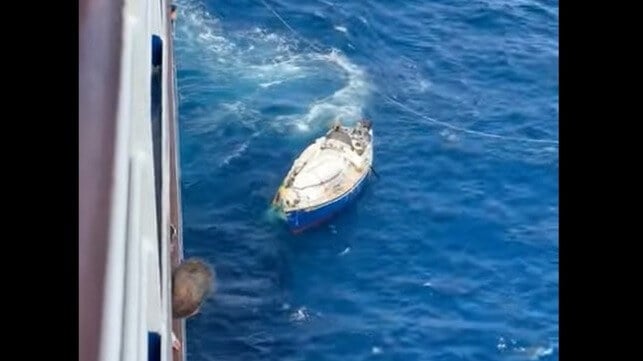
On Tuesday, the crew of the Silver Whisper got a distress call from the Canadian-flagged sailboat April Alice. The small yacht was dismasted and disabled at a position about 420 nautical miles off the coast of Oregon, and the sole crewmember had sustained a shoulder injury. The casualty was too far from shore for a U.S. Coast Guard helicopter rescue, and Silver Whisper was the vessel best placed to respond. The master diverted slightly northward to meet up with the yacht, arriving about seven hours later. 

On arrival, the crew found that the vessel in distress was in rough shape, lacking its mast and with rigging in disarray. In a typically rough North Pacific swell, the master of Silver Whisper maneuvered carefully alongside, and the crew passed a line across to the April Alice to secure the sailboat; however, the line parted, and the cruise ship's captain had to repeat the evolution. This time it was successful, and the survivor came aboard. He was provided a medical evaluation and initial treatment for his shoulder injury. 

About one hour after beginning the rescue operation, Silver Whisper got under way once more, leaving the wreck of the sailboat behind. The cruise ship returned to her home port of Vancouver on schedule on Thursday. 

Passenger Jeff Hall told the Vancouver Sun that the captain had instructed guests to return to their cabins during the rescue due to rough conditions and the need to secure the ship's stabilizers; most complied. 

"They missed one of the best parts of the cruise. We all - except for those who returned to their cabins - had a bird's-eye view of the rescue," Hall told the outlet.


Two Crew Injured as Russia Continues Attacks on Merchant Ships Near Odesa

cargo ship struck by Russian drone
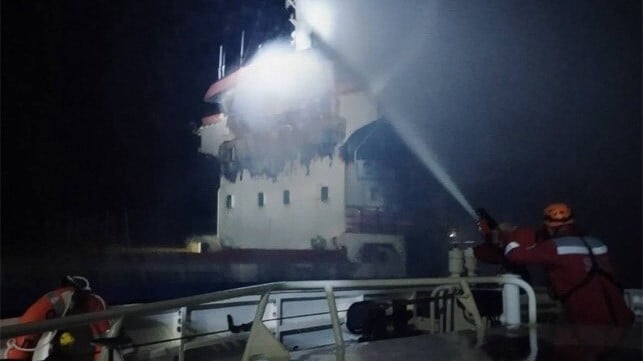
Ukraine aided in fighting the fire after the ship was struck by a Russian drone (Ukrainian Navy)

Published May 29, 2026 2:19 PM by The Maritime Executive


A small, Turkish-owned cargo ship was set on fire, and two crewmembers sustained minor injuries as Russia continues to attack merchant ships sailing near Ukraine. Turkey’s Ministry of Foreign Affairs responded, repeating its concerns regarding the risk and threats posed by the recent escalation.

The general cargo ship Ant (5,095 dwt) had sailed from the Odesa area and was heading to Turkey with an unspecified dry cargo. The ship was struck off the coast of Ukraine overnight on May 28.

The Ukrainian Navy responded and helped to evacuate two crewmembers who the Turkish authorities reported sustained minor injuries. Turkey’s Consulate General in Odesa was monitoring the care for the crew. 

The  Ukrainians aided the crew in containing the fire and putting it out. Pictures provided by the Ukrainian Navy showed the bridge and upper level of the deckhouse damaged by the fire.

Built in 2006, the vessel sails under the flag of Vanuatu and appears to have been regularly operating in the Black Sea and making port calls in Ukraine. It is also not the first time the ship has been in trouble. Three years ago, the Hellenic Coast Guard aided the ship when it was holed in a collision with another cargo ship in the eastern Aegean near Turkey.


Ukrainian officials said the Ant was being towed for repairs (Ukrainian Navy)


Vice Prime Minister Oleksiy Kuleba said the attack was one of three on merchant ships overnight. He did not provide details on the other two ships, but said the Ant was being towed for repairs.

The attacks on the ships were reported to be part of a larger wave of Russian attacks across Ukraine overnight. Ukraine’s Air Force was reporting that a total of 232 drones and one ballistic missile were fired, targeting 14 locations in Ukraine. It said that 217 of the drones were shot down, while there were reports that at least two people were killed and 25 were injured across Ukraine.

“We reiterate our warning to all parties to refrain from steps that could lead to an uncontrolled escalation of the conflict,” Turkey’s Ministry of Foreign Affairs said in its statement. It repeated calls for ensuring the safety of navigation for civilian vessels in the Black Sea.

Yesterday, Ukraine was suspected of drone attacks on three empty shadow fleet tankers that had entered the Black Sea. One of the vessels was reported damaged, while the report said at least two other drones failed to detonate while aimed at tankers anchored off the coast of Turkey.

NATO also issued a strong condemnation after a Russian drone strayed into Romania and hit the roof of an apartment building. It sparked a fire, and two people were injured. Romanian officials called it a “serious and irresponsible escalation” by Russia. Romania immediately requested a fast delivery of anti-drone systems from NATO.

How effective are Ukraine’s drone strikes at destroying Russian refinery production?

How effective are Ukraine’s drone strikes at destroying Russian refinery production?
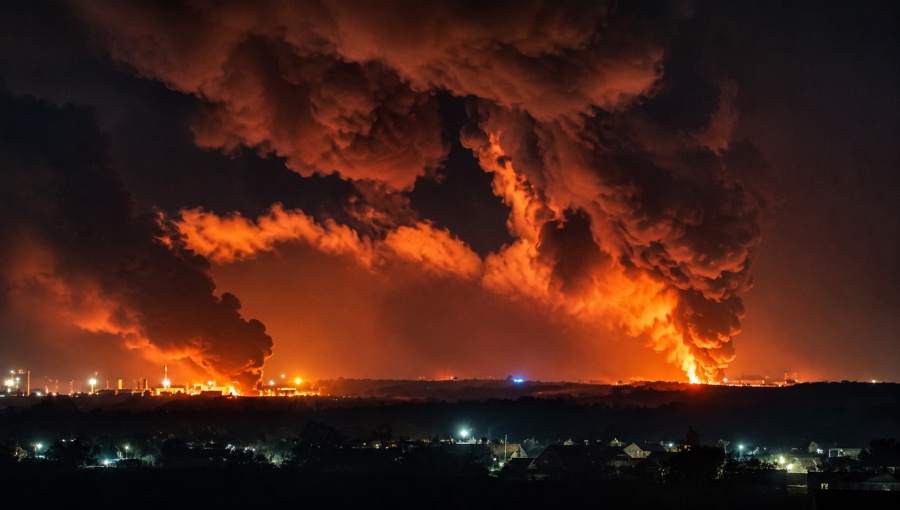
Ukraine has been incessantly attacking Russian refineries with long-range drones, but reports on how effective these attacks are paint a mixed picture. / bne IntelliNewsFacebook
By Ben Aris in Berlin May 29, 2026

Wrangling over how effective Ukraine’s drone strikes of Russian refineries has broken out amidst conflicting reports of just how much damage is being done to Russia’s key oil infrastructure.

Since last summer, Ukraine has stepped up its campaign against Russia’s cash cow industry in an effort to cut the Kremlin off from one of its main sources of income. This year Ukraine is firing more drones at Russia than Russia fires at Ukraine for the first time ever.

As the campaign reached a crescendo last month with sustained attacks on Russia’s Baltic Sea oil terminals at Primorsk and Ust-Luga that handle a fifth of Russia’s oil traffic, Reuters reported that Russia’s oil exports were down by 40%.

However, later reports based on government figures said that while production at refineries was down by some 10-15%, exports had been largely unaffected and the damage at the two ports was largely superficial and had been repaired.

Ukraine has ramped up its drone production and is on course to make some 7mn drones this year, according to Ukrainian President Volodymyr Zelenskiy. At the same time it has introduced a new class of long-range drones that can reach deep into Russia’s interior to hit the far flung oil refineries scattered across the country. At issue is to fly the thousands of kilometres needed to reach their targets, the payload of the drones is restricted by fuel consumption concerns. Consequently, while the drones can do a lot of damage, typically causing major fires, the explosive package is not enough to destroy a refinery. As one analyst put it: “There is a big difference between hitting a refinery six times with 50kg of explosive and hitting it once with 300kg.”

Conflicting reports

On May 20 Reuters reported “Exclusive: Oil refining at a standstill in central Russia after Ukrainian drone strikes, sources say,” that key refineries at Kirishi, Moscow, Nizhny Novgorod, Ryazan, Yaroslavl, that produce some 30% of Russian petrol and a quarter of its diesel, had all gone offline.

“Virtually all major oil refineries in central Russia ‌have been forced to halt or scale back fuel output following Ukrainian drone attacks in recent days, according to official data and sources,” Reuters reported. “Moscow has already introduced a gasoline exports ban starting ​from April until the end of July.”

The combined capacity of refineries ​that have fully or partially halted operations exceeds 83mn metric ⁠tonnes per year, or around 238,000 tonnes per day. That accounts ​for around one quarter of Russia's total refining capacity, according to Reuters.

However, a follow up report by Russian Forbes reported that the impact of the attacks was a lot less damaging.

“Such losses during the peak fuel season could have been a serious blow to the country's economy, but experts interviewed by Forbes do not believe the damage is that significant. Forbes investigated why gasoline shortages occur on the exchange but not at gas stations, how long it typically takes to restore damaged refineries, and how Belarus can help,” Forbes reported.

There is no doubt that the attacks have reduced the throughput at Russian refineries and as IntelliNews reported, Russia has been forced to turn to Belarus to top up supplies to meet domestic demand. But the imports from Belarus are limited.

Russia's domestic consumption of gasoline runs at over 100,000 tonnes per day, which makes the 17,000 tonnes bought from Belarus in early May a significant share, but not a crisis. "Volumes remain small compared with Russia's daily consumption of over 100,000 tonnes," noted energy expert Sergei Vakulenko. “This is not yet a crisis of supply, but it is a signal of the strain on the system.”

On May 21, the Ministry of Energy said that the domestic motor fuel market in Russia remains stable, and the industry is prepared for seasonal demand growth.

"Currently, the domestic market is sufficiently supplied with light petroleum product reserves, the logistics infrastructure is functioning reliably, and there have been no disruptions in regional supply," the Ministry of Energy stated, without specifying reserve volumes, Forbes reports.

Following a meeting on the fuel market on May 26, Deputy Prime Minister Alexander Novak said that the government's priority remains "the reliable and uninterrupted supply of fuel to domestic consumers in the required quantities" and the need to develop additional response measures in the event of disruptions.

Domestic fuel costs have risen, but only modestly, suggesting the impact of the drone strikes is limited. From May 20 to 26, prices for AI-92 gasoline on the St. Petersburg Exchange rose by 2%, from RUB66,136 to RUB67,443 per tonne, and for AI-95, by 3%, from RUB72,833 to RUB74,954 per ton.

Rather than losing a quarter of its production, expert calculations suggest the volume of unsatisfied orders on May 26 was 41,000 tonnes for AI-92 and 34,000 tonnes for AI-95. And even those shortages could be merely market demand triggered not by physical shortages, but from traders anticipating a surge in demand.

Another factor affecting demand calculation is the possibility that the main suppliers such as Lukoil, Rosneft, and Gazpromneft have stopped selling fuel on the exchange and are instead supplying it to their own gas stations.

Another point of contention is that Reuters’ calculation uses the refineries entire production capacity as a basis for its projection, but experts interviewed by Forbes say that is an exaggeration as even if a refinery is hit, most are still continuing to work albeit at reduced levels. Some facilities can be repaired in a matter of days, while others will require more time, experts say.

"Experience shows that in previous years, there were no attacks on Russian refineries that would have caused damage requiring lengthy repairs," Stanislav Mitrakhovich, an expert at the Financial University and the National Energy Security Fund told Forbes. "I believe that even now, there's no way to disable large refining facilities for long periods, although attacks can reduce production for a short period."

The bottom line is that Russia is not yet suffering from a fuel crisis and any shortfall caused by Ukraine’s attacks can be covered by imports from Belarus for now. Russia consumes over 3mn tonnes of gasoline monthly, according to Maxim Shevyrenkov, head of the Commodity Market Analysis Center at the Institute of Energy and Finance. Belarus is capable of shipping over 200,000 tonnes of gasoline per month, and Belarusian petroleum products are imported into Russia duty-free, Shevyrenkov points out.

A similar investigation by independent Russian outlet Meduza came to similar conclusions: Ukrainian drones are being fired more frequently and penetrating deeper into Russian territory, but Russia’s refineries’ production bounces back quickly.

The main conclusions of Meduza’s investigation included:

  • The frequency and depth of UAF strikes on Russian territory have risen substantially since mid-2025 and have held at a stable level — more than 30 verified attacks per month.
  • There has been no surge in strike intensity in 2026, despite a number of high-profile attacks on Moscow, Tuapse, Perm, and other major cities.
  • Strikes on oil infrastructure represent approximately one-third of Ukraine’s long-range campaign in 2026, consistent with the second half of 2025. Ukraine’s military has likely learned in recent months to target the refinery equipment that is particularly difficult to repair.
  • The average range of UAF strikes against targets deep inside Russia has increased recently: in May, the figure doubled y/y, from 400 kilometers (249 miles) to 800 kilometers (497 miles).
  • This may indicate that Russia’s air defences are being depleted, but we don’t yet have enough data to verify.
  • The UAF’s long-range campaign was most effective in its first phase, in late summer and early fall of 2025, when Russian refineries suffered their greatest capacity losses.
  • By mid-fall of that same year, oil industry operators had adapted — judging by available data — to the more intensive strikes on their facilities, and had learned to repair damaged equipment quickly or draw on spare capacity.

Friday, May 29, 2026

EMBRACING UKRAINIAN FASCISM

RAGOZIN: Melnyk reburial signals ideological shift in Ukraine

RAGOZIN: Melnyk reburial signals ideological shift in Ukraine
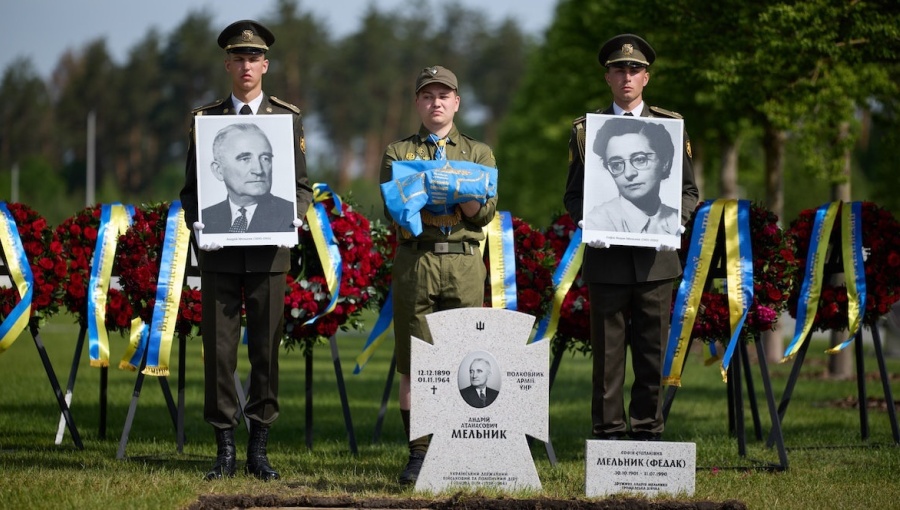
Ukrainian President Volodymyr Zelenskiy attended the reburial of Andriy Melnyk, one of the leaders of the Organisation of Ukrainian Nationalists (OUN). / Volodymyr Zelenskiy via XFacebook
By Leonid Ragozin in Riga May 29, 2026

Last week, Ukrainian President Volodymyr Zelenskiy went to the National Military Memorial Cemetery to take part in the reburial of Andriy Melnyk, Adolf Hitler’s ally in World War II and one of the leaders of the Organisation of Ukrainian Nationalists (OUN). Next to Zelenskiy, stood his chief of staff Kyrylo Budanov, who has been overseeing a visible ideological shift in Ukraine since assuming office early this year. 

In a tweet published on the occasion, Budanov wrote that the reburial heralds the creation of the “Pantheon of Prominent Ukrainians”. The choice of Melnyk’s ashes as an object of national veneration sends a clear signal about the direction of that shift.

Over seven years in the presidential seat, Zelenskiy has undergone a remarkable transformation from a dove seeking rapprochement with Russia to a defiant wartime leader and the Kremlin’s sworn enemy. His attitude to Ukraine’s history has changed just as radically.

Soon after he was elected in 2019 on the promise of peace, Zelensky made a point about celebrating May 9, the Soviet Victory Day, by visiting the grave of his grandfather who fought in the Red Army.

This populist gesture was designed to appeal an overwhelming majority of Ukrainians, in both the east and west of the country, whose ancestors fought on the Soviet side in WWII and who gave their votes to the new president. A memo published by Ukraine’s ministry of foreign affairs in October 2014 cites the figure of 7mn residents of Ukraine who fought in the Soviet army during WWII versus only 240-250 thousand who collaborated with the Nazis.

As his 57th Guard Division was pushing the Germans out of Mairupol, Sloviansk and Kramatorsk, lieutenant Semyon Zelenskiy was avenging the deaths of his father (President Zelenskiy’s great-grandfather) and three brothers, all of whom perished in the Holocaust.

Meanwhile, Melnyk was attempting to set up a fascist Ukrainian puppet state in Ukraine with a constitution, authored by his friend Mykola Stsiborsky, which described future Ukraine as “authoritarian and totalitarian state”. In a letter to Hitler in 1941, Melnyk pleaded that anti-Soviet Ukrainians be “allowed to march shoulder to shoulder with the legions of Europe and with our liberator, the German Wermacht”. Meanwhile, his subordinates in Ukraine took part in Jewish pogroms in Bukovyna and assisted the Germans in killing the Jews elsewhere around the country.

Melnyk’s pleas fell on deaf ears in Berlin since Hitler saw Slavs as an inferior race subject to enslavement and extermination. He was interned by the Nazis in a camp for foreign VIPs, who were treated humanely and respectfully, and released in 1944 when Hitler felt Ukrainian fascists could help him stall the Red Army’s onslaught in western Ukraine. Failing to receive guarantees of a pro-Nazi Ukrainian state, Melnyk ended up offering his services to Western allies in the US-occupied zone.

The World Holocaust Remembrance Centre, Yad Vashem, stated that it was deeply troubled by Melnyk’s reburial in Kyiv. “Honouring the leader of a movement [OUN] that supported and collaborated with Nazi Germany during the persecution and murder of millions of Jews undermines the moral integrity essential to Holocaust remembrance,” its press release said.

OUN’s dream Ukraine

Melnyk died in 1964 and was buried in Luxembourg where his remains were lying peacefully until Zelenskiy’s administration decided to repatriate them in May this year. “Colonel Andriy Melnyk returned to a different Ukraine – not the one he had been forced to leave, but the one he had dreamed of,” Zelenskiy said at the reburial ceremony.

Today’s Ukraine is indeed much closer to Melnyk’s ideals than those Zelenskiy’s grandfather was fighting for.

Built in 1974 and topped with the 102m-tall Motherland statue, Kyiv’s WWII History Museum was designed to commemorate Soviet war heroes like Semyon Zelenskiy. In the WWII cult developed under the Ukraine-born Soviet leader Leonid Brezhnev, this was one of the three most sacred sites in the entire Soviet country.

In 2026 however, it housed an exhibition dedicated to the Russian Volunteer Corps (RVC), a military unit formed by fugitive Russian neo-Nazis who believe that today’s Ukraine is much closer to their ideals than Russian President Vladimir Putin’s authoritarian regime. They see Putin’s Russia as a continuation of the Bolshevik internationalist project, citing Putin’s tolerance to mass immigration from Central Asian countries as proof.

In its propaganda and symbols, RVC draws inspiration from Gen. Andrey Vlasov’s Russian Liberation Army which fought on Hitler’s side in WWII. Featuring prominently in the exhibition, RVC’s symbol is called Spayka, best translated as fascia. It was designed in the 1930s by the Russian emigre organisation White Cause which later joined the Russian Fascist Party. 

The exhibition was officially curated by RVC’s khorunzhy (ideological officer), Aleksey Lyovkin. Having served a sentence for racially motivated attacks on migrants in his native Tver in Russia, Lyovkin founded a band called M8L8TH (which translates as Hitler’s Hammer and contains the numerical symbol 88 that stands for Heil Hitler in skinhead jargon) before moving to Ukraine in 2015.

Although it existed in Russian imperial forces, khorunzhy is not an official rank in the Ukrainian army. It originally meant flag-bearer in the Cossack troops, but it resurfaced in the Russo-Ukrainian war as an equivalent of the Soviet politruk, a political officer. 

Officially non-existent in the Ukrainian army, khorunzhy is used as a rank in politically autonomous units that form what its members call the “Azov family” or “movement”. Born out of the original Azov battalion, this far right mega-group currently controls Ukraine’s 3rd Army Corps commanded by Andriy Biletsky, its founder and political leader. 

The 3rd Corps runs its own school of political officers which is named after Yevhen Konovalets, Melnyk’s predecessor as the OUN leader. Its political bible is Natiocracy, an ethnonationalist teaching of OUN ideologist and Melnyk’s ally, Mykola Stsiborsky.

The Azov battalion in its original forms had a significant presence of Russian neo-Nazis, like Lyovkin or the most prominent living Russian neo-Nazi leader Sergey “Malyuta” Korotkikh, who was in charge of the battalion’s intelligence. 

These Russians (though not Korotkikh) eventually formed the core of RVC, which ideologically is a part of the Azov family but operates under the auspices of Ukraine’s military intelligence, the HUR. The latter was headed by Zelenskiy’s chief of staff Budanov from 2020 to 2026.

An ideology for New Europe

Melnyk’s reburial would be hard to imagine under Zelenskiy’s previous chief of staff, Andriy Yermak, who graduated from secondary school in the Soviet times and whose father served at the USSR’s embassy in Kabul during the Soviet occupation of Afghanistan. His Russian-born mother grew up in Leningrad. Hardly famous for political restraint, he still displayed some ethical red lines when it comes to history and politics.

But Yermak took upon himself the role of chief scapegoat in a massive anti-corruption investigation that targets Zelenskiy’s immediate entourage. He has been formally charged in a multilayered corruption case which involves four mansions, one of which belongs to him and another one likely to Zelenskiy himself. 

Budanov is another story. Born in 1986, he is largely a product of post-independence Ukraine with all of its geopolitical ambivalences and mafia state realities. An ideological orphan, he was provided with a social lift when he joined unit A2245 of the HUR whose members were trained by the CIA. 

A Washington Post investigation, published in 2023, revealed that the military intelligence agency Budanov would become the head of was created under the CIA’s supervision from scratch and hermetically sealed from other Ukrainian spy agencies to avoid Russian interference. The HUR is “our baby”, the newspaper’s CIA source boasted. Since the end of WWII, the CIA’s Ukrainian operation has been defined by the influx of OUN cadres who previously worked for the Germans. 

Ideology is a swear word with the liberal-democratic paradigm which Ukraine is still ostensibly pursuing, but Zelenskiy’s chief of staff is not shy about using the word. 

“Ukraine today embodies true Europe — both geographically and, above all, ideologically,” he wrote on May 9, the day of the Soviet victory over the Nazis, also marked as Europe Day in the EU. “We are defending the security and values of the entire continent: freedom, respect and the right to one’s identity,” he continued, adding the word “identity” where centrist politicians would normally mention human rights or social justice. 

His ideology reveals itself in commemorative events like Melnyk’s reburial, which he organised. Zelenskiy named Budanov first when listing officials who helped to make it happen. It also spills into his sometimes surprising statements, like when he mused on the meaning of Rus, the Kyiv-centred medieval state which gave its name to Russia. “Rus is Ukraine. But Rus is more, much more and Ukraine is the motherland of everything, even of those who we are fighting against,” he told the audience at the Kyiv Stratcom Forum this month. “You see where is the issue: We have handed over much of our history to them, we did it voluntarily. They privatised it, although they are nobody. We are the Rus, we should rule them.”

These imperial sentiments hark back to the ideas first expressed by Azov Movement ideologists back in 2014-16. They boil down to recreating the Russian Empire, only with the capital in Kyiv rather than Moscow.

Budanov’s effort to build the pantheon of Ukrainian heroes is expected to bring more results in the coming months and years. Negotiations are underway with the US and European countries about the repatriation of prominent Ukrainians who died in exile, prominently featuring OUN leader Stepan Bandera and Simon Petlyura who led Ukrainian nationalists in the Russian civil war. 

But Zelenskiy mentioned only one figure who is going to be reburied for sure. It is Yevhen Konovalets, who headed the OUN before Bander and Melnyk and after whose name the Azov Movement’s ideological school bears.

Leonid Ragozin is a freelance journalist based in Riga. He covered Russia, Ukraine and other countries for leading global media, including the BBC, Bloomberg and Al Jazeera. Leonid co-authored “En eiropeisk tragedie”, a book about the roots of Russo-Ukranian conflict published in Norway.
 

Iran and Oman could legally charge for Hormuz passage against US wishes

Iran and Oman could legally charge for Hormuz passage against US wishes
/ bne IntelliNewsFacebook
By bnm Gulf bureau May 29, 2026

Iran and Oman could lawfully collect navigation service fees from ships passing through the Strait of Hormuz under international maritime law, Yemeni journalist Samir al-Nimri has argued, Eghtesad Online reported on May 29.

Writing on the social platform X, al-Nimri said no part of the strait counts as international waters because the entire channel falls within the two countries' territorial seas. Under the UN Convention on the Law of the Sea, he said, every state may extend its territorial waters up to 12 nautical miles from its coast.

"Not even a drop of water in the Strait of Hormuz belongs to the international community," he wrote.

He said the strait measures no more than 21 nautical miles at its narrowest point, where Iranian waters to the north meet Omani waters to the south and enclose it completely. The convention guarantees a right of transit passage and bars states bordering straits from blocking that passage or imposing charges on it, he said.

Al-Nimri drew a distinction between banned transit charges and permitted service fees. Artificial waterways such as the Suez and Panama canals levy full legal charges on every vessel because they were dug by human effort, he wrote, with Suez alone generating more than $10bn a year.

Natural straits such as Hormuz, Malacca and Gibraltar carry no right to charge for passage itself, he said, but bordering states may collect fees for pilotage and navigation services. He cited Turkey's practice in the Bosphorus and Dardanelles under the Montreux Convention, where charges cover guidance and rescue services rather than passage.

"Tehran and Muscat, if they cooperate and agree, can legally collect enormous sums," he wrote.

He said the prospect angered US President Donald Trump, who held what he called a dangerous card in the form of threatened sanctions on Omani officials and financial institutions, posing a serious threat to a sultanate he described as one of the world's most stable states.

"Iran cannot relinquish control of the strait, even if World War Three begins," he wrote.


Global oil inventories falling at record pace, critical storage threshold about to be breached - IEA

Global oil inventories falling at record pace, critical storage threshold about to be breached  - IEA
With Hormuz closed, oil storage is falling fast and a critical minimum storage level threshold is about to be breached that will cause prices to spike. / bne IntelliNewsFacebook
By Ben Aris in Berlin May 29, 2026

Global oil inventories are declining at a record rate as the market absorbs a major Middle East supply disruption, raising the risk of sharp price increases if the Strait of Hormuz remains closed, according to the International Energy Agency.

In its latest monthly market update, the IEA said stockpiles are being drawn down rapidly to offset lost supplies and warned that inventories could approach critical levels if the key shipping route does not reopen. “Rapidly shrinking buffers amid continued disruptions, may herald future price spikes ahead,” the agency said.

The warning comes as industry executives and analysts increasingly focus on the role of inventories in cushioning the market from supply shocks. Darren Woods, chief executive of Exxon Mobil (XOM), told the company’s first-quarter earnings call that the oil market “has not felt the full impact of the supply loss thanks to commercial inventories held by the industry, strategic reserves controlled by governments and tankers in transit”.

Those stocks helped mitigate the disruption during March and April, Woods said, but he cautioned that inventories were nearing a critical threshold. Commercial inventories would eventually fall to levels where they could no longer serve as an effective source of supply, he said. “We anticipate as that happens and the strait remains closed, that we will continue to see increased prices in the marketplace,” Woods said.

Analysts at UBS expect global inventories to approach historic lows by the end of May. Market participants argue that inventories do not need to be exhausted to trigger severe price volatility because a substantial portion of global stocks is required to keep pipelines, storage facilities and transport networks operating efficiently.

According to estimates cited by analysts, global inventories have fallen from more than eight billion barrels in February to roughly 7.6bn barrels. If the Strait of Hormuz remains closed into September, inventories could decline to about 6.8bn barrels – breaching the minimum storage level needed to operate the oil transport system.

Billions of barrels in inventory may sound like a lot but the reality is that only about 800mn barrels are available without straining the system if the technical reserves are removed from the equation. Those reserves are needed to keep pipelines and tanks filled at minimum levels so the supply chain actually works and oil put in at one end of a pipe comes out of the other end.  Below the minimum levels and the energy system breaks down.

Rosemary Kelanic, director of the Middle East Program at Defence Priorities, said higher prices would likely be needed to curb demand before inventories reached those levels. “That level of spike -- to $150 or even $200/barrel -- will cause ‘severe economic contraction’ in 3Q2026 according to Rapidan, a top-notch shop,” she said. “In other words, if Trump doesn't make concessions to reopen Hormuz imminently -- and perhaps even if he does! -- we're looking at a global recession.”


Indonesia bets on resource nationalism to plug fiscal gaps

Indonesia bets on resource nationalism to plug fiscal gaps
/ Noah Ridge - UnsplashFacebook
By IntelliNews May 30, 2026

As Indonesia remains laser-focused on macroeconomic recalibration, the country has moved forward in its efforts to balance high-stakes fiscal intervention with the ever-unpredictable realities of its domestic extractive sector, Netral News reports.

With the government in Jakarta deploying a resource nationalism policy and creating fiscal tools to capture corporate resource rents, Indonesia also faces mounting pushback from its grassroots mining communities.

Mineral export bans and upcoming windfall taxes have become the country’s overarching strategy - one that is increasingly running up against regulatory bottlenecks, illegal capital leakages, and local governance deficits that threaten to undermine its broader industrial ambitions.

Export levies

The Indonesian Ministry of Finance is turning to fiscal instruments to insulate the state budget in real time from external commodity shocks and global monetary tightening. As reported by Sustainability Online, the government’s introduction of export duties and a windfall tax on coal is projected to generate substantial state revenue.

In simulation data compiled by the Centre of Economic and Law Studies (CELIOS) and published by Betahita it is shown that a targeted windfall tax on coal corporations could generate up to IDR66.03 trillion (approximately $3.7bn) in fresh state revenue. In contrast, a similar tax on the booming nickel sector could yield an additional IDR14.08 trillion.

This fiscal cushion arrives at a critical juncture for the country. In its 2026 state budget, Indonesia allocated more than IDR380 trillion for fossil energy subsidies and compensation to state utilities such as oil company Pertamina and electricity company PLN, calculated under a conservative oil price assumption of $70 per barrel.

With global crude benchmarks like Brent spiking toward $140 per barrel at times due to ongoing geopolitical instability, and coal prices hitting $145.86 per tonne, the government is scrambling to plug a widening deficit using debt or targeted spending cuts.

Finance Minister Purbaya Yudhi Sadewa has actively discussed implementing these windfall taxes and export levies on the country's nickel and coal sectors to restrict raw export volumes and defend a volatile rupiah, as detailed in reports from Kontan. According to Betahita, the National Development Planning Agency (Bappenas) has formalised these plans within the 2027 Government Work Plan (RKP) documents released on May 8. Bappenas aims to chase a total state revenue-to-GDP ratio of 11.82%–12.40% by 2027. This ambitious target relies on a targeted, measured implementation of a commodity windfall tax alongside the deployment of the data analytics-driven Coretax Administration System to capture underreported corporate profits.

Pushback, however, emerges from international environmental monitors like 350.org, which argue that using these multi-billion-dollar windfalls to prop up artificially cheap domestic fossil fuels is counterproductive. Research from Betahita highlights a socio-economic paradox: ordinary citizens are subjected to paying through taxes for subsidies, suffering from a three-layered cost-of-living crisis, while enduring soaring household utility bills as well as bearing the physical costs of climate disasters. But the nation's top 50 tycoons, heavily concentrated in extractive industries, generate IDR4,92 trillion annually. CELIOS data notes that it would take Indonesia's top five billionaires 603 years to deplete their wealth even if they spent IDR2bn every single day.

Betahita also cites research from the Institute for Development of Economics and Finance (INDEF), which points out that Indonesia's current gross-revenue royalty framework (PP 18/2025) is an obsolete relic of the oil and gas era that fails to capture supernormal profits. When coal prices skyrocketed sixfold, state revenues failed to scale proportionally, resulting in an estimated IDR592 trillion in lost state revenue over 12 years.

As a result, INDEF advocates for a dual-track reform: a short-term revision of current royalty tariffs to make them responsive to market price changes, and the long-term passage of a Progressive Resource Rent Tax (PRRT) bill that automatically captures windfalls when corporate profit margins surge past normal thresholds.

Bottlenecks

Right now, the central government focuses on capturing value from corporate mining conglomerates. But the legal and regulatory framework which governs small-scale, artisanal mining is fracturing at the same time. According to a report from Netral News, the Ministry of Energy and Mineral Resources of Indonesia (ESDM) has been urged to revise the regulation on artisanal mining legalisation to accommodate the field miners’ needs.

During an audience with the Artisanal Miners Association of Indonesia (APRI) on May 25, it was pointed out that current regulations, specifically Government Regulations and ESDM Ministerial Regulation No. 14, are failing because they only recognise three formal entities: cooperatives, micro, small, and medium enterprises (MSMEs), and regional state-owned enterprises (BUMDs).

The structural flaw in this approach is that there is still a significant portion of the rural population that refuses to join government-mandated cooperatives, pushing thousands of local operators into the informal and illegal economy. The structural bottleneck is further exacerbated by bureaucratic infighting over licensing authority. Under the current framework, People's Mining Areas (WPR) are ideally designated by provincial governments, while specific zoning permits are held by the central government, leading to widespread regulatory overlap with pre-existing corporate Mining Business Licences (IUP).

Furthermore, local governments often lack the technical capacity to process environmental impact assessments, particularly for artisanal gold mining operations that require strict oversight regarding mercury contamination.

Market distortions

This challenge in formalising artisanal mining is connected with systemic corruption and local market distortions. These, in turn, dilute the state's regulatory grip. As reported by the official DPR RI portal, lawmakers have previously warned of a pervasive risk at the regional level, where local elites frequently carve up mining permits to benefit select cronies, effectively freezing out ordinary citizens from legal resource wealth.

To combat this regional capture and ensure that artisanal output feeds cleanly into the national industrial supply chain, Commission XII is pushing a model where regional state-owned enterprises (BUMDs) serve as the primary institutional off-taker for small-scale miners. BUMDs should act as a crucial structural bridge, establishing local processing facilities and guaranteeing transparent purchase prices for cooperative-mined materials. This mechanism is designed to wrest control of local mineral flows away from predatory, unlicensed middlemen who exploit miners and ignore environmental degradation, redirecting those resources into the formal national economy or monitored export markets.

This domestic supply chain formalisation is vital if Indonesia intends to meet the stringent global Environmental, Social, and Governance (ESG) standards required by international capital. In neighbouring Malaysia, for instance, a 4.6-GW AI-focused data centre boom has seen the government reject nearly 30% of infrastructure proposals due to environmental non-compliance, as reported by the New Straits Times.

If Indonesia hopes to secure sustained institutional investment, such as the $4.6bn in foreign direct investment (FDI) recorded from Singapore in Q1 2026, the expansion of mega-projects like the $24bn Tuban Refinery, or PT Hua Chin Aluminium’s recent 480,000-tonne expansion at the Morowali Industrial Park, it must demonstrate that its entire resource ecosystem, from artisanal miners to high-tech smelters, operates under clear, transparent, and enforceable legal parameters.

To achieve this, Bappenas is expanding digital tracking systems like the Mineral and Coal Information System (SIMBARA) to prevent informal leakages and under-reporting. Without a comprehensive overhaul of its artisanal mining rules to eliminate local corruption and integrate small-scale miners into the formal tax base, Indonesia’s resource nationalism risks building an industrial superstructure on an unstable and fractured legal foundation.