U$ AUSTERITY
UNHCR Forced To Make Deep Cuts, Despite Rising Needs Worldwide
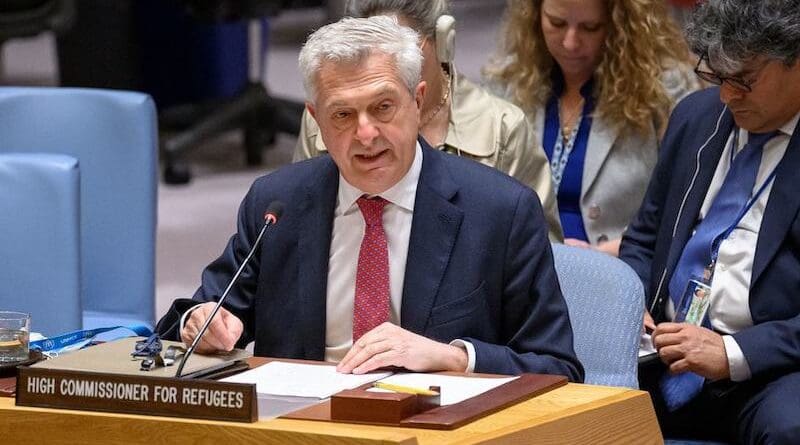
Filippo Grandi, UN High Commissioner for Refugees (UNHCR), briefs members of the UN Security Council. Photo Credit: UN Photo/Loey Felipe
By UN News
The UN refugee agency (UNHCR) announced on Monday that it is cutting global staffing costs by around 30 per cent, following a comprehensive review of its activities, spending, staffing and structure, prompted by major funding shortfalls.
This will entail cutting just under half of all senior positions at the agency’s Geneva headquarters and regional bureaux.
Around 3,500 permanent staff posts have been discontinued, hundreds of temporary staff positions have been terminated, and some offices have been downsized or closed worldwide.
According to the report, decisions on where to cut costs were guided by the priority to maintain operations in regions with the most urgent refugee needs.
Financial realities
The announcement follows a warning in March from UNHCR that severe funding cuts were putting millions of refugee lives at risk, with immediate and devastating consequences.
The agency anticipates it will end the year with available funding at roughly the same level as a decade ago – despite the number of refugees forced to flee having nearly doubled in that time to over 122 million.
“In light of difficult financial realities, UNHCR is compelled to reduce the overall scale of its operations,” said Filippo Grandi, the United Nations High Commissioner for Refugees. “We will focus our efforts on activities that have the greatest impact for refugees, supported by streamlined headquarters and regional bureau structures.”
‘Unshakeable’ commitment to refugees
Despite the prioritisation of refugee needs, key programmes – including financial assistance to vulnerable families, health, education, and water and sanitation – have been significantly impacted.
In response, UNHCR is coordinating with UN partners, aid groups and host countries to mitigate the impact on those who rely on its support by streamlining operations, exploring new models and utilising technology to enhance efficiency.
“Even as we face painful cuts and lose so many dedicated colleagues, our commitment to refugees remains unshakeable,” said Mr. Grandi.
“Although resources are scarcer and our capacity to deliver is reduced, we will continue to work hard to respond to emergencies, protect the rights of refugees and pursue solutions.”
'Brutal' funding cuts push UN to slash humanitarian operations
Millions of vulnerable people face heightened risk after the UN announced it would scale back aid programmes amid unprecedented global funding cuts. OCHA chief Tom Fletcher called for more solidarity to prevent needless suffering.
Issued on: 16/06/2025 -

The United Nations has announced it is drastically scaling back its global humanitarian operations due to what it describes as the most severe funding shortfall in its history – a move that could leave tens of millions without crucial support.
The UN Office for the Coordination of Humanitarian Affairs (OCHA) revealed on Monday that it now seeks $29 billion (€25 billion) in funding for 2025, a significant drop from the $44 billion originally requested in December.
The pared-down appeal is described as “hyper-prioritised”, focusing only on the most life-threatening crises.
The funding squeeze comes at a time when global needs are soaring.
The return of Donald Trump to the White House in January has seen the United States – historically the world’s largest donor – slash its foreign aid budget dramatically, sending shockwaves through the humanitarian sector.
'Brutal cuts'
Other major donor countries have followed suit, tightening their purses amid economic uncertainty.
“Brutal funding cuts leave us with brutal choices,” said OCHA chief Tom Fletcher in a statement.
“We’re asking for just one percent of what the world spent last year on war. But more than money, this is an appeal for humanity, for global responsibility and solidarity to prevent needless suffering.”
While visiting a hospital in Afghanistan’s Kandahar province earlier this year, Fletcher warned that cutting support to those most in need is not something to celebrate.
“The impact of aid cuts is that millions die,” he said plainly.
UN brands record 110 million displaced people an 'indictment' of the state of the world
'Difficult decisions'
So far this year, the UN has received only $5.6 billion of the $44 billion initially requested – just 13 percent of what it needs to help the world’s most vulnerable communities.
Originally, the plan was to reach 190 million people across more than 70 countries.
Even then, the UN acknowledged it would still leave 115 million people beyond its reach.
With the funding gap widening, aid officials are now forced to make difficult decisions.
“We have been forced into a triage of human survival,” Fletcher admitted. “Too many people will not get the support they desperately need, but we will save as many lives as we can with the resources at hand.”
In practical terms, this means aid will now target the most severe emergencies first, prioritising those in “extreme or catastrophic conditions”.
Fletcher emphasised that every dollar must go where it can save the most lives, as swiftly as possible.
Macron calls malnutrition a 'fight for peace' as donors pledge €25bn
'Catastrophic hunger'
Monday's announcement came alongside a stark joint report by the UN’s Food and Agriculture Organization and World Food Programme, which highlighted worsening hunger in 13 global hotspots.
Five countries – Sudan, the Palestinian territories, South Sudan, Haiti and Mali – are on the brink of famine, with millions at risk of starvation.
“This report is a red alert,” said WFP chief Cindy McCain. “Without urgent funding and safe access, we simply cannot save lives. The window to prevent catastrophic hunger is closing fast.”
The WFP itself is grappling with a 40 percent cut to its budget for 2025, threatening critical food assistance for 58 million people worldwide.
Despite the scale of the challenge, Fletcher insists the world must not lose hope.
“Human solidarity can still turn this tide,” he said. “With swift, united action, we can prevent the worst and protect the most vulnerable among us.”
(With newswires)


No comments:
Post a Comment