Shawn Fain’s UAW Is Facing Strong Headwinds
Editor’s Note: This article appears as the United Auto Workers (UAW) union prepares for its 39th UAW Constitutional Convention, scheduled for June 15-18, 2026. A version of this article will appear in the Fall 2026 issue of New Labor Forum.
The strength of a union and its leadership can be gauged most accurately when the headwinds are strongest: when political opponents command the White House and Congress, when the economy sours, employers play hardball, layoffs proliferate, and new organizing drives stall out. Many American unions confront that situation today, but members and leaders of the United Auto Workers (UAW), who assemble this June for their first constitutional convention since reformer Shawn Fain was elected union president more than three years ago, might be feeling it more acutely than anyone else in the labor movement.
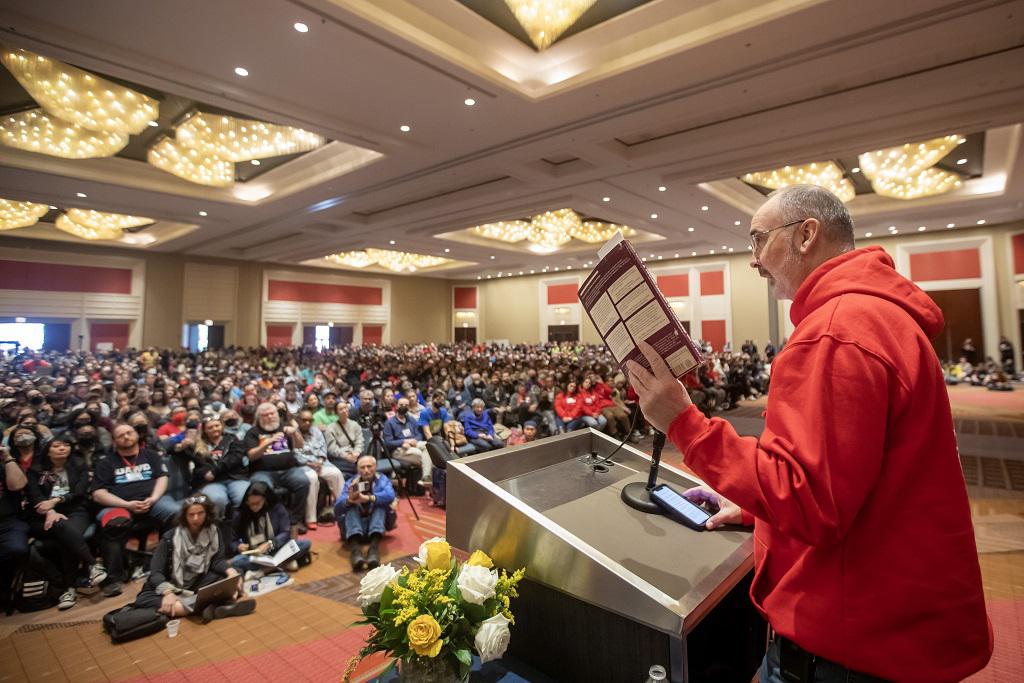
At the convention, almost a thousand delegates will debate a wide variety of topics, from the level of strike pay and union dues to a ban on hiring most non-UAW members onto the union staff. There will be speeches on how to stop layoffs in UAW organized factories and how to get the organizing drive in the South going again. And once the convention is over, we’ll also know who is running for top office in the union. Fain and his team of 13 executive board candidates, dubbed the “Stand Up Slate” after the 2023 “Stand Up Strike” against the Big Three automakers, will face opposition. Still, his team is likely to retain control of the union after October 2026, when a government-appointed monitor counts the mail-in ballots sent to upwards of a million UAW members and retirees in the weeks before. After conversations with scores of unionists in recent weeks, Fain says he feels “confident” about the outcome.[1]
But just holding office is hardly the point. Fain and most of those who backed him have sought to make the UAW once again synonymous with working-class power and militancy and transform the union into the “vanguard in America,” a phrase coined by Walter Reuther, the UAW’s legendary president, right after his caucus won full power in the union in 1947. That ambition has set a salutary standard for all labor partisans, but it has been thwarted by obstacles arising from within the union and without, circumstances and problems that in one degree or another bedevil all progressive insurgents who find themselves in high union office.
Fain’s presidency has attempted to reverse decades of union defeat, decline, and demoralization. Beginning in the early 1980s, when all industrial unions faced competition from abroad and union busting at home, the UAW has bled members, power, and political influence. In the late 1970s, UAW had a million and a half members, with nearly 100 percent of all automobile production in the U.S. union made. Today, the union has a working membership of 400,000 (half the number of the union’s retirees), and of that number only about 150,000 work in the core auto industry. In the U.S., half of all production is non-union, with Toyota, Nissan, Mercedes, and other foreign companies intensely hostile to the UAW.
But even more debilitating was the sense of passivity and resignation of so many in the union leadership. As UAW president Owen Bieber, who in the 1980s and 1990s presided over some of the union’s most consequential setbacks and concessions, told historian John Barnard, “Things that we had to do. We did.”[2] That defeatism was exacerbated by two things: the Soviet-style rule of an increasingly insular one-party “Administration Caucus,” and the growth of a collaborative industrial relations ideology that attempted to cast labor and capital as partners in a common endeavor. Not unexpectedly, a wide variety of corruptions spread through the union staff and hierarchy, ranging all the way from various forms of nepotism and favor trading that enabled loyalist rank-and-filers to win cushy staff jobs at Detroit’s Solidarity House or in one of the regional offices; to the California golf junkets and outright theft of union dues that led to the criminal conviction and jailing of a dozen union leaders, including two former presidents.
This was the context, in 2020, where genuine reform finally became possible in the UAW. When a Michigan district court appointed a federal monitor to supervise the transformation of the union, a rank-and-file group, Unite All Workers for Democracy (UAWD) put the free and fair election of a new cohort of union leaders at the top of their agenda. In a government-supervised referendum, the membership voted to junk the system whereby convention delegates, all too often beholden to the existing leadership, chose union officers and instead instituted a one-person, one-vote union-wide ballot.
When the votes were counted in 2022 and 2023 (there was a runoff among the two presidential contenders), a haphazardly cobbled reform slate swept every office it contested. Shawn Fain, once an electrician from Kokomo, Indiana, became president, while Margaret Mock, an African American woman who had worked most recently at the Stellantis Warren Michigan Truck plant (Local 140), became Secretary-Treasurer, responsible for a wide variety of duties including purchasing, auditing, and strike assistance.
Fain did not know Mock very well, but since he was running against Ray Curry, who was just the second Black UAW president, her presence on the ticket was important. But a clever electoral strategy was hardly a hallmark of the slate headed by Shawn Fain. Normally, no two candidates would come from the same local. But in 2022 Rich Boyer, whom Mock had known since the beginning of her career, was also from Local 140, though not a top leader there. He was elected a UAW Vice President in charge of Stellantis.
Once in office, Fain had less than six months to prepare for negotiations, and a possible strike, with Detroit’s Big Three: Ford, General Motors (GM), and Stellantis, which had taken over most of the old Chrysler production facilities. Since Fain defeated Curry by just a few hundred votes, he hardly had a united rank and file behind him. Perhaps even more important, most of the existing staffers and local union officers were skeptical of his leadership. That made Fain particularly dependent on the crew of thirty-something East Coast activists he recruited to his staff. These included Jonah Furman, who as communications director put a brilliant series of union advocacy messages online; lawyer Benjamin Dictor, heavily involved in the UAW’s decision to break with past practice and conduct simultaneous negotiations with all three Detroit based automakers; and Chris Brooks, a key strategist and Fain’s chief of staff. [3]
Brooks, who hailed from Chattanooga, Tennessee, the site of a big Volkswagen (VW) factory, had been a reporter for Labor Notes, a newsletter-cum-organizing center long critical of the old UAW, and then an organizing director at the NewsGuild. Energetic and determined, Brooks played a key role in shaping the innovative strike strategy in the fall of 2023 that generated what even the most anti-union commentators considered a pathbreaking union victory. But Brooks has also been described, even by admirers, as “arrogant” and a “know-it-all.”[4]
In a memo Brooks wrote at the outset of his tenure, he outlined the big, disruptive changes he wanted the new Fain team to put forward: “Everything we do, at every stage, must be reinforcing the message: there is a new sheriff in town, something different is happening. This starts with who is appointed to what, who does and does not get fired, and by demonstrating the willingness of the new leadership to embrace new ideas and new practices.” As for the union’s old guard, Brooks expected resistance and resentment. “The mantra of the counter-revolution is going to be ‘we’ve never done it this way,’” he wrote. “People will be upset because their jobs are going to change and because new things are being expected of them.”[5] As Brooks would later put it, “newly elected leaders can’t be saddled with the top lieutenants of the incumbents they have just defeated.”[6]
Not unexpectedly, disdain for the “white boys from Brooklyn” spread through some offices at Solidarity House, the UAW headquarters. But Fain stuck by his new staffers, telling the Wall Street Journal — which would soon publish a twenty-first century version of an old red-baiting meme by highlighting the “new hires who never worked in an auto factory” — that “I thought it was important to bring in people that weren’t ingrained in the system.”[7] That fall, when the resentment of some veteran UAW staffers became manifest, Fain doubled down at a large staff meeting. He had his crew of thirty-somethings stand up on the stage, then told the audience that he would “slit the fucking throats” of anyone who “messed” with his new hires.[8]
This tension between outside activists, often from middle-class backgrounds, and those veteran unionists who have worked their way out of the shop and into the ranks of the union apparatus, has been endemic in the labor movement, especially evident when reformers assume power in a union. During the UAW faction fight of the mid-1940s, Reuther won support by denouncing Communist-oriented staffers—not just because of their politics, but because they had come from outside union ranks. Just a few years later, some of the more conservative officers on the UAW executive board saw the brain trust around Reuther, many from New York, as an “alien faction.” In the summer of 1949, this resentment exploded when southern-born Vice President John Livingston denounced Brendan Sexton, editor of the UAW’s Ammunition, as one of the “obnoxious long-hairs” who peddled socialist ideas on union time.[9]
This same insider-outsider tension reemerged when the United Mine Workers’ Arnold Miller won a surprise victory against a profoundly corrupt regime early in the 1970s and then imported a cohort of New Left activists to help him reform the union. But the old-fashioned red-baiting became so intense that Miller soon purged headquarters of a group whose skills were admittedly useful, but who were also seen as occupying posts that should have gone to deserving and loyal mineworkers.[10] Just a few years later, when Ed Sadlowski campaigned for president of the Steelworkers, just four international representatives out of 600 supported his insurgency.[11] Even unions like the Communications Workers of America (CWA), urban and occupationally diverse, have encountered this tension, reports Bob Master of the New York/New Jersey CWA region.[12] It’s almost an “existential” issue, observed one union reform advocate, who told me that in conversations with many UAW members that “99 out of a 100” thought the union should not hire from the outside. But that must be weighed against the larger purpose of the union. “Is the UAW a jobs program for 500 people or is it a movement to change the lives of 500,000 workers and their families?”
A Tumultuous Reform Process
All this set the stage for what would turn out to be a highly consequential meeting of the UAW executive board in February 2024. By this time, the UAW had turned its sights on organizing the non-union auto factories in the South, first VW in Chattanooga but also Mercedes in Vance, Alabama and Toyota in Georgetown, Kentucky. Immediately after the conclusion of the 2023 Stand Up Strike, all the non-union companies raised wages to meet the new UAW standard. Fain called that the “UAW bump.” Upwards of ten thousand Southern auto workers signed union authorization cards, many with little or no encouragement from a UAW organizer.
“The workers are ready,” Fain told his executive board. “This is our time…We haven’t seen a moment like this in our lives and we may not see one again…it is not a time for half measures and being conservative. It’s time to swing for the fences.” A “generational leap” could rebuild the UAW, said Fain, not unlike that of the founding generation in the 1930s and 1940s.[13]
Fain was here outlining a theory of momentum organizing, an approach to unionization pushed forward by Chris Brooks and many of the new staff hires, that eschewed the careful planning and step-by-step organizing of the sort most unions practiced when confronted by management hostility and worker hesitation. That approach, one refined and advertised by the late Jane McAlevey, was essential in normal times, but now Fain and his team wagered that the UAW’s exceptionally high-profile strike had created a “movement moment,” a “brief period in time that workers are ready to join by the thousands.” [14]
Of course, that did not mean that the union could neglect the recruitment and training of union advocates in the factory and community. But even here, the UAW was trying something new. It had been trying to organize the big VW complex in Chattanooga for more than a decade, and a handful of veteran staffers were on the scene. But Fain wanted to inject more energy and elan into the effort. He therefore recruited nearly a dozen West Coast unionists, who had won their spurs in university organizing.
Their leader, Carla Villanueva, who held a Ph.D. in Latin American history, would later argue, in a New Labor Forum article co-authored with Michael Belt, that at both VW in higher education momentum was hardly enough. The UAW’s big National Labor Relations Board election victory at VW (73 percent voting for the UAW in April 2024) was the product of an intense cadre building effort in every department and on every shift, so that nearly all the 4,300 workers understood the stakes.[15]
Regardless of the organizing methodology, Fain and his team wanted to strike while the iron was hot, while union enthusiasm in the South was high, and before the Tennessee business and political elite could mobilize. The UAW had appropriated $40 million for the organizing campaign, so Furman sought to hire a couple of D.C.-based media and consulting firms, both of which had close connections to the Biden administration or the Democratic Party. They would spread the UAW message on billboards and on television and social media throughout East Tennessee. The contracts would be worth upwards of half a million dollars each and both would be “no-bid,” an exception to the “three-bid” procedure mandated by the outside monitor and the UAW constitution. Fain and Furman argued that delay would sap the momentum, and, equally important, the three-bid contract procedure would alert anti-union forces in Tennessee to the renewed UAW effort.[16] In years past, billboards the UAW sought to rent had instead been secured by the National Right to Work Committee and other business groups, who emblazoned them with messages like “The UAW Wants Your Guns” and pictures of derelict factories with the tag line, “Detroit: Brought to You by the UAW.” [17]
But Secretary-Treasurer Margaret Mock was unwilling to cut corners. In December 2024, she had angered Furman and the rest of the Fain team when she refused to sign off on one of the D.C. contracts. Her office had spent the Christmas holidays vetting Conexion, the media company Furman wanted, but the delay angered Brooks, Fain, and other newcomers—just one more instance, they thought, of Mock not grasping the need for organizing speed and message. Thus, for example, when the 2023 strike began, Mock wanted to save money by using up the many thousands of generic picket signs stored at various UAW local offices, much to the annoyance of Furman and Brooks who had crafted strike-specific messages. And then there were the petty holdups and reimbursement denials when organizers found their UAW credit card unworkable. In one instance, Mock rejected a $151 pizza bill, paid by Brooks with his personal card, when Shawn Fain visited Chattanooga to meet with key UAW organizers.
Complained Fain, “every time we make a request, we’re being investigated like we’re doing something corrupt…we get blocked and it turns into a damn fight just to get done what we need to get done.” To which Mock replied that because of the corruption scandal of just a few years back, she was indeed “strict” when enforcing UAW expenditures guidelines. “I was sent here with a mandate,” she argued, “The membership said, go in there and you protect our money at all costs. Am I counting dollars and pennies and nickels and dimes? Absolutely. That’s my job.”[18]
But Mock’s outlook embodied more than just green-eyeshade rigidity. Early in her tenure, according to union staffers, she had unsuccessfully tried to get her son on the UAW staff focused on Stellantis.[19] Later, her hostility to Brooks and other new staffers—and her defense of the old system whereby union jobs were a reward for years of service—became clear when she told the executive board, “I am totally against hiring anybody from outside. We have hundreds of thousands of members…So I take offense that our people aren’t qualified.” That’s a sentiment she will put forward in a resolution, prohibiting “nonmembers from exercising policy making, strategic direction or supervisory control” at the UAW’s constitutional convention in June 2026. [20]
While that’s a popular sentiment in the ranks, Mock was almost entirely isolated at that February 2024 executive board meeting. Significantly, she had no support from Chuck Browning, a veteran UAW officer, then Vice President in charge of Ford, who had been a Curry partisan in the election just a year before. Browning, however, was now an enthusiastic supporter of Fain’s “kick ass” organizing strategy, and he thought the new UAW president entirely within his rights to reassign some of Mock’s responsibilities so as to eliminate what he also considered her obstructionism.[21] Thus the union’s executive board stripped Mock of some 11 departments under her supervision, prompted by a report from the UAW’s compliance officer asserting that she had used her authority “to delay, obstruct, or even block the work of other departments.” For “weeks and even months” she used the Purchasing Department to drag out approval of vital union tasks. It was a “dereliction of duty,” concluded the report.[22]
Enter the Monitor
Margaret Mock may have lost the battle on the UAW executive board, but she had a powerful ally waiting in the wings. In May 2021, the Michigan federal court that oversaw the union’s corruption case appointed Neil Barofsky UAW monitor, a post that gave him a wide-ranging mandate to investigate virtually any aspect of the union’s activities to “remove fraud, corruption, illegal behavior, dishonesty, and unethical practices from the UAW.” Barofsky, a former prosecutor and a Democrat, was the Treasury Department’s Special Inspector General in 2009 and 2010 overseeing the $700 billion Troubled Assets Relief Program, after which he wrote a book, Bailout, asserting that because of Treasury Secretary Tim Geithner’s regulatory favoritism to the banks, the American people “should be enraged by the broken promises to Main Street and the unending protection of Wall Street.” Thereafter, Barofsky joined the law firm Jenner & Block, where he co-chaired its New York-based monitorship practice.[23]
It’s a lucrative business, in the U.S. and abroad, where courts and government agencies use monitorships as part of various investigations, legal settlements, and regulatory actions. Big companies like Credit Suisse, Citigroup, Glencore, GM, Uber as well as the New York City Housing Authority have been Jenner & Block clients. With at least three partners working with Barofsky on the UAW monitorship, Jenner & Block billed the union more than $25 million in the four years that ended in 2025.[24]
Courts have imposed monitorships on unions far less frequently than on companies and other government entities. Beginning with the Teamsters in 1989, monitorships at the Laborers and Carpenters have supervised fair elections and excluded officials guilty of outright corruption from union affairs. But Barofsky saw his mandate at the UAW as far more intrusive, a perspective derived from his work with corporations and government agencies where he saw “a flawed or dysfunctional corporate culture” as the object of reform and rehabilitation. But “fixing a broken culture is no easy task,” wrote Barofsky in a monitorship handbook written by Jenner & Block attorneys. To do so required “the successful monitor to develop a deep understanding of the company’s business and financial objectives.” In other words, Barofsky was going to be a nanny correcting and cajoling a set of potentially wayward wards.[25]
Such a perspective may or may not have worked when it came to the hierarchically structured capitalist enterprise, but trade unions are something else again. If the monitor does in fact create conditions under which a free and fair election can be held, democracy itself holds the solution to the most important problems that emerge within the union. That is the rough-and-tumble democratic union “culture” that represents real reform. It is unlikely that Barofsky had much of a feel for that dynamic. His firm had contracted out the sometimes-complex work involved in holding both the UAW referendum on a one-member, one-vote basis and the subsequent election of all the top officers. And in all his many reports on the transgressions he saw in UAW governance, there was nary a word of understanding that the whole point of the union was the mobilization of a working class for effective combat with enterprises of enormous wealth and power. [26]
Barofsky exacerbated these difficulties when on December 13, 2023, he made a phone call, “strictly on a personal level,” to President Fain, then in Pennsylvania for a Mack Truck negotiation, urging him to rethink the UAW president’s talk at a Capitol Hill rally the next day where several unions would call for a Gaza ceasefire. Fain’s appearance was in line with a recently adopted UAW executive board resolution on the Israeli incursion, a position that reflected the growing strength and radicalism of that portion of the union, largely in the Northeast and on the West Coast, composed of grad students, contingent faculty, public defenders. [27]
When Barofsky made the phone call, he was actually in Switzerland, where he was investigating the extent to which Credit Suisse had failed to divulge previously unreported relationships between the bank and the Nazis. Barofsky was clearly among those equating opposition to the Gaza war with a species of anti-Semitism, a sentiment that he punctuated by describing how his children had been “harassed” when passing a UAW protest where members were holding signs and “chanting hateful comments.”
Not unexpectedly, Fain took offense, not only because it was impossible for the monitor to make a “personal” phone call, given the legal and supervisory authority at his command, but also because of the veiled charge that either Fain or others in the UAW were anti-Semitic. Said Fain at a later executive board meeting: “For anybody to ever fucking say I’m anti-Semitic, brother, I’ll fight your ass in front of this building in a heartbeat.”[28]
Fain was willing to let it all pass after the call. But then in mid-February, Barofsky e-mailed the entire executive board, this time prompted by a message he had received from the Anti-Defamation League (ADL), which noted that UAW Local 7902, composed of NYU and New School lecturers and teaching assistants, issued a pro-Palestine resolution and come out in favor of BDS (Boycott, Divestment, and Sanctions) against Israel, which might put that union in violation of a New York State anti-BDS law. This prompted another round of recriminations. At an executive board meeting Barofsky attended remotely from New York, Ben Dictor, who made a point of mentioning that he became bar mitzvah at the Wailing Wall in Jerusalem, took the lead in pummeling the monitor. He called the ADL, who Barofsky cited in questioning the UAW’s Gaza stance, an outside “interest group” and wanted to know if the UAW was being billed for “unsolicited political advice” based on concerns raised by an outside third party. [29]
Barofsky was humiliated; “lesson learned,” he later admitted.[30] But as Ken Paff, a founder and leader of Teamsters for a Democratic Union, put it, “Monitors are powerful. If you go to war with them, you’re going to lose.”[31]
Until that conflict, Fain had maintained “a pretty collaborative working relationship with the monitor,” said one UAW official.[32] However, within days of the February 2024 executive board meeting where she was stripped of her posts, Margaret Mock complained to Barofsky of what she saw as a set of illicit and retaliatory persecutions. Almost immediately, he sent the union a request for all its internal communications bearing on that potential transgression. This inaugurated more than a year of investigations and interviews in which Barofsky probed and judged the degree to which Fain and his close assistants had unjustly harmed Mock and also Rich Boyer, the Stellantis vice president who was also stripped of some of his responsibilities in May 2024, after it became clear that during the 2023 negotiations he had permitted his corporate adversaries to actually strengthen an attendance policy that had long been an irritant for thousands of factory workers.
Barofsky’s Javert-like investigation turned up a good deal of damaging information on Fain, Brooks, and other unionists in their corner. None of it was criminal or corrupt, but it did violate what the monitor thought to be good governance and ethical practice. Fain had made the determination to sideline Mock late in 2023, so Brooks and Furman colluded with the union’s ostensibly independent compliance officer to edit and revise portions of the report that indicted Mock for her delays and other transgressions. Barofsky also thought it untoward that Fain, seeking to deflect any charge of racism, had Laura Dickerson and LaShawn English, both African American women on the union’s executive board, formally introduce the compliance report for discussion. When Barofsky sought thousands of internal UAW documents, e-mails, and other messages related to these issues, Fain and his team either delayed their release or attempted to delete some of them from their computers and iPhones. From Barofsky’s perspective, all this was emblematic of a “union culture that remained mired in fear and distrust,” with staffers “scared to death, scared to lose jobs if they don’t march to [the President’s] tune,” because his approach is “you’re either with me or against me.”[33]
Such divisiveness was real, but Barofsky’s solicitude for frightened staffers reflected a set of corporate values that saw culture rather than politics as the site of reform and renewal in a 400,000-member union whose new leadership was seeking, however imperfectly, to create a more effective combat organization. Thus Labor Notes’ Jane Slaughter, who has been a keen observer of UAW affairs for decades, offered a rather different and more persuasive interpretation of the union’s internal tensions: “Old guard UAW staffers at the international and in the regions, often using their staff union, have dug in their heels against the new expectations, filing dozens of grievances—and griping about new staff who came on with a different attitude. A strict staff contract limits elected leaders’ ability to dismiss holdovers standing in the way.”[34]
But Barofsky’s will would not be thwarted, at least for a season. Finding that Fain had acted with “illegitimate and retaliatory intent” after both Mock and Boyer had been stripped of their responsibilities, Barofsky threatened to take his charge to the Trump Justice Department unless the UAW caved. And that the union did in late 2025, agreeing to retore to Mock and Boyer all the departments and assignments lost the previous year, while demoting Jonah Furman and forcing Chris Brooks to resign under pressure. [35]
Towards the Next Internal Election
Neither Mock nor Boyer are members of the slate Shawn Fain has assembled for the general membership election that begins when ballots are mailed out this August. Mock is running for Secretary-Treasurer, but at this writing, it does not look as if she will anchor an opposition slate. As one veteran unionist on Mock’s side during the UAW’s internal conflicts told me, there’s “no political basis for the formation” of such an opposition.[36] While Mock has come to represent the outlook of the old Administration Caucus, which former president Ray Curry has even sought to revive, her perspective has little in common with other Fain opponents, largely sectarian radicals and self-starters who never signed on to his agenda in the first place. [37]
Because Fain’s new electoral team, the “Stand Up Slate,” is composed of several figures who were members or backers of the old Administration Caucus, some observers have described it as either a “more progressive version” of that caucus, or perhaps even the UAW’s “Thermidor.”[38] Only three people who were part of the original UAWD-backed slate in 2022 are still on the Fain ballot lineup, and the UAW president has chosen as his new chief of staff, Brandon Keatts, who worked for many years under Chuck Browning. Fain told me he was “disgusted” with the three years of executive board infighting and wants to groom a new generation of union militants, but in the meantime, “I need people who know how the union works.” So, there are some “holdovers” from the old regime.[39]
Fain is right to combine forces, because if the union is successfully moving forward, then many of the old divisions transcend themselves. Brooks has cited an old organizer maxim: “we win people over, we don’t write them off.”[40] Thus, Mike Miller, the West Coast director, wanted more money and support for his organizational work in higher education, so in 2022 he backed Ray Curry, a calculated bet that the old regime would hold on to power and purse. But once Fain was in, Miller quickly became a team player, forming a productive alliance with the younger and more radical Brandon Mancilla, director of the New York/New England region, where colleges and universities were also a big organizing target. That kind of programmatic integration may well be more difficult in the Midwest auto centers, where many local unions are still controlled by a set of “get along, go along” leaders unwilling to mobilize their membership for shop-floor fights with management. They may well expect officials like Laura Dickerson, another Browning protégé now running for vice president and Brandon Campbell, a Chrysler/Stellantis veteran staffer, candidate for Secretary-Treasurer, to protect their interests.[41]
But the fate of UAW’s revitalization will also be shaped by conditions over which union leaders have little control, and here the near-term prospects are hardly bright. The Trump Administration’s about face on the electric vehicles (EV) transition has made the UAW’s organizing effort much more difficult, North and South. There have been layoffs at GM’s Factory ZERO, near Hamtramck, which built electric trucks and SUVs, and at the Ultium Cells battery plants in Lordstown, Ohio and Spring Hill, Tennessee. Near Memphis, Ford’s BlueOval SK joint venture with a Korean battery maker has dissolved, putting in jeopardy a narrow UAW election victory at this large buckle of the mid-South “battery belt.” Workers getting the shaft at such new production facilities are as likely to blame Fain’s UAW for not protecting their jobs as they are to pin responsibility on GM, Ford, or Trump. That’s one reason for the demise of the UAW’s once hopeful Southern organizing drive.
Meanwhile, Stellantis workers are furious that for the first time in over a decade, they will take home no profit-sharing checks in 2026 while checks of upwards of $10,000 are in the pipeline at GM and Ford. Stellantis reported a $26 billion loss in 2025, largely attributed to the cost of the on-again, off-again EV transition. Layoffs have mounted since the UAW’s 2023 strike, with blame for the failure of the company to reopen its Belvidere Assembly Plant, then considered a signal victory for the UAW after the union convinced the company to reopen the plant through the strike, landing on Fain’s shoulders. Not unexpectedly, support for the Stand Up Slate may well prove weak among the nearly 40,000 UAW members at Stellantis. And since Mock has roots among these workers, their disaffection may constitute her one chance of retaining power and office in the union. [42]
Such discontent exists throughout UAW ranks, not unlike the economic and social disquiet now spreading in so many working-class neighborhoods. So, the forthcoming UAW election, free, fair, and un-gerrymandered, will constitute more than a referendum on the Fain leadership. It will be a token of the larger hopes and frustrations confronting tens of millions of American workers.
Notes
[1] Author’s phone conversation with Shawn Fain, April 28, 2026.
[2] John Barnard, American Vanguard: The United Auto Workers During the Reuther Years, 1935-1970 (Detroit: Wayne State University Press, 2004), 477.
[3] Nora Eckert and Mike Colias, “Activists Helped Get Huge UAW Win – New hires who never worked in an auto factory transformed union’s strategy,” Wall Street Journal, November 1, 2023, A1.
[4] Author’s telephone interviews with Bob Master, April 23, 2026; and Steve Early, April 21, 2026.
[5] As quoted in Harold Meyerson, “A House of Labor Divided,” The American Prospect, April 1, 2026.
[6] Chris Brooks, “Four Lessons from the UAW’s Turn Toward Class Struggle,” Jacobin, February 2026.
[7] Eckert and Colias, “Activists Helped Get Huge UAW Win.”
[8] UAW Monitor’s Twelfth Report, June 10, 2024, p. 15.
[9] Nelson Lichtenstein, Walter Reuther: The Most Dangerous Man in Detroit (Urbana: University of Illinois Press, 1996), 312.
[10] Author’s phone interview with Grace Hale, April 21, 2026.
[11] Author’s interview with Early.
[12] Author’s interview with Master.
[13] UAW Executive Board Minutes, February 20, 2024.
[14] UAW Executive Board Minutes, February 20, 2024; and see Chris Brooks, “Seizing the Moment: Lessons from the Front Lines of the UAW’s Fight to Scale Up,” New Labor Forum, vol 35, no. 1 (Winter 2026); and Lichtenstein, “The United Auto Workers’ Southern Offensive,” New Labor Forum, vol 34, no. 1 (Fall 2024).
[15] Michael Belt and Carla Villanueva, “It’s All About the Leaders: Manufacturing Wins in the UAW,” New Labor Forum, April 14, 2026, https://newlaborforum.cuny.edu/2026/04/14/its-all-about-the-leaders-manufacturing-wins-in-the-uaw/.
[16] UAW Executive Board Minutes, February 20, 2024.
[17] Stephen Silvia, The UAW’s Southern Gamble: Organizing Workers at Foreign-Owned Vehicle Plants (Ithaca: Cornell University Press, 2023), 119-20.
[18] UAW Executive Board Minutes, February 20, 2024.
[19] Three people, including Fain, have made this claim in conversations with me.
[20] UAW Executive Board Minutes, February 20, 2024; copy of Mock’s resolutions in author’s possession.
[21] UAW Executive Board Minutes, February 20, 2024.
[22] Monitor’s Twelfth Status Report, June 17, 2025, page 65.
[23] Ben Protess and Jessica Silver-Greenberg, “Neil Barofsky, Old Foe of Bank Bailouts, Said to Be a Monitor for Credit Suisse,” New York Times, June 23, 2014.
[24] Kimberly Ricci, “High Cost of UAW Corruption Keeps Going Up, and More Financial Findings from the Union’s LM-2,” Labor Relations Link, April 7, 2026, https://news.lrionline.com/cost-uaw-corruption-federal-monitor-lm-2-2025/.
[25] Neil M. Barofsky, Matthew D. Cipolla and Erin R. Schrantz, “Changing Corporate Culture,” in The Guide to Monitorships edited by Anthony Barkow, Neil Barofsky, Thomas Perrelli (London: Law Business Research, 2020).
[26] Author’s phone interview with Will Bloom, April 20, 2026.
[27] E-mail, Benjamin Dictor to Neil Barofsky, “UAW Ceasefire Resolution,” Outlook.office.com, February 19, 2024, online; Ryan Grim, “The UAW’s Federal Monitor Twice Pressured the Union to Back Off its Call for Gaza Ceasefire, then Launched an Investigation,” Drop Site News, July 11, 2024, https://www.dropsitenews.com/p/shock-documents-reveal-the-uaws-federal.
[28] UAW Executive Board Minutes, February 21, 2024.
[29] UAW Executive Board Minutes, February 21, 2024; and see “Resolution: UAWD Opposes Attacks on the UAW by the Government and Billionaire Class and Calls for the Replacement of Federal Monitor Barofsky,” October 2024 Annual Meeting, https://laborforpalestine.net/2024/10/13/resolution-uawd-opposes-attacks-on-the-uaw-by-the-government-and-billionaire-class-and-calls-for-the-replacement-of-federal-monitor-barofsky/.
[30] UAW Executive Board Minutes, February 21, 2024.
[31] Author’s phone interview with Ken Paff, April 20, 2026.
[32] Grim, “The UAW’s Federal Monitor Twice Pressured the Union to Back Off Its Call for a Gaza Ceasefire.”
[33] UAW Monitor’s Thirteenth Report, November 14, 2025, page 8.
[34] Keith Brower Brown and Jane Slaughter, “The UAW’s Rank-and-File Takeover Isn’t Over Yet,” Labor Notes, October 2024.
[35] UAW Monitor’s Twelfth Report, page 84; UAW Monitor’s Thirteenth Report, page 5, 10.
[36] Author’s phone interview with Bill Parker, April 19, 2026.
[37] Breana Noble and Robert Snell, “Ex-UAW President Ray Curry Calls on Reuther Administration Caucus, Criticizes Current Leaders,” Detroit News, July 21, 2025; Shannon Jones, “Major Shakeup at UAW headquarters as Crisis of Bureaucracy Deepens, World Socialist, December 19, 2025.
[38] Author’s Zoom interview with Andrew Bergman, April 28, 2026.
[39] Author’s phone conversation with Shawn Fain, April 28, 2026.
[40] Brooks, “Four Lessons from the UAW’s Turn Toward Class Struggle.”
[41] Author’s interview with Bergman.
[42] Luke Ramseth, “Stellantis Says No 2025 Profit Sharing Checks for its U.S. Autoworkers,” Detroit News, February 26, 2025; Neal Boudette, “Shawn Fain, Who Pledged to Reform UAW, Faces Internal Dissent,” New York Times, September 15, 2025, B1.


No comments:
Post a Comment