Ukraine shifts from wartime survival to long-term economic planning

Ukraine’s economic debate is increasingly shifting from short-term wartime survival toward the question of how to sustain development during a prolonged conflict, as economists warn that modest growth forecasts underline the scale of the country’s structural challenges, reported Ukraine Business News.
The IMF forecast in April that Ukraine’s real GDP would grow by just 2% in 2026, reflecting slowing momentum after several years of wartime disruption and dependence on external financing.
Former central bank chairman Bohdan Danylyshyn said the figures showed Ukraine remained trapped in what he described as “low-growth war conditions”, where the economy is no longer collapsing but is still far from entering a phase of rapid recovery.
“For a country that has lost part of its industrial base, suffered demographic decline and widespread infrastructure destruction, 2% growth means survival rather than development,” Danylyshyn argued in recent commentary on Ukraine’s economic outlook.
Ukraine’s economy shrank sharply following the start of the war in 2022, with industrial facilities, energy infrastructure and logistics networks repeatedly targeted by missile and drone strikes. While international financial assistance has helped stabilise public finances and the banking system, economists increasingly warn that the country risks stagnation unless wartime spending is transformed into a broader industrial strategy.
The IMF has argued that defence expenditure can stimulate economic activity if a significant share of spending remains inside Ukraine through domestic production, employment, research institutions and local supply chains.
Analysts say this could accelerate the development of sectors such as defence manufacturing, engineering, electronics, materials science and energy technology, while also reducing Ukraine’s dependence on imports.
Danylyshyn said Ukraine’s defence policy should become the foundation of a new industrial model centred on technology, innovative manufacturing and applied science. Public spending, he added, should increasingly be evaluated according to its internal multiplier effect, particularly in sectors including defence, energy, transport, housing and infrastructure.
Foreign aid also needs to be tied more closely to domestic economic capacity-building, economists say. If external financing stimulates local production, localisation, lending, exports and employment, it can function not only as emergency assistance but as a long-term development mechanism.
At the same time, investor sentiment towards Ukraine has improved in recent weeks, helping drive a rally in Ukrainian Eurobonds.
According to analysts at Ukrainian investment group ICU, international investors were encouraged by a series of Western media reports suggesting Russia’s military campaign may be losing momentum.
The Financial Times reported earlier this month that Chinese leader Xi Jinping had privately indicated Russian President Vladimir Putin may regret launching the invasion, although Beijing later denied the report.
German newspaper Bild subsequently highlighted what it described as mounting Russian battlefield difficulties, including heavy losses, stalled territorial gains and Ukrainian strikes deep behind Russian lines. Bloomberg later reported that Ukraine and its allies were increasingly confident Russia’s offensive operations were slowing.
Against that backdrop, Ukrainian Eurobonds rose by around 3% last week alone and have gained nearly 25% since late March, when global market volatility triggered a sharp sell-off.
Eurobonds maturing in 2029 climbed to around 84 cents on the dollar, their highest level since Ukraine’s 2024 debt restructuring. Series C bonds due in 2032 rose to approximately 82 cents, while longer-dated securities linked to future GDP performance also advanced, though they remained below earlier highs.
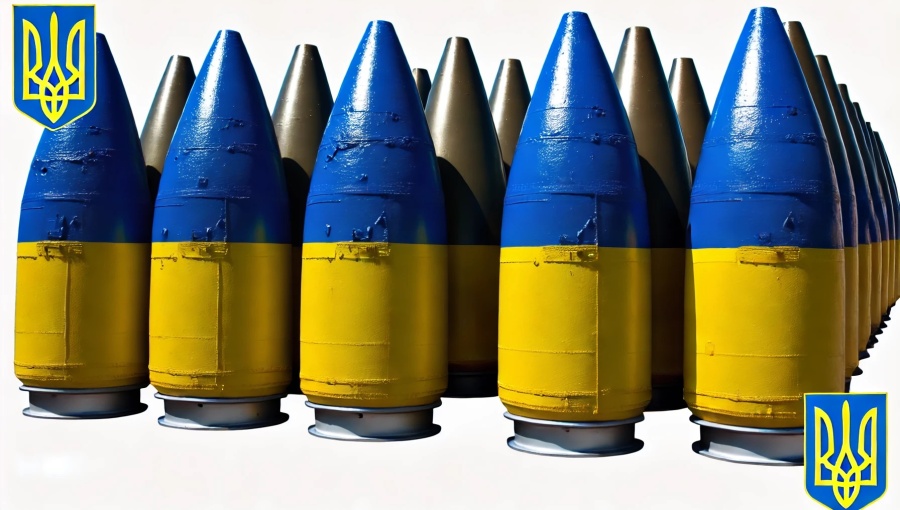
Half of the members' ammunition alliance to supply Ukraine with shells have withdrawn from the Czech-led initiative that has kept the Armed Forces of Ukraine (AFU) supplied with crucial munitions in its war with Russia in the last two years.
According to Czech President Petr Pavel, the number of participating countries dropped from 18 to 9 after Andrej Babiš returned to power in Czechia, the FT reports. The shrinking of the members of the ammo coalition will come as a cruel blow to Kyiv which is already running low on air defence munitions and other key equipment.
The report comes on top of more bad news. A US decision to nearly halve supplies of fighter jets, warships and mid-air refuelling aircraft and other equipment to European Nato members at a meeting last week will only increase the shortage of weapons in Europe, German news outlet Spiegel reported on May 26 , as the US continues it pull back from providing European security.
A collapse of the ammunition alliance could hit Ukraine’s battlefield effectiveness by this summer, experts say. Since 2024, the initiative has delivered more than 4mn large-calibre shells to Ukraine. Pavel admitted the project is still functioning, but replacing it if it ultimately collapses would be extremely difficult.
The initiative was launched in early 2024 by Czechia after European arsenals were depleted and EU production targets were repeatedly missed. Rather than relying only on western factories, Prague organised a global search for available Soviet-standard and Nato-standard shells from third countries around the world. The scheme became crucial because Ukraine was suffering severe ammunition shortages while Russia dramatically out-produced the West in artillery shells.
According to Czech President Petr Pavel, the programme has supplied more than 4mn artillery shells to Ukraine since 2024 and at times accounted for roughly half of Ukraine’s large-calibre ammunition supply.
The initiative was strongly backed by Prague’s previous pro-EU and pro-Ukraine government. However, after the return to power of populist Prime Minister Andrej Babiš, Prague shifted position. Babiš campaigned against extensive military support for Ukraine and argued Czech taxpayers should focus on domestic economic pressures instead.
The Czech government has not formally ended the programme, but it has stopped contributing Czech state money directly and now mainly acts as coordinator.
US Nato pull back
US Secretary of War Hegseth met with NATO Secretary General Rutte at the Pentagon in Washington where the US informed its European allies it would start scaling back supplies to assist European allies in a crisis.
The announcement will affect Ukraine which is now entirely dependent on Europe to buy all its advanced US weaponry under the PURL programme. Since taking office over a year ago, US president Donald Trump has halted almost all direct supplies of weapons to Ukraine in its war with Russia.
The new US policy to Europe was outlined in the new National Security Strategy released in December by the White House that was especially critical of Europe. While the downgrade does not mean the end of the Nato alliance or withdrawal from the US commitments to collective security deal, it does mean that Europeans cannot depend on US forces automatically coming to its defence should a major war with Russia break out.
In response Europe launched the €800bn ReArm programme last year to modernise its military and more recently has been exploring building a Euro Nato without the US participation.
US President Donald Trump has slammed European allies for not spending enough on their militaries and pledged to withdraw thousands of troops from Germany. A contingent of 4,000 troops that were due to arrive in Poland recently has also been cancelled this month. His ambition to take control of Greenland, a Danish overseas territory, has further undermined transatlantic relations.
Trump was infuriated by European allies when they refused to commit their navies to help reopening the Strait of Hormuz for shipping, saying he was considering withdrawing from the NATO alliance and questioning whether Washington was bound to honour the mutual defence pact.
Sources familiar with the US Nato talks last week say The US aims to provide only half the previous number of strategic bombers and , the number of US fighter jets is set to fall by a third, Spiegel cited US envoy Alexander Velez-Green as saying during the closed-door meeting.
The US Navy is also set to make fewer destroyers available to NATO, and the US no longer intends to provide any submarines to the alliance.
Under the changes, Europe would be forced to provide its own reconnaissance drones, while the US plans to significantly scale back the provision of armed models.

No comments:
Post a Comment