Sunday, June 05, 2022

‘One thing that human beings value above all else is our autonomy’: The gloves are off: Elon Musk is the latest CEO to tell workers to return to the office


Elon Musk is giving his employees an ultimatum.


© MarketWatch photo illustration/Getty Images, iStockphoto

Opinion by Quentin Fottrell - Friday
MarketWatch

Related video: Elon Musk Tells Tesla Workers to Get Back to Office

Tesla’s chief executive officer and founder responded Thursday to an apparent leaked email that called on employees to return to the office: “They should pretend to work somewhere else” were his choice of words on Twitter in the early hours of Thursday morning.

The email in question, dated May 31 and signed “Elon,” was candid, and was addressed to the electric-car maker’s executive staff. It was bluntly entitled: “Remote work is no longer acceptable.”

The Great Resistance has seen employees pitted against companies over whether they should return to the office full time after more than two years of working from home. The COVID-19 pandemic has turned people’s lives upside down and led to more than 1 million fatalities in the U.S. alone, but it has also given millions of workers a rare insight into the possibility of working remotely, and still being as productive as they were when they were in the office.

Tesla, which employs roughly 100,000 workers worldwide, has already received pushback in Germany, where it employs 4,000 workers and plans to expand to 12,000. The IG Metall union in the German state of Brandenburg Sachsen, where Tesla’s German plant is based, did not react kindly to Musk’s return-or-quit dictat, Reuters reported Thursday.

“Whoever does not agree with such one-sided demands and wants to stand against them has the power of unions behind them in Germany, as per law,” Birgit Dietze, the district leader for IG Metall in Brandenburg Sachsen, said per the news agency.

It’s not too surprising that some employees are pushing back hard against management’s expectations about returning to in-person work, even if most employees legal options are limited. “If we feel like somebody is trying to force us to do something we tend to push against that change with equal force,” David Schonthal, professor of strategy at Northwestern University Kellogg School of Management.

“One thing that human beings value above all else is our autonomy. Over the last two years, we lost the camaraderie and personal interaction with our colleagues, but we gained our autonomy where we can make our own schedule,” he added.

Employees may have legal grounds in the U.S. to work remotely under the Americans with Disabilities Act if they have a medical condition that makes them particularly vulnerable to COVID-19. But unless the requirement to report to the office is at odds with a stay-at-home order in their state —which have long been lifted across the U.S. — even unionized workers who wish to work remotely are likely out of luck.
‘If we feel like somebody is trying to force us to do something we tend to push against that change with equal force.’ — David Schonthal, professor of strategy at Northwestern University Kellogg School of Management

In the aforementioned Tesla email, Musk said that exceptional circumstances would be considered and reviewed directly by him, but noted that managers could not just show up at the most convenient Tesla office. The email also read: “Moreover, the ‘office’ must be a main Tesla office, not a remote branch office unrelated to the job duties, for example, being responsible for Fremont factory human relations, but having your office be in another state.”

For those who can work from home part- or full-time, this may be a luxury problem. Tesla’s factory workers do not have the privilege to work from home, and may have little appreciation for those managers who choose not to be on site full time. Similarly, teachers, medical workers, retail workers and service workers are, for the most part, working in-person. In fact, the Labor Department says only 7.7% of employees teleworked in April, although the Federal Reserve Board’s survey on Americans’ economic well-being released last month estimated a higher percentage of employees (22%) are working entirely from home.

Tom Murphy, professor of management at the MIT Sloane School of Management in Cambridge, Mass., said it’s hard to predict what Musk will say and do, and hard to say what will happen with Tesla, “but in the long run employees will vote with their feet and choose to work in companies which give them more flexibility about where and when they work. This is how the markets work: buyers and sellers find people they want to do business with — in this case, it’s happening with the labor market.”
‘Tesla is kick-starting its own local Great Resignation.’ — Nicholas Bloom, a professor in the department of economics at Stanford University

There will always be senior executives who feel strongly that workers should be in the office much or all of the time, and some companies may choose to work that way, he added. “But I think the tide of history is against that. More and more companies will give more and more workers more and more freedom about where they work. Technology makes it possible, in many cases, to be more or just as productive in a way that is time efficient and life-friendly for the workers.”

So how many workers — at Telsa and elsewhere — would actually jump ship? “In response to Musk’s demand, almost 60% of employees will return to the office full time,” said Nicholas Bloom, a professor in the department of economics at Stanford University, “but about 7% are likely to quit on the spot and about 30% actively look for another job.” That’s based on his own monthly poll of 2,500 workers.

“Typically, the folks quitting will be higher educated in hot areas like IT and finance, where many other firms are offering work-from-home for 2 to 3 days per week. So the majority of employees will return, but Tesla is kick-starting its own local Great Resignation,” Bloom added.

Other global surveys suggest a higher percentage of workers would consider leaving or have already found a new gig. But that also assumes they would be entering a still-strong jobs market. There is another game-changer that could cause workers to stay put: The specter of a recession.
‘Employees will vote with their feet and choose to work in companies which give them more flexibility about where and when they work.’ — Tom Murphy, professor of management at the MIT Sloane School of Management

However, Murphy said there is an important missing piece in the working-from-home debate — informal interactions that don’t happen in formally scheduled meetings. “These are things that happen in the hallway or next to the coffee machine. Those informal interactions can also be supported online.” Murphy said he was working on his own alternative to Zoom and Google Meet — a more intimate video chat called “Mingler” that works on open-source software.

Musk isn’t the first CEO to vent. JPMorgan Chase’s CEO Jamie Dimon told workers at a Wall Street Journal event in May 2021 that remote work “doesn’t work for people who want to hustle, doesn’t work for culture, doesn’t work for idea generation. We are getting blowback about coming back internally, but that’s life.” But Dimon recently acknowledged in the bank’s latest annual report that “working from home will become more permanent in American business.”

What Musk tweeted likely reflects what many companies are thinking with respect to working from home, and the need to get workers back into the office, “but most wouldn’t take the risk of framing it as a blanket statement like that,” said Vanessa Burbano, an associate professor of business at Columbia Business School in New York.

“So as not to alienate or drive away employees who place a lot of value on flexibility and the ability to work from home,” she added, “companies that want to get workers back into the office will want to do so in a way that says to these workers, ‘We hear you, we understand that you place value in this, let’s find a compromise.'”

Ultimately, there is a valuable lesson for the next CEO like Musk or Dimon who chooses to throw down the gauntlet, Schonthal said. “Co-design a return to work with your employees instead of forcing your will or decision upon them,” he said. “When employees feel like they have authorship in the change or return to work, it diffuses any ‘reactance.’ They feel like they have a hand in it themselves, and it makes them much more receptive to change.”
Tesla reported having paid a PR firm to monitor employees online in 2017 and 2018

Tesla reportedly paid a PR firm to monitor employees online in 2017 and 2018. The firm focused on research conducted by labour organizers through a Facebook group.


 Tesla sign on the building on car sales

MobileSyrup - Friday

The core reasoning behind Tesla bringing on a PR firm is due to its staff trying to form a union at the company’s Fremont, California factory. According to invoices and documents obtained by CNBC, MikeWorldWide (MWW) PR tried to identify conversations regarding workplace conditions. The monitoring covered anything from unfair labour practices to a sexual harassment lawsuit.


Via the report, three Tesla employees who worked at the Fremont factory were advised not to connect with high ups online. This extended to staff joining online groups without surveying the members. Additionally, two current employees are also cautious about Tesla continuing to monitor social media posts to this day.

Copies of Tesla’s current communication policies have also been seen. These reportedly state that managing personnel should not look into an employee’s social media presence without a notable reason drawing back to the company. However, the company also states that employees should not address labour issues online. Instead, they are “more likely to resolve concerns about work” through the company directly.

News of this comes at a time when Tesla CEO Elon Musk is very adamant about free speech online. In his bid to acquire Twitter for $44 billion, Musk has been outspoken about how the social media platform should be used for free speech. Prior to approaching a deal to purchase Twitter, Musk used the platform to complain about the state of free speech. The question of whether “a new platform is needed” was also brought into question.

Ultimately, this led Musk to purchase 9.2 percent of Twitter and later reach a deal to own the company. However, the acquisition has not gone through fully at the time of writing.

Image credit: Shutterstock

Source: CNBC Via: The Daily Beast
Permian Basin rivals Saudi Arabia, Russia in oil production


Bob Campbell, Odessa American, Texas
Fri, June 3, 2022, 6:03 PM·3 min read


Jun. 3—The Permian Basin is now pumping more oil than every country in the world except Saudi Arabia and Russia and considering the multiple factors at play, its global status will keep rising.

That's according to Rystad Energy, an independent research and business intelligence company based in Oslo, Norway, which says the Basin will boom from the record 5.2 million barrels per day that it produced in May to 5.6 million bpd by the end of this year and 6.5 million bpd in 2023, or almost half of a record total U.S. production of 13.2 million bpd.

"The Permian has become the hot spot for U.S. oil production thanks to significant resources, low break-even costs and high oil content," said Espen Erlingsen, Rystad's director of upstream research. "This trend is only likely to continue as global oil markets struggle with supply constraints and the demand for oil shows little sign of easing."

Asked if 6.5 million bpd is realistic, Henry Resources President David Bledsoe of Midland said, "I think we can get there, but it depends a lot on how the major oil companies view their capital budgets and their interactions with Wall Street.

"The private companies will continue to drill."

With the Basin's rig count standing at 343, up from 225 a year ago and nearly half of the national count of 727, Bledsoe said, "It will be the best thing for the industry if we add a lot of production rates like we have in the past, drive the prices down and don't continue the wild ride of price volatility, which is hard on all of us.

"The reason we have seen an uptick in production in the last few months is that we were deciding to do that a year ago. It takes about a year from the decision to add production for that production to come online."

Society of Professional Engineers spokesman Steve Rassenfoss of Houston said the Basin's output is primarily a result of its technology. "You're achieving a huge amount of oil, which is indicative of the fact that you have gotten really good at technology and you keep getting better," Rassenfoss said Thursday.

"The Permian Basin has a great concentration of talented people who are very good at applying the new technology in new ways."

Rassenfoss said 6.5 million bpd "doesn't seem much out of line" if the needed equipment and fracking sand are found. "The Eagle Ford Shale Play in South Texas and the Bakken Formation in North Dakota had been shrinking, but now they're growing," he said.

"Get $100 oil and people get interested."

Texas Independent Producers & Royalty Owners Association President Ed Longanecker said the Basin's growth "is not overly surprising because the oil and gas producers have responded to the higher commodity prices and the call to increase domestic production and address the supply shortage and growing demand.

"The Permian is one of the most prolific formations in the world, so it's good to see how it stacks up to the producing nations around the world," Longanecker said Thursday from Austin. "You have the resources and infrastructure with the community and region that is accustomed to supporting the oil and gas industry."

Longanecker said reaching 6.5 million bpd "will obviously depend on a number of market factors.

"If the commodity prices remain high and nothing overly burdensome is enacted at the federal level, we should reach new records in Texas this year or next year, driven largely by the Permian," he said. "Growth in production could be affected by challenges in the workforce, shortages of materials and an adversarial federal policy environment."
Remote, hybrid work creating schism as popular option unavailable to many workers

TORONTO — Employees like Matt Fairbanks are one of the reasons the hospitality and restaurant industry is struggling to find workers even as the pandemic wanes.


The 34-year-old former bartender has moved from slinging beers in Toronto to selling software to restaurants for a Saskatchewan company — which he does remotely.

"I was always kind of one foot out of the hospitality industry and the pandemic really showed me how vulnerable the work was and the instability of it all," he said in an interview.

Gone are the harrowing commutes, while the additional flexibility has improved his work-life balance. Fairbanks's company allows employees to work from out of the country for up to 90 days, take unlimited vacation and travel or work from anywhere in Canada.

"I've actually encouraged a lot of my friends from the restaurant industry to kind of look at other options and change kind of how they're doing their life, too."

Remote work flourished during the pandemic as companies temporarily closed their offices, but it has created a schism among Canadian workers. While 40 per cent of work in Canada can be done remotely, experts say, that means 60 per cent of workers are unable to access this benefit because they are required to be on-site.

And that can create resentment and a backlash from workers viewed as essential, such as nurses, ambulance workers and retail employees, who were applauded during the pandemic but are unable to realize the benefits that come from working remotely, said change management expert Linda Duxbury, a Chancellor’s Professor of management at Carleton University’s Sprott School of Business, who has studied remote work for decades.

"The problem we're going to have here is we're going to create two classes of workers — the haves and the have nots," she said in an interview.

Those who can work remotely, particularly professionals such as accountants, lawyers and tech workers, flourished financially during the lockdowns while those forced to work on-site were often overworked or lost their jobs entirely amid reduced capacity and businesses that shuttered for good.

That second group was told they were valued and important "and now they don't feel important," Duxbury said.

The ability to work remotely has been one of the pivotal moments in the history of work, even though its application is generally limited to knowledge workers, said Erica Pimentel, assistant professor of accounting at the Smith School of Business at Queen’s University.

"So when 60 per cent of the workforce is excluded from this massive change, well that's obviously going to have some implications for society," she said, because it's very inconsistent in how it affects the population at large.

Related video: Help Needed: Remote work permanently changes workforce

Duxbury cautions that the jury is still out on remote work, or what she calls "enforced work from home." She constantly hears from businesses seeking best practices and examples of what others are doing. But she said it's too early to assess the work style as everybody is experimenting with different models.

"Remote work during the pandemic was one big giant experiment. Now we're moving to the second experiment, the follow up, which is hybrid work," she said.

The appropriateness of remote work is very job dependent. It isn't conducive to brainstorming, socialization, coaching, mentoring, onboarding, team-building and client satisfaction.

And while people who work from home put in far more hours — estimated at four to 10 additional hours per week — data suggests it hasn't increased productivity, Duxbury said.

"Just because we worked 100 per cent remote for the last two plus years doesn't mean it's a sustainable model for a lot of people and a lot of jobs moving forward."

Despite the drawbacks, remote work is being increasingly favoured, especially by generation Z, digital natives who have always had access to the internet and social media, said Pimentel.

This cohort is coming of age and joining the workforce with new attitudes about employers' duty to them and how different parts of their lives fit together that is different from millennials, generation X and baby boomers, who are in many cases now the bosses.

"And so there's this generational like mismatch between bosses and their employees and everybody is unhappy."

Many companies would rather have employees return to the office full-time, but are facing stiff opposition from workers who have grown to like working from home, said Duxbury. Faced with record job vacancies amid decades-low unemployment rates and threats of resignations, employers have been forced to be flexible.

That means employees with a skill that's in demand are able to negotiate better work conditions than somebody without those skills.

Tech workers, who accounted for most of the three per cent of Canadians who worked remotely before the pandemic, are among those in the driver's seat now.

Demands to work remotely have gone from being the exception to the rule because it's so hard to compete for talent, said Kristina McDougall, founder and president of executive search firm Artemis that specializes in tech employment.


"Unless there is an absolute reason why you physically need to be present, like you're working on a robot or you need to be in the building, most organizations are having to be flexible," she said.

The growth in remote work has also transformed where companies source their workforce because people can work anywhere and don't have to be near a company headquarters. That widens the jobs an individual can consider, but it also gives companies a wider pool of candidates as well as increased competition with other potential suitors.

McDougall believes the movement to remote work is permanent for sectors like technology because the pandemic has proven that organizations can get things built with people working remotely.

"You can't put the genie back in the bottle. People are now finding it trivial that they might need to go into an office every day."

This report by The Canadian Press was first published June 5, 2022.

Ross Marowits, The Canadian Press
60 firefighters, 6 helicopters working to douse out-of-control wildfire in northwestern Alberta

CBC/Radio-Canada - 2h ago

More firefighters and air support have been dispatched to battle a wildfire that has been raging in northwestern Alberta for several days.


© Submitted by Victoria Ostendorf/Alberta WildfireThe wildfire, located about 20 kilometres northwest of Zama City, Alta., has grown to 3,000 hectares as of Sunday morning.

A fire ignited near Zama City, a hamlet around 700 kilometres northwest of Edmonton, on June 1 due to lightning, according to Victoria Ostendorf, wildfire information officer for Alberta Wildfire's High Level forest area.

By Saturday, Alberta Wildfire classified the fire as out of control and it had grown to 1,800 hectares. A team of 46 firefighters and five helicopters were dispatched to the area.

As of 11:30 a.m. Sunday, the wildfire has grown to 3,000 hectares and there are now 60 firefighters and six helicopters trying to extinguish the flames, Alberta Wildfire said in an update.

Firefighters, with help from air support, have been able to start establishing control lines on the south and east sides of the fire, the update says.


The wildfire, which is burning about 20 kilometres northwest of Zama City, Alta., poses no threat to the community, it adds.

There are no emergency alerts in effect Sunday morning, according to the Alberta Emergency Alert Index.

There are five other wildfires burning with Alberta Wildfire's High Level forest area, of which Zama City, Alta., is a part. Two are being held, the other three are under control.

The High Level forest area is currently under a fire advisory due to warm temperatures and little rain in the forecast.

Under the advisory, existing fire permits are still valid but may be suspended or cancelled if the weather conditions continue. New permits are being reviewed and approved on a case-by-case basis, Alberta Wildfire says.

Any burning — except for campfires — without a valid permit is prohibited under the advisory.

Up to 15,000 may join largest ever migrant caravan to walk through Mexico to US

Lillian Perlmutter in Tapachula  Fri, June 3, 2022,

<span>Photograph: Juan Manuel Blanco/EPA</span>
Photograph: Juan Manuel Blanco/EPA

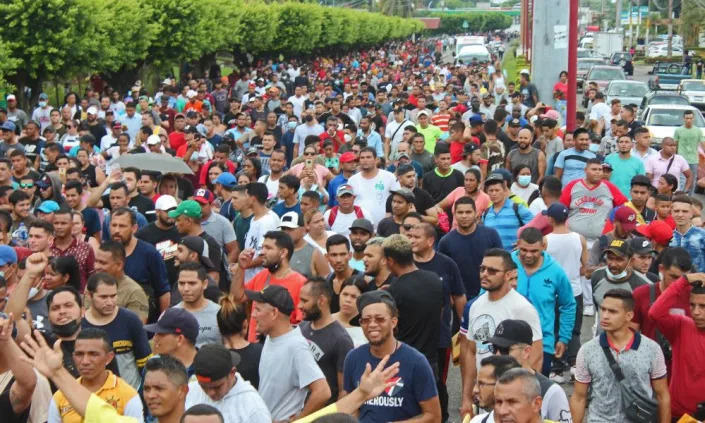
Liozanys Comeja credits her survival to her teacup chihuahua, Mia. Originally from Venezuela, Comeja moved to Colombia five years ago, but decided to leave her new life behind this month due to the rising cost of living. She crossed the Darien Gap, a notorious stretch of jungle between Colombia and Panama, with Mia tucked in her backpack, eventually making her way across eight countries. Now, Comeja is hoping the dog will help her make it through the grueling final leg of their journey.

Comeja has joined about 11,000 others who on Monday will leave Tapachula, a sweltering city on the Mexico-Guatemala border, and head north for the United States. It will depart as leaders from across the hemisphere gather in Los Angeles for the Summit of the Americas.

“Whenever I get discouraged, Mia calms me down,” Comeja said. When they arrive at the US border, Comeja plans to cross the Rio Grande on foot.

This is not the first migrant caravan to leave Tapachula, but it may be the largest ever recorded in Mexico: its numbers are expected to swell in the coming days, and may reach 15,000 people – plus Mia the chihuahua.

“This is the largest mass human migration I have seen in at least the past 10 years,” said Luís Villagrán, an organizer of the caravan and director of the non-profit Center for Human Dignification.

Nearly 70% of its members are women and children, aged between infants to people in their 70s, said Villagrán. Huddled together for protection, they aim to walk the entire length of Mexico. Most have only one pair of shoes; some, just plastic flip-flops. The road they will travel, known as the coastal route, may be difficult to traverse due to mudslides left behind by Hurricane Agatha, as well as the overbearing presence of the sun.

The largest number of migrants in the caravan come from VenezuelaCuba and Nicaragua – three countries whose authoritarian rulers Joe Biden has conspicuously refused to invite to the summit. But there are also Haitians, Salvadorans, Hondurans, Guatemalans and even citizens of India, Bangladesh, and several African countries.

Related: Cubans choose exile to escape post-protest political crackdown

Earlier this month, the Mexican National Migration Institute (INM), wrote to Villagrán, expressing sympathy for the caravan’s members and pledging to help the most vulnerable among them. The letter also acknowledges that the caravan is a result of the stunning tsunami of migration from nearly every country in the Americas to the United States in the past few years, attributing this migration to elevated rates of violence and economic instability in the continent.

It is a striking response from the leaders of a bureaucracy that migrants often describe as routinely unhelpful and even deliberately dysfunctional.

But the letter also marks the first time the Mexican government has responded to a caravan before its departure, and may signal a shift in how the authorities respond to large groups of migrants.

“Immigration is used as a political tool. These women and children are like coins to be exchanged. It’s very possible [Mexican President Andrés Manuel López] Obrador wants to use this caravan to look like a humanitarian before the Summit of the Americas,” Villagrán said.

But caravan members are well aware of the potential dangers they face. In recent months, Mexico’s National Guard has become increasingly violent in its response to migrants. When Villagrán led a smaller caravan in April, he was beaten and several of his teeth were cracked by National Guard troops.

In Tapachula, the National Guard is routinely used to corral, detain, and teargas unruly groups of migrants in front of the city’s INM office, where people often wait for weeks or months for the humanitarian visa needed to leave the city.

On Tuesday, thousands gathered at Tapachula’s city center to write their names on a list that Villagrán would submit to INM to secure visas for the group. At one point, an altercation broke out as migrants worried others would get to the list before them, and they would be left behind.

Before they depart, Villagrán and the migrants are demanding humanitarian visas be given immediately, so the group can pass through migration checkpoints without being arrested or attacked by Mexican National Guard, as happened in April. Anyone attempting to cross through one of the checkpoints without a visa is sent back to Tapachula and forced to wait months for papers that may never come.

Over the past three months, migrants have poured into Tapachula’s parks and shelters at twice or three times the previous rate. Migrant shelters that once housed no more than 400 people are now accommodating nearly 2,000. Bathrooms overflow, food dwindles until it is just one scoop of beans, and migrants sleep in the hallways, or on spread out sweatshirts in the jungle.

Grace, another traveller from Venezuela, said she only hoped that her five-year-old daughter, Bláiche, would not remember the scenes they had lived through in the crowded shelter.

“Of course I’m joining the caravan! I’m leaving as quickly as I can,” she said. “This place is a trap.”

THAT IS THE ROOT CAUSE
Analysis: Corruption in Central America frustrates U.S. plan to tackle migration 'root causes'


Fri, June 3, 2022
By Ted Hesson, Daina Beth Solomon and Matt Spetalnick

WASHINGTON (Reuters) - More than a year into U.S. President Joe Biden's sweeping effort to tackle the "root causes" of migration with aid to Central America, projects likely worth millions of dollars have been canceled or put on hold due to corruption and governance concerns, U.S. officials and others tracking the issue said.

The setbacks come as the Biden administration is hosting the Summit of the Americas in Los Angeles next week, where the United States hopes to find common ground with other nations and issue a joint statement on migration.

At the same time, corruption in Guatemala, El Salvador and Honduras has also limited potential investment from U.S. companies, another prong of Biden's strategy, according to a group coordinating the effort.


In one striking example, the U.S. Agency for International Development (USAID) abruptly suspended an undisclosed amount of funding tied to Guatemala's justice ministry in July 2021 after the firing of a special prosecutor targeting corruption days earlier.

USAID also redirected funding away from projects linked to the justice ministry in El Salvador weeks after El Salvador's Congress, dominated by lawmakers aligned with President Nayib Bukele, voted to remove top judges and the attorney general in May 2021.

Bukele tweeted at the time that the dismissals were warranted and that they were "cleaning house."

USAID declined to detail the specifics of the projects or say how much funding was suspended in both cases, but it likely amounted to millions of dollars in funding to strengthen legal systems, experts told Reuters.

As the efforts faltered in the past year, record numbers of migrants attempted to cross the U.S.-Mexico border illegally, fueling criticism by Republicans as they seek to gain control of Congress in Nov. 8 midterm elections. Migrants from the three countries - collectively known as the Northern Triangle - were caught crossing the border more than 300,000 times from Oct. 2021 to April of this year, according to U.S. government data, a quarter of all border apprehensions.

Biden, a Democrat who took office in January 2021, vowed to reverse the isolationist approach of his Republican predecessor, former President Donald Trump, who suspended aid to the region in an effort to strong-arm the countries into cracking down on migrants heading north.

Signaling the importance of the strategy, Vice President Kamala Harris was put in charge. She marshaled prominent U.S. companies to invest in the region and traveled to Guatemala in June 2021, where she heralded the start of a "new era."

But U.S.-Guatemala relations cooled a month later when Guatemalan Attorney General Maria Consuelo Porras fired the country's leading anti-corruption prosecutor. Relations grew more tense last month, when Guatemalan President Alejandro Giammattei reappointed Porras to her role, which led the United States to sanction her for corruption.

Giammattei's office, in response to questions from Reuters, said corruption is a historical and structural problem and the government has prioritized fighting it.

'DISINCENTIVE FOR INVESTMENT'

The tensions could spill over into the summit. Biden officials hope the hemispheric gathering, held every three or four years, will help reassert U.S. influence in the region after what Biden said is years of neglect under Trump, but it remains unclear whether Guatemala's Giammattei will attend.

Philip Gordon, Harris' national security adviser, said in an interview that the administration has been "honest from the start" about the challenges of corruption and that it "needs to be dealt with."

When asked about U.S. criticism over corruption in Guatemala's justice system, Guatemalan Foreign Minister Mario Bucaro said last week that the government was addressing the matter but would not allow outside interference affect the country's sovereignty.

The governance issues also have dampened the potential of the Harris-led private sector initiative to invest in the three countries.

The Partnership for Central America, a non-profit organization launched last year to coordinate the effort, in March pulled out of co-hosting an event with the Guatemalan government over the country's approach to corruption, said Jonathan Fantini-Porter, the group's executive director.

The partnership also has limited its engagement in El Salvador.

"Corruption's a big thing," Fantini-Porter said. "It’s a disincentive for investment."

With limited options for partners in the region, Harris flew to Honduras in January to attend the inauguration of President Xiomara Castro. Juan Orlando Hernandez, Castro's predecessor, was arrested and extradited to the United States on drug-trafficking and firearms charges.

The Biden administration requested $861 million for the Central America root causes effort last year, a more than 50% increase over the previous year and is asking for even more this year. But even some Democratic allies are skeptical of the push for more funds.

"We credit them with recognizing that supporting criminals is a bad idea," said Tim Rieser, a foreign policy aide to Senator Patrick Leahy, the Democratic chairman of the Senate Appropriations Committee. "On the other hand, it's not yet clear what the plan is."

(Reporting by Ted Hesson in Washington and Daina Beth Solomon in Mexico City; Additional reporting by Matt Spetalnick in Washington, Gustavo Palencia in Tegucigalpa, Enrique Garcia in Guatemala City and Nelson Renteria in San Salvador; Editing by Mica Rosenberg)
WAR ON KURDISTAN NORTH
EXPLAINER: What is behind Turkey's Syria incursion threats?


BASSEM MROUE and ZEYNEP BILGINSOY
Fri, June 3, 2022, 

BEIRUT (AP) — In northern Syria, residents are bracing for a new fight. With the world’s attention focused on the war in Ukraine, Turkey's leader says he’s planning a major military operation to push back Syrian Kurdish fighters and create a long sought-after buffer zone in the border area.

Tensions are high. Hardly a day passes by without an exchange of fire and shelling between the U.S.-backed Syrian Kurdish fighters, and Turkish forces and Turkey-backed Syrian opposition gunmen.

Analysts say Turkish President Recep Tayyip Erdogan is taking advantage of the war in Ukraine to push his own goals in neighboring Syria — even using Turkey’s ability as a NATO member to veto alliance membership by Finland and Sweden as potential leverage.

But a major incursion by Ankara comes with risks and complications, threatening to upset Turkey's ties with both the United States and Russia. It also risks creating a new wave of displacement in a war-ravaged region where the Islamic State group still lurks in the shadows.

Here’s a look at the situation on the ground and some of the key issues:

TURKISH AMBITIONS

Erdogan last month outlined plans to resume Turkish efforts to create a 30-kilometer (19 mile) deep buffer zone in Syria, along its southern border through a cross-border incursion against U.S.-allied Syrian Kurdish fighters. Erdogan wanted to create that zone in 2019 but a military operation fell short of achieving it.

“We’ll come down on them suddenly one night. And we must,” Erdogan said, without giving a specific timeline.


Since 2016, Turkey has launched three major operations inside Syria, targeting Syria’s main Kurdish militia — the People’s Protection Units or YPG — which Turkey considers to be a terrorist organization and an extension of the outlawed Kurdistan Workers’ Party, or PKK. The PKK has for decades waged an insurgency within Turkey against the government in Ankara.

The YPG, however, forms the backbone of U.S.-led forces in the fight against Islamic State militants and has been a proven top U.S. ally in Syria.

Turkey, through the three previous military operations in Syria, already has control over a large chunk of Syrian territory, including the towns of Afrin, Tel Abyad and Jarablus. Ankara plans to build thousands of housing units in those areas, to ensure what it says will be the “voluntary return” of 1 million out of the 3.7 million Syrian refugees currently in Turkey.

Erdogan said Wednesday that Turkish troops now aim to take new areas, including the towns of Tel Rifaat and Manbij, which sits on a major intersection of roads on Syria’s west-east highway known as the M4. Turkey says the Syrian Kurdish fighters use Tel Rifaat as a base to attack areas held by Turkey-backed Syrian opposition fighters.

There have been also reports that Turkish troops might enter the strategic border town of Kobani, where the U.S. military and Kurdish fighters first united to defeat IS in 2015. The town holds powerful symbolism for Syrian Kurds and their ambitions of self-rule in this part of Syria.


WHY NOW?


Analysts say Erdogan likely sees a confluence of circumstances, both international and domestic, that make an operation in Syria timely. The Russians are preoccupied with the war in Ukraine, and the Americans need Erdogan to drop his objections to the expansion of NATO to include Finland and Sweden.

“They (Turks) sense an opportunity to try and get concessions from the West,” said Aaron Stein, head of research at the Foreign Policy Research Institute in Philadelphia.

A Syria offensive could also be used to rally Turkish nationalist voters at a time when their economy is in decline, with inflation running at 73.5%. Turkey is set to hold presidential and parliamentary elections next year, and previous incursions into Syria to drive out the YPG have bolstered support for Erdogan in past balloting.

So far, there are no signs of mobilization pointing to an imminent invasion, although the Turkish military could be called upon fairly quickly. Syrian Kurdish fighters, however, say they are taking Turkey’s latest threat seriously and have been preparing for a possible attack.


They warn that an incursion would affect their ongoing fight against IS and their ability to protect prisons in northern Syria where thousands of extremists, many of them foreign nationals, have been locked up since IS was defeated territorially three years ago.

TURKEY’S US AND RUSSIA TIES


A large-scale military operation carries high risks and is likely to anger both the U.S and Russia, who also have a military presence in northern Syria.

Turkey and Russia support rival sides in Syria’s 11-year conflict but have been closely coordinating in the country’s north. While Russia has not officially commented, it has in recent days sent fighter jets and helicopter gunships to a base close to the border with Turkey, according to Syrian opposition activists.

As one of Damascus' closest allies, Russia's role in Syria has been paramount in turning the tide of the conflict in Syria — which started amid Arab Spring uprisings in 2011 — in favor of Syrian President Bashar Assad. The Syrian opposition fighters were relegated to an enclave in the northwest and Turkey's sphere of influence.

But with Moscow focused on Ukraine, it's unlikely Vladimir Putin will stand in Erdogan's way over what is essentially just a strip of land along Turkey's southern border.

Washington has made clear its opposition to a Turkish military incursion, saying it would put at risk hard-won gains in the campaign against IS.

“We recognize Turkey’s legitimate security concerns on its border. But again, we are concerned that any new offensive would further undermine regional stability,” said State Department spokesman Ned Price.

Stein, the analyst, said any operation would be complicated because of Russian presence in both potential hotspots, Kobani and Tel Rifaat.

Whether an operation takes place boils down to the question on how far Erdogan is prepared to go in Syria, particularly in and around the Kobani area — and whether he would be unchallenged by Moscow and Washington.

“How much risk does he want to take? The evidence that we have is that he takes a lot of risk,” Stein said.

___

Bilginsoy reported from Istanbul.


Turkish tanks and troops are deployed near the Syrian town of Manbij, Syria, Oct. 15, 2019. Hardly a day passes in northern Syria without Kurdish fighters and opposition gunmen backed by Turkey exchanging gunfire and shelling and concerns are rising that the situation will only get worse in the coming weeks with Ankara threatening to launch a new major operation along its southern border. (Ugur Can/DHA via AP, File)More

What the Crisis in Sri Lanka Means for the World

Ian Bremmer
Sat, June 4, 2022, 

SRI LANKA-POLITICS-ECONOMY-PROTEST
A demonstrator throws back a tear gas canister fired by police to disperse students taking part in an anti-government protest demanding the resignation of Sri Lanka's President Gotabaya Rajapaksa over the country's crippling economic crisis, in Colombo on May 29, 2022. 
Credit - ISHARA S. KODIKARA-AFP

Many middle-income and developing countries are now suffering from a combination of internal political dysfunction and external economic shocks generated mainly by COVID-19 and the war in Ukraine. Sri Lanka provides a powerful example and a warning for countries in other regions that will face similar predicaments.

Sri Lanka is not a poor country. When adjusted for purchasing power, per capita GDP in this nation of 22 million people is higher than in South Africa, Peru, Egypt, or Indonesia. But the country now faces a political crisis powered by severe shortages of food, fuel, electricity, and medicine. The currency is collapsing, and the government can’t afford imports or to make its debt payments. At times in recent weeks, violent protests have threatened to spiral out of control.

How did we get here?

A quarter century of civil war, which ended in 2009, has created a legacy of violence at the heart of Sri Lanka’s politics. In 2019, a terrorist attack by an ISIS-inspired Islamist group on minority Christians made international headlines. On Easter Sunday, a series of bombs detonated in churches and hotels killed and injured hundreds of people. Those attacks, and the sense of insecurity they created across the island nation helped elect Gotabaya Rajapaksa, a former defense minister with a reputation for toughness, later that year.

Gota, as the president is widely known, then named his older brother, Mahinda, a former president, as prime minister. A landslide election victory in 2020 gave the Rajapaksas a two-thirds parliamentary majority, which then allowed them to rewrite Sri Lanka’s constitution to give the president extraordinary new powers.

Then hubris kicked in. Family and friends were given important posts in government. A series of economic mistakes, including populist tax cuts, deprived the government of revenue and made it much harder to borrow money abroad.

External shocks have also played a big role in Sri Lanka’s troubles. COVID-19 devastated a tourism sector still reeling from terrorism, a sector that’s critical for government revenue and job creation in the country. The pandemic also cut deeply into remittances, money sent home by Sri Lankans working abroad.

The increasingly unpopular Rajapaksas refused to accept the need for government spending cuts and tax increases to help Sri Lanka avoid even tougher economic conditions. A ban on chemical fertilizers to push farmers toward organic farming in the middle of the economic crisis made matters worse for the country’s food supply.

Then came Russia’s invasion of Ukraine and the damage it is now inflicting on global food and fuel prices. Russia and Ukraine are both leading exporters of grain, and the war has shut in much of that production. Russia and its ally Belarus, which also faces Western sanctions for allowing Russia to use his country’s territory as a launchpad for attacks on Ukraine, are leading producers of fertilizer. Higher prices for fuel are the natural result of supply worries that have pushed oil above $100 per barrel. Sri Lanka also imports more than 80 percent of its medical supplies. Donors in India and in Europe have helped, but there’s a limit to how much they are willing to do.

In Sri Lanka, public anger came to a head in early May. Economic pressures exacerbated infighting within the Rajapaksa family, particularly between the president and prime minister. After the government appeared to send counter-protesters to attack the mainly peaceful crowds that called for the prime minister to resign, bloodshed ensued. Enraged anti-government protesters then went on an arson spree, attacking the homes of Rajapaksa family allies, and threatening the prime minister’s own residence. The PM was forced to step down, and he needed the protection of security forces for a 4 AM evacuation of his home.

A state of emergency was declared across the county. Angry mobs have launched more attacks on politicians and their homes. Hundreds have been injured in recent weeks, and some have died. A member of parliament was killed in his car. Two more of President Rajapaksa’s siblings and a nephew have resigned their cabinet posts.

Late last month, Sri Lanka defaulted on its debt for the first time in the nation’s history.
What now?

President Rajapaksa, struggling to survive politically, has pledged to reverse some of the constitutional changes that gave him more power. He has accepted help for Sri Lanka’s economy from India and China, and he’s appealed to the IMF for a bailout. New Prime Minister Ranil Wickremesing, a political veteran, has been brutally honest in his public comments on the scale of the problems Sri Lanka faces and the need for bold action to solve them. He has said Sri Lanka will raise tax rates to earn a bailout from the International Monetary Fund. He then used a televised speech to call on protest groups to join in the process of reform. He pledged that parliamentary committees will allow lawmakers, young people and experts to work together.

For now, the protesters continue to demand President Rajapaksa’s resignation, though there don’t appear to be enough votes in parliament to impeach him, and the opposition looks to have little interest in sharing responsibility for cleaning up this mess by joining a government of national unity.

In short, a chastened Sri Lankan government will try to muddle through, hope the pandemic and Russia’s war in Ukraine end soon, and do its best to secure long-term financial health.

It’s a pattern that will be repeated in many developing countries in coming years.


Sri Lankan protesters reject PM’s offer to include them in Parliament committees on political reforms

Maanya Sachdeva
Sat, June 4, 2022, 4:41 AM·2 min read

Youth-led protest groups in Sri Lanka, currently crippled by economic and political crisis, have rejected prime minister Ranil Wickremesinghe’s offer to include them in parliamentary reform committees.

Mr Wickremesinghe on 29 May in a televised statement said that governance in Sri Lanka will be broad-based through parliamentary committees, with lawmakers youth and experts working together.

He added that under proposed constitutional reforms, powers of President Gotabaya Rajapaksa will be clipped while those of Parliament will be fortified.

He said: “The youth are calling for a change in the existing system. They also want to know the current issues. Therefore, I propose to appoint four youth representatives to each of these 15 committees.”

However, on Friday, it was reported that these leaderless groups had rejected Mr Wickremesinghe’s offer, calling it an attempt to weaken the anti-establishment movement.

Further, they criticised Mr Wickremesinghe’s “Hunger Games approach” of picking and choosing between protestors from diverse backgrounds to be appointed to these committees.

Speaking to The Straits Times, the former chief of Sri Lanka’s human rights commission Ambika Sathkunanathan said: “What Ranil is doing is dodgy. This whole Hunger Games approach is especially terrible - he’s saying ‘you decide which one of you will be in Parliament.”

Protesters have camped out outside the president’s office for more than 50 days, since March, demanding the resignation of the Rajapaksa family– including the president – as the country tethers on the brink of bankruptcy.

Sri Lanka has already defaulted on its foreign loans, and is grappling with acute shortages of essential items such as cooking gas, fuel and medicines.

Many have been forced to wait in long queues for hours to try and buy necessities, with many still returning empty-handed.

Last month, former prime minister Mahinda Rajapaksa was forced to resign and Mr Wickremesinghe was sworn in on 12 May.

Mr Wickremesinghe, in his first address to the country, prepared the country for tough months ahead as he aimed to steer the economy back on track.

Additional reporting by Associated Press


ETHOPIA'S WAR OF AGRESSION
Ethiopia’s mass arrests show rift with former Amhara allies

Fri, June 3, 2022

NAIROBI, Kenya (AP) — Once a key ally of Ethiopia’s federal government in its deadly war in the country’s northern Tigray region, the neighboring Amhara region is now experiencing government-led mass arrests and disappearances of activists, journalists and other perceived critics.

More than 4,500 people have been arrested in the Amhara region as of May 23, according to officials, but some activists say the real figure could be much higher. They accuse Ethiopia’s government of targeting ethnic Amhara people it considers a threat to its authority as it tries to move on from the Tigray crisis.

The arrests are the latest sign that the federal government of Ethiopia — Africa’s second-most populous country with 115 million people — is struggling to centralize its authority among scores of ethnic groups. The Amhara are the second-largest ethnic group and, along with Tigrayans, the source of many of the country’s leaders — and critics, especially after frustration grew during the war when Tigray forces invaded the Amhara region and attacked civilians.

The federal government’s arrests among the Amhara are “a pre-emptive action to consolidate their power, which they think is slowly slipping out of their hands, especially in the Amhara region,” Yilkal Getnet, deputy chairman of the opposition party Hibir Ethiopia, told The Associated Press. “For me, these mass arrests are politically motivated.”

The independent Ethiopian Human Rights Council earlier this week said it's not known where most detainees in the Amhara region are being held, alleging that many people were subjected to “kidnappings.” Separately, the government-created Ethiopian Human Rights Commission called the “unlawful detention” of at least 19 journalists a “new low.”

On Wednesday, federal police announced it had identified 111 online media outlets it called illegal and are “attempting to cause a rift between the government and the general public.” It said 10 suspects are in custody.

Ethiopia’s government and Amhara regional officials defend the arrests and say they will continue.

“There were attempts to portray the government as weak, and to cause public unrest and violence,” regional spokesman Gizachew Muluneh told a press conference on Wednesday. “This conspiracy has failed. Anarchism and illegal activities have no place here.”

The Ethiopian Government Communication Service, citing requests by the public to ensure law and order, said measures are being taken against “groups that pit society against one another.”

The mass arrests aren’t limited to the Amhara region, but it’s there that outcry has been the loudest. Among those arrested are members of the Amhara militia known as the Fano which was an ally of federal forces when fighting Tigray forces. Fano members, while celebrated in state media, also were accused of some of the war’s worst atrocities.

They are now described in state media as an “irregular force,” and efforts are underway to disarm some of the fighters.

“Fano militia strengthened due to the war, and partly the arrests are an effort to bring them under government control,” said William Davison, an analyst with the International Crisis Group. “However, the broad sweep of the detentions, including multiple journalists, suggests the government is also trying to control the narrative as fears grow among Amhara that their interests will be undermined by federal government efforts to end its conflict with Tigray’s authorities.”

Three of Ethiopia's largest opposition parties have called on the federal government to stop the arrests.

“Journalists, activists, Fano militia members, academicians, political party members and retirees are being abducted in a pretext of a ‘law enforcement operation,’” the Enat Party, All-Ethiopia Unity Party and Ethiopian Peoples’ Revolutionary Party said in a joint statement this week. “The government is using this operation to silence dissent, break the morale of the public and snatch the leaders away.”

The Amhara Association of America shared with the AP a list of several dozen detainees whom it said were targeted in recent weeks. It also alleged that seven people were killed on May 20 in Motta town in the Amhara region when army and regional special forces fired on a peaceful demonstration against the mass arrests.

The federal government fears Amhara political elites could emerge as its most pointed critics during the current respite from the Tigray war, said Yilkal with the opposition Hibir Ethiopia. The federal government in March declared a humanitarian cease-fire in the conflict that erupted in November 2020, though tensions continue.

“Those who coordinated, supported, and led the war are being arrested and chased,” Yilkal said. He now fears for his safety, saying his lawyer was arrested in recent days. He said the charge sheet says the lawyer is accused of “inciting violence and unrest.”