Sunday, June 12, 2022

SOUNDS LIKE FLORIDA
Russia seeks to militarize schoolchildren and censor textbooks amid war

Kremlin security chiefs are making radical changes in how history is taught


By Robyn Dixon
June 11, 2022 

Schoolchildren enter the Museum of the Great Patriotic War (also known as the Victory Museum) in Moscow on March 17.

RIGA, Latvia — As President Vladimir Putin’s war against Ukraine drags on, Russia’s teachers are being turned into front-line soldiers in an information war designed to mold children into loyal militarized nationalists. The nation’s powerful security chiefs, leading propagandists and parliamentary hard-liners are pushing radical changes to the education system, as the Education Ministry takes a back seat.

Schools have been ordered to carry out “patriotic” classes parroting the Kremlin line on the war, and teachers who refuse to give the classes have been fired. Textbooks are being purged of almost all references to Ukraine and its capital, Kyiv.

Russia’s parliament rejected as unsatisfactory the Education Ministry’s plan on how it would review history textbooks, calling this a matter of “national security” and requesting the head of Russia’s foreign spy service to take charge.

And the powerful chief of the Russian Security Council, Nikolai Patrushev, a close Putin ally, has demanded sweeping changes to education, as part of a whole-of-government effort to shape loyal citizens from cradle to grave.

Anton Litvin, a Moscow father of two, had a nice home and good job, but when the government began using schools for propaganda in the war against Ukraine, he quit and left the country. He said he was revolted by the thought that his children could be brainwashed by lessons about “patriotism” and Putin’s take on history. The breaking point came when teachers sent home brochures urging him to sign his 8-year-old son up for summer camp with the Young Army, a military youth group launched by the Defense Ministry in 2015.

“I don’t want my kids to join the regime at this young age and to be someone’s soldiers to fight against peaceful people,” said Litvin, who sacrificed his job at a prominent Moscow aeronautics company and is now a stay-at-home dad in the Georgian capital, Tbilisi, looking for a new job.

Since 2013, Putin has driven changes to the teaching of history as part of a campaign to build a national identity based on the Soviet Union’s role in defeating the Nazis in World War II. But after the invasion of Ukraine, the tempo of change in schools was “like a waterfall,” Litvin said.

“Everything is getting worse. It’s like it’s going back to the Soviet Union,” he said. “Children are taught that war is good, actually, from the perspective of our government.”

Russian President Vladimir Putin attends a meeting with families awarded Orders of Parental Glory via a video link on June 1. (Mikhail Metzel/Sputnik/AFP/Getty Images)

Russia’s efforts to militarize students underscores the Kremlin’s long-term ambitions: not just cementing Russian support for the war but also building a generation of youth loyal to Russia’s increasingly totalitarian regime — unlike many Russian millennials today who oppose the regime and the war.

Putin constantly plays on Russian nostalgia for past Soviet power to justify the war, but his “is not a new Soviet regime. It is much closer to a fascist regime and what they’re doing now is a different sort of propaganda,” said Grigory Yudin, professor of political philosophy at the Moscow School of Social and Economic Sciences. “They’re trying to actively militarize children to engage them in this war, to engage them in support for this war.”

Patrushev, the Security Council chief, last month demanded a major overhaul of Russia’s education system to develop a new “patriotic” generation. He urged the adoption of a comprehensive system to “implement the state’s program at all stages of a person’s maturation and formation as a citizen.”

A key proponent of the invasion known for his anti-Western rhetoric, Patrushev said teachers were at the forefront of a “hybrid war being waged against Russia.” But many of them, he complained, “manipulated” children and distorted history. He criticized the history curriculum and lamented that textbooks did not cover Soviet heroism in World War II properly.

A participant of a public event holds a flag displaying the symbol Z in support of Russia's armed forces involved in a military conflict in Ukraine, in central Saint Petersburg, Russia, on May 27. A sign on a flag reads: "We don't abandon our people." (Anton Vaganov/Reuters)

Then, amid complaints that the Education Ministry had fallen short, Russia’s upper house of parliament asked on Thursday that Sergei Naryshkin, head of the Foreign Intelligence Service and chairman of the Russian Historical Society, take charge of reviewing history textbooks, because “the current situation requires a special attitude” to teaching.

“Today, it is one of the components of the country’s national security,” said Ekaterina Altabayeva, deputy chairwoman of the Science, Education and Culture committee.

The main impact of changes to textbooks and curriculum is expected after the summer break.

“There’s a whole revolution going on now in the Russian education system, because it’s been rapidly changing since February,” Yudin said. He added, “They want to get back control over young minds, and they also need these people as cannon fodder.”

While the Education Ministry has ordered teachers to give patriotic lessons that reflect the Kremlin’s line on Ukraine, they have been a hard sell at times.

One history teacher in a Moscow high school, for example, failed to persuade several students in his class, including a 17-year-old named Nikita.

“I don’t trust my history teacher. He is more of an overly-patriotic propaganda man,” Nikita said, adding students paid no attention to the patriotic lessons. The student declined to give his surname to avoid problems at school. “I just stood up and left the classroom. Two others did the same.”

But many students were wary of openly opposing the war, he added. “My friends do not support the war. We try to be careful. For instance, I don’t want my classmates to know what my thoughts are.”

For some, the mandatory sessions on the war are an onerous but unavoidable duty.

“Both teachers and students, I think, understand that it’s not a real lesson. It’s not about learning. It’s something else, an obligatory event,” said a Moscow history teacher, Alexander. He said teachers were given guidelines on teaching history, “but what we say is not officially regulated.”

But officials seem determined to curb teachers’ freedom to decide how they teach history. Just days after the February invasion, Foreign Ministry spokeswoman Maria Zakharova summoned teachers to meetings where they were ordered to toe the government line on the war.

Russian female cadets, members of the Young Army movement, march during Victory Day Parade rehearsals on May 7 in Moscow. (Getty Images) (Contributor/Getty Images)

Some teachers who refused to teach the patriotic lessons were fired. Patrushev has warned that authorities could target school heads whose students did not have books about World War II or could not name Russian war heroes from past centuries.

“History is a subject that the authorities are always trying to use for propaganda purposes,” said Dmitry, a teacher from provincial Russia, where most people support the war. “History teachers are much more vulnerable than other teachers.”

Textbook publishers, meantime, are carrying out a Soviet-style purge of almost all references to Ukraine. After the invasion, management at Russia’s main text book publisher Prosveshchenie — meaning Enlightenment — ordered editors to slash references to Ukraine and Kyiv, according to a report by the independent Russian media Mediazona in April, based on interviews with three editors.

One editor said that “we have a task to make it look as if Ukraine simply does not exist,” the outlet reported.

Russian textbooks have just a page about the millions of people shot or jailed illegally in Soviet times, according to Marina Agaltsova, a lawyer with Memorial, a renowned nonprofit dedicated to exposing Soviet-era repression that was shut down by authorities last year.

“If you have only one small stain on the big, glorious history of the Soviet Union, of course you would think that the Soviet Union is a great state, and we all have to get back to that state,” she said.

Memorial historian Nikita Petrov said Russia’s insistence that students unquestioningly accept the Kremlin’s version of history was “dangerous.”

In late 1970s, Petrov, then a chemistry student, had got his hands on a smuggled copy of British historian Robert Conquest’s “The Great Terror” about the Stalin-era purges. Smuggled books on Soviet history were like gold to him, he recalled. He decided that becoming a historian was more important than being a chemist.

“In the Soviet Union, history did not exist as a science. Facts were hidden and not revealed. And people did not know historical facts. They knew only what they were told,” he said.

He spent years uncovering the Stalin-era execution of his great-grandfather. Lawsuits seek to bury the evidence.

Russia’s ‘foreign agent’ law now threatens rights group that survived even Soviet pressures

Putin’s war propaganda becomes ‘patriotic’ lessons in Russian schools
‘Drag queens aren’t going into schools to shoot kids’: Drag Queen Story Hour hits back at GOP ban attempts


The flamboyant LGBT+ education charity described Republican attacks as ‘smoke and mirrors’ to distract from gun control

Io Dodds
San Francisco

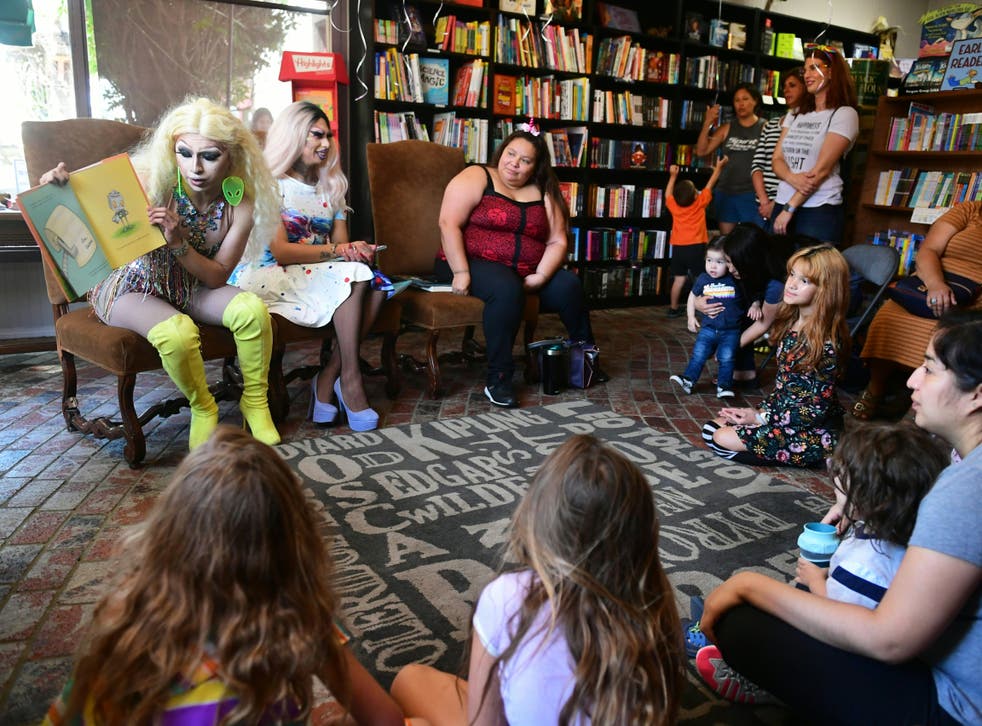
A Drag Queen Story Hour at a bookshop in Riverside, California in June 2019
(Frederic J Brown/AFP via Getty Images)

Republican proposals to ban drag shows for children are "just smoke and mirrors" to distract from the party's failure to prevent gun massacres, the head of Drag Queen Story Hour (DQSH) has said.

The embattled LGBT+ education charity, which organises children's book readings by drag queens in schools, libraries, and book shops, has become a major flashpoint for social conservatives and been forced to cancel some events after receiving violent threats.

On Monday a GOP state legislator in Texas said he would file a bill to ban all drag shows "and other inappropriate displays" in the presence of minors, while on Friday Florida's Republican governor Ron DeSantis suggested he might ask child protection officials to investigate parents who take their children to drag events.

But in an interview with The Independent, DQSH's executive director Jonathan Hamilt shot back: "All this is just smoke and mirrors to distract us from what's really happening.

"You know, 19 students just got shot in Texas, and Texas legislation wants to ban minors from going to drag shows. It makes zero sense. It's a sad, sorry excuse... [for] the lack of gun control, and that's the real issue.

"Drag queens aren't going into schools to shoot kids... when did we decide that it's appropriate to teach kids how to hide under desks and not to talk about LGBT people and histories?"

Mr Hamilt, who also performs drag under the name Ona Louise, pointed to research by the gun control campaign group Everytown for Gun Safety, which found 96 incidents of gunfire on American school grounds in 2022 so far, resulting in 40 deaths and 78 injuries.

"There's been like 40 deaths [in school shootings] this year, and no children have been killed or hurt by anybody who attended a Drag Queen Story Hour, or at any Pride event," Mr Hamilt said. "If people really wanted to protect children, it wouldn't be banning LGBTQ education, it would be banning guns."

Asked on Friday whether his comments about Texas also applied to Florida, Mr Hamilt indicated that they did, saying: "This is part of a coordinated campaign to deny the rights of LGBTQ people, who already endure disproportionate rates of suicide and homelessness, and legislate us out of existence.

"Any attempt to criminalise our work is rooted in tired homophobic and transphobic hate and misinformation, and we refuse to give in to politicians who are too bigoted and boring to comprehend our vision for a world in which every child can be safe fully expressing who they are."

Texas and Florida politicians move to ban children’s drag shows

The proposed bills in Texas and Florida came after videos of children dancing with and tipping drag performers at a "family-friendly" midday show at a gay bar in Dallas went viral among conservatives.

The event, which was unaffiliated with DQSH, was a Pride-themed spin-off from the bar's regular afternoon drag brunches, starting earlier than usual and without the usual event's age restrictions. DQSH organises more sedate book reading events often hosted by public buildings.

Both types of events have been claimed by right-wing media and online influencers as evidence that the LGBT+ rights movement is a threat to children, echoing a recent surge in baseless claims of "grooming" against LGBT+ people that appears to have inspired street harassment and violence.

Last week a DQSH reading in North Carolina was cancelled due to violent threats, while another DQSH event at a US military base in Germany was pulled after US senator Marco Rubio accused the charity of exposing children to "sexually charged content".

Opponents claim that drag is inherently sexual and not appropriate for children, while advocates argue that drag is an art like any other and that child-friendly drag events can teach kids about LGBT+ culture and gender nonconformity.

"The events of this past weekend were horrifying and show a disturbing trend in which perverted adults are obsessed with sexualising young children," said Bryan Slaton, the Texas representative who proposed the drag show ban, referring to the Dallas bar event.

On Thursday, Florida representative Anthony Sabatini promised a similar bill to "terminate the parental rights of any adult who brings a child to these perverted sex shows".

Asked by reporters whether he would back that bill, Mr DeSantis said he had instructed his staff to consider the idea. "We have child protective statutes on the books; we have laws against child endangerment," he said. "It seems like there’s a concerted effort to be exposing kids more and more to things that are not age appropriate."

It comes amid a concerted push by Republican state politicians to ban discussions of LGBT+ life from school classrooms, as with Florida's so-called "Don't Say Gay" law, and criminalise gender transition healthcare for transgender children.

‘Do you bring your kids to an R-rated movie? I hope not’

Mr Hamilt said threats are "nothing new" for DQSH, which was founded in 2015 in San Francisco and has faced growing hostility in red states since 2017, including at least one bomb threat.

"'Groomer' is one of the nicer words," he said. "I receive a bunch of personal death threats and hate mail and tonnes of different attacks on a daily basis... that's something shocking to a lot of people, but people tend to forget that the queer community faces this adversity and pushback on a daily basis."

However, he said the torrent of threats can be overwhelming for local officials, who are not always confident answering back and advocating for the events, meaning story hours are sometimes cancelled even though there is no credible danger.

Responding to Republicans' claims, Mr Hamilt described drag as simply a way of highlighting and exaggerating the way all people "perform" different personas in daily life, and likened the difference between a drag event for adults and one for children to that between R-rated films and children's films.

"I'm not going to lie and say drag is never sexualised, because drag is an art form and it can be sexual like anything else can be," he said.

"Drag with adults in an adult setting could be sexual, sure. Is it sexual at a Drag Queen Story Hour? No! Do you bring your kids to an R-rated movie? I hope not. There are actors in R rated movies, and those same actors can be in a family friendly comedy that's rated G...

"Someone who is bigoted or doesn't want to do the research, they're not going to understand that an adult drag show at an adult bar, in the evening, with alcohol, is different from a Drag Queen Story Hour nonprofit event at 11am at a public library.

"Obviously, all adults act differently when they're around children and when they're not. Every schoolteacher has a private life outside of working with children, and you act appropriately around children. That's just a normal thing that all adults do, no matter who you are – gay or straight, drag queen or not."


Recommended


UN human rights experts urge China to allow them ‘full access’

10 June 2022

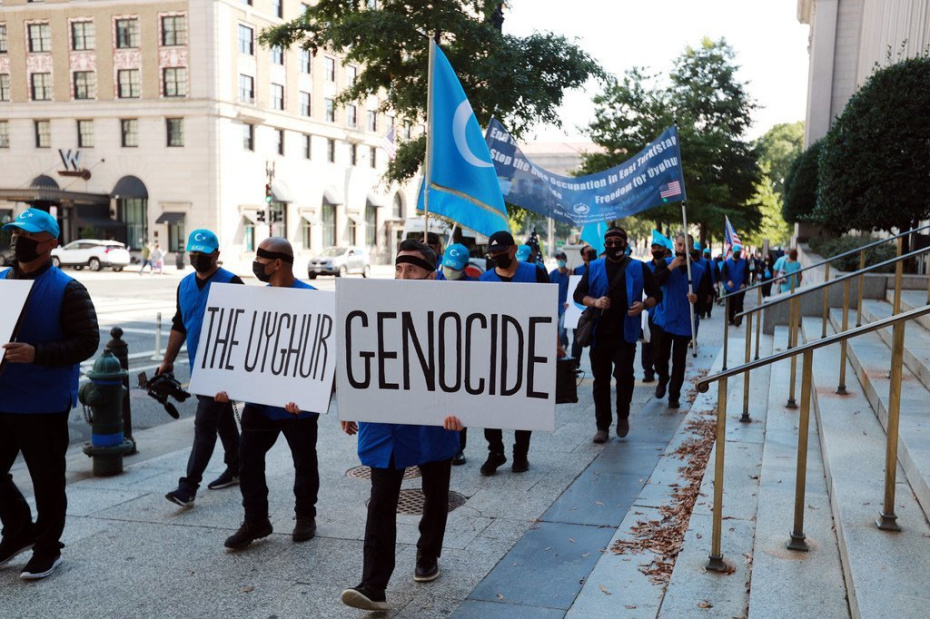
Dozens of independent UN human rights experts on Friday urged the Chinese Government to “cooperate fully” with the UN human rights system over abuse allegations, and grant them “unhindered access – particularly to prisons and detention centres.

“Strengthening engagement with independent human rights experts and Human Rights Council Opens in new window mechanisms is crucial to full and transparent enforcement of China’s human rights obligations,” the group of more than 40 experts said, ahead of the Council’s landmark 50th session, which begins on Monday.
Systemic violations

In a statement Opens in new window, they recalled the Government’s high-level engagementOpens in new window with the High Commissioner during her recent visit Opens in new window to the country, and stressed the value of constructive dialogue, with all UN human rights entities.


The experts stressed that those meetings should not be a substitute for the “urgent need” to carry out a complete assessment of the human rights situation in the country, and especially in the Xinjiang Uyghur Autonomous Region (XUAR), the Tibet Autonomous Region, and in the Hong Kong Special Administrative Region.

“The Government of China must address specific and systematic human rights violations,” they said, calling on authorities in Beijing to ensure full and transparent cooperation with the entire UN human rights system.
 
Catalogued concerns

The rights experts renewed the calls made by 50 UN Special Rapporteurs and human rights experts in a June 2020 joint statement Opens in new window, that catalogued concerns over the treatment of ethnic minorities in XUAR and Tibet, alleging excessive force against protesters, as well as in Hong Kong, and reports of retaliation against people voicing their concerns publicly over COVID-19Opens in new window pandemic policies.

The statement highlighted the need to protect fundamental human rights in China, including freedoms of expressionOpens in new window, cultural rights, peaceful assemblyOpens in new window and association, religion or beliefOpens in new window, and non-discriminationOpens in new window; to prevent forced labourOpens in new window in the formal and informal economy, protect journalists and healthcare workers; and to promote women’s freedom from sexual violence.

The independent experts also called on the Government to ensure sexual and reproductive health rightsOpens in new window are equally guaranteed to all women and girls, regardless of ethnic or religious identity.

“Since 2017, we have repeatedly raised concerns about widespread violations of the rights of Uyghurs and other Muslim minorities in the Xinjiang Uyghur Autonomous Region on the basis of religion or belief and under the pretext of national security and preventing extremism,” the experts said.

“Deep concerns also persist about the rights of religious and ethnic minorities in the Tibet Autonomous Region and other parts of the country.”
 
Concerns continue

The UN experts noted previous serious concerns they have expressed over the alleged harassmentOpens in new window, enforced disappearancesOpens in new window, arbitrary detentionOpens in new window and undue prosecution and sentencingOpens in new window of lawyers and human rights defenders including women human rights defenders, business-related human rights abuses and of trafficking for purposes of forced labour and other purposes of exploitation.

“UN Special ProceduresOpens in new window experts continue to voice their concerns over the absence of protection for the right to privacy, reported use of mass surveillanceOpens in new window including in the XUAROpens in new window, entrenched censorship and consolidation of anti-terrorism and seditionOpens in new window law applied to Hong Kong,” they stated.

The experts reiterated recommendations made in the June 2020 joint statementOpens in new window, urging the Human Rights Council to convene a special session on China; consider the creation of a Special Procedures mandate; and appoint a UN Special Envoy or or a panel of experts to closely monitor, analyse and report annually on the human rights situation in China.
Consistent approach

They emphasized the value of a consistent UN approach in assessing China’s human rights obligations and commitments.

“Upholding the same standards and their equal application to all States, big and small, is important to maintaining the integrity, credibility and moral authority of Human Rights Council and UN systems for human rights enforcement around the world,” the experts said.

Special Rapporteurs and independent experts are appointed by the Geneva-based UN Human Rights Council to examine and report backOpens in new window on a specific human rights theme or a country situation. The positions are honorary and the experts are not paid for their work.

Click hereOpens in new window for the name of all the experts who participated in this statement.
HEY GEN Z TREE HUGGERS 
Young people wanted in UK forestry amid critical shortage of tree surgeons

Institute of Chartered Foresters says 70% more staff must be recruited to meet current tree planting targets


The New Forest. Experts say there are not enough trees available to meet planting targets. 
Photograph: David Clapp/Getty Images

Sandra Laville
Sat 11 Jun 2022 07.00 BST

When Kevin Martin was a child he spent days beneath the canopy of Hampshire woodlands while his father, a tree surgeon, scaled the heights of oak and ash above him.

Twenty years later, with a degree and with research for a master’s under way, Martin is in charge of tending to the 14,000 trees at the Royal Botanic Gardens in Kew. With trees at the forefront of UK strategies to reach net zero by 2050, Martin and others like him are key professionals on the frontline of the fight to mitigate the impact of climate change and adapt to the changing conditions.

But the army of tree experts needed to fulfil the government’s promise to increase tree planting to 30,000 hectares a year (90m-120m trees) by the end of 2024 is nowhere to be seen. Skills shortages in arboriculture and forestry are at critical levels, and a new generation is not being recruited to take over from an ageing workforce. A report from the Institute of Chartered Foresters says the industry needs to recruit 70% more people to meet planting targets set by government and the Intergovernmental Panel on Climate Change. (IPCC)

“We need to have a big campaign using social media, public billboards, television, to start recruiting to fill this skills shortage,” said Martin. “It needs to come from industry, but it also needs to be addressed in education when kids are starting to choose what subjects they are interested in. We need to change the culture in education, which is very much that you only go into land-based industries if you are thick – which is absolutely not the case. Everyone needs to be involved in this.”

Within the industry there is a degree of soul-searching going on to understand why young people are not coming through to the profession. Outdated stereotypes of male “lumberjacks”, need to be addressed, according to John Healey, a professor of forest sciences at Bangor University, as do questions of diversity. “There is a shortage of young men wanting to come into the profession, but that is even more acute amongst young women.”

It was at Bangor where in 1916 Mary Sutherland became the first woman in the world to graduate with a forestry degree, he points out, which makes the university even more aware of the need to bring women in.


Free tree for every Welsh household in climate initiative

“It has been a distinguished career that many women since have taken up, but the profession clearly still suffers from the kind of macho image of a lumberjack cutting down trees, whereas it is all about an environmental ethos of expanding woodlands, biodiversity and green space. We spend a lot of time communicating that, but it doesn’t register sufficiently.”

The Committee on Climate Change, a government advisory body, laid out the target of 30,000 hectares a year of forests and woodland by 2024 in its net zero report. The CCC says increasing forest cover to “at least 17% of the UK’s land area”, along with improved woodland management, would sequester an additional 14m tonnes of CO2 each year.

But the workforce to grow, plant and care for these trees is in short supply both in forestry and within arboriculture, which involves tree care ranging from looking after urban trees to running nurseries to produce the new saplings. John Parker, the chief executive of the Arboriculture Association, said: “The trouble is that people do not know what arboriculture is. Schoolchildren don’t say ‘when I grow up I want to be an arboriculturalist’. We need to change that.”

He said the government needed to address the shortages in the workforce. “Trees are so high up the political agenda at the moment, but if we want to have all these wonderful trees doing all these wonderful things for us, we have to have tree professionals to work on them. There is no point planting millions and millions of trees if you are not going to look after them.

“We also need to produce the trees in the first place. We haven’t got enough trees available to meet the planting promises that are being made. It takes time to produce trees of the size we need, it has to start years in advance of when they are required.”


Scotland hopes to save wild salmon by planting millions of trees next to rivers

Many of the next generation of tree experts will come from places such as Myerscough College in Lancashire, which offers foundation as well as undergraduate and postgraduate degrees in arboriculture, tree management and urban forestry. But student numbers remain stable, with no sign of the increases that will be required to fill the skills gap. Alex McKelvie, the head of green space and creative studies, said: “There is a struggle to get young people to know about the industry and to recruit and keep them. So we are lacking a skilled workforce at a critical time.”

The college works hard to attract young women into the profession, he said. “There is nothing in this profession that a girl cannot do rather than a boy; in fact, girls make phenomenal tree climbers and the industry is working hard to attract more young women.”

It is not just among the ranks of school leavers that the industry is seeking to recruit its future experts. Healey said there was a noticeable rise in mature students joining the forestry master’s programme at Bangor. “The students are significantly older,” he said. “Some have been in other careers – for example, working in the City of London – and want to do something quite different,” he said.

The attractions of a career with trees, Healey believes, are numerous. “The work really matters,” he said. “It is fulfilling to do a job that makes an important difference to the world in terms of the biodiversity crisis and climate change.

“Choosing this career means you are right in the midst of an intriguing and exciting challenge. There are no easy solutions, there is practical challenge and there is intellectual stimulation to decide how we get this right.”

Saturday, June 11, 2022

Ms: The first magazine owned, run, and written by women


It's 50 years since feminist campaigner Gloria Steinem co-founded the first magazine in America to be owned, run, and written by women. Ms. covered issues such as equal rights, abortion, and domestic violence in a way that no other magazine had before. With its glossy covers it helped bring feminism into the mainstream. BBC Witness History spoke to co-founder Gloria Steinem.

Invasive bug spreading across US could endanger California wine industry. 
What to know

Daniella Segura, The Charlotte Observer - Friday

An invasive insect making its way across the country could potentially threaten California’s wine industry, new research shows.


The spotted lanternfly, an insect native to Asia known to kill grapevines and damage crops, may make its way to California’s grape-producing counties in five years, according to a new analysis from North Carolina State University researchers.

“This is a big concern for grape growers; it could lead to billions of dollars of losses in the agricultural sector,” Chris Jones, the study’s lead author, said in a June 8 news release.

California produces 82% of the country’s grapes, researchers said.

Jones said it is hard to predict the exact damage that may come from the bug to grape-producing areas. If no preventative measures are taken, though, the insect could be common throughout the country by 2037, researchers say.

The spotted lanternfly was first seen in the country in Pennsylvania in 2014, researchers say. It is now in at least 11 different states.

In the study published in Communications Biology, a computer simulation tool was used to “predict the timing of the spread of the spotted lanternfly,” the news release said.

The bug “can damage or destroy commercially valuable crops,” including grapes, apples and peaches, researchers say. The bug kills the plants by feeding on them, and it can also leave behind a “honeydew” residue, which can further damage the plants as it encourages mold growth.

California, along with Washington state, have “highly suitable” climates for the bug, researchers say.

While there is a “low probability” the insect will reach California’s grape-producing counties by 2027, there is a “high probability” by 2033, researchers say. It will “likely spread through the grape-producing region by 2034.”

Jones hopes the study urges others to create strategies to manage the insects.

“We hope this helps pest managers prepare,” Jones said in the release. “If they can start early surveillance, or start treating as soon as the spotted lanternfly arrives, it could slow the spread to other areas.”

©2022 The Charlotte Observer. Visit charlotteobserver.com. Distributed by Tribune Content Agency, LLC.


Petr Kropotkin

Activists in Athens protest the invasion attacks carried out by the Turkish state

The invasion attacks carried out by the Turkish state were protested in Athens with a march.


ANF
ATHENS
Saturday, 11 Jun 2022

Members of TekoJIN, Navenda Çanda Demokratîk a Kurd, Defend Kurdistan, RiseUp Rojava and Tevgera Ciwanên Şoreşger (TCŞ) protested the Turkish state's attacks on South Kurdistan and the new threats against Northern and Eastern Syria with a march in Athens.

Executives and members of international revolutionary organizations also joined the march, which started in Syntegma Square, and saw the participation of hundreds of people.


The crowd, which opened posters of Kurdish people's leader Abdullah Öcalan, PKK flags and banners condemning the attacks by the Turkish state, often chanted "Biji Serok Apo", "Bijî berxwedana gerila", "Kurdistan goristan ji bo fascistan".

The crowd first went to the Parliament building in Sintegma Square and handed over a dossier on the attacks against Kurdistan, crimes against humanity and violations of rights to all political parties.

The crowd then came to the Greek Representation of the European Union to hand over a dossier. When the door was not opened, the mass condemned this attitude with a statement. The mass walked from here to the American Embassy and delivered the dossier there.

The institutions that made a statement here condemned the attacks against Kurdistan and called on European states to be sensitive to the crimes committed by the Turkish state. They emphasized that the Kurdish people will not give up their struggle.


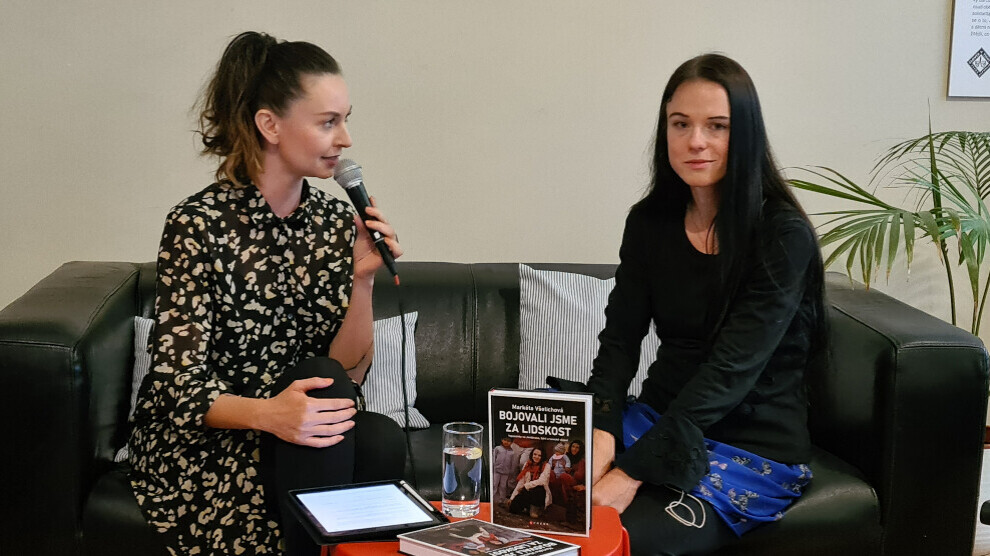
Markéta Všelichová: We fought for humanity

Czech Republic citizen Markéta Všelichová, who went to Rojava in 2015 to support the Kurdish people fighting against ISIS mercenaries, talked about her experiences in her book 'We fought for humanity'.


ANF
PRAGUE
Saturday, 11 Jun 2022

Czech Republic citizen Markéta Všelichová went to Rojava in 2015 to offer her support in the war of the Kurdish people against ISIS mercenaries and was arrested in Turkey with her husband Miroslav Farkas while trying to cross from Turkey to South Kurdistan in 2016.

Všelichová, who spent 4 years in prison in Turkey, talked about her experiences in her book 'We fought for humanity'.

Introducing her book in a program held in Prague last Tuesday, Všelichová talks about her long struggle that started in Shengal and went on in Rojava. Všelichová also tells about the years she spent in a Turkish prison. She shares her memories of her Kurdish friends in prison and a photo album she prepared from Shengal and Rojava in the last part of her book.

Visiting Rojava with her husband and daughter Arien in April, Všelichová went to Raqqa, where she met old friends and visited refugee camps. Všelichová, who is actively fighting for Rojava in her country, the Czech Republic, said that she wants to contribute more to the Kurdish community here.

Time in prison


Markéta Všelichová went to Shengal to provide humanitarian aid for the first time in 2015 and went from there to Rojava. She was arrested at the border while crossing to South Kurdistan in August 2016 with her husband, Miroslav Farkas.

Všelichová and her husband were charged by a court in Şırnak on charges of being YPG members and aiding, and were sentenced to 6 years and 3 months.

These sentences caused a crisis between the Czech Republic and the Turkish state. The couple, who stayed in Şırnak, Şakran and Erciyes prisons for 4 years, were eventually released in July 2022 as a result of pressure from the Czech government.

The couple, who speak Kurdish very well and named their new-born daughter Arien in Kurdish, continue their work for Rojava.


New verdict from Belgium: The PKK is not a terrorist organisation

The Foreigners Litigation Council in Belgium said the PKK is not a terrorist organisation.


MAXIME AZADI
BRUSSELS
Thursday, 9 Jun 2022

The Foreigners Litigation Council (Conseil du contentieux des étrangers) annulled a decision to exclude the benefit of international protection to a Turkish national of Kurdish origin accusing him of having participated, outside his country of nationality, in the financing of the PKK, considered a terrorist organisation.

The Council said instead that “on the basis of the various sources of information submitted to it concerning the nature, structure, organization, activities and methods of the PKK”, it “considers that the acts committed by this organization, taken as a whole, cannot be qualified as terrorist acts.”

The ruling added that “the Council agrees with the point of view expressed by the Brussels Court of Appeal in its judgment of 8 March 2019, a point of view that the Court of Cassation endorsed in its judgment of 28 January 2020.”

The Council was evaluating the objection made after the rejection of a Kurdish refugee's political asylum request and concluded that the applicant could not be excluded on international protection.