Sunday, June 12, 2022

Residents ‘living in the shadow’ of Grenfell Tower on fifth anniversary of fire

Dozens died in block of flats in west London in 2017

Residents have described what it has been like “living in the shadow” of Grenfell Tower, five years after the blaze that claimed 72 lives.

Members of the community in North Kensington, west London, spoke of how the fire “seems like it was last night”, with the tower a constant reminder of the trauma they have suffered.

The June 2017 disaster left the 67 metre-tall building dilapidated and charred.

Authorities took four months to cover the block in a protective wrap with green hearts and the message: “Forever in our hearts.”

Five years on, no decision has been made about the future of the building. But the Grenfell Tower Memorial Commission said a garden was “by far” the most popular idea from a survey of survivors, bereaved relatives and local residents.

Eman Yosry, a resident of Markland House tower block near Grenfell Tower, said the flats are “in front of us all the time”.

In an interview ahead of the anniversary on Tuesday, Ms Yosry spoke about losing many people she knew in the fire, saying: “I feel I can’t describe how sad and how difficult and painful it was.”

Growing tearful, she added: “I don’t know what to say.”

Ms Yosry said: “You can’t get away or forget what happened. It’s there, it’s in front of us all the time.

“Everywhere you go – you see Grenfell Tower. You go to anywhere near the area, you see the tower.”

Nahid Ashby, a resident of the Frinstead House tower block on the Silchester estate near the tower, said: “We’re still living in the shadow.”

Eman Yosry during an interview at the Grenfell Recovery Centre, west London, ahead of the fifth anniversary of the Grenfell Tower fire. PA.

Ms Ashby described what it was like waiting for months for authorities to cover the burnt-out tower.

She said: “A lot of people were saying from the very beginning: ‘Are you going to cover it so we don’t have to look at it?’

“But by the time they covered it, it felt even worse because, I don’t know, they’re just covering it all up because that fire shouldn’t have happened.”

Mohammad Tehrani, 66, who lives in Bramley House next to the tower, said the disaster was always on his mind.

Mr Tehrani, who was at the foot of the tower on the night five years ago, said he saw body bags being carried out of the building and watched debris falling from it.

Showing a video he took of the debris surrounding Bramley House in the morning, Mr Tehrani said he cleared it up as children walked past on the way to school.

The 66-year-old said the ordeal “seems like it was last night” for the community while authorities try to “brush it under the carpet”.

He said: “I mean for us it hasn’t aged.

“It just seems it was last night so five years (on) and they try to ignore, they try to brush it under the carpet.”

Mr Tehrani said he is now able to talk about the disaster without crying but it is still “inside me”.

He also said he still gets flashbacks at night, seeing people “behind the windows begging for their lives”.

“This is something that we’ve seen that we will never forget – no matter what you do, it’s in your mind.

“For four years I used to cry every time you asked me a question, I couldn’t control myself.

“I’m trying my best but it’s inside me still. You can’t help it.”

Mr Tehrani said the way the disaster has cast a long shadow on the lives of children in the community is “so bad”.

He added: “I feel so sorry for my grandchildren, I feel so sorry when I see the young people, because I don’t think they will have a good future because of the things happening.

“They don’t speak but it’s at the back of their mind – if I’m 66 years old and I cannot forget that night, just imagine.

“I mean even my granddaughter lost some friends in her school.

“They don’t say anything but obviously it’s internally affected them – all of them.

“Some of the children, I’ve heard from our community, they don’t even go to the gas fire, they don’t like to see their mother cooking on the gas fire.

“You see it’s so bad.”

Elizabeth Campbell, leader of Kensington and Chelsea Council, said: “On the fifth anniversary of the Grenfell tragedy, and always, our first and last thoughts are with those who lost their lives, their families and their friends.

“The bereaved and survivors continue to show incredible strength, courage, and solidarity, as they search for truth and justice.

“They have set us the challenge of being the best council – something I intend to strive towards."

A representative of the Department for Levelling Up, Housing and Communities said: “The Grenfell Tower tragedy must never be allowed to happen again and our thoughts are with the bereaved families, survivors and residents.”


Top Tax Contributors To Pakistan’s Economy – OpEd

Location of Pakistan and Pakistani Rupee coin.

By 

No country can become a prosperous and welfare state unless it manages all its financial requirements both on development and administrative sides within its own financial resources. 

Deficit in tax collection domain is one of the major problem faced by Pakistan since its inception and because of this the government is forced to borrow loans for virtually everything. As a result, there is less money in the budget to spend on the welfare and wellbeing of citizens. 

There are many factors that led to this deficit in the tax collection in Pakistan. The federal cabinet highlighted the issue of a huge backlog of revenue cases and showed its greater concern relating to revenue collection amounting to trillions of rupees. A low tax base leads to low tax revenue. The Federal Board of Revenue (FBR) after a survey claimed that only 1% of Pakistanis pay taxes. The evaders include many billionaire companies and individuals in the country. To enhance the tax base, Pakistan needs more entities from the corporate sector to file the taxes. Mostly the people from the private sector use means to evade tax payments and as a result the poor people have to suffer. However, in this vicious circle of tax evasion there are still some institutions and organisations that contribute heavily to the national economy through payment of regular taxes thus setting a good precedent for others to follow. 

One of these institutes is the Fauji Foundation. After 1947, proportionate share of the balance fund was transferred to Pakistan. Fund remained with the Government until 1953, when Rs 18.232 Million were transferred to C-in-C. In 1954, Fauji Foundation was founded as a “Charitable Trust” incorporated under “Charitable Endowment Act 1890.”

Fauji Foundation (FF) is rendering welfare to 9.9+ Million individuals, amounting to Rs 10 Billion per annum. It also provides jobs to a large number of civilians (70%), much more than retired service personnel (30%).

Fauji Foundation has contributed significantly to the national cause in the fields of industry, social development, employment opportunities while enhancing the national exchequer by paying considerable taxes. The commercial undertaking is contributing in overall economy of the country. In 2020/21, FF has deposited tax amounting to Rs 150 Billion in national treasury. FF has paid Rs 1 Trillion to the Government over the last five years as taxes and levies. Fauji Foundation is not enjoying any special privileges, and is playing by market rules and operating under relevant regulatory authorities. 

Another organisation which is contributing to national development is Army Welfare Trust – AWT, is a financial and industrial group which seeks to provide stability and progress to the armed forces and the nation. AWT paid Rs 2.54 Billion as taxes during the period from October 2019 to Septemper 2020.

The data reveals some other private entities that pay heavy income taxes include the Oil and Gas Development Company Ltd (OGDCL) which paid Rs17.9 billion. It was followed by the Pakistan State Oil Company Limited (PSO). In the banking sector The United Bank Limited (UBL) paid Rs12 billion, while the Standard Chartered Bank (Pakistan) Ltd, Rs4 billion. If all commercial and business organisations and institutions continue to pay their fair share in the taxes domain, government will be much facilitated in terms of revenue collection to run its economic and financial affairs.

Humais Sheikh is an independent Defence Analyst based in Islamabad. He has completed his Masters in Defence and Strategic Studies from Quaid-I-Azam University, Islamabad.

Pakistan’s Defense Budget In The South Asian Region – OpEd

Military truck carrying intermediate-range ballistic missile of Pakistani army, November 27, 2008 (Courtesy SyedNaqvi90)

By 

Montesquieu was a sociologist and political scientist of the eighteen century who believes that geographical location of an area will have implications for its habitants. Pakistan is the country located in the geographical line with having security challenges and a chronic crisis in its neighbour. 

Newly independent countries at the end of World War II had no option but to go under the umbrella of one of the global power to safeguard their national interest. Being a colony of British’s, Pakistan naturally adopted US camp. Soon after independence Pakistan faugh war of 1948 with India and then war of 1965 and 1971. Kashmir remained the bone of contention between bot the neighbours resulted in wars and then ultimately an unstoppable strategic battle between both the countries. 

Russian invasion of Afghanistan and later US “War on Terror” and its attack on Afghanistan once again brought instability in the region. In August 2021, US and NATO forces left Afghanistan yet the country is suffering at the hands of lack of resources and crisis of governance with non-actors like TTP. 

South Asian region is a closely located region with porous border where insurgency travels and incidents of one country directly affects others. In this situation, Pakistan have been looking to get out from the label of security state to a normal state but repeated  incidents of anarchy  and security challenges in region does not allow Pakistan to do so. On Eastern side, Pakistan has India with a chronic Kashmir conflict and a history of wars. On Western side, Pakistan has Afghanistan which is struggling to survive on its own, non-state actors in Afghanistan remained a constant threat for Pakistan. Pakistan is facing attacks from the terrorists operating from the other side of border in its area of erstwhile FATA and Afghanistan. During this scenario, Pakistan Army fenced porous Afghan border through its resources to tackle the issue of cross border infiltration from Afghanistan. 

Gabriel Almond a political scientist has said that the States are arranged in such a paradoxical order that willingly or unwillingly for their survival, they have to interact with each other. Pakistan in this situation is compelled to adopt a strategic outlook while looking into the strategic scenario of the region. Strategic gestures and stereotyping is necessary to deal and to hold a position to defend the national interest. Latest military trainings and equipment, research and experimentation, interaction with the allies and formation of new allies is the need for Pakistan. This is a constant process which requires proper expenditure yet Pakistan Armed forces are managing this within their limited resources. 

Pakistan have been a weak economy over the recent years, corona pandemic, international conflicts i.e Ukraine war, global inflation and internal political instability has made it difficult for Pakistan to meet the requirement. Pakistan Armed forces has been successfully fulfilling their responsibilities in defending the country and dealing the pandemics within their limited resources.

On the other hand, India has a defence budget of $ 70 billion and Pakistan carries a defence budget of $ 11 billion, this depicts the huge difference in the amount of budget which India spends as compared to Pakistan.  It is a fact that when it comes on spending on an individual soldier, India spends four times more as compared to Pakistan. On a single soldier, Pakistan spends around $ 13 thousand while India spends $ 42 thousand. India is third on annual defence expenditure in the World and this defense budget of India is seven times more than Pakistan. It has also been a challenge for Pakistan that India remained the second biggest importer of weapons between 2016-20. 

Despite of constant increase in Indian budget and the constant challenges of the threats, Pakistan Army has not increased its budget in the last two years. Strategic needs of country were fulfilled through the available resources. Despite of economic difficulties, Armed forces of Pakistan are continuing their operational capabilities against terrorism and adoring themselves with the modern strategic gadgets from the available resources.

Jawad Ahmed is an Islamabad based researcher with having interest in Politics, Bilateralism and Strategic Studies. Can be reached at Jawwadahmedikhlaq89@gmail.com

 LA REVUE GAUCHE - Left Comment: Search results for PERMANENT ARMS ECONOMY 

EU Warns it May Act to Defend Spain - MOROCCO ALLIANCE, in Dispute with Algeria

Friday, 10 June, 2022 - 

A sign directing to the Consulate General of Spain in Algiers, Algeria June 9, 2022. (Reuters)

Asharq Al-Awsat

Top European Union officials said Friday the bloc was treating the crisis between Algeria and Spain with the "utmost concern" and warned it was prepared to take action to defend the interests of its members.

In a joint statement, European Commission executive vice president Valdis Dombrovskis and EU foreign affairs chief Josep Borrell said the decision by Algeria to suspend a two-decade-old friendship treaty with Spain, potentially freezing trade between the two countries, appeared "to be in violation of the EU-Algeria Association Agreement, in particular in the area of trade and investment."

"This would lead to a discriminatory treatment of an EU member state and adversely affect the exercise of the Union’s rights under the Agreement," the statement said.

While urging dialogue to resolve the dispute, the EU officials said "the EU is ready to stand up against any type of coercive measures applied against" an EU nation.

The statement came after Spanish Foreign Minister José Albares traveled to Brussels on Friday to discuss the country's crisis with Algeria.

The treaty suspension was the latest move by Algeria to put pressure on Madrid after the Spanish government changed its long-standing policy regarding the contested territory of Western Sahara. Algeria recalled its ambassador to Spain in March after Madrid came out in support of Morocco’s attempts to keep Western Sahara under its rule. Algeria supports the Polisario Front, the territory’s independence movement.

After the meeting with EU officials, Albares said "the unilateral measure" taken by Algeria violated the accord with the EU.

He sad the EU and Spain agreed "to make a firm defense of our businesses and Spain's interests, which are also European businesses and the interests of the European Union."

Albares insisted that "what we want is dialogue and we're not going to give any excuse for any escalation."

The statement Friday came after the EU on Thursday urged Algeria to reverse its decision.

Spain's chief worry has been that the suspension might affect important gas supplies from Algeria, but the government said that so far this has not happened. Algeria supplies 23% of Spain's gas needs.


Spain and the rest of the 27-nation bloc are hustling now to find alternatives to Russian energy imports to protest Russia’s war in Ukraine.

Industry ministry figures show Spain exported 2 billion euros ($2.1 billion) in goods to Algeria last year while it imports were valued at nearly 5 billion euros.
SAUDI PRESS BLAMES HOUTHI
Five Bln Dollars Needed to Rehabilitate Yemen’s Transport Sector, Ports and Airports

Friday, 10 June, 2022 

Yemeni youths commute on donkeys carrying plastic cans
 in the southern city of Aden on September 16, 2020. Photo: AFP

Aden - Wadah al-Jalil

The financial needs for the recovery and reconstruction of the transport sector in Yemen range between $363-443 million over five years, an estimate that could reach $2.1-4.1 billion, to rebuild the country’s major ports and airports.

A recent Yemeni study said that the Houthi coup has caused significant loss in the transport sector, destroying roads, bridges, ports and airports. It added that 29 percent of the total road network within cities was severely damaged, and 511.1 km of roads were totally destroyed.

According to the study prepared by the Yemeni-based Center for Studies and Economic Media, at least 50 percent of the road network in the cities of Al-Hazm, Taiz, Saada and Marib was damaged.

The war caused the closure of the highway between Sanaa and the city of Marib, which stretches along 173 km and links the country’s capital to the important oil and gas fields in the east.

The Houthi expansion also led to the closure of a number of important strategic 928 km roads, including the 200 km long road between the cities of Mocha and Hodeidah on the western coast of the country, the Aden-Bab al-Mandab Road in Mocha (350 km), and the Taiz-Mocha Road (100 km).

The militias are besieging the city of Taiz, causing the closure of all the main roads linking it with its surroundings and the rest of the governorates, which is leading to severe economic losses to public and private institutions and increasing burdens on the citizens, according to the study.

Moreover, the study noted that the Houthi militia planted mines in a large number of vital roads linking the most important cities of the country, such as the Sanaa-Marib road, east of the capital and the Taiz-Aden highway.

According to the World Bank estimates, the damage in the roads and bridges infrastructure is estimated at $500 million.

In addition, the ports of Hodeidah, Salif, and Mocha were severely damaged, as the Houthi militia exploited them to import weapons and divert their resources to the war effort. The ports of Aden and Mukalla need approximately $49.5 million to maintain their dilapidated equipment.

The war also affected the normal operation of air transport, while airports in Sanaa, Taiz, Aden and Al-Hodeidah stopped working or operated at a very low capacity, according to the study.

According to the statistics of the Ministry of Industry and Trade, losses incurred by the airports amount to $2 billion, including damage to infrastructure, navigational and technical equipment, radars, and the suspension of travel.
No Matter How Ukrainian Crisis Ends, China’s Arms Giants are Always Winners?

June 11, 2022
By Valerio Fabbri


Russia’s military operation in Ukraine has changed the recent fortunes of the weapon industry, enabling it to make huge profits. The Russia-Ukraine conflict, which has been going on since February 24, has witnessed a massive growth in defence spending. In April, the U.S. had stated that it will send an additional 800 million U.S. dollars in weapons, ammunition and other security assistance to Ukraine. The European Union recently announced that it would buy and deliver 450 million U.S. dollars of arms to Ukraine. According to rough estimates, the U.S. and NATO have sent 17,000 anti-tank weapons and 2,000 Stinger anti-aircraft missiles, for instance.

So, arms industry across the globe is looking at the Russia-Ukraine conflict as the golden opportunity rather than a crisis. Chinese arms manufacturers are no different here. China’s arms industry is no different. Although no information is available regarding new sales opportunities for Beijing, experts claim that heavy demand for Chinese arms and ammunitions is expected from several countries including Middle-Eastern and African countries. The ongoing conflict has compelled several countries to increase their budget on defence and security, while China sees it as an opportunity to sell arms and ammunitions and make money, given that several countries are set to spurn Russia to avoid consequent sanctions and may look at China for arms supplies.

China is currently the fourth-largest military equipment exporter in the world, increasing not only its arms sales, but also military training and investment in Africa’s infrastructure projects, which are giving Beijing a foothold on the continent. “The trend is clearly upward and what that arms sales diplomacy gives China is a lot more influence, a lot more power, over those African states,” said Dylan Lee Lehrke, a lead analyst at Jane’s: “It’s a military dependency.” Nearly 70% of the 54 countries on the African continent possess Chinese armoured military vehicles, and nearly 20% of all military vehicles in Africa are imported from China, according to the new analysis by Jane’s, a company known for its publications on global weapons. The study shows sharp increases over the past two decades in Chinese military equipment sales to Africa, compared with the continent’s traditional benefactor, Russia. Countries like Tanzania, Nigeria, Sudan, Cameroon, Zimbabwe, Zambia, Gabon, Algeria, Namibia, Ghana and Ethiopia are among the top importers of Chinese arms.

China’s footprint in the entire Middle East has been widening rapidly ever since the announcement of its Belt and Road Initiative (BRI) in 2013. China’s focus has been on clinching major BRI-connected economic investment deals, mainly infrastructure and connectivity projects in Middle East, Beijing has taken note of the lucrative defense markets of the Middle East. The developing geopolitics in the region, and also uncertain policies on the part of the United States, seem to have prompted China to reorient its strategies. According to the Stockholm International Peace Research Institute (SIPRI)’s recent report China has sold 4.6% of international weapon exports from 2017-21. Interestingly, this compared to China’s 6.4% share of the global arms market in the preceding five-year period. This represented a 31% drop for China in terms of global arms sales, considerably lower than the 4.6% drop in global arms sales in 2017-21 compared to 2012-16. China has trailed behind the U.S., Russia and France from 2017-21 but remained ahead of traditional heavyweights such as Germany, Italy and the United Kingdom. Pakistan, Bangladesh and Thailand are China’s clients for arms and ammunitions. The report stated that nearly half of Chinese weapon exports – 47%, in fact – went to closest ally Pakistan, while Beijing’s next largest clients were Bangladesh and Thailand at 16% and 5% respectively.

When it comes to military equipment, China has clients mostly in Asia. According to available information, some 79% of Chinese arms exports were destined for Asia in the period between 2017 and 2021, with as many as 48 countries procured Chinese equipment. Given the relative strength of China’s position on the arms export table, it is perhaps surprising that China also appeared fifth in the international list of arms importers, behind India, Saudi Arabia, Egypt and Australia. As far as arms imports are concerned, China soaked up 4.8% of global arms imports from 2017 to 2021, compared to 2012-16 when it imported 4.4%. SIPRI reported that 81% of China’s most recent imports came from Russia, while 9.1% emanated from France and 5.9% from Ukraine. SIPRI has noted that Chinese arms imports remained stable between 2012-16 and 2017-2021, and mainly came from Russia in both periods. However, China’s arms imports are likely to decrease in the next few years as its industry is now capable of producing most types of major arms.

China has been a supplier of affordable and functional military equipment, including small arms, armoured vehicles, artillery, naval vessels, aircraft and missiles. It has sold 36 J-10C fighters to Pakistan, and delivered HQ-22 (FK-3) surface-to-air missiles (SAM) to Serbia. Experts however said that a lot of countries have little or no faith in Chinese companies because of poor after sales support. China has a bad reputation of not providing aftersales support, and equipment can rapidly decline into non-functional machinery. The more sophisticated the equipment it sells, the more maintenance support it will require from China. Available reports suggested that Jordan put its Chinese-manufactured CH-4 armed drones up for sale less than two years after buying them. Countries like Morocco, Nigeria and Turkmenistan have preferred drones from Turkey rather than China.

A RAND Corporation study in 2021 clearly pointed lacuna in Chinese defence contracts, stating there is a lack of transparency and accountability. China itself is under American and European military sanctions, and these certainly affect exports. Thailand awaited its first S26T submarine from China, with delivery delayed, first by COVID-19, and then by the fact that Germany refused to sell diesel engines to China for the vessel. Also, China lacked the ability to manufacture highly sophisticated parts as it is still not considered as first-rate developer and producer of state-of-the- art military material. In short, while Chinese military capabilities are limited vis-à-vis Western technologies and developments, Bejing’s assertive policy in terms of arms sales and presence around the world should raise some cautionary eyebrows.

From our partner RIAC


SEE

Russia’s Invasion Of Ukraine: What Does Russia Stand To Gain Through Its Maritime Operations? – Analysis

 Russia's President Vladimir Putin attends the Navy Day parade in St. Petersburg on July 25. Photo Credit: Kremlin.ru

By 

Russia’s recent military operations against Ukraine have expanded its control over critical Sea Lanes of Communication (SLOC) in the Black Sea. SLOC give the region international economic importance by forming a conduit for trade between Europe, the Greater Middle East, and the Russian Federation.

In addition to facilitating transshipments, Black Sea littoral countries are major contributors to the global supply chains of several important commodities, including metals, hydrocarbons, and food. While the long-term status of territories and assets seized by Russia following its invasion on February 24th remains ambiguous, if left under Russian control they could considerably bolster Russia’s geopolitical position.

Russia’s Economic Interest in the Black Sea

The Black Sea already has significant economic importance for Russia, especially in regards to grain and hydrocarbon exports. Russia relies heavily on its Black Sea deep water ports to transport grain, 90 percent of which it exports through the maritime domain. Major Black Sea terminals in Novorossiysk, Tuapse, and Taman allow Russia to retain its position as one of the world’s leading grain exporters. Russia has continued to invest in Black Sea export capacity over recent years. The inauguration of a new deep-water berth at Novorossiysk in July 2021 has upgraded the grain terminal carrying capacity from 50,000 tons to 7 million tons per year, the second largest transhipment volume in Russia.

The Black Sea also plays a major role in the exportation of Russian hydrocarbons to markets in Europe. The majority of hydrocarbons transit the Black sea as gas through two underwater pipelines, BlueStream and TurkStream, which are responsible for a combined 30 billion cubic meters of gas annually. Hydrocarbons are also transported by tankers across the sea as refined and crude petroleum. The CPC terminal near Novorossiysk shipped roughly 60.7 million tons of oil across the Black Sea in 2021. Direct control over the SLOC in the Black Sea allows Russia to protect and expand on its economic interests.

Russian Black Sea Operations

By seizing Ukrainian ports along the coastline and controlling access to shipping lanes, Russia stands to make tangible gains from its invasion of Ukraine. Russia has already occupied several important Ukrainian ports along the Black Sea and Sea of Azov and continues to advance down the Ukrainian coastline. According to statements made by Russia’s high command, the occupation of the entire Ukrainian coastline remains a strategic objective. Combined, the cargo capacity of Ukraine’s 13 ports hovers around 230 million tons per year. Ukraine’s reliance on these ports has grown exponentially over recent decades. From 2013 to 2019, the amount of commodities exported through seaports increased by 85 percent. By controlling Ukraine’s access to the sea, Russia is greatly enhancing its own export capacity while delivering a crippling blow to Ukraine’s economy.

Russia has also expanded its influence over SLOC through its occupation of Snake Island. Despite its acquisition through illegal annexation, Russia could lay claim to the island’s maritime zones. According to the United Nations Convention on the Law of the Sea, islands give sovereign nations jurisdiction over a territorial sea that extends 12-nautical miles from the shoreline. The key shipping lanes connecting the major Ukrainian ports of Odesa, Mykplaiv, and Kherson to international markets pass through or near Snake Island’s territorial waters. Although foreign ships are normally entitled to innocent passage, countries can still regulate the movement of foreign vessels. Russia’s unilateral decision to cut off traffic through the Kerch Strait and along Russian occupied coastlines in the recent past demonstrates its willingness to enforce economic blockades.

Changing the Status Quo

In terms of geopolitical leverage, Russia’s military operations enhance Putin’s ability to place pressure on local and regional economies. Snake Island’s close proximity to the Danube Delta also means the island is strategically located to potentially regulate trade along the Danube River, which functions as a major transport corridor for the European Union. Altogether, by occupying coastal or island territory near the Danube, Volga, Dnipro, and Dnister deltas, Russia can threaten the major rivers transporting commerce into the Black Sea. Only the Turkish Straits, controlled by Turkey via the Montreux Convention, would offer an alternative waterway for maritime transport attempting to access harbors in the Black Sea.

Russia’s maritime operations also directly impact international markets. In the short-term, the invasion of Ukraine continues to affect the prices of high-demand commodities produced in the Black Sea region, including grain, coal, iron, steel, aluminum, neon, platinum, and nickel. Plans by Russia to compile a list of export bans in retaliation to Western sanctions can further exacerbate strain on the global economy moving forward. In the long-term, Russian occupation of Ukrainian coastal territories along the Sea of Azov and the Black Sea would give Putin control over major production centers for commodities like steel and iron. Although the permanent occupation of Ukrainian territory would require a significant amount of funds to rebuild and hold, the coastal areas could potentially become an asset to the Russian economy in the future.

Conclusion

Russia is consolidating its control over major SLOC, seaports, and coastal territories around the Black Sea. Occupying the associated maritime access points and production centers allows Russia to expand its influence over regional markets. Although Ukraine is actively defending its territory, Russia continues to make incremental gains along the coastline. If permanent, the territorial losses would not only significantly impact the Ukrainian economy, but also threaten the security of major global supply chains.

Michael van Ginkel is a senior visiting Fellow at the Institute for Foreign Affairs and Trade and an Honorary Fellow at the University of Wisconsin’s Center for Russia, East Europe, and Central Asia.


Lobbyists In US Play Key Role In Turkish-American Relations – OpEd

June 11, 2022 
 Arab News
By Sinem Cengiz*

The US political system enables pressure groups and lobbies to access the policymaking process and exert their influence on foreign policy. Through their activities, these groups aim to become powerful political players. In this regard, four major lobbies — namely Armenian, Greek, Jewish and Turkish — play a significant role in shaping Turkish-American relations. Despite them pursuing different agendas, these four lobbies have one common goal: To protect the interests of their homeland by getting the US on their side.

Since Turkey has recently engaged in a reconciliation process with both Israel and Armenia, the position of the Jewish and Armenian lobbies in the US has been questioned. During a recent panel on Turkish-American relations organized by a prominent Turkish university, I raised this question with one of the panelists: Prof. Kemal Kirisci, a non-resident fellow at Brookings and an expert on Ankara-Washington ties. He closely follows the activities of these lobbies. Kirisci said the influence of these lobbies had significantly declined and this was due to several reasons related to Turkey’s relations both with its previous foes and with Washington.

Before touching on how these lobbies gained their considerable influence on Turkish-American relations, it is important to briefly explain their agendas and relations with Ankara. Countries interested in the political decision-making process in the US and which seek to influence Congress or the White House achieve their goals mainly through lobbying. In this regard, the Armenian, Greek and Jewish lobbies pay particularly close attention.

The Armenian lobby’s attention is concentrated on the issues concerning Turkey and Azerbaijan. It used to actively affect US politics and even caused the tension in Turkish-American relations seen in the 1980s.

The Greek lobby focuses on issues in Turkish-Greek relations, such as the Aegean Sea continental shelf dispute and the Cyprus conflict. Since the 1980s, the Greek lobby has also been actively lobbying against US arms sales to Turkey. Since both Athens and Ankara are NATO members, giving them geostrategic value in the eyes of US policymakers, their lobbying activities receive a great deal of attention. The Turkish lobby is a relative latecomer to the US arena and therefore is lacking some experience.
Advertisement

In recent decades, there has been considerable cooperation between the Greek and Armenian lobbies in the US. This is not only due to their common concerns related to Turkey, but also their shared adherence to the Orthodox Church. These two lobbies have turned into important allies in the US political arena.

The Jewish lobby groups, which have been supportive of Turkish interests in the US, especially by adopting a pro-Ankara position on the issue of the Turkish-Armenian conflict, traditionally countered the Greek-Armenian alliance.

However, this situation started to change following the deterioration of Turkish-Israeli relations after 2009. The support of Israeli lobbies dramatically declined as a result of the Mavi Marmara incident in May 2010, when Israeli commandos attacked a flotilla carrying humanitarian aid for Gaza, killing nine people. This incident and subsequent developments not only strained Ankara-Tel Aviv relations, but also incited the Israeli lobby in the US to act against Turkey’s interests.

This situation automatically paved the way for the Greek and Armenian lobbies to have the upper hand and exert further influence on US politics. One of the most significant examples of this was in 2010, when the Jewish groups stepped back from actively lobbying against a congressional resolution declaring the events of 1915 as genocide. The tragic events that led to the deaths of hundreds of thousands of Armenians are a greatly controversial matter for Ankara and Yerevan, as Armenians describe the events as genocide while Turkey rejects that description and says both Turks and Armenians were killed.

Turkey has repeatedly urged US presidents not to use the word “genocide” during their speeches on the memorial day every April 24. The Jewish lobbies were effective in influencing the White House and pressing lawmakers not to advance a bill that would recognize the events as genocide. However, US President Joe Biden’s use of the term last year was welcomed by some Jewish groups that had lobbied against recognition in 2007. Turkey condemned Biden’s statement, saying that it was made due to the pressure of certain lobbyists.

Now, things seem to have changed again. Turkey and Armenia have recently appointed special envoys to restore diplomatic relations, which have been interrupted since the early 1990s, and to open a border crossing. Meanwhile, Isaac Herzog visited Ankara in March, becoming the first Israeli president to visit Turkey in 14 years. There is an ongoing dialogue between the two countries that is supported by the US.

There is a general understanding in Ankara that Turkey’s rapprochements with Israel and Armenia may have a substantial impact on the Armenian and Jewish lobbies in Washington. More importantly, this rapprochement may even play a constructive role in Turkish-American relations in general, despite the existence of several structural problems between the two sides.

• Sinem Cengiz is a Turkish political analyst who specializes in Turkey’s relations with the Middle East. Twitter: @SinemCngz

Canada and Denmark reportedly reach settlement over disputed Arctic island

  11/06/2022 

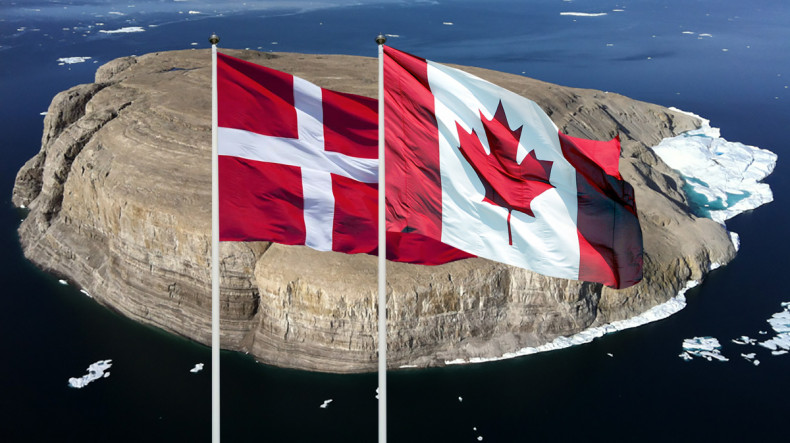
Canada and Denmark have reached a settlement in a decades-old border dispute over Hans Island, a 1.3-square-kilometre rock in the Arctic sea passage between Greenland and Ellesmere Island, The Globe and Mail reports, citing its sources.

The Inuit name for the island is Tartupaluk – describing its kidney-like shape – and under the agreement, a border will be drawn across the island, dividing it between the Canadian territory of Nunavut and the semi-autonomous Danish territory of Greenland.

The Canadians and Danes plan to unveil the settlement June 14 and celebrate it as an example of how countries can resolve border disputes peacefully even as Russia ignored the rules-based international order and launched a full-scale military assault on Ukraine, the sources say. The Globe and Mail is not identifying the sources because they were not authorized to speak publicly on the matter.

The dispute over tiny Hans Island dates back to the early 1970s when the countries were negotiating their maritime boundary; they left the status of the islet for future negotiations.

Aluki Kotierk, president of Nunavut Tunngavik Inc. (NTI), the legal representative of the Inuit of Nunavut on native treaty rights and treaty negotiation, said the dispute has never troubled the Inuit. But she nonetheless hailed the deal.

“The dispute between Canada and Denmark over Tartupaluk or Hans Island has never caused issues for Inuit. Regardless, it is great to see Canada and Denmark taking measures to resolve this boundary dispute,” Ms. Kotierk said in a statement.

“As geographic neighbours with family ties, Inuit in Nunavut and Greenland recognize the significance of working together toward our common future. NTI expects this long-standing relationship between Inuit in Nunavut and Greenland to be a symbol of continued co-operation between Canada and Denmark.”

She also noted the fundamental role that the Inuit play in cementing Canada’s authority over its Arctic territory. “Canada’s sovereignty in the Arctic is only possible because of Inuit use and occupancy,” Ms. Kotierk said.


The crew of Danish warship Vedderen carry out a flag-raising ceremony on the uninhabited Hans Island off northwestern Greenland, on Aug. 13, 2002.

The Canadian Press

Canada and Denmark have reached a settlement in a decades-old border dispute over Hans Island, a 1.3-square-kilometre rock within the Arctic sea passage between Greenland and Ellesmere Island, sources say.

The Inuit title for the island is Tartupaluk – describing its kidney-like form – and underneath the settlement, a border shall be drawn throughout the island, dividing it between the Canadian territory of Nunavut and the semi-autonomous Danish territory of Greenland.

The Canadians and Danes plan to unveil the settlement June 14 and have a good time it for example of how nations can resolve border disputes peacefully whilst Russia ignored the rules-based worldwide order and launched a full-scale army assault on Ukraine, the sources say. The Globe and Mail shouldn’t be figuring out the sources as a result of they weren’t approved to talk publicly on the matter.

The dispute over tiny Hans Island dates again to the early Seventies when the nations had been negotiating their maritime boundary; they left the standing of the islet for future negotiations.

Aluki Kotierk, president of Nunavut Tunngavik Inc. (NTI), the authorized consultant of the Inuit of Nunavut on native treaty rights and treaty negotiation, mentioned the dispute has by no means troubled the Inuit. However she nonetheless hailed the deal.

“The dispute between Canada and Denmark over Tartupaluk or Hans Island has by no means induced points for Inuit. Regardless, it’s nice to see Canada and Denmark taking measures to resolve this boundary dispute,” Ms. Kotierk mentioned in an announcement.

“As geographic neighbours with household ties, Inuit in Nunavut and Greenland acknowledge the importance of working collectively towards our widespread future. NTI expects this long-standing relationship between Inuit in Nunavut and Greenland to be an emblem of continued co-operation between Canada and Denmark.”

She additionally famous the elemental function that the Inuit play in cementing Canada’s authority over its Arctic territory. “Canada’s sovereignty within the Arctic is barely potential due to Inuit use and occupancy,” Ms. Kotierk mentioned.

Michael Byers, an Arctic skilled and political scientist at College of British Columbia, applauded information of a deal. He mentioned 2022, when Russia is violating Ukraine’s sovereign territory, is an ideal alternative for Canada and Denmark to “clear up their very own yard and ship a sign to different nations.”

Tussles over Hans Island date again many years.

Again in 1983, Canada issued a land-use allow to a Canadian petroleum firm to ascertain a scientific camp on Hans Island that may research how sea ice may have an effect on drilling rigs, Prof. Byers mentioned. In 1984, Tom Hoyemthen the Danish minister for Greenland, flew to Hans Island by helicopter and planted a Danish flag, prompting the Canadian authorities to situation a diplomatic protest, he added.

Further Danish flag vegetation – and Canadian protests – adopted in 1988, 1995, 2002, 2003 and 2004, Prof. Byers mentioned. In 2000, a crew of geologists from the Geographical Society of Canada visited the island, mapped its location and took geological samples.

In 2004, the Wall Avenue Journal quoted Peter Taksoe-Jensen, authorized adviser to the Danish international minister about how each nations maintained a way of humour all through the dispute: “When Danish army go there, they go away a bottle of schnapps. And when [Canadian] army forces come there, they go away a bottle of Canadian Membership [whisky] and an indication saying, ‘Welcome to Canada.’ ”

In 2005, then-defence minister Invoice Graham visited Hans Island to claim Canada’s declare. His journey got here shortly after Canadian army personnel visited the island and planted a Canadian flag and constructed an Inuit stone marker referred to as an inukshuk.

Mr. Hoyem, the previous Danish minister, responded by writing a column in The Globe the place he asserted that, “Hans Island has been used for hundreds of years by Greenlandic Inuit as a super vantage level to get an summary of the ice scenario and of the searching prospects, particularly for polar bears and seals. The Canadian Inuit have by no means used the island.”

Prof. Byers mentioned Canadians ought to do not forget that the Inuit in Greenland and Nunavut “are the identical individuals and they didn’t have boundaries and borders previous to Europeans arriving.”

He mentioned he thinks that the actual fact Prime Minister Justin Trudeau has not made Arctic sovereignty a part of his political model has helped create a scenario the place a deal could possibly be struck.

“It’s an excellent instance of how whenever you dial down the political temperature, you may resolve factors of friction.”

The settlement signifies that for Canadians who can afford the various 1000’s of {dollars} it will value to achieve this islet, Hans Island presents them a singular Canadian land border with Europe.

“It is possible for you to to go to Hans Island and step from Canada into Europe and again into Canada. I can’t think about there shall be any border official there,” Prof. Byers mentioned.

He mentioned the settlement to his information has no impression on surrounding maritime rights as a result of Canada and Denmark settled these issues in 1973.