The Counterculture That Sprang From San Francisco
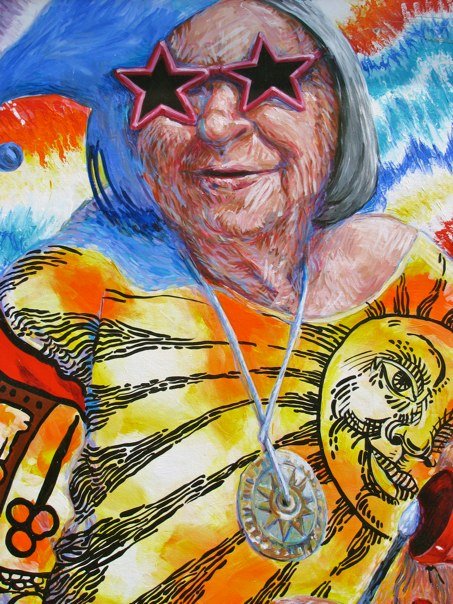
Mural, Bolinas, California. Photo: Jeffrey St. Clair.
Paul McCartney heard rumors of the wild goings-on in the Haight and visited on April 4, 1967. At the Fillmore Auditorium, he listened to a rehearsal by the Jefferson Airplane. At Marty Balin’s and Jack Casady’s apartment and along with his girlfriend at the time, Jane Asher, he played an acetate (a type of phonograph) of The Beatles’ “Sgt. Pepper’s” album, which would be released later that year. Thousands of others flocked to the Haight, once a largely Black neighborhood, for the music, the drugs, and the revolution that was promoted by the Diggers, who named themselves after 17th century English dissidents. Gerard Winstanley and his Digger comrades aimed to turn the world upside down would probably have felt at home in the Haight in 1967 when the great American counterculture was “busy being born” to borrow the words from Bob Dylan’s ballad “It’s All Right, Ma (I’m only bleeding).”
How counter was the counterculture? And if you were alive then and there how counter was your own personal culture? Not sure? You might be able to decide on your own when the Counterculture Museum opens this spring on the corner of Haight and Ashbury in the neighborhood where hippies and their friends reigned supreme for about two years in the late 1960s.
Then disaster struck. Bad drugs. Bad health. Bad cops. Paradise rarely lasts long, not for Diggers or hippies. But the melodies from that time and place have played on and on. Dozens of books have been written about that era including Charles Perry’s brilliant The Haight Ashbury that comes with an introduction by Grateful Dead member Bob Weir who says, “We weren’t all stoned all the time. But we were all artists, musicians, and freaks all the time.”
The Haight staged a comeback in the 1990s, largely because of the efforts of gay men. Today it is a vital San Francisco neighborhood with Amoeba, a gigantic record store, Gus’s, an excellent grocery, two cannabis dispensaries, a post office, a few decent cafes and restaurants, and dozens of shops and boutiques selling tie-dyed T-shirts, hoodies and sneakers. It also attracts a great many tourists who want to imbibe the magic of the hippie era, buy rolling papers, roaches, posters and R. Crumb Comic books.
Estelle and Jerry Cimino, a husband and wife team and the founders of the Counterculture Museum—they are also the founders of the Beat Museum in North Beach —plan to give as much if not more space to the anti-war and civil rights movements as they do to the “youth culture” of the Sixties that created communes, staged rock festivals, made marijuana a commodity, and went on overland journeys to India to seek gurus in ashrams.
That decision to blend the movement and the counterculture might surprise and even shock veterans and historians of the Sixties. After all, they were two separate entities from about 1967 to 1972. In those heady days, Yippies tangled with members of SDS, Abbie Hoffman battled Tom Hayden of the Red Family and Weatherwoman Bernardine Dohrn, who once called Abbie “a thorn in her side.” Abbie called her “Bernie” much to her distress. At the time, the rivalries and clashes seemed as significant as the divisions in 1917 and 1918 between the Mensheviks and the Bolsheviks or those between American anarchists and American members of the US Communist Party during the 1930s and 1940s.
In the fall of 1970— five months or so after the National Guard shot and killed four students at Kent State and police shot and killed two and injured twelve students at Jackson State—I joined a small delegation that traveled from New York to Algeria to meet with Eldridge Cleaver and Timothy Leary, both living there in exile with the pipe dream of creating a new organization that would appeal to Black Panthers, Yippies, members of SDS, as well as psychedelic warriors who belonged to the League for Spiritual Discovery.
The other members of the delegation were Marty Kenner, Brian Flannigan, Anita Hoffman, Jennifer Dohrn and Stew Albert. In the background in Algiers were Kathleen Cleaver, Eldridge’s wife, and several young Panthers who had fled the US rather than go on trial and go to jail. In the elegant Panther embassy, in-between visits from the North Korean Ambassador, the young Panthers listened to Motown, smoked dope and danced. I danced and smoked with them. I also dropped acid with Leary and watched a visiting Russian volleyball team trounced an Algerian team.
Anita Hoffman represented Abbie who was not allowed to leave the US; that was an order from Judge Julius Hoffman who presided over the Chicago Conspiracy trial. Marty Kenner represented Panther support groups, Stew Albert spoke for his pal, Jerry Rubin, Jennifer Dohrn conveyed the sentiments of her sister, Bernardine and Brian Flannigan, who had been arrested during the “Days of Rage” in October 1969, expressed the anger of the quintessential street fighting man.
I had a singular objective. Bernardine asked me to meet with Eldridge and tell him in confidence that Leary was untrustworthy, that he had blabbed to reporters and acid heads, gave away secrets about the Weather Underground, and named the names of people who helped him escape from Lompoc Prison and also aided and abetted his flight from the US.
Eldridge taped my conversation with him and held an AK-47 (a gift of the North Korean Ambassador to Algeria) in his lap the whole time we talked. He overreacted to the information I delivered and put Leary and his wife Rosemary under house arrest. The members of the delegation were confined to Eldridge’s pad, which was different from the Panther Embassy and also different from the house in the hills where Eldridge lived with Kathleen.
Don Cox, the Panther Field Marshall gave us a tour of Algiers and described the history of the Algerian liberation movement. On one occasion we enjoyed a sumptuous seafood dinner, while a couple of CIA agents kept their eyes trained on us.
One afternoon, in the pad, I wrote a press release in which I quoted Eldridge, who called for armed struggle, and Leary who wanted cosmic voyagers to travel to outer space. Not surprisingly they couldn’t agree on anything. Also, not surprisingly they both returned to the US, surrendered to the authorities and made deals that kept them from long prison terms.
That fall, I flew from Algiers to Paris, reencountered with Abbie and met pseudo French Yippies —pseudo because they were living at home with their parents. I also roamed the Left Bank with Jean-Jacques Lebel, a French Beat, a translator, and a surrealist. We looked for trouble that never arrived. The young French Yippies seemed to have the best of two worlds. They defied older generations, rioted in the streets and came home to eat their mothers’ gourmet cooking.
My favorite person from that time was Bernadette Devlin, the Irish revolutionary who was fond of saying of the British, “kick them when they’re down.” Nasty but oh so satisfying.
At home in New York I wrote an account of Leary and Cleaver in Algeria. Paul Krassner published it in The Realist under the title, “Eldridge & Tim, Kathleen & Rosemary” and with an illustration that depicted the two couples in bed together in a spoof of the movie, Bob & Carol & Ted & Alice that capitalized on and reflected some of the sexual politics of that era.
I don’t expect the Counterculture Museum to offer exhibits that will highlight the fiasco in Algeria or the odd position of the French Yippies who were both in and out of the global counterculture. The Ciminos emphasize unity not disunity, hope not despair, creativity not self-destruction and positive gains not loses. That’s surely the best tact to take especially since they want to attract visitors and inspire them.
The counterculture that sprang up in the Haight Ashbury is worth remembering and celebrating, especially because the Ciminos will connect it to the movements of the past and political causes of today.
Estelle describes the museum as though it’s a beloved child. “The Counterculture Museum will celebrate the vibrant legacy of Haight-Ashbury by preserving art, activism, and creative expression that once defined the neighborhood. Far from being a relic of the past, counterculture continues to shape music, fashion, social movements and the spirit of independent thinking,” she says.
Estelle adds, “By bringing history to life through exhibitions, events, movies and storytelling, the museum hopes to strengthen the community, enrich the cultural fabric of Haight-Ashbury, and support local merchants by drawing visitors eager to experience the authentic, enduring impact of the counterculture movements.”
It’s worth remembering because as far as I can see there are few if any genuine countercultures today in the US. Journalists and reporters who write about them seem to assume that they’re dead and buried.
In a recent article published in The New Yorker about the documentary filmmakers, Albert and David Maysles, and editor and director, Charlotte Zwerin, journalist Michael Schulman notes that the Rolling Stones concert at Altamont Speedway in December 1969 marked “a death knell for the counterculture.” Indeed, it seemed to be the flip side of Woodstock. Ever since then cultural critics have held funerals and burials for the counterculture though in the 1970s the counterculture spread from New York’s Lower East side and San Francisco’s Haight Ashbury to the countryside where it put down rural roots.
In the late 1960s and early 1970s in the aftermath of the bloodbaths at Kent and Jackson state I wrote two contradictory pieces about the counterculture: one of them titled “Children of Imperialism” which largely denounced youth culture and the other “New Morning which was issued as a communiqué by the Weather Underground and that herald the arrival of youth culture. Some Black Panthers described it as a betrayal of Third World Liberation struggles.
At that time I thought that the Weather Underground needed a base and a constituency; hippies seemed the only potential allies around, especially since the organization had given up on the white working class. But I could also see that hippies and freaks had adopted some of the racist notions of their parents. They idealized American Indians and Third World peasants and saw themselves as active consumers buying and selling drugs, music, and even rebellion which was framed as a commodity.
Perhaps the Counterculture Museum will convert millennials and members of Generation Z to the cause of rebellion and resistance today but it will be an uphill battle. “We seem to be going backward,” Estelle says, thinking of Trump and company. But she and Jerry Cimino are not giving up their culture war
“It’s important to educate young people about the past so they understand that positive change can happen today just like it did in the 1960s and 1970s,” she says. Jerry adds that the counterculture of the 1960s happened because “the boomers reached critical mass and because their coming coincided with the arrival of global electronic mass media.” Today technology seems more reactionary than ever before, especially when it’s in the hands of autocrats like Elon Musk and his minions.
If the Ciminos wanted help with their museum they could do no better than turn to Stannous Flouride who has lived in the Haight for 43 years and who gives popular walking tours in the neighborhood wearing a black leather jacket and an ancient button that screams “Yippie!” “City Hall hated the hippies,” Flouride says. “Mayor Joe Alioto wanted to destroy them, so he canceled services to the neighborhood, like garbage removal, which prompted the Diggers to organize a ‘clean-in.’ The Diggers fed thousands of kids and provided the spiritual and political backbone for the hippies.”
If Flouride were creating a counterculture museum he says he’d feature the Diggers, The Panthers, jazz, rock, the January 1967 “Human Be-in” and the “Summer of Love.” He adds “there is really no counterculture here as there was in the Sixties.” He adds, “The only remaining counterculture is hip hop which appeals to both young whites and young Blacks.”
If I wanted to revive a slogan from the Sixties and put it back in circulation it might be, “The spirit of the people is greater than the Man’s technology.” It was greater in Vietnam and it can be greater around the world again. Get off your phones and your laptops. Go into the streets and make as much noise as you can.
If the Counterculture Museum succeeds it will send visitors into the streets of the Haight and beyond. It will turn into its opposite, not a museum with artifacts but a cradle of resistance and rebellion with ideas and tools for insurrections. After all, museums are usually repositories of the past, and as such they are innately conservative and rarely innovative. It’s time to bring about a cultural revolution in the world of the counterculture.