Monday, March 03, 2025

Iran’s early recordings revive forgotten sound heritage

By AFP


Visitors try out an installation at the SoundScapes exhibition that brings together early sound recordings from Iranian history - Copyright AFP ATTA KENARE


Menna Zaki and Ramin Khanizadeh

In a century-old building in Tehran, Saeed Anvarinejad turned the dial of a vintage radio to tune into some of Iran’s earliest recorded sounds, some serving as reminders of the seismic changes that shaped the country’s history.

Along with a team of fellow enthusiasts, he spent months tracking down the earliest recordings of Iranian music, speeches, interviews, theatrical plays, radio broadcasts and even the hum of daily life from more than a century ago up to the present day.

“Sound is a phenomenon we pay little attention to… although it’s very important,” said Anvarinejad, one of the organisers of the “SoundScape” exhibition.

And “the era of early sound recording in Iran is a very important time in the socio-political history of the country”.

He highlighted the emotional power of early voice recordings, saying they captured “in a very raw and pure way… the feeling that people have at that moment,” unlike written records.

According to Anvarinejad, the oldest surviving sound recordings from Iran date back to 1898 and 1899, during the reign of Mozaffar al-Din Shah of the Qajar dynasty, which reigned over the country from the late 18th to the early 20th century.

His rule saw the unfolding of the Constitutional Revolution, a pivotal moment in Iran’s political transformation that established a parliament and constitutional monarchy.

“It was a time when… a new order was taking shape in the Iranian mind and very important things were happening politically, socially and culturally,” he added.

“We thought it would be good to have a new approach to the sound (from that time) and engage audiences with it.”

Upon tuning the wooden-framed antique radio, a chilling broadcast announced the overthrow of prime minister Mohammad Mosaddegh in 1953, who had pushed for the nationalisation of Iran’s oil industry sparking a coup d’etat orchestrated by the United States and Britain.

“This is Tehran! Good news! Good news! People of the cities of Iran, be awake and alert, the traitor Mosaddegh has fled!” crackled the voice of a radio anchor.


– ‘Mysterious void’ –


Other audio included Iran’s first recorded call to prayer in either 1912 or 1913, and the 1959 report on the death of Qamar, the first woman singer to perform in public in the country.

One striking installation at the exhibition involved a mechanical device mounted on a concrete wall with gears, chains, wheels and a lever which played old recordings of the stringed tar instrument through retro telephone handsets.

Another, “Mowj Negar”, featured printed sound waves arranged in three rows on one wall, with a metal device which moved along the waves.

When moved, the device activates melodies from the Qajar and early Pahlavi (1925-1979) eras that once echoed through Iran’s grand palaces and bustling city streets.

Nearby stood a wooden cabinet named “The Silent Closet”, displaying a series of photos from the First World War -— but without a single accompanying sound.

“There are no sound recordings from Iran during this period, not because technology was unavailable, but likely because the country was in such turmoil that recording sound was not a priority,” said Atabak Axon, another exhibition organiser.

“There was a 12-year silence that remains a mysterious void in Iran’s auditory history.”

For centuries, sound has played a central role in Persian culture, connecting belief with poetry and identity.

For 21-year-old Sarvin Faizian, visiting the exhibition with friends was a deeply moving experience “as if I was experiencing my parents’ past.”

Similarly, Fatemeh Sadeghi described feeling overwhelmed by nostalgia, while 63-year-old Kamran Asadi found the exhibition unexpectedly personal.

“It is a very good and intimate atmosphere for me,” he said, lingering on an old song playing in the background.

“It is good for the younger generation to learn where Iran’s heritage of music and art came from.”


Razzies 2025: The anti-Oscars name Worst Picture of the year - 'Madame Web' 'honoured'

And the 2025 Razzie winners are...
Copyright Sony Pictures - Lionsgate Films - Warner Bros
By David Mouriquand
Published on 

Love them or loathe them, the Razzies have 'honoured' some the right films for the worst films of the year. Here's the lowdown.

Every year, it’s the same dance.

The best of the best will be celebrated with the Oscars this weekend. But for every action, there’s an equal reaction. The cosmic scales must be balanced. Enter: The Razzies, the anti-Oscars, celebrating the worst films of the year.

And love them or loathe them, it's hard to argue with their award picks this year.

Topping this year’s Razzies with three wins, including Worst Picture, is the Spider-Man spin-off movie Madame Web. On top of the ‘top’ gong, the film won Worst Actress for Dakota Johnson, as well as Worst Screenplay.

While punching down is never a good look, it’s hard to argue, as Madame Web is cinematic herpes. And Johnson knows it. She previously went on the record to share with the publication Bustle that she was unlikely to “do anything like it again.”

Worst actor went to Jerry Seinfeld for his work in the Netflix movie, Unfrosted, which he also directed and co-wrote; the dire Joker: Folie à Deux nabbed Worst Sequel and Worst Screen Combo for Joaquin Phoenix and Lady Gaga; while Francis Ford Coppola rightly won Worst Director for his Cannes-premiering epic farce Megalopolis.

Fair play to the director: he accepted his Razzie award, celebrating his “honour” on Instagram.

“I am thrilled to accept the Razzie award in so many important categories for Megalopolis, and for the distinctive honor of being nominated as the worst director, worst screenplay, and worst picture at a time when so few have the courage to go against the prevailing trends of contemporary moviemaking!” he wrote.

Coppola continued: “In this wreck of a world today, where ART is given scores as if it were professional wrestling, I chose to NOT follow the gutless rules laid down by an industry so terrified of risk that despite the enormous pool of young talent at its disposal, may not create pictures that will be relevant and alive 50 years from now.”

“My sincere thanks to all my brilliant colleagues who joined me to make our work of art, MEGALOPOLIS, and let us remind ourselves us that box-office is only about money, and like war, stupidity and politics has no true place in our future,” he concluded.

Fair play, sir. You’re a good sport.

Your film, on the other hand, remains an absolute train crash. Read our full review here.

It's not all bad new though. Pamela Anderson nabbed the Razzie Redeemer award, given to a former Razzie winner who has turned their career around. Anderson was named worst new star for Barb Wire in 1996, but she received critical acclaim and award recognition for her work in The Last Showgirl.

Here is the full list of this year’s Razzie ‘winners’:

Worst Picture

  • Borderlands
  • Joker: Folie à Deux
  • Madame Web (WINNER)
  • Megalopolis
  • Reagan

Worst Actor 

  • Jack Black - Dear Santa
  • Zachary Levi - Harold and the Purple Crayon
  • Joaquin Phoenix - Joker: Folie à Deux
  • Dennis Quaid - Reagan
  • Jerry Seinfeld - Unfrosted (WINNER)

Worst Actress 

  • Cate Blanchett - Borderlands
  • Lady Gaga - Joker: Folie à Deux
  • Bryce Dallas Howard - Argylle
  • Dakota Johnson - Madame Web (WINNER)
  • Jennifer Lopez - Atlas

Worst Supporting Actor 

  • Jack Black (Voice Only) - Borderlands
  • Kevin Hart - Borderlands
  • Shia LaBeouf (in drag) - Megalopolis
  • Tahar Rahim - Madame Web
  • Jon Voight - Megalopolis, Reagan, Shadow Land & Strangers (WINNER)

Worst Supporting Actress 

  • Ariana DeBose - Argylle & Kraven the Hunter
  • Leslie Anne Down (as Margaret Thatcher) - Reagan
  • Emma Roberts - Madame Web
  • Amy Schumer - Unfrosted (WINNER)
  • FKA twigs - The Crow

Worst Director 

  • S.J. Clarkson - Madame Web
  • Francis Ford Coppola - Megalopolis (WINNER)
  • Todd Phillips - Joker: Folie à Deux
  • Eli Roth - Borderlands
  • Jerry Seinfeld - Unfrosted

Worst Screen Combo 

  • Any Two Obnoxious Characters (But Especially Jack Black) - Borderlands
  • Any Two Unfunny “Comedic Actors” - Unfrosted
  • The Entire Cast of Megalopolis - Megalopolis
  • Joaquin Phoenix & Lady Gaga - Joker: Folie à Deux (WINNER)
  • Dennis Quaid & Penelope Ann Miller (as “Ronnie and Nancy”) - Reagan

Worst Prequel, Remake, Rip-Off or Sequel 

  • The Crow
  • Joker: Folie à Deux (WINNER)
  • Kraven the Hunter
  • Mufasa: The Lion King
  • Rebel Moon 2: The Scargiver

Worst Screenplay 

  • Joker: Folie à Deux
  • Kraven the Hunter
  • Madame Web (WINNER)
  • Megalopolis
  • Reagan


 KING OF CANADA

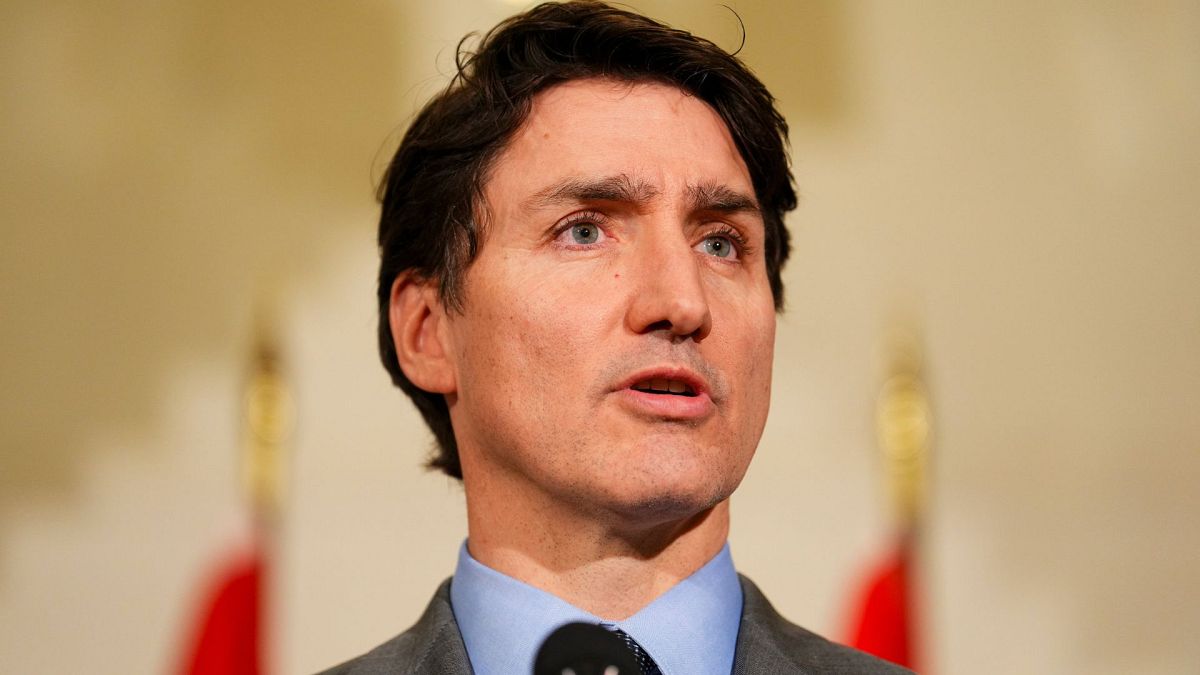
Trudeau to discuss Trump’s annexation threats with King Charles

Canada Prime Minister Justin Trudeau holds a press conference at Canada House in London, 2 March 2025.
Copyright Sean Kilpatrick/The Canadian Press via AP
By Oman Al Yahyai with AP
Published on 

The British monarch, who is Canada's head of state, has been criticised for his silence on the issue.

Canadian Prime Minister Justin Trudeau is expected to bring up US President Donald Trump’s recent threats to annex Canada when he meets King Charles III on Monday.

Their meeting comes after some Canadians criticised the British monarch, who is Canada's head of state, for failing to publicly respond to Trump's comments.

Speaking in London on Sunday, Trudeau said the pair would discuss topics that Canadians deem important.

“Nothing seems more important to Canadians right now than standing up for our sovereignty and our independence as a nation,” he said.

Former Alberta Premier Jason Kenney defended the king over his public silence, noting that the monarch acts solely on the advice of Canada’s prime minister.

“The government of Canada should ask the head of state to underscore Canadian sovereignty,” he wrote on X.

Meanwhile, constitutional lawyer Lyle Skinner expressed his hope that Monday's discussion would lead to "the king making a statement regarding his Canadian realm".

However, experts remain divided on whether Trudeau will formally ask Charles to make a public statement. 

Daniel Béland, a political scientist at McGill University, warned that it was a "highly delicate diplomatic matter".

Not only could Trump be angered but a mistake could also "hurt the image and political legitimacy of the monarchy", he added.

Béland suggested that Trudeau should speak with UK Prime Minister Keir Starmer first about Trump’s threats to make Canada the US' 51st state. 

Some have questioned the king's role in Canada as a result of the issue.

“Canadians will need to decide what purpose King Charles III serves as King of Canada if he can’t even speak up for our sovereignty," former Canadian public servant Artur Wilczynski said.

Abolishing the monarchy would require a constitutional amendment, a process fraught with challenges.


Moscow has created a database to track anti-war Russians, court case reveals

Moscow has created a database to track anti-war Russians, court case reveals
The database reportedly includes profiles of Russians who have participated in anti-war protests, shared critical opinions on social media, or otherwise opposed what the Kremlin refers to as its "special military operation" in Ukraine. / bne IntelliNews


By bne IntelliNews March 3, 2025

Russia has confirmed the existence of a database tracking citizens who have expressed opposition to the war in Ukraine, raising concerns over intensified state surveillance and repression.

According to Radio Free Europe/Radio Liberty (RFE/RL), the revelation emerged during a court case in Tatarstan involving activist Andrey Bogdanov, who was convicted of "repeatedly discrediting" the Russian army and attempting to set fire to a military enlistment office. Case documents revealed that officers from the Centre for Combating Extremism (Centre "E") identified and prosecuted Bogdanov using a specialised database of individuals with anti-war views.

The database reportedly includes profiles of Russians who have participated in anti-war protests, shared critical opinions on social media, or otherwise opposed what the Kremlin refers to as its "special military operation" in Ukraine. Bogdanov, previously fined twice in 2022 for protesting against the war, was sentenced to four and a half years in prison.

While unofficial watchlists and state monitoring of opposition figures have long been suspected, this case marks one of the first instances where law enforcement has explicitly referenced such a database in legal proceedings. Authorities claim the database merely records individuals who have been convicted of offences.

Since the start of the full-scale invasion of Ukraine, Russia has intensified its crackdown on anti-war activism. The human rights organisation OVD-Info estimates that more than 20,000 people have been detained for anti-war actions, while 1,190 criminal cases have been launched against anti-war dissidents. Although large-scale protests have become rare due to severe legal consequences, authorities continue to target individuals expressing dissent online. The database appears to be a key instrument in this broader effort to stifle opposition.


COMMENT: The multipolar world has no place for US-Russia imperialism

COMMENT: The multipolar world has no place for US-Russia imperialism
As Washington threatens allies and Moscow plays false champion to the Global South, the EU faces a stark choice – forge a new multipolar alliance or be crushed between two naked emperors. / bne IntelliNews


By Marco Cacciati March 2, 2025

If anything, the disgraceful ambush that US President Donald Trump and Vice President JD Vance staged for Ukrainian President Volodymyr Zelensky in the Oval Office was a candid admission of guilt. It serves as a wake-up call the world must heed without further delay.

For those still harbouring doubts, the US has finally revealed itself as a fully-fledged imperialist power, whose aggressiveness and disdain for the rules-based global order mirror that of its Cold War counterpart: Russia.

It comes as little surprise that Trump's America and Russia find common ground: a "strong man" mentality, disregard for human rights and minorities, dominant right-wing conspiratorial narratives, contempt for rules-based order, and eagerness to interfere in other countries' political affairs.

"The interventions from Washington were no less dramatic and drastic and ultimately outrageous than the interventions we have seen from Moscow," recently said Germany’s likely next chancellor Friedrich Merz, after tech billionaire and Trump aide Elon Musk threw his weight behind the far-right and pro-Russia party Alternative für Deutschland (AfD), which polled at over 20% during the February 23 election.

Between hammer and anvil

Caught in the crossfire, alongside war-battered Ukraine, is Europe. Despite the "big, beautiful ocean" separating the new and old worlds, as Trump puts it, dismantling eight decades of close trade and security cooperation will be no easy feat, but the new US administration seems committed to speeding up the process.

To the east, Europe borders directly with Russia, a devious and increasingly belligerent autocracy whose revanchist imperial ambitions have long been evident.

Meanwhile, in light of recent developments, to the west the situation is equally concerning. Not only is the US no longer interested in the special partnership that followed the second world war, but it is now openly hostile to the European project. "The EU was formed to screw the US," Trump recently remarked. We should have learnt by now that the president and his exceptionally loyal cabinet – chosen for their unwavering devotion to the MAGA cause rather than merit – walks the talk. In his second term, it has become abundantly clear: traditional friends and allies mean nothing.

"The defence of Europe is not our problem; been there, done that, twice," said Defence Secretary Pete Hegseth in his 2020 book "American Crusade", adding: "Nato is a relic and should be scrapped and remade in order for freedom to be truly defended." The Pentagon chief's words should send chills down the spine of European leaders, as Washington's priorities shift from alliance defence to potentially unilateral offensive actions.

In this regard, Trump's threats to invade Panama and Greenland should not be taken lightly; his conception of territorial integrity differs little from that of Russian President Vladimir Putin.

The Washington-Moscow axis emerges

Now working in tandem behind the scenes, Washington and Moscow appear to be conspiring to resurrect the bipolar world that underpinned the Cold War, with scant regard for everything in between.

Unlike in 1945, however, they face two significant obstacles: the EU, a united, successful – for all its faults – and highly institutionalised bloc of countries, and China, the world's second-largest economic superpower.

In a recent interview with Breitbart, Secretary of State Marco Rubio – a "neocon" diplomat and one of the few figures in the Trump administration not considered a MAGA stooge – outlined US plans for Beijing, which he suggests need to be separated from Moscow by pulling a "reverse Nixon".

"The better outcome for both the Russians and the Americans is that the Russians are not purely dependent on China as a junior partner," Rubio said, indicating that the Moscow-Beijing "no-limits" relationship – where limits do, in fact, exist – represents the primary obstacle hindering Russia from improving relations with the US.

The bottom line: screw Ukraine and Europe whilst pursuing closer relations with Moscow, where besides ideological affinities there is money to be made – as emerged during the Riyadh talks.

Europe's path forward: From whining to winning

This means it is high time for Brussels – and London – to stop whining and pull together, learning the tricks of their former partner-turned-adversary.

The EU should deftly mirror Washington's moves, aiming to decouple China from Russia by convincing Beijing that their trade relationship with Europe is substantially more valuable than Russia's and, if not already evident, that Washington will employ any means necessary to impede their growth.

In fact, China's trade with the European Union far outweighs its economic exchanges with Russia. In 2024, bilateral trade between China and the EU reached $762bn, more than three times the estimated $220bn to $240bn in trade between China and Russia. While Moscow and Beijing have deepened economic cooperation, particularly in energy and infrastructure, the scale of trade with the EU underscores the bloc's central role in China's external commerce.

Some may raise human rights and democracy concerns when dealing with emerging powers, but we should not delude ourselves: these will be disregarded under Trump regardless. The US is rapidly dismantling international support mechanisms – and key soft power instruments – such as USAID, which has provided vital aid to developing countries for over 60 years.

Domestically, the Trump administration is testing the limits of presidential power and rolling back diversity programmes, pursuing an anti-LGBT+ agenda, banning transgender individuals from military service and potentially introducing a federal ban on abortions, among other measures.

The EU can no longer position human rights as a precondition for trade – and potentially security – agreements. It must adapt to the new reality by dropping tariffs on China and promoting additional trade agreements under WTO rules with the Global South. The EU-Mercosur deal, finalised in December though still awaiting ratification in Brussels, and Foreign Affairs Representative Kaja Kallas’ recent outreach to Latin America could serve as a blueprint.

"Come on. You cannot have a trade war with China and Europe at the same time," French President Emmanuel Macron told Trump during a recent meeting at the White House. Likewise, Europe cannot afford to fight simultaneous trade wars against both the US and China, while keeping Russia sanctioned for its full-scale invasion of Ukraine.

But more substantial action is required. From its humbled position of “demoted empire,” the EU should convince the wider Global South that it is on their side, while Russia is not. Despite its rhetoric, Moscow does not stand for multipolarity, but is conspiring with the US to return to a Cold War power balance, plotting to carve up the world into spheres of influence. And for all its propaganda efforts, Russia – unlike China – has contributed negligibly to development in the Global South.

Meanwhile, there is little need to underline how the US will not act in favour of the developing world. With USAID gone and Washington's increasing isolationism, no help will come from America – which, in any case, has long played second fiddle to Beijing in global development.

Apart from Ukraine, some suggest that even Iran, post-Assad Syria and perhaps Gaza could be swapped between Russia and the US – in close alignment with Israel – in a geopolitical trade-off. A troubling hypocrisy from Washington, with its self-appointed role of "policeman of democracy," and equally damaging for Moscow's carefully cultivated image as a champion of the Global South and defender of Palestinians' rights.

Reshaping BRICS for a truly multipolar future

All the more, the EU should endeavour to lobby developing countries to expel Russia from BRICS – a formidable, burgeoning trading bloc where Moscow, under its current leadership, has no rightful place given Putin's imperialistic impulses – and assume its position. Let us transform BRICS into BEICS and allow the two malign empires to wallow in their own mire.

Trump will govern for perhaps four years and hopefully be replaced eventually, but the EU must play the long game. Trump 2.0 shows why the US can no longer be relied upon and rings the death knell for Atlanticism. Yet it could serve as a powerful catalyst for the formation of a new multipolar world based on the respect for nations’ territorial integrity and rules-based order.

Today, the US remains the world's most powerful nation, while Russia maintains significant nuclear capabilities and mighty military force. Still, if the rest of the world can overcome differences and unite for the common good, this unbridled duo could be subdued and restrained through established intergovernmental organisations such as the UN, the WTO and, perhaps, a revamped BEICS (without the cumbersome R).

Marco Cacciati is the regional editor for Latin America at bne Intellinews.


Zelensky: Victim of Colosseum Politics


There was a revolting tabloid quality to the Oval Office reception given to Ukrainian President Volodymyr Zelensky on February 28, but then again, President Donald Trump is a tabloid brute, a man incarnated from the nastiest, shallowest precepts of yellow press clippings and, ultimately, the reality television empire that gave him a crown and forever enshrined him in the culture of brash Americana.  From the foamy cable television rot of the republic, Trump’s progress was inexorable.

With such ingredients, the White House has become a studio, with the statesmanship of the bullying show paramount.  The electors are to be entertained by what might be called colosseum politics.  They want bread, but are very keen on the circuses.  They want season tickets to the MAGA tent where they can witness muscular events.  They want to know that the US will recoup what it gives, with interest.

When the satirically gifted Hugh Hector Munro (“Saki”) warned that being a pioneer was never wise, seeing as the Early Christian tended to get the fattest lion, it would be better to say that the lions here – Trump and his shock troop deputy J.D. Vance – seemed to have been on lettuce offerings and stale water for a week.  The lean, mean duo were remorselessly and disgracefully hungry, making sure the Ukrainian leader was subject to a battering that proved unusually long.  (These Oval office briefings before the press are usually short, snappy matters: a few anodyne questions; a few general remarks that barely ripple.)

It was also evident that Zelensky had not gotten the brief about Trump, prompting Marek Magierowski in the National Interest to describe him as “a worse psychologist than [French President] Emmanuel Macron and [UK Prime Minister Keir Starmer], who had paid a visit to the White House just before him and, to some extent, ‘charmed’ the US president.”

Unlike the two leaders who had come before him, Zelensky thought it wise to engage in a squabble about Russian intentions and the character of Russia’s Vladimir Putin, the factual record (always dangerous in dealing with Trump, who regards facts as, as best, malleable), a duel that saw shock trooper Vance weigh in.  According to the Veep, Zelensky was not there to “litigate” the matter before the American public, which is precisely what he and Trump seemed to be doing.  This was the language of prefects and school masters, with the student reluctant to play along.

It was a salient reminder that support for Ukraine has iced over, that it is no longer the blue-eyed boy of US politics, Western civilisation’s consecrated prop against Russian savagery.  Republican Senator from South Carolina Lindsey Graham even went so far as to demand that the Ukrainian leader “either … resign and send somebody over and we can do business with, or he needs to change.”

Trump’s opponents have fumed at the president for having laid an ambush for the Ukrainian leader and promoting Russian talking points, naturally exonerating previous administrations for their contributory role (former Assistant Secretary of State Victoria Nuland’s intervention comes to mind) in feeding the conflict.  “Zelenskyy flew to Washington,” quipped Massachusetts Democrat Rep. Jake Auchincloss, “but he walked into the Kremlin.”

What remains crudely apparent is that Zelensky had been given ample warning about what awaited but seemingly failed to see the billowing smoke signals.  At a Saudi-sponsored investment meeting in Florida, Trump had declared that the Ukrainian leader was only “really good” at one thing: “playing Joe Biden like a fiddle.”  He was also a “dictator” who had refused to have elections.  “He’s low in the Ukrainian polls.  How can you be high with every city being demolished?”

Zelensky had also done little for his own cause last year by injudiciously involving himself in the US elections, speaking at a Kamala Harris campaign rally and paying a visit to a munitions plant in Scranton, Pennsylvania last September.  “It is in places like this where you can truly feel that the democratic world can prevail,” Zelensky stated at the time.

That the visit was also conveniently located in a battleground state that the presidential contenders had to win hardly helped his case in the Oval Office skirmish.  Vance could not resist unsheathing his sword.  “You went to Pennsylvania and campaigned for the opposition in October,” he snapped.  “Offer some words of appreciation for the United States of America and the president who is trying to save your country.”

As a result of colosseum politics, no deals were reached, and certainly not one regarding US access to Ukrainian rare earth minerals, leaving Zelensky to seek solace in the bosom of weak European powers unhinged by the values of Trumpland.  The lustre of the cause, at least across the pond, has not entirely vanished, though European support is hardly likely to swing matters on or off the battlefield for Kyiv.

Binoy Kampmark was a Commonwealth Scholar at Selwyn College, Cambridge. He lectures at RMIT University, Melbourne. Email: bkampmark@gmail.comRead other articles by Binoy.


Breaking news. Trump pauses US military aid to Ukraine following disastrous Oval meeting

Trump pauses US military aid to Ukraine following disastrous Oval meeting
Copyright 
By Abby Chitty with AP
Published on 

A White House official said Trump wants President Zelenskyy to commit to reaching a peace deal with Russia.

President Donald Trump has directed a “pause” to US military assistance to Ukraine after a disastrous Oval Office meeting as Trump seeks to pressure Ukrainian President Volodymyr Zelenskyy to engage in peace talks with Russia.

A White House official said Trump is focused on reaching a peace deal to end the more than three-year war sparked by Russia's all-out invasion of Ukraine, and wants Zelenskyy “committed” to that goal.

The official added that the US was “pausing and reviewing” its aid to "ensure that it is contributing to a solution.”

The pause is not believed to be a permanent end of US assistance.

Trump in the leadup to his 2024 election win vowed to quickly end the war in Ukraine. He's expressed increasing frustration with Zelenskyy over the war, while simultaneously expressing confidence that Russian President Vladimir Putin can be trusted to keep the peace if a truce in the conflict is reached.

Trump earlier on Monday slammed Zelenskyy for suggesting that the end of Russia's war against Ukraine likely "is still very, very far away".

The comments come as prominent Trump allies escalate pressure on Zelenskyy to dramatically change his approach to the US president, who has made quickly ending the war a top priority, or step aside.

The relationship between Trump and Zelenskyy has been strained following a contentious meeting at the White House, where Trump and Vice President JD Vance chastised Zelenskyy for not being sufficiently appreciative of US support for Ukraine.

In his upcoming speech before Congress, Trump is set to discuss the future of a US-Ukraine agreement involving rare earth minerals, which has now been thrown into doubt.

While he had previously refused to sign the deal with Ukraine, citing a lack of appreciation from President Zelenskyy, Trump has, however, continued to describe the deal as "great." He is expected to reveal further details during his address on Tuesday.

US Secretary of State Marco Rubio has also assured British officials that the US is committed to negotiating an end to the Russia-Ukraine conflict, expressing gratitude for the UK’s efforts to encourage Europe to bolster its defence in a phone call with British Foreign Secretary David Lammy.


Latin American leaders blast Trump-Zelensky diplomatic fallout

Latin American leaders blast Trump-Zelensky diplomatic fallout
"This is a betrayal of Zelensky over gas. The wars of the 21st century are the wars of the fossil economy,” said Colombian President Gustavo Petro. / bne IntelliNews=
By bne IntelliNews March 3, 2025

The diplomatic rift between the United States and Ukraine has drawn sharp criticism from Latin American leaders, with Brazilian President Luiz Inácio Lula da Silva and his Colombian counterpart, Gustavo Petro, offering pointed remarks on the tense Oval Office meeting where Ukrainian President Volodymyr Zelensky clashed with US President Donald Trump.

"Since the creation of diplomacy, we have not seen a scene as grotesque, as disrespectful as the one that occurred in the Oval Office of the White House," Lula stated while in Montevideo to attend the inauguration of Uruguayan President Yamandu Orsi.

The Brazilian leader went further, suggesting a deep personal slight. "You can't talk about democracy if there is no respect for other human beings. I think that Zelensky was humiliated. I think that in Trump's mind, Zelensky deserved that," Lula told assembled journalists.

Echoing a different but equally critical perspective, Colombian President Petro framed the situation as a fundamental betrayal of Ukraine's geopolitical strategy. "Zelensky proposed a war with Western weapons, and now he is betrayed and left without weapons before Russia, which uses its own," he wrote on X.

"This is a betrayal of Zelensky over gas. The wars of the 21st century are the wars of the fossil economy.”

The Colombian president, who recently slammed the proposed US-Ukraine minerals deal as “stupidity” and claimed that Russians and Ukrainians are "slavic brothers," also offered what he sees as a potential resolution. "At this point, Zelenskyy should change his policy," Petro suggested, advocating for direct dialogue with Moscow.

He called for Zelensky to "talk to (Russian President Vladimir) Putin without intermediaries and make peace and a great Slavic political and economic agreement open to the world."

Lula, in line with his long-standing calls for a diplomatic resolution, pointed out that "only peace can bring the world back to normality and can make us live in prosperity again."

Last month, Lula ruled out sending troops to Ukraine but said Brazil would support a peacekeeping mission following a ceasefire.

He added that resolving the war would require direct talks between Moscow and Kyiv, while stressing the EU's crucial role. "The Ukraine problem will be resolved at the negotiating table. Trump's role in wanting to negotiate without listening to the European Union is bad, very bad," Lula said.

The statements come against a backdrop of growing uncertainty in the international arena. Trump's reported moves towards negotiating directly with Russia have caught Kyiv and EU governments off guard, with European leaders hastily convening in London over the weekend to reaffirm their unwavering support for Ukraine.