Monday, March 03, 2025

The Trump-Putin Axis and Its Impact on Global Politics


 March 3, 2025
Facebook

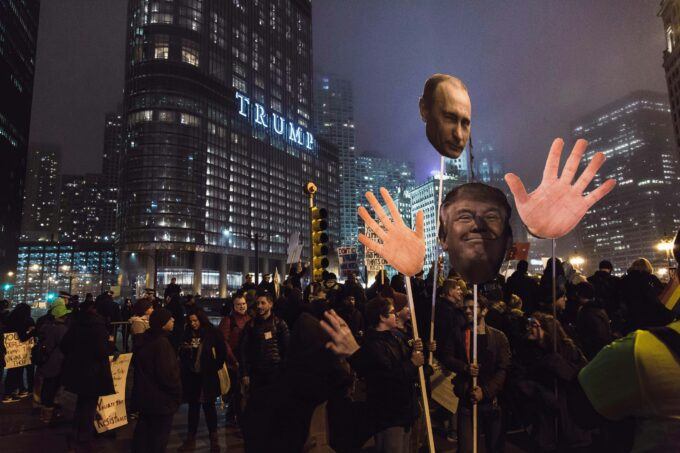
Image by Jon Tyson.

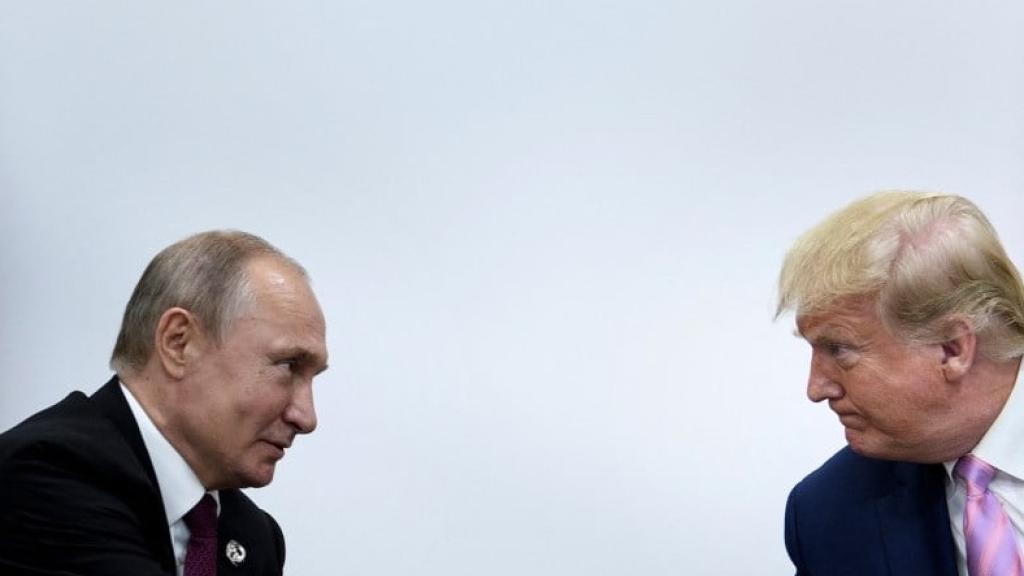
Donald Trump’s forging of a political alliance with Russia’s Vladimir Putin at the expense of Ukraine’s struggle for self-determination may not be totally unexpected, but its speed and extent represent a dramatic transformation of world politics.

Nothing more sharply—and crudely—signals this transformation than Trump and J.D. Vance’s public browbeating of Ukrainian President Volodymyr Zelensky on February 28 at what was supposed to be a brief session to take questions from the press prior to a private meeting to discuss conditions for ending the war. In a breathtaking display of imperial arrogance, Trump and Vance turned the session into a shouting match as they insulted and threatened Zelensky for stating the obvious—that Putin cannot be trusted, and that any peace deal requires security guarantees for Ukraine. Trump then cancelled further talks with Zelensky and ordered him to immediately leave the country. This brazen take-down and humiliation of a democratically elected head of state for not totally submitting to U.S. dictates is unprecedented. It is as ominous as Trump’s inauguration five weeks earlier.  Ukraine will be left to feel the full wrath of Putin’s murderous war machine just as Palestine is being left to face Netanyahu’s fascistic effort to annihilate its very existence.

This is hardly the first time a major imperialist power has suddenly forged an alliance with a longstanding adversary. One can recall war criminal Richard Nixon’s sudden opening to China in the early 1970s, which led to a rapprochement that ended up extending the Vietnam War by several years (Mao reduced aid to North Vietnam to curry favor with the U.S. and Nixon used his entente with him to demand greater concessions from Hanoi). But an even more striking antecedent is the Hitler-Stalin Pact of 1939. This may sound like an exaggeration—after all, the alliance between fascist Germany and Stalinist Russia gave the green light to World War II, and no one is suggesting a third world war is imminent-—although the risks of it are ever-present. Nonetheless, the 1939 Pact is worth recalling since it produced a shift in world politics that had crucial ideological ramifications, as many leftists supported it in the name of opposing Western imperialism while others denounced it as a betrayal of the principles of socialism. Today’s U.S.-Putin alliance likewise has profound ideological ramifications, as seen in how leftists opposed to Ukraine’s struggle for self-determination now find their position being shared by MAGA Republicans, while others on the Left are searching for revolutionary new beginnings opposed to all forms of occupation and colonialism, from Gaza to Ukraine.

The Betrayal of Ukraine

The Trump-Putin alliance was forged with the convening of direct talks on February 18 between representatives of U.S. and Russian imperialism in Saudi Arabia, a meeting that excluded both the Ukrainians and the U.S.’s European allies, some of whom were not even informed of it beforehand. These were not negotiations: Trump simply adopted virtually all of the Kremlin’s talking points without so much as suggesting a single concession from Putin. The Russian delegates could hardly conceal their shock and glee at what Trump gave away at zero cost to themselves.

On February 24, following the talks in Saudi Arabia, the Trump administration voted against a Resolution of the UN General Assembly condemning Russia’s 2022 invasion of Ukraine—the first time it did so, joining Russia, China, Belarus, North Korea, and Israel, as well as 12 other Moscow-friendly countries (93 other countries voted yes, 65 abstained). Brandishing the lie that Ukraine, not Russia, started the war, Trump clearly allied the U.S. with Putin.

Not a peep of opposition to this was heard from a single Republican member of Congress—even though many of them spent years bashing Russia and voting aid to Ukraine. Many Democrats expressed outrage but seem lost as to what to do next. So much for the claim that the U.S. ruling class has a vested interest in helping Ukraine!

Trump insists that Ukraine cannot recover twenty percent of the country that Russia occupied since 2014 and 2022, and that no U.S. troops will be used to patrol a ceasefire which is to be imposed largely on Russian terms. Nor can it join NATO, until now the inter-imperialist alliance of the U.S. and Western Europe.

Most revealing, Trump demanded that the Ukrainian government repay $500 billion to the U.S. (at least four times as much as the value of all the military and economic aid it received under Biden) by surrendering 50% of the proceeds from its sale of national resources, such as minerals, oil and gas, and port fees. Ukraine was moreover expected to repay the U.S. twice the value of any future U.S. aid (it does not indicate whether this would include any military assistance). This amounts to paying $100 percent interest on top of the total principle of a “loan.” Taken as a whole, this would entail that a higher percentage of Ukraine’s GDP become turned over to the U.S. than the allies demanded in the form of reparations from defeated Germany after World War I.

That would clearly amount to turning what is left of Ukraine (Putin is demanding annexation of parts of it he does not now control) into an outright economic colony of U.S. imperialism. If this mis-named “peace plan” were to go forward, the U.S. would reap profits at Ukraine’s expense and Russia could secure the conquest of parts of its territory while building up its diminished military apparatus (Russian forces are nearing exhaustion due to heavy losses, especially in soldiers and heavy weapons like tanks and artillery) in order to ready itself to launch a renewed assault in a few years.

Not surprisingly, Zelensky initially balked at Trump’s demands, insisting that any concessions to the U.S. contain security guarantees that could prevent the overthrow of the government or a renewal of the war. It remains to be seen if the Europeans will provide them. They too were taken aback by the recent turn of events and are unsure how to respond: most of the leaders of the European states have lived so long under the protective umbrella of the U.S. that they cannot imagine how to exist otherwise.

Zelensky has been under tremendous pressure to capitulate to U.S. demands. On February 26 a tentative agreement between Trump and Zelensky was announced that placed slightly less onerous conditions on the amount the U.S. would get from the sale of Ukraine’s natural resources. Zelensky reluctantly agreed, even though the proposal provided no security guarantees for Ukraine. Trump ruled out sending any U.S. peacekeeping forces and says the burden for providing them would fall to the Europeans—which Russia insists it will never accept. On February 26, Russian Foreign Minister Sergei Lavrov referred to any deployment of such peacekeepers as “empty talk.”

Trump claimed that the presence of U.S. companies on the ground in Ukraine to extract its mineral resources would “provide automatic security” (Ukraine does not currently have the ability to extract more than a small amount of its mineral wealth). But as many in Ukraine have pointed out, the presence of U.S. companies in eastern Ukraine did nothing to stop Putin from invading and occupying those areas. Moreover, over half of Ukraine’s mineral resources are located in the eastern part of the country which is currently occupied by Russia. Trump is surely eyeing those resources as well—which Putin would be glad to provide him with so long as Ukraine is severely weakened and demilitarized.

Meanwhile, discussions among European members of NATO about increasing military aid to Ukraine are hardly reassuring. It could take years for them to make up for Ukraine’s loss of U.S. military assistance. For example, the entire British army currently has fewer artillery pieces than one brigade possessed in the 1990s. Russia could rest and rebuild for a few years (or less) and then renew its longstanding aim to take over all of Ukraine.

Setting the Record Straight

The ideological fallout from the Trump-Putin alliance is already evident from the way Putin’s false claims about Ukraine are being normalized—and not alone by Trump.

Foremost among these is the claim that Ukraine started the war by provoking Russia through its repression of Russian-language speakers in eastern Ukraine and its desire to join NATO. This overlooks the fact that the war actually began in 2014, when Russia invaded eastern Ukraine and Crimea in response to a mass democratic movement on the streets of Kiev which ousted its pro-Moscow leader, Viktor Yanukovych. As he had done earlier in South Ossetia, Abkhazia, and elsewhere, Putin sent in troops (often in the guise of residents) to stoke separatist sentiment. The response of the U.S. and NATO at the time was meek: it slapped limited sanctions on Russia but did little else. When Russia launched its full-scale invasion in February 2022, the U.S. initially told Zelensky to flee the country on the grounds that there was no chance of holding off the Russian military. The Ukrainians then succeeded in doing so to the shock and surprise of both the U.S. and Putin. Only then did the pipeline of military and economic aid begin to flow from the U.S./NATO to Ukraine.

As I stated at the time of Russia’s 2022 invasion, the claim that the U.S./NATO were itching for a fight with Russia and jumped at the chance when Putin invaded gets it all wrong. Intra-imperialist conflicts are often driven by economic factors, such as the drive to accumulate capital on an ever-expanding scale at the expense of rivals. But this does not apply to the conflict between the U.S. and Russia, since the latter’s economy is too weak to pose a threat to U.S. economic dominance. As Russian sociologist Ilya Matveev puts it, “Post-Soviet Russia’s economic clout has always been far too limited to threaten the centers of capital accumulation in the Global North… In fact, the Kremlin’s decisions in 2014 and 2022 were the product of a specific ideological vision that overemphasizes Russia’s vulnerabilities and calls for preventive military action under the slogan of ‘offense is the best defense.’ Russia’s conflict with the West, unlike the U.S.-China rivalry, is rooted less in structural, particularly economic, causes and more in ideological (mis)perceptions.”

This explains why the U.S. and NATO provided enough support for Ukraine to hold off Russia but not enough to enable it to inflict a major victory. I wrote in July 2024, “That the U.S.’s conflict with Russia is not structurally rooted in the dynamics of global capital accumulation does not make it less dangerous. But it does suggest that a change of government in the U.S. in the coming months can easily lead to a rapprochement between Western imperialism and Putin’s Russia.” That has now occurred, capped off by Trump’s claim that Ukraine is responsible for starting the war.

Putin also claimed that Zelensky is an illegitimate leader of a regime stocked with “Nazis.” In fact, he was voted in through a democratic election with over 70% of the votes while the neo-fascist far-Right (which surely exists in Ukraine, as it does in virtually every European country as well as the U.S.) got 2%. Trump responded to Zelensky’s objection to being excluded from the discussions over the future of Ukraine by denouncing him as a “dictator” who has the support of only 4% of the populace. In fact, as of the end of 2024 his support was 52%, but following Trump’s reversal of U.S. policy in favor of Russia, it shot up to 63%. Many of his most prominent critics, such as Valery Zaluzhny, former Commander-in-Chief of the Army who was dismissed by Zelensky one year ago, now say they intend to vote for him once the war is over (Ukraine’s Constitution prohibits an election from being held during wartime).

Meanwhile, Putin’s effort to break apart the Western alliance, which has long been his goal, is being codified by Trump as he treats his NATO allies as an after-thought—except when it comes to prodding them to ramp up military spending so as to free the U.S. from being responsible for Europe’s security. The U.S.’s European allies are completely flummoxed by Trump’s threat to cut off military aid to Ukraine and lift sanctions on Russia: they have been thrown into a new world that their neoliberal mindset never prepared them for.

Redrawing the Political Map

What we are witnessing today is a redrawing of the political map, as the U.S. is now transitioning from its decades-long pursuit of single world dominance under the illusory claim of supporting democracy to forging a united front of reactionary and neo-fascist powers intent on pursuing national and regional interests.

This is not isolationism—neither Trump, Putin, nor Xi Jinping fit into that category. It is rather an effort to respond to the U.S.’s failure to secure single world domination (as seen from its defeats in Iraq and Afghanistan) by reverting to a twenty-first-century form of annexationist territorial imperialism. This was initiated by Putin’s imperialist invasion of Ukraine in 2014 and 2022, and it is now embraced by Trump as he threatens to annex Greenland, Panama, Canada, and even Gaza as he promotes Israel’s effort to expel its entire Palestinian populace. This is why Trump finds so much in common with Putin—they share a similar view of the world, in which even the pretense of international law and norms must be cast aside. This should not be written off as a mere quirk of his personality or reduced solely to his business interests (though they both play a big part): they are a reflection of a world gradually being divided up into regional power blocs based on naked national self-interest. As Peter McLaren put it, “Trump and Putin do not seek peace—they seek a pact. A deal that cements Russia’s aggression as legitimate and Ukraine’s sovereignty as expendable. A deal that undermines not only Ukraine but the very idea that nations have the right to exist beyond the will of imperial masters.”

Of course, it is not alone foreign affairs that binds Trump to Putin—at least for now (one thing about neo-fascists is that they rarely have an easy time getting along with their co-conspirators). What most of all connects them is their disdain for the advances made by women, workers, national minorities, and LGBTQ people over the past decades. The far Right sees in Putin the exemplar of the white-racist attack on democracy that they adore. As Putin stated a few years ago, “The U.S. continues to receive more and more immigrants, and, as far as I understand, the white, Christian population is already outnumbered…. We have to preserve [white Christians] to remain a significant center in the world.”

This is why those who concede even the slightest ground to Trump’s narrative on Ukraine make a big mistake when they presume it can be somehow separated from his attacks on immigrants, women, workers, and people of color in the U.S.—or separated from his unwavering support for Israel’s genocide against the Palestinians. One example is Medea Benjamin of Code Pink, who in a recent article entitled “Trump Gives Peace a Chance in Ukraine,” wrote: “On both sides of the Atlantic, Trump’s initiative [on Ukraine] is a game changer. Those of us anxious to see peace in Ukraine should applaud Trump’s initiative…. If Trump can reject the political arguments that have fueled three years of war in Ukraine and apply compassion and common sense to end that war, then he can surely do the same in the Middle East.” But the last thing that motivates Trump is compassion and common sense when it comes to Ukraine (or anywhere else)—which is why to expect him to “do the same in the Middle East” is an invitation for ethnic cleansing and genocide. He cares not a whit about the Ukrainians, and even less about “peace.” He is concerned with extracting as many resources from as many places as he can while forging a united front with like-minded authoritarians to crush what is left of democratic norms and institutions.

This is why Ukraine remains a touchstone of global politics. If Trump and Putin can succeed in curtailing its fight for self-determination, it will make it all the harder to advance freedom struggles elsewhere. Stating that fact does not entail supporting Zelensky or the current Ukrainian government, which clearly governs under a neoliberal agenda, any more than it entails supporting NATO (whose very existence we have long opposed). But as Trotsky noted in his writings on fascism, the truth is concrete: and the concrete truth is that to remain neutral in the face of occupation and colonial domination is to become its accomplice.

Oleg Shein argues, “While Putin is President—and he will be a president as long as he lives—this war will continue. The reason lies within Russia: Putin does not have a positive program, for the country. External conflict is the basis of his power. It is a way to consolidate the elite and govern the people. Perhaps the war against Ukraine will enter a phase of smoldering. But as long as Putin rules in Russia, the history of external conflict will continue.”

Solidarizing with Ukraine – and the Larger Struggle

Ukraine is facing a difficult situation. The ground war has not been going well for it over the last year, and a cut-off of U.S. aid is sure to make the problem worse. So far, it has received half of its armaments and aid from the EU, and a number of states (such as France and Poland) promise to contribute more. It is unclear how much of a difference that will make. But what cannot be denied is the tenacity of the Ukrainians: despite some Russian advances over the past six months, they have taken far less territory than what most analysts anticipated. Zelensky will be under continuous pressure to agree to some kind of rotten compromise, but while the Ukrainian people desperately want peace, the vast majority do not want what they call “a peace of the grave,” that would deny their right to exist as a nation and a culture. It is thus likely the struggle will go on, perhaps in the form of guerilla warfare, even if a dishonorable “peace” is imposed by the great powers behind their backs.

This too carries risks: it is possible that the far Right will grow in power in Ukraine the more desperate the situation becomes. The Ukrainian Marxist writer Hanna Perekhoda addresses this as follows: “The argument that the presence of the far right in Ukraine justifies a refusal to send arms is based on a rather blatant error of logic…. There are far-right movements in France and Germany that are infinitely more influential than in Ukraine, yet no one would dispute their right to self-defense in the event of aggression…. This argument is all the more hypocritical given that many of these same voices on the left do not hesitate to support resistance movements that include actors who are more than problematic. Why demand a purity from Ukraine that no other society is required to show when it has to defend itself? What is undeniable is that the war, which has lasted for more than ten years, has already helped to strengthen and trivialize nationalist symbols and discourse that were previously marginal. Wars do not make any society better. However, the relationship between the delivery of arms and the strengthening of the far right in Ukraine is inversely proportional. The weapons sent to Ukraine are used first and foremost to defend society as a whole against an invading army. Ukraine’s victory guarantees the very existence of a state in which citizens can freely and democratically choose their future. Conversely, nothing strengthens extreme right-wing movements or terrorist organizations more than military occupation and the systematic oppression that goes with it.”

This is not the time to refrain from solidarizing with Ukraine—it is more important than ever. It is vital not just for their sake but for ours, as we become increasingly subjected to fascistic repression inside the U.S., the extent of which has only just begun to be seen.

This piece first appeared on New Politics.

PETER HUDIS is the coeditor (with Kevin Anderson) of The Power of Negativity: Selected Writings on the Dialectic in Hegel and Marx by Raya Dunayevskaya (Lexington Books, 2001) and author of Marx’s Concept of the Alternative to Capitalism (Haymarket Books, 2013) and Frantz Fanon: Philosopher of the Barricades (Pluto Press, 2015).

Trump’s Autocratic Moves Toward Corporate Fascism


 March 3, 2025
FacebookTwitter

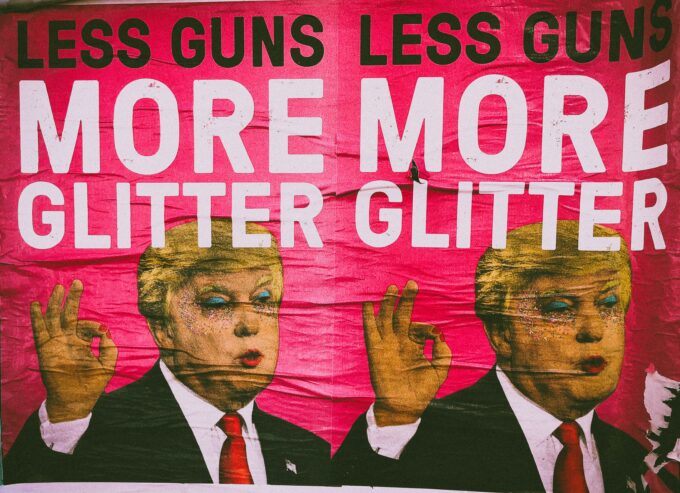
Image by Rob Walsh.

Trump has mused publicly about his fondness for Viktor Orbán, Hungary’s “elected” dictator, and how he accomplished commanding control over his people. Trump and his loyal Trumpeteer and Musketeer cohorts are taking an American-style approach, step by faster step, far ahead of the conventional resistance.

Step One is to announce that you are a STRONGMAN ruling by largely unlawful Executive Orders and ignoring the laws that demand congressional action.

Step Two is to dominate the news cycle and expand your own “news” media, such as Trump’s for-profit company Truth Social. Trump is a juggernaut of declarations, attacks on perceived opponents or “woke” activity, and he lies about conditions in the country and the world, and more lies about his false successes. He has regular meetings at the White House with apprehensive reporters who know they are getting played, but relay his sound bites, often unrebutted to the people (such as his false outbursts about U.S. AID’s activities abroad).

Step Three is to always be on the offensive and never admit mistakes or to being wrong or ignorant about anything. This puts the resistance on the defensive, reacting instead of proactively keeping Trump off balance.

This tactic is working to keep the hapless Democrats still in disarray, like “deer-in-the-headlights.” This freeze led to the Democrats’ ignominious defeat on November 5 by the most politically vulnerable GOP presidential candidate ever.

The Democrats blew an opportunity to use the two month interregnum between the election and Trump’s inauguration to hold public hearings in the Senate laying down challenges on very popular agendas opposed by the GOP (to raise the minimum wage, expand the child tax credit,  increase social security benefits frozen for over forty years,  tax the under-taxed, sometimes zero-taxed, super rich and giant corporations, and crack down on corporate crooks exploiting consumers and workers, especially on health insurance and credit transactions.) Instead, the Democrats disgracefully took their vacations and departed with a whimper on January 20th.

Step Four is to push ferociously plutocratic redirection, disruptions and suspensions of federal agencies so as to benefit enriching the super-rich like Musk and Trump. This means firing the law enforcers against corporate crime, such as major contracting fraud, and stealing from Medicare, Medicaid, and the bloated defense budget.

Step Five is to redirect massive monies (such as from Medicaid) from America’s social safety net to pay for even more military dollars and tax cuts for the rich and big corporations than Trump gave them in 2017. These cuts were never seriously challenged by the Biden Administration or Congressional Democrats like House Ways and Means Chair Rep. Richard Neal (D – MA). This brazen move is so cruel that some GOP Congressional toadies are beginning to quiver since many Medicaid recipients were Trump voters and people are turning out at crowded town meetings to loudly berate the surprised Republicans.

Step Six is to deeply consolidate Der Fuhrer’s power inside government and outside countervailing forces. Trump fired top military generals without cause, pushed out the chief lawyers for the three military services and replaced them with heel-clicking loyalists ready to obey any illegal order in violation of the Nuremberg rules. Remember that the unstable Trump has his finger on the nuclear trigger.

Throwing out competent civil servants in agencies dedicated to helping Americans in need (Meals on Wheels, Head Start) and replacing them with clenched-teeth Trumpers now wrecking or illegally closing down federal agencies (the Consumer Financial Protection Bureau) devoted to auto safety, airline safety, workplace safety, environmental, climate, health protection, pandemic preparedness, and consumer protection from relentless profiteering, and protection of fair labor standards and practices.

Step Seven is using the withholding of federal grants and spewing of propaganda to reduce important research and free speech on university and college campuses, intimidating and suing the corporate owners of the mainstream media to get in line or else face exclusion from the White House press corps and face FCC investigations of the radio and TV business, including NPR and PBS.

Who’s left, you might say, to stop Trump, who is on the road to a deep corporate fascist state?

The answer is: THE PEOPLE, taking their sovereign power under the Constitution to protest with specific demands, and to fully use the courts, give backbone to the media and launch a giant “You’re Fired” march on Washington in the Spring for a groundswell behind Impeachment. Trump is harming all Americans – Red State, Blue State, conservatives and liberals which can bring together a left/right movement changing Congress in the 2026 elections.

He is rescinding huge grants on renewable energy projects mostly going to Red States. He is canceling or suspending millions of government contracts to small business contractors or subcontractors. He is unemploying thousands of their workers every day, fueling inflation with steep tariffs, shaking the stock markets, fomenting chaos, anxiety and dread through American households and the business community itself.

Will Trump get away with what he is wrecking and self-enriching? Trump and his crew of demolitionists, led by the Musk and his poisonous Tusks recognize no boundaries, no legal or moral limits. My sense is NO. This guess is based on the immediate energy, courage and smart defiance by the growing resistance from all backgrounds around the country. Time is of the essence before the next step toward a dangerous police state arrives.

CLARION CALL FOR LARGE ORGANIZED RALLIES BACK HOME WHERE THE PEOPLE ARE AGAINST THE CRIMINAL, UNCONSTITUTIONAL DICTATORSHIP OF THE TRUMP/MUSK ONGOING WRECKING OF AMERICA AND AMERICANS.

CRITICAL PROTECTIVE LIFELINES ARE BEING ELIMINATED IN ALL STATES – RED AND BLUE – endangering the health, safety, and economic, well-being of Americans – workers, small business, the elderly, the infirm, the children, the air, water, and undermines protection against rising epidemics and violent climate damage to communities.  TRUMP/MUSK are slashing emergency services provided by our federal workers from the FAA to FEMA to EPA the monitoring of dangerous hotspots of toxic chemicals.

TRUMP/MUSK are already unlawfully violating contracts and cutting off millions dollars in federal payments for small business contractors.  This, of course, harms the workers in these firms. Efforts for cleaner air and water, and key farm programs are being dismantled.

To enrich themselves and other billionaires, TRUMP/MUSK are cutting thousands of skilled IRS investigators focused on big-time tax evasion by the Super-Rich. There is a criminally insane takeover of our government that every day is dictating, without Congressional authority, deadly actions that amount to a dictatorship. TRUMP/MUSK are the “an enemy of the people.” This is not what Trump supporters voted for. They did not vote for a Kleptocracy that goes after people’s programs and that does nothing to stop the hundreds of billions of dollars of corporate welfare, corporate crime against  US taxpayers (such as fraud inflicted on Medicare and Medicaid), and bloated big business contracts with Uncle Sam that are now not being investigated.

Saving our country from the cruel and vicious dictatorship seizing our government can only come from the people – Americans of all political backgrounds who show up and speak up at rallies, preferably outside local Congressional offices (with their Senators and Representatives invited)  – rural, suburban, urban communities nationwide.. The TRUMP/MUSK overthrow   of the existing corporate state, can soon become a POLICE STATE. Actions by citizens must expand rapidly before the egomaniacal, openly lying, vengeful TRUMP throws our beloved country into anarchical convulsions leading to massive disasters.

The Founding Fathers freed America from the tyrant King George III and gave us the Constitution to block any future Kings.  Trump, who wants to be a King said, “I have an Article II, where I have the right to do whatever I want as president.”

Respect the trust bequeathed to us from our first Patriots in 1776 and 1783. Mobilize and galvanize NOW.

Ralph Nader is a consumer advocate, lawyer and author of Only the Super-Rich Can Save Us! 

Seven ways that Trump is a danger to America and the world

Monday 3 March 2025, by Dan La Botz


President Donald Trump is a menace—a mortal danger—to America and the world. We knew before he was elected that he would be a threat to our well-being, but in his first weeks in office he has proven to be far more dangerous than anyone foresaw. From foreign policy, to public health, to the environment, to the lives of working class and poor people his policies will be catastrophic, increasing the urgent need for strategies of resistance.


Trump’s foreign policy, breaking with an older model of imperial domination through the NATO alliance with European nations, is based on the notion of great powers—the United States, China, and Russia—with their regional spheres of influence. We are back to a cruder nineteenth century imperialism and colonialism with Trump claiming Greenland and Panama—and Gaza for himself. While claiming to be a peace-maker, he is supporting Russia’s war on Ukraine and Israel’s war on Palestine, encouraging the aggressors, destabilizing the world and increasing the risks of future wars.

The world’s health is also in danger. Trump has withdrawn the United States from the World Health Organization, weakening both the American and the global capacity to respond to new diseases and to pandemics. Trump’s hatchet man, Elon Musk, is dramatically cutting the staff of the Centers for Disease Control and the National Institutes of Health. Trump’s Secretary of Health, Robert F. Kennedy, Jr. is an anti-vaxxer who has canceled expert advisory meetings to prepare this year’s flu vaccinations. He takes control just as the U.S. had its first measles death in ten years and as bird flu is evolving and affecting more animals and humans. All of these developments increase the likelihood of a catastrophic global pandemic.

Global warming, which is caused largely by the burning of fossil fuels, is an increasing threat to people around the world. The last ten years, 2015-24 were the hottest on record and has caused a variety of natural disasters, from floods and wildfires to droughts and hurricanes. He has withdrawn the United States from the Paris climate agreement, and he shut down the U.S. Interagency Working Group on the Social Cost of Greenhouse Gas. Implementing his slogan “Drill, baby, drill,” he declared a national energy emergency to justify increased petroleum production and is opening more federal lands to exploration and oil drilling. He is also ending federal programs that encourage electric vehicles. Given the size of the U.S. economy all of these will mean more global warming worldwide.

Trump’s attack on the working class and the poor is also affecting both the United States and the world. Trump and Musk have shut down or cut staff and programs that provide health, education, and housing to low-income people, particularly affecting the elderly and children. The Republicans have prepared a federal budget proposal that would reduce Medicaid, a program that benefits millions of low-income and disabled people. And Musk has shut down USAID, the development and assistance program that provided food and health care to millions around the world. Americans will face hunger, people in other countries will face starvation.

Then there are the issues of racism, sexism, and authoritarianism. Trump’s ended diversity, equity, and inclusion programs intended to promote fairness for racial minorities. This reverses 60 years of progress on fighting racism. He has also worked to take away women’s abortion rights and has attacked trans people. His team is full of sexual abusers—Trump himself, Defense Secretary Peter Hegseth, Robert Kennedy, and Musk. Trump and vice-president J.D. Vance are also working to strengthen rightwing forces around the world, from Vladimir Putin of Russia, to Victor Orban in Hungary, to the Alternative for Germany Party (AfD). We. need a global movement to stop Trump and those like him.


Attached documentsseven-ways-that-trump-is-a-danger-to-america-and-the-world_a8881.pdf (PDF - 905.2 KiB)
Extraction PDF [->article8881]


Dan La Botz
Dan La Botz was a founding member of Teamsters for a Democratic Union (TDU). He is the author of Rank-and-File Rebellion: Teamsters for a Democratic Union (1991). He is also a co-editor of New Politics and editor of Mexican Labor News and Analysis.


International Viewpoint is published under the responsibility of the Bureau of the Fourth International. Signed articles do not necessarily reflect editorial policy. Articles can be reprinted with acknowledgement, and a live link if possible.


Russian political prisoner Boris Kagarlitsky on the Moscow-Washington axis


Published 

Putin and Trump

First published in Russian at Rabkor. Translation by Dmitry Pozhidaev for LINKS International Journal of Socialist Renewal.

[Editor’s note: This letter was sent by Boris Kagarlitsky on February 19 from the penal colony in Torzhok, Russia, where he is serving a five-year sentence for “justification of terrorism.” As such, it does not cover more recent developments, in particular the meeting between Ukrainian President Volodymyr Zelensky and United States President Donald Trump. Nevertheless, in contains important insights for understanding what is occurring today.]

After the television announced that we would now be aligning with the United States against Europe, some confusion arose among the inmates of IK-4 prison. The most well-read among them rushed to the library to request 1984 by George Orwell. A queue quickly formed.

In reality, understanding the logic of these events is not difficult. The Russian ruling elite desperately needs the support of Donald Trump’s administration to extricate themselves from the dead-end situation they have created. The trouble is that the price of this assistance may turn out to be prohibitively high.

As I have written before, for the first time in many decades, the US is governed by people who do not consider themselves bound by the rules and obligations that existed throughout the 20th century. There was much debate about the fate of the world-system described by [Immanuel] Wallerstein and the hegemony of the US. Some believed it was threatened by China’s rise, while others saw Russia’s policies as an attempt to alter or dismantle the global order. Now we understand that US hegemony is indeed coming to an end, but its destroyer is the US administration itself — because hegemony is a burden of obligations and responsibilities that Trump refuses to carry.

The end of hegemony does not mean the end of imperialism. On the contrary, we are witnessing the most aggressive and shameless form of imperialism, where the US interacts with its neighbors through a “big stick” policy. Washington’s new orientation is towards dominance, one that does not take into account the interests or rights of others. Russia is being openly offered the role of a junior partner in this enterprise — one directed against China, Europe, and indeed the entire rest of the world, including even Canada.

It seems that the people in power in Moscow have little choice but to accept these terms, especially since Trump will accommodate them on the Ukraine issue (to the extent that it does not interfere with the interests and ambitions of his own team). Beyond that, all that remains is to hope for good fortune and the ability of European diplomats to keep the situation under control. But the Moscow-Washington axis is clearly taking shape.

The problem is that such a pivot, being unprepared and forced, contradicts economic, political and cultural trends — including those cultivated by the current government. And it is not just about how this shift will be perceived by the patriotic public, for whom anti-Americanism is a central ideological pillar. More importantly, Russia's economic ties are oriented towards Europe and China, while the US has little to offer in return. Worse still, under Trump, the process of pushing Russian suppliers out of European markets will continue.

Russian business, which dreams of normalising relations with the West, will indeed get normalisation — but in such a form that things will only get worse. As for politics, the Trump administration not only tolerates Russia’s current leadership; it sees it as ideal. A partner unconstrained by public opinion, unconcerned with the opposition, and indifferent even to the economic interests of its own country — such a partner is perfect. For Russian liberals who still believe that the US embodies the forces of good, this will be an unpleasant revelation. Likewise for those in the “Global South” who had hoped to find in Vladimir Putin an ally against US imperialism. However, such disillusionment was inevitable in any case.

Fortunately, there are good reasons to believe that the rapprochement between these two authoritarian projects will not be smooth. It will face resistance even at the elite level. European states are unlikely to allow themselves to be completely sidelined from the settlement process, which means they will retain some influence over events. In Russia itself, business circles interested in ties with Europe and China will be forced to resist — albeit through bureaucratic lobbying rather than political means. Even within the US, Trumpism’s position is not as solid as it might have seemed in November 2024, after the Democrats’ electoral collapse. Though the Trumpist administration has shown a remarkable immunity to public opinion, resistance will grow amid an unprecedented split within the ruling class.

I believe that we are not headed for a bleak era of triumphant totalitarianism in the spirit of Orwell’s 1984, but rather a period of sharp and sometimes chaotic struggle. We simply need to recognise the threat and understand its scale.


SLOCs and Chokepoints: Panama, Greenland, Canada – and Indigenous Peoples


Early into his second term as US President, Donald Trump threatened to seize control of the Panama Canal, Greenland, and Canada, possibly through military force. To justify seizing the Canal, Trump lamely asserted that the US has been subjected to “unfair” transit fees since control reverted to Panama, in 1999, under terms of the 1977 Torrijos-Carter Treaty.  Similarly unpersuasive, Trump argued that the US “needs” the natural resources (like oil, gas, uranium, copper, cobalt, nickel, and rare earth metals) of Canada, as well as those under Greenland’s melting ice sheet.

A common denominator in these three cases is how they all fall under the category of “Sea Control,” due to their important locations along “Sea Lines of Communication” (SLOCs) and “maritime chokepoints.”  Sea Control is one major facet of “Full Spectrum Dominance,” the paradigm of global military primacy operationalized by the George W Bush administration, during the so-called Global War on Terrorism (GWOT).

The paradigm originally derived from the notion of the “Unipolar Moment,” when the Soviet Union collapsed, in 1991, and left the US as the “world’s sole superpower” – presumably forever after.  One of the ancillary principles of Full Spectrum Dominance was articulated as the “Wolfowitz Doctrine,” which argued for preventing the emergence of “peer” or “near-peer” rivals – also forever.  Another key ancillary was the policy of “strategic denial,” sometimes called “anti-access/ area denial” (A2/AD).

Nothing is very new about the general idea of controlling sea lanes and chokepoints.  These have been relevant in naval strategies for centuries, all around the world.  (A sampling of current literature titles would include: “Lawful Sea Control to Protect Sea Lines of Communication and Chokepoints” and “Southeast Asian Chokepoints: Keeping Sea Lines of Communication Open” and “Maritime Chokepoints: Key Sea Lines of Communication (SLOCs) and Strategy” and “Choke Points“).  What’s new is how Full Spectrum Dominance applies to today’s evolving situation in the SLOCs and chokepoints of and around Panama, Greenland, Canada, and elsewhere.

Whoever controls a chokepoint has the obvious advantage of keeping it open to merchant transit, ideally under “freedom of navigation” rules and norms, such as are enumerated in the United Nations Convention on the Law of the Sea (UNCLOS) – which the US has not ratified.  On the other side of the coin, the very definition of chokepoints implies that they can be closed off and blockaded by force – presumably given some alleged military necessity, legal or otherwise.

Panama

This map illustrates global Sea Lines of Communication (SLOCs) and Maritime Chokepoints.  The significance of the Panama Canal is clear to see, as it is the singular chokepoint of the Western Hemisphere, between the Atlantic and Pacific oceans.  This importance has remained the same since it opened, in 1914, but direct military US control of the Canal and the entire “Canal Zone” ended and was transferred to Panama, in 1999.

The importance of the chokepoint is somewhat complicated.  In this next map, it is clear that the Canal is only the primary chokepoint among several others in the Caribbean.  In order to transit the Canal, in either direction, a ship must also transit secondary passages, the most important of which is the Windward Passage, between Haiti and Cuba (near Guantanamo – GITMO).  Other significant secondary chokepoints would be the Mona Passage (between Puerto Rico and the Dominican Republic), the Yucatan Channel (between Cuba and Mexico), the Florida Straits (between Cuba and Florida), and the passage between Grenada and Trinidad-Tobago, through which maritime traffic extends up and down the east coast of South America, to and from ports including Rio, Belem, and Buenos Aires.

Apart from all that GITMO has come to represent as a hell-hole, in the context of the GWOT, it is important to recognize it as a major naval base at a very strategic chokepoint.  The base was originally leased from a newly-independent Cuban government, following the Spanish American War of 1898.  That lease was declared “perpetual,” and it carried over into the era since the Cuban Revolution of 1959, when it became maintained by force against a hostile state host.

US military force has conditioned political affairs in Central and South America and the Caribbean since the days of the Monroe Doctrine, in 1823.  Since the Panama Canal first opened, in 1914, armed force has always been at the intersection between regional events on the land and those on the water.  The Canal indirectly explains Ronald Reagan’s illegal military intervention of Grenada, in 1983, when a Socialist politician was elected to govern a tiny island – which just happens to sit astride a major Caribbean SLOC and chokepoint.  It also indirectly explains Bill Clinton’s policy of preventing Socialism in Haiti, on the other side of the Windward Passage from Socialist Cuba, during the 1990s.  And of course, it explains George HW Bush’s intervention in Panama, in 1989, in so-called “Operation Just Cause” (mocked by critics as “Operation Just Because”).

The pretext of that intervention was to arrest Panamanian President Manuel Noriega, who had been an asset of the DEA and the CIA, and who cooperated in training soldiers for the Contra War against the Socialist Sandinistas in Nicaragua, during the 1980s.  He stepped out of line and outlived his usefulness, when he agreed to join Panama to the “Contadora” group of Central American and European nations, who demanded a regional solution to the Contra War and the ongoing bloodbaths in Guatemala, El Salvador, and elsewhere.  That demand implied sympathy for Socialism, and so Noriega had to go.  He was arrested for drug trafficking, tried, convicted, and sentenced to 40 years in a US prison.  Hundreds of Panamanians were murdered in the intervention.

At that point, in 1989, the US military was vacating some 45 bases in the Canal Zone. These were largely relocated into the near distance.  There are no US naval or air bases at present in Panama, but there are nine in Honduras, seven in Guatemala, five in El Salvador, four in Costa Rica, seven in Colombia, and seven in Nicaragua, and elsewhere in the Caribbean (see the map).

In 1989, the Socialist world was falling apart, with the Soviet withdrawal from Afghanistan, the collapse of Yugoslavia and the Warsaw Pact countries, rebellion and repression in China, electoral defeat of the Sandinistas, and then, the Soviet Union up and died.  In Panama, up to that point, the presumption was that any threat to the Canal was coming from the Soviet adversary.

Then, a steady stream of hysterical alarm that “Communist China” would take control of the Canal, or already had control, took over.  This hysteria had been constant, ever since the Torrijos-Carter Treaty of 1977 was signed, but around 1990, it went ballistic.  They’ve been crying wolf for 36 years now.

Trump’s current obsession over China and the Canal is based partly on account of the port facilities a Hong Kong-based corporation, CK Hutchison, now owns on both ends of the passage, and other Chinese infrastructure projects.  The alarm is also based partly on the deep economic relations China has developed with Panama and other Central and South American countries.  American economic primacy has a peer or near-peer rival, and that’s a problem, as per the Wolfowitz Doctrine, even though it’s not military – at this point.  China’s Belt-and-Road Initiative and the BRICS organization are colliding head-on with Full Spectrum Dominance, and one major flash point is in Panama.

Both Trump and his new Secretary of State, Marco Rubio, have alleged without evidence that China might block the Panama chokepoint.  This is pure imperialist propaganda, hyperbole, and total hypocrisy.  The truth is that only the US presently has the capabilities to do such a thing, despite the physical relocation of its military bases from the Canal Zone since 1999.

China has no significant power projection capabilities anywhere in the Western Hemisphere.  Any Chinese attempt to block or blockade the Panama chokepoint would require military force, and the presumption would have to be that all the pre-positioned US firepower, including the 4th Fleet of the Navy, would sit still and concede control of all the chokepoints of the Caribbean, as well as allow enemy forces anywhere near the Canal.

The bottom line is not that China is a serious threat to American “national security” in Panama.  Instead, Trump’s policy is to reassert direct US military control, with its implicit threat to blockade the Canal against anybody, with or without a credible pretext.  Gunboat diplomacy has defined US policy in Panama since the beginning.  “Hard power” is what Trump believes makes America “great.”  Bring the hammer.

Greenland, Denmark, and Canada

Few of the current maps of SLOCs and chokepoints demonstrate how Sea Control applies to Greenland and Canada, which have become subjects of the current crisis being created by Donald Trump, in his stated intent to seize control of both countries.

Climate change and global warming have brought the situation into the spotlight, as melting Arctic ice has resulted in opening the Northwest Passage, along the Canadian and Alaskan Arctic coastlines.  There is little in the way of military presence throughout that SLOC and down the west coast of Greenland, except for the US Pituffik Space Base, which is located strategically on the Nares Strait chokepoint, at the northern end of Baffin Bay.  Pituffik SB was formerly known as the Thule Air Base, a US Cold War installation where ICBMs were deployed under the glaciers.

On the Russian side of the Arctic coastline, along the also-melting Northern Sea Route, there has been some intensive exploration for petroleum and mineral resources.  Russia has claimed ownership of much of the Arctic Ocean basin, including the North Pole.  Meanwhile, China is increasingly interested in opening the Transpolar Sea Route, for more economical transportation in its burgeoning Belt-and-Road Initiative trading system.  The Arctic route between China and Europe is far shorter than the alternative through the Suez and Panama Canals.

During the Cold War, Greenland’s importance in NATO’s defense architecture was determined by its strategic location, as the western coastline of the so-called GIUK Gap (between Greenland, Iceland, and the UK), shown in the map here.  Soviet submarines and surface warships of the Northern Fleet had to transit to and from their bases around Murmansk and the Kola Peninsula through the chokepoint, in order to sail into and out of the Atlantic Ocean.

The GIUK Gap strategy is probably still operational, but Greenland’s location along the Northwest Passage amplifies its importance, as Russian and Chinese vessels already pass along its coastlines, where new chokepoints have yet to be established, especially on the western and southern shores.  Both China and Russia are looking for opportunity to build harbors, ports, and naval bases all around Greenland’s littoral.  The US wants to build bases, too.  Perhaps, so does Denmark.

Adversarial competition explains some of Trump’s urgency to seize control – and to deny that control to Canada, Greenland, and Denmark, as well as to Russia and China.  “Strategic denial” applies not only to military transit, but also to the many petroleum and mining companies competing for leases that might be negotiated with the present sovereign state of Denmark, or perhaps more importantly, with any new indigenous Greenlandic government, if it should become independent from Denmark.

In this map, Arctic military bases are located, illustrating the situation.  Obviously, Full Spectrum Dominance of the Arctic is going to require a big upgrade, construction of numerous military bases, just to balance present Russian deployments.  And such development would depend on the cooperation of Greenland, Denmark, and Canada, which might not be forthcoming.  It would be easier for the US if it just owned all that territory, and cooperation with other parties would not be necessary.

None of this is to deny the importance of both Greenland and Canada as present and future resource colonies.  There is some huge potential for oil and gas drilling, as well as mineral extraction, in both cases.  Just whose corporations would be eligible for permitting and licensing that kind of development is an open question.  Competition is already fierce, and it includes Russian and Chinese companies, as well as American, Canadian and Danish concerns.  They all have stars in their eyes, and are salivating over the riches that they might colonize and monopolize – and deny to other parties.

The complications and consequences of colonial capitalist industrial development, while laying waste to Arctic environments and ecosystems with pollution and contamination, as the ice melts and sea levels rise, still don’t rise quite to the level of conflict over SLOCs and chokepoints.  Can industrialization happen without a solid foundation of political control of the territory, backed up with military force?  For the US, Full Spectrum Dominance is the whole story.  As in the Wolfowitz Doctrine:  No peer rivals!  To allow easy access to Russia and/or China is simply out of the question, unless the US has a total, global lock on Sea Control.  That’s the sub-text of Trump’s message.

The Indigenous Dimension

In the 1970s, the international movement for rights of indigenous peoples began to coalesce in the United Nations, and it led to the promulgation of the UN Declaration on the Rights of Indigenous Peoples (UNDRIP), in 1993.  Throughout that development, indigenous peoples of the Arctic were instrumental actors, and their activism generated organizations that today have two main levels.  The top level can be identified as the Arctic Council, which includes the governments of Denmark, Norway, Sweden, Finland, Iceland, Canada, Russia, and the USA.  It is a state-centric organization, founded in 1996, and it also includes 13 other states as Observers.

The Arctic Council was created in great part to contain the political pressures of indigenous peoples demanding recognition through the UNDRIP movement. The Council relegated them to a non-voting second level of “Indigenous Permanent Participants,” comprised of six regional indigenous organizations, one of which is the Inuit Circumpolar Council (ICC), which represents Inuits of Greenland (and therefore Denmark, today), Canada, Alaska, and Russia.  The other Permanent Participants are:  the Aleut International Association, the Arctic Athabaskan Council, the Gwich’in Council International, the Saami Council, and the Russian Association of Indigenous Peoples of the North (RAIPON: representing Aleuts, Chukchis, Nenets, Yupiks, Evenks, Sahkas, and over a dozen other Arctic peoples).

In early indigenous organizing within the UN, Greenland Home Rule was considered a good example of positive relationships possible between states (in this case, Denmark) and indigenous peoples.  But for many Greenlanders (80-90 percent of whom are Inuit), Home Rule never came close enough to decolonization, and they advocated for total independence.  Their movement has now grown to a point where that goal might be realized – just as Donald Trump comes along and tries to buy the entire island.  It’s not the least bit clear with whom Trump would make one of his infamous real-estate deals.  Trump asked: “Who owns Greenland, anyway?”  We may be about to find out.

An independent Greenland would face a host of problems, getting started.  Probably the worst case scenario would to be bought out and owned by the United States, and rendered into an analog of an Indian reservation, or a captured nation, like Hawaii, Puerto Rico, or Guam – consigned to the Interior Department and subordinated to the Bureau of Land Management.  Another big problem would be to organize a military capability to control and defend its own SLOCs and chokepoints.

In an alternative scenario, the Inuit people of Greenland might find the greatest support in their current alliances with other Arctic indigenous peoples.  After all, it really has been a collective effort, within the UN and the Arctic Council, that brings Greenland’s aspirations for independence to the table.

This is especially true for the Inuits who inhabit the Nunavut Territory of Canada, just across the Nares Strait and Baffin Bay.  In the vast area of Nunavut, as in Greenland, Inuits comprise some 80-90 percent of the population.  Nunavut’s Arctic coastline is also Canada’s.   The entire littoral defines the SLOC that is the Northwest Passage, along which there are numerous possible chokepoints, control of which Donald Trump defines as a question of “national security,” not just for the US, but for the entire “Free World.”

Whether the Nunavut Inuits generate a united political force-field to defend and protect themselves is yet to be seen.  Likewise, the question is whether this population finds support and unity among other Arctic peoples, especially among Inuit relatives in Greenland, who are facing the same threat of being taken captive by the United States, in its quest for Full Spectrum Dominance.

Marc Sills, Ph.D. is an independent writer living in New Mexico.