It’s possible that I shall make an ass of myself. But in that case one can always get out of it with a little dialectic. I have, of course, so worded my proposition as to be right either way (K.Marx, Letter to F.Engels on the Indian Mutiny)
Friday, March 06, 2026
After Strikes on Dubai, UAE May Target Iran's Shadow Fleet Operators
The financial and operational networks that undergird Iran's sanctioned oil trade pass through Dubai, where they operate in the shadows in a lightly-regulated market. That may soon become a problem for Tehran. According to the Wall Street Journal, the UAE - growing tired of Iran's missile and drone attacks - has warned the Iranian government that in retaliation, it may start seizing assets linked to these shell companies.
The freewheeling business environment of the UAE's free trade zone system has been a home for sanctioned oil trading for years, both for Iranian and Russian grades. The shadow fleet of tankers that serve gray-market crude is managed in no small part out of Dubai. As an example, one of the most prominent shadow fleet operators to work in the city, Indian shipowner Capt. Jugwinder Singh Brar, has been accused by the U.S. Treasury of working with Yemen's al-Jamal network to move Iranian oil - a double violation of U.S. sanctions. Brar stands accused of using his fleet of small tankers to pick up Iranian oil cargoes, then blending them with other grades to obfuscate the real source. "The Iranian regime relies on its network of unscrupulous shippers and brokers like Brar and his companies to enable its oil sales and finance its destabilizing activities," said Treasury Secretary Scott Bessent last year.
Operations like Brar's now-sanctioned network could be a target of opportunity for the UAE, which could use asset seizures to clamp down on Iranian oil smuggling. Iran's kinetic attacks threaten to undermine the Emirates' carefully cultivated reputation for security and stability, the ingredients underpinning the runaway success of Dubai as a luxury destination and financial hub. Iran's drone and missile attacks have created unwanted optics: well-publicized strikes on a hotel, the city's U.S. consulate, and on a tank farm at Fujairah have caused damage to physical infrastructure, but the potential for reputational damage is even more concerning.
An asset seizure targeting Iran's facilitator network in the UAE could be a devastating blow. The Treasury believes that UAE-based front companies account for about 60 percent of the covert Iranian financial activity that passes through the American banking system, the Journal reports, suggesting a target-rich environment.
Beyond financial measures, the UAE is contemplating direct action to seize Iranian shadow fleet tankers in Emirati waters, officials told the WSJ - a major escalation for a nation that maintained neutrality between the U.S. and Iran just last week.
Iranian Bomb Boat Targeted Sonangol Tanker off Kuwait
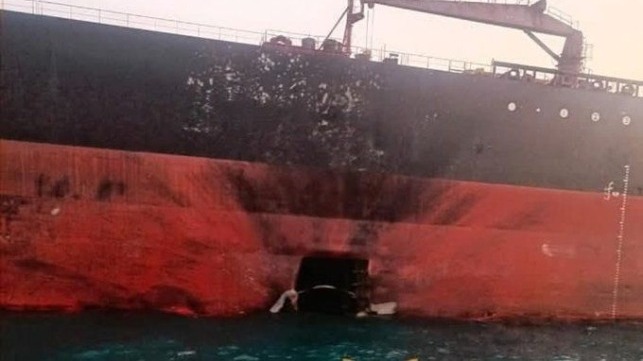
New footage appears to suggest that Iranian forces used a drone boat to attack the tanker Sonangol Namibe off the coast of Kuwait.
The tanker was at anchor about 30 nm to the southeast of Kuwait's Mubarak al Kabeer port on Wednesday night when an explosion occurred on the port side. The hull was penetrated and the ship has taken on water, according to UKMTO. However, there were no injuries, and the blast did not start a fire, according to the security agency.
The vessel was in ballast at the time of the blast, but satellite imaging taken the day after the strike shows a small petroleum slick emanating from the tanker.
The strike expanded the proven kinetic risk zone to the far northeastern end of the Gulf, confirming the possibility of an Iranian strike at any location within the area. It also showed that the threat picture for shipping will continue to include surface attacks, even though Iran's larger combatant vessels have substantially been eliminated by U.S. forces.
Iran is a longtime operator of unmanned bomb boats: it began providing the technology to Yemen's Houthi rebel group years before the concept was adopted and developed by Ukraine. Drone boats require a different defense strategy to prevent kinetic strikes, and they are difficult to defeat in swarms, as demonstrated by the Black Sea campaign targeting Russian warships and tankers.
The strike may have outsize importance for regional energy production. According to local Basra News, Sonangol Namibe was due to call at an Iraqi loading terminal to take on oil. Iraq is so short on shoreside storage space that it has begun to shut in production; A proven threat to tanker tonnage in Iraq has more immediate implications for the global crude oil supply than a similar threat in Saudi Arabia or the UAE, as Iraq's tank farm capacity is low and any production shut-in will take weeks to restart.
The UKMTO has reported an apparent attack on a tanker at a position off the coast of Kuwait, resulting in a hull breach.
The tanker - identified as the Suezmax Sonangol Namibe - was at anchor about 30 nm to the southeast of Kuwait's Mubarak al Kabeer port on Wednesday night. An explosion occurred on the port side, witnessed by the master. A small craft was seen departing the scene.
The blast penetrated a cargo tank, resulting in a spill of oil in the water, according to UKMTO. In a later statement, the operator said that a ballast tank was breached, but that no oil was spilled. The ship has taken on water as well, according to UKMTO.
No fires have been reported, and the crew are unharmed. Contrary to the initial report, the vessel was in ballast at the time of the blastInvestigations into the circumstances of the attack are under way.
The apparent attack is materially different from other recent maritime strikes in the region, in several ways. Geographically, it is the furthest point west from the Strait of Hormuz, suggesting that the warlike risk zone fully spans the length of the Arabian Gulf. The presence of a small craft also suggests a hand-placed charge - a limpet mine - which would be consistent with past operations attributed to Iran.
In June 2019, two vessels were hit by suspected limpet mine attacks in the Gulf of Oman. One of the devices was spotted intact on the hull of the tanker Kokuka Courageous, and it closely resembled a known Iranian device, according to U.S. Central Command. Suspected Iranian operatives removed the device and departed before U.S. forces could arrive. Cmdr. Sean Kido, a dive team leader with CENTCOM, told Reuters at the time that blast damage elsewhere on the Kokuka Courageous was consistent with a limpet mine attack - not an airborne munition.
Positioning of Unladen Tankers Signals Shipping's Risk-Reward Calculations
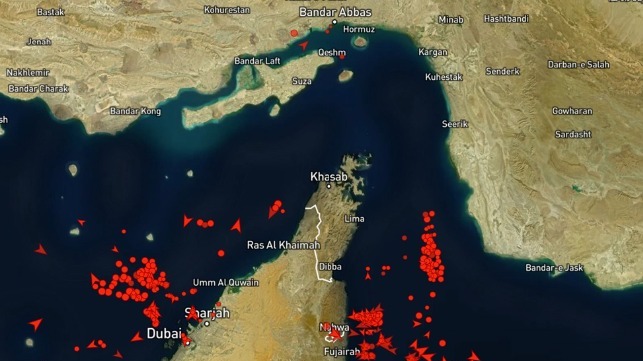
Still expecting to profit: empty tankers lined up off Fujairah, Khor Fakkan and Dibba (MarineTraffic)
Shipowners and managers, and ultimately ship masters, have the ultimate responsibility for assessing risk to their vessels and their cargoes. Governments may be keen to persuade operators that the coast is clear, in support of attaining political objectives, but captains always need to be the final arbiter, not the least because lives are at risk.
Hence the behavior of tankers, in particular those with freedom of movement outside the Gulf, gives an indication of how the non-government world is assessing the potential course of the ongoing war with Iran.
If unladen tankers give up holding off Fujairah and Oman, then it is because they assess the risk of loading from terminals on the Gulf of Oman outweighs the reward of record profits to be had from Mideast-to-Asia voyages - or, alternatively, that there is little prospect of the Straits of Hormuz being opened up in the short term. For such tankers, the commercial choice then is to sail away and to find cargoes elsewhere.
From insiders in the oil and gas trading community, it appears that some regard it as too risky to load at present. But most of the unladen tankers off Fujairah and Oman are still sticking around, implying that ship owners and managers consider there is a good prospect of the Iranian grip over the Straits of Hormuz being broken soon. There are for example 17 unladen LNG carriers currently loitering in the Gulf of Oman off Ras al Hadd, numbers not depleted by more than one or two who have given up waiting. This implies there is confidence that the American war plan will move - once local air superiority is achieved - to suppressing the still-active drone threat.
The Iranian threat extends well beyond the immediate Strait of Hormuz area, as it appears that Iran has the wider objective of closing down all oil and gas movements within the region, presumably with the objective of mobilizing oil and gas consuming nations - and China in particular - to press for a cessation of hostilities.
This threat the Gulf nations are having to deal with on their own, with the Americans clearly having their hands full dealing with the primary threat from Iran. But it seems extraordinary that Western nations, and other consumer nations in Asia, do not consider that their national and economic security interests need to be protected and defended from these Iranian attacks. On the contrary, the British Prime Minister, for example, speaking in the House of Commons on March 4, appeared to be only concerned with evacuating British citizens from the area - seemingly unconcerned about the lack of Royal Navy presence in the Gulf or capability to defend other British interests and those of historic and economic partners.
Bandar Abbas Naval Harbor Smoking from Multiple Hits
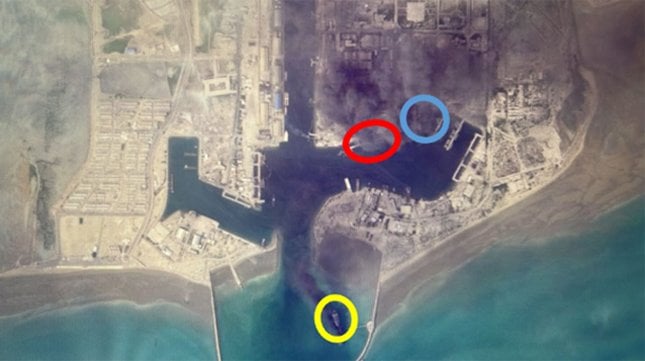
Bandar Abbas Naval Harbor at 12.00 (UTC) on March 2 (Sentinel-2/CJRC) Yellow: berth of IRINS Kurdestan (K442). Red: berth recently of 2 x Moudge Class frigates. Blue: Berth area of IRINS Zagros (H313) and Hengam Class logistic vessels.
Imagery taken over Bandar Abbas at midday (UTC) on March 2 shows the Naval Harbor wreathed in black smoke. From the smoke pattern and dispersal, it appears that there have been at least three strikes on ships berthed in the harbor.
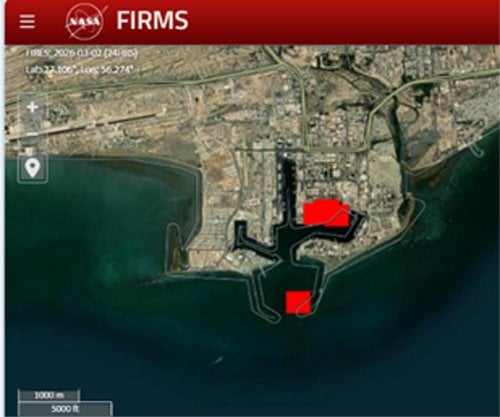
The heat spots are confirmed in NASA FIRMS imagery, which suggests that the heat spots were initiated perhaps up to 24 hours previously.
The regular Iranian Navy (Nedaja) has consistently moored classes of ships on particular berths in the Naval Harbor, making it easy to predict which ships lie beneath the smoke. Moreover, clear imagery of the harbor was obtained in the immediate days before the launch of Operation Epic Fury, so that one can make a good guess from which particular ships smoke is belching.
At its normal pier in the outer harbor, still afloat, is IRINS Kurdestan (K442), or possibly IRINS Makran (K441), still on fire at its stern.
These two converted tankers have given the Nedaja the ability to provide logistic support for long-range deployments, a capability that the Nedaja lost when IRINS Kharg (K431) caught fire and sank in mysterious circumstances off the coast of Jask on June 2, 2021.
The dockside alongside which three Moudge Class frigates were moored several days ago is ablaze along its length. The vessels concerned, therefore, may be IRINS Sabalan (F73), IRINS Sahand (F74), and/or IRINS Jamaran (F76), which had been spotted moored here on February 27. It has been tentatively reported, however, that IRINS Jamaran (F76) was sunk alongside its berth at the Konarak Naval Base in Chah Bahar.
A large area of smoke covers the area where the Moudge Class intelligence collection frigate IRINS Zagros (H313) is normally berthed, which in turn is adjacent to a pier that normally is home to Hengam Class logistic vessels, veteran but heavily used in support of short and medium range deployments.
On the eastern side of the Naval Harbor, the piers which normally house Kaman Class fast attack craft, and Kilo and Fateh Class diesel electric submarines, are not covered by smoke. Potentially targets in this area could have sunk, hiding any indicators of attack beneath the waters of the harbor.
The evident damage apparent in the imagery of the harbor correlates with the statement from President Donald Trump that nine Iranian Navy ships have been destroyed in Operation Epic Fury. U.S. Central Command on Monday also claimed to have sunk the drone carrier Shahid Bagheri, saying U.S. forces had struck the ship within hours of launching Operation Epic Fury. However, it should be noted that these easy targets were all old ships, which tended to be used for conventional naval operations, rather than the missile-equipped speed boats and fast attack craft used by the IRGC Navy in harassment operations in the Straits of Hormuz.
Jebel Ali Port Resumes Operations as Most Regional Ports Remain Operational
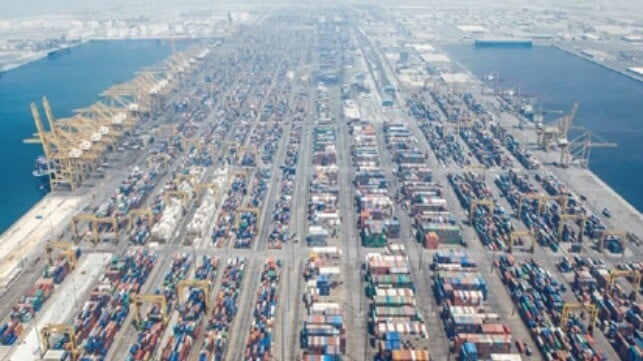
Jebel Ali, the largest container port in the region, briefly suspended operations (DP World)
After widespread reports of a possible missile strike and a fire at the Jebel Ali Port in Dubai, operations resumed on Monday. Most ports across the Middle East report operations are continuing despite the efforts by the Iranians to target ports as part of their campaign to disrupt the region.
Videos circulating online showed a smoke cloud rising from the container port in Dubai, creating concerns as Jebel Ali is the largest port in the region. In addition to being a key import and export location, it is a transshipment hub for much of the region. Reports began circulating that operations were suspended.
The Dubai City Defense force confirmed that it was quickly able to bring the fire under control with minimal damage. Officials are asserting that it was debris from a successful intercept of a drone that caused the fire and not a missile or drone strike on the port. Dubai, however, has been one of the areas heavily targeted by the Iranians, with reports of multiple intercepts and strikes, including on hotels and residential buildings.
DP World, which operates the container port, is saying operations were suspended as a precaution, and they undertook a safety review. As of Sunday evening local time, March 1, it was reporting that all four terminals were operating normally. The Dubai Ports Authority confirmed the operations while saying it was “monitoring developments closely” and would remain in close coordination with the relevant authorities. It said that “enhanced safety and security measures” would remain in place across the Jebel Ali Port.
Ports in the UAE, Kuwait, Saudi Arabia, Iraq, and Qatar, as well as further afield in Jordan, Egypt, Lebanon, Israel, and Cyprus, are also said to be operating normally. Inchcape, one of the leaders in providing port services, compiled a comprehensive report on the status of the port.
Ports in Bahrain have reportedly suspended operations temporarily, while Oman has partial restrictions. This comes after the countries were targeted by the Iranians. The Oman News Agency had earlier reported that two drones had targeted the port area and that one person was injured.
The key LNG terminals have, however, also been closed after their operations came under attack. Citing safety concerns, Qatar Energy said it had suspended operations at its Ras Laffan facility, with Inchcape also reporting that Qatar had suspended processing crew visas at Ras Laffan Port. Severe GPS signal interference was also being reported at Ras Laffan.
While the ports remain mostly operational, ships have stopped transits of the Straits of Hormuz due to the repeated attacks by the Iranians and a suspension of war risk insurance. In addition, many of the major shipping lines are reporting that they have placed restrictions on operations. MSC Mediterranean Shipping reported that it was suspending all bookings of the Middle East, while Ocean Network Express also reported it will temporarily suspend acceptance of new bookings for cargo moving both to and from the Persian Gulf until further notice. Maersk and HAPAG-Lloyd were among the companies that reported their vessels would stop transits in the Persian Gulf region. Maersk reported it was suspending reefer, dangerous/special cargo acceptance in and out of UAE, Oman, Iraq, Kuwait, Qatar, Bahrain, and Saudi Arabia, and not taking new bookings, including to parts of the Indian subcontinent. It also said all vessels would divert from the Suez Canal – Red Sea corridor.
In response to the ongoing missile attacks, U.S. commanders said they were focusing on quickly addressing Iran’s capabilities to strike neighboring facilities. U.S. Central Command reported on Monday, March 2, that because “Iran continues to maliciously launch ballistic missiles, indiscriminately targeting military and civilian locations throughout the region,” its efforts were being increased. It reported overnight that the massive B-1 bombers had been deployed to strike deep inside Iran to degrade Iranian ballistic missile capabilities. The U.S. released videos of mobile missile launchers being targeted and destroyed, while Iran responded with a video of underground bunkers storing large numbers of drones and missiles that it said it would be launching at the American forces and their supporters.
Cruise Lines Navigate Gulf Conflict Amidst Continued Iranian Strikes
Given the centrality of the oil trade to the GCC states, tankers have rightfully received the most attention of any vessel class in the new conflict in the Gulf. But cruising is increasingly popular in the region, and at least half a dozen cruise ships are in the affected area - including some which may be staying longer than expected due to ongoing Iranian strikes.
One of these vessels is newly homeported in the region. The Saudi cruise ship Aroya Manara (ex name World Dream) is currently moored in Dubai, and independent operator Aroya is deferring plans for a round-trip cruise through the Strait of Hormuz to visit Muscat.
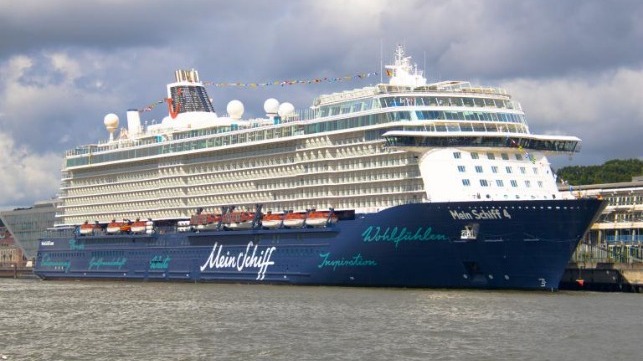
Many others are temporarily based in the UAE or Qatar. German firm TUI Cruises has two vessels berthed in the area - the Mein Schiff 4 in Abu Dhabi and the Mein Schiff 5 in Doha. Abu Dhabi was attacked by Iran in a missile strike over the weekend, and passengers aboard Mein Schiff 4 were able to see Iranian drones hit the water from on board the vessel. Mein Schiff 5 is scheduled to conduct a series of round-trip cruises in the Gulf, and was slated to depart Doha on Saturday.
TUI has temporarily suspended sailings for both vessels, but it is unclear when passengers or crew will be able to depart: with airspace restrictions in place, travel in or out of the GCC is currently difficult.
Shipping giant MSC's cruise division has one vessel currently moored at Doha, MSC Euribia. The ship has about 5,000 passengers on board from its previous voyage, but it will not be departing as planned for its next seven-night cruise in the Arabian Gulf. Instead, it will be staying in port "due to the current situation and the air space closure in the Middle East."
Privately-held Celestyal Cruises, based in Athens, operates two cruise ships; both are in the Gulf, west of Hormuz. The line said in a statement Sunday that the next departures for Celestyal Journey (departing Doha) and Celestyal Discovery (departing Dubai) have been canceled: both were due to sail on Monday, but the line intends to put passenger and crew safety first in light of current circumstances. Guests of the Journey have the option to stay aboard or to go ashore in Doha, but authorities in Dubai have instructed Celestyal Discovery not to disembark passengers for the time being. The UAE has suspended all flights to and from Dubai amidst ongoing Iranian missile and drone attacks, so passengers would have few options for onward travel.
Conservative Anglicans challenge historic female leader with rival leadership
Issued on: 06/03/2026
Conservative Anglican leaders in Nigeria have restructured their organisation signalling a break from the traditions of the historic Anglican Communion. Gafcon leaders have opposed liberal trends such as same-sex marriage, the ordination of openly LGBTQ+ clergy in the Anglican churches of Europe and North America, including the Episcopal Church in the United States and the recent nomination of the Church's first female leader.
El Salvador's Bukele holding dozens of political prisoners: rights group Guatemala City (AFP) – The government of El Salvador's President Nayib Bukele, known for a harsh crackdown on street gangs and dissent, is holding dozens of political prisoners, a rights group charged Thursday.
Such detentions had not happened in El Salvador since its long civil war of the 1980s, making the country now as oppressive as Nicaragua and Venezuela, the NGO Cristosal said at a presentation in Guatemala City.
The group's directors fled to Guatemala last July, saying they were being persecuted by Bukele's administration.
Their report tallied 86 political prisoners, including the NGO's chief anti-corruption investigator, Ruth Lopez.
Bukele has called himself the "world's coolest dictator" and is close to US President Donald Trump.
He rules under a state of emergency during which crime has been slashed as authorities have arrested 91,000 people, often acting without warrants and accusing the detainees of gang affiliation.
Thousands of innocent people were swept up in the crackdown, and around 8,000 have been released.
"For the first time since the peace agreements, after the war, we can state that there are political prisoners in El Salvador," Rene Valliente, head of research at Cristosal, told a news conference.
He was alluding to the 1992 accord that ended the war between a US-backed right-wing government and leftist guerrillas supported by Cuba.
The report said that besides the political prisoners at least 245 other people had been harassed in one way or another by the Salvadoran government, while cautioning the figure could be much higher.
Most are human rights advocates who criticized the gang crackdown, journalists, union leaders or environmental activists, the report said. 'Old forms of state violence'
"Ultimately, the famous 'Bukele model' is a regime like so many others -- a dictatorship that kills, tortures, robs and persecutes," said Cristosal's president Noah Bullock.
"What we see is a return to old forms of state violence exercised by tyrants and autocratic regimes to concentrate power and hold on to privileges," he said.
Bukele, who has been president since 2019, secured last August the right to seek indefinite re-election after his party-controlled Congress approved a sweeping constitutional reform.
The Salvadoran government did not immediately respond to the report.
Cristosal said along with using criminal courts as "a means of repression," the harassment included threats, having people followed, attempts at public shaming and "the systemic use of preventive incarceration."
"These methods are similar to those seen in countries like Nicaragua and Venezuela," the report said.
Lopez, the NGO's anti-corruption investigator, was detained in May 2025 on charges of embezzling state funds when she worked for an electoral court a decade ago.
She has denied the charges and accused the government of trying to silence her.
Bukele, whose crackdown on street gangs has won over many Salvadorans, was re-elected in 2024 with a massive majority.
"I don't care if they call me a dictator. I'd rather be called a dictator than see Salvadorans killed in the streets," he said in a speech last year.
As civilians in southern Beirut are ordered to evacuate ahead of an Israeli offensive, François Picard is pleased to welcome Nadim Houry, Executive Director of the Arab Reform Initiative (ARI). Houry describes the war on Iran and the ensuing conflict spreading across the Middle East as "one large illegal war" whose consequences are rapidly overwhelming Lebanon and threatening to reshape the entire region.
Hundreds of thousands of civilians have been ordered to flee with almost no warning and no clear refuge, while the Lebanese state is struggling to reassert its authority after years of economic collapse and political paralysis.
Our Spotlight interview aired shortly prior to French President Emmanuel Macron's announcement pledging armoured vehicles for the Lebanese government.
Lebanon faces what officials described as “one of the most dangerous moments in recent memory” after Hezbollah launched attacks on Israeli forces from areas both south and north of the Litani River, triggering a renewed Israeli air and ground campaign.
Announcing its ground incursion into southern Lebanon, Israel said it aims to establish what it called a permanent “security zone” along the border.
The exact depth of the proposed zone remains unclear, but its humanitarian cost is already emerging. More than 80 towns and villages have been emptied following successive evacuation orders, forcing tens of thousands of residents to flee north of the Litani River.
Orders to vacate have also reached Beirut’s southern suburbs, where residents have been told to leave their homes and not expect to return until Israel decides the time is right.
The evacuation net has spread wide, reaching villages deep in the south and others pressing against the western Bekaa.
Israeli reports estimate the number of Lebanese who will be forced from their homes at around 350,000 — on top of the roughly 85,000 frontline villagers who never made it back from earlier rounds of displacement.
Recent days have shown that Hezbollah remains active south of the Litani River, most visibly when its fighters engaged an Israeli tank in the border town of Kafr Kila.
The group has also maintained a steady stream of drone and rocket attacks toward Israel’s Upper Galilee from positions north of the river.
The Lebanese Army has redeployed along the border zone it has held since the Nov. 27, 2024, Israel-Hezbollah ceasefire, declaring in January that it had successfully cleared more than 90 percent of Hezbollah weapons from the area.
A military source confirmed that Israeli troops had crossed into Lebanon on Tuesday, moving through the towns of Kafr Kila and Khiam, shortly after Israel’s Defense Minister Israel Katz issued orders to seize additional strategic positions and tighten the grip on southern Lebanon.
The Israeli military called it a “forward defensive measure.”
Statements from Israeli officials and developments on the ground suggest a broader strategy to establish a civilian-free buffer zone along the 120 kilometer border, extending 10 kilometers deep into Lebanese territory.
That translates to roughly 1,200 square kilometers — close to 10 percent of Lebanon’s territory.
The blueprint was already being drafted during the 66-day war of 2024. Israeli forces razed homes in frontline border villages and sprayed chemical agents across farmland, stripping away vegetation that Hezbollah fighters had used for cover.
Five hilltop positions — Hamames, Uwayda, Aaziyyeh, Jabal Blat, and Labbouneh — remain under Israeli control inside Lebanese territory. The Lebanese Army reports additional positions have been established in recent months.
Brig. Gen. Mounir Shehadeh, the former Lebanese government coordinator with the United Nations Interim Force in Lebanon (UNIFIL), said that during the 2024 war, Israel sought to occupy all of southern Lebanon south of the Litani River.
However, UNIFIL forces deployed in the area refused to evacuate their positions.
“Israeli forces subsequently targeted those sites, injuring peacekeepers and shelling the entrance to the UNIFIL headquarters,” Shehadeh told Arab News.
He said the ceasefire agreement and the role of US mediation imposed “a fait accompli” in the border region. “Israel continued to violate the agreement through assassinations and the bulldozing of villages during this period,” he said.
Shehadeh noted that the term “buffer zone” is a concept Israel has used since its inception.
“In the media, it is framed as protecting settlements, but in reality Israel uses it to reshape facts on the ground, hoping that over time the buffer zone will become part of Israel. The Golan Heights is a clear example of this,” he added.
Shehadeh said the scale of the evacuation map suggests the buffer plan goes way beyond a localized response to rocket fire. Instead, it points to an attempt to impose a comprehensive security zone that would depopulate the border area and transform it into an open military zone.
“The Litani River is crucial to Israeli doctrine,” he said. “Based on that, the boundaries of the proposed buffer zone can be roughly estimated as follows.
“To the south, the entire Blue Line from Naqoura to the outskirts of Shebaa Farms; to the north, a line running roughly parallel to the Litani River in some sections and extending between three and eight kilometers into Lebanese territory, depending on terrain and population density.
“To the west, the Mediterranean coast at Naqoura; and to the east, the outskirts of the Arqoub region and the highlands overlooking the Upper Galilee.”
The buffer zone could span approximately 250 to 400 square kilometers, depending on the depth of the actual incursion.
Shehadeh added that if Israeli forces reach the outskirts of the Litani River, it would effectively revive a security belt similar to the one that existed before 2000, but on a larger scale extending toward the outskirts of the western Bekaa Valley.
If Israel continues advancing, it could push even further north to the Awali River, as it did during the 1982 war that culminated in the occupation of Beirut, he said.
For its part, UNIFIL expressed “grave concern” regarding Israeli calls for the evacuation of civilians to the north of the Litani.
It also reported several Israeli military movements and activities in its area of operations, including in the vicinity of Khiam, Beit Lif, Yaroun, Houla, Kfar Kila, El Khirbe, and Kfar Shouba, amid ongoing Israeli airstrikes and other aerial activities.
UNIFIL considered these actions “not only a violation of Resolution 1701, but also a violation of Lebanon’s sovereignty and territorial integrity.”
It also noted the new salvo of rockets and shells fired from Lebanese territory towards Israel, in violation of Resolution 1701.
The Lebanese Armed Forces command confirmed the incursion of Israeli forces into Lebanese territory in what it called a “flagrant violation of international resolutions and Lebanese sovereignty, following the launching of rockets and drones from Lebanese territory.”
It added that it continues to implement the decisions of the political authorities “in a manner that takes into account the supreme national interest,” and that it is coordinating with UNIFIL and the committee supervising the cessation of hostilities agreement “to halt Israeli attacks.”
The statement added that military units are redeploying at several border points within their assigned sectors despite limited capabilities, while implementing exceptional measures to maintain security and prevent armed activity in various areas.
According to Shehadeh, UNIFIL has already begun reducing troop numbers and withdrawing equipment ahead of the expected end of its mission in southern Lebanon in late 2027.
“In contrast, Israel no longer recognizes the Blue Line or Resolution 1701,” he told Arab News. “This will present Lebanon with a new security and geographical reality, altering the lines of deployment and engagement and complicating any subsequent political settlement.”
UNIFIL said its forces are still present on the ground and continue to carry out their tasks in southern Lebanon and along the Blue Line.
It also noted that it has adapted its activities in support of Resolution 1701, including, where possible, facilitating humanitarian assistance and protecting civilians, adding that the mission’s civilian footprint would be adapted accordingly.
Politically, the outlook in Lebanon’s external diplomacy appears no less bleak than the situation on the ground. Officials have been in contact with the US and France, urging them to pressure Israel to halt its attacks, but so far those efforts appear to have yielded little result.
The UN Security Council is set to hold a briefing next Tuesday on the implementation of Resolution 1701.
A senior Lebanese political source told Arab News: “The facts on the ground are changing every minute. What we are trying to do is stop the ongoing military operations so we can assess how to return to the negotiating table and implement international resolutions.”
The official source added that while the Lebanese government had openly raised the prospect of negotiations with Israel, Lebanon no longer appears to be a priority in international calculations, leaving the situation largely determined by the balance of power on the ground.
Meanwhile, the number of displaced people has reached almost 100,000, a figure expected to rise sharply following the mass exodus that began Thursday from Beirut’s southern suburbs, home to more than one million residents from across Lebanon’s various sectarian communities.
The Lebanese Ministry of Health reported on Thursday that at least 102 people have been killed and 638 injured since Israeli airstrikes on Lebanon began on Monday.
Lebanese Social Affairs Minister Haneen Sayed said that 83,847 displaced people, equivalent to 18,033 families, had registered in shelters due to the Israeli evacuation warnings, noting that the number of shelter centers had reached 399 across Lebanon.
Information Minister Paul Morcos said after the cabinet’s emergency session on Thursday that Prime Minister Nawaf Salam had criticized those responsible for dragging Lebanon into the latest escalation.
Quoting Salam, Morcos said: “Whoever committed a sin is the one who dragged Lebanon into repercussions we could have done without. Talk of treason is not courage; it is irresponsible and incites strife.”
The remarks came after Hezbollah Secretary-General Sheikh Naim Qassem criticized the government on Wednesday night as he defended the Iran-backed group’s decision to abandon earlier pledges to keep Lebanon neutral amid the regional conflict.
Morcos also announced that the government had decided to reinstate visa requirements for Iranian nationals entering Lebanon. It would also ban any activity by the Iranian Revolutionary Guard Corps, a main backer of Hezbollah, while seeking to deport its members from Lebanon.
Arab News
Arab News is Saudi Arabia's first English-language newspaper. It was founded in 1975 by Hisham and Mohammed Ali Hafiz. Today, it is one of 29 publications produced by Saudi Research & Publishing Company (SRPC), a subsidiary of Saudi Research & Marketing Group (SRMG).
Lebanese PM says 'humanitarian disaster is looming' from displacement
Issued on: 06/03/2026 - FRANCE24
Thick plumes of smoke were seen rising over Beirut as the Israeli military announced they had begun an additional wave of strikes in the Lebanese capital. As Hezbollah fired rockets at Israel on Monday, Israel launched strikes on Beirut's southern suburbs and Lebanon's east and south. The Israeli military said it had carried out 26 waves of strikes overnight in the southern suburbs.
Israeli airstrikes pound Lebanon, displacing hundreds of thousands
Issued on: 06/03/2026 - FRANCE24
Prime Minister Nawaf Salam is calling on the international community to help Lebanon amid the ongoing Israel-Hezbollah war as he warned '"a humanitarian crisis was looming". The fresh Israeli strikes have forced hundreds of thousands of people to flee targeted areas. FRANCE 24's Renée Davis spoke to some of them in Beirut.
France ramps up military aid to Lebanon as Macron calls for halt in attacks
France will strengthen its cooperation with the Lebanese Armed Forces and provide armoured transport vehicles along with operational and logistical support, President Emmanuel Macron has said, as Lebanon is pulled deeper into the war in the Middle East.
Issued on: 06/03/2026 - RFI
Lebanese President Joseph Aoun (left) has asked President Emmanuel Macron (right) to intervene to prevent Israeli airstrikes on Beirut's southern suburbs.
"Everything must be done to prevent this country, so close to France, from once again being drawn into war," Macron said on Thursday in a post on X (formerly Twitter).
"At this moment of great danger, I call on the Israeli prime minister not to expand the war to Lebanon. I call on Iranian leaders not to further draw Lebanon into a war that is not its own," the French leader added.
Macron's comments followed a request by Lebanon's President Joseph Aoun for the French president to intervene to "prevent the targeting of the southern suburbs [of Beirut] following threats by the Israeli army against its residents," the Lebanese presidency said in a separate statement.
Israel launched fresh airstrikes on Beirut on Thursday, having ordered hundreds of thousands of people to leave the city's southern suburbs.
The Israeli military says it is targeting the Iranian-backed Hezbollah armed group across Lebanon, with Beirut's south seen as its stronghold.
Hezbollah has launched rockets and drones over the border into Israel in retaliation for the assassination of Iran's Supreme Leader Ayatollah Ali Khamenei.
Lebanese state media said on Friday that Israel had launched overnight strikes on several towns in the east and had also targeted the eastern town of Dours at dawn.
Its health ministry says 123 people have been killed in Israeli strikes since Monday. At least 90,000 have been displaced.
Humanitarian aid
Macron also announced the "immediate despatch of humanitarian aid" to Lebanon.
"Several tonnes of medicines are being transported, along with shelter solutions and assistance supplies," he said.
Foreign Minister Jean-Noël Barrot confirmed in a TV interview that five tonnes of medical equipment and several tonnes of humanitarian supplies would arrive in Lebanon "as early as next week".
France has said it aims to prevent escalation across the region and has taken steps to protect its own positions amid the wider conflict involving the United States, Israel and Iran.
"Hezbollah must immediately cease its fire toward Israel. Israel must refrain from any ground intervention or large-scale operation on Lebanese territory," Macron said.
'Not at war'
The president has sought to reassure the public that France is neither waging war in the Middle East nor intending to become embroiled in one.
"I fully understand and hear your concerns, but I wanted to be absolutely clear... France is not part of this war. We are not in combat, and we will not be drawn into this conflict," Macron said in an Instagram post on Thursday evening, responding to a young user who had expressed anxiety over the potential fallout from the Israeli-American offensive against Iran..
France has dispatched military reinforcements to the Middle East – including the aircraft carrier Charles de Gaulle – to safeguard French nationals and allies caught in the crossfire of Iranian reprisals, helping them "intercept drones and missiles," he explained.
"In an entirely peaceful capacity, we are mobilising to try to secure maritime traffic," Macron continued.
Earlier on Tuesday, the president had announced he was seeking to build a coalition to protect the "shipping lanes vital to the global economy" in the region.
"We shall endeavour to act as reasonably and peacefully as possible, because that is France's role."
(with newswires)
Israel strikes Beirut’s southern suburbs after issuing a blanket evacuation order
Issued on: 05/03/2026 - FRANCE24
Israel launched a series of strikes on the southern suburbs of Beirut Thursday after ordering all residents of the densely populated area to evacuate. Traffic was gridlocked in Lebanon 's capital on Thursday as panicked residents tried to flee after Israel's military issued an evacuation notice telling residents to “save your lives and evacuate your homes immediately,” and specified which routes they should take to escape. FRANCE 24's Catherine Norris-Trent reports from Beirut.
US likely responsible for Iranian girls' school bombing, investigation says
Issued on: 06/03/2026 - FRANCE24
A tragedy at a primary school in Iran is sparking international outrage as new details emerge regarding who may be responsible. While the physical destruction is absolute, the political fallout is only just beginning. According to Reuters, a US investigation suggests the US itself was likely responsible for the strike.
HUBRIS
With Iran war, US goes it alone like never before
Washington (United States) (AFP) – When the United States fought the 1991 Gulf War, president George H.W. Bush boasted of building a broad coalition unseen in decades. When his son attacked Iraq in 2003, he faced wide criticism but secured several steadfast US allies.
Now, a generation later, President Donald Trump has attacked Iran, and he is barely even trying to make friends.
Trump launched the war alongside Israel, which had long pressed the United States to strike Iran's ruling clerics.
Trump's strategy toward other countries has been focused on intensely pressuring them to cooperate and loudly complaining when they say no.
Trump berated crucial ally Britain as "very, very uncooperative" and said of Prime Minister Keir Starmer: "This is not Winston Churchill we're dealing with."
The center-left prime minister had restricted US warplanes to using two British bases and only for "defensive" purposes, saying he did not believe in "regime change from the skies."
Trump threatened to cut off all trade with Spain after left-wing Prime Minister Pedro Sanchez refused to let US forces use bases.
The United States and Israel made no pretense of going through the United Nations before launching the war that quickly killed Ayatollah Ali Khamenei, Iran's supreme leader.
"It essentially sends the message to the world that Trump's United States sees itself above the law and doesn't even think it needs to claim otherwise," said Kristina Kausch, a deputy managing director at the German Marshall Fund.
She said the war only reinforced European perceptions of Trump, who has stunned the continent by threatening to seize Greenland from NATO ally Denmark.
"The degree to which there is US isolation or loss of soft power will depend on how disastrous the consequences of this decision," she said of the Iran attack.
Refocusing on nation-state
Trump has withdrawn the United States from numerous international bodies, vowing to go it alone in an "America First" foreign policy and to re-emphasize the centrality of the nation-state.
Nadia Schadlow, who was deputy national security advisor in Trump's first term, said the war showed how countries cannot rely on the United Nations when they believe security interests are at stake.
"I believe that the UN has value for collaboration, for discussion, for debate. But I don't believe it can prevent wars, especially when one country is determined, and feels that it must act in the interests of its national security," said Schadlow, now a senior fellow at the Hudson Institute.
"It seems that the decision-makers made a determination that security and surprise were critical and were more important than consultation."
Rare unambiguous statements of support for the war came from the right-wing leaders of Argentina and Paraguay as well as from Prime Minister Anthony Albanese of Australia, which has fought alongside the US in every major war.
Albanese backed action "to prevent Iran from obtaining a nuclear weapon." Canadian Prime Minister Mark Carney voiced similar support, although he soon called for de-escalation.
French President Emmanuel Macron opposed the attack as running counter to international law, while German Chancellor Friedrich Merz voiced hope for an end to the Islamic republic while hoping the war will be short.
Washington has shown little interest in sensitivities of friendly countries.
The United States torpedoed an Iranian warship that had just paid a goodwill visit to India, a frequent US partner, killing at least 84 sailors off Sri Lanka, after Defense Secretary Pete Hegseth vowed to reject "stupid rules of engagement."
Strategic benefit for China?
Iran, like Venezuela where Trump removed the president in January, had a privileged relationship with both Russia and China -- which were unwilling or unable to defend their allies against US firepower.
China has also relied on the two countries for oil, although it had reduced its dependence.
But the war could also benefit China. US forces are rapidly using up bombs, missiles and other resources that could be used in a theoretical defense of Taiwan, which Beijing claims, and Beijing is able to observe US war operations in Iran, said Jacob Stokes, a senior fellow at the Center for a New American Security.
Chinese strategists had described the first two decades of the century as a time of opportunity with the United States preoccupied in Afghanistan and Iraq, Stokes said.
"There is this potential for a grand strategic benefit, as Beijing is quite happy to see the United States get bogged down in the Middle East again," he added.
President Donald Trump said Washington will help choose the next leader of Iran as US and Israeli forces continued air strikes amid growing concerns of a broader conflict after drones launched from Iran struck Azerbaijan and Israel pushed into southern Lebanon.
With the United States and Israel currently engaged in a sixth day of war against Iran, the number of countries in the region to suffer Tehran’s retaliatory strikes, which have targeted both military and civilian infrastructure, grew again on March 5.
Trump, speaking to Reuters in a phone interview, said he wants to be involved in choosing Iran’s next leader, while ruling out Mojtaba Khamenei, the son of the late Supreme Leader Ali Khamenei – a hardliner who has been considered a favorite to succeed his father.
“We want to be involved in the process of choosing the person who is going to lead Iran into the future,” he was quoted by the agency as saying.
“We don’t have to go back every five years and do this again and again…Somebody that’s going to be great for the people, great for the country.”
The supreme leader was killed last weekend in air strikes as US and Israeli military operations pummeled the country.
Since then, a steady barrage of strikes have decimated Iran’s military, communications infrastructure, and other key facilities across the country.
Iran has retaliated with attacks on US military bases across the Middle East, dragging Arab Gulf states — and others such as Turkey and Azerbaijan — onto the frontlines of a war they have long tried to avoid.
Iran’s neighbor Azerbaijan, which has longstanding ties with Israel, reported attacks launched from Iranian territory on March 5.
Two people were injured after drones have struck Azerbaijan’s Nakhchivan autonomous region, with one damaging the region’s airport and a second landing near a school, according to Azerbaijan’s Foreign Ministry.
President Ilham Aliyev said that “Iran committed an act of terror against the territory of Azerbaijan, against the state of Azerbaijan” with the attack, while the Foreign Ministry said Baku “reserves the right to respond.”
Later in the day, Iran’s Foreign Ministry denied that the country had targeted Azerbaijan.
Millions of ethnic Azerbaijanis live in Iran. Azerbaijan is also one of the main oil suppliers to Israel, while Israel has been a key defense partner for Baku for years.
Many in Azerbaijan see Israel’s military supplies as critical during country’s campaign to regain control of the Karabakh region from Armenia.
A day earlier, a ballistic missile launched from Iran was heading toward Turkish airspace and was intercepted by NATO air defense systems, according to Turkish officials.
NATO Secretary-General Mark Rutte condemned Iran but said the incident does not provide immediate reason to trigger the alliance’s mutual defense clause, Article 5.
“The most important thing is that our adversaries have seen yesterday that NATO is so strong and so vigilant, and even more vigilant, if possible, since Saturday,” Rutte said on March 5, referring to when the US-Israeli strikes began on February 28.
Earlier, a State Department spokesman said US Secretary of State Marco Rubio had spoken with Turkish Foreign Minister Hakan Fidan to discuss recent developments and had pledged “full support” for the NATO ally.
Ukraine To Provide Expertise Against Iran’s Drones
As air travel disruptions continued across the Middle East with Iran firing missiles and drones against Israel and other regional countries, Ukrainian President Volodymyr Zelenskyy said his offers to provide support in countering Tehran’s Shahed drones were accepted.
“We received a request from the United States for specific support in protection against Shaheds in the Middle East region,” Zelenskyy said on his social media on March 5.
Tehran has long been an ally of Russia, supplying it with military equipment and technology and fueling Moscow’s war effort against Ukraine. Zelenskyy said earlier that Russia’s military had used at least 57,000 Shahed drones in attacks on his country, including against its civilian and energy infrastructure.
Now, the Ukrainian president said Kyiv will help its partners with expertise: “I gave instructions to provide the necessary means and ensure the presence of Ukrainian specialists who can guarantee the required security.”
Ukraine, which has just entered the fifth year of repelling Russia’s full-scale invasion, has been suggesting to share its experience in defending against Iranian-made drones since the first Iranian attacks across the Gulf.
Asked on the matter, US President Donald Trump, who has previously criticized some of the European leaders for failing to provide enough support for US military actions said he’ll take “any assistance from any country.”
Trump: US Holds ‘Strong Position’
Trump on March 4 vowed that there would be no let up with the joint air campaign that has killed Iranian Supreme Leader Ali Khamenei and other security, military, and political leaders.
He added that Tehran’s arsenal of ballistic missiles was being “wiped out rapidly.”
Trump has said he ordered the attack on Iran to prevent the country from developing a nuclear weapon but has also said he wanted Tehran to cease its ballistic missile program and to end violence against anti-government protesters, thousands of whom were killed in a brutal crackdown in recent weeks.
Seeking to counter concerns of American ‘”boots on the ground” in the war, the White House on March 4 said deployment of US ground troops in Iran is “not part of the plan for this operation at this time.”
Instead, Trump backed the Kurds in launching their own offensive, saying he thinks it’s “wonderful that they want to do that.” Asked by Reuters if the United States would offer air cover for such an operation, Trump refused to answer.
Earlier in the week, sources told Axios that the president spoke with Kurdish leaders, who sought consultation on whether and how to attack Tehran’s security forces. Netanyahu Claims ‘Historic Gains’
Israeli Prime Minister Benjamin Netanyahu’s office said the two allies had made “historic gains” in their war against Iran, which is in its sixth day.
“Israel and the United States have together made historic gains to protect our citizens and the civilized world,” government spokeswoman Shosh Bedrosian said in a video message.
As Bedrosian also claimed the attack on Iran was necessary as Tehran was rebuilding its nuclear weapons program in “new underground bunkers” and that there were signs it planned “to attack Israel and US forces in the region,” without providing details.
Separately, Israel stepped up its attacks on strongholds of Iran-allied Hezbollah forces in Lebanon after the group launched missiles into northern Israel. According to Israeli military, Tel Aviv’s goal was to create “a buffer…between our residents and any threat,”
French President Emmanuel Macron on March 4 said he urged Netanyahu to refrain from launching a ground offensive in Lebanon.
“I reiterated the necessity for Hezbollah to immediately cease its attacks on Israel and beyond. This escalatory strategy is a grave mistake that puts the entire region at risk,” Macron wrote on X.
“I also called on the Israeli Prime Minister to preserve the integrity of Lebanese territory and to refrain from launching a ground offensive. It is crucial for the parties to return to the ceasefire agreement,” Macron added.
Reports indicate that Israeli ground forces have already crossed the border into Lebanon, although details remain unclear.
On March 5, Israeli military warned residents in Beirut’s southern suburbs to evacuate immediately. “Save your lives and evacuate your residences immediately,” Israel’s military forces spokesman Avichay Adraee said on X.
With reporting by RFE/RL’s Radio Farda, RFE/RL correspondent Alex Raufoglu in Washington
RFE/RL journalists report the news in 21 countries where a free press is banned by the government or not fully established.
The conflict in West Asia is already having global reverberations. The firepower on display on all sides is formidable, increasing casualties and limiting travel, expatriate mobility and trade. The takedown of refineries and energy assets will severely impact the global energy flows. Prices of crude oil and natural gas have already increased as energy flows through the Straits of Hormuz have been affected. Countries across the world are watching nervously. Our experts, Security Fellow Lt. General Narasimhan and Energy Fellow Amit Bhandari, discuss the ongoing West Asian conflict, how it will pan out, and its implications for India.
Q: How will the conflict evolve from this point? How long is it likely to last?
A: This conflict was a long time coming. First, the U.S. and Israel went after Iran’s nuclear facilities in 2025, but it was clear that Iran had moved its nuclear infrastructure somewhere safe, and the attacks did not actually achieve what they had sought to. Second, there were already negotiations going on with Iran to sort out the issues of its nuclear programme – and no progress was made even in the last meeting, which was at the end of February. For the U.S. and Israel, it seems to have tilted the balance in favour of launching an offensive. But clearly the U.S. has been preparing for this conflict for almost two or three months now. This is visible by the fact that almost 50% of deployable fighter aircraft have been moved to this theatre, along with aircraft carrier groups and a number of other ships. So the conflict was expected.
Now that it has begun, what happens next? Iran has approximately 2,000 to 2,500 missiles – they have launched only a few so far, 70-100 missiles at the six or seven Gulf countries, which can beat the air defence of that country.
The initial U.S.-Israel attack has wiped out Iran’s leadership – but they had planned for this, and the plans have been implemented. In this case, the Islamic Revolutionary Guards Corps (IRGC) gets split into 31 autonomous units – one for Tehran and the other 30 for each of the provinces. Each of these units can make their own decisions, pick their own targets and do what they have to do. This mosaic defence plan has multiple parts to it, including decentralised decision-making. In case of an attack on Iran, they are to adopt defence in depth, meaning layered defences.
The third part is survivability over winning. Finally, they will also go into asymmetric or guerrilla warfare in case of an invasion by the U.S. and Israel – something that has happened in Afghanistan and Iraq. Their objective is to cause as much damage as they can to the U.S. and Israel.
If the conflict stops at missiles and aerial bombing, it should end within a week or two. But if it goes into an invasion and asymmetric guerrilla warfare situation, there is no limit to how long it can go on for.
Q: Iran has used drones and missiles on a large scale in the conflict so far. Are there any lessons for India from this conflict, especially given our own experience during Operation Sindoor last year? Also, how is the evolution of armed conflicts in the drone era, as witnessed in the past three or four conflicts?
A: The large-scale use of drones started during the Azerbaijan-Armenian conflict. It was then used in Russia-Ukraine, Israel-Gaza, India-Pakistan, and now this West Asia war.
Q: What are the wider geopolitical implications of the conflict, especially for China and Russia? Are there any beneficiaries of this conflict?
A: The first beneficiary of this conflict is of course, Israel. The White House did not expect any kind of a threat from Iran over the next decade. If Iran gets weakened in some form, the first beneficiary is Israel. Second, the U.S. can always boast about regime change and having caused them damage. But they will not be able to take out Iran’s nuclear deterrent.
For China, Iran is a source of oil – China kept importing oil from Iran even during the sanctions period. Chinese ships would switch off their transponders while loading up on Iranian oil in the Gulf. They may have to source this oil from other areas such as Russia. So far, China has made just anodyne statements about a need to end violence.
China will just sit this conflict out, because in any case, either the U.S., Israel, or Iran will be weakened – China will benefit from any or all of this.
India, too, has made anodyne statements. While India seems to have picked a side in the conflict, there hasn’t been any physical support. Prime Minister Narendra Modi was in Israel just before the conflict began. There is a parallel to that – Russia’s President Putin went to China at the start of the Winter Olympics in February 2022 before the Ukraine conflict began.
Q: What has been the impact of this conflict on the energy space?
A: The perception in the energy markets is that this will be a short conflict, which may be over in two or four weeks. We know that 20% of the global oil supply passes through the Straits of Hormuz, and traffic has reduced considerably in the past few days. Hypothetically, if the traffic were to stop for two or four weeks, or longer, there would be widespread panic in the energy markets. That hasn’t happened – the price for Brent is still $78-79/barrel. If there is a serious concern about the stoppage of traffic in the straits, the price would be far higher.
Iran has started to target a number of energy installations – a Saudi refinery, a Kuwaiti refinery, and a UAE oil platform. The attacks on oil infrastructure are partly an attempt to create panic amongst other countries. Oil buyers don’t worry about where they import oil from – West Asia or somewhere else. If the price of oil goes up, it goes up for everyone. So it may be an attempt to induce a larger panic in the global community so that some kind of a negotiated settlement or off-ramp could be created.
Finally, Russia is going to be one of the beneficiaries of the conflict, as it is the second-largest exporter of oil in the world. At this point in time, when there is a concern around a large source of supply, the world economy cannot have another big supplier being pushed out of the marketplace completely.
About the author:
Lt Gen S L Narasimhan is the Adjunct Distinguished Fellow for China and National Security Studies at Gateway House.
Amit Bhandari is the Senior Fellow on Energy, Investment and Connectivity.
Gateway House: Indian Council on Global Relations is a foreign policy think-tank established in 2009, to engage India’s leading corporations and individuals in debate and scholarship on India’s foreign policy and its role in global affairs. Gateway House’s studies programme will be at the heart of the institute’s scholarship, with original research by global and local scholars in Geo-economics, Geopolitics, Foreign Policy analysis, Bilateral relations, Democracy and nation-building, National security, ethnic conflict and terrorism, Science, technology and innovation, and Energy and Environment.
Trump’s Iran War Is Grounds For Impeachment, According To The Constitution – OpEd
Prior to the American Revolution, the power over war and foreign affairs was lodged in the executive branch. European monarchs decided when to commit their countries to wars and military incursions. In countries such as Great Britain with representative assemblies, elected officials could withhold funds if they disapproved of a foreign adventure, but there their power ended.
The Founding Fathers rejected the European model. Our first charter of union, the Articles of Confederation, lodged all executive functions in Congress. Under the Articles, Congress possessed “the sole and exclusive right of determining on peace and war.” The thirteen sovereign states were forbidden to engage in hostilities except in cases of invasion or imminent attack.
So, what would the Founders think of President Donald Trump’s war on Iran? They would assume we have abandoned the U.S. Constitution and opted for the European model they rejected. Despite extensive congressional powers over foreign affairs, the president did not consult the national legislature on whether to commit American forces to war in the volatile Middle East. Trump coordinated the start of hostilities with the Israeli government, but not with representatives elected by the American people. This is the height of personal hubris.
Congress sits as mere spectators while the war spreads. Regional conflict intensifies, American service members are killed, and Israeli forces advance into Lebanon. With such a hornets’ nest kicked over, one must wonder whether at this late date Congress can have any meaningful input—especially with the president deploying more troops to the region.
The president’s war on Iran is contrary to the Constitution and rejects safeguards in our republican federation. The attack—its escalation and projected duration of weeks or months—serves as grounds for articles of impeachment. No one person—president or otherwise—should be allowed to commit the country to a Middle Eastern war without the consent of Congress.
Although the Constitution of 1787 created the presidency as the executive branch for the union, the Framers left the matters of war and peace with Congress. In a republican federation, the Founders reasoned, only the people’s representatives should be able to commit the country to war. Consequently, Article I, Section 8 vests Congress with the power to declare war, to raise armies, to equip a navy, to commission privateers to prey on enemy shipping, to call forth the state militias (today the National Guard) to repel invasions, and to make rules concerning prizes seized in conflict.
The Constitution designates the president as the commander-in-chief of the armed forces, but this title simply preserves civilian control over the military. It does not vest the president with authority to use our armed forces as his personal servants who he can dispatch to fight at his pleasure.
In defending the commander-in-chief power, the Federalists (those urging ratification of the Constitution) drew contrasts to the British king. In the North Carolina convention, James Iredell pointed out that the king of Great Britain “is not only the commander-in-chief of the land and naval forces, but has the power, in time of war, to raise fleets and armies. He also has the authority to declare war.” In the South Carolina convention, Charles Pinckney made similar points and stressed that the executive’s “powers did not permit him to declare war.”
James Wilson assured the Pennsylvania convention that the Constitution would not “hurry us into war” because “the important power of declaring war is vested in the legislature at large” and not the president. Whereas the ambitions of kings are prone to carry countries into conflict, Wilson believed that “nothing but our national interest can draw us into a war.”
This concern about the executive and war was succinctly expressed in a letter from James Madison to Thomas Jefferson a decade after ratification. “The constitution supposes, what the History of all Govts demonstrates,” elucidated Madison, “that the Ex. is the branch of power most interested in war, and prone to it.” For this reason, Maidson explained, the Philadelphia Convention “vested the question of war in the Legislature.”
If the Constitution means what it says, then Congress must reclaim the authority the Framers deliberately placed in its hands. The question is not whether one supports or opposes this particular conflict, but whether we will preserve a republic in which the momentous decision to wage war rests with the people’s representatives rather than the will of a single executive. The Founders feared the concentration of war-making power because history taught them where it leads. If we permit that power to drift back into the hands of one person, we do more than risk another protracted conflict abroad—we erode the very constitutional structure designed to safeguard our liberty at home.
William J. Watkins, Jr. is a Research Fellow at The Independent Institute and author of the Independent books, Crossroads for Liberty: Recovering the Anti-Federalist Values of America’s First Constitution, Reclaiming the American Revolution: The Kentucky and Virginia Resolutions and Their Legacy, and Patent Trolls: Predatory Litigation and the Smothering of Innovation. Full Biography and Recent Publications
Iran conflict is 'not a justified war': Former US special envoy for Iran Robert Malley
Issued on: 05/03/2026 - FRANCE24
11:59 min
Robert Malley, former US special envoy for Iran under Joe Biden and a key negotiator of the 2015 Iran nuclear deal, told FRANCE 24 that the US-Israeli war against Iran is "not a justified war, not a necessary war and not a lawful war". For Malley, the "cacophony" over the conflict's rationale "reflects the fact that this is a joint Israeli-US decision" and a marriage of what US President Donald Trump "saw as a historic opportunity and a man who is driven by hubris and self-aggrandizement".
Six months after Nepal's revolution, Generation Z hopes for change in elections
Issued on: 05/03/2026 - 06:15 min
In Nepal, 18 million people are eligible to vote in this Thursday's parliamentary elections. More than 120 parties are running, over a third of them created after the September 2025 uprising, which was largely driven by Generation Z. Among their demands: an end to corruption and nepotism and above all, job creation. Every day, nearly 2,000 young Nepalis leave the landlocked Himalayan country to find work abroad.
Just a few weeks after the revolution that overthrew the government in Nepal, nearly 1 million new voters registered on the electoral rolls. An unprecedented figure, reflecting the scale of the political earthquake that shook the country: more than 70 people killed and hundreds injured, parliament and dozens of ministries set ablaze, and a youth movement determined to rid itself of the old political guard that has shared power for nearly two decades.
For the past 20 years, Nepali political life has been dominated by the same figures and the same parties, regularly accused of corruption and nepotism. This time, Gen Z wants to break with the old system. FRANCE 24's Alban Alvarez, Sacha Desmaizières and Praveen Kumar Yadav report.
Nepal's rapper-turned-politician takes early lead in key polls
Kathmandu (AFP) – Nepal's centrist party of rapper-turned-politician Balendra Shah took an early lead in the high-stakes parliamentary election on Friday, as slow counting continued after the first polls since last year's deadly uprising.
But despite Shah's party loyalists dancing on the streets of Kathmandu in celebration -- the numbers of votes counted remain too low to be confident that it will translate into concrete wins.
By Friday afternoon, 24 hours after polls closed, early trends issued by the Election Commission put Shah's Rastriya Swatantra Party (RSP) ahead.
Alongside Shah, key figures vying for power include Marxist leader KP Sharma Oli, four-time prime minister who was ousted by the September 2025 anti-corruption protests, and the newly elected leader of the Nepali Congress party, Gagan Thapa.
At 5:00 pm (1115 GMT), RSP was leading in more than half of the 165 constituencies.
But there were only two declared results, and RSP had been confirmed only in one, the same as Nepali Congress.
Prakash Nyupane, a spokesman for the Election Commission, said that counting was ongoing "in a peaceful manner" across the Himalayan nation, from snowbound high-altitude mountain regions to the hot plains bordering India.
Voters have chosen who replaces the interim government in place since the September 2025 uprising, in which at least 77 people were killed, and parliament and scores of government buildings were torched.
Youth-led protests under a loose Gen Z banner began as a demonstration against a brief social media ban, but were fed by wider grievances at corruption and a woeful economy.
Kunda Dixit, publisher of the weekly Nepali Times, told AFP that if trends did reflect final wins, the political shift was dramatic.
"This is even a bigger upset than we expected -- it underscores the level of public disenchantment with the old parties for under-performance, as well as anger over the events of September," he said.
The polls are one of the most hotly contested elections in the Himalayan republic of 30 million people since the end of a civil war in 2006.
All eyes are watching the results in the key head-to-head battleground constituency of Jhapa-5, a usually sleepy eastern district, where 35-year-old Shah challenged directly the veteran Oli, aged 74.
Shah, better known as Balen, snappily dressed in a black suit and sunglasses, has cast himself as a symbol of youth-driven political change.
At 5:00 pm local time, at 10 percent of the votes counted in Jhapa-5, Shah was ahead by nearly five times as many votes as Oli.
Soldiers with armoured trucks manned barbed wire barricades around the counting centre in Jhapa.
"I hope this result changes the fate of the country for the better," Bhagawati Adhikari, 38, told AFP, who was among a crowd of dozens at Jhapa gathered outside the security cordon.
"The country should be peaceful and secure, youth should get opportunities, corruption should stop -- that's my appeal."
More than 3,400 candidates ran for 165 seats in direct elections to the 275-member House of Representatives, the lower chamber of parliament, with 110 more chosen via party lists. Turnout was 59 percent.
Full nationwide tallies could take several days.
Dixit raised the possibility that Shah's RSP could stage a dramatic win.
"If RSP hits the magic 138 seats, Balen will become prime minister -- and hopefully a cabinet of technocrats," added Dixit.
Sushila Karki, the interim prime minister, praised the peaceful conduct of a vote she has said was critical in "determining our future".
Karki, a 73-year-old former chief justice who reluctantly left retirement to lead the nation, now faces the challenge of managing the reaction to results.
The election saw a wave of younger candidates promising to tackle Nepal's dismal economy, challenging veteran politicians who have dominated for decades and argue that their experience guarantees stability and security.
In Jhapa, 68-year-old shopkeeper Ved Prasad Mainali sat listening to a radio.
"Oli may lose, but his supporters wont come out on the streets. If they do, they will face an opposition from a larger crowd that wants change," he told AFP.
"To Oli, I would like to say, that he has ruled for many years -- he has done some good for the country, now he should just rest peacefully. Jhapa is ready to welcome a new prime minister."




.png)


