Wednesday, April 01, 2026

GOP May Kick 300,000 More Off Healthcare to Help Find $200 Billion for Trump’s Iran War

“Republicans in Congress want to cut Americans’ healthcare to pay for more war in Iran. Let that sink in.”
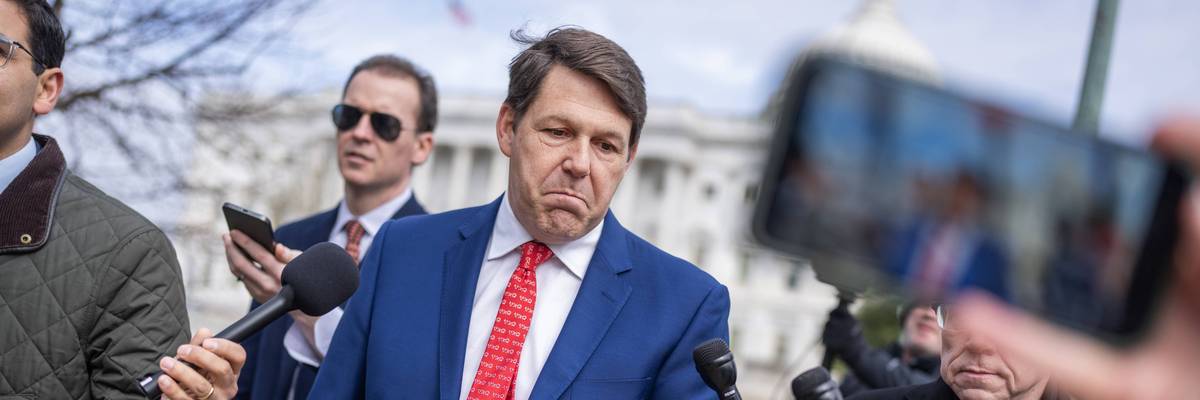


House Budget Committee Chair Jodey Arrington (R-Texas) talks with reporters outside the US Capitol on March 19, 2026.
(Photo by Tom Williams/CQ-Roll Call, Inc. via Getty Images)

Jessica Corbett
Mar 30, 2026
COMMON DREAMS

Republicans won’t think twice about *literally* sacrificing you to get their way.”

That’s how Democrats on the US House Ways and Means Committee responded to Axios’ Monday reporting on congressional Republicans considering more healthcare cuts to help fulfill President Donald Trump’s request for $200 billion to continue partnering with Israel for an unconstitutional war on Iran—including a potential ground invasion.

Other critics said:“Is this America First?”
You know who isn’t losing their government subsidized healthcare over this war that their government started? Israelis.”
Republicans would rather set money on fire than try to help a single American see a doctor.”
Cutting healthcare to pay for another regime change war in the Middle East. It’s like GOP want to lose in November.”
Are they calling this strategy Project Blue Wave?”
This should surprise no one: MAGA wants to pay for a war that no one wants by chipping away at your healthcare.”

Michael Hardaway, a geopolitical strategist who has worked for top Democrats, argued that they “must convert this into a House AND Senate majority in November,” noting that Republicans “took healthcare away from millions of Americans to pay for tax cuts for the 1%.”

That was last year, when congressional Republicans and Trump used the budget reconciliation process to pass their so-called One Big Beautiful Bill Act. Between $1 trillion cuts to Medicaid over the next decade and failing to extend expiring Affordable Care Act (ACA) tax credits, the OBBBA is expected to strip healthcare coverage from up to 15 million Americans.


While the impacts of the OBBBA will play out over years, already, “in red states and blue states alike, Republican healthcare cuts are hitting communities like a wrecking ball,” Senate Finance Committee Ranking Member Ron Wyden (D-Ore.) said last week, while releasing a related report with House Energy and Commerce Committee Ranking Member Frank Pallone Jr. (D-NJ).

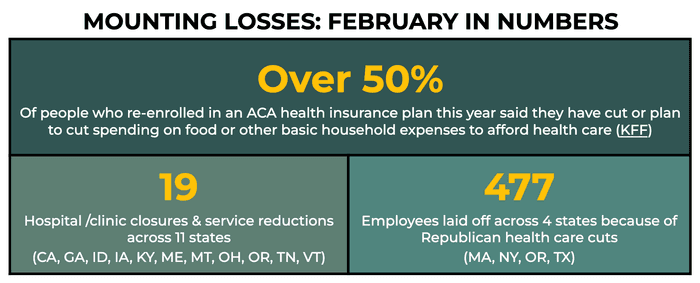
Wyden and Pallone found that over half of the people who reenrolled in an ACA plan this year have had to or plan to reduce spending on other essentials; at least 19 health facilities have closed across 11 states; and nearly 500 employees were laid off in four states because of the GOP’s healthcare cuts last year.

“Despite attempts by Trump and his allies to cast blame elsewhere, the stories and facts are rolling in from across the country,” Wyden said. “Democrats will not stop elevating the voices of Americans whose health is in harm’s way as a result of Republicans’ healthcare cuts.”


One proposal that the GOP considered but ultimately did not include in the OBBBA related to ACA cost-sharing reductions. The Congressional Budget Office estimated that the specific policy considered last year would save $31 billion but leave 300,000 more Americans uninsured through 2034.

Reporting emerged last week that House Budget Committee Chair Jodey Arrington (R-Texas) wants to bring back the push for that policy. It quickly spurred criticism, with Sen. Elizabeth Warren (D-Mass.) saying: “Republicans in Congress want to cut Americans’ healthcare to pay for more war in Iran. Let that sink in.”


“Republicans ransacked $1 trillion from Medicaid, and then they more than doubled premiums for over 20 million Americans in order to fund tax breaks for billionaires and big corporations,” Leslie Dach, chair of the advocacy group Protect Our Care, said in a statement last week. “Now, care for 15 million working Americans will be ripped away, nursing homes and hospitals are on the chopping block nationwide, and Americans are buried under skyrocketing healthcare hikes.”

“But that’s not enough for Republicans who have been at war with working families’ healthcare for decades—now they want to slash healthcare even more to bankroll the war in the Middle East and to fund ICE, Trump’s unaccountable, lawless paramilitary force,” Dach continued, referring to US Immigration and Customs Enforcement. “The American people reject these Republican priorities and will make their voice known in November.”

Axios reported Monday on Arrington’s preferred timeline for a new budget package: “60 to 90 days,” he said.

Arrington is also eyeing some potential changes to Medicare, which provides health insurance coverage to Americans age 65 and older, according to Axios:One, known as “site-neutral” payments, would equalize payment across hospital outpatient facilities and doctors’ offices. A second would crack down on what critics say is insurance company gaming of the Medicare Advantage system through “upcoding” of patients’ medical conditions.
Arrington expressed skepticism that either would be included, saying they’d open up “a false narrative that we’re cutting Medicare.”

As for Medicaid, one of the programs attacked by the OBBBA, Arrington told the outlet that there is hesitancy “to open that back up,” but some policies considered in 2025 could be revived.

In a Monday statement, Democratic National Committee rapid response director Kendall Witmer called out Trump and Vice President JD Vance for past and possible future GOP healthcare cuts, accusing them of breaking their campaign promises.

Donald Trump and Republicans already made the largest cuts to healthcare in history, causing healthcare costs to skyrocket for millions of Americans while billionaires and big corporations get massive tax cuts,” Witmer said. “Now, Republicans want to slash even more healthcare funding for working families to pay for their war with Iran.”

“After promising on the campaign trail to stop the endless wars, reduce the national debt, and lower costs,” Witmer added, “Trump and JD Vance have done the opposite: putting everyday Americans on the chopping block to wage their deadly and costly war of choice.”
As Loudly Predicted, Trump-GOP Medicaid Cuts Decimating Hospitals Across US

Of the roughly 450 hospitals identified in a new analysis as at risk of closure or service cuts, around 200 are located in congressional districts represented by Republicans.


A healthcare worker turns on a light in the emergency operation room at a medical complex in Hondo, Texas.
(Photo by Kaylee Greenlee for The Washington Post via Getty Images)


Jake Johnson
Mar 31, 2026
COMMON DREAMS

The unprecedented Medicaid cuts that US President Donald Trump and congressional Republicans approved last summer are putting hundreds of hospitals across the country at high risk of cutting services or permanently shutting their doors, a potentially devastating outcome for millions of poor Americans that was repeatedly predicted ahead of time.

The advocacy group Public Citizen released a report Monday identifying 446 hospitals that could be forced to reduce services or close because of the Trump-GOP Medicaid cuts, which will amount to around $1 trillion over the next decade. The at-risk hospitals collectively served 7 million patients in 2024, according to Public Citizen’s analysis.

Nearly 200 of the hospitals listed in Public Citizen’s report are located in congressional districts represented by Republicans who voted for the Medicaid cuts, and 146 are in states represented by Senate Republicans—nearly all of whom supported the sprawling budget package that included the assault on Medicaid.

“Trump’s cuts to Medicaid will hurt millions of low-income and disabled Americans, and will deepen financial strains that are already plaguing rural and safety-net hospitals—compromising their ability to deliver care, potentially leading many to close,” said Public Citizen researcher Eileen O’Grady, the author of the report. “Congress should take urgent action to restore all Medicaid funding cuts enacted by Trump and Republicans in Congress, and should extend the enhanced premium tax credits for coverage through the Affordable Care Act marketplaces.”


The report comes as Republicans are reportedly considering billions of dollars in additional healthcare cuts—and kicking hundreds of thousands more off their health coverage—to help fund Trump’s illegal and increasingly expensive war on Iran.

Public Citizen found in its report that there’s at least one hospital at risk of closing or slashing services in 44 states and Washington, DC. States with the highest proportion of at-risk hospitals are Connecticut, California, New York, Massachusetts, and Washington, the analysis shows.

“It is notable that while there are more at-risk hospitals in Democrat-led states and congressional districts, a substantial number of hospitals in Republican-led states and congressional districts are threatened by Medicaid cuts,” the report observes. “Almost all congressional Republicans voted to pass the Big Ugly Law.”
Peer-Reviewed Health Study Warns of Trump’s ‘Silent But Deadly Assault’ on Health of Americans

“This is not just a policy shift—it’s a wholesale abandonment of government commitments to the American public,” said one advocate.


Kentucky Utilities Ghent Generating Station, a coal-fired power plant, is seen on February 14, 2026 in Ghent, Kentucky.
(Photo by Jon Cherry/Getty Images)


Julia Conley
Mar 31, 2026
COMMON DREAMS

The so-called “Make America Healthy Again” movement encapsulated a key campaign promise ahead of President Donald Trump’s second term in office, with Trump telling one Pennsylvania crowd in 2024, “We’re going to get toxic chemicals out of our environment, and we’re going to get them out of our food supply.”

But the Trump administration has gradually announced a slew of public health-related policies and proposals since the president took office—pushing to loosen emissions rules for the cancer-causing gas ethylene oxide; suggesting the polio vaccine should be optional; and mandating the production of carcinogenic glyphosate—and a peer-reviewed study has now cataloged the “grave threat to America’s health” that Trump’s policies present.

“During the first administration of President Donald Trump, nearly 100 environmental and occupational protections, including air-quality safeguards, were rescinded,” reads the study, published in The New England Journal of Medicine (NEJM) on March 25. “Although many of those rescissions were delayed by litigation or reversed by President Joe Biden, they inflicted considerable harm on Americans’ health. The second Trump administration’s actions have been even more aggressive, portending greater harm.”

Weeks after the US Senate confirmed Health and Human Services Secretary Robert F. Kennedy in February 2025—a confirmation that he secured after making the baseless claim that Americans would prefer the for-profit insurance system over universal healthcare and refusing to reject debunked claims about vaccines—the administration appeared to make clear its true views on public health when it announced 31 climate regulation rollbacks.

“Those initiatives and other administration actions are set to reverse progress on pollution, make workplaces more dangerous, and (in Environmental Protection Agency Administrator Lee Zeldin’s words) drive ‘a dagger straight into the heart of the climate change religion,’” reads the study.

The proposals swiftly introduced by the administration included:Loosening standards for particulate matter 2.5 pollution, which killed approximately 460,000 people in the US from 1999 to 2020;
Ending subsidies for clean energy production under the One Big Beautiful Bill Act;
Weakening tailpipe emissions standards, putting Americans at greater risk for cardiopulmonary mortality and climate crisis risks; and
Delaying implementation of stronger silica rules for coal miners—putting them at risk for black lung disease—while also demanding that coal plants continue production.

Ken Cook, co-founder of the Environmental Working Group (EWG), said the study described “a deliberate dismantling of safeguards that protect the air, water, and health of nearly every person in this country—all in the service of polluters.”

“This is not just a policy shift—it’s a wholesale abandonment of government commitments to the American public and the MAHA movement that helped propel Trump into office,” said Cook, who did not contribute to the study.

Philip Landrigan, a pediatrician and public health physician who directs the Global Observatory on Planetary Health at Boston College and is the lead author of the paper, told EWG that the “impacts of these rollbacks will fall most heavily on the most vulnerable among us—including infants—resulting in brain injury, neurodevelopmental disorders, increased preterm births, and elevated lifelong risk of chronic disease.”

Children and other vulnerable populations, including those in low-income communities situated close to petrochemical industrial areas, are likely to have increased mercury, benzene, and arsenic exposures—raising their risk of developing cancers and other diseases—due to the Trump administration’s rollbacks, according to the study.

“Several proposed policies would weaken water-quality standards, reducing drinking-water safety for millions of people,” reads the paper. “For example, the EPA seeks to weaken regulations governing effluent discharges from coal-fired power plants. The resulting increase in waterborne lead, mercury, and arsenic will increase the incidence of bladder cancers and adversely affect children’s cognitive function.”

The study’s authors emphasized that “statistics and documentation are not enough” to protect the public from the White House’s harmfiul policies.

“Unless health professionals speak up, and unless we put a human face on the tragic consequences of these environmental rollbacks, the connection between these seemingly abstract policy changes and the real health harms they cause may remain invisible,” reads the study. “We health professionals must call urgent attention to this silent but deadly assault on Americans’ health, work with broad coalitions to halt it, and ultimately rebuild the agencies, protections, and shared sense of trust and responsibility that have given us clean air and water and enabled us and our children to live longer, healthier lives.”

Cook noted that the NEJM itself has been a target of the administration, with Kennedy calling highly respected, science-based journals “corrupt” and the Department of Justice questioning the publication’s editorial integrity.

“No amount of political pressure or intimidation should silence independent science or the experts working to protect public health,” Cook said. “The NEJM and the study’s authors rightly ignore those threats and lay bare the real-world consequences of the Trump administration’s actions—and the American people deserve to hear it.”
Coalition Sues Trump EPA for Torching Air Pollution Standards

“The repeal of these protections will mean more asthma attacks, emergency room visits, and premature deaths,” said more than two dozen environmental and health groups.


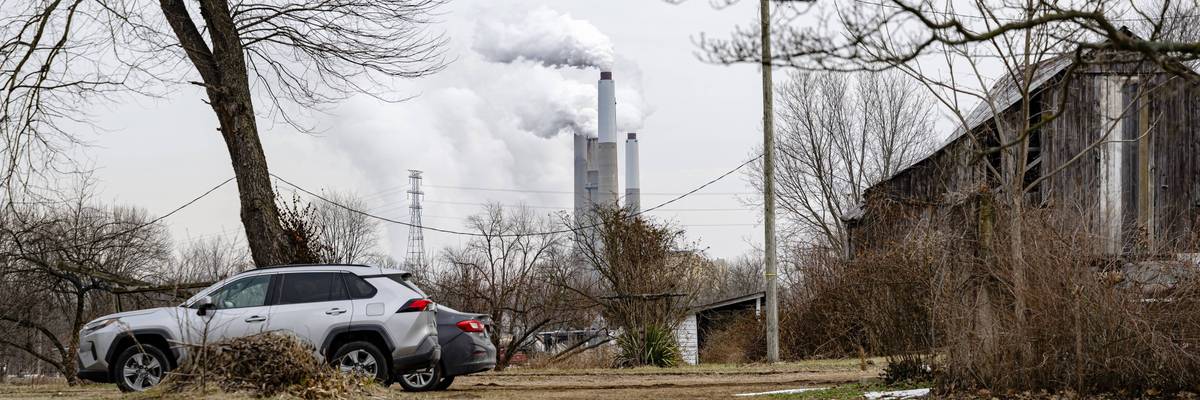
The flue-gas stacks of Mill Creek Generating Station, a coal-fired power plant, are seen from the Valley Village neighborhood on February 14, 2026 in Louisville, Kentucky.
(Photo by Jon Cherry/Getty Images)

Stephen Prager
Mar 30, 2026
COMMON DREAMS

A coalition of more than two dozen environmental and health groups sued the Trump administration on Monday for repealing Environmental Protection Agency rules that curbed dangerous chemical pollution from coal-fired power plants.

As part of President Donald Trump’s efforts to dramatically expand the use of coal, the EPA last month finalized the repeal of the 2024 Mercury and Air Toxics Standards (MATS), which tightened existing restrictions on the emission of mercury, lead, and other brain-damaging chemicals from power plants.

Coal emits more planet-heating carbon dioxide per unit than any other fossil fuel. Coal plants also release a slew of other chemicals that can cause numerous health complications, including asthma, lung cancer, and respiratory infections.

The EPA says coal-fired power plants are also the single largest source of airborne mercury emissions, which can impair cognitive development, especially in young children.

MATS was created in 2012 to counter these effects and proved quite successful. Within six years of its enactment by the EPA, the amount of toxic mercury being emitted into the atmosphere from energy plants had declined by 90%, according to an agency report.

The Trump EPA has not repealed MATS entirely. Instead, it has targeted amendments enacted by the Biden administration in 2024 that lowered caps on mercury emissions, as well as on other toxic chemicals such as nickel and arsenic.

The EPA has also repealed rules requiring constant monitoring of toxic chemical emissions. Instead of installing expensive systems to track their outputs 24/7, plants can revert to conducting occasional checks.

The repeal came after the administration had already given dozens of coal plants a two-year exemption from the standards last April, even though, according to the agency, 93% were already on track to meet the requirements.

According to an analysis of EPA data by the Natural Resources Defense Council (NRDC) last month, sulfur dioxide pollution from coal plants increased by 18% last year, with those exempt from the rules surging almost twice as much as those not exempt.

The lawsuit, filed in the US Court of Appeals for the District of Columbia, argues that the Trump administration’s actions violate the Clean Air Act, ignore the scientific record, and endanger communities living near power plants.

The suit is backed by groups including the NRDC, the Sierra Club, and the Environmental Defense Fund, as well as the American Academy of Pediatrics and the American Lung Association.

“The repeal of these protections will mean more asthma attacks, emergency room visits, and premature deaths,” the groups said in a statement challenging the repeal. “This administration is not just rolling back rules, it is eliminating the monitoring infrastructure needed to know what is coming out of these smokestacks in the first place.”

“It is allowing coal plants to spew out more neurotoxic mercury into our air and food supply, while simultaneously keeping the communities most at risk in the dark about how serious that threat is,” they said. “This is a betrayal of the EPA’s core mission.”
EPA Ripped for ‘Routinely’ Failing to Label Cancer-Causing Pesticides

“If the agency is going to allow such chemicals to be freely sold at Home Depot, Walmart, and farm supply stores, the very least the EPA must do is require a clear cancer warning on the label,” said one critic.


A crop duster sprays fields near Pullman, Washington with pesticide.
(Photo by Wolfgang Kaehler/Avalon/Universal Images Group via Getty Images)

Brett Wilkins
Mar 30, 2026
COMMON DREAMS

The US Environmental Protection Agency has repeatedly failed to warn consumers of the cancer risks posed by pesticides—even when its own research has found those products to be carcinogenic, a pair of green groups said Monday.

The Center for Food Safety studied the EPA’s permitted risk level in active components of both currently approved and legacy pesticides. CFS researchers found that the EPA allowed pesticides with a cancer risk “as high as 1 in every 100 people exposed, a far greater level than the EPA’s benchmark of a 1-in-a-million chance of developing cancer.”

“Of the 570 unique pesticide chemicals that EPA’s Office of Pesticide program has classified for carcinogenic potential since 1985, over one-third (200, or 35%) are either possible human carcinogens (127) or likely to be carcinogenic to humans (73),” the CFS report notes. “The status of 62 others (11%) is uncertain, because EPA lacks sufficient data to make a determination.

A second report, from the Center for Biological Diversity (CBD), shows that of the 200 pesticides that are possible or likely human carcinogens, 125 are still registered for use.

CBD analyzed the labels of every pesticide currently approved by the EPA and found that the agency has placed cancer warnings on just 69 of 4,919 pesticide labels (1.4%) “containing an active ingredient that the agency has designated a ‘likely’ human carcinogen.” Additionally, the EPA has put cancer warnings on just 242 of the 22,147 pesticide labels (1.1%) that “contain an ingredient the agency has designated as a ‘possible’ human carcinogen.”

CFS science director Bill Freeses said in a statement Monday: “It’s bad enough that the EPA approves cancer-causing pesticides. But if the agency is going to allow such chemicals to be freely sold at Home Depot, Walmart, and farm supply stores, the very least the EPA must do is require a clear cancer warning on the label. Warnings save lives by incentivizing users to wear protective equipment that reduces risk.”

Lori Ann Burd, director of environmental health at the CBD, said on Monday that “it’s dumbfounding that the EPA has failed to require any cancer warning on thousands of pesticide products sold to the public that the agency itself has linked to cancer.”

“Why should anyone have confidence in the EPA’s ability to keep tabs on the pesticide industry and protect us all from harmful poisons when it won’t even compel companies to put long-term health warnings on pesticides it knows are really dangerous?” she added.


Last month, CFS, CBD, and others denounced the EPA’s reapproval of the pesticide dicamba—which scientific studies have linked to increased risk of cancer and hypothyroidism in high-dose exposure—for certain cotton and soybean crops.

The new CFS and CBD analyses come ahead of next month’s oral arguments in Monsanto Company v. John L. Durnell, a case before the US Supreme Court in which Bayer, the Germany-based pharma giant that bought Monsanto in 2018, is seeking substantial immunity from future lawsuits filed by people in the United States who used glyphosate-based products like Roundup weedkiller and were then diagnosed with rare pesticide-linked cancers. The company has paid out billions of dollars to settle such suits.

CBD and other advocacy groups have also warned that the industry-backed Farm Bill currently advancing in the Republican-controlled Congress weakens or delays pesticide safety regulation, preempts state-level cancer warning rules, and shields chemical companies from lawsuits.
‘As Horrific as It Is Illegal’: Trump ‘God Squad’ Blasted for Attack on Endangered Species

“This administration cannot recklessly play God with our shared American heritage at Secretary Hegseth’s arbitrary say-so,” said one conservationist.


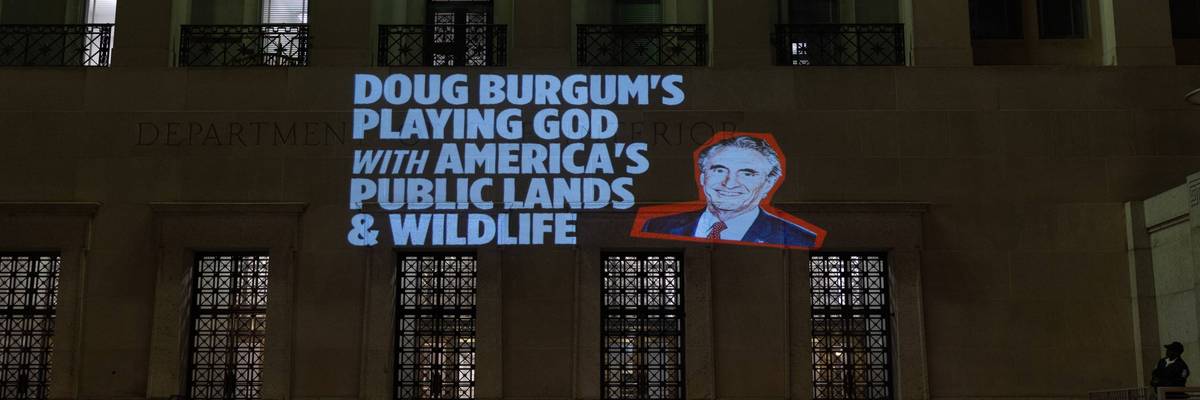
Protest messages are projected at the US Department of the Interior on March 30, 2026 in Washington, DC.
(Photo by Tasos Katopodis/Getty Images for Save Our Parks)


Jessica Corbett
Mar 31, 2026
COMMON DREAMS

The Trump administration’s so-called “God Squad” swiftly came under fire from conservationists on Tuesday after voting unanimously for an “unprecedented” exemption allowing fossil fuel operations in the Gulf of Mexico to ignore policies intended to protect endangered species.

In the lead-up to the snap meeting, the Center for Biological Diversity filed a lawsuit in a Washington, DC federal court, and the administration confirmed in a filing last week that US Interior Secretary Doug Burgum, who chairs the Endangered Species Committee, organized the gathering at Defense Secretary Pete Hegseth’s request.

The closed-door but livestreamed meeting proceeded as scheduled after a federal judge declined to block it. The New York Times reported Tuesday that as protesters rallied outside the Department of the Interior, Hegseth told the panel inside that “when development in the Gulf is chilled, we are prevented from producing the energy we need as a country.”

“Recent hostile action by the Iranian terror regime highlights yet again why robust domestic oil production is a national security imperative,” Hegseth claimed, though he emphasized that the administration’s position on the matter preceded President Donald Trump’s war on Iran, which has caused a surge in gasoline prices.

While a spokesperson for the oil and gas industry’s trade group, the American Petroleum Institute, welcomed the vote on regulations for what president calls the Gulf of America, Brett Hartl, government affairs director at the Center for Biological Diversity, declared that “this amoral action by Pete Hegseth and Trump’s cronies is as horrific as it is illegal, and we’ll overturn it in court.”

The center plans to update its suit to challenge Hegseth’s “unfounded” national security determination and the unlawful exemption granted by the committee on Tuesday.

“Americans overwhelmingly oppose sacrificing endangered whales and other marine life so the fossil fuel industry can get richer,” said Hartl. “This has nothing to do with national security and everything to do with Trump and his lackeys kowtowing to Big Oil.”

“The fossil fuel industry has certainly gotten its money’s worth from supporting Trump’s reelection. I’m sure CEOs are gleeful about this vote, hoping to make even more money by sacrificing our country’s wildlife and gutting environmental protections,” he added. “When we overturn this heartless, cowardly act by Hegseth and the goons on the extinction committee, it’s important for people to remember who failed to speak out against their actions.”


In addition to Burgum, the panel includes the agriculture and Army secretaries; the Environmental Protection Agency and National Oceanic and Atmospheric Administration administrators; and the chair of the Council of Economic Advisers. Tuesday was only the fourth time the committee has convened since it was created by Congress nearly five decades ago, according to the Times.

“In a farcical piece of political theater consisting of high-level officials reading scripted remarks and engaging in zero deliberation, the Trump administration stripped America’s wildlife heritage in the Gulf of Mexico of essential protections. The Endangered Species Act has not slowed an iota of oil from being extracted from the Gulf,” Andrew Bowman, president and CEO of Defenders of Wildlife, said in a post-meeting statement. “I cannot stress enough how unprecedented and unlawful this action is.”

“Invoking national security cannot justify potentially pushing the Rice’s whale—or any of our nation’s irreplaceable wildlife species—into the abyss of extinction,” he asserted. “If this administration were truly concerned about national security, it would focus on what will protect our quality of life and a secure future for all Americans. That includes healthy lands and waters that support people and the wildlife that we love and rely upon.”

Bowman added that “this administration cannot recklessly play God with our shared American heritage at Secretary Hegseth’s arbitrary say-so. We will fight this injustice every step of the way.”

While Trump and his appointees have worked to serve the fossil fuel industry and roll back Endangered Species Act protections throughout both of his terms, Lisa Gilbert, co-president of Public Citizen, suggested that, despite Hegseth’s claims, Tuesday’s meeting was tied to the new war in the Middle East and its consequences around the world.

“Trump’s attempt to use secret meetings to sidestep the law and end key protections is a dangerous precedent by an unpopular administration that failed to understand the consequences of starting a war in the Middle East,” she said. “Using ‘national security’ as justification to take shortcuts with legal requirements is a dangerous move with far-reaching implications.”

“The Endangered Species Act requires that documents and meetings must be open to the public, yet the administration is cloaking this decision in secrecy,” she explained. “Fossil fuel companies are not requesting this waiver, nor is any other industry—instead the Trump administration is using its war in Iran to justify a power grab that will do nothing to lower the price of fuel here in the US.”


The night before the meeting, Save Our Parks projected messages onto the facade of the Interior Department building: “Doug Burgum’s Playing God With America’s Public Lands & Wildlife,” “Burgum’s Censoring Science, History, and the Truth,” and “GOD SQUAD ENTER HERE.”

Jayson O’Neill, a spokesperson for Save Our Parks, said that “Burgum has a ‘god complex’ over America’s parks, public lands, and wildlife. Throughout his entire tenure in the DC swamp, Burgum has used the heavy hand of government to muzzle the truth, limit public participation, strip science from decisions, and even whitewash and censor our history.”


“Now, Burgum and his so-called ‘God Squad’ are continuing this failed leadership, ignoring science and public opinion to serve the interests of his buddies in the oil industry,” he added. “Burgum’s censorship is as unpopular as it is un-American.”
‘Let Me Clear Things Up’: Bernie Sanders Explains Wealth Tax to Wall Street Overlord Jamie Dimon

“If my 5% wealth tax on billionaires was enacted, you’d owe $135 million more in taxes, and a family of four making $150,000 or less would receive a $12,000 tax return payment. Oh, and you’d still be worth more than $2.5 billion.”


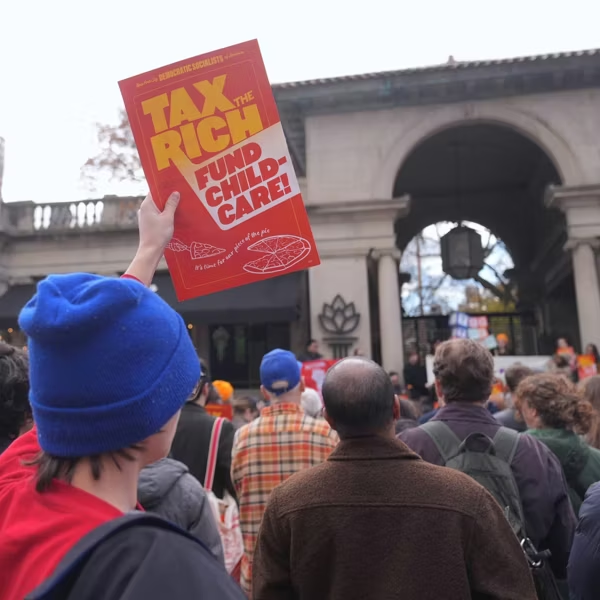
Sen. Bernie Sanders (I-Vt.) holds a “Tax the Rich” rally at Lehman College to press New York Gov. Kathy Hochul to raise taxes on millionaires in New York City on March 29, 2026.
(Photo by Selcuk Acar/Anadolu via Getty Images)


Stephen Prager
Mar 31, 2026
COMMON DREAMS

As billionaires nationwide rally to stop tax increases on the wealthy, US Sen. Bernie Sanders stepped in to “clear things up” for one of Wall Street’s top power brokers after he railed against the proposal.

Following in the footsteps of California, where a popular ballot initiative to impose a one-time 5% tax on the state’s 200 billionaires has gained steam, Sanders (I-Vt.) and Rep. Ro Khanna (D-Calif.) introduced their own federal proposal earlier this month to tax those with net worths of more than $1 billion 5% of their annual household wealth.


‘The Current Tax Code Is Rigged,’ Plus 6.2 Trillion Other Reasons to Tax America’s Ultrarich


Nationwide General Strike Planned for May 1: No Kings Organizer

The proposal is projected to raise $4.4 trillion over the next decade to provide direct payments to lower-income Americans, reverse Republicans’ cuts to Medicaid and Affordable Care Act spending, expand Medicare, and build millions of affordable housing units, among many other expenditures.

Jamie Dimon, the CEO of JPMorgan Chase, who is worth about $2.8 billion according to Forbes, appeared on Fox News on Tuesday and was asked by anchor Brian Kilmeade about Sanders’ frequent accusations that billionaires “don’t pay their fair share” in taxes.

“I don’t know what he means by fair share,” Dimon said. “I’ve listened to that my whole life, and I don’t know what he means.”

The two did not address the facts that may have led Sanders to draw such a conclusion. For instance, the senator often notes that fewer than 1,000 billionaires own more wealth than the bottom half of the US, around 175 million people.

Those billionaires also manage to pay a lower effective tax rate than the average American by wielding loopholes that allow them to exempt large chunks of their fortunes.

Sanders took to social media to respond to Dimon’s incredulity about his idea of “fairness.”

“Ok, Jamie: Let me clear things up for you,” the senator wrote. “If my 5% wealth tax on billionaires was enacted, you’d owe $135 million more in taxes, and a family of four making $150,000 or less would receive a $12,000 payment.”

“Oh, and you’d still be worth more than $2.5 billion,” Sanders added. “Seems pretty fair to me.”


Dimon’s remarks came as billionaires are in a full-blown panic over the proposal for a one-time 5% tax in California, which is projected to raise about $100 billion, mostly to cover the Medicaid funding shortfall caused by the massive cuts in last year’s GOP budget law.

A poll earlier this month showed that the measure, which will be put to voters in November, has about 2-1 approval, despite a more than $80 million effort by the state’s elite—most notably Google co-founders Sergey Brin and Larry Page—to stop it in its tracks.

Dimon himself is not known to have contributed to the effort. But during his Tuesday appearance on Fox, he echoed one of the movement’s oft-used talking points: that raising taxes on the rich leads to an “exodus” of wealth from financial hubs like New York and California.

As Forbes senior contributor Teresa Ghilarducci explained late last year, “Decades of economic research show that billionaire ‘flight’ is rare, exaggerated, and often confused with tax avoidance through accounting maneuvers rather than physical relocation.”

Christopher Marquis and Nick Romeo similarly said last month in a piece for TIME that “despite multiple debunkings, the ‘millionaire exodus’ panic remains a popular narrative,” even though it is “frequently based on biased or sloppy arguments where anecdote replaces systematic evidence, correlation poses as causation, and every modest redistributive proposal is framed as an existential threat to prosperity.”


Renault says developing ground-based military drone


By AFP
March 30, 2026


Renault image: — © AFP/File Jewel SAMAD

French carmaker Renault said on Monday it was developing a ground-based drone for military and civilian use as Europe scrambles to boost weapons production in the face of Russian aggression.

French industry magazine L’Usine Nouvelle said that the carmaker is working in partnership with the Belgian group John Cockerill, which owns the main French supplier of military vehicles Arquus.

“Our R&D teams are testing and exploring various options, such as ground robots, which also have potential for civilian applications,” Renault said in a statement to AFP.

“This is an exploratory study project,” the company said without confirming the name of the partner company.

The car manufacturer said that it had been contacted by the defence ministry earlier this year.

“Our R&D teams are working on various projects in the defence sector, while also seeking civilian applications in each case,” added Renault.

According to L’Usine Nouvelle, the land drone prototype that Renault is developing is said to be the size of a small car and is expected to be unveiled at the Eurosatory international defence and security exhibition in June.

Designed for battlefield reconnaissance, it resembles a lunar rover equipped with several suspended cameras, according to the specialist publication.

In January, Renault said it was teaming up with Turgis Gaillard, a French defence group, to produce aerial drones in France.

Aerial and terrestrial drones have redefined the nature of war in recent years.

Last week a top NATO commander, Pierre Vandier, said NATO countries must respond to challenges such as Russia and Iran mass-producing drones, whose capacities are rapidly evolving.
Chinese robotaxis stall in apparent ‘malfunction’: police


By AFP
April 1, 2026


Baidu's driverless taxi service began charging for rides in Beijing in 2021 and operates in designated areas across several cities - Copyright AFP Pedro PARDO

A string of self-driving robotaxis owned by Chinese internet giant Baidu stalled in central China, stranding passengers after an apparent “system malfunction”, police said Wednesday.

Local authorities in Wuhan, Hubei province, began receiving calls “one after another” on Tuesday night about “multiple Apollo Go cars stopped in the middle of the road, unable to move”, police said in a statement.

Apollo Go is Baidu’s driverless taxi service which began charging for rides in Beijing in 2021 and operates in designated areas across several cities.

“After investigation, preliminary findings suggest the cause was system malfunction,” police added, without specifying how many cars were impacted.

Social media users shared videos of themselves attempting to contact customer service from inside their stalled robotaxis as other vehicles passed by.

“Apollo Go, are you paralysed?” one person wrote on social media, alongside a video of unanswered calls to the company dialled from an in-car tablet.

The light green Apollo Go logo was visible on the steering wheel.

The social media user said they were “stuck” in the middle of the road for more than 30 minutes.

Baidu did not immediately respond to AFP’s request for comment.

The company has announced deals to have its cars on popular rideshare apps Lyft and Uber and is seeking to expand its presence outside China.

In the fourth quarter of 2025, Apollo Go delivered 3.4 million driverless rides, with total rides increasing over 200 percent compared to the same period a year prior, according to company filings.

The company has a fleet of more than 500 driverless cars in Wuhan.
Italy delays coal phase-out by over a decade


By AFP
March 31, 2026


Italy's delay to its phase-out of coal runs contrary to EU climate goals. - Copyright AFP Shammi MEHRA


Ella IDE

Italy’s parliament voted Tuesday to delay the closure of the country’s coal-fired power stations by over a decade, a move experts slammed as “worrying” political propaganda.

In a fresh challenge to the EU’s green transition, Giorgia Meloni’s hard-right coalition government pushed the shutdown back from 2026 to 2038 on “energy security” grounds.

Italy is heavily reliant on imported gas and Rome is under pressure from industry and consumers over the rise in already sky-high energy costs due to the Middle East war.

While Brussels insists that phasing out coal is key to achieving the EU’s climate goals, Rome says it may be forced to use its coal-fired power stations if gas prices continue upwards.

But experts who spoke to AFP said that reactivating the plants would not lower electricity prices.

Italy’s move comes as others including Germany, South Korea, the Philippines and Japan, have similarly signalled that coal-fired plants could ease energy woes caused by the war.

The Italian government’s bill extending the phase-out was approved by the lower house of parliament Tuesday, and now goes to the Senate, where the ruling coalition has a majority.

The delay is “a worryingly backward-looking political signal”, while “any security gain is far from guaranteed”, Beatrice Petrovich, senior energy analyst at energy think tank Ember, told AFP.

Only Germany, Poland, and Bulgaria share a coal phase-out date as unambitious as Italy’s new one, she said.

The EU’s climate commissioner, Wopke Hoekstra, who was in Rome Tuesday for a hearing with senators on Italy’s energy mix, declined to comment on Rome’s decision.


– ‘Old fleet’ –


Climate think tank ECCO said Rome’s postponement was “symbolically damaging, but low-impact in practice — at least for now”.

“The government is deliberately maintaining ambiguity between ‘not dismantling’ and ‘actually using’ coal plants for political gains”, it said.

Italy currently has four coal-fired power stations. Two of them are on the mainland, are dormant and lost their authorisation to burn coal in January, ECCO said.

Restarting them would mean applying for new permits, a process that takes years and would be subject to significant legal and community opposition, it said.

The other two are in Sardinia, and are earmarked for closure in 2028-2029, once the island is electrically linked to the mainland via a new submarine cable.

ECCO’s Executive Director Luca Bergamaschi told AFP Italy’s “old and largely non-operational coal fleet would be very expensive to restart”.

Petrovich agreed that “coal plays a minor role in Italy’s power mix and this won’t change going forward”.

Italy’s total coal generation in 2025 was approximately 2,975 GWh, and less than 1 percent of national electricity output, according to state-controlled power grid operator Terna.

There is no financial incentive for operators to return to coal, and the price of coal imported to Europe has recently surged, the experts said.

Coal is also uncompetitive against gas under the EU’s carbon tax scheme.

Including it in the energy security tool-kit “risks being an additional burden on Italy’s electricity consumers, who already pay some of the highest electricity prices in the EU”, Petrovich said.