Tuesday, May 26, 2026


Brazil is prosecuting a union leader for Palestine solidarity
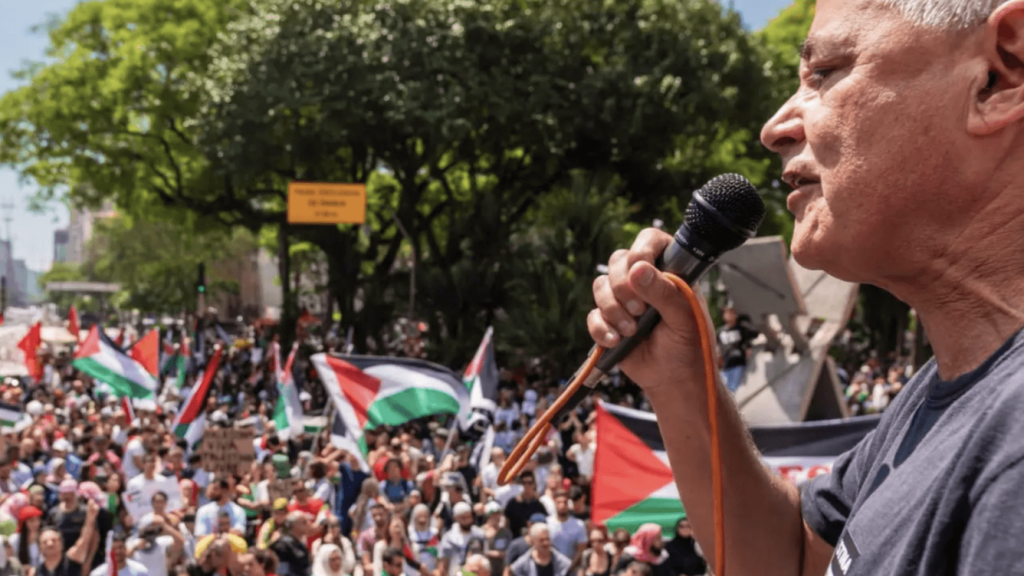

Zé Maria

First published at Counterpunch.

The conviction of Brazilian worker of union and political leader José Maria de Almeida is not simply a case of judicial overreach or a dispute over the boundaries of political speech. It marks a new phase in the use of antisemitism law as a weapon against militant currents in the labor movement — particularly those that link working-class struggle to international solidarity with Palestine.

On April 28, a federal court in São Paulo sentenced de Almeida — known as Zé Maria, national president of the Unified Socialist Workers’ Party (PSTU) — to two years in prison for racism. The charge stemmed from a speech he delivered at an October 2023 rally in solidarity with Palestinians, in which he denounced the Israeli state and invoked the slogan “Free Palestine, from the river to the sea.” The complaint, filed by the Israeli Confederation of Brazil (CONIB) and the Israeli Federation of the State of São Paulo (FISESP), argued that such statements constituted antisemitism. The court agreed. (Read the full court ruling here)

Zé Maria is not a marginal figure. He is a veteran of Brazil’s labor struggles. A metalworker, he was first arrested in 1977 for distributing May Day pamphlets under Brazil’s military dictatorship and again in 1980 during the historic ABC region strikes alongside Luiz Inácio Lula da Silva. He helped found the Workers’ Party (PT) and later broke with it over its accommodation to ruling-class alliances, going on to build the PSTU and the CSP-Conlutas union federation. He represents a current of independent, combative unionism that has consistently opposed both neoliberal restructuring and the political subordination of labor to electoral projects.

That such a figure can now be criminally prosecuted for a speech delivered at a political rally signals a shift in terrain. What is at stake is not simply the policing of rhetoric, but the imposition of new legal limits on the forms of internationalism that sectors of the labor movement are permitted to express.

For American readers, the stakes are immediate. The same legal logic that convicted Zé Maria — rooted in the conflation of anti-Zionism with antisemitism — has been codified in the International Holocaust Remembrance Alliance (IHRA) working definition, which 47 countries have adopted. The United States has enshrined it by executive order, and the Department of Education now uses it to prosecute discrimination complaints under Title VI of the Civil Rights Act. What is happening to Zé Maria in São Paulo is a warning about what is coming for the American left if we do not fight back.

From dictatorship-era militancy to criminal court

Zé Maria’s trajectory is inseparable from the history of Brazil’s working-class movement. Born in 1957, he became politically active during the final decades of military rule. His arrests in 1977 and 1980 placed him squarely within the wave of labor militancy that helped destabilize the dictatorship and usher in a new era of working-class organization.

In the early 1980s, he participated in the founding of both the PT and the Central Única dos Trabalhadores (CUT), Brazil’s largest union federation. In 1988, he led the Mannesmann strike, during which workers occupied the factory and maintained production under their own management. He served on the CUT’s national board. But by the 1990s, as the PT increasingly oriented toward institutional alliances and governance, Zé Maria broke with the party. He later helped found CSP-Conlutas, a union federation committed to political independence from the state and to linking workplace struggles with broader social and international causes. Today, CSP-Conlutas represents more than 2 million affiliated workers across Brazil.

This trajectory matters for understanding the present case. Zé Maria does not simply represent “the left” in the abstract. He embodies a specific political current within the labor movement — one that insists on independence, militancy, and internationalism.

A speech recast as a crime

The charges focused on statements Zé Maria made at a public rally in solidarity with Palestinians, where he sharply criticized the Israeli state and defended Palestinian resistance. Prosecutors argued that these statements constituted antisemitic racism rather than political critique. The court accepted this argument, convicting him under Brazil’s anti-racism law and sentencing him to two years in an open regime, along with a fine.

The defense argued that his remarks were protected political expression under Brazil’s constitution and pointed to Jewish organizations internationally that hold similar positions. Jewish Voice for Peace, the largest progressive Jewish anti-Zionist organization in the world, stated in a June 2025 amicus brief that “anti-Zionism means supporting justice for the Palestinian people, including their right to live in freedom and equality.” These arguments were rejected. In the court’s reasoning, the State of Israel was treated as representative of a “Jewish collectivity,” collapsing the distinction between a political project and a people.

Zé Maria rejected the ruling in unequivocal terms. In a May 1 address, he declared: “This sentence has no basis — historical, political, or legal. It is based on the worn-out arguments that the Zionist movement uses to try to defend the indefensible — the genocide of the Palestinian people — and to try to silence criticism of the racist, colonialist, Zionist State of Israel.”

Writing in Folha de S. Paulo, he clarified the distinction at stake: ” Antisemitism is racism, which I repudiate with all my might. Zionists make up a political movement — Zionism, whose racist and colonialist ideology is the basis of the State of Israel.”

By redefining political criticism of a state as an attack on an ethnic or religious group, the ruling establishes a mechanism through which specific political positions can be recast as forms of racism — and therefore subjected to criminal sanction.

Why target a union leader?

The choice of target is revealing. In recent years, Palestine solidarity has increasingly taken root within organized labor. In Brazil, one of the most consistent expressions of this trend has come from CSP-Conlutas, the independent union federation that Zé Maria helped build after breaking with the PT-aligned CUT.

CSP-Conlutas has positioned itself as an alternative pole within the labor movement: critical of the PT’s alliances with business sectors, opposed to austerity measures, and committed to an internationalist politics that links domestic struggles to global ones. As detailed in a May 2026 profile of Zé Maria, the federation is characterized by its effort to “articulate union struggles with broader social movements.” Its support for the Boycott, Divestment, and Sanctions (BDS) movement and its participation in solidarity initiatives with Gaza are not peripheral stances, but integral to its political orientation.

From this perspective, the prosecution of Zé Maria appears less as an isolated response to a controversial speech than as an attempt to discipline a specific current within the labor movement — one that insists on maintaining political independence and articulating solidarity across borders. By recasting anti-Zionist positions as forms of racism, the legal system creates a mechanism through which such currents can be delegitimized and potentially criminalized.

This dynamic is particularly significant in a context where much of Brazil’s institutional labor leadership remains tied to the governing coalition. Independent federations like CSP-Conlutas — which represents more than 2 million workers — retain the capacity to mobilize opposition and connect workplace struggles to broader political questions. Targeting one of their most prominent leaders sends a clear signal: certain forms of militancy — especially those that extend beyond national boundaries — may now fall outside the limits of legally acceptable politics.

Zé Maria himself has framed the case in collective terms, calling for unity across political differences to build a non-sectarian united front: “I call on everyone, to political and popular organizations, regardless of whether they agree with the PSTU or not, to unite to defend basic things: the democratic right of every citizen to express their opinions.”

The implications extend far beyond any single organization. If positions like his can be treated as criminal offenses, then unions, rank-and-file networks, and social movements that adopt similar stances may face comparable risks. What is at stake is whether the labor movement can continue to articulate an independent internationalism at all.

The legal weapon: Antisemitism frameworks and the IHRA

The broader significance of the case becomes clearer when situated within the growing international use of the International Holocaust Remembrance Alliance (IHRA) definition of antisemitism. While presented as a nonbinding “working definition,” the IHRA framework has increasingly been incorporated into legal and institutional settings, where its accompanying examples — including those that equate certain forms of anti-Zionism with antisemitism — take on practical force.

Forty-seven countries have adopted the IHRA definition in some form. Brazil was one of them under Jair Bolsonaro, who joined the IHRA in 2021. The Lula administration withdrew from the IHRA in July 2025, but the framework has reemerged through judicial interpretation and proposed legislation. Bill 1424/2026, introduced by Congresswoman Tabata Amaral (PSB-SP), would formally codify the IHRA definition and treat the State of Israel as a “Jewish collectivity.” If enacted, activists involved in boycott campaigns could face up to five years in prison.

The irony is unmistakable. In July 2025, Amaral formally questioned the Foreign Ministry about Lula’s IHRA withdrawal. Now she leads the charge to enshrine the same definition Lula rejected.

The IHRA definition has become US government policy

In the United States, the same legal framework is now official policy. Since 2019, Executive Order 13899 has directed the Department of Education to consider the IHRA definition when evaluating antisemitic discrimination under Title VI of the Civil Rights Act — which applies to virtually every public and private university receiving federal funding. The Antisemitism Awareness Act of 2025 (S. 558), currently pending in the Senate, would codify this into law.

A turning point came in March 2025, when Mahmoud Khalil, a Columbia University student and Palestinian refugee, was arrested by ICE. Columbia, facing the loss of $400 million in federal funding, formally adopted the IHRA definition in July 2025.

This pattern extends beyond the United States. In Germany, more than twelve thousand “Gaza-related” criminal cases have been opened against activists. In France, a proposed IHRA-based law would criminalize calling for the destruction of a state recognized by France; UN experts condemned the bill in April 2026, stating that “criticism of Israel and Zionism does not constitute antisemitism.”

While the specific legal frameworks differ, the pattern is consistent: political positions associated with solidarity with Palestine are increasingly reframed as forms of extremism or discrimination, enabling their regulation through legal means.

Leading voices against the weaponization of antisemitism

Criticism of the IHRA framework has come from many quarters — including from its own drafter. Kenneth Stern, who wrote the IHRA working definition, has warned against its use as a regulatory tool, insisting it was intended only for data collection. More than 300 scholars have since developed the Jerusalem Declaration on Antisemitism (2021) as an alternative framework, emphasizing that criticism of Israeli state policy and Zionism is not inherently antisemitic. And more than 700 Jewish faculty members have signed statements rejecting the IHRA definition, arguing that “criticism of the state of Israel, the Israeli government, policies of the Israeli government, or Zionist ideology is not — in and of itself — antisemitic.”

Similar critical voices have risen in Latin America. Argentine artist-publisher Dani Zelko has written on dismantling hegemonic Jewish identity in the context of the Palestinian genocide. In Brazil, journalist Breno Altman has argued that anti-Zionism is a political critique, not racism, and that before Zionism, Palestine was one of the safest places for Jews.

US labor and academic opposition to IHRA

American unions and academic associations are not waiting for Zé Maria’s fate to be decided in São Paulo. They have already started fighting back — because they know that what happened to him could happen here.

In New York City, public-sector workers are putting their pension funds on the line. At least four unions have passed divestment resolutions, refusing to let their dues bankroll what they call apartheid and genocide. Local 1113 declared in April 2026 that it “refuses to allow its members’ dues to financially support apartheid, persecution and genocide” and called for divestment from Israeli companies. Local 3005 followed suit in September 2024, with its president stating: “Divesting from genocidal violence is more important than ever.”

The Massachusetts Teachers Association passed a resolution in June 2025 rejecting the IHRA definition outright — arguing it has become a political cudgel to silence pro-Palestinian advocacy. For the MTA, this is a matter of academic freedom and First Amendment rights.

Then there is the AAUP. Under its new president, Todd Wolfson, the organization has embraced a more confrontational posture. That shift is visible in the AAUP’s formal rejection of the IHRA definition. The association has sent letters to the Department of Education opposing its adoption and has listed refusal of the IHRA definition as an explicit demand. In September 2025, the AAUP’s Committee A on Academic Freedom and Tenure argued that the Trump administration has “used antisemitism as a smokescreen” to attack universities. Read the AAUP’s position here.

The most aggressive institutional pushback has come from the California Faculty Association, representing faculty across the 23-campus California State University system. The CFA’s Palestine, Arab, and Muslim (PAM) Caucus has over a hundred members and states flatly that “anti-Zionism is categorically not antisemitism.” In March 2024, the CFA Board joined the National Labor Network for Ceasefire statement. The union’s LA chapter was even earlier, endorsing a ceasefire in November 2023. When Cal Poly Humboldt students were disciplined for pro-Palestine protests, the CFA condemned “police brutality and continued repression”. At the CFA’s 2026 Equity Conference, the union hosted a panel on “ detangling antisemitism,” arguing the term “has become so elastic…that it now obscures more than it clarifies.”

Beyond these institutions, two networks are doing real organizing. Labor for Palestine National Network (L4PNN) works inside unions, helping workers distinguish anti-Zionism — a political critique — from antisemitism, racism against Jews. They have produced toolkits for labor activists facing IHRA weaponization. (Find them at Labor for Palestine.)

The Coalition for Action in Higher Education (CAHE) operates on campuses, helping educators fight back through faculty senate resolutions, teach-ins, and legal defense for colleagues targeted by Title VI complaints. CAHE’s annual National Days of Action have involved more than 200 campus actions nationwide.

This is not an academic abstraction. These networks — and unions like the CFA — are building the resistance the moment demands. They know that the legal weaponization of antisemitism is already here. The only question is whether we organize against it now, or wait until it’s our turn in court.

Brazil labor’s response — and what is at stake

The response from Brazil’s labor movement has been notable for its breadth. On April 29, nine national union centrals — including CUT, Força Sindical, and CSP-Conlutas — issued a joint note condemning the conviction as “a serious attack on freedom of expression and a restriction on international solidarity,” situating it within “a broader context of persecution of voices that denounce what they classify as genocide of the Palestinian people.”

On May 7, the National Federation of Federal Judiciary Workers (Fenajufe) issued a motion of support warning that “political manifestations, especially those linked to international solidarity among peoples, are being criminalized,” calling the ruling “a worrying precedent” for “the entirety of trade union organizations and social movements.”

The Rio de Janeiro State Union of Education Professionals (Sepe-RJ) added: “If today they seek to silence Zé Maria, tomorrow they may try to silence teachers, students, and workers who rise up against injustices.”

These responses reflect a clear understanding of what is at stake. If the legal reasoning applied in this case is generalized, it could reshape the terrain on which unions operate. Positions taken in solidarity with international struggles could expose individuals to legal liability. More broadly, the ability of labor organizations to articulate independent political perspectives could be curtailed through the selective application of criminal law.

Zé Maria has warned explicitly about this trajectory: “If this trend catches on, Zionism will have succeeded in transforming the Brazilian justice system into an instrument for defending the atrocities committed by Israel. And those who dare to criticize the killing could be imprisoned.”

What is at issue, then, is not only the fate of a single union leader, but the future of a particular kind of labor politics — one that seeks to connect workplace struggles with global questions and refuses to confine itself within the limits of state-sanctioned discourse.

International solidarity Is needed

Zé Maria’s appeal is pending before the Federal Court of São Paulo (TRF3). Bill 1424/2026 is pending in the Chamber of Deputies. International solidarity can make a difference — especially when it comes from U.S. unions. In the U.S., activist and union organizations can sign the international petition for Zé Maria’s acquittal and, if possible, send solidarity motions from their unions or organizations to internacional@cspconlutas.org.br.

Zé Maria closed his Folha op-ed with a rallying cry that now resonates across borders: “They will not silence us. And Palestine will be free, from the Jordan River to the sea.”

Blanca Missé is an Associate Professor of Cinema at San Francisco State University, a member of the San Francisco State University Chapter of the California Faculty Association, the Ukraine Solidarity Network, the Labor for Palestine National Network, and a militant of Workers’ Voice.

 

Why Australian governments support Israel — and why it is important to get that right

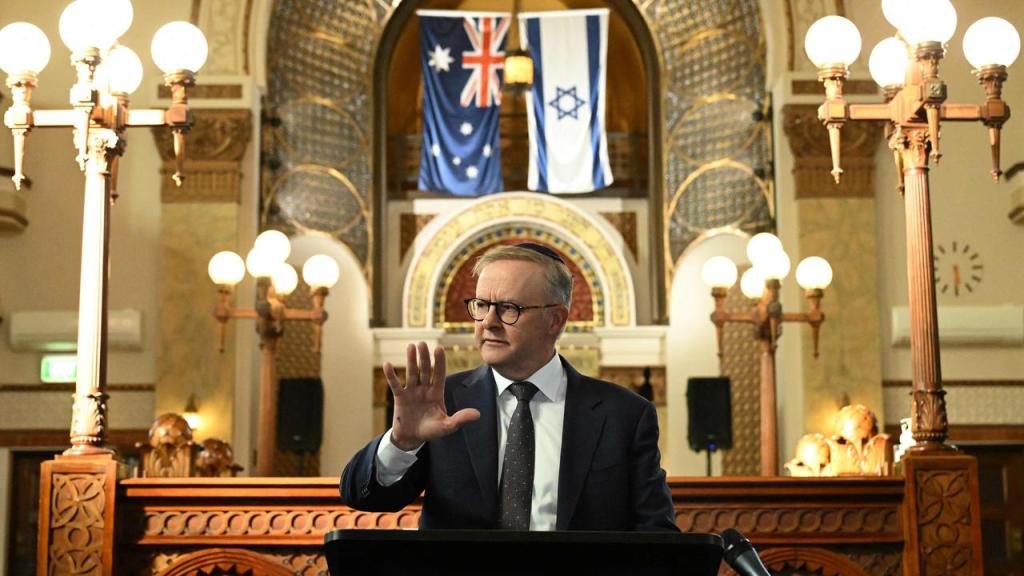
Albanese Australia Israel flag

First published at Revitalising Labour.

On April 28 and April 29, Andrew Brown published two articles on Michael West Media exploring the role of the pro-Israel lobby in Australian politics. Central to his argument is that the lobby has successfully purchased the Australian government, subordinating it to Israeli state interests, and that the enforcement arm of that operation suppresses any politician, journalist, or institution that steps out of line. Similar arguments have circulated widely among people horrified by Israeli state conduct and confused about why the Australian government has not acted more forcefully. Brown’s articles are a clear and serious articulation of that frame.

I believe the frame is mistaken. And getting it wrong has consequences, not just for the quality of the analysis but for the political possibilities it opens and closes. I want to offer a different explanation: that Australia’s deference to Israeli interests is primarily a consequence of its strategic alliance with the United States, and the identification by Australian capital of its own interests with that alliance. That explanation accounts for everything Brown’s frame accounts for, and accounts for things Brown’s frame cannot.

Before developing that argument, a clarification is necessary. I am not arguing that the lobby does not exist. It clearly does. Nor am I arguing that Israel does not exercise significant influence through soft power initiatives directed at Australian politicians and journalists. It does, in ways similar to what other states do, including states Australia treats as hostile. Brown is correct that the Israel lobby is treated more positively than Chinese-aligned influence operations. But I believe this asymmetry reflects the perceived strategic interests of the Australian ruling class, not state capture by the lobby or the Israeli state. The lobby has weight because it operates within a framework of shared interests. That is a fundamentally different thing from having purchased the framework.

Australia is also a colonial settler state built on the dispossession of First Nations people. There is a dimension of Australian capital’s identification with Israel that flows from this, a recognition of itself in Israel’s position that shaped the pre-existing sympathies within which the strategic alliance argument operates. That sympathy shifted in relation to apartheid South Africa under the pressure of social movements, with Australia playing a significant bridging role within the Commonwealth, aligning with Global South pressure for meaningful action against British resistance, and helping translate that pressure into the financial sanctions that proved decisive. The same possibility exists in relation to Israel, which is part of why getting the analysis right matters for what political action is available.

What Brown gets right

Brown’s two articles do real investigative work that deserves to be taken seriously. The documentation of the AIJAC trip program — fourteen trips over four years to Israel for Coalition MPs, part of a broader pattern in which Israel sits alongside the US and Taiwan as a leading destination for foreign-funded parliamentary travel, is a legitimate transparency concern regardless of how you explain it. The Federal Court finding in Antoinette Lattouf’s unfair dismissal case confirmed that the ABC had breached the Fair Work Act by terminating her engagement on the basis of political opinion, with the judge finding the ABC had “abjectly surrendered the rights of its employee to appease a lobby group,” and the WhatsApp campaign by Lawyers for Israel directed at ABC management is a matter of public record. The Mossad passport forgery operation and the anonymous national security official’s assessment quoted by Peter Hartcher that Israel knows “they’ve got us by the balls, partly because of the Israel lobby” are documented facts. The asymmetry between the Segal plan — with its proposed monitoring powers over media and universities, and the subsequently and reluctantly appointed Islamophobia envoy with no equivalent powers is real and worth scrutinising. These are legitimate concerns. The question is not whether they exist but what explains them ,and that requires starting with how Australian foreign policy is actually constructed.

The US alliance and Australian foreign policy

Australia has understood its security and economic interests as bound to the US alliance since the Second World War, when the Curtin government’s explicit turn to America replaced the British Empire as the primary strategic anchor. Australian capital has identified its regional interests; trade, investment, security architecture, with the continuation and reliability of that alliance ever since. This institutional commitment shapes Australian foreign policy across all domains, including its relationship with Israel, which is a strategic partner of the United States. For the fuller development of how this operates in the current moment, see Alliance deference, not Trumpism.

The historical construction of the US-Israel relationship

The United States was not initially a supporter of Israeli statehood. Truman overrode State Department opposition in 1948, and the early relationship was ambivalent. When Israel, Britain, and France invaded Egypt during the 1956 Suez crisis, the US forced all three to withdraw, Australia was notable among Commonwealth nations for supporting Britain’s position rather than the US, illustrating the prior stage of British imperial deference before the transition to the US alliance framework was complete. The lobby existed in the US. The strategic assessment overrode it.

The relationship changed sharply after the Six-Day War in 1967. Israel’s military defeat of the combined forces of Egypt, Jordan, and Syria, armies armed and trained by the Soviet Union, demonstrated that Soviet military capacity could be defeated in the field. Both this military demonstration and the converging strategic pressures of oil, Cold War competition, and post-colonial instability together produced the shift. The lobby grew in influence within that space. It did not create it.

The next significant shift came with the Camp David Accords of 1978 and the Iranian Revolution of 1979. Camp David was US imperial realpolitik executed with precision, offering Egypt the return of the Sinai Peninsula and economic support in exchange for its permanent removal from any future Arab military coalition against Israel. The Multinational Force and Observers established in the Sinai as the structural guarantee of that agreement remains there today, with Australian troops among its participants since 1982. The fall of the Shah the following year removed the other primary US regional partner simultaneously. This combination left Israel as the only remaining anchor of US strategic architecture in the region, producing the depth of US commitment that has characterised the relationship ever since.

The weight of the lobby flows from the strategic need, not the other way around. When the strategic assessment shifts sufficiently, the lobby’s influence will weaken faster than its current organisational strength would suggest, because the power was always primarily the shared interests, not the organisational shell.

Where the frame fails

With that framework established, it is worth noting that the lobby capture thesis, as Brown deploys it, never specifies what it should predict. A thesis used to explain everything, where every piece of evidence confirms it and nothing could disconfirm it, is doing rhetorical rather than analytical work. If capture is genuinely the claim, it should predict capture: no diplomatic protests, no independent commissioners producing unwanted findings, no departures from Israeli government preferences that draw Israeli government criticism. The interest analysis predicts something different: a government that manages the relationship, retains independent judgment on specific questions, and occasionally departs from Israeli preferences when other interests require it. Here is what the evidence shows.

On the Mossad passport operation: Israeli diplomat Amir Laty was expelled, a formal protest registered. AIJAC described the expulsion as “unhelpful” and the Executive Council of Australian Jewry called it “greatly disappointing”, the lobby was unhappy with the response. That is consistent with a government managing a junior partner relationship, not one executing lobby preferences.

The Hartcher quote Brown uses as his strongest evidence, an anonymous official saying Israel has us “by the balls, partly because of the Israel lobby”, describes subordination under pressure, not capture. A captured official wouldn’t resent the constraint or tell journalists about it anonymously. Brown omits the stronger evidence against capture in the same article: a close Rudd colleague stating explicitly that “Israel should not assume that this friendship can be taken for granted.”

Lattouf’s case illustrates how the suppression mechanism operates and its limits. The enforcement worked at the individual level, she was removed from air. The Federal Court then found against the ABC, costing it over $2 million, producing a public judgment that the enforcement had caused unlawful conduct, and establishing a precedent that makes the same strategy more legally costly for future targets. Her journalism questioning claims about chants at a Sydney protest was subsequently supported by the forensic evidence. That is not a captured system. That is an institution that made a serious and costly mistake within a system that retains enough independence to identify and rule against it.

The same institutional independence is visible in the Royal Commission into antisemitism and social cohesion. The right attacked Virginia Bell’s appointment because they believed she wouldn’t deliver the findings they wanted. The government appointed her anyway. The initial focus of the terms of reference, what agencies did wrong in relation to the Bondi attack, was not the lobby’s preference: the lobby wanted the broader antisemitism question front and centre from the outset. The interim report was produced before the public hearings on the antisemitism question. Its more analytically significant finding was that it found no failure of government policy or legislative framework in relation to the Bondi attack, directly contradicting what the right was pushing for. The lobby lost the Bell appointment contest, lost the interim report framing contest, and is now pursuing its objectives through the public submissions process, the rational response of an actor operating within a system it influences but doesn’t control.

The active effort to distort the interim report’s findings, claiming it found things it didn’t find, is itself evidence the process wasn’t captured. The Nightly’s verbatim testimony coverage without qualification, the “imagine” editorial, and the defence of Anzac Day booing as freedom of expression, disruptions organised by people with documented white supremacist connections, reflect selective concern rather than consistent principle. If it were a captured process, the distortion wouldn’t be necessary.

The Scanlon Foundation’s 2024 social cohesion report, cited by the government itself, found that social cohesion had been declining for years before the Palestine solidarity protests began. The social cohesion framing that positions majority public political expression as a threat to social cohesion is itself a social cohesion problem. For the fuller development of this argument see How to undermine social cohesion.

Jillian Segal was making Kristallnacht comparisons in February 2025, before the Bondi attack, which was then absorbed into a pre-existing narrative. The Dural caravan, used to justify rushing hate speech legislation through NSW parliament, was subsequently revealed to be a fabricated criminal plot organised by criminals for personal gain, not an antisemitic terrorist attack. The AFP had believed this for some time. Albanese acknowledged he had known. Independent MP Rod Roberts said parliament was misled and the legislation would not have passed had the truth been known. A captured institution just acts. It doesn’t justify itself, and it wouldn’t reveal that the justification was premised on fabricated information. The disclosure happened because different institutional actors had obligations that pulled toward disclosure rather than suppression.

Brown’s frame also reproduces the unified community thesis, treating Australian Jewish institutional life as a coherent transmission belt for Israeli state interests. The Jewish Council of Australia and the broader network of anti-Zionist Jewish organisations actively oppose Israeli government policy, publicly contest the Segal and lobby agenda, and have engaged seriously with the Palestinian solidarity movement. Virginia Bell, Jewish, independent, producing findings the lobby didn’t want, faced direct hostility for doing so. The unified community thesis, in practice, means Jewish people are acceptable when they perform the required political function and attackable when they don’t.

The desperation and persistent distortion that characterise the response, the Segal and lobby agenda for monitoring powers, the Queensland laws, the WhatsApp campaign against Lattouf, the active misrepresentation of what the interim report found, is not the operation of embedded power at its most confident. It is the operation of embedded power losing its grip. Polling through late 2025 consistently showed strong majority support for stronger government action on Gaza and ceasefire. Public opinion was moving against the lobby’s position even as its institutional presence grew.

What this amounts to is a body actively seeking to capture Australian institutions, and that has not succeeded despite significant resources. The enforcement mechanism is real: the WhatsApp campaigns, the trip programs, the media pressure, the Royal Commission submissions process. It imposes real costs on individuals and produces chilling effects on institutions. But it is inadequate to produce systemic capture. And what the lobby is seeking to enforce is so far removed from what the evidence shows that the enforcement increasingly requires the suppression of reality rather than the management of legitimate disagreement. The Australian government cannot be convinced it has no other interests at play. So it softens its criticism, doesn’t go as far as the evidence warrants, but it does criticise, it does depart, and that is never enough for the lobby because the lobby’s demand is maximalist. Israeli state conduct keeps producing the evidence the enforcement is trying to suppress faster than it can be suppressed.

The antisemitism question

The lobby capture thesis can honestly be read as reproducing structural antisemitic tropes regardless of intent. The attribution of Australian government behaviour primarily to Jewish institutional agency; a coherent, coordinated network of Jewish institutional actors purchasing the compliance of Australian democratic institutions, sits uncomfortably close to older and uglier explanatory frameworks. A frame that locates structural conditions in Jewish collective agency rather than in the political decisions of the Israeli ruling class and the strategic interests of US and Australian capital performs the same explanatory function as the antisemitic shortcut, regardless of intent.

Antisemitism is real. It exists in Australian society and it exists within the solidarity movement. Antisemitic ideas were embedded in ruling class ideology for centuries and remain historically sedimented in the culture that formed the movement and its members. The horror at what is happening in Gaza is real and the moral urgency it generates is legitimate. But that urgency can slide into frameworks that locate the cause of Palestinian suffering in Jewish people as a whole rather than in the political decisions of the Israeli ruling class.

When someone in the movement faces an antisemitism allegation, the correct response is to ensure they have access to a fair process, the specific claim examined on its merits, evidence properly tested, while holding open the possibility that the allegation is true. The minimisation tactics that appear routinely, questioning motives, contextualising the behaviour as understandable given Gaza, explaining why it might not be as serious as it looks, pre-determine the outcome before any examination. The correct motivation is empathy and the basic human standing of the person experiencing the harm, not what it costs the movement.

Content that a fair-minded person reading honestly finds genuinely uncomfortable, not because of how opponents have characterised it but because of what it actually says, is where the movement’s accountability failure is most damaging. When the dishonest actor can lift from reality rather than fabricate, they reach the persuadable middle rather than just confirming the views of people already hostile.

The Jewish Council of Australia and the broader network of anti-Zionist Jewish organisations have demonstrated that both positions can be held simultaneously, acknowledging that antisemitism exists within the left while explicitly rejecting its weaponisation as a suppression mechanism. They have welcomed the interim report’s findings while calling for genuine gun reform. That is the model. They don’t need antisemitism from the solidarity movement on top of that.

The foundational Zionist claim that Israel is necessary for the safety of Jewish people globally is being demonstrated as false by Israeli state conduct itself. When the lobby and Segal characterise ceasefire posters and criticism of Israeli conduct as antisemitism, they suppress the political pressure that would end the conduct producing the actual antisemitism spike, while making genuine antisemitism harder to identify and isolate, because when everything is antisemitism, nothing is.

The movement cannot build a truly just world while reproducing the racism it claims to oppose. Addressing antisemitism seriously is not a concession to the lobby’s agenda. It is a basic requirement of political seriousness about what Palestinian liberation actually demands.

Australian departures from US and Israeli preferences

Australia’s recognition of Palestinian statehood, Penny Wong’s statements calling for Israeli restraint in Lebanon and opposition to further annexation, and Australia’s position that any Iran ceasefire should apply to the whole region all drew Israeli government criticism. When the Israeli government attempted to tie the Bondi Beach shootings to these policy positions, the Albanese government did not recant them.

These are not the actions of a government whose foreign policy has been purchased. The most telling indicator is what the debate is actually about, the argument from those pushing for stronger action is that these positions don’t go far enough, not that they don’t exist. A captured government doesn’t generate that debate.

The Australian media amplifying Netanyahu’s attacks on ALP departures reflects the same alliance deference logic that shapes Australian government behaviour, an institutional culture that tries to read what the US interest requires before taking a position. The Nightly is the most explicit expression of this: a dedicated US politics tab, coverage extending to what US late night hosts say about Trump, editorial architecture that treats Australian political culture as a satellite of US political culture. This is not lobby capture. It is institutional orientation that has so thoroughly internalised the identification of Australian interests with US interests that departing from it feels like departing from the responsible centre.

Independence from Israeli preferences in relation to Lebanon is not new. Australia has maintained personnel as part of UN peacekeeping and observation operations in southern Lebanon, specifically mandated to observe and report violations of UN Security Council resolutions, with those reports flowing through Australian command, and the Multinational Force and Observers in the Sinai for decades. An Australian officer was wounded while conducting a routine UN patrol to inspect the Blue Line, confirmed publicly by the Department of Defence and reported by the ABC. Australia subsequently joined a statement by the MIKTA foreign ministers, Mexico, Indonesia, the Republic of Korea, the Republic of Türkiye, and Australia, condemning attacks on UN peacekeepers. A government fully subordinate to Israeli interests would simply not maintain that institutional architecture. The IDF does not fire on the assets of a captured system.

The departures are not anomalies requiring explanation. They are evidence that the ALP makes its own judgements about where Australian capital’s interests lie, and occasionally concludes they diverge from what Israel or the US want. The lobby has influence within that framework. It does not override it.

The current crisis in the US-Israel relationship

The strategic rationale that constructed the US-Israel relationship is now running in reverse. Israel was useful to the United States because it was a capable, reliable regional partner that could project US power without requiring direct US military engagement. That premise has inverted. Gaza stripped US diplomatic credibility in the Global South in ways that no amount of management can restore. The ICC arrest warrants, the ICJ proceedings, the UN Secretary General’s statements, these are the rules-based order’s own institutions producing the verdict on US conduct.

Netanyahu lobbying Trump into the Iran war has accelerated the damage to the point of structural irreversibility. The war had almost no serious internal administration support, what backing it received came primarily from Lindsey Graham. On the day before strikes began, Iran had agreed to zero stockpiling of enriched uranium and full IAEA verification. The US attacked anyway. Any future nuclear diplomacy now takes place against the demonstrated reality that the US cannot be trusted to honour agreements. The war is directly impacting Australia through the closure of the Strait of Hormuz, the economic disruption, and the pressure on the alliance framework, the fuller development of which is in Alliance deference, not Trumpism.

The condemnation of this conduct is being made on principle by people whose entire professional commitment is to defending US imperial interests coherently pursued. Junior State Department officials resigned at personal cost. Democratic senators who attended classified briefings stated they had seen no evidence of an immediate Iranian threat. Senior figures within the national security establishment, including retired military officers associated with groups like The Bulwark and the Lincoln Project, have objected on strategic grounds, though they represent a minority within the retired flag officer community. The objection is significant precisely because it comes from within the institutions most committed to US imperial interests.

The US context is also the strongest available evidence against the lobby capture thesis. The lobby is substantially more powerful in the United States than in Australia. If lobby capture were the correct explanation, the US should show the deepest capture. Instead it shows the most significant internal contestation: 40 out of 47 Democratic senators voting against military bulldozers after AIPAC spent $221 million in Democratic primaries, serious foreign policy figures making the strategic case against the current configuration of the relationship, and that contestation still lagging behind where public opinion already is.

The donor networks that funded the lobby’s weight are struggling to attract donations as the shared interests dissolve. The transatlantic alliance has been significantly fractured and its full recovery seems unlikely. The Israeli right under Netanyahu has pursued conduct actively damaging Israel’s long-term security, its alliance relationships, and the strategic rationale that made the US-Israel relationship so powerful. The lobby defending that conduct is defending the Israeli right against Israeli long-term interests.

The political programme

The analysis matters beyond the intellectual exercise because it determines what political action is available. The lobby capture thesis produces a dead end, if the system is closed, the available responses are exposure and denunciation, neither of which has moved the Australian government’s position on Gaza in years of trying. The correct analysis opens different terrain.

The ALP occasionally makes judgements that specific Australian interests diverge from what Israel or the US want, and those departures are the political purchase points. The correct response to a departure is to defend it, build constituency around it, and push for more. When Australia reinstated UNRWA funding in March 2024, humanitarian organisations defended the decision publicly and clearly. When Peter Dutton called for Penny Wong to be sacked over the decision, the solidarity movement’s response was muted. The humanitarian sector did what the movement needs to do, defend the departure when it came under attack, make the attacker pay the political cost. Leading with criticism that it doesn’t go far enough does the lobby’s work, denying the ALP the political reward for moving and signalling that movement in that direction has no constituency.

The correct response is to take departures seriously on their own terms and demand the concrete steps they imply. Adopt the measures the Hague Group called for, arms embargo, vessel transit restrictions preventing ships carrying arms to Israel from using Australian ports, review of public contracts to prevent support for illegal occupation, and active support for ICC compliance. Condition arms transfers. Use the UNIFIL framework. Each of these is a demand the Australian government could conceivably meet, linked to interests it already acknowledges.

The Royal Commission is an example of the ALP navigating difficult terrain with more skill than its left critics gave it credit for. The government appointed Virginia Bell despite the right’s attacks, moved ahead over lobby objections. The interim report found no failure of government policy in relation to the Bondi attack, directly contradicting what the right was pushing for, and did not sustain the Segal and lobby agenda. The left’s premature condemnation of the commission as captured forecloses the defence of findings worth defending. The right is amplifying testimony through the Nightly to construct an alternative factual record, occupying the public narrative space the left has largely ceded by deciding the outcome in advance.

The starting point for assessing any government action is what the government is doing and why, not what the lobby’s position is. But the analytical work starts from government behaviour and what pressure could produce different behaviour, not from the lobby’s position as the reference frame.

Polling consistently showed strong majority support for stronger action on Gaza and ceasefire through late 2025, despite the lobby’s significant institutional weight. Public opinion was moving against the lobby’s position even as its visible presence grew. A movement that takes the middle seriously, that defends each step in the right direction while pushing for more, that makes precise interest-based demands rather than values-conversion demands that won’t be met, is positioned to translate that public sympathy into political pressure that actually moves governments. The lobby knows the middle is where the contest is. The solidarity movement needs to contest it there.

The goal is not to convert the ruling class. It is to change specific decisions. Getting the analysis right is what makes those decisions visible as targets and the pressure points accessible. The Israeli right is acting against the long-term interests of the Israeli state. The question the solidarity movement needs to be asking is not who to denounce but what to do next.

Van Hollen Says Democratic Party Must End Whitewashing, Admit ‘Complicity’ in Gaza Genocide

“Primary voters won’t trust any Democratic presidential candidate who does not have a record of moral and strategic clarity on these issues.”


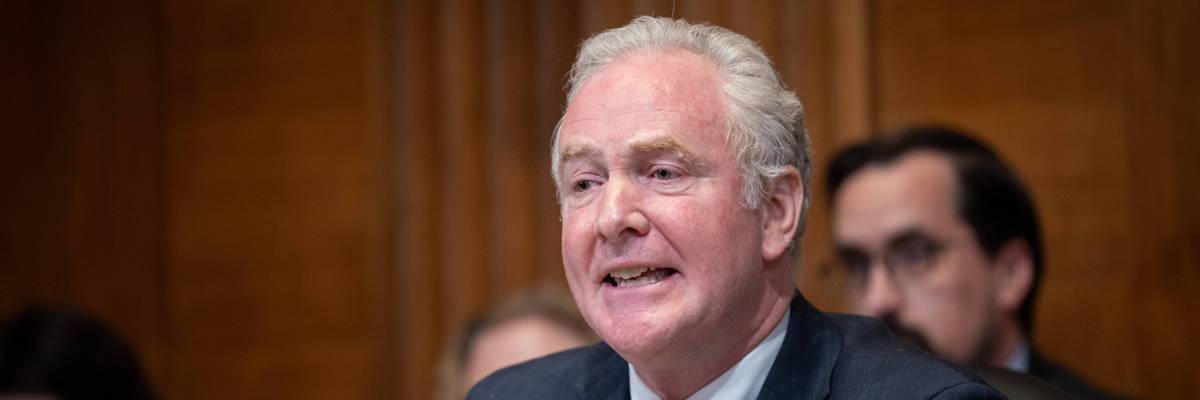
Senator Chris Van Hollen (D-Md.) speaks during a Senate hearing at the Dirksen Senate Office Building in Washington, DC, on May 19, 2026.
(Photo by Nathan Posner/Anadolu via Getty Images)

Stephen Prager
May 26, 2026
COMMON DREAMS


A senior Senate Democrat said his party needs to own up to its “complicity” in Israel’s genocide in Gaza and attacks on Palestinians, and warned against reinstating the foreign policy officials from the Biden administration who have enabled them.

In a New York Times op-ed published Tuesday, Sen. Chris Van Hollen (D-Md.)—a senior Democrat on the Senate Foreign Relations Committee who has visited the occupied Palestinian territories multiple times since October 7, 2023—wrote that “Democrats need to face a hard truth,” that their party “has provided reflexive and unconditional support to Israeli governments, even as their actions have increasingly undermined American interests and values.”

Seeming to recognize the overwhelming shift in opinion against Israel among the US public, and especially Democratic voters, over the last two-plus years, the senator said Americans “do not want to be complicit in ethnic cleansing in the West Bank, or what human rights organizations and scholars have determined to be genocide in Gaza.”

The things he witnessed firsthand while visiting the region—the ruins of Gaza left behind by US-provided bombs, the “apartheid system” in the West Bank, and the accelerating forced displacement of Palestinians by violent West Bank settlers—he said, were the responsibility of “both Republican and Democratic administrations.”

While noting President Donald Trump’s role in legitimizing Israel’s expansionist project during his first term, Van Hollen said former President Joe Biden “failed to reverse most of these actions, even as Israel elected the most extremist government in its history” and after October 7, “failed to use US leverage as Israel imposed devastating collective punishment on the people of Gaza.”

He said Democrats must pursue a “last-gasp effort” to revive the idea of a “two-state solution,” which he acknowledged Israel’s gradual annexation of the West Bank has made increasingly untenable.

“Presidents have paid lip service to that goal even as Israeli settlements stretched into the West Bank. This time must be different. The United States must draw a red line against Palestinian displacement, and we must enforce it,” Van Hollen said, calling for the US to restrict “offensive” weapons to Israel until it agrees to a plan to end the occupation of Palestinian territory and one for a two-state solution.


Van Hollen said “Democrats must stand firm against... headwinds” like the powerful influence of pro-Israel lobbying groups like the American Israel Public Affairs Committee (AIPAC), which has used its vast resources to target candidates who criticize Israel.

“Primary voters won’t trust any Democratic presidential candidate who does not have a record of moral and strategic clarity on these issues, especially if, as a legislator, he or she voted to send [Prime Minister Benjamin] Netanyahu bombs even as his government imposed a total blockade on Gaza,” Van Hollen said. “Nor will they support a candidate who plans to re-enlist the senior Democratic decision makers who whitewashed the truth during the Biden administration and refuse to acknowledge their complicity.”

“Democrats failed to meet the moment in 2024,” he concluded. “Americans were rightly fed up with Democratic hypocrisy and complicity in the gross violation of the values we profess to hold dear. That, in turn, hurt our credibility with voters. We cannot let that happen again.”


Van Hollen’s message comes as many of the senior figures who architected Biden’s “blank check” policy toward Netanyahu attempt to rehabilitate their images in a Democratic Party where Israel is now persona non grata.

As Harrison Mann—an ex-intelligence professional who resigned in protest over Gaza—recently wrote, these officials are “popping up everywhere” in the second Trump era with words of measured contrition.

Former Secretary of State Antony Blinken acknowledged in March during a speech at Harvard that the US “maybe” could have acted more quickly to force Israel to accept a ceasefire, “such that the suffering the people endured, the loss of the children, so many others, could have been averted.” Jake Sullivan, Biden’s former national security adviser, now says that the US should withhold weapons from Israel, a policy he opposed during his time in the White House.

Prior to Van Hollen, another top Democrat, Sen. Brian Schatz (Hawaii), the caucus’s chief deputy whip, made a similar plea—without naming names—that the next Democratic presidential administration cannot simply invite these same establishment figures back into positions of authority.

“I’m not into black listing anyone from future work in their area of expertise, but I do think it’s fair to want a whole new crop of foreign policy staffers in the next democratic administration,” Schatz wrote on social media Sunday. “It’s not like the same 120 people are the only people who know anything.”


Van Hollen has previously been more pointed in saying that figures in both parties who supported the genocide “should be held accountable for US complicity in the man-made humanitarian disaster, indiscriminate killings, and massive destruction we have witnessed in Gaza.”

Adam Johnson, a journalist at The Intercept who recently wrote a book about the role of the media and the Biden administration in “selling” the genocide to the American public, criticized Van Hollen for refusing to use the term directly (instead defaulting to the less explicit phrase “ethnic cleansing”).

However, Johnson said it was a good sign [that] this is becoming more and more conventional wisdom.“ He said the ”next step“ was to ”name names and make specific commitments“ regarding the policies the party should and should not promote in Israel and Palestine.