Thursday, May 28, 2026


China could become a net refined zinc exporter in 2026, analysts say


Stock image.

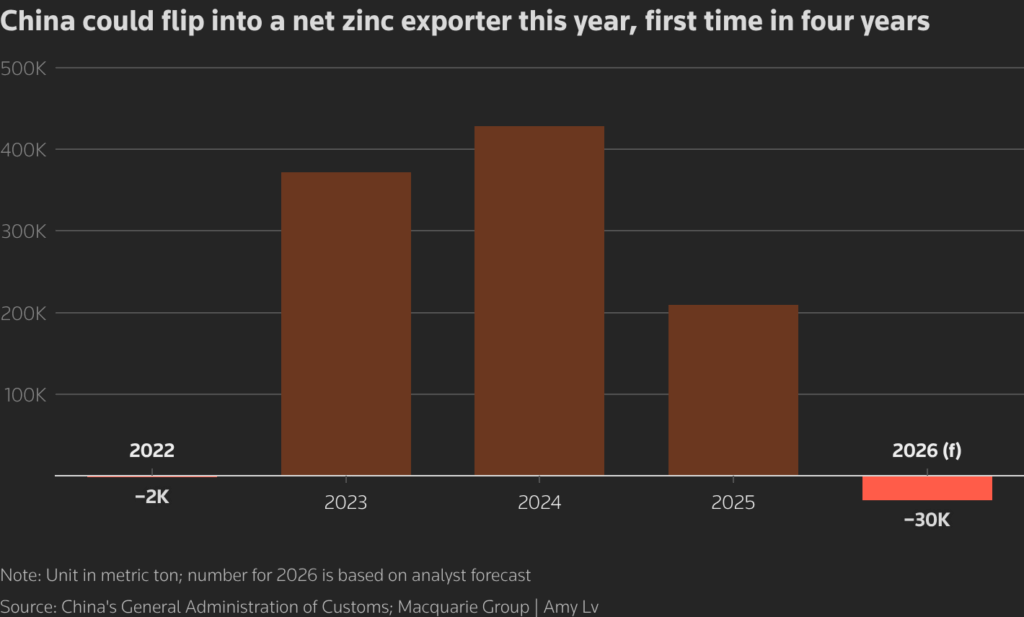
China could export more refined zinc than it imports for the first time in four years in 2026, analysts said, as growing supply and weak demand at home push companies to supply the metal to the world’s markets.

China, which produced roughly half the world’s zinc last year, has long also been a major importer of the metal mainly used to galvanize steel.

However, net refined zinc exports are expected to be 30,000 tons this year, according to Alice Fox, commodities strategist at Macquarie Group, versus 209,767 tons of net imports last year and 428,890 tons in 2024.

At home, the refined zinc supply growth is forecast to outpace demand this year at 4.2% to 1%, according to Fox, as new capacity comes online while demand is still saddled by the struggling property sector.

Meanwhile, the reverse is true in the rest of the world, due to the production suspension or scale-down of smelters in Peru and Kazakhstan because of accidents, tightening supply of zinc concentrate. In addition, production costs have risen due to higher energy costs caused by the US-Israeli war on Iran.

“China got very close to self-sufficiency in refined metal by end-2025,” said Olga Hepting, principal zinc analyst at the CRU Group, a consultancy. “It will likely remain in surplus while the rest of the world is in deficit in 2026, leading to exports, possibly in the third to the fourth quarter.”

Prices outside China are also rising more rapidly than the domestic benchmark. The most-traded zinc contract on the Shanghai Futures Exchange was up 3% this year as of Friday, while the London Metal Exchange’s global benchmark has gained 11%.

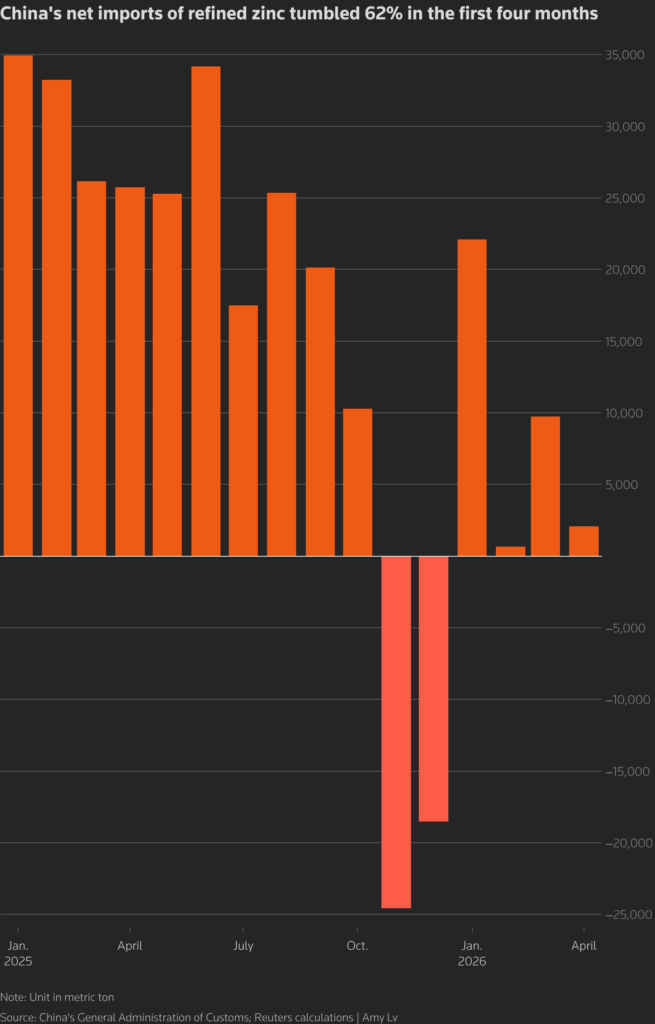
While China was still a net importer in the four months to April, net imports fell 62% from a year earlier, according to Reuters calculations of Chinese import data. Analysts expect the flip to exports to occur in the second half of this year.

To be sure, Hepting noted that should the Iran war drag on, the global hit to demand from higher energy prices could eat into China’s export markets.

(By Amy Lv and Lewis Jackson; Editing by Thomas Derpinghaus)


Chinese firms speed up plans to build new coal power plants: GEM


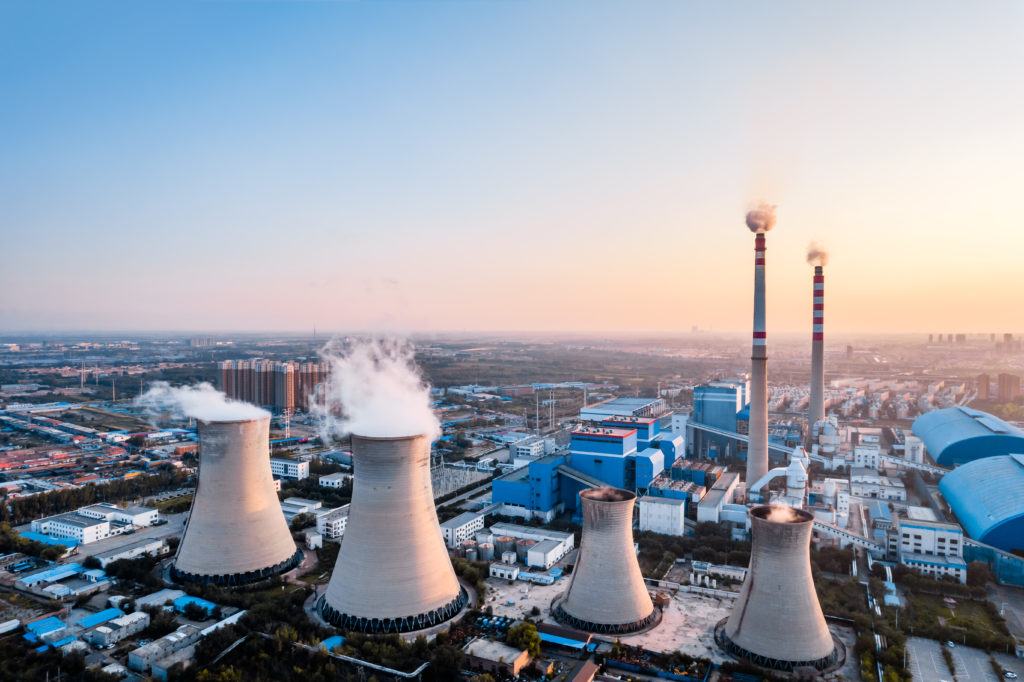
Thermal coal plant in Inner Mongolia, China. Stock image.

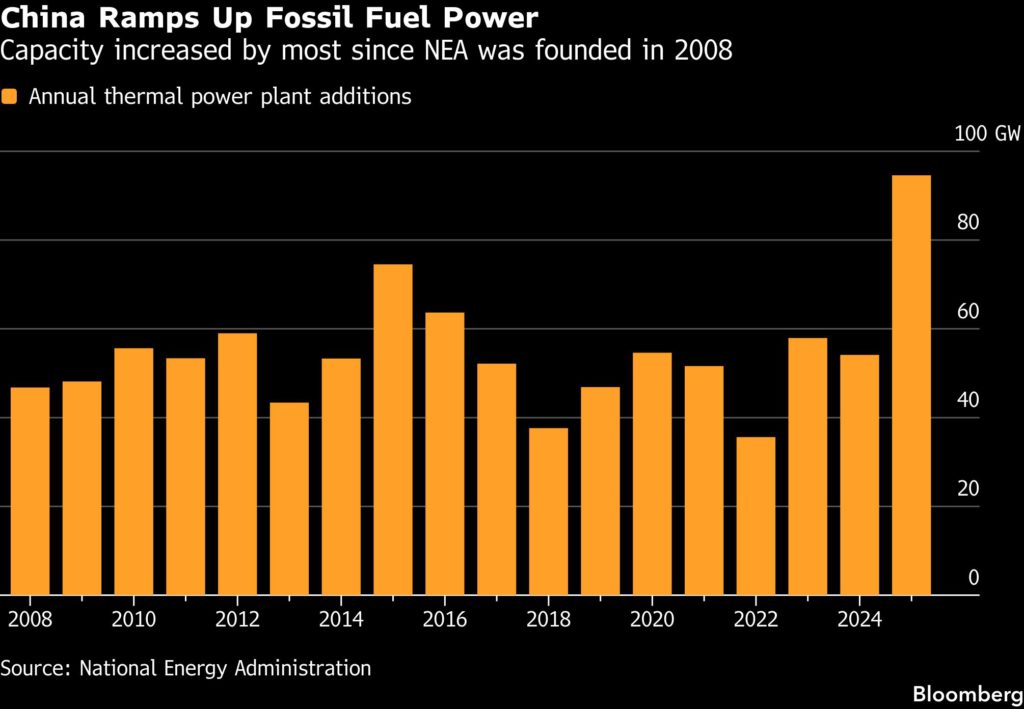
Chinese firms are accelerating the pace at which they propose new coal-fired power plants, even as the government moves to rein in growth after the rapid expansion in recent years.

Companies requested approval for 51 gigawatts of new plants in the first quarter of the year, according to Global Energy Monitor, ahead of the record pace set in 2025 that saw 162 gigawatts of new proposals over the full year. Construction has boomed since a spate of power shortages in 2021 and 2022 as the government touts coal’s role as a reliable back-up to intermittent renewables.

Still, it’s unclear how long the government will let the spree continue. Beijing has said coal use will peak before 2030, and in April the environment ministry said it plans to “rationally control” coal-powered capacity. Of the new proposals in the first quarter, only 3 gigawatts have been approved, according to GEM.

Coal’s domestic abundance also relies on a hazardous mining industry that’s once again in the spotlight after the deadliest accident in years on Friday left at least 82 dead.

The onslaught of new coal plants in China comes even as a surge in clean energy reduces the need for fossil fuels. Thermal generation fell last year for the first time in a decade, although it’s since rebounded. Coal plant utilization fell from 56% to 52% in 2025, and the current batch of proposals risks intensifying that trend, tying up capital that might be better deployed elsewhere in the power system, said Christine Shearer, a researcher at GEM.

“The debate in China today is often less about whether renewables can grow quickly enough, and more about whether policymakers are willing to let coal’s role diminish as clean energy scales up,” Shearer said.

The new requests were spread evenly across the quarter, according to GEM. That indicates there wasn’t a sharp reaction to the global energy shock stemming from US and Israeli strikes on Iran at the end of February.

“The latest crisis may strengthen the justification for continuing coal development, but the underlying expansion likely would have been happening anyway,” Shearer said.


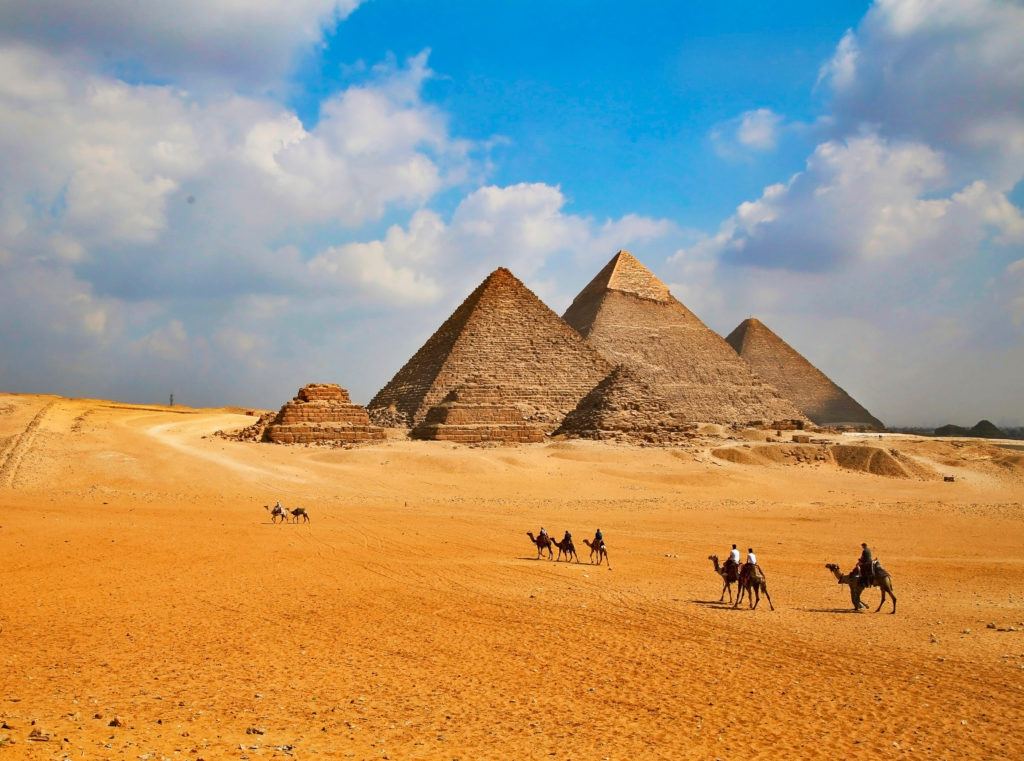
Egypt eyes first aerial survey in 40 years to map mineral riches


Stock image.

Egypt will carry out its first comprehensive aerial mining survey in more than four decades, part of efforts to unlock mineral discoveries and attract foreign investment.

Xcalibur Smart Mapping will work with Egypt’s Nuclear Materials Authority and local company Drone Tech, using advanced aircraft and geophysical technologies to map the North African country’s mineral wealth, authorities said Sunday in a statement.

The survey, covering areas including Egypt’s Eastern and Western deserts and the Sinai Peninsula, marks the country’s first such activity in 42 years, Energy Minister Karim Badawi said at a signing ceremony.

It will create a “modern, highly accurate mining database” to help investors identify commercially viable mineral deposits faster and with lower exploration risk, Badawi said.

Though Egypt has a history of gold-mining that stretches back thousands of years to the time of the ancient pharaohs, its mineral wealth remains largely undeveloped.

Seeking to boost investor interest, Cairo about six years ago introduced new regulations that limited levies and dropped a requirement that miners form joint ventures with the government.

(By Salma El Wardany)


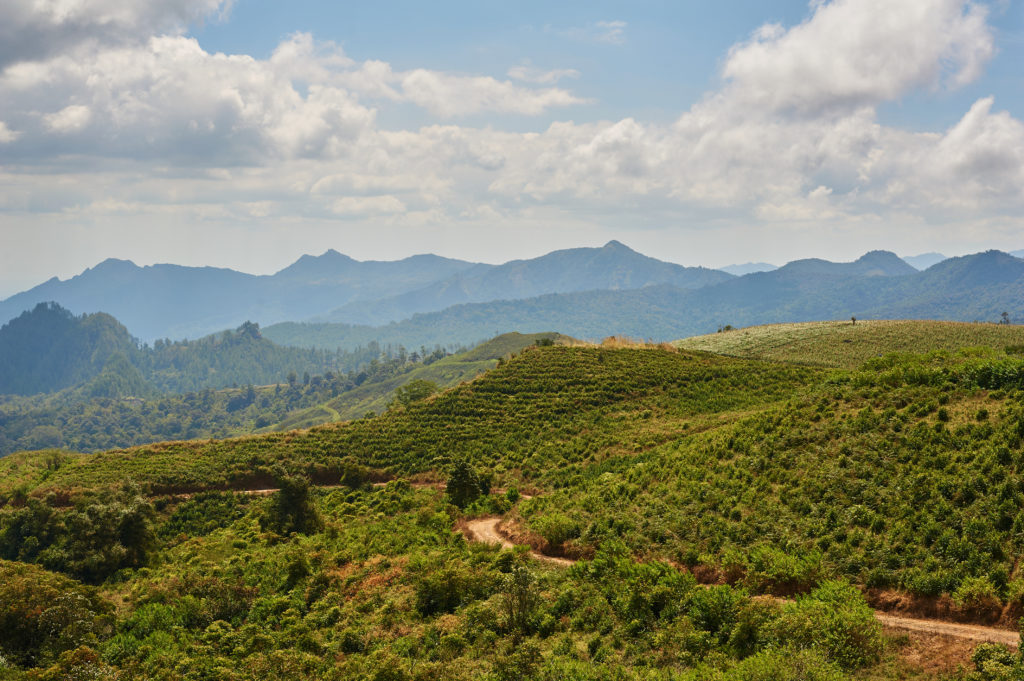
Indonesia plans to beat global trading giants at their own game

Malino, South Sulawesi, Indonesia. Stock image.

For years, Indonesia’s raw materials have been ferried from remote mines and plantations to global markets by armies of traders who handle negotiations, loans and even cranes and river barges.

Now the government is taking over, hoping to save billions of dollars it says are otherwise lost in transit.

Under the surprise plan, the country will take control of exports of the country’s major commodities. It’s a sweeping move reminiscent of the country’s authoritarian past — radical even for President Prabowo Subianto, a former general who has sought to harness the country’s raw materials and centralize economic management since he took power in 2024.

The policy, Prabowo said May 20, is intended to eventually increase transparency and curb tax evasion. In the short term, it has rattled already nervous investors, and left traders, producers and even some government officials scrambling to understand how it can even begin to be implemented.

Only the broad strokes of the plan have so far been made public, including a decision to begin with coal and palm oil, two commodities in which Indonesia has unparalleled clout as a top exporter. Details are yet to be decided. What is already evident, according to many of those involved, is that the mission is daunting.

Commodity producers spread across the Indonesian archipelago connect with foreign buyers through a network of hundreds of agents, traders and trading houses, from multinational giants like Trafigura Group to small, local firms. The links — financial, personal and logistical — have been forged over decades, and will have to be replicated in just months.

“It’s going to be a real uphill battle,” said Kevin O’Rourke, political analyst and principal at Jakarta-based consultancy Reformasi Information Services. “There is a whole ecosystem of human relations. It’s not something that can be subjected to this type of disruptive action on such a short time scale.”

The new entity, Danantara Sumberdaya Indonesia, will sit under sovereign wealth fund Danantara — an outfit that was itself set up just over a year ago and reports to Prabowo.

Pandu Sjahrir, Danantara’s chief investment officer, has sought to reassure investors that it will be market-friendly. It will be an operator not a regulator, he said on Friday, staffed with the best talent recruited from the industry, and meeting high governance standards. Its new CEO will be a former director of PT Vale Indonesia.

Prabowo has been more blunt. Indonesia, as leading producer, should have more control over the price at which it sells its raw materials, he said in his address to lawmakers on Wednesday, and cannot afford to leak an annual sum he estimates at $150 billion.

Indonesia’s natural resources industry is perilous even for the most experienced and deep-pocketed firms. Asset and company ownership is frequently opaque, the government has battled corruption for years and — as the past week has demonstrated — policy changes can be abrupt and unexpected. Over the years, multinational miners have largely abandoned the country, leaving local firms to take over prized assets.

That’s left room for commodity traders, whose more nimble business model has allowed them to buy and sell raw materials while, in many cases, avoiding the entanglement of owning assets.

In coal, their most crucial contribution is credit. Traders draw from international banks and finance small miners, who in turn promise discounted coal to be delivered at a later date. Those are crucial funds for companies that may struggle to find affordable credit lines — and it is unclear how the new Danantara system can replace that.

Not all coal producers need traders to supply funds. The top six miners in Indonesia, including PT Bayan Resources and PT Adaro Andalan Indonesia, have ample access to credit and account for about half of the 600 million tons of annual supply. But the remainder is split between scores of smaller firms, many of whom produce less than a million tons a year and are in need of cash.

Those small mines make Indonesia the world’s top thermal coal exporter. And most of that coal goes to China, where Prabowo’s attempts to exert control have already irked buyers.

Several major Chinese trading firms — whose prominence in Indonesia has grown in recent years, along with Chinese investors like nickel heavyweight Xiang Guangda of Tsingshan Holding Group Co. — fear that their long-term contracts could face disruption and heftier costs once Danantara’s new trading entity begins operations, according to three traders familiar with the matter. They asked not to be named as the matter is sensitive.

Some coal and palm oil contracts extend through 2027. Renewing these contracts will almost certainly mean dealing with different interlocutors and meeting new requirements, though they could also gain access to additional mining assets, they added.

Then there are the practical challenges of building an Indonesian version of Glencore Plc in a matter of months, and the question of state meddling in its dealings.

The new entity will handle exports that total some $65 billion a year, requiring vast working capital, connections and manpower. Executives for Danantara have already sought advice from other commodity traders on how to manage the project, according to people familiar with the matter. They asked not to be named as the requests were not public.

In the palm sector, long-fragmented supply chains connect smallholder farmers to agents to merchants to global food giants — a business dominated by large conglomerates like Wilmar International Ltd and Musim Mas Holdings Pte Ltd.

The prospect of disruption is already impacting the market. Bidders have pulled back from Indonesian tenders on fears the restrictions may slow shipments and swell stockpiles.

“It’s definitely going to be a bumpy road for everyone,” said Putra Adhiguna, managing director at the Australia-based Energy Shift Institute. “The government included.”

(By Eddie Spence)
 

Russia fails again to sell stake in gold miner UGC


The Kremlin and the waterfront. Moscow, Russia. Stock image.

Russia has failed for a second time to auction the stake in gold producer Uzhuralzoloto (UGC) that it seized last year, the federal property management agency said on Tuesday, dealing a blow to the government as it seeks to ease budget pressures.

A Russian court ruled last July that a majority stake in UGC, previously owned by businessman Konstantin Strukov, should be seized and transferred to the state, part of a broader pattern of nationalization of Russian corporate assets.

The latest auction follows an attempted sale earlier in May, when no bids were received for Strukov’s assets. The lot, with a starting price of 162.02 billion roubles ($2.2 billion), included a 67.2% stake in UGC.

Budget pressures

This time, the auction was declared invalid because only one bidder submitted a complete application and paid the deposit. A second contender, engineering company Russkie Ugli, failed to pay the deposit and provide the required documents, the agency, Rosimushchestvo, said in a statement.

The agency did not share further details on the bidders, but auction documents seen by Reuters show that the sole bidder was gold miner Pokrovskiy Rudnik. Gold producer Atlas Mining, which owns Pokrovskiy Rudnik, declined to comment.

Rosimushchestvo has not said whether it will hold another auction.

As budget strains deepen, the failed sale is a setback for the finance ministry, which had planned to sell the stake by the end of 2025. It did not reply to a request for comment.

The lack of qualified bidders was despite the sale being structured as a Dutch auction, in which the price is gradually lowered until a bid is placed. This could have seen the stake sell for as little as 50% of the initial asking price.

Another court-confiscated asset, Moscow’s Domodedovo Airport, was sold via Dutch auction for the minimum price of $869 million in January, with only one bidder participating.

(By Anastasia Lyrchikova, Darya Korsunskaya and Alessandra Prentice; Editing by Guy Faulconbridge and Mark Potter)

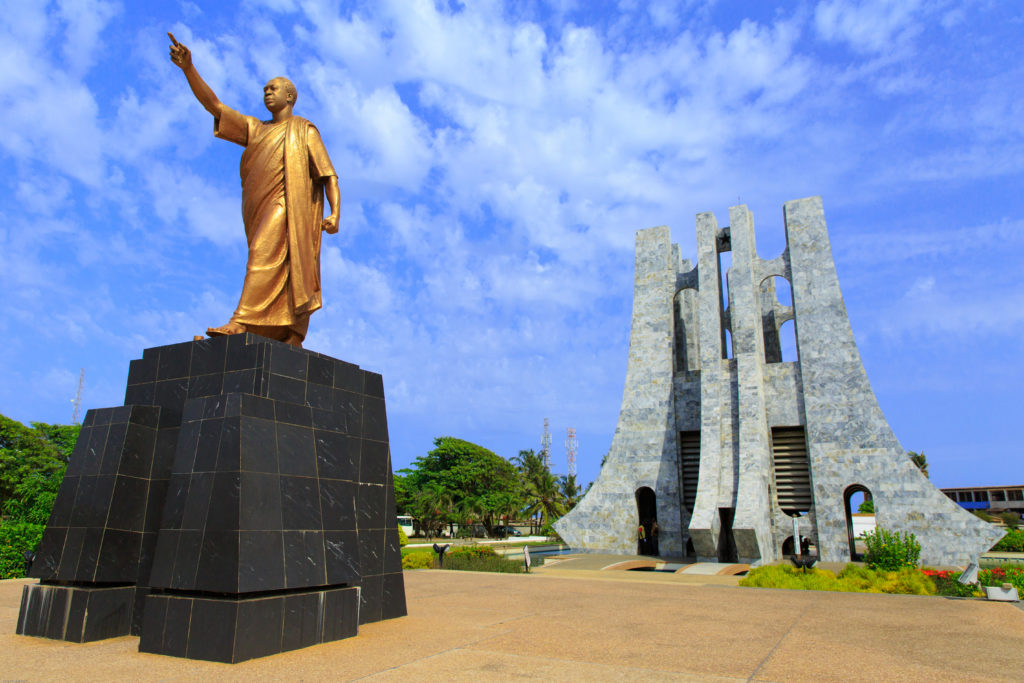
Ghana to start buying 30% of large gold mines’ output from June

Kwame Nkrumah Memorial Park, Accra, Ghana. Stock image.

Ghana’s central bank said it plans to increase gold purchases from the West African nation’s large-scale producers to 30% of their output from 20%, starting June 1.

The Bank of Ghana, which has been buying 20% of refined gold from mining firms with cedis for its reserves, has finalized negotiations to lift that to 30% of their doré or unrefined gold, Paul Bleboo, who heads gold management at the regulator, said by phone.

The decision to switch to doré gold will help boost local processing capacity and job creation, he said, adding that the parties have agreed to a 0.6% price discount.

Accra-based Gold Coast Refinery will process the doré gold to refined gold before shipping to the South Africa-based Rand Refinery for London Bullion Market Association certification, Bleboo said.

Africa’s top gold producer in 2022 ordered mining firms, including South Africa’s Gold Fields Ltd., UK-based AngloGold Ashanti Plc and American miner Newmont Corp. to start selling part of their output to the central bank to help boost reserves and support the local currency.

(By Moses Mozart Dzawu)


Ghana commits to renewing Gold Fields’ Tarkwa lease but rules out automatic extension

Tarkwa mine. Credit: Gold Fields

Ghana’s government is committed to renewing the mining lease for Gold Fields’ Tarkwa mine, it said on Monday, adding that it will subject the South African miner to fresh scrutiny of its plans before any renewal is granted.

Isaac Andrews Tandoh, CEO of Ghana’s Minerals Commission, the sector regulator, denied the government was delaying the lease renewal process, saying officials had held meetings with Gold Fields as recently as last Friday.

Tandoh said the company must present its development plans to a technical committee at the Minerals Commission, followed by a ministerial-level presentation, after which a decision on renewal will be made.

“It won’t be business as usual where we just automatically renew the lease,” Tandoh told Reuters.

Lands and Natural Resources Minister Emmanuel Armah Kofi Buah said the government had not adopted a blanket nationalization policy to take advantage of the sector but was seeking partners that would leave behind expertise and empower Ghanaians in the industry.

Some civil society and community groups have called on the government not to renew the Tarkwa lease, arguing that its benefits have not been shared sufficiently with host communities.

In April 2025, the government rejected Gold Fields’ application to renew its lease for the Damang mine and assumed operational control of the asset.

The Ghana Chamber of Mines warned this month that lease revocations and renewal uncertainty risk creating the impression that “security of tenure in Ghana is not guaranteed”, potentially hurting investment.

The lease for Tarkwa — a cornerstone asset for the South African miner that produced about 427,000 ounces of gold in 2025 — expires in 2027.

(By Emmanuel Bruce; Editing by Anait Miridzhanian and David Goodman)


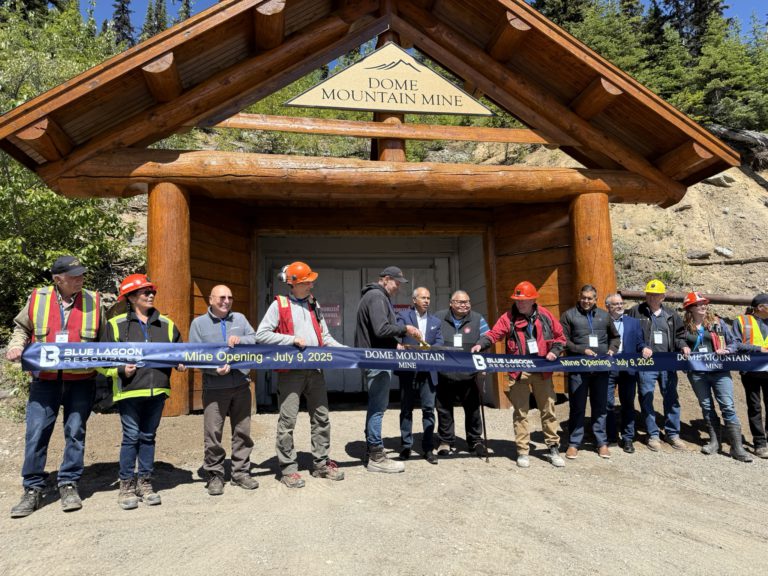
Blue Lagoon achieves commercial production at Dome Mountain gold-silver project in BC


Blue Lagoon CEO Rana Vig (center) with staff members at the opening ceremony in July 2025. (Image: Bruno Venditti)

Blue Lagoon Resources (CSE: BLLG) has officially attained commercial production at its Dome Mountain gold and silver project in British Columbia.

In a statement on Monday, the company said it has maintained underground mining rates in excess of an average of 100 tonnes per day for more than 30 consecutive days.

Last year, Blue Lagoon reopened the Dome Mountain mine, located near Smithers in the province’s northwest, more than 30 years after the last major exploration activity. At the time, the company said it plans to pursue additional permits to mine deeper zones and expand into the nearby Argillite Vein.

Blue Lagoon acquired the project in 2020 and has since focused on drilling and developing the Boulder Vein system.

Under the company’s current mining permit, Dome Mountain is permitted to mine up to 55,000 tonnes annually. Blue Lagoon is targeting consistent production of 150 tonnes per day.

Dome Mountain is now among a small number of newly permitted mining projects in British Columbia to successfully transition into active production in recent years.

Also on Monday, Blue Lagoon announced that its offtake partner, Ocean Partners Holdings, is making an equity investment of C$3 million ($2.1 million), purchasing shares of the company at C$0.90 apiece — equal to the closing market price of the stock on May 15 and representing no discount to market.

“Achieving commercial production at Dome Mountain is the culmination of years of persistence, technical work, permitting success, and strong collaboration with our industry partners and the Lake Babine Nation,” Blue Lagoon CEO Rana Vig said in a news release.

Wednesday, May 27, 2026


Codelco and SQM budget $3 billion for lithium project in Chile


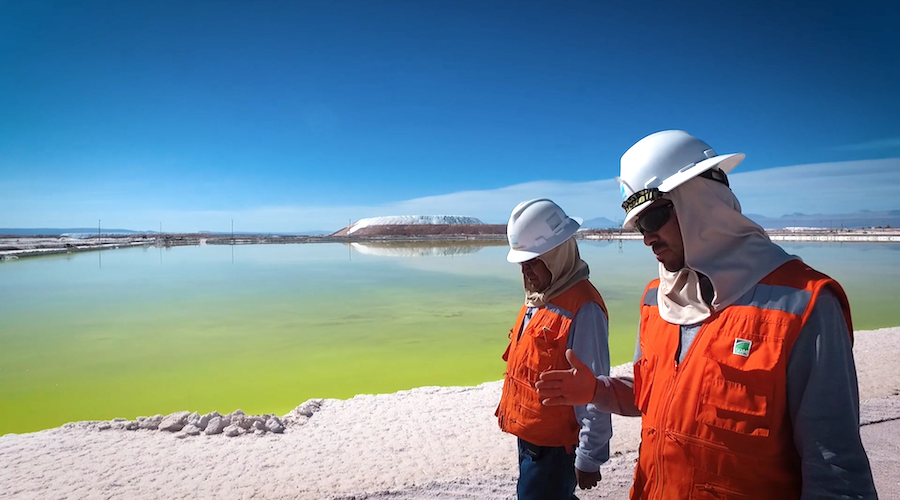
Codelco and SQM are advancing their Nova Andino JV in Chile’s north. (Image courtesy of SQM.)

Chilean mining companies Codelco and SQM are budgeting $3 billion to deploy new extraction technologies at their lithium joint venture in the Atacama Desert.

Their Novandino Litio partnership set its latest projection after wrapping up design work on a project to introduce more direct ways to recover lithium from brine under the Atacama salt flat in northern Chile, environment manager Julio Garcia said. The venture plans to submit an environmental impact study to regulators in June.

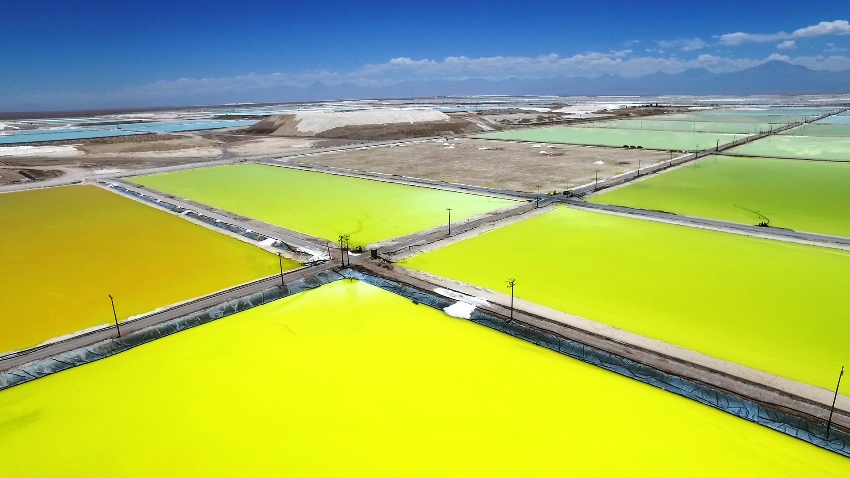
After years of testing, Novandino is advancing toward commercial operations of technologies known in the industry as direct lithium extraction, or DLE. They are touted as cleaner and faster than the traditional evaporation method, in which vast quantities of salty water get vaporized in one of the driest places on Earth, raising concerns about microbial ecosystems.

But large-scale commercial success for direct extraction remains largely unproven. The Atacama is a high-stakes proving ground: if DLE works there, it helps de-risk the technology globally. One key facet of the new process is reinjection, in which lithium-depleted brine is returned to the salt flat to preserve hydrological and geochemical balance.

“It will be rigorously monitored to determine that it not only delivers the recovery rates it promises, but also does not generate any type of impact,” Garcia said in an interview from Novandino’s Santiago offices.

The company has completed years of testing and engineering work on the technologies as it seeks to scale up output to meet demand for electric vehicles and large battery storage, while lowering environmental impacts. The approach combines nano-filtration and mechanical evaporation, along with other technologies already in use at its refinery.

Subject to environmental and other permitting, construction at the project dubbed Salar Futuro will start toward the end of the decade, with full implementation extending into the mid-2030s, Garcia said. Novandino has yet to make a final investment decision. Its previous guidance for the project cost was $2 billion-plus.

The project would gradually replace part of the traditional evaporation system, while maintaining some ponds for potassium production and pre-concentration. Freshwater extraction would eventually end.

Novandino was formed late last year after lithium supplier SQM agreed to hand over a majority stake in its Chilean brine assets to state-owned Codelco in exchange for extending operations.

(By James Attwood)


SQM posts surge in quarterly profit as lithium market tightens


Lithium brine ponds in northern Chile. (Image courtesy of SQM)

Chilean lithium producer SQM posted on Tuesday a jump in first-quarter profit and revenue, helped by higher prices and stronger sales volumes on robust demand for electric vehicle batteries and energy storage.

The world’s second-largest lithium producer, said net income more than doubled to $365 million in the quarter from January to March quarter, but missed an estimate of $426 million from analysts polled by LSEG.

Revenue climbed 70% to $1.76 billion, beating analysts’ forecast of $1.62 billion, while adjusted EBITDA more than doubled to $837 million, also topping the LSEG estimate of $787 million.

SQM said revenue from the lithium and derivatives business, its largest unit, surged to $1.19 billion, driven by a rebound in prices and a 25% increase in sales volumes.

Chief executive Ricardo Ramos said the company sold about 69,000 metric tons of lithium carbonate equivalent (LCE) during the quarter as it ran at full capacity to satisfy strong customer demand.

SQM said its average realized lithium price rose about 95% from a year earlier to roughly $17.8 a kg, reflecting a tight market turnaround after a slump from record highs in 2022.

Prices for the battery metal came under pressure as supply growth outpaced demand, hurting margins for global producers including SQM and US-based rival Albemarle.

But demand has recently been supported by rapid growth in battery energy storage systems, alongside continued electric vehicle adoption.

Reflecting that improvement, SQM said it now expects its total lithium sales volumes to grow about 15% in 2026, up from a previous forecast of 10%, and estimated global lithium demand could exceed 1.9 million metric tons of LCE this year.

SQM also highlighted progress in its partnership with Chilean state miner Codelco, through their Nova Andino Litio venture, which aims to expand lithium production in the Atacama salt flats.

Ramos said the partners were finalizing documentation to begin environmental permitting for the Salar Futuro project in the coming months.

SQM, one of only two companies producing lithium in Chile, also makes specialty plant nutrients, iodine and industrial chemicals.

(By Kylie Madry; Editing by Daina Beth Solomon and Clarence Fernandez)


Gold miner set to reboot Hong Kong listing type not seen in 12 years


Stock image.

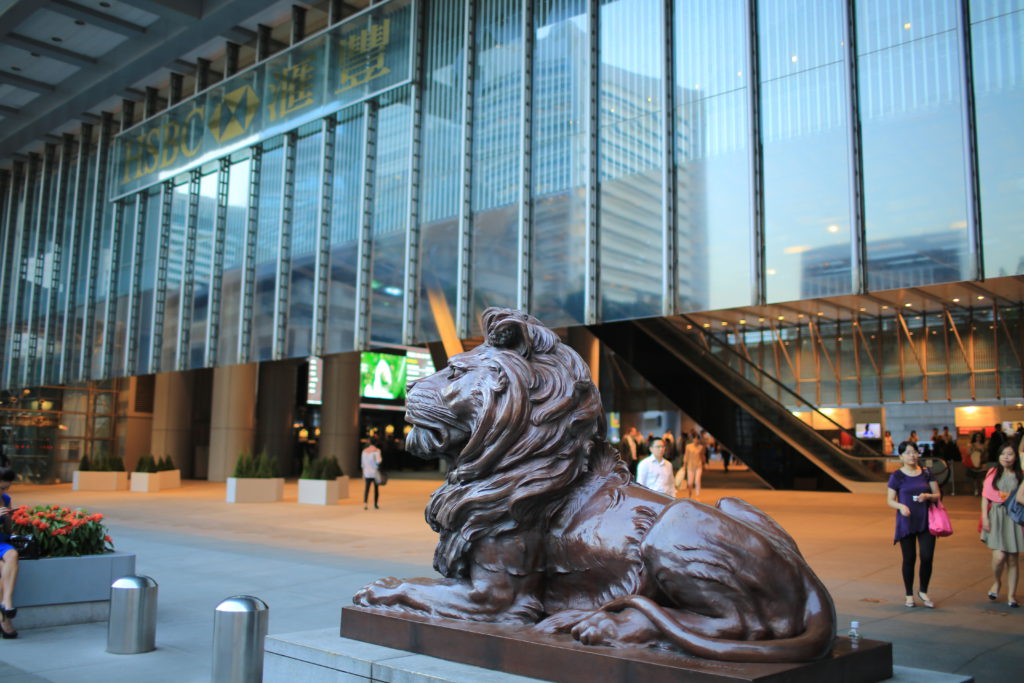
Indonesian gold miner PT Merdeka Gold Resources is gearing up for a Hong Kong stock-market debut with a listing structure that’s fallen out of favor for more than a decade, a sign of the city’s booming market for fundraising drumming up interest across Asia and beyond.

The Jakarta-listed company, a unit of PT Merdeka Copper Gold that went public in Jakarta in 2025, is planning a second float in Hong Kong as soon as June to raise at least $500 million, people familiar with the matter said, asking not to be named to discuss nonpublic information. It plans to sell Hong Kong depositary receipts, according to the people and as suggested by the listing paperwork. 

Listings in Hong Kong are on the upswing, with proceeds this year on track to surpass the four-year high of 2025. While mainland Chinese and Hong Kong companies have dominated recent fundraising activity, the stock exchange has been pushing to bring issuers to the market from further afield, including less capital-rich regions like Southeast Asia.

The surprise in the Merdeka deal is the potential reboot of the instrument known as HDR for the first time in 12 years. The listing would test investor appetite for the securities as well as for non-Chinese listings — with some prospective issuers closely tracking its success as they weigh their options.

Deliberations, including on the size and timing, are ongoing, the people added. The proceeds raised would ultimately depend on gold prices, some of the people said. A Merdeka Gold representative declined to comment.

The Hong Kong exchange introduced HDRs in 2008, which represent underlying shares, as an alternative listing route for companies from markets that prohibit share issuance or the maintenance of a share register abroad. But unlike American depositary receipts — a similar way for foreign companies to list in the US — HDRs have struggled to gain traction.

After an initial wave of listings, interest gradually faded as trading volumes declined and several companies delisted, including Coach parent Tapestry Inc. and commodity-trading giant Glencore Plc. Only clothing brand Uniqlo’s owner Fast Retailing Co. still has HDRs trading in Hong Kong since its 2014 debut — the city’s last such listing.

Trading activity in Fast Retailing’s HDRs shows that decline. About 8,600 HDRs were traded daily on average last month, down from more than 198,000 in their first year. That compares with about 1.2 million shares traded each day on the Tokyo Stock Exchange, according to data compiled by Bloomberg.

“In the absence of active trading, investor attention actually tends to decline further over time,” said Kenny Ng, strategist at China Everbright Securities International Co. “In the short term, I expect this low-trading-volume situation may continue.”

To see a meaningful revamp, HDRs would need more high-profile companies to adopt such listings, Ng said.

Companies exploring the securities have typically been those that needed to overcome home market restrictions on issuing shares abroad, said Jeckle Chiu, a partner advising on transactions at the law firm Johnson Stokes & Master.

Hong Kong Exchanges & Clearing Ltd. in 2023 struck a cooperation agreement with the Indonesia Stock Exchange to explore cross-border listings in both markets, part of a broader effort to woo non-Chinese companies to list in the Asian financial hub. Firms in the pipeline for a Hong Kong listing include PT MNC Digital Entertainment, part of an Indonesian conglomerate led by a founder with ties to US President Donald Trump, and the China-based business of Italian equipment-parts maker Carraro Group.

For Merdeka Gold, the listing would also offer an alternate venue at a time when Indonesia’s stock market is under pressure. The benchmark Jakarta Composite Index is the world’s worst performing major stock gauge this year, having lost 28.9% as fiscal discipline concerns compound risks of an MSCI Inc. market reclassification and a potential credit rating downgrade. Hong Kong’s Hang Seng Index is down 0.1% in the same period.

“The MSCI issue has highlighted Indonesia’s free-float, liquidity and transparency challenges, so a Hong Kong listing can help strong Indonesian companies broaden their investor base and reduce reliance on domestic market liquidity alone,” said Mohit Mirpuri, a partner at SGMC Capital Pte.

Merdeka Gold shares, though, have outperformed the market. They have risen 151% since their Jakarta listing in September 2025, giving the company a market capitalization of $6 billion, but have come off their peak in March. The price of bullion has fallen since the start of the Iran war.

(By Dave Sebastian)

Uzbekistan resumes gold export with $1.5 billion through April


Credit: Navoi Mining and Metallurgical Company

Uzbekistan, one of the world’s largest gold producers, has resumed full-scale gold exports in April after a half-year pause.

The nation exported about $1.5 billion of non-monetary gold in the first four months of the year, the National Statistics Committee reported Tuesday, indicating that most of it was sold in April.

The country, which mines about 130 tons of gold a year, effectively stopped exports after September, while its central bank emerged as one of the world’s biggest buyers of the precious metal.

Yellow metal exports were zero in January and February this year and totaled just $30 million in March, according to earlier reporting. At the same time the central bank’s reserves fell by about 100,000 troy ounces in April, signaling sales, according to reserve statistics disclosed on May 8.

Uzbekistan’s exports resumed even as the US-Israel war with Iran weighs on the global economic outlook, though Central Asian economies have so far appeared relatively resilient to the shocks.

Gold remains a key buffer for Uzbekistan’s economy and a major source of export and budget revenue. The metal’s prices hit a record this year and averaged about $4,800 per ounce this year.

Russia, another major global gold producer, has also accelerated its gold sales.

(By Yuliya Fedorinova)

Copper startup in IPO talks ahead of Peru mining expansion

Copper startup Quilla Resources Inc. is in discussions with prospective advisers about listing shares in Toronto as it weighs expansion plans in Peru.

The company led by veteran Peruvian mining executive Victor Gobitz is considering an initial public offering next year after restarting the idled Chapi mine in southern Peru, Gobitz said.

“In Toronto there is an ecosystem specialized in mining,” he said, referring to the preference for a Canadian listing. “If Quilla continues growing, hopefully we will graduate to New York in a few years.”

Gobitz, the former boss of a mine owned by BHP Group and Glencore Plc, is pitching investors on a project that builds on an existing operation rather than a greenfield development. That means it can be expanded faster and at lower cost as miners struggle to bring on new supply for the energy transition and data centers. His team is also watching for other opportunities that may arise in Peru.

For now, the focus remains on restarting Chapi and advancing exploration across the broader land package near a major Freeport-McMoRan Inc. mine to determine whether a much larger deposit lies beneath the current operation. Quilla is arranging a new capital raise ahead of its anticipated IPO.

Chapi began ramping up in February and is expected to reach full capacity in the fourth quarter. Eventually, Gobitz wants to raise annual output to 30,000 metric tons, a plan that would require an investment of $200 million to $300 million. Tapping the deposit’s full potential could mean a new owner with deeper pockets, he said.

(By James Attwood and Carla Samon Ros)


Eramet partially restarts mineral sands production in Senegal after fire damages


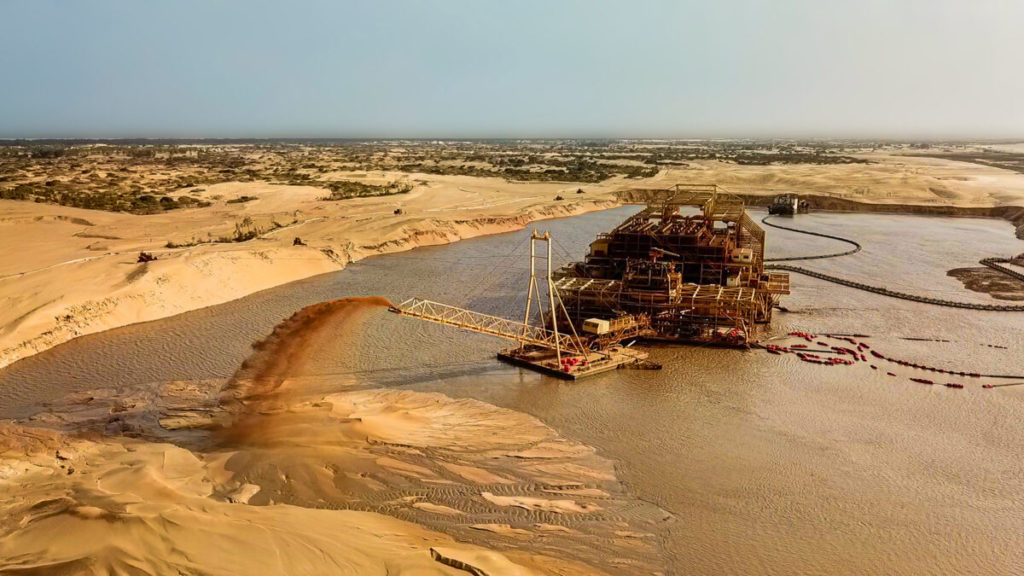
Eramet Grande Côte extracts sand from the dunes located along the Atlantic coast. Credit: Eramet

French mining and metallurgic group Eramet on Wednesday said it had partially restarted production of heavy mineral concentrate at its plant in Senegal, as it seeks to mitigate a hit to its revenue from a fire that occurred in February.

The company said the affected plant now operates at around one-third of its nominal capacity. It aims to return to full production level by the first quarter of 2027, following reconstruction of damaged facilities.

Having paused its original mineral sands production target, Eramet now sees an output of between 300,000 and 400,000 metric tons of heavy mineral concentrate in 2026, versus 900,000 tons before the fire.

The company’s shares fell around 1.5% in early trading, pushing their year-to-date losses to 5.3%.


(By Mateusz Rabiega; Editing by Milla Nissi-Prussak)