GAO: U.S. Navy's Unmanned Systems Programs Needed Restructuring
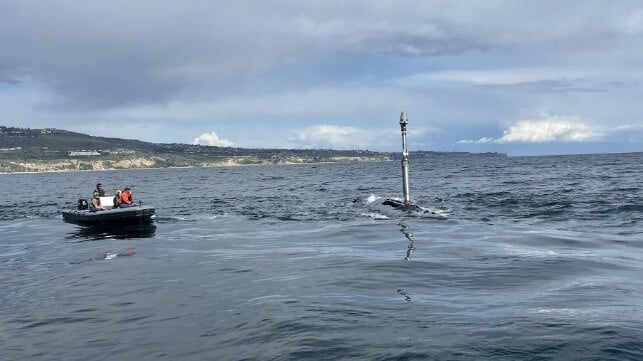
In a new unclassified version of a study on the U.S. Navy's unmanned systems efforts, the Government Accountability Office (GAO) says that the service needed to reorganize its acquisitions programs in order to give robotic autonomous systems the resources and leadership focus that they deserve, instead of letting them fall through the cracks when manned weapons platforms take priority. The USN has already taken actions in response, and has concurred with the findings.
The classified version of the GAO's audit report was completed in March 2025, and it focused on organizational issues that have slowed down the service's adoption of unmanned vessels, subs and aircraft. After interviewing 200 defense officials and visiting the Navy's development and testing centers, the GAO made three main findings.
First, leadership turnover and changing priorities made it hard to focus on specific goals, even on modifying the service's organizational structure for autonomous systems acquisition - a task the Navy had itself identified more than a decade prior.
Second, autonomous systems programs were all housed within the organizational structures for different domains - surface vessels with surface vessels, aircraft with aircraft, subs with subs. This put them in competition with manned platforms for dollars. Meanwhile, enabling technologies that are required for all kinds of unmanned systems (in all domains) had no specific home and were not adequately resourced.
Third, the Navy was setting requirements for its unmanned programs early on, locking in the specifics before developing the technology. While normal for big-ship acquisition programs, a rigid approach to requirements created challenges for the Large Unmanned Surface Vessel (LUSV) and Extra Large Unmanned Undersea Vehicle (XLUUV) programs, GAO found, causing delays and blocking the evolution of the systems' capabilities.
To get at these issues, GAO recommended putting robotic autonomous systems of all kinds - subs, boats, ships, and aircraft - into one portfolio and managing it as a whole, with a focus on developing capabilities rather than specific devices. A "capability-centric" and iterative approach would align better with commercial best practice, GAO concluded.
The Navy agreed with GAO's conclusions, and in late 2025 it rolled out the new "Portfolio Acquisition Executive Robotic Autonomous System (PAE RAS)," adopting GAO's phrasing and conceptual structure. PAE RAS absorbed about 200 projects from 25 program offices, all under Rebecca Gassler, former chief engineer of the secretive Project Overmatch effort. The Navy's new "marketplace" framework for the Medium Unmanned Surface Vessel (MUSV) is the most visible early result of PAE RAS's new approach: it brings a distinctly commercial feel, putting the onus on the developer to deliver a functioning product without committing Navy R&D dollars up front.
GAO also advised Congress to sunset a 2021 clause in the defense authorization bill that required the Navy to put an existing program executive office (PEO) from elsewhere in the NAVSEA organizational structure in charge of buying autonomous systems - meaning that one PEO was dual-hatted with the extra job of "acquisition executive agent for autonomy." This person was initially the PEO Unmanned and Small Combatants (PEO USC), the rear admiral responsible for the Constellation-class frigate and the Littoral Combat Ship. In its classified report in March 2025, GAO asked Congress to help the Navy "take actions related to a key stakeholder for acquiring autonomy"; Congress subsequently allowed the Navy to appoint someone of its choice, not an existing PEO, and the position is now held by a longtime autonomous systems engineer, Ryan Fitzgerald.
The unified organizational approach echoes the brief period in 2015-18 when the Navy had two offices with a comprehensive unmanned-systems function: the Deputy Assistant Secretary of the Navy for Unmanned Systems and the Director of Unmanned Systems, with purview over programs in all domains. Both were disestablished within a few years of launch, but some of the same leaders from that time period are now in charge again at PAE RAS.
Polaris Evaluates "Unmanned Bridge" for Open-Ocean Navigation
Most recent AI-navigation ventures have been in the realm of "assisted navigation," with the modest goal of augmenting the bridge team, but some are forging ahead into the realm of truly unmanned operations - at least in benign conditions. Korean tech firm Avikus - along with its parent company HD Hyundai Heavy Industries, Polaris Shipping and ABS - has launched a study on a "conditional unmanned bridge" system for low-risk use in the open ocean. It is an early test of the technology's potential to not only improve safety, but also reduce labor hours.
"The unmanned bridge concept is expected to be the first form of autonomous shipping to enter the market under the IMO MASS Code framework," explained Jaeho Kang, Co-CEO of Avikus, in a statement released Tuesday. A non-mandatory MASS Code was adopted by IMO last month, and will be formalized in mandatory form in 2030; in between, Avikus says, data and experience from real-world testing will help inform the final rule. Avikus' autonomous navigation support system has type approval from DNV, and it is installed as standard equipment on newbuilds from HD Hyundai, giving it an early leg up on achieving commercial scale.
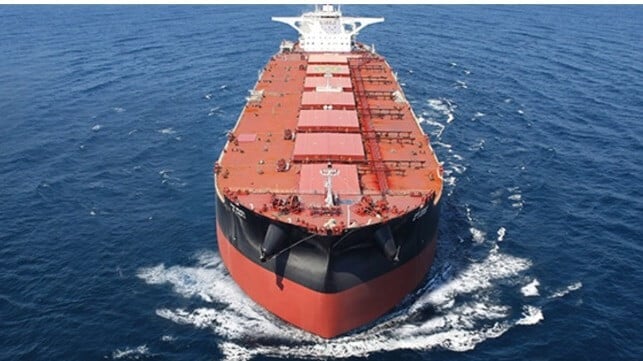
In the test with Polaris, Avikus will work with ABS and HD Hyundai to design a system and operating framework for fully unmanned operations during open-ocean passages, where traffic is light. The test case is a 325,000 dwt very large ore carrier (VLOC), which navigates long stretches of open ocean for much of its operating lifespan.
Polaris will pull on its own operational data from the vessel to determine where the boundary should be between unmanned and manned conditions on the bridge, Polaris chief operating officer DoHoon Kim said in a statement, taking into account crew response times. Avikus will pull together the technical requirements; HHI will handle any vessel design modifications required; and ABS will evaluate the concept's safety and its regulatory compliance, including a gap analysis.
"The technical complexity of the concept lies not in any single system, but in the interactions between autonomous navigation, vessel design and the conditions during unmanned bridge periods," ABS Chief Technology Officer and SVP Patrick Ryan said in a statement. "ABS will apply a structured safety evaluation, drawing on hazard identification, functional safety analysis, and alignment with the IMO MASS Code, to get a clear, evidence-based picture of the unmanned bridge concept."

No comments:
Post a Comment