Friday, May 29, 2026

EMBRACING UKRAINIAN FASCISM
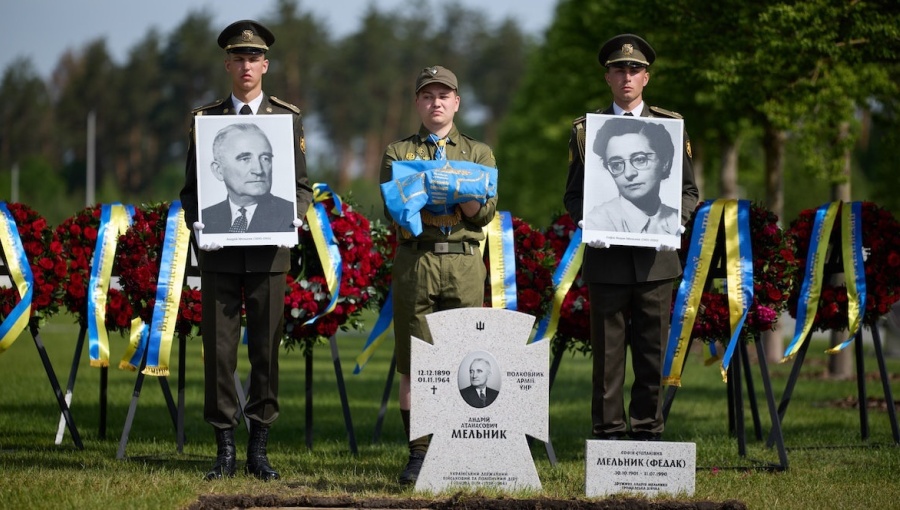
RAGOZIN: Melnyk reburial signals ideological shift in Ukraine

RAGOZIN: Melnyk reburial signals ideological shift in Ukraine
Ukrainian President Volodymyr Zelenskiy attended the reburial of Andriy Melnyk, one of the leaders of the Organisation of Ukrainian Nationalists (OUN). / Volodymyr Zelenskiy via XFacebook
By Leonid Ragozin in Riga May 29, 2026

Last week, Ukrainian President Volodymyr Zelenskiy went to the National Military Memorial Cemetery to take part in the reburial of Andriy Melnyk, Adolf Hitler’s ally in World War II and one of the leaders of the Organisation of Ukrainian Nationalists (OUN). Next to Zelenskiy, stood his chief of staff Kyrylo Budanov, who has been overseeing a visible ideological shift in Ukraine since assuming office early this year. 

In a tweet published on the occasion, Budanov wrote that the reburial heralds the creation of the “Pantheon of Prominent Ukrainians”. The choice of Melnyk’s ashes as an object of national veneration sends a clear signal about the direction of that shift.

Over seven years in the presidential seat, Zelenskiy has undergone a remarkable transformation from a dove seeking rapprochement with Russia to a defiant wartime leader and the Kremlin’s sworn enemy. His attitude to Ukraine’s history has changed just as radically.

Soon after he was elected in 2019 on the promise of peace, Zelensky made a point about celebrating May 9, the Soviet Victory Day, by visiting the grave of his grandfather who fought in the Red Army.

This populist gesture was designed to appeal an overwhelming majority of Ukrainians, in both the east and west of the country, whose ancestors fought on the Soviet side in WWII and who gave their votes to the new president. A memo published by Ukraine’s ministry of foreign affairs in October 2014 cites the figure of 7mn residents of Ukraine who fought in the Soviet army during WWII versus only 240-250 thousand who collaborated with the Nazis.

As his 57th Guard Division was pushing the Germans out of Mairupol, Sloviansk and Kramatorsk, lieutenant Semyon Zelenskiy was avenging the deaths of his father (President Zelenskiy’s great-grandfather) and three brothers, all of whom perished in the Holocaust.

Meanwhile, Melnyk was attempting to set up a fascist Ukrainian puppet state in Ukraine with a constitution, authored by his friend Mykola Stsiborsky, which described future Ukraine as “authoritarian and totalitarian state”. In a letter to Hitler in 1941, Melnyk pleaded that anti-Soviet Ukrainians be “allowed to march shoulder to shoulder with the legions of Europe and with our liberator, the German Wermacht”. Meanwhile, his subordinates in Ukraine took part in Jewish pogroms in Bukovyna and assisted the Germans in killing the Jews elsewhere around the country.

Melnyk’s pleas fell on deaf ears in Berlin since Hitler saw Slavs as an inferior race subject to enslavement and extermination. He was interned by the Nazis in a camp for foreign VIPs, who were treated humanely and respectfully, and released in 1944 when Hitler felt Ukrainian fascists could help him stall the Red Army’s onslaught in western Ukraine. Failing to receive guarantees of a pro-Nazi Ukrainian state, Melnyk ended up offering his services to Western allies in the US-occupied zone.

The World Holocaust Remembrance Centre, Yad Vashem, stated that it was deeply troubled by Melnyk’s reburial in Kyiv. “Honouring the leader of a movement [OUN] that supported and collaborated with Nazi Germany during the persecution and murder of millions of Jews undermines the moral integrity essential to Holocaust remembrance,” its press release said.

OUN’s dream Ukraine

Melnyk died in 1964 and was buried in Luxembourg where his remains were lying peacefully until Zelenskiy’s administration decided to repatriate them in May this year. “Colonel Andriy Melnyk returned to a different Ukraine – not the one he had been forced to leave, but the one he had dreamed of,” Zelenskiy said at the reburial ceremony.

Today’s Ukraine is indeed much closer to Melnyk’s ideals than those Zelenskiy’s grandfather was fighting for.

Built in 1974 and topped with the 102m-tall Motherland statue, Kyiv’s WWII History Museum was designed to commemorate Soviet war heroes like Semyon Zelenskiy. In the WWII cult developed under the Ukraine-born Soviet leader Leonid Brezhnev, this was one of the three most sacred sites in the entire Soviet country.

In 2026 however, it housed an exhibition dedicated to the Russian Volunteer Corps (RVC), a military unit formed by fugitive Russian neo-Nazis who believe that today’s Ukraine is much closer to their ideals than Russian President Vladimir Putin’s authoritarian regime. They see Putin’s Russia as a continuation of the Bolshevik internationalist project, citing Putin’s tolerance to mass immigration from Central Asian countries as proof.

In its propaganda and symbols, RVC draws inspiration from Gen. Andrey Vlasov’s Russian Liberation Army which fought on Hitler’s side in WWII. Featuring prominently in the exhibition, RVC’s symbol is called Spayka, best translated as fascia. It was designed in the 1930s by the Russian emigre organisation White Cause which later joined the Russian Fascist Party. 

The exhibition was officially curated by RVC’s khorunzhy (ideological officer), Aleksey Lyovkin. Having served a sentence for racially motivated attacks on migrants in his native Tver in Russia, Lyovkin founded a band called M8L8TH (which translates as Hitler’s Hammer and contains the numerical symbol 88 that stands for Heil Hitler in skinhead jargon) before moving to Ukraine in 2015.

Although it existed in Russian imperial forces, khorunzhy is not an official rank in the Ukrainian army. It originally meant flag-bearer in the Cossack troops, but it resurfaced in the Russo-Ukrainian war as an equivalent of the Soviet politruk, a political officer. 

Officially non-existent in the Ukrainian army, khorunzhy is used as a rank in politically autonomous units that form what its members call the “Azov family” or “movement”. Born out of the original Azov battalion, this far right mega-group currently controls Ukraine’s 3rd Army Corps commanded by Andriy Biletsky, its founder and political leader. 

The 3rd Corps runs its own school of political officers which is named after Yevhen Konovalets, Melnyk’s predecessor as the OUN leader. Its political bible is Natiocracy, an ethnonationalist teaching of OUN ideologist and Melnyk’s ally, Mykola Stsiborsky.

The Azov battalion in its original forms had a significant presence of Russian neo-Nazis, like Lyovkin or the most prominent living Russian neo-Nazi leader Sergey “Malyuta” Korotkikh, who was in charge of the battalion’s intelligence. 

These Russians (though not Korotkikh) eventually formed the core of RVC, which ideologically is a part of the Azov family but operates under the auspices of Ukraine’s military intelligence, the HUR. The latter was headed by Zelenskiy’s chief of staff Budanov from 2020 to 2026.

An ideology for New Europe

Melnyk’s reburial would be hard to imagine under Zelenskiy’s previous chief of staff, Andriy Yermak, who graduated from secondary school in the Soviet times and whose father served at the USSR’s embassy in Kabul during the Soviet occupation of Afghanistan. His Russian-born mother grew up in Leningrad. Hardly famous for political restraint, he still displayed some ethical red lines when it comes to history and politics.

But Yermak took upon himself the role of chief scapegoat in a massive anti-corruption investigation that targets Zelenskiy’s immediate entourage. He has been formally charged in a multilayered corruption case which involves four mansions, one of which belongs to him and another one likely to Zelenskiy himself. 

Budanov is another story. Born in 1986, he is largely a product of post-independence Ukraine with all of its geopolitical ambivalences and mafia state realities. An ideological orphan, he was provided with a social lift when he joined unit A2245 of the HUR whose members were trained by the CIA. 

A Washington Post investigation, published in 2023, revealed that the military intelligence agency Budanov would become the head of was created under the CIA’s supervision from scratch and hermetically sealed from other Ukrainian spy agencies to avoid Russian interference. The HUR is “our baby”, the newspaper’s CIA source boasted. Since the end of WWII, the CIA’s Ukrainian operation has been defined by the influx of OUN cadres who previously worked for the Germans. 

Ideology is a swear word with the liberal-democratic paradigm which Ukraine is still ostensibly pursuing, but Zelenskiy’s chief of staff is not shy about using the word. 

“Ukraine today embodies true Europe — both geographically and, above all, ideologically,” he wrote on May 9, the day of the Soviet victory over the Nazis, also marked as Europe Day in the EU. “We are defending the security and values of the entire continent: freedom, respect and the right to one’s identity,” he continued, adding the word “identity” where centrist politicians would normally mention human rights or social justice. 

His ideology reveals itself in commemorative events like Melnyk’s reburial, which he organised. Zelenskiy named Budanov first when listing officials who helped to make it happen. It also spills into his sometimes surprising statements, like when he mused on the meaning of Rus, the Kyiv-centred medieval state which gave its name to Russia. “Rus is Ukraine. But Rus is more, much more and Ukraine is the motherland of everything, even of those who we are fighting against,” he told the audience at the Kyiv Stratcom Forum this month. “You see where is the issue: We have handed over much of our history to them, we did it voluntarily. They privatised it, although they are nobody. We are the Rus, we should rule them.”

These imperial sentiments hark back to the ideas first expressed by Azov Movement ideologists back in 2014-16. They boil down to recreating the Russian Empire, only with the capital in Kyiv rather than Moscow.

Budanov’s effort to build the pantheon of Ukrainian heroes is expected to bring more results in the coming months and years. Negotiations are underway with the US and European countries about the repatriation of prominent Ukrainians who died in exile, prominently featuring OUN leader Stepan Bandera and Simon Petlyura who led Ukrainian nationalists in the Russian civil war. 

But Zelenskiy mentioned only one figure who is going to be reburied for sure. It is Yevhen Konovalets, who headed the OUN before Bander and Melnyk and after whose name the Azov Movement’s ideological school bears.

Leonid Ragozin is a freelance journalist based in Riga. He covered Russia, Ukraine and other countries for leading global media, including the BBC, Bloomberg and Al Jazeera. Leonid co-authored “En eiropeisk tragedie”, a book about the roots of Russo-Ukranian conflict published in Norway.


Iran and Oman could legally charge for Hormuz passage against US wishes

Iran and Oman could legally charge for Hormuz passage against US wishes
/ bne IntelliNewsFacebook
By bnm Gulf bureau May 29, 2026

Iran and Oman could lawfully collect navigation service fees from ships passing through the Strait of Hormuz under international maritime law, Yemeni journalist Samir al-Nimri has argued, Eghtesad Online reported on May 29.

Writing on the social platform X, al-Nimri said no part of the strait counts as international waters because the entire channel falls within the two countries' territorial seas. Under the UN Convention on the Law of the Sea, he said, every state may extend its territorial waters up to 12 nautical miles from its coast.

"Not even a drop of water in the Strait of Hormuz belongs to the international community," he wrote.

He said the strait measures no more than 21 nautical miles at its narrowest point, where Iranian waters to the north meet Omani waters to the south and enclose it completely. The convention guarantees a right of transit passage and bars states bordering straits from blocking that passage or imposing charges on it, he said.

Al-Nimri drew a distinction between banned transit charges and permitted service fees. Artificial waterways such as the Suez and Panama canals levy full legal charges on every vessel because they were dug by human effort, he wrote, with Suez alone generating more than $10bn a year.

Natural straits such as Hormuz, Malacca and Gibraltar carry no right to charge for passage itself, he said, but bordering states may collect fees for pilotage and navigation services. He cited Turkey's practice in the Bosphorus and Dardanelles under the Montreux Convention, where charges cover guidance and rescue services rather than passage.

"Tehran and Muscat, if they cooperate and agree, can legally collect enormous sums," he wrote.

He said the prospect angered US President Donald Trump, who held what he called a dangerous card in the form of threatened sanctions on Omani officials and financial institutions, posing a serious threat to a sultanate he described as one of the world's most stable states.

"Iran cannot relinquish control of the strait, even if World War Three begins," he wrote.


Global oil inventories falling at record pace, critical storage threshold about to be breached - IEA

Global oil inventories falling at record pace, critical storage threshold about to be breached  - IEA
With Hormuz closed, oil storage is falling fast and a critical minimum storage level threshold is about to be breached that will cause prices to spike. / bne IntelliNewsFacebook
By Ben Aris in Berlin May 29, 2026

Global oil inventories are declining at a record rate as the market absorbs a major Middle East supply disruption, raising the risk of sharp price increases if the Strait of Hormuz remains closed, according to the International Energy Agency.

In its latest monthly market update, the IEA said stockpiles are being drawn down rapidly to offset lost supplies and warned that inventories could approach critical levels if the key shipping route does not reopen. “Rapidly shrinking buffers amid continued disruptions, may herald future price spikes ahead,” the agency said.

The warning comes as industry executives and analysts increasingly focus on the role of inventories in cushioning the market from supply shocks. Darren Woods, chief executive of Exxon Mobil (XOM), told the company’s first-quarter earnings call that the oil market “has not felt the full impact of the supply loss thanks to commercial inventories held by the industry, strategic reserves controlled by governments and tankers in transit”.

Those stocks helped mitigate the disruption during March and April, Woods said, but he cautioned that inventories were nearing a critical threshold. Commercial inventories would eventually fall to levels where they could no longer serve as an effective source of supply, he said. “We anticipate as that happens and the strait remains closed, that we will continue to see increased prices in the marketplace,” Woods said.

Analysts at UBS expect global inventories to approach historic lows by the end of May. Market participants argue that inventories do not need to be exhausted to trigger severe price volatility because a substantial portion of global stocks is required to keep pipelines, storage facilities and transport networks operating efficiently.

According to estimates cited by analysts, global inventories have fallen from more than eight billion barrels in February to roughly 7.6bn barrels. If the Strait of Hormuz remains closed into September, inventories could decline to about 6.8bn barrels – breaching the minimum storage level needed to operate the oil transport system.

Billions of barrels in inventory may sound like a lot but the reality is that only about 800mn barrels are available without straining the system if the technical reserves are removed from the equation. Those reserves are needed to keep pipelines and tanks filled at minimum levels so the supply chain actually works and oil put in at one end of a pipe comes out of the other end.  Below the minimum levels and the energy system breaks down.

Rosemary Kelanic, director of the Middle East Program at Defence Priorities, said higher prices would likely be needed to curb demand before inventories reached those levels. “That level of spike -- to $150 or even $200/barrel -- will cause ‘severe economic contraction’ in 3Q2026 according to Rapidan, a top-notch shop,” she said. “In other words, if Trump doesn't make concessions to reopen Hormuz imminently -- and perhaps even if he does! -- we're looking at a global recession.”


Indonesia bets on resource nationalism to plug fiscal gaps

Indonesia bets on resource nationalism to plug fiscal gaps
/ Noah Ridge - UnsplashFacebook
By IntelliNews May 30, 2026

As Indonesia remains laser-focused on macroeconomic recalibration, the country has moved forward in its efforts to balance high-stakes fiscal intervention with the ever-unpredictable realities of its domestic extractive sector, Netral News reports.

With the government in Jakarta deploying a resource nationalism policy and creating fiscal tools to capture corporate resource rents, Indonesia also faces mounting pushback from its grassroots mining communities.

Mineral export bans and upcoming windfall taxes have become the country’s overarching strategy - one that is increasingly running up against regulatory bottlenecks, illegal capital leakages, and local governance deficits that threaten to undermine its broader industrial ambitions.

Export levies

The Indonesian Ministry of Finance is turning to fiscal instruments to insulate the state budget in real time from external commodity shocks and global monetary tightening. As reported by Sustainability Online, the government’s introduction of export duties and a windfall tax on coal is projected to generate substantial state revenue.

In simulation data compiled by the Centre of Economic and Law Studies (CELIOS) and published by Betahita it is shown that a targeted windfall tax on coal corporations could generate up to IDR66.03 trillion (approximately $3.7bn) in fresh state revenue. In contrast, a similar tax on the booming nickel sector could yield an additional IDR14.08 trillion.

This fiscal cushion arrives at a critical juncture for the country. In its 2026 state budget, Indonesia allocated more than IDR380 trillion for fossil energy subsidies and compensation to state utilities such as oil company Pertamina and electricity company PLN, calculated under a conservative oil price assumption of $70 per barrel.

With global crude benchmarks like Brent spiking toward $140 per barrel at times due to ongoing geopolitical instability, and coal prices hitting $145.86 per tonne, the government is scrambling to plug a widening deficit using debt or targeted spending cuts.

Finance Minister Purbaya Yudhi Sadewa has actively discussed implementing these windfall taxes and export levies on the country's nickel and coal sectors to restrict raw export volumes and defend a volatile rupiah, as detailed in reports from Kontan. According to Betahita, the National Development Planning Agency (Bappenas) has formalised these plans within the 2027 Government Work Plan (RKP) documents released on May 8. Bappenas aims to chase a total state revenue-to-GDP ratio of 11.82%–12.40% by 2027. This ambitious target relies on a targeted, measured implementation of a commodity windfall tax alongside the deployment of the data analytics-driven Coretax Administration System to capture underreported corporate profits.

Pushback, however, emerges from international environmental monitors like 350.org, which argue that using these multi-billion-dollar windfalls to prop up artificially cheap domestic fossil fuels is counterproductive. Research from Betahita highlights a socio-economic paradox: ordinary citizens are subjected to paying through taxes for subsidies, suffering from a three-layered cost-of-living crisis, while enduring soaring household utility bills as well as bearing the physical costs of climate disasters. But the nation's top 50 tycoons, heavily concentrated in extractive industries, generate IDR4,92 trillion annually. CELIOS data notes that it would take Indonesia's top five billionaires 603 years to deplete their wealth even if they spent IDR2bn every single day.

Betahita also cites research from the Institute for Development of Economics and Finance (INDEF), which points out that Indonesia's current gross-revenue royalty framework (PP 18/2025) is an obsolete relic of the oil and gas era that fails to capture supernormal profits. When coal prices skyrocketed sixfold, state revenues failed to scale proportionally, resulting in an estimated IDR592 trillion in lost state revenue over 12 years.

As a result, INDEF advocates for a dual-track reform: a short-term revision of current royalty tariffs to make them responsive to market price changes, and the long-term passage of a Progressive Resource Rent Tax (PRRT) bill that automatically captures windfalls when corporate profit margins surge past normal thresholds.

Bottlenecks

Right now, the central government focuses on capturing value from corporate mining conglomerates. But the legal and regulatory framework which governs small-scale, artisanal mining is fracturing at the same time. According to a report from Netral News, the Ministry of Energy and Mineral Resources of Indonesia (ESDM) has been urged to revise the regulation on artisanal mining legalisation to accommodate the field miners’ needs.

During an audience with the Artisanal Miners Association of Indonesia (APRI) on May 25, it was pointed out that current regulations, specifically Government Regulations and ESDM Ministerial Regulation No. 14, are failing because they only recognise three formal entities: cooperatives, micro, small, and medium enterprises (MSMEs), and regional state-owned enterprises (BUMDs).

The structural flaw in this approach is that there is still a significant portion of the rural population that refuses to join government-mandated cooperatives, pushing thousands of local operators into the informal and illegal economy. The structural bottleneck is further exacerbated by bureaucratic infighting over licensing authority. Under the current framework, People's Mining Areas (WPR) are ideally designated by provincial governments, while specific zoning permits are held by the central government, leading to widespread regulatory overlap with pre-existing corporate Mining Business Licences (IUP).

Furthermore, local governments often lack the technical capacity to process environmental impact assessments, particularly for artisanal gold mining operations that require strict oversight regarding mercury contamination.

Market distortions

This challenge in formalising artisanal mining is connected with systemic corruption and local market distortions. These, in turn, dilute the state's regulatory grip. As reported by the official DPR RI portal, lawmakers have previously warned of a pervasive risk at the regional level, where local elites frequently carve up mining permits to benefit select cronies, effectively freezing out ordinary citizens from legal resource wealth.

To combat this regional capture and ensure that artisanal output feeds cleanly into the national industrial supply chain, Commission XII is pushing a model where regional state-owned enterprises (BUMDs) serve as the primary institutional off-taker for small-scale miners. BUMDs should act as a crucial structural bridge, establishing local processing facilities and guaranteeing transparent purchase prices for cooperative-mined materials. This mechanism is designed to wrest control of local mineral flows away from predatory, unlicensed middlemen who exploit miners and ignore environmental degradation, redirecting those resources into the formal national economy or monitored export markets.

This domestic supply chain formalisation is vital if Indonesia intends to meet the stringent global Environmental, Social, and Governance (ESG) standards required by international capital. In neighbouring Malaysia, for instance, a 4.6-GW AI-focused data centre boom has seen the government reject nearly 30% of infrastructure proposals due to environmental non-compliance, as reported by the New Straits Times.

If Indonesia hopes to secure sustained institutional investment, such as the $4.6bn in foreign direct investment (FDI) recorded from Singapore in Q1 2026, the expansion of mega-projects like the $24bn Tuban Refinery, or PT Hua Chin Aluminium’s recent 480,000-tonne expansion at the Morowali Industrial Park, it must demonstrate that its entire resource ecosystem, from artisanal miners to high-tech smelters, operates under clear, transparent, and enforceable legal parameters.

To achieve this, Bappenas is expanding digital tracking systems like the Mineral and Coal Information System (SIMBARA) to prevent informal leakages and under-reporting. Without a comprehensive overhaul of its artisanal mining rules to eliminate local corruption and integrate small-scale miners into the formal tax base, Indonesia’s resource nationalism risks building an industrial superstructure on an unstable and fractured legal foundation.


Asia’s coal comeback complicates energy transition across region

Asia’s coal comeback complicates energy transition across region
/ Albert Hyseni - UnsplashFacebook
By IntelliNews May 29, 2026

The war in Iran is reshaping Asia’s energy landscape and forcing governments to reconsider existing coal phase-out plans as fears grow over disruptions to LNG exports from Qatar and the continued closure of the Strait of Hormuz.

According to The Economy, countries across the region are reviving coal-fired generation to shore up electricity supplies, not least Taiwan where the government has resumed purchases of coal-fired electricity, while across the Taiwan Strait, China too is increasing investment in coal use. South Korea and Japan meanwhile are moving to ease restrictions on coal-fired power generation as governments prioritise energy security.

According to Bloomberg, Taiwan Power Co. has been purchasing coal-fired electricity from the Mailiao power plant since April. Taiwan, home to some of the world’s largest semiconductor producers, relies on LNG for around half of its electricity generation, and in 2024 about one-third of its LNG imports came from Qatar.

But with the Iran war disrupting supply chains after Qatar’s largest LNG export terminal shut down, Taiwan has struggled to secure LNG supplies through May and finalised contracts covering roughly half of June demand, but additional procurement costs are expected to reach into the billions of US dollars to complete.

As such, the renewed use of coal is intended both to address supply risks and to limit the impact of higher gas prices on electricity tariffs.

China is also responding to the ongoing limit in supplies by changing how coal is used rather than simply burning more of it for power generation. The report says that China Shenhua Energy, the country’s largest listed coal producer, plans to cut coal output by 0.6% this year while increasing investment in coal-to-olefin production facilities; olefins being key feedstocks for plastics, textiles and solvents. The company also plans to double annual production capacity to 1.4mn tonnes next year.

The shift reflects tightening supplies of oil-derived feedstocks such as naphtha and liquefied petroleum gas (LPG), both affected by disruption in the Strait of Hormuz. China International Capital Corporation said coal’s profitability advantage over oil in chemical production has reached its highest level since 2015.

South Asia and the subcontinent are facing similar pressures. Bangladesh has increased coal-fired generation and electricity imports since March while rationing gas supplies. At the same time, Pakistan has avoided blackouts on the scale seen during the Ukraine war in 2022 thanks to expanded solar capacity, but it is also increasing domestic coal generation and curbing demand for now.

India is responding by raising coal imports while reducing industrial gas consumption for the same reasons.

To the east, governments in Southeast Asia are also formalising fuel-switching policies. Philippine Energy Secretary Sharon Garin recently told Reuters that the Philippines plans to increase coal-fired generation – at least temporarily – to contain rising electricity costs. Without intervention, electricity tariffs could rise by around 16% as early as June.

Manila is now seeking stable coal supplies from Indonesia, reversing a trend that saw Philippine coal-fired generation decline last year for the first time in nearly two decades.

Vietnam’s state utility EVN is another body negotiating additional coal imports to conserve LNG supplies, while Thailand has increased operating rates at its largest coal-fired power plant and has also raised biofuel blending ratios from 7% to 10%.

South Korea and Japan in Northeast Asia are also finding it increasingly difficult to maintain aggressive coal phase-out policies.

According to Korea Customs Service data, South Korea imported 8.82mn tonnes and 9.08mn tonnes of coal in March and April respectively, up 26.3% and 27.2% year-on-year, the report adds. In doing so, combined imports for the two months reached their highest level in three years.

Coal imports rarely reach winter-like levels during spring, when energy demand is usually lower. The increase thus reflects tightening LNG supplies caused by the Hormuz crisis and force majeure declarations in Qatar. In knock-on effect, South Korea’s LNG imports fell 10.2% year on year in March and 14.6% in April.

In response, Seoul lifted the seasonal 80% operating cap imposed on coal-fired plants for air quality reasons. Even as early as March 24, President Lee Jae-myung instructed officials to review closure plans for three coal-fired units — Hadong Unit 1, Boryeong Unit 5 and Taean Unit 2 — which had been scheduled to shut from June.

Seoul has also decided to expand nuclear generation significantly to offset LNG volatility but for now, coal is viewed as the quickest short-term substitute because existing infrastructure is already in place.

Japan is taking a similar approach given that more than 90% of its crude oil imports come from the Middle East, with around 70% passing through the Strait of Hormuz.

As a result, and according to NHK and Nikkei, Tokyo suspended operating restrictions on thermal power plants for one year from April 1 as part of emergency energy measures. The government is simultaneously diversifying crude imports while relying on coal-fired generation as a contingency option.

If ICE Shows Up at the World Cup, Essential Service Workers Are Ready to Strike


Hotel staff and food service workers who keep SoFi stadium functioning say they’ll walk off the job if ICE is present.

May 28, 2026

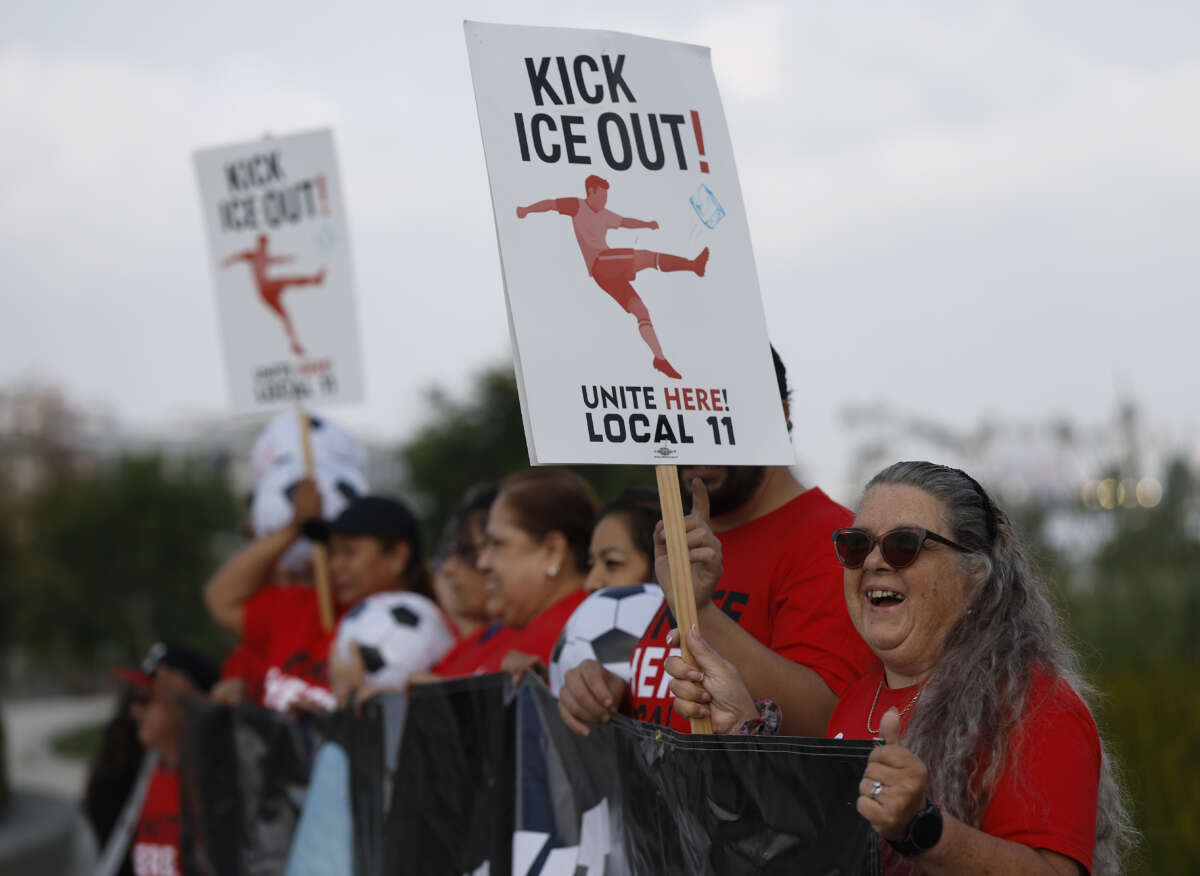
Union workers hold signs as they rally outside of SoFi Stadium ahead of the 2026 FIFA World Cup to demand investigations into FIFA’s security and worker accreditation policies, while also calling for protections against immigration enforcement activity and AI-related job displacement at the stadium, on May 18, 2026, in Inglewood, California
.Justin Sullivan / Getty Images


As the World Cup nears, Los Angeles’s service workers — the people who staff hotels and keep the restaurants and bars going inside the city’s big stadium — have threatened to go on strike if the tournament becomes hunting grounds for Immigration and Customs Enforcement (ICE).

They have good reason to be worried. The Department of Homeland Security (DHS) has indicated that it may not routinely check attendees’ immigration status, but it has fudged on the broader issue of ICE presence, saying its agents will be available at soccer games.

Acting ICE Director Todd Lyons told Congress earlier this year that “ICE, specifically homeland security investigations, is a key part of the overall security apparatus for the World Cup.” Newly appointed DHS head Markwayne Mullin has told agents to be prepared to be “out there every day.” Yet, faced with lagging hotel bookings around the country for the World Cup and the risk that international fans will be scared off by reports of preparations for heavy-handed ICE actions, DHS officials have also been trying to assure host cities that they won’t be making arrests at the stadiums.

Uncompromised, uncompromising news

Get reliable, independent news and commentary delivered to your inbox every day.

Email*


Unite Here Local 11, which has had a long run of recent successes in its efforts to unionize hotels, airport concessions, and other parts of LA’s hospitality industry, wants to force the issue. The union’s leadership indicated last week that more than 2,000 workers are prepared to walk off the job at SoFi stadium should ICE agents show up during the World Cup.

“Our members are super-charged about this,” Kurt Petersen, co-president of the local, told Truthout. “The threat to workers’ safety is very real, and people are going to have to make decisions about what they’re going to do.” Petersen says several of the union’s members have been detained during anti-immigration surges over the past year; while union lawyers have largely been successful in securing their release, the fear amongst immigrant workers — including those with documentation — is pervasive.

Petersen didn’t want to draw attention to individual cases, but he told Truthout that just last week, a Unite Here member walked out of immigration court with his wife and their two young children, only to immediately be abducted by ICE. And recently, Petersen said workers at a Culver City hotel temporarily walked off their jobs when they found out that ICE agents were renting rooms inside. According to Petersen, the agents were gone, and the workers returned to their positions over the next days. (He was unwilling to name the hotel as, he said, he didn’t want to draw attention to the workers there.)

Seventy-year-old Yolanda Fierro, who has worked at SoFi stadium since it opened in 2020, serving as a “suites runner” — bringing food and drink to attendees who have tickets to watch matches in the suites — fears ICE will bring its racial profiling tactics into the World Cup.

“Why are you going to come to a stadium and terrorize our employees who have been trying to do their jobs since day one? And what about all the fans from all over the world? Are you going to target them? So, no, we don’t need ICE there. ICE needs to go to the desert and melt.”

The knowledge that some of their colleagues have already been targeted by ICE is fueling some of the anger from stadium workers at the agency. “If ICE showed up, we would call a strike,” Fierro says angrily. “And if we’re not there, who’s going to man the stadium, do all the other stuff?”

The union local is seeking a commitment from FIFA, the governing body of the World Cup, that it won’t cooperate with ICE. The union has also informed hotels and other venues connected to the World Cup that the presence of ICE agents would constitute “unusually dangerous conditions” and, according to the terms of its workers’ collective bargaining agreement, would trigger the workers’ right to refuse to work in such conditions. That could, potentially, lead to work stoppages beyond the SoFi stadium itself as the tournament gets underway.

Unite Here Local 11’s position against ICE being embedded in stadiums around the country comes after Amnesty International, the ACLU, and more than 120 other human rights organizations published a joint travel advisory warning World Cup visitors from overseas that they risk falling victims to the Trump administration’s “draconian immigration and anti-human rights agenda.”

For SoFi stadium workers such as 61-year-old LA native Eva Miles, who has worked as a bartender at the stadium since it opened, the preparations for World Cup have brought a mix of exhilaration and fear. She is happy that she can be at SoFi for the opening match, in which the U.S. plays Paraguay, on June 12. But she is worried that the match will turn into an anti-immigrant circus. “I’m hoping we can keep them out,” she said of ICE. “Because there’s no room for them to come in. It’s a game and it’s where everyone should have a fun time and enjoy themselves and not have to worry about getting arrested for things they have not done.”

Miles anticipates that the energy among the fans will already be intense as the tournament gets underway. “We don’t need ICE to make it any crazier,” she said. “But what can you do if they force their way in there?” Then, she answered her own question. “Yes,” she said when asked if she would strike. “I would do it. We’re rallying. We are all for keeping them out.”


ICE and Prison Guards Retaliate Against Detainees and Protestors at Delaney Hall

ICE and prison guards have escalated their attacks on detainees and activists at Delaney immigrant jail in New Jersey.
May 29, 2026

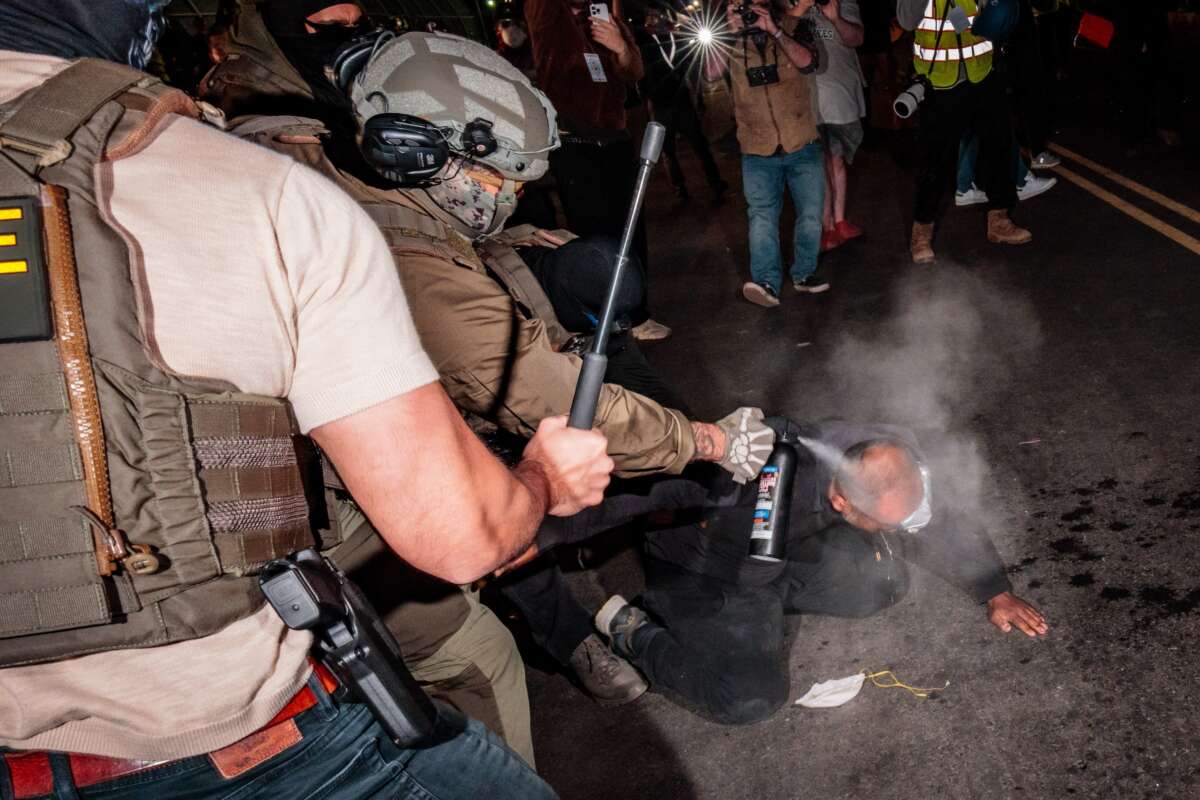
ICE agents spray a protestor with a chemical irritant before detaining them outside of the federal immigration center at Delaney Hall, where ICE is housing detained immigrants, on May 28, 2026 in Newark, New Jersey.Adam Gray / Getty Images

Support justice-driven, accurate and transparent news — make a quick donation to Truthout today!

As hundreds of immigrant detainees mark a week of their hunger and labor strike at Delaney Hall in Newark, New Jersey, Immigration and Customs Enforcement (ICE) agents and prison guards are violently retaliating against protesters both inside and outside the facility.

The anti-strike crackdown has included attacking detainees with pepper spray and batons, transferring strike leaders out of the facility, and arresting protestors who have gathered outside the jail, which is staffed by private prison company GEO group.

In remarks outside Delaney Hall on Thursday, Li Adorno, an organizer with Cosecha New Jersey, said:

We are here today because we got information from inside that’s telling us that ICE and GEO are going unit by unit, and they’re dispersing gas, and they’re beating people up. Right now, we have already heard that they have gone through all of the units. This is retaliation for the organizing, for the freedom of speech, that they [the strikers] exercise as they do their hunger strike, as they do their labor strike.

He condemned New Jersey Gov. Mikie Sherrill (D) for only visiting the site once, after four days of protest, and for not launching an investigation into the conditions at jail.

“It is very infuriating that we let ICE and GEO do whatever the hell they want. It’s infuriating to see humanity die inside when these ICE agents are teargassing indiscriminately against people who are exercising their constitutional rights,” Adorno said.

A GEO Group spokesperson confirmed to The Intercept that staff used “chemical agents” on Delaney detainees on Thursday, but did not comment on the question of retaliation.

North New Jersey Democratic Socialists of America, which has been participating in the protests, also criticized the governor for her lack of action.

“We call on Gov. Mikie Sherrill to call off the state police, who are currently blocking off road access to Delaney Hall, to return to Delaney Hall to meet with the strikers, and to use her office to take real action towards closing the facility,” the organization said in a statement to Truthout.

Jorge Alvarez, an activist who has demonstrated outside Delaney Hall every day since the protests began, told Truthout that the goal of the protests was initially to “halt any transfers” of detainees.

The first day that ICE showed up to Delaney Hall was Sunday, when protesters were holding a children’s rally outside the jail in solidarity with the detained and their families, Alvarez said.

“There were people performing for the children, playing guitars,” he said. “I remember having a box of Capri Sun in one hand, and a slice of pizza in another, when people started blowing the whistles that ICE had just showed up.” He and others quickly moved to form a human chain to block ICE from moving forward — only for ICE to throw protestors to the ground, breaking up the line they had formed.

ICE escalated their violence the next day, Alvarez said, with agents taunting protesters, using pepper spray, and shooting pepper bullets. “My hands are up, and I’m telling them, my hands are up, my hands are up.” But an ICE agent still “charges at me and hits me with his baton, in my neck,” he said. “That’s when I realized things were escalating, and since then, things have only continued to escalate.”

Alvarez said that he spoke with activists in Minnesota and Chicago who had seen his videos from the protests and noted how violent the ICE agents were, even compared with their own experiences.

“Despite all this, there is an immense amount of support from the community,” he said. The demands of the detainees must be met, he concluded — and Delaney Hall must be closed down.

Detention Watch Network released a statement in support of the protests on Wednesday.

“Trump’s cruel mass detention expansion is exacerbating the inhumane conditions that are inherent to ICE’s detention system and have been well documented for decades,” the organization said. “Over the past year, there have been increasing reports of death, medical neglect, use of force, isolation, retaliation, overcrowding, lack of food, and rampant transfers that cut people off from their loved ones and support networks. A shocking 18 people have died in ICE custody this calendar year — and 49 people total have died under this administration.”

In addition to the 200 people still on hunger and labor strike in Delaney Hall, 20 people have also launched a hunger strike in an ICE jail in Adelanto, California, the organization noted.

“The hunger strikers at Adelanto and Delaney Hall are bravely calling attention to a long-known truth: Immigration detention as a whole is unnecessary, rife with systemic abuses and completely arbitrary – full stop,” said Nanci Palacios Godinez, membership and organizing director at Detention Watch Network. “People in immigration detention are describing it as ‘hell on earth’ because it is.”

“No one should suffer in these conditions,” she went on. “Immigrants are our family members, neighbors, friends, and coworkers – worthy of dignity and respect regardless of where they came from or how they arrived in the U.S.”


Biden-Era Advisors Who Oversaw Gaza Genocide Regroup to Shape Democratic Party Foreign Policy

Biden-era advisors are reconvening to plan the party’s approach for the coming election cycle.

By Shireen Akram-Boshar , TruthoutPublishedMay 28, 2026
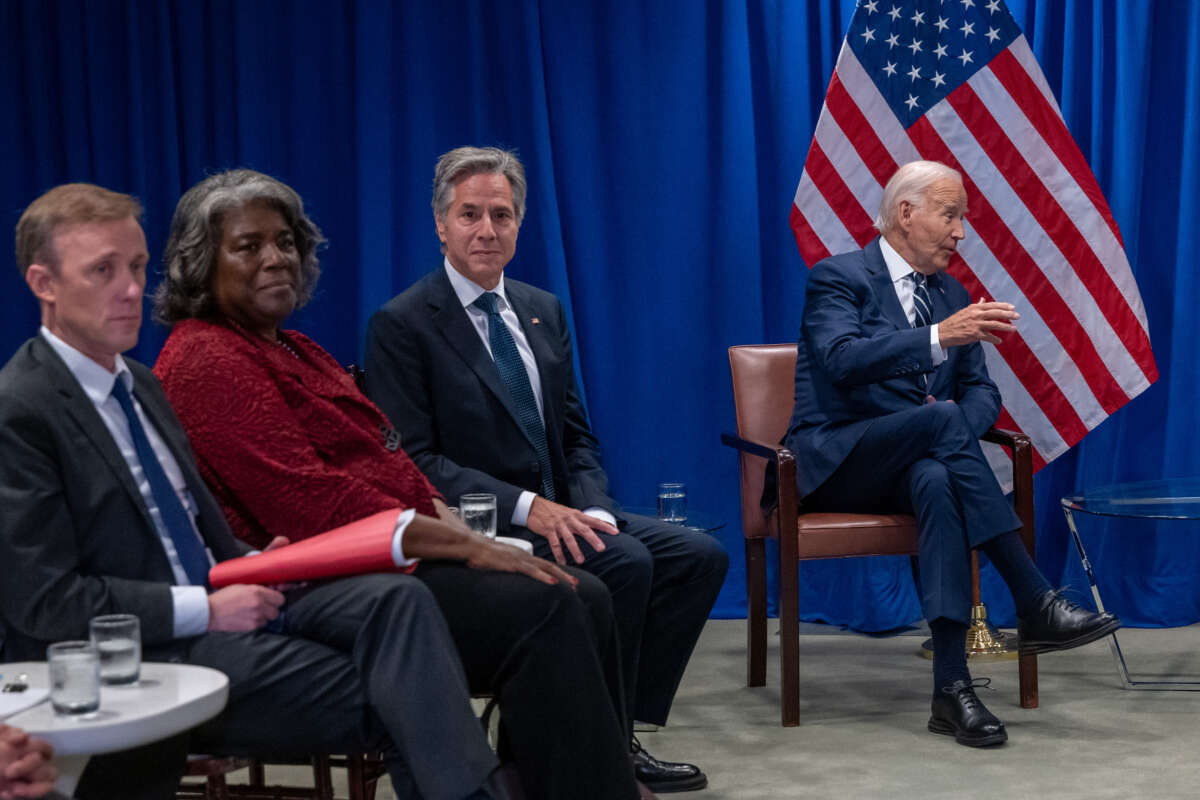
Then-President Joe Biden is joined by members of his cabinet, including Secretary of State Antony Blinken, U.S. Ambassador to the UN Linda Thomas-Greenfield and National Security Advisor Jake Sullivan as he meets with UN Secretary-General António Guterres during the United Nations General Assembly (UNGA) at the United Nations headquarters on September 24, 2024 in New York City
.Spencer Platt / Getty Images

In an op-ed in the The New York Times on Tuesday, Sen. Chris Van Hollen (D-Maryland) condemned members of his own party for their approach to the “Israeli-Palestinian conflict,” saying that “Democrats failed to meet the moment in 2024.” The op-ed comes as Biden administration advisors who helped engineer Israel’s genocide in Gaza are regrouping in an effort to shape the party’s approach to Palestine ahead of the next presidential election.

“Americans were rightly fed up with Democratic hypocrisy and complicity in the gross violation of the values we profess to hold dear,” Van Hollen wrote, admitting what the 2024 Democratic National Committee autopsy neglected to report. “That in turn, hurt our credibility with voters.”

“Both Republican and Democratic administrations are responsible for where we are today,” Van Hollen said, outlining a few of the crimes of Trump and Biden in allowing Israel’s impunity. Van Hollen then suggested that Democrats “can — and should — be both ‘pro Israeli’ and ‘pro-Palestinian.’” Despite saying that Democrats “cannot accept the status quo,” his op-ed goes on to encourage normalization efforts between Israel and states in the region, Saudi Arabia in particular — efforts that have aided Israel’s impunity and cemented a repressive status quo in the Middle East.

Just as Van Hollen calls for Democrats to change their approach to Israel, Biden-era advisors are reconvening to plan the party’s approach for the coming election cycle. In April, some Democrats restarted a foreign policy group, National Security Action, to formulate a foreign policy they say will help the party win in 2028, and to staff the next Democratic administration.

National Security Action was founded in 2018 by Ben Rhodes, Obama’s deputy national security advisor; and Jake Sullivan, advisor to Hillary Clinton, and later, national security advisor to Biden. The organization helped shape Democratic candidates’ foreign policy messaging in the 2020 election, and then helped staff President Biden’s national security team. They hope to do the same for the 2028 election cycle.


US Group Demands ICC Investigate Biden for Role in Israel’s Genocide in Gaza
The group laid out extensive evidence of the legal case against Biden officials in a 172-page report.By Sharon Zhang , Truthout February 24, 2025


Maher Bitar, a Palestinian American who worked in senior defense intelligence and defense policy for the Biden administration, and now director of the group, has said that the National Security Action group will function as a “hub” to work through the Democratic Party’s approach to foreign policy for it “to be ready for 2028 and beyond.” He also said that the group would bring together Democrats with a variety of ideas: “We are not excluding anyone,” he said. In practice, that has meant that any dissension and support for Palestine has been dwarfed by other voices as the party has moved further to the right over the past two decades.

Bitar provided intelligence assessments and coordinated defense policy on Gaza during the genocide.

As national security advisor to Biden, Jake Sullivan “helped enable” the “slaughter” of thousands of Palestinians, according to the Council on American-Islamic Relations (CAIR). Sullivan “coordinated the Biden administration’s unwavering support for Israel’s genocide in Gaza” by facilitating arms shipments to Israel, providing diplomatic cover, and maintaining that Israel’s actions did not constitute a genocide.

Sullivan, Bitar, and others who were part of the Biden administration are the former president’s “loyal lieutenants,” journalist Julia Ioffe said, noting frustration among some in the party that they are still attempting to shape the Democratic Party’s foreign policy.

These “Biden Bros” include Antony Blinken, former Secretary of State under Biden who has been appointed to the board of directors of the Democratic Party-aligned Center for American Progress. During the Biden administration, Blinken certified to Congress that Israel was not blocking humanitarian aid to Gaza, contrary to reports of human rights groups and State Department experts themselves. Blinken also oversaw the U.S. delegation to the UN that vetoed repeated Security Council resolutions calling for a ceasefire. And he continued to send Israel weapons, while approving $26 billion in aid to Israel over the course of the genocide.
THE GRIFT

Trump’s “Board of Peace” Has No Funds for Gaza Reconstruction

“For us, it doesn’t look like a peace deal, it looks like a trap,” said Bisan Owda, a Palestinian journalist in Gaza.

May 29, 2026

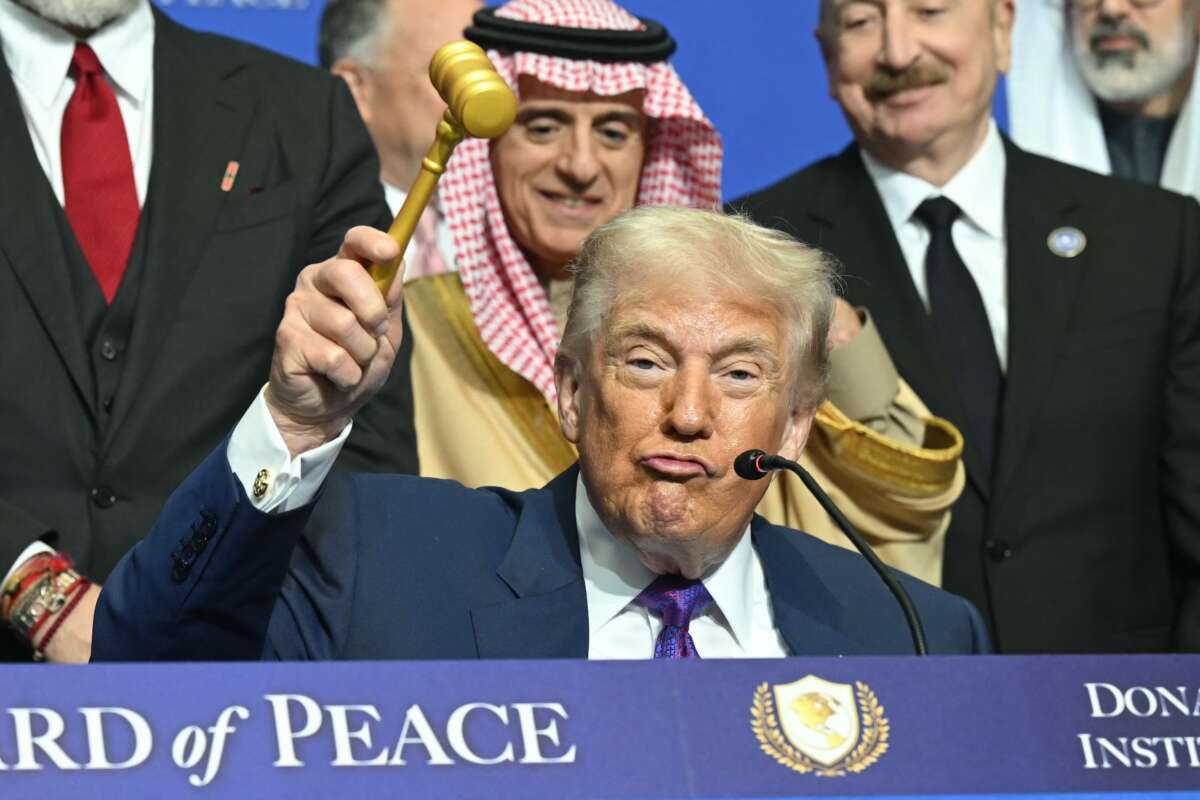
US President Donald Trump holds a gavel during a signing ceremony at the inaugural meeting of the "Board of Peace" in Washington, DC, on February 19, 2026.Saul Loeb / AFP

President Donald Trump’s “Board of Peace” fund has no money for the reconstruction of Gaza, despite raising billions of dollars since January.

On Wednesday, the Financial Times reported that “Zero dollars have been deposited” into the board’s financial fund — but that the body has received donations directly into its JP Morgan bank account, which allows it to override transparency regulations.

At its inaugural meeting in February, member states pledged $7 billion for the Board of Peace’s relief and reconstruction package for Gaza, and Trump promised an additional $10 billion.

The Financial Times reported that earlier this year, Morocco contributed $3 million and the United Arab Emirates (UAE) $20 million to the board’s JP Morgan account, and that this funding has helped cover the position of Nickolay Mladenov, the “director-general” of the Board of Peace, as well as salaries for the Palestinian technocrats selected by the board to govern Gaza. The UAE also provided $100 million to train a new police force in Gaza — but the funds are frozen and the program has not started.

In April, a U.S. official traveled to Saudi Arabia to ask its leaders to follow up on its $1 billion pledge to the board, as it had become concerned that funds were not materializing, according to Middle East Eye. Officials claimed that the U.S. has been relying on the Gulf region to fund the board.

Earlier this month, Reuters reported that the U.S. is considering asking Israel to hand over $5 billion in tax money it collected from the Palestinian Authority in the occupied West Bank — money it has been withholding from the Palestinian Authority — to help fund the Board of Peace. This suggests that the Trump administration is hoping that the Palestinian Authority — which has partial, limited jurisdiction over the West Bank, and not Gaza — will foot part of the bill for Gaza’s reconstruction, despite the fact that it was not invited to join the board and that it is undergoing a deep financial crisis.

Over 20 countries have signed onto the Board of Peace, but many key NATO allies declined to sign on, including the U.K., France, Germany, Italy, Spain, Norway, and Sweden. Reportedly, these countries were concerned by Russia’s involvement as well as suggestions that the Board of Peace might be the Trump administration’s attempt to replace the UN.

At the Board of Peace inaugural meeting, Trump said that the body might one day oversee the UN. “The Board of Peace is going to almost be looking over the United Nations and making sure it runs properly,” he said.

Secretary of State Marco Rubio stated that while the board’s first agenda point is the reconstruction of Gaza, it would eventually expand: “We hope that this can serve as a model for other complex and difficult situations, so they can be solved in the same way.”

The board’s charter noted that states seeking permanent membership would be required to pay $1 billion.

The board’s plan for Gaza “reconstruction” centers largely on Jared Kushner’s blueprint for a high-tech tourism hub filled with skyscrapers, rather than addressing the wants and needs of Palestinians whose homes, schools, and hospitals have been destroyed in Israel’s genocide.

Palestinians in Gaza have condemned the Board of Peace as a scheme to further deny Palestinian sovereignty.

“The Board of Peace is talking about rebuilding Gaza, the disarmament, the entry of the international forces, and the illusion of tourism destinations over the graveyards of our children…. For us, it doesn’t look like a peace deal, it looks like a trap,” said journalist Bisan Owda, who has been documenting Israel’s genocide for more than two years.

In a video for Mondoweiss, Owda interviewed Palestinians in Gaza about the Trump administration’s plan for their homeland.

“People have endured this war for two years,” one man said. “Some lost their children, some lost their homes, their futures, their businesses. And in the end you come and tell me all that is gone, and you’ll give me — as we hear — a whole neighborhood housed in an apartment building. And I’m supposed to forget my land, forget who I am, forget my property and my heritage?”