“For us, it doesn’t look like a peace deal, it looks like a trap,” said Bisan Owda, a Palestinian journalist in Gaza.
By Shireen Akram-Boshar ,
May 29, 2026
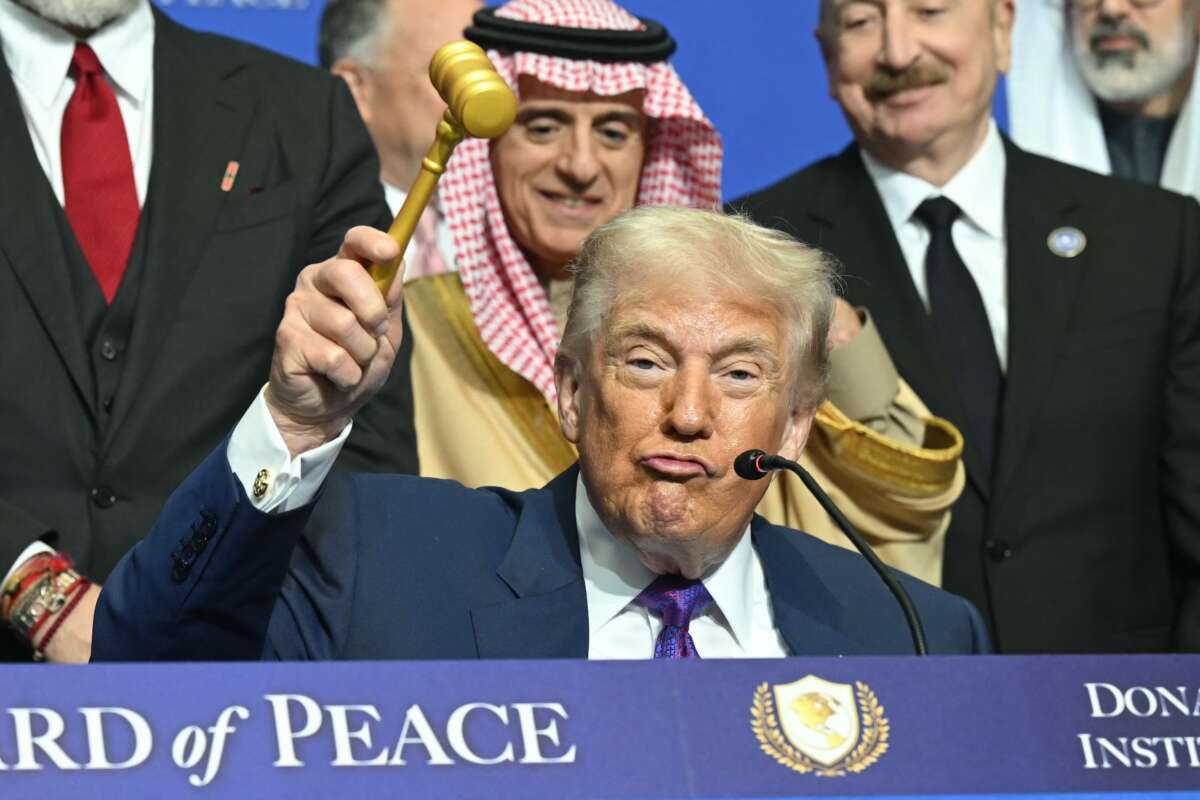
US President Donald Trump holds a gavel during a signing ceremony at the inaugural meeting of the "Board of Peace" in Washington, DC, on February 19, 2026.Saul Loeb / AFP
President Donald Trump’s “Board of Peace” fund has no money for the reconstruction of Gaza, despite raising billions of dollars since January.
On Wednesday, the Financial Times reported that “Zero dollars have been deposited” into the board’s financial fund — but that the body has received donations directly into its JP Morgan bank account, which allows it to override transparency regulations.
At its inaugural meeting in February, member states pledged $7 billion for the Board of Peace’s relief and reconstruction package for Gaza, and Trump promised an additional $10 billion.
The Financial Times reported that earlier this year, Morocco contributed $3 million and the United Arab Emirates (UAE) $20 million to the board’s JP Morgan account, and that this funding has helped cover the position of Nickolay Mladenov, the “director-general” of the Board of Peace, as well as salaries for the Palestinian technocrats selected by the board to govern Gaza. The UAE also provided $100 million to train a new police force in Gaza — but the funds are frozen and the program has not started.
In April, a U.S. official traveled to Saudi Arabia to ask its leaders to follow up on its $1 billion pledge to the board, as it had become concerned that funds were not materializing, according to Middle East Eye. Officials claimed that the U.S. has been relying on the Gulf region to fund the board.
Earlier this month, Reuters reported that the U.S. is considering asking Israel to hand over $5 billion in tax money it collected from the Palestinian Authority in the occupied West Bank — money it has been withholding from the Palestinian Authority — to help fund the Board of Peace. This suggests that the Trump administration is hoping that the Palestinian Authority — which has partial, limited jurisdiction over the West Bank, and not Gaza — will foot part of the bill for Gaza’s reconstruction, despite the fact that it was not invited to join the board and that it is undergoing a deep financial crisis.
Over 20 countries have signed onto the Board of Peace, but many key NATO allies declined to sign on, including the U.K., France, Germany, Italy, Spain, Norway, and Sweden. Reportedly, these countries were concerned by Russia’s involvement as well as suggestions that the Board of Peace might be the Trump administration’s attempt to replace the UN.
At the Board of Peace inaugural meeting, Trump said that the body might one day oversee the UN. “The Board of Peace is going to almost be looking over the United Nations and making sure it runs properly,” he said.
Secretary of State Marco Rubio stated that while the board’s first agenda point is the reconstruction of Gaza, it would eventually expand: “We hope that this can serve as a model for other complex and difficult situations, so they can be solved in the same way.”
The board’s charter noted that states seeking permanent membership would be required to pay $1 billion.
The board’s plan for Gaza “reconstruction” centers largely on Jared Kushner’s blueprint for a high-tech tourism hub filled with skyscrapers, rather than addressing the wants and needs of Palestinians whose homes, schools, and hospitals have been destroyed in Israel’s genocide.
Palestinians in Gaza have condemned the Board of Peace as a scheme to further deny Palestinian sovereignty.
“The Board of Peace is talking about rebuilding Gaza, the disarmament, the entry of the international forces, and the illusion of tourism destinations over the graveyards of our children…. For us, it doesn’t look like a peace deal, it looks like a trap,” said journalist Bisan Owda, who has been documenting Israel’s genocide for more than two years.
In a video for Mondoweiss, Owda interviewed Palestinians in Gaza about the Trump administration’s plan for their homeland.
“People have endured this war for two years,” one man said. “Some lost their children, some lost their homes, their futures, their businesses. And in the end you come and tell me all that is gone, and you’ll give me — as we hear — a whole neighborhood housed in an apartment building. And I’m supposed to forget my land, forget who I am, forget my property and my heritage?”
President Donald Trump’s “Board of Peace” fund has no money for the reconstruction of Gaza, despite raising billions of dollars since January.
On Wednesday, the Financial Times reported that “Zero dollars have been deposited” into the board’s financial fund — but that the body has received donations directly into its JP Morgan bank account, which allows it to override transparency regulations.
At its inaugural meeting in February, member states pledged $7 billion for the Board of Peace’s relief and reconstruction package for Gaza, and Trump promised an additional $10 billion.
The Financial Times reported that earlier this year, Morocco contributed $3 million and the United Arab Emirates (UAE) $20 million to the board’s JP Morgan account, and that this funding has helped cover the position of Nickolay Mladenov, the “director-general” of the Board of Peace, as well as salaries for the Palestinian technocrats selected by the board to govern Gaza. The UAE also provided $100 million to train a new police force in Gaza — but the funds are frozen and the program has not started.
In April, a U.S. official traveled to Saudi Arabia to ask its leaders to follow up on its $1 billion pledge to the board, as it had become concerned that funds were not materializing, according to Middle East Eye. Officials claimed that the U.S. has been relying on the Gulf region to fund the board.
Earlier this month, Reuters reported that the U.S. is considering asking Israel to hand over $5 billion in tax money it collected from the Palestinian Authority in the occupied West Bank — money it has been withholding from the Palestinian Authority — to help fund the Board of Peace. This suggests that the Trump administration is hoping that the Palestinian Authority — which has partial, limited jurisdiction over the West Bank, and not Gaza — will foot part of the bill for Gaza’s reconstruction, despite the fact that it was not invited to join the board and that it is undergoing a deep financial crisis.
Over 20 countries have signed onto the Board of Peace, but many key NATO allies declined to sign on, including the U.K., France, Germany, Italy, Spain, Norway, and Sweden. Reportedly, these countries were concerned by Russia’s involvement as well as suggestions that the Board of Peace might be the Trump administration’s attempt to replace the UN.
At the Board of Peace inaugural meeting, Trump said that the body might one day oversee the UN. “The Board of Peace is going to almost be looking over the United Nations and making sure it runs properly,” he said.
Secretary of State Marco Rubio stated that while the board’s first agenda point is the reconstruction of Gaza, it would eventually expand: “We hope that this can serve as a model for other complex and difficult situations, so they can be solved in the same way.”
The board’s charter noted that states seeking permanent membership would be required to pay $1 billion.
The board’s plan for Gaza “reconstruction” centers largely on Jared Kushner’s blueprint for a high-tech tourism hub filled with skyscrapers, rather than addressing the wants and needs of Palestinians whose homes, schools, and hospitals have been destroyed in Israel’s genocide.
Palestinians in Gaza have condemned the Board of Peace as a scheme to further deny Palestinian sovereignty.
“The Board of Peace is talking about rebuilding Gaza, the disarmament, the entry of the international forces, and the illusion of tourism destinations over the graveyards of our children…. For us, it doesn’t look like a peace deal, it looks like a trap,” said journalist Bisan Owda, who has been documenting Israel’s genocide for more than two years.
In a video for Mondoweiss, Owda interviewed Palestinians in Gaza about the Trump administration’s plan for their homeland.
“People have endured this war for two years,” one man said. “Some lost their children, some lost their homes, their futures, their businesses. And in the end you come and tell me all that is gone, and you’ll give me — as we hear — a whole neighborhood housed in an apartment building. And I’m supposed to forget my land, forget who I am, forget my property and my heritage?”

No comments:
Post a Comment