Thursday, June 11, 2026

Led by US, Nuclear-Armed Nations Spent ‘Unthinkable’ $119 Billion on Their Arsenals Last Year

“At a time when the cost of living is soaring and millions struggle to afford food and fuel, this is outrageous,” said the International Campaign to Abolish Nuclear Weapons.


A protester ties banners on an airbase fence during a demonstration at RAF Lakenheath on April 3, 2026 in Lakenheath, England.
(Photo by MartinPope/Getty Images)


Jake Johnson
Jun 09, 2026
COMMON DREAMS

Research published Tuesday by a renowned nonproliferation group shows that the world’s nine nuclear-armed countries spent a total of $119 billion last year—$3,768 per second—on their arsenals of civilization-destroying weaponry, even as the rising costs of basic necessities left millions of families unable to make ends meet.

The International Campaign to Abolish Nuclear Weapons (ICAN), which won the Nobel Peace Prize in 2017, found that the United States spent more than every other nuclear-armed nation combined, shelling out $69.2 billion in taxpayer money for its sprawling arsenal of atomic weapons—a 22% increase compared to 2024.

“At a time when the cost of living is skyrocketing and food and fuel are unaffordable for so many, it is unthinkable that these nine countries are spending billions on a false promise of security,” said Susi Snyder, ICAN’s director of programs and co-author of the new report. “Nuclear weapons cannot be used without causing catastrophe, and the false logic of nuclear deterrence requires us to trust our enemies with our very survival.”

Behind the US, the next biggest nuclear weapons spenders in 2025 were China, the United Kingdom, Russia, and France. Every nuclear-armed country spent more on their arsenals last year than they did in 2024.

“Several nuclear-armed states have published nuclear weapons spending projections of tens of billions or even past $1 trillion for the next decade or several decades,” the report states. “And all nuclear-armed states have weapons systems that will remain operational at least until 2050, if not until the next century.”


ICAN found that world hunger, which is on the rise as the US-Israeli war on Iran threatens a global food crisis, “could have been ended with what was spent on nuclear weapons in the last three years alone.”

“The spending on nuclear weapons in 2025 is equal to 32 times the regular UN annual budget for the year,” the report observes. “One second of British nuclear spending could have bought 242 liters of petrol, even with fuel prices skyrocketing. Investments in energy transition and decentralization efforts would also have contributed to addressing fuel insecurity; one day of nuclear weapons spending could have instead helped 17,000 individuals transition to solar-powered homes or paid to plant 2 billion trees.”

“That is a way to spend for security,” the report adds, “not the premeditated mass murder this spending represents.”

ICAN also details the corporate beneficiaries of ever-growing nuclear weapons spending—and companies’ efforts to lobby lawmakers responsible for appropriating funds.

“The US has the most companies involved in its nuclear arsenal,” ICAN’s report shows. “The following 19 companies have outstanding contracts worth at least $375 billion for work related to nuclear weapons: Amentum, BAE Systems, Bechtel, Boeing, BWX Technologies, Fluor, General Dynamics, Huntington Ingalls Industries, Honeywell International, L3 Harris, Leidos, Leonardo, Lockheed Martin, Northrop Grumman, Peraton, Rolls Royce, RTX (Raytheon), SPAInc, and Textron.”

The US corporations “significantly involved in nuclear weapons production” spent $134 million on lobbying last year, according to ICAN.

“This project has documented exorbitant spending on nuclear weapons for years, outside of democratic oversight or public scrutiny,” the report states. “The funds that go to nuclear arms could instead have strengthened global diplomatic capacities, including through the United Nations, to generate sustained security through multilateral agreement. Instead, a new nuclear arms race is underway, demonstrating a long-term plan that if not stopped, has the potential to end life as we know it.”

“Every citizen, politician, and banker can choose to further the development and maintenance of nuclear weapons or demand their dismantlement,” the report concludes.













Finally, Someone in Congress Is Listening to Our Pleas for Military Budget Cuts

While congressional efforts to reign in military spending face steep odds of passing, growing pushback shows us that a different path is possible.


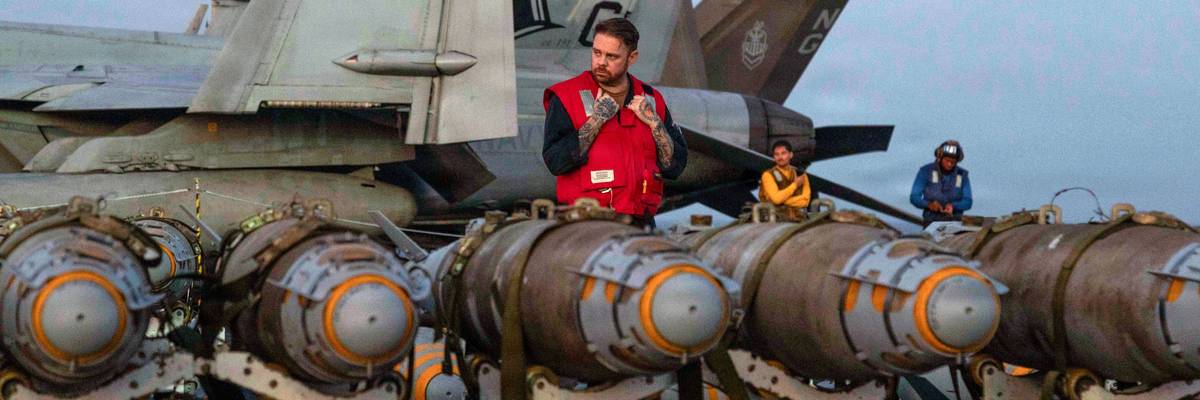
In this handout released by US Central Command, US Sailors transfer ordnance on the flight deck of Nimitz-class aircraft carrier USS Abraham Lincoln (CVN 72), on February 27, 2026 in the Arabian Sea.
(Photo by US Central Command via Getty Images)
Common Dreams

Last week, Democratic Massachusetts Rep. Seth Moulton introduced an amendment to the National Defense Authorization Act, or NDAA, that would have cut $150 billion from the president’s proposed military budget. While it didn’t pass, 12 members of the House Armed Services Committee voted against advancing the bill, signaling a shift from decades of bipartisan support for unchecked spending on weapons and war.

Now the NDAA goes to the Senate, where resistance to unchecked military spending is also on the rise. The Senate Appropriations Committee has repeatedly delayed action on the NDAA because of disagreements between the parties over top-line numbers. This pushback is even more critical as the war in Iran again escalates. Congress must say no to more war and war funding.

The majority of people in the US don’t want endless wars that line the pockets of military contractors while making life harder for everyone else. If more lawmakers start following the will of their constituents, it could point the way to a brighter and safer future for all.

This year, the military budget soared past $1 trillion dollars, paid for by cuts made to Medicaid, food assistance programs, infrastructure funds, and more. Overall, nearly 72% of all discretionary spending went to pay for the military, homeland security, Immigration and Customs Enforcement, and other related programs. The National Priorities Project estimated that on Tax Day this year, the average taxpayer paid over $4,000 for weapons and war.

A $1 trillion military will not save us from climate change, overdose deaths, or industrial accidents. It won’t even save us from another military.

If President Donald Trump has his way, those numbers will be even higher next year. The presidential budget released this April seeks $1.5 trillion for military spending.

The $500 billion increase exceeds the total combined amounts the US spent in 2025 on public health, education, job training, transportation, agriculture, and vital safety net programs like the Supplemental Nutrition Assistance Program and childcare. And even these massive cuts to lifesaving social programs are not enough to cover the massive proposed military expenditure. Trump’s budget would drive the country further into debt.

The president, the weapons company lobbyists, and most of Congress want us to believe that this money is a generational investment in our security. They want us to believe that there is no price too high for safety. But a $1 trillion investment in weapons won’t keep us safe in the same way that a $1 trillion investment in umbrellas won’t keep us dry in the ocean. The problems we face—in our communities, in the United States, and globally—require solutions that reduce violence rather than compounding it.

Over the past quarter century the US has spent trillions of dollars on wars and militarism, but global and national risks have only increased. The post-9/11 “War on Terror” resulted in up to 5 million direct and indirect deaths, yet the Taliban is back in power in Afghanistan, the destabilization of Iraq directly contributed to the creation of ISIS, and in 2025 there were more violent conflicts between states than any time since WWII.

The Trump administration’s unprovoked war against Iran is just the latest example of the spectacular failures of military force. While the US was able to quickly destroy key Iranian infrastructure, months later they are now in a weaker negotiating position than at the outset. The cost of continued war—both in dollars and lives—is unconscionable.

The US military is the most expensive, lethal, and technologically advanced the world has ever seen, and US military spending is more than 60 times that of Iran. The idea that we can, and should, resource an enormous military prepared to fight both Russia and China simultaneously is preposterous. Continuing to throw trillions of dollars away on weapons that we hope to never use in wars that we can never win makes no sense. Peace, not war, requires generational investments in security. Getting there will require courageous action from our elected officials.

A $1 trillion military will not save us from climate change, overdose deaths, or industrial accidents. It won’t even save us from another military. It is time for a new paradigm. Real generational security comes when people are housed, fed, healthy, and have hope for a better future.

This is not a call to turn inward, but to invest in international cooperation rather than international destruction. Addressing global problems through international investment isn’t a utopian vision. Spending even a fraction of the military budget to address the root causes of poverty and conflict would have a massive domestic and global impact. If the US reduced military spending, other countries would be likely to follow, freeing up global resources to meet human needs.

Internationally, the World Food Program estimates that it would cost $93 billion per year to end world hunger by 2030. Ending extreme global poverty would cost approximately $300 billion per year—a fraction of the US military budget. At home, the child tax credit gave $2,000 per child to all US families with children. That program could be continued with less than half of the increase sought for the military.

There are some signs of hope. Recent war powers votes have received far more support, across party lines, than previous ones. While congressional efforts to reign in military spending face steep odds of passing, growing pushback shows us that a different path is possible. Refusing to rubber stamp a deadly status quo takes courage and resolve. Congress must vote against military spending increases; continue to advocate for spending cuts; and invest in diplomacy, development, human rights, and human needs. That is where real security can be found.


Our work is licensed under Creative Commons (CC BY-NC-ND 3.0). Feel free to republish and share widely.


Mike Merryman-Lotze
Mike Merryman-Lotze has worked with the American Friends Service Committee as the Palestine-Israel Program Director since 2010.
Full Bio >


Israel to Blame for 56% of 22,600+ Civilians Killed by Explosive Weapons Globally Last Year

“What is particularly alarming is that this harm has become persistent across conflicts worldwide, risking the normalization of civilian suffering on a massive scale,” said the report’s lead author.


Palestinians try to inspect and rescue the bodies of victims from a burning vehicle bombed by Israeli forces despite a ceasefire in Gaza City on November 22, 2025.
(Photo by Anas Zeyad Fteha/Anadolu via Getty Images)


Jessica Corbett
Jun 10, 2026
COMMON DREAM

While the overall number of civilians killed by explosive weapons decreased by 21% last year, largely due to Israel scaling back attacks on the Gaza Strip and Lebanon in response to ceasefire deals, “the majority—56%—of all global civilian fatalities in 2025 could be attributed to Israeli armed forces, most of which occurred in Palestine,” according to an annual report released Wednesday.

The report is the latest publication from the Explosive Weapons Monitor, a research initiative of the International Network of Explosive Weapons, whose members include nongovernmental organizations around the world such as Action on Armed Violence, Center for Civilians in Conflict, Human Rights Watch, Humanity & Inclusion (HI), PAX, and Save the Children.

Based on data from Armed Conflict Location & Event Data as well as Insecurity Insight, the monitor found that there were at least 22,616 civilian fatalities from explosive weapons across 65 countries and territories last year.

In addition to Lebanon and Palestine, the Democratic Republic of Congo, Ethiopia, Iran, Iraq, Myanmar, Somalia, South Sudan, Sudan, Syria, Ukraine, and Yemen were “heavily impacted,” the publication says. Countries’ armed forces were responsible for the vast majority—85%—of all incidents that reportedly affected civilians or civilian infrastructure last year.

“The number of attacks in which explosive weapons affected humanitarian aid operations, aid workers, and camps increased by 52%,” to 2,541, last year—and while they were documented in 17 countries and territories, “about 90% of all incidents were recorded in Palestine,” the report notes.

Attacks on education increased by 64%, to 1,416; they occurred in 27 places, but were most common in Myanmar, Palestine, and Ukraine. The report also highlights continued attacks on healthcare facilities and workers (1,272 incidents in 22 places), and on food and water systems (1,082 incidents in 15 places).

“Every destroyed school, hospital, market, water system, or humanitarian convoy represents far more than damaged infrastructure—it represents opportunities lost, futures disrupted, and communities pushed further from recovery,” said Alma Taslidžan, HI’s disarmament advocacy manager, in a statement.

“Long after the explosions end, civilians continue to live with the consequences of disrupted healthcare, interrupted education, damaged livelihoods, and the daily challenge of rebuilding their lives,” Taslidžan emphasized. “For many, the consequences of explosive weapons become part of everyday life and suffering for years to come.”


The report argues that “it remains a critical humanitarian priority” to bring the 2022 Political Declaration on Strengthening the Protection of Civilians from the Humanitarian Consequences Arising From the Use of Explosive Weapons in Populated Areas into greater effect.

The publication also calls out eight countries—Cambodia, Kenya, Morocco, Nigeria, Somalia, South Korea, Turkey, and the United States—that endorsed the declaration but whose armed forces reportedly used explosive weapons that caused civilian harm in 2025.

“The devastating impact of explosive weapons on civilians is both foreseeable and preventable. Yet across numerous conflicts, their continued use has entrenched a pattern of civilian harm that is increasingly treated as routine rather than exceptional,” said Katherine Young, the report’s lead author and the monitor’s research and monitoring manager, in a statement.

“When explosive weapons are used in populated areas, civilians suffer,” Young stressed. “What is particularly alarming is that this harm has become persistent across conflicts worldwide, risking the normalization of civilian suffering on a massive scale.”

The release of the report comes amid renewed Israeli attacks on Lebanon—which intensified after the United States and Israel launched an illegal war on Iran in February, and have continued despite a new ceasefire agreed to in April—as well as on Palestinians in Gaza and the occupied West Bank.

“This weekend, eight children were reported killed and a further 17 injured in five different locations in the Gaza Strip, while in the West Bank, a 7-month-old boy died after being shot by Israeli forces in the Tel Rumeida area of Hebron,” said Edouard Beigbeder, the United Nations Children’s Fund (UNICEF) regional director for the Middle East and North Africa, on Wednesday.

“We cannot let this become the new normal—children losing their lives to violence should cause global outrage and must be condemned at every level,” he continued. “UNICEF calls on the Israeli authorities to take decisive action to protect all Palestinian children. Authorities must ensure transparent, credible, and robust investigations, as well as accountability whenever children are killed or maimed.”

Since the Hamas-led October 7, 2023 attack on Israel, Israeli forces have slaughtered at least 72,991 Palestinians in Gaza—an assault widely condemned as genocide. That includes 981 people killed since the ceasefire reached last October, according to local health officials. Israeli attacks on Lebanon have left thousands more dead, including at least 3,666 since early March, per the Lebanese Ministry of Public Health.

Berlin, Israeli defence giant IAI sign deal for aerospace and defence innovation hub

The agreement foresees a new innovation centre for defence and dual-use technologies in the German capital

Euractiv
New Arrow 3 air defense system goes into operation
03 December 2025, Saxony-Anhalt, Annaburg: The launcher of the new Arrow 3 missile defense system stands in front of the radome in Annaburger Heide after commissioning. The Air Force declares the so-called initial capability of the air defense system and thus completes the first step of commissioning. The air defense system is intended to provide early warning and combat incoming ballistic missiles outside the earth's atmosphere. It is being procured in response to the threat posed by Russia. Photo: Jan Woitas/dpa (Photo by Jan Woitas/picture alliance via Getty Images)

The State of Berlin and Israeli defence group Israel Aerospace Industries (IAI) plan to establish an innovation centre focused on aerospace, defence, security and dual-use technologies in the German capital. The agreement was signed by Berlin Mayor Kai Wegner and IAI President and CEO Boaz Levy this week on the sidelines of the ILA Air Show.

IAI was the prime contractor for the Arrow-3 missile defence system delivered to Germany at the end of last year. Berlin sees the system as a cornerstone of its ambition to play a leading role in the European Sky Shield Initiative. IAI also supplies Heron TP drones to the German Air Force.

Under the agreement, the planned hub will support start-ups operating in aerospace, defence, security and dual-use technologies through accelerator programmes, partnerships and pilot and proof-of-concept projects.

“Berlin is the right location for an aerospace and defence innovation hub,” Wegner said. Given the current geopolitical environment, it was important to establish such a centre in the German capital and strengthen investment in the aerospace sector, he added.

The initiative reflects “our long-term commitment to Europe and our vision of building deep strategic partnerships that combine innovation, industrial capabilities and operational expertise,” Levy said.

IAI is not the only Israeli defence company expanding its presence in Europe. Elbit Systems, Israel’s largest defence contractor, plans to increase its German workforce to 1,000 employees over the next four years. During the ILA Air Show, Elbit also signed an MoU with German manufacturer Diehl Defence to establish production of the SkyStriker loitering munition in Germany.

“Israel is proud of the strength of security cooperation between Germany and Israel,” Israeli ambassador Ron Prosor told Euractiv.

The relationship extended both to major procurement programmes and projects that attract less public attention, he said. “That stands in stark contrast to other European countries such as France, which are choosing to forgo this cooperation at the expense of their citizens’ security.”

(cz)

Indian Officials, Sailor’s Union Condemn ‘Gruesome’ US Killing of 3 Ship Workers in Gulf of Oman

“The deaths of Aditya Sharma, Shivanand Chaurasiya, and Patnala Suresh are a painful reminder that seafarers continue to bear the human cost of conflicts in which they have no stake,” said the Forward Seamen’s Union of India.


A screenshot shows US military video footage of a strike in the Indian crewed Settebello on June 9, 2026.
(Photo: US Central Command)

Jake Johnson
Jun 11, 2026
COMMON DREAMS

Indian government officials and the country’s largest sailor’s union issued statements Thursday condemning a US strike that killed three Indian nationals on a commercial vessel in the Gulf of Oman earlier this week.

The Forward Seamen’s Union of India warned that the “gruesome” attack on the Settebello, as well as other strikes on Indian-crewed vessels this week, demonstrates “the alarming deterioration of safety and security in one of the world’s most important maritime corridors and exposed thousands of seafarers to unacceptable risks.”

“The deaths of Aditya Sharma, Shivanand Chaurasia, and Patanala Suresh are a painful reminder that seafarers continue to bear the human cost of conflicts in which they have no stake,” said the union’s general secretary, Manoj Yadav. “Their sacrifice must not be forgotten, and their deaths must lead to concrete action to improve the protection of maritime workers everywhere.”

Randhir Jaiswal, a spokesperson for India’s foreign ministry, said in response to the US tanker strikes that “these attacks must cease.”

“We also call for dialogue and diplomacy so that we can have an early return to peace and stability in the region,” said Jaiswal, who noted that India’s government registered its “strong protest” with a US diplomat.

The US Central Command (CENTCOM) said in a statement Thursday that it has “disabled” three oil tankers in the Gulf of Oman this week, accusing the vessels of violating a US blockade on Iran that experts say is illegal under international law.

CENTCOM claimed that the Palau-flagged, Indian-crewed Settebello “attempted to transport Iranian oil” and “repeatedly failed to comply with directions from American forces” on Tuesday. In response, according to CENTCOM, a US aircraft “fired precision munitions into the ship’s engine room,” killing three Indian nationals.

CENTCOM did not mention any casualties in its statement.

“More victims of an illegal war,” Brian Finucane, senior adviser to the US Program at the International Crisis Group, wrote in response to news of the deadly US strike, which came amid the Trump administration’s broader assault on Iran that has killed thousands of people, hurled the Middle East into turmoil, and sparked global economic chaos.
As the World Cup Begins, Voters Say Trump Is Torpedoing United States’ Global Reputation

Republican voters were the only political faction who believed Trump has improved global views of the US since beginning his second term in office.


FIFA World Cup 2026 signage is displayed on June 8, 2026 in Kansas City, Missouri.
(Photo by Jay Biggerstaff/Getty Images)


Brad Reed
Jun 10, 2026
COMMON DREAMS

As soccer fans from across the world travel to the United States this month to cheer on their countries’ teams at the 2026 FIFA World Cup, a poll released Wednesday by Data for Progress suggests Americans don’t believe many visitors have warm feelings toward the host country after a year-and-a-half of President Donald Trump’s leadership.

Overall the poll found that 62% of American voters think the country’s reputation has deteriorated under Trump, with just 32% saying it’s gotten better.

Republicans were the only political faction to believe Trump has improved global views of the US, while Independents and Democrats overwhelmingly said the president has made them worse.

The poll also found 52% of US voters believed Trump’s mass deportation policies have hurt the country’s image in the world, with just 34% saying the deportations have helped.

Trump’s immigration policies collided with the World Cup earlier this week when Somali referee Omar Artan, who was selected by the International Federation of Association Football (FIFA) to work at the celebrated event, was barred from entering the US despite having a valid visa.

A Trump administration official claimed Artan had an “association with suspected members of terror organizations,” but provided no evidence for the allegation. US Rep. Rashida Tlaib (D-Mich.) called his treatment by the US “a disgrace.”

Polling data published last year by Pew suggests that Democrats and Independents are more accurately measuring global public sentiment of the US under Trump’s leadership than Republicans.

Specifically, Pew found that net positive perceptions of the US dropped by 10 percentage points or more among residents in a dozen countries between 2024 and 2025, including in key allies such as Canada, Mexico, Germany, and France.

What’s more, Pew found only five countries where the United States’ reputation has improved since Trump’s election: South Africa, India, Israel, Nigeria, and Turkey.

Trump during his second term has taken a number of actions that have sparked anger from foreign governments, including making repeated threats to seize Greenland as a US territory, invading Venezuela and abducting its president, imposing an oil blockade on and threatening to take over Cuba, launching a global trade war, and waging an illegal war of choice on Iran.
ANTI SOMALI RACISM

‘Shameful’: Global Fury at Racist Trump After Somali Referee Bound for World Cup Refused Entry by US


“I’m just simply a referee who’s trying to live his dream, the biggest dream of my life, to come to the World Cup.”


Omar Artan looks on during the AFCON Group F match between Gabon and Ivory Coast at Marrakech stadium, Marrakech, Morocco on December 31, 2025.
(Photo by Ulrik Pedersen/NurPhoto via Getty Images)


Brad Reed
Jun 09, 2026
COMMON DREAMS

The Trump administration is facing international outrage after Somali referee Omar Artan, who was selected by FIFA to work at the 2026 World Cup, was barred from entering the US.

As ESPN reported on Monday, FIFA confirmed that US Customs and Border Protection (CBP) had denied Artan entry into the country after he arrived in Miami on Saturday on a flight from Istanbul.

CBP said that it had denied Artan entry after subjecting him to “additional inspection” and determining him “to be inadmissible due to vetting concerns.”

FIFA released a statement after Artan’s denial of entry in which it didn’t criticize the US for barring one of its own referees, merely saying that “FIFA is not involved in host country immigration processes, including visa adjudications.”

Artan reacted with disappointment to being denied the opportunity to referee the World Cup, but said he is “in a positive mood” and “focused on the next challenges in my refereeing career.”

“I would like to thank FIFA and [the African federation] for all their support and I promise to keep my refereeing levels up as I concentrate on the future,” Artan added. “I want to thank the football family for their messages and wish my colleagues all the best success during the World Cup and I look forward to joining them again in future competitions.”

In an interview with The New York Times published Tuesday, Artan said that he was interviewed by CBP at the Miami airport for 11 hours and then detained for several more before being told he was being sent home.

“I am very, very disappointed,” Artan told the Times. “I’m just simply a referee who’s trying to live his dream, the biggest dream of my life, to come to the World Cup.”

“I had the right papers and everything,” Artan added. “I had the right visa.”

As noted in a Monday report from Agence France-Presse, Artan is a highly respected official, having been “named by the Confederation of African Football as men’s referee of the year.”

President Donald Trump has a long history of making racist attacks against Somalis, referring to them collectively as “garbage” last year, and accusing them last month of being “all crooks.” Last June, Trump issued a proclamation designed to “fully restrict and limit the entry of nationals” from Somalia and other nations.

Given Trump’s well documented bigotry, critics were quick to link the president’s racism with the poor treatment Artan received upon arriving in the US.

“What an absolute disgrace,” commented Jeremy Corbyn, former leader of the UK Labour Party. “A FIFA-certified referee being denied entry to the United States purely because he is Somali. The World Cup is meant to bring people together. This is racism, plain and simple. Shameful.”

Meral Hussein-Ece, a Liberal Democrat and member of the UK House of Lords, accused the Trump administration of completely spoiling the entire purpose of the World Cup, which is to bring people together in friendly global competition.

“A Somali referee makes history—first ever from his country to officiate a World Cup match,” wrote Hussein-Ece. “The US: ‘Not allowed in.’ So much for ‘sport brings the world together.’ Unless you’re from the ‘wrong’ country. Shameful. The ‘World Cup’ belongs to everyone—not just those the US approves of.”

Christina Unkel, president and general manager of the Tampa Bay Sun Football Club, said what happened to Artan is “heartbreaking on so many levels,” as “he worked so hard, proved himself on so many levels, and [was] selected as the best of the best.”

Journalist Helen Kennedy said that countries around the world need to send Trump a strong message that the treatment of Artan is unacceptable.

“The world should boycott these games,” she wrote. “How much does it take to show that?”
FIFA Counts Goals, Mexicans Count the Disappeared

Our goals are bigger than getting a ball in net. We want justice, and the day Mexico has that, there will truly be something to celebrate.


An anti-World Cup soccer match was held in Mexico City earlier this year.
(Photo by Tamara Pearson)


Tamara Pearson
Jun 11, 2026
Common Dreams

From teachers to the mothers searching for the forcibly disappeared, Mexico will be holding numerous, massive protests against the 2026 Men’s World Cup as it kicks off in Mexico City on Thursday. This follows hundreds of protests and actions held over the past months as FIFA and governments prioritize tourists and corporations over urgent local needs and the environment.

The Scoreboard and Fouls

1. Take FIFA to forget that there is empire: The World Cup, being held in Mexico, the US, and Canada, will “unite the people,” said Canadian soccer player, Jonatha Osorio. “The world will be invading Canada, Mexico, and the USA with a big wave of joy and happiness,” said FIFA president Gianni Infantino, on a glitzy summer’s evening in New York.


The same countries are also currently holding talks to renew the US-Mexico Canada (USMC) North American free trade agreement for another 16 years. The USMCA, an update to the North America Free Trade Agreement, is codified empire, depriving Mexico of corn sovereignty, institutionalizing the US’ dominance and Mexico’s structural and economic dependence, while sacrificing Mexico’s rivers and soil to US and Canadian mines.

The giddy glamour of the World Cup spectacle is not unity but sedation, its stadium lights obscuring the negotiated details of imperialism and the unfestive realities of barbed borders, wage apartheid, and centuries of accumulated harm.

The US and Mexico are employing selective hospitality for the World Cup—or, more precisely, implementing racist and classist measures of city beautification for some, and social cleansing, deportations, raids, repression, and evictions for others.

2. A corporate exploitation bonanza: The soccer ball is the pretext. The World Cup is actually a giant advertising campaign—experiential marketing designed to drive sales for the corporate sponsors and move mass amounts of merchandise.

Behind those sales there is extreme exploitation. Adidas and the company Someone Somewhere paid 150 Indigenous Nahua embroiderers in Naupan, Puebla 36 pesos (US$2) an hour to hand-stitch the Mexico World Cup jersey—which Adidas then sold for 4,000 pesos. Diario Cambio reported that the women were also forced to abandon their traditional sewing techniques and use French knots and zigzag stitching instead to fill in commercial logos—a sidelining of cultural knowledge. The companies also promised the workers social security, in order to justify their “fair trade” branding (and pricing), but never kept the promise.

And while World Cup merchandise floods Mexico’s street stalls and shops, an estimated 70% of Mexicans will watch the matches on television, with a corresponding increase in junk food purchases to go with that. Inside statidums, FIFA has prohibited the use of reusable water bottles in the three host countries, meaning spectators must buy water or soft drinks, generating huge amounts of rubbish as well as profits for corporations.

3. Coca Cup: The Cup trophy arrived in a Coca-Cola plane at Mexico City’s airport in late February. The Mexican government rolled out the red carpet, with foreign affairs secretary Juan Ramón de la Fuente receiving the corporation and the trophy as though they were fellow officials. The trophy and massive Coca-Cola boards then toured the country, including a photo shoot at the sacred and world heritage site, Chichén Itza, and an appearance on the president’s daily news show.

Coca-Cola has had advertising at every FIFA tournament since 1950. The promotions and sponsorship are a major part of its strategy to increase consumption during the games, and for acquiring new customers. Coca-Cola, along with companies like Pepsi and Nestle, extract (steal) over 133 billion liters of Mexico’s water annually, and Mexico is already the biggest consumer of Coca-Cola globally, at an average of 163 liters of soft drink per person per year. The FIFA-Coca-Cola alliance is spoon-feeding more empire to a country it is already slowly poisoning.

4. Red carpet for tourists, disposable locals: The US and Mexico are employing selective hospitality for the World Cup—or, more precisely, implementing racist and classist measures of city beautification for some, and social cleansing, deportations, raids, repression, and evictions for others.

The US is promoting the World Cup as a way to “showcase” their “hospitality,” while simultaneously violating a range of human rights with its closed border, Immigration and Customs Enforcement racial profiling, and illegal and cruel deportations.

In Mexico City over the past month, officials have also held anti-migrant raids, where police, the military, and migration authorities have detained people who are typically irregular precisely because of the closed border to the north and horrific wait times and unfair outcomes from Mexican institutions. Social cleansing for the World Cup also includes removing vendors from the area near the Mexico City stadium and homeless people from parts of the city where tourists are expected. Sex workers report that a new 17-kilometer bike lane built for the World Cup has left thousands of them without work, and local communities, who weren’t consulted, said they support bike lanes, but this one cuts through bus stops, endangering pedestrians.

The government is also valuing Mexico’s beautiful axolotls more as World Cup mascots than living creatures. It spent 62 million pesos adorning walls around the city and the light-rail with axolotl images, while nearby in Xochimilco, the animals are endangered due to contaminated runoff and public works.

Further, the government is staging Day of the Dead celebrations in June just for tourists, while erecting massive metal perimeters around Mexico City’s main square. There is a two-kilometer exclusion zone around the stadium that is causing huge difficulties for locals as well as stopping protesters and protecting the tourists and wealthy who can afford expensive stadium seats.


The government has adorned the light-rail train with axolotls for the World Cup, while the animal itself lacks care and protection. (Photo by Tamara Pearson)


5. Street soccer: “The streets are our soccer fields, and we assert our right to the city, to protest, and to freedom of assembly,” said members of the Assembly for the Common Good and Against the War. And indeed, billions of dollars and corporate sponsorships aren’t necessary for sport or fun. Known as cascaritas in Mexico—and by other names around Latin America and much of the Global South—informal and improvised soccer games played in parks, parking lots, and in the streets can be easy, free, and truly inclusive.

This soccer is played with a few backpacks or empty water jugs as goal posts, a hand-painted or chalk-drawn court, and an empty can or an old plastic ball. The name, cascaritas, comes from orange peal, because even an orange can be a ball—though it will eventually become quite beaten up and the peal will come off. When the objective is to have fun, any genders and ages can join in, only a few basic rules are followed, and even those watching are more involved, as they are the neighbors and friends of the players.

6. Protest, organizing, and community is what actually brings people together: Over the past few months, movements and collectives around Mexico have held hundreds of events protesting the World Cup and its direct impact, as well as using it to draw attention to the reality in the country, and beyond.

People have held soccer against genocide and for Palestine, feminist soccer, soccer matches against the looting of water and against gentrification with US President Donald Trump’s head as a ball, soccer in San Pedro Xolostoc to promote community building, and soccer matches against a rubbish dump on Indigenous lands. In Jalisco, collectives held an Anti-World Cup People’s Cascarita to denounce that while the state and national governments prepare for the World Cup, they aren’t doing anything about the water crisis, housing, and disappearances. Various groups stood in front of the World Cup Watch to announce the formation of an Assembly for the Common Good and a series of anti-World Cup actions. And of course there have been countless actions for the forcibly disappeared, and the massive education worker strikes and marches—mentioned below.

For Thursday, families looking for the forcibly disappeared have called for a national protest, and will be joined by teachers, retirees, transport workers, small farmers, healthcare workers, and other movements. Already, participants in this protest have faced problems, with a contingent of 17 buses from Guerrero state of student teachers and parents of the 43 Ayotzinapa students that were forcibly disappeared, being stopped by police from reaching Mexico City, Monday.

“The ball is coming home, when will they?” activists painted in massive letters on the road in Mexico City, in front of a wall of posters for the 133,00 forcibly disappeared. Our goals are bigger than getting a ball in net. We want justice, and the day Mexico has that, there will truly be something to celebrate.

7. Safety for the World Cup, but not for women, Indigenous communities, activists, or journalists: Mexico announced that it will deploy almost 100,000 security forces (including police, military, and private security) to the three cities hosting the World Cup. The national government also approved US Armed Forces’ entry into the country, to train and prepare Mexican forces for the World Cup. Meanwhile, no such resources are deployed to prevent or solve femicides—with an impunity rate of 95%—nor to clean our dead rivers, monitor workplace abuses, and so on.

8. Students and educators come last: The Mexican government initially announced a massive three-month-long school holiday to accommodate the World Cup schedule, by bringing forward the usual holidays by six weeks. Many teachers are only paid for classroom hours and struggle during holidays, while parents and carers would have had to seek childcare, and children would have missed out on significant learning. After much criticism, the measure was retracted.

Teachers have also gone on strike and threatened to stop the World Cup, holding protests, marches, road blocks, and more since mid May to demand pension rights, among other worker rights, which President Claudia Sheinbaum promised in her campaign but hasn’t delivered. Instead, these protests have been blocked with hundreds of police and repressed with tear gas and rubber bullets, with one teacher losing his left eye and sight in the other, as a result. Protesting teachers used rope to tumble three giant statues of soccer players that the government had erected on a key road in Mexico City.

9. Complicit venues: The venue in Mexico City, Azteca Stadium (technically called Banorte), the largest in Latin America, is owned by Televisa via Grupo Ollamani. Last year, the government granted Televisa a water concession next to the stadium for 450 million liters a year—thereby illegally privatizing local public water, and causing water shortages for those nearby. Not only does Televisa own the stadium, but it and TV Azteca are the companies with transmission rights.

In Guadalajara, clandestine mass graves have been found near the Akron Stadium, where four matches will be played. In Guadalajara too, the government is employing heavy machinery to renovate and clean up the city in preparation for the World Cup, but there is no digging equipment available to help searchers find the thousands of forcibly disappeared.


Our work is licensed under Creative Commons (CC BY-NC-ND 3.0). Feel free to republish and share widely.


Tamara Pearson
Tamara Pearson is a long-time journalist based in Latin America, and author of The Butterfly Prison. Her writings can be found at her blog. Twitter: @pajaritaroja
Full Bio >
Despite Trump’s Relentless Attack on Renewables, Solar Surpassed Coal Energy in US for First Time in May

“Solar is cheaper, cleaner, more reliable,” said Rep. Jared Huffman. “Trump needs to end his war on clean energy and get on board with what’s best for America.”


Landowners, educators, and government employees stand under solar panels during a tour of a Solar Stampede site in Saltillo, Texas on May 28, 2026.
(Photo by Angela Piazza/The Dallas Morning News via Getty Images)

Julia Conley
Jun 11, 2026
COMMON DREAMS

Since taking office 16 months ago, President Donald Trump has gone to extreme lengths to try to reverse the undeniable trend in the direction of solar power and away from expensive, planet-heating coal—but two new reports reveal how, despite Trump’s relentless efforts, Americans are using renewable solar energy to power their homes and businesses more than ever.

The global energy think tank Ember revealed Wednesday that in May, for the first ever, solar supplied more of the United States’ electricity than coal, at 12.8%. Coal dropped to its fourth-lowest point last month, delivering just 12.2% of electricity. Solar also became the third-largest source of electricity in May, behind gas and nuclear power.

The previous month, coal hit an all-time low, according to data from the US Energy Information Administration analyzed by Ember.

Another report from the Solar Energy Industries Association (SEIA) and the analytics firm Wood Mackenzie found that solar and battery storage accounted for 91% of all new energy generation capacity in the first quarter of 2026.

The news comes a week after Trump announced $700 million in new funding for the nation’s coal industry, some of which is planned for the building of two brand-new coal-fired plants, which would be the first to be built in the US in 13 years.

US Rep. Jared Huffman (D-Calif.) compared Trump’s latest effort to “lighting $700 million taxpayer dollars on fire,” but emphasized that “the proof is there.”

“Solar is cheaper, cleaner, more reliable,” he said. “Trump needs to end his war on clean energy and get on board with what’s best for America.”


Last week’s announcement is one of numerous steps Trump has taken to prop up coal, one of the fossil fuels that scientists warn are heating the planet and increasingly causing destructive extreme weather events.

In February the president ordered the Pentagon to sign taxpayer-funded contracts with coal plants that otherwise would have been retired in the coming years, to provide electricity to military installations.

The Department of Energy also pledged $625 million to “expand and reinvigorate America’s coal industry,” an effort that has run into opposition even from the industry itself. In Colorado, two utilities, Tri-State Generation and Transmission Association and the Platte River Power Authority, which co-own a coal-fired plant the administration has demanded stay in operation, filed a petition earlier this year asking the DOE to allow them to close the facility, saying they’ve built solar and wind farms and that being forced to buy coal and maintain the plant amounts to a violation of the US Constitution’s takings clause.

While demanding that coal production continues, Trump has taken direct aim at the booming solar industry—canceling projects and terminating $7 billion in funding for an affordable renewable energy program.

On the online news show “Breaking Points,” Ryan Grim noted that solar and wind power surged in the first quarter before Trump joined Israel in waging war on Iran, a decision that sent oil prices skyrocketing.

“I would imagine the second quarter is going to see 98%” of energy generating capacity coming from solar power, said Grim.


“Who out there is like, ‘You know, what we need to do is invest deeply in building out our fossil fuel infrastructure’ at this point?” he said.
Former Governors Call Trump SNAP Cuts a ‘Ticking Time Bomb’ as Hunger Surges

“SNAP participation is already declining at alarming rates, with over 3.5 million people leaving” the program since the passage of the GOP budget law, the Democratic senators said.


A child helps load food boxes during the Martin Luther King Jr. Day of Service at the OC Food Bank in Garden Grove, California on Monday, January 19, 2026.
(Photo by Paul Bersebach/MediaNews Group/Orange County Register via Getty Images)

Brad Reed
Jun 09, 2026
COMMON DREAMS

Several US senators who formerly served as their states’ governors on Tuesday warned that the cuts to food aid in the One Big Beautiful Bill Act are a “ticking time bomb” for millions of Americans.

In a joint statement, Sens. John Hickenlooper (D-Colo.), Tim Kaine (D-Va.), Mark Warner (D-Va.), Maggie Hassan (D-NH), Jeanne Shaheen (D-NH), and Angus King (I-Maine) drew on their experiences as governors to outline how the changes made to the Supplemental Nutrition Assistance Program (SNAP) in the GOP’s 2025 budget law would soon handcuff state governments’ ability to deliver essential assistance.


Report Finds ‘Remarkable Increase in Food Insecurity’ Across US Under Trump


Over 700,000 Poor Kids Across 12 States Have Lost Food Aid Under Trump-GOP Budget Law

“Starting October 2027, most states will be required to pay 5% to 15% of SNAP benefit costs for the first time,” the senators said. “The Congressional Budget Office projects this will shift more than $35 billion from the federal government to states between 2028 and 2034, with states expected to respond by cutting another $7 billion in food assistance.”


The senators said that the GOP’s SNAP cuts mean states “will be forced to raise taxes, cut education, healthcare, or transportation, or restrict access to SNAP itself,” with some being “forced to drop the program entirely.”

They then pointed to numbers showing that “SNAP participation is already declining at alarming rates, with over 3.5 million people leaving” the program since the passage of the GOP budget law.

The senators’ warnings about the impact of the SNAP cuts came shortly after a study from the Federal Reserve Bank of New York showing food insecurity in the US reaching its highest levels since the Covid-19 pandemic.

The New York Fed researchers said their study found “a remarkable increase in food insecurity, particularly among lower-educated and lower-income households and households with young children,” as well as “a contemporaneous increase in pessimism among the same groups, along with a sharp decline in job-finding expectations.”

Despite this, Trump-appointed US Secretary of Agriculture Brooke Rollins last month described millions of people losing their access to SNAP as a positive sign that “America is back in business.”

When confronted by Rep. Shontel Brown (D-Ohio) about this during a House Agriculture Committee hearing last week, Rollins baselessly claimed that all of the people who had been removed from SNAP had been added to the program fraudulently, including “200,000 dead people.”


Trump Official Lies That ‘No One Was Kicked Off’ SNAP as Millions Lose Food Aid—Including Kids

“Did 700,000 children simply not apply?” asked one advocate in response to USDA chief Brooke Rollins’ Senate testimony.


US Department of Agriculture Secretary Brooke Rollins testifies during a Senate hearing on Capitol Hill on June 10, 2026 in Washington, DC.
(Photo by Anna Moneymaker/Getty Images)

Jake Johnson
Jun 10, 2026
COMMON DREAMS


The head of the US Department of Agriculture on Wednesday falsely told senators that “no one was kicked off” the Supplemental Nutrition Assistance Program, claiming that the millions of people—including many children—who have lost federal nutrition assistance in recent months were no longer eligible for aid or decided not to apply for it.

USDA Secretary Brooke Rollins declared that “no one in Washington or in America wants to see a family go hungry,” but insisted that anyone who is no longer receiving SNAP benefits has “chosen not to reapply or they’re an able-bodied adult that can either work for 20 hours a week or volunteer.”

Rollins’ testimony conflicts with a growing number of anecdotal reports and expert analyses showing that families across the United States are losing SNAP benefits at the fastest rate in decades. The Center on Budget and Policy Priorities (CBPP) estimates that at least 700,000 children have lost SNAP since President Donald Trump signed into law a Republican budget package last summer, enacting the largest-ever cuts to the federal nutrition program.


“Did 700,000 children simply not apply?” Rachel Sabella, director of the No Kid Hungry New York campaign, asked in response to Rollins’ remarks.

Katie Bergh, a CBPP policy analyst, pointed to recent reporting by NBC News, which spoke to a mother of two in Arizona who said her “benefits stopped without warning three months ago” after the state began implementing new eligibility requirements included in the Republican budget law.

“It’s been really hard,” the mother said. “We’ve been going to food banks every week... We’re eating less, we’re eating more frozen stuff.”

Rollins, a multimillionaire, has openly celebrated the massive and rapid decline in SNAP participation during Trump’s second White House term, claiming that the roughly 4 million people who have been “moved” off the program are closer to realizing “the American dream”—even as hunger grows to levels not seen since the height of the Covid-19 pandemic.

“This is a celebration of work and the dignity of work,” Rollins told senators on Wednesday.

But CBPP concluded in an analysis released in late April that the “dramatic” loss of SNAP benefits across the country “cannot be explained by a rapid improvement in people’s economic well-being or reduced need for help affording food.”

“Labor force data show that the unemployment rate was flat between July 2025 and March 2026, the most recent data available,” the think tank observed. “A more likely explanation for why people are losing access to food assistance is that states are now facing new challenges as they respond to the cuts in [the Republican budget law]—the largest in the program’s history.”