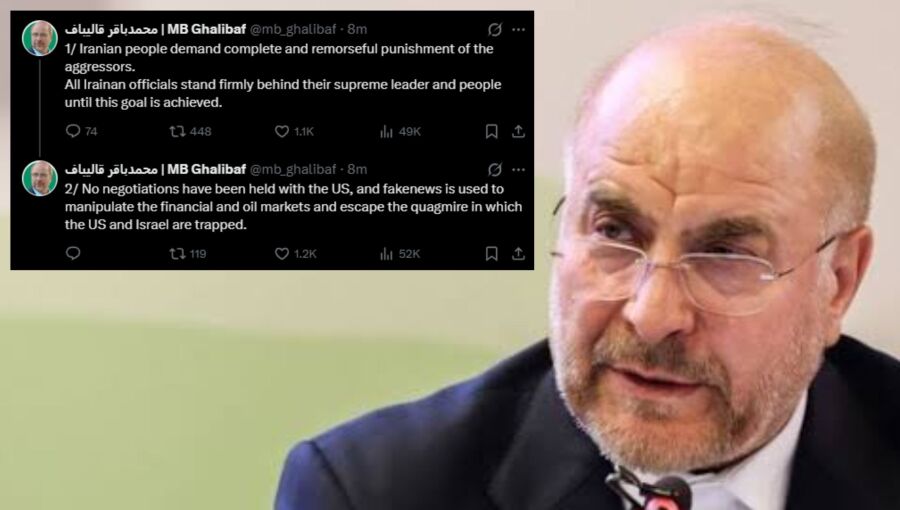
Iran's parliament speaker, Mohammad Bagher Ghalibaf, denied that any negotiations with the United States have taken place, accusing Washington of spreading disinformation to manipulate financial and oil markets, on March 23.
The denial came hours after US President Donald Trump posted on Truth Social claiming that Washington and Tehran had held productive conversations over two days focused on ending hostilities, and that he had instructed the Department of War to postpone military strikes against Iranian power plants for five days.
An Israeli official said mediating countries were trying to convene a meeting in Islamabad, with Ghalibaf and other Iranian officials representing Tehran, and Trump's envoy Steve Witkoff, Jared Kushner and possibly Vice President Vance representing Washington.
Iran's foreign ministry said there had been no talks between Iran and the US, while acknowledging some countries in the region were working to reduce tensions.
Ghalibaf, posting on X in a series of messages on March 23, said Iranian officials stood firmly behind the country's supreme leader and vowed to pursue what he called complete punishment of those he described as aggressors.
He also accused the US and Israel of being trapped in a "quagmire" and said false reports of negotiations were being used to engineer favourable moves in commodity and currency markets.
Ghalibaf has emerged as one of Iran's highest-ranking surviving officials following the killing of Supreme Leader Ali Khamenei and severe degradation of the country's military command in US-Israeli strikes late last month.
On March 22, Ghalibaf had warned on X that critical infrastructure and energy facilities across the region could be "irreversibly destroyed" should Iranian power plants be targeted by the US.
Trump postponed the strikes against Iranian power plants for five days on March 23, with Oman's foreign minister saying his country was mediating between the two sides.
US President Donald Trump announced on March 23 that he had ordered a five-day suspension of planned strikes on Iranian power plants and energy infrastructure, he said on social media.
The American president said the US and Iran had held "very good and productive conversations" over the preceding two days aimed at a "complete and total resolution" of the conflict.
The announcement came just hours before Trump's 48-hour ultimatum for Iran to reopen the Strait of Hormuz was due to expire, averting what would have been a major escalation that Iran had warned would trigger "irreversible" destruction of Gulf energy infrastructure.
"Based on the tenor and tone of these in depth, detailed, and constructive conversations, which will continue throughout the week, I have instructed the Department of War to postpone any and all military strikes against Iranian power plants and energy infrastructure for a five day period, subject to the success of the ongoing meetings and discussions," Trump wrote on Truth Social.
Has Trump TACO'd on the Iran war?
Donald Trump's announcement on March 23 that he was suspending strikes on Iranian power plants for five days, citing "productive" direct talks with Tehran, has a familiar smell to it. It smells like a TACO.
The acronym, coined by Financial Times commentator Robert Armstrong, stands for "Trump Always Chickens Out." It describes a pattern that has played out repeatedly across this presidency: escalate with theatrical threats, watch the consequences pile up, then quietly reverse course while claiming victory.
Trump TACO'd on tariffs, sometimes levying and rescinding the same duties within a weekend. He TACO'd on Greenland, settling for what he called "the concept of a deal" after markets swooned. He TACO'd on mass deportations. And now, with oil above $113 a barrel, Gulf infrastructure ablaze, his own counterterrorism chief having resigned in protest, and G7 leaders pleading for an end to the fighting, the president appears to be reaching for the same playbook on Iran.
Consider the sequence. On Friday, Trump said he was "winding down" the military campaign. On Saturday, he issued a 48-hour ultimatum threatening to obliterate Iranian power plants. On Sunday, hours before the deadline expired, he announced talks and suspended the threat. Three contradictory positions in 72 hours. This is vintage TACO.
But this time, the TACO has a problem
The difficulty, as analysts have pointed out, is that it takes two to TACO. Trump can unilaterally lower a tariff or recall immigration agents. He cannot unilaterally end a war in which the other side is still firing missiles.
Iran's parliament speaker Ghalibaf has threatened "irreversible" destruction of Persian Gulf energy infrastructure. The IRGC has struck Qatar's Ras Laffan, Kuwait's largest refinery and the Bazan refinery in Haifa. Iran is charging $2mn per vessel for passage through the Strait of Hormuz. The new supreme leader, from his unknown location, has issued a Nowruz message dripping with defiance. None of this suggests a regime ready to capitulate on Trump's terms.
Wars don't end just because someone declares them to be finished.
What Iran actually wants
Iran's ambassador to Germany laid out the terms in blunt language on March 22: a guarantee that attacks will not be repeated, compensation for damages, and a regional security system "without Israel." IAEA chief Grossi said nuclear talks were impossible while fighting continued. Iran's foreign minister has written to the UN Security Council accusing the US and Israel of war crimes.
This is not a government preparing to accept an unconditional surrender. It is a government that has taken enormous losses — its supreme leader, its security chief, its intelligence minister, its Basij commander, its IRGC spokesman and up to half its gas processing capacity — and is still fighting.
Where from here?
The five-day pause may be genuine. Perhaps back-channel talks through Oman, Belarus or another intermediary have produced something substantive. Perhaps Iran, bleeding from three weeks of bombardment, sees an opportunity to negotiate from a position that is not yet total defeat.
Or perhaps this is simply Trump buying time while three Marine expeditionary units steam towards the Persian Gulf, the Kharg Island seizure plans mature, and the administration works out how to declare victory on a war that has gone on longer, cost more and achieved less than anyone in the White House expected.
The TACO theory says Trump will look for the exit. The Iran war suggests the exit may not exist on terms either side can accept. And as one analyst warned: "Markets are pricing in a TACO. The problem is that in this case, it takes two to taco."
The world will find out by March 28 whether this is a genuine off-ramp or just another Trump feint before the next escalation.

No comments:
Post a Comment