UK
The Local Election Disaster of 2026: Can We Save Labour?
MAY 10, 2026
In 1929 the first British General Election took place under universal suffrage. In the light of the catastrophic local election results, Bryn Griffiths asks will the next General Election, on the centenary of this important milestone, also bring us the worst election outcome since all the British people secured the right to vote?
Labour members are reflecting upon whether Starmer’s performance is so bad that he will enable Nigel Farage to enter 10 Downing Street. In this utterly miserable moment on Saturday 9th May 2026, I first attended the Momentum National Coordinating Group and then travelled on to a Lewes Labour gathering to consider Votes Turns and Wipeouts.
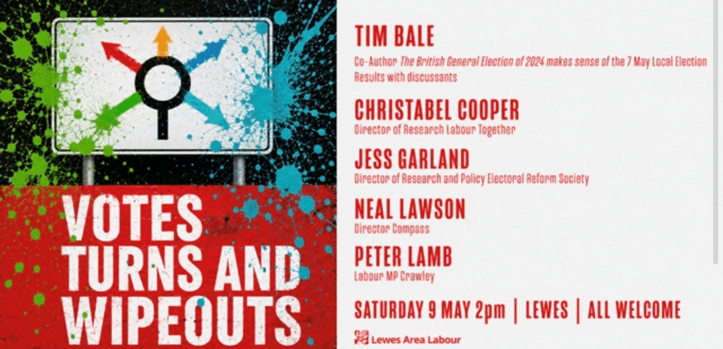
The flyer for the Lewes Labour Party Event on 9 May 2026
The Farage threat
If Farage was to enter 10 Downing Street in 2029 he would become the worst Prime Minister in living memory. It would be as if Enoch Powell, instead of being frozen out by Ted Heath in the 1970s, had led the Tory Party and gone on to become our Prime Minister. We all remember the massive series of defeats for the labour movement that followed Margaret Thatcher’s election in 1979, but we can assume that Farage has the potential to be a whole lot worse.
So, how bad was the 2026 local election result? Is the party facing an ‘existential threat’ as John McDonnell suggested on the Labour Left Podcast back last autumn? What is to be done to save the party before it is too late?
The bad news
In Lewes, the keynote address was by politics Professor Tim Bale, Queen Mary University London, a co-author of The British General Election of 2024. He introduced, what at points was a doom-laden event, by telling us: “The bad news is there is no good news.” To make sure we got the point he added that the word “catastrophic understates the situation” and the result was “devastatingly bad”. Tim added that he had been sceptical about a Farage victory in 2029 but he now thinks Farage is on course to win if things don’t change. So, Farage may well be our next Prime Minister.
Earlier in the day at the Momentum National Coordinating Group Mike Phipps, the Labour Hub editor, had suggested that the 2026 elections signalled a fracturing of Labour’s progressive coalition. Labour now not only faces the loss of some working-class votes to Reform but also the peeling away of progressive voters to the nationalists, in Scotland and Wales, and to the Greens as well. Due to the crisis of Labour, progressive voters now have other places to go.
What actually happened on Thursday 9th May 2026, according to Tim Bale, was that Nigel Farage managed to reassemble much of the Boris Brexit coalition, but this time it was to support Reform. As a result, according to Sky TV, it was Reform who were the clear winners with 27% of the vote. The Tories followed behind with 20% of the vote and Labour came third with 15%. The Greens and Liberal Democrats were very close on our tails with 14% with the balance being made up by other parties. The translation of local election votes into national percentages is a difficult task and the percentage figures vary a little across outlets but the story is always the same: Reform won and the electorate’s message is universally bad for Labour.
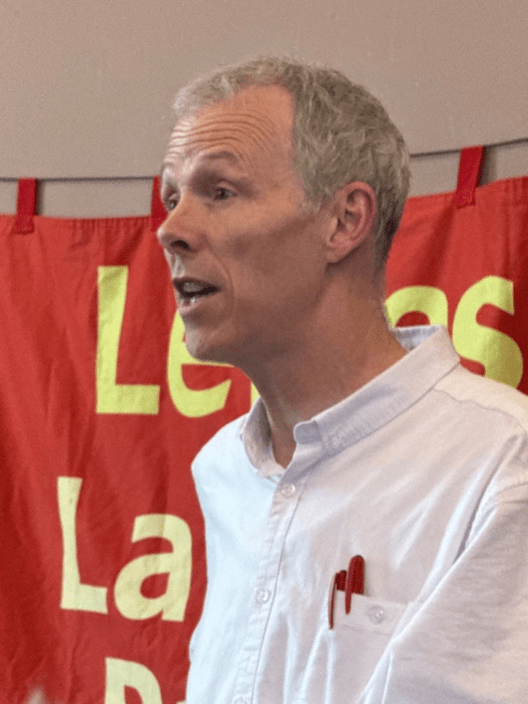
Professor Tim Bale, Queen Mary University London, a co-author of The British General Election of 2024 addresses the Lewes Labour Party event
According to Tim Bale, another disturbing aspect of the local election result is the resurgence of the Scottish National Party and the rise of Plaid Cymru which means Labour can no longer be seen as a national party. It is as if Tom Nairn’s Break up of Britain is happening before our very eyes.
Fragmentation
In the aftermath of the Caerphilly by-election and a local council by-election in Colchester, I told A Story of Fragmentationin Britain’s two-party system. The fragmentation of United Kingdom electoral politics has previously been mapped by Hannah Bunting, the Co-Director of the Elections Centre at the University of Exeter, when she wrote in The Conversation last year that “UK local elections delivered record-breaking fragmentation of the vote”. In Hannah’s words, “the 2025 council election broke records for the extent of fragmentation – a significant movement away from the dominance of the two parties that have dominated British politics for the past century.”
The process of fragmentation consolidated in the 2026 local elections, with the pollster John Curtice reporting a record low of 34% for the combined total of Labour and the Tories who historically have been the two main parties under the first past the post electoral system.
Given this political fragmentation taking place across Britain, we need to look at the party-specific electoral stories which are emerging to help us map the new political landscape.
The Greens
John Curtice reported that in his calculations the Greens got around 18% of the vote with Labour and the Conservatives trailing with 17% each. The figures confirm Tim Bale’s suggestion that “catastrophic” understates the seriousness of the result for Labour. Bale went on to explain how the Labour seats tally tells a misleading story. Reform may have been winning the seats in big numbers but in many cases the explanation for their victories was that it was the Greens who were reducing Labour’s vote and handing seats to Reform as our supporters abandoned Labour to the left.
To make matters much worse, Tim Bale reported that polling by Focal Data suggests that the Green wave is a more permanent phenomenon than a temporary protest vote.
Labour
The Labour story is utterly depressing. The Starmer narrative that this is mid-term blues and we must keep our nerve and keep on track is utterly delusional. It overstates Labour’s ability to bounce back. Labour councillors form the bulk of Labour’s door step campaigners so when you lose 1,496 Labour councillors you also lose a large proportion of our door knockers. It is also the case that in many areas councillor expenses pay for our Labour leaflets. Without councillors how do we fund our leaflets next time?
Bale also pointed out how damaging the impact of Starmer’s stance on Gaza had been to Labour’s previously strong support in the Muslim community. Bale said that Starmer’s Nick Ferrari interview on Gaza had been one of the most damagingly impactful statements by a party leader that he could remember when it came to losing votes.
Reform
The Reform re-creation of the Boris Brexit coalition to win a vote of 26% and 1,451 new seats is utterly depressing. Tim Bale pointed out that the Conservatives on these kinds of results would ensure that we get a Reform Government. The only point of doubt is whether they would seek to heal the division on the right after the 2029 General Election, or would they even more frighteningly come to some arrangement with Farage before the election even takes place? If they were to heal their divisions with some form of electoral understanding before 2029, the General Election result would be much worse.
The Liberal Democrats
The Liberal Democrats did not make much progress but along with the Greens they form another part of a picture of a fragmenting left of centre electoral bloc.
Mainstream
Back in Lewes, another former Labour Left Podcast guest Neal Lawson of Compass, a key mover of Mainstream, the new ‘soft left’ organisation, was in barnstorming form. Compass had previously pointed out in their aptly named report Thin Ice – Why the UK’s progressive majority could stop Labour’s landslide melting away that an electoral strategy that leans heavily towards trying to out-Farage Farage on his own anti-migrant territory was fatally flawed as it would undermine our own electoral base. Neal who has been vindicated and was visibly unhappy about it captured the mood of the meeting.
Meanwhile, Mark Perryman, who organised the event and recently published The Starmer Symptom, reviewed on Labour Hub here, pointed out that 36 of the top 50 Green target seats at the next General Election are Labour seats and, echoing other speakers and John McDonnell MP, suggested Labour is facing an existential crisis.
I left Lewes more convinced than ever that we must back the candidates in Labour’s National Executive elections who say they wish to Reset the Labour Party. We need to back candidates across Labour’s progressive majority which include both supporters of the Centre Left Grass Roots Alliance and the newly formed Mainstream. I hope you will join me in backing all the candidates who stand for rebuilding basic democracy, pluralism and fair process within our party.
What is to be done?
If we are to stop Nigel Farage entering Downing Street we need to rebuild Labour’s ‘progressive coalition’. We are up against a Reform Party which has rebuilt the Boris Brexit coalition so the task is absolutely urgent.
To re-start the important task of progressive coalition-building, we need a change of leadership but we also need to change the toxic culture brought about by Labour Together which is a systemic problem at the very heart of the Labour machine. It’s a culture eloquently described by Paul Holden in the recent Labour Left Podcast. Labour’s Cabinet, with the possible exception of Ed Milliband is no place to look for a new Leader as they were hand-picked by Labour Together and Keir Starmer to take the Party in the direction which has caused us so much damage.
At the time of writing it seems clear that Starmer is going and he will not be the Leader of the Labour Party when we fight the next General Election. Starmer’s departure is so clear that in Lewes even Christabel Cooper, the Director of Research at Labour Together conceded Starmer would not lead us into the next General Election. What is not clear is the manner of his departure. Will he leave suddenly in an attempt to allow the Parliamentary Labour Party (PLP) to circumvent a proper discussion within the party and attempt a PLP coronation? Will he be forced to depart to a clear timetable to allow for a smooth and orderly transition this year? Starmer is currently threatening Labour members with a continuation of his leadership so perhaps he will stagger on to be felled by yet another crisis in the not-so-distant future.
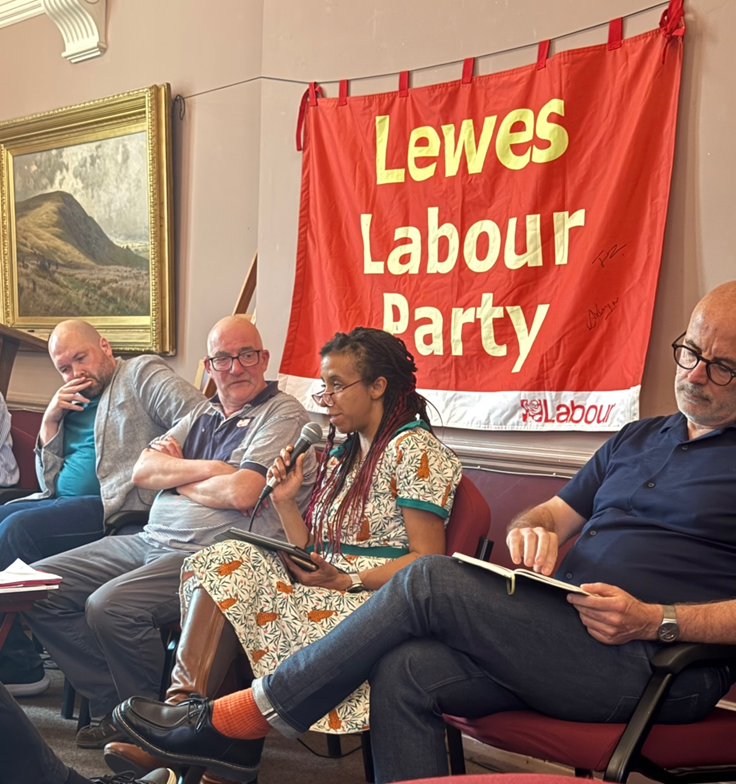
Christabel Cooper, the Director of Research at Labour Together addresses Lewes Labour Party flanked by (l-r) Peter Lamb MP, Mark Perryman and Compass’s Neal Lawson.
Given Labour’s problems are so much more than a Labour Leader who is hated by a large part of the electorate we need a plan that reaches far wider than a change in the face at the top. I would suggest the following questions would be good ones to pose to any of the leadership candidates that emerge.
Will you shoot rightwards rather than leftwards to do all you can to stop Nigel Farage entering Downing Street? In the local elections Labour’s relentless attacks on the Greens led by Labour Together’s toxic factionalist and Cabinet member Steve Reed MP were utterly shameful. If we are to attract Green voters back to the Labour fold we need to address their policy concerns and make Nigel Farage our main enemy.
What will you do to save the link to unions like UNITE and show that Labour will again act for working people? An important feature of Labour’s existential crisis is the possibility of losing big trade union affiliations, most notably UNITE’s. Not only would this devastate Labour’s finances but further loosen Labour’s identity as a Party that represents working class people, further accelerating the fragmentation of Labour’s base.
How will you restore Labour’s democracy? Labour’s internal culture is toxic with excellent hard working Labour representatives being dumped by the party. To give one clear example, Hackney MP Diane Abbott, the Mother of the House and Britain’s first Black woman MP, has had the whip withdrawn. The result has been a moribund local party and the election of a Green Mayor in Hackney.
Would you signal an end to Labour’s creeping authoritarianism by supporting John McDonnell MP’s call for an independent inquiry into Labour Together? If we are to show that Labour is bringing an end to the toxic culture that led to the appointment of Peter Mandelson as the United States Ambassador, the Party needs to signal a clear break with Labour Together. Labour needs to be apologising to the British public and an independent inquiry would be a great way to signal we have started to change.
Will you support Labour’s Conference policy of proportional representation to ensure that Nigel Farage’s Reform could not enter Downing Street with as little as say 28% of the vote? We should not risk Nigel Farage following Keir Starmer by securing his own wide but shallow parliamentary majority. A new leader needs to be crystal clear on this policy so in the event of a hung parliament we know we can forge a coalition to lock out Nigel Farage.
Will you question Labour’s long held policy of Atlanticism and forge an ethical foreign policy independent of Donald Trump and his ally Benjamin Netanyahu? Labour needs a new debate on its approach to foreign policy now that events in Gaza and Iran have well and truly broken the so called ‘special relationship’. In a multi-polar world we need to reconsider, in the words of the late Robin Cook MP, what an ‘ethical foreign policy’ should look like.
When Starmer goes, we should support an attempt by the Socialist Campaign Group to stand a candidate but it is very likely that the Morgan McSweeney-instigated rule change that requires around 80 MP nominations to get on the ballot will prevent this from happening. To facilitate a proper leadership election taking place we need to push back against any rushed attempt to secure a coronation by the Parliamentary Labour Party. Now more than ever we need a serious debate with time, if we are going to save the Labour Party and stop Nigel Farage.
If we cannot have a Campaign Group candidate on the ballot paper I think Andy Burnham is best placed to answer all the questions above. The obvious concern after Labour Together’s factional blocking of Andy’s attempts to re-enter Parliament will be that the members’ favoured choice will fail to even make the ballot paper.
Can we stop Farage?
The big question is can Farage be stopped in 2029? The answer is that there is clearly the potential to beat him as we know from the local elections that there is a left of centre electoral bloc made up of the Greens, Labour and the Liberal Democrats which commands the votes of around half the electorate. The problem is that under first past the post there is every possibility that Farage supported by the Conservatives could enter 10 Downing Street with as little as say 28% of the vote.
The difficult task is to reconstruct Labour as a progressive bloc which can win or at least get as far as achieving a hung parliament from which an anti-Farage coalition can emerge. But we all know that the precondition for embarking on the long march to the re-creation of Labour as a progressive coalition is the removal of Sir Keir Starmer as our Labour leader and the end of Labour Together’s toxic political culture at the heart of our party. If we don’t carry out these essential political tasks we will all be doomed and Nigel Farage will be our next Prime Minister.
What happens next in the Labour Party matters to the whole of the left. It is clear that the Greens cannot win a parliamentary majority alone so who becomes the next Labour leader will be crucial to us all. If there is a hung parliament will the Labour Leader in 2029 pick up the phone to call Zach Polanski? Will they be prepared to back proportional representation? Will they have a respectful conversation with the nationalists of Scotland and Wales? We know the answers we need to hear if we are going to rebuild Labour as a progressive coalition to stop Farage and win.
Bryn Griffiths is an activist in Colchester Labour Party and North Essex World Transformed. He is the Vice-Chair of Momentum and sits on the Campaign for Labour Party Democracy’s Executive.
Bryn hosts Labour Hub’s spin off – the Labour Left Podcast. You can find all the episodes of the podcast here or if you prefer audio platforms (for example Amazon, Audible Spotify, Apple, etc,) go to your favourite podcast provider and just search for the Labour Left Podcast.
To explore the key themes in this article you may wish to watch the Labour Left Podcast with Paul Holden to understand the role of Labour Together. The latest podcast with David Renton looks at the threat of the extreme right.
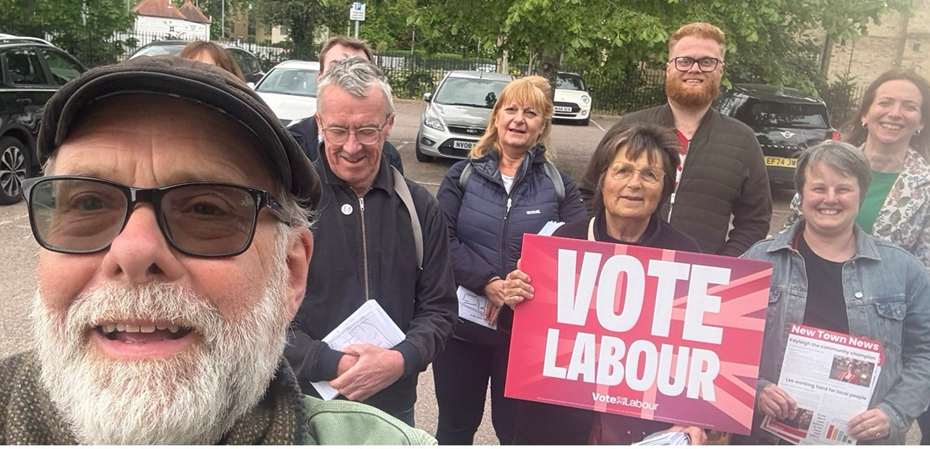
Main image: the author out leafleting in Colchester’s New Town and Christ Church. Photos c/o the author.
Red Wall Tory voters defect to Reform, but Muslim vote leaves Labour
MAY 16, 2026
Michael Hindley looks at May’s local election results in the former East Lancashire Cotton Belt.
The four East Lancashire District Council elections (Blackburn with Darwen, Burnley, Hyndburn and Pendle) all saw a collapse in Labour representation, and though the boundaries do not correspond exactly to Westminster constituencies, the results spell disaster for Labour in the sub-region. The Westminster Labour victories in 2024 were a temporary respite, and not a revival.
It is clear that the long-term prospects for Labour in East Lancashire were set in the ‘Red Wall’ election of 2019, and didn’t fundamentally change in 2024.
To recap, the metropolitan chatterati got very excited with Boris Johnson’s victory in December 2019, which in essence was down to a clever, opportunist slogan of “Get Brexit Done”. That election was in effect the ‘Second EU Referendum’, which Keir Starmer, then Labour’s Europe Spokesperson, had naively demanded. Labour promised to renegotiate the terms of membership and put the subsequent new deal to another referendum; a faint echo of a far more skilful Harold Wilson’s clever winning strategy in 1974.
East Lancashire had been staunchly anti-Europe in the 1975 Referendum held to confirm our membership. East Lancs retains a deep reservoir of Euro-scepticism, as I well know as a former Hyndburn Council leader and MEP for the sub-region from 1984 to 1999.
The clever campaign slogan of “Get Brexit Done” fed on that anti-EU sentiment, despite East Lancashire’s great success in attracting EU funds, which to some degree alleviated the ravages of Thatcher’s stripping of East Lancashire’s manufacturing base and starving of local government aid.
Only in Blackburn did Labour escape the General Election of December 2019 election cull.
But Johnson and subsequent Tory governments had not the slightest intention of alleviating the misery of social and economic distress and the failures of successive PMs, Liz Truss and Rishi Sunak drained the Tory Party’s reservoir of support.
The Labour ‘landslide’ of 2024 had everything to do with the peculiarities of the First Post the Post (FPTP) electoral system and the exhaustion of the Tory Party had very little to do with Starmer’s cautious policies. In fact in the East Lancs seats, which Labour regained (Burnley, Hyndburn, Rossendale and Darwen and Pendle) the Labour vote actually fell,but was compensated for by a collapse in the Tory vote.
Starmer did not enter Number 10 with any popular enthusiasm, more a relief that the Tories were gone.
The immediate fiasco of the winter fuel allowance and the ‘second child cap’ severely dented any idea that ‘change’ was coming. Also, the immediate revelation that the Labour elite were freeloading on Lord Alii’s generosity and also accepting freebies for pop concerts and sporting events increased the grumbling that ‘they’re all the same’.
The collapse in confidence in Starmer’s Labour had set in long before the damage of the Mandelson scandal. Most significant, and often overlooked in election analysis, is the continued impact of the Israeli government’s horrendous destruction and slaughter in Gaza, which still continues despite a bogus ceasefire.
The outrage felt among the usually loyal Muslim Labour voters and representatives has been profound and lasting. Throughout East Lancs, Muslim Labour councillors resigned in protest against the Starmer government’s failure not only to explicitly condemn Israel’s attacks on Gaza, but in effect to become complicit in those attacks. Many of those ‘Independent’ defectors kept their seats in the recent local elections and there are now some thirty-five such local councillors identifiable as Muslim ‘Gaza’ Labour defectors.
This disillusion climaxed in the Rochdale by-election in February 2024. The local Labour Party selected the much respected and competent Labour Leader on Lancashire County Council and Pendle-based, Azhar Ali. Some intemperate remarks of his were magnified by a press in full hue and cry to accuse another Labour figure of anti-Semitism. The former MP and former Leader of Lancashire County Council, Louise Ellman, at first spoke in his favour but then on the leaking of further intemperate remarks, joined the chorus to drop Azhar Ali.
Buckling under the pressure, the Labour leadership dropped Azhar Ali but too late to stop his name appearing on the ballot paper. The inevitable drop in the Labour vote in Rochdale led to the itinerant radical George Galloway winning the seat, only to lose the seat in the May General Election.
Azhar Ali is now the Leader of a small groups of Greens and Independents in County Hall under the name ‘Progressive Lancashire’, perhaps a sign of things to come.
Worst was to follow for Labour in Lancashire in the County elections in May 2025, when Reform advanced spectacularly from a few councillors to a staggering overall majority.
The percentage of people identifying themselves as Muslims in East Lancashire boroughs is higher than the national average of 6.5%. (Blackburn 35%, Pendle 26%, Burnley and Hyndburn 14% each), figures eagerly seized on by the anti-immigration Reform party, which deliberately conflates immigration with refugees and asylum seekers.
The nadir of Labour’s loss of support amongst Muslim voters came in the General Election of 2024, when an ‘Independent’ won Blackburn, which had been a safe Labour seat for decades and had had Philip Snowden, Barbara Castle and Jack Straw as its MPs.
The winner, Adnad Hussain, another Labour defector, won. Like other Muslim representatives, Hussain, a local businessman, is pro-Palestine but socially conservative. Although an initial supporter of the ‘Independent Group’ of MPs, he soon left after its transformation into ‘Your Party’.
The Greens have little impact on the electoral map of East Lancashire, but a growing membership and have an appeal to younger votes.
Boundary changes in East Lancashire were gerrymandered by the Tories to ensure their survival but the plan failed disastrously as the Reform surge ate into the Tory vote. Ironically it was this loss of Tory votes, which saw Labour win seats despite a fall in the Labour vote.
Labour needs East Lancashire seats to form a government and it is significant that two of Labour’s 2024 new winners, have called for Starmer’s resignation. My own conversations throughout East Lancs with many friends with longstanding experience in Labour politics were adamant that Starmer’s unpopularity was a decisive issue on the doorstep.
Will Andy Burnham’s possible entry into an eventual leadership contest change the picture? Currently reading Chris Moss’ Lancashire, I came across a very apt description of Lancashire urban society. Though Lancashire is now a post-industrial society, the atmosphere hasn’t really changed. The original quote comes from 1930s Bolton but is as accurate today as then.
“…the complete discrepancy between what all the people I am working with think and what is being reported in the newspapers and on the BBC. The gap between leader and led, between… Westminster chatter and Lancashire talk has built an invisible barrier that is dangerous in democracy.”
The feeling in ‘Red Wall’ East Lancs, is that Starmer simply doesn’t get it; but Andy Burnham does. Burnham’s record in Manchester, East Lancs’ most accessible metropolis, is admired across all sections of the North West.
The challenge though is, can Andy Burnham translate that empathy into national policy?
Michael Hindley is a former Leader of Hyndburn Council, a Lancashire County Councillor and MEP for Lancashire East. He is now a freelance writer and speaker on international politics. This article first appeared on his substack here.
Image: https://socialistalternative.info/2022/07/01/wakefield-by-election-yet-another-tory-catastrophe/ Creator: Kim Hansen (Wikimedia Commons User:Slaunger) Copyright: Kim Hansen Licence: Attribution 3.0 Unported CC BY 3.0 Deed
Labour’s catastrophic results necessitate new leadership
MAY 9, 2026
‘Sweeping gains for Reform’ was the dominant headline following the first wave of results in Thursday’s local government elections. It’s undeniable that Reform were highly effective at converting votes into seats, particularly in parts of the North and especially in areas represented by prominent Labour MPs.
BBC Political Editor Chris Mason pointed out that in Tameside, Greater Manchester, the seat of former Deputy Prime Minister Angela Rayner, Labour lost 16 of the 17 seats it was defending to Reform. In nearby Wigan, where the local MP is Cabinet Minister Lisa Nandy, Labour lost all 22 seats it was defending to Reform.
In many such areas, this is a reaction to politics-as-usual, a vote by desperate voters for the ‘Change’ that Keir Starmr promised in 2024 but signally has failed to deliver. Elsewhere, Reform made gains at the expense of the Tories, a straightforward switch between the two right wing parties.
Where did Labour’s votes go?
But polling expert Professor John Curtice counselled caution in drawing any conclusion that it is Reform who are doing most damage to Labour in these elections. “That is not the pattern,” he argued. “A sharp fall in Labour’s performance is accompanied more often by an above average Green performance than it is by a strong Reform performance.”
Politics Professor Rob Ford agreed: while Labour may have lost most seats to Reform, it lost more votes to the Greens and this split allowed Reform to come through the middle. He warned: “If Labour react to this pattern by saying ‘we need to win back votes from Reform’ they risk making a major misdiagnosis, one which could make their current troubles even worse.”
London Mayor Sadiq Khan went further. He said: “Labour has lost votes in London to a variety of different parties, but the biggest change has been Labour voters switching to the Greens.” He said that many people who had voted Labour in 2024 “clearly feel angry, disappointed and let down.”
“They want a Labour government to address the cost-of-living crisis while demonstrating the core values the party was established to promote,” he continued.
Green leader Zack Polanski certainly had a lot to celebrate, including the end of two-party politics, as his party made substantial gains, especially in London. But without proportional representation, this fracturing of the progressive vote has unhealthy consequences, with good socialists in both Labour and Greens – and sometimes independents too – running against each other. In some cases, this allowed candidates – sometimes from the far right – to win with a small percentage of the vote. With a future Reform-led government a distinct possibility, this is a luxury the left simply cannot afford.
For Labour, the break-up of its coalition of radical progressives and working class voters is producing a stark polarisation. Nowhere is this clearer than in Wales with the Labour voters moving to Plaid Cymru and Reform to demand different kinds of radical change. Even Labour’s First Minister Eluned Morgan could not retain her seat. Contrast this with the picture a few years ago under Mark Drakeford’s leadership, when a clear Welsh Labour identity helped the Party in Wales to buck national trends that were unfavourable to Labour.
Some caution clearly needs to be exercised when extrapolating from these results projections for the Westminster Parliament. Turnout may have been higher than usual, but it was still significantly lower than in a general election. For a variety of reasons, older voters tend to vote more in second-order elections, and this cohort tends to favour parties of the right, compared to younger voters. In a general election, where younger voters are likely to be more engaged, the Greens might do even better, Reform UK less so.
Who’s responsible?
Much of the blame for Labour’s dire performance must be attributed to the Starmer government’s failure to deliver the promised change, instead attacking Labour’s base with the winter fuel allowance policy and the continuation of the two-child benefit cap. All the worthy things the government may be doing are marginalised by its refusal to address the cost of living crisis.
But a good part of Labour’s dismal showing is down to what the Starmer faction, led by the now disgraced Mandelson and McSweeney, have done, not just in government, but to the Party itself, with their factional expulsions, deselections and blocking of decent candidates.
Take Hackney, where the Greens made sweeping gains to win a majority on the Council and the mayoralty. “Hackney North MP Diane Abbott has been suspended for nearly two years and the Constituency Labour Party is moribund, without even branch meetings, let alone any pretence at internal democracy. The result is yesterday’s collapse in the vote,” pointed out David Osland.
In Brent, northwest London, where Labour won all but eight seats in 2022, the Council passed to no overall control. The Borough Party was the centre of a Campaign Improvement Board, answerable only to the National Executive Committee. It tore up the local selection process by branches and imposed candidates centrally, barring several sitting councillors, many from the left, with impeccable records, in the process. Some joined the Greens and retained their seats. The widespread demoralisation of Labour members undermined effective campaigning and all opposition parties made sweeping gains, leaving Labour councillors in a minority.
Change the leader
The news agenda has moved on from analysing the results to weighing up how long Keir Starmer has left in office. A change of leadership is undoubtedly necessary, as increasing numbers of MPs – and not just from the left – are now saying publicly.
“There was one issue on the door and it was Keir. If he leads us into a future election we are dead,” one Labour MP told the BBC. Another usually loyal Labour MP, in an area that went heavily Reform in Thursday’s poll, said the reassuring thing was that voters didn’t really hate Labour, but “they did hate Keir.”
Former Cabinet member Louise Haigh said: “Unless the government delivers urgent and significant change it’s clear the PM cannot lead us in to the next election.”
Clive Lewis MP spelled it out: “The Prime Minister needs to go. That is not negotiable. The only thing now in his gift is the nature of the contest that follows. It must be open, fair and legitimate. Everyone who should be part of that process must be allowed to take part. That means no blocking Andy Burnham. And it means a clear departure date, no later than the autumn. These results are existential for the Labour Party. Existential. Anyone still saying we should simply carry on ‘delivering the plan’ has lost touch with political reality, and with the public. The voters have spoken. It is not for the leadership to pretend they have not.”
This is eminently sensible. And it should be added: replacing the current leader with a ‘better communicator’ will not address Labour’s woes if the political direction remains the same. Labour needs new leadership, but also new policies that address the combined crises of health, climate and cost of living – and much more.
Urgent! A letter from defeated Labour councillors and candidates is now circulating calling on Keir Starmer to set a timetable for his departure. Please get defeated candidates and councillors to sign.
On the Monday evening after the elections – 11th May, 6.30 – 7.30 – Arise and the Trade Union Coordinating Group will be hosting an online discussion asking these questions. Left MPs including John McDonnell and Richard Burgon will be joined by trade union leaders Fran Heathcote (PCS) and Daniel Kebede (NEU) to think through the significance of what has happened and the political lessons for activists on the left.
Register here to join the meeting.

No comments:
Post a Comment