“Cramer here is having what should be the normal reaction to Trump actively insider trading on his own decisions,” said journalist Ryan Grim.
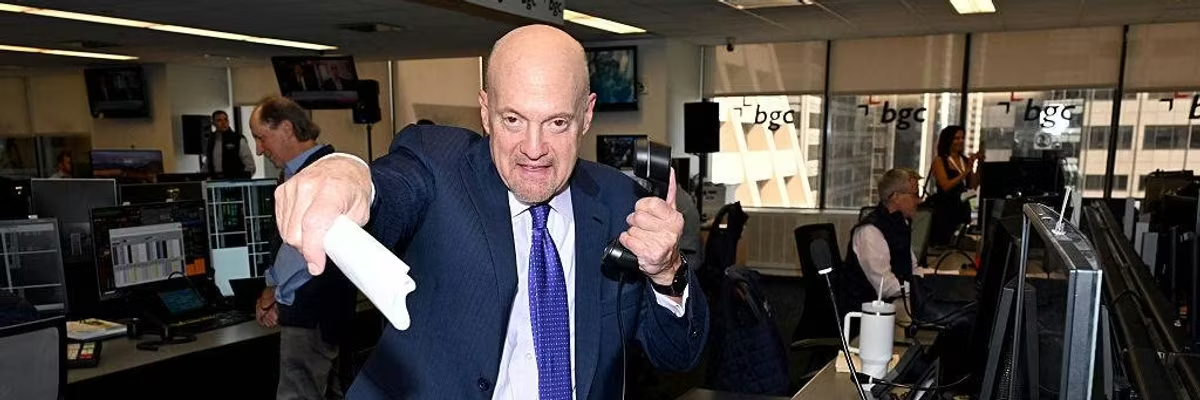
Jim Cramer attends Charity Day 2025 Hosted by Cantor Fitzgerald Relief Fund at BGC Group on September 11, 2025 in New York City.
(Photo by Dave Kotinsky/Getty Images for Cantor Fitzgerald)
Brad Reed
May 18, 2026
COMMON DREAMS
One of Wall Street’s most recognizable gurus, Jim Cramer, became notably tongue-tied on Monday after President Donald Trump’s recent stock-trading spree entered into a televised conversation with his colleagues on CNBC.
Disclosures published by the US Office of Government Ethics last week revealed that Trump in the first quarter of 2026 carried out over 3,700 stock transactions, including over 30 stock purchases worth $1 million or more.
As noted by The Financial Times, Trump’s investments included transactions involving Tesla, Nvidia, Apple, Meta, Visa, Citi, Boeing, Qualcomm, and GE Aerospace, whose executives all accompanied the president on his trip to China last week.
When CNBC co-host Carl Quintanilla brought up these trades during Monday’s edition of “Squawk on the Street,” Cramer spent ten straight seconds mumbling incoherently.
This promoted co-host David Faber to reassure viewers that “we’re not having technical difficulties here,” even as Cramer appeared to short circuit.
Journalist Ryan Grim said that Cramer’s reaction to mention of Trump’s trades was understandable given that some of the companies whose stocks he traded have been direct beneficiaries of the president’s illegal war with Iran and other policies.
“Cramer here is having what should be the normal reaction to Trump actively insider trading on his own decisions,” remarked Grim. “Just sputtering speechlessness.”
Journalist Judd Legum on Monday published an analysis of the Trump stock trades in which he identified multiple instances where the president purchased stocks of companies shortly before—or in some cases, on the exact same day—that he publicly singled them out for praise.
Specifically, Legum found that Trump bought tens of thousands of dollars’ worth of shares in biotech firm Thermo Fisher Scientific on the same day he took a tour of one of its manufacturing facilities, and hundreds of thousands of dollars’ worth of shares in Apple on the same day he delivered a speech calling it “a great company,” while saying then-CEO Tim Cook has “done a good job.”
Trump also bought up shares in Micron Technology and then described it as “one of the hottest companies” during an interview with Fox News just one day later.
And nine days after buying millions of dollars’ worth of shares in Dell, Trump delivered a speech in Georgia where he told his audience to “go out and buy a Dell computer.”
In analyzing the trades, Legum explained how Trump has destroyed any remaining guardrails preventing US presidents from using their office to personally enrich themsleves.
“If Trump wanted to legally remove himself from investment decisions he could do so by creating a qualified blind trust,” Legum wrote. “Instead, before returning to the White House, Trump transferred his assets in a trust that is managed by his son, Donald Trump Jr. There are no legal or practical barriers preventing Trump from being involved in the management of his assets.”
Rep. Dan Goldman (D-NY) warned Trump that details of his assorted stock trades would eventually come to light.
“This smells like blatant and criminal insider trading,” Goldman wrote in a social media post. “Even worse, Trump is personally profiting off of his illegal deportation dragnet. Since we know congressional Republicans will pretend like they never saw this and won’t do a thing, anyone involved in these trades should preserve their records for my investigation in January 2027.”
Trump may have accidentally bought sushi stock instead of what he intended
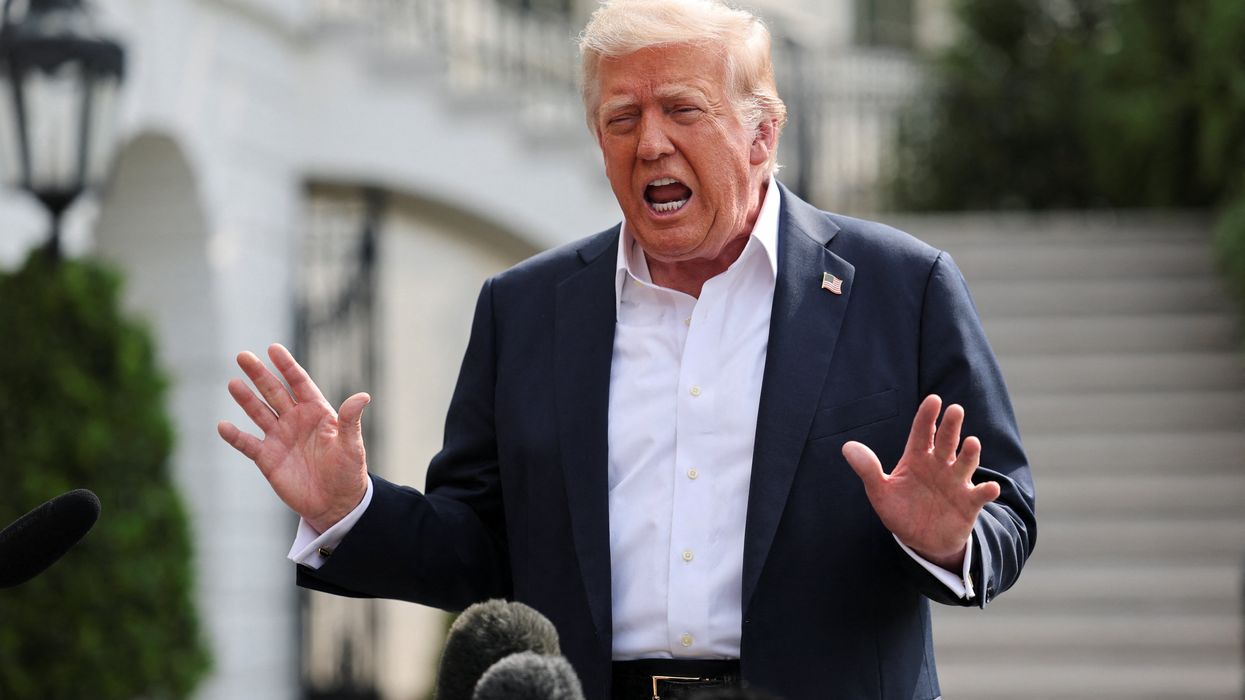
U.S. President Donald Trump speaks to reporters as he departs for travel to Texas to tour areas affected by deadly flash flooding, from the South Lawn of the White House in Washington, D.C., U.S., July 11, 2025. REUTERS/Jonathan Ernst
May 20, 2026
ALTERNET
President Donald Trump faces immense controversy for continuing to buy and trade stocks, even though doing so creates a conflict of interest for him as president. Yet there is at least one Trump stock trade which has attracted attention for a somewhat different reason — namely, that it may have been accidental.
On Feb. 2 the president bought between $1 million and $5 million worth of stock in the conveyor belt sushi chain Kura Sushi, according to a report by the Associated Press. People online quickly noticed that, much as Trump scheduled a press conference at Four Seasons Total Landscaping in 2020 instead of the famed hotel with a similar name, he may have accidentally purchased a sushi stock instead of something else he wanted.
“Some people are speculating that perhaps Trump (and the people managing his investment portfolio) intended to buy something like FujiKura, an electrical equipment company that also makes golf equipment, or Kura Oncology, which develops cancer treatments and has the stock ticker KURA,” reported Gizmodo’s Matt Novak. “Kura Oncology’s stock is currently up 9% on the day, perhaps because so many people online are speculating about Trump’s odd stock purchase. FujiKura is down 8% on the day, but that slide kicked off yesterday after a three-year forecast dashed investors’ hopes.”
Most of Trump’s other trades have involved the major tech firms that are also shaping his policies on issues like regulation and AI, including Amazon, Nvidia, Apple and Microsoft. He also has traded in the tobacco company Philip Morris, the private prison company GEO Group, the bodycam company Axon and defense contractors like Palantir and RTX, formerly known as Raytheon. All of them have direct business before the government or are at least subject to potentially costly and high-profile regulations. Some of their CEOs have joined him on high profile trips to nations like China.
“That said, there are some restaurant groups in the stocks that Trump bought,” Gizmodo noted. “Trump purchased Cheesecake Factory stock worth $15,001-$50,000 on March 4 and Dave & Buster’s stock worth $15,001-$50,000 on Feb. 26. Maybe Trump is just a big fan of skee-ball.”
Financial columnist Matthew Lynn has previously warned about the potential corruption in Trump’s stock trading while in office.
“A Rose Garden announcement triggers panic on Wall Street,” Lynn recently wrote for The Washington Post, “then a post on Truth Social sends stock prices soaring. A promise of upcoming news launches a market rally, which slumps when the actual news is delivered that evening.” In general, Trump tends to make presidential proclamations which then directly impact his stock holdings, which Lynn described as “troubling.”
“According to a recent report from the financial research firm Fundstrat, Trump was the driver of the five best trading days on the S&P 500 index since the start of his second term,” Lynn wrote. “And he was also responsible for its five worst trading days. Such as? On April 3, 2025, the S&P 500 fell 4.8 percent when Trump announced ‘Liberation Day’ tariffs, and it bounced back 9.5 percent when most were suspended six days later.”
By contrast “none of the five best or worst trading days under Joe Biden were driven by one of his announcements,” Lynn wrote. “During Bill Clinton’s eight years in office, only one of the five worst days could be pinned on the president or his administration, and none of the best. Sentiment on the stock market was routinely driven by interest rate announcements, corporate earnings or economic data. Not by the guy in the White House.”

No comments:
Post a Comment