Friday, December 11, 2020

CRUEL & INHUMANE
For 2nd straight day, U.S. gov't to execute federal prisoner
RIGHT TO LIFE? 
THEY ARE NOT FETUSES
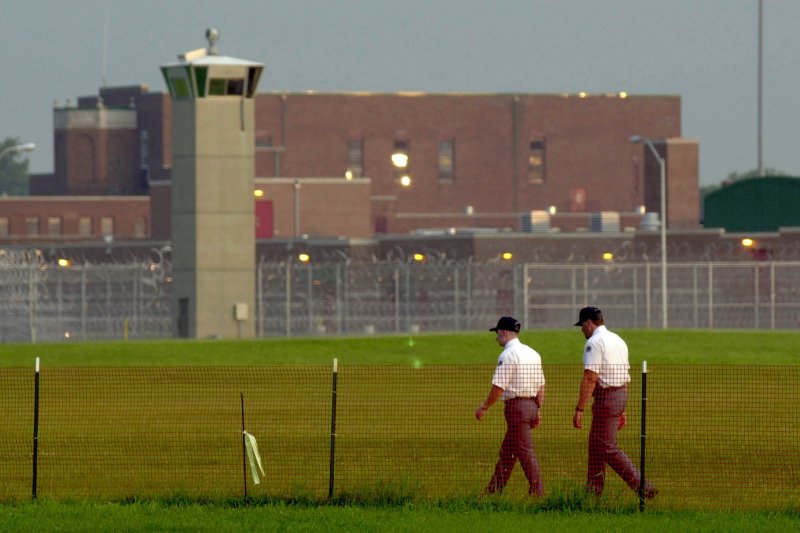
An exterior view of the federal penitentiary in Terre Haute, Ind., where Alfred Bourgeois is scheduled to be executed on Friday. The lethal injection would be the 10th federal execution this year after a 17-year moratorium ended in July by the Trump administration. File Photo by Mark Cowan/UPI | License Photo

Dec. 11 (UPI) -- The U.S. government on Friday plans to execute a man convicted of killing his 2-year-old daughter nearly two decades ago.

Alfred Bourgeois, 55, is set to receive a lethal injection at the U.S. Penitentiary in Terre Haute, Ind. The Supreme Court on Friday evening denied his request for a stay.

His attorneys said Bourgeois' execution would be unconstitutional because he is intellectually disabled and can't understand his punishment. They submitted evidence of IQ test scores of 70 and 75, as well as assessments by experts.

The Eighth Amendment bans executing people with such impairments as cruel and usual punishment.

Bourgeois was among the first inmates slated for death last year when Attorney General William Barr announced the resumption of federal executions after a 17-year hiatus. A federal judge stayed his execution in March, saying his lawyer made a strong case for his intellectual disability.

Bourgeois was convicted in 2004 of capital murder for the 2002 death of his daughter in Corpus Christi, Texas. Prosecutors said the girl died when Bourgeois became angry with her for turning over her potty training chair in the cab of his 18-wheeler and slammed her head into the vehicle's window.

Investigators said he regularly physically and sexually abused the toddler before her death. Bourgeois said he was innocent of the child's death and blamed her mother.

If executed, Bourgeois would become the 10th federal death row inmate to be put to death since July.

The last time a single presidential administration held that many executions was under President Dwight Eisenhower in the 1950s. The 34th president executed 10 people -- including the Rosenbergs, who were convicted of espionage -- over a seven-year period.


The U.S. Justice Department executed Brandon Bernard on Thursday and plans to hold three more executions before President-elect Joe Biden is inaugurated on Jan. 20. Orlando Hall was executed Nov. 19, more than a week after Biden was projected to win the presidency.

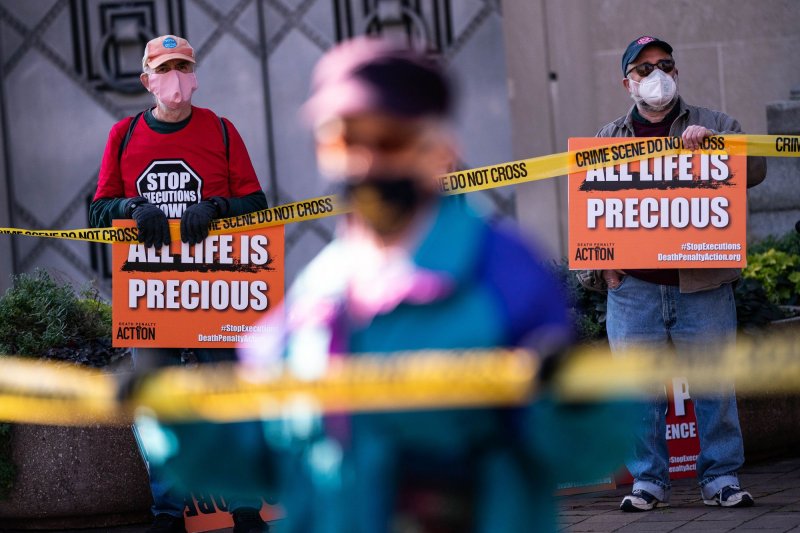
A group of anti-death penalty advocates protested the resumption of federal executions Thursday in a series of demonstrations in Washington, D.C., and Terre Haute. Death Penalty Action spokeswoman Allison Cohen told UPI that activists were especially concerned that executions were taking place after Trump lost his re-election bid.

Hall's execution last month was the first to happen during the transition of a presidency since 1889 under the administration of President Grover Cleveland.

"It's crazy that we are executing our federal death row prisoners during the lame-duck session," Cohen said, calling the effort "politically motivated."

U.S. government executes Brandon Bernard 
for Texas slayings

Demonstrators with the group Death Penalty Action participate in a protest Thursday against the death penalty at the U.S. Department of Justice in Washington, D.C., where the group is calling on ending the death penalty and asking President Trump to stop the five death penalty executions scheduled before he leaves office. Photo by Kevin Dietsch/UPI | License Photo

Dec. 10 (UPI) -- The U.S. government on Thursday executed a man convicted of killing a Texas couple two decades ago -- the second such execution of the lame-duck presidency of Donald Trump.

Brandon Bernard, 40, was given the lethal injection just before 9 p.m. at the U.S. Penitentiary in Terre Haute, Ind., for the 1999 deaths of Todd and Stacie Bagley, married youth ministers. His was the 9th execution carried out by the federal government and 16th overall in the United States this year.

Robert Owen, Bernard's attorney, said his client's loved ones were "full of righteous anger and deep sadness."

"Many things went wrong to put Brandon on death row, including egregious government misconduct in concealing evidence and misleading the jury, which the courts refused to remedy," he said. "Before Brandon's execution, five of the jurors who sentenced him to death said they no longer stood by that verdict. They joined the lead appellate prosecutor on Brandon's case in urging President Trump to commute his death sentence to life without parole."

"Brandon's execution is a stain on America's criminal justice system."

The execution came shortly after the Supreme Court denied Bernard's application for a stay of execution. His attorneys sought to appeal his case based on allegations that prosecutors withheld evidence they said may have spared their client the death penalty.

The defense team asked the Supreme Court for a 14-day delay so new attorneys added to the team Thursday -- Alan Dershowitz and former U.S. Solicitor General Ken Starr -- could have time to review the case.

Defense attorneys said they discovered evidence showing their client had a lesser role in the crime and the gang that perpetrated the killings. They argue that knowledge "almost certainly" would have persuaded at least one juror to vote for life in prison over the death penalty.

Bernard's lawyers accuse the government of withholding the evidence, which they say was found while reviewing court documents for the resentencing of one of Bernard's co-defendants, showing the information was in the government's possession.

Bernard and accomplice Christopher Vialva were sentenced to death in 2000 for the murders.

Prosecutors argued at trial that the Bagleys gave Vialva and two other accomplices in the case a ride before the men held them at gunpoint and locked them in the trunk of their vehicle. They also stole the couple's money and a wedding ring.

Bernard's attorneys said he was not with those three accomplices when they kidnapped the Bagleys, but was called to join later in his own vehicle. The four then drove the Bagleys and the two vehicles to Fort Hood Army base, where prosecutors said Vialva shot the couple in the head and set the car on fire.

Todd Bagley died instantly but Stacie Bagley, unconscious from a gunshot wound, died of smoke inhalation, federal prosecutors said.

Defense lawyers said Bernard believed he was called to help dispose of the Bagleys' vehicle and let them go free. Police arrested the four men after their vehicle slid off the road into a ditch near the Bagleys' burning vehicle.
Brandon Bernard was executed for the slayings of Todd Bagley and Stacie Bagley. File Photo courtesy of the attorneys for Brandon Bernard

Because the murders took place on a military reservation, they were considered federal offenses.

Vialva was executed for his role in September.

Earlier this month, dozens of people -- including jurors from Bernard's trial -- signed a clemency petition asking Trump to commute his death sentence. The petition asked Trump to consider that Bernard was just 18 at the time of the crime, had a clean prison record, showed remorse and conducted outreach work while incarcerated. They ask for his death sentence to be commuted to life in prison.

U.S. Attorney General William Barr resumed federal executions in July after a 17-year hiatus. Daniel Lewis LeeWesley Purkey and Dustin Honken were executed in July; Lezmond Mitchell and Keith Dwayne Nelson in August; William LeCroy and Vialva in September; and Orlando Hall in November.

Hall's execution was the first to be carried out during a lame-duck presidency since President Grover Cleveland's administration in 1880, according to the Death Penalty Information Center. Some critics, including Democrats in Congress, have called for the Trump administration to halt the executions scheduled for the remainder of his term and leave them for President-elect Joe Biden's administration to handle.

"These executions are a further illustration of how deviant and dangerously out of touch this government's conduct has been during the entire course of this execution spree," DPIC Executive Director Robert Dunham told UPI in November.

"No lame-duck president has attempted to carry out an execution in more than a century. And to cavalierly do so, as infections from a virus that has killed a quarter-million Americans are exploding across the country, exhibits a pathological lack of concern for public health and safety."


UPI Reader Poll: Death penalty

Do you support the use of the death penalty in the United States?

Supporters 'occupy' Oregon neighborhood to save family from eviction

Dec. 11 (UPI) -- Activists in Oregon continued Friday to occupy a blocks-long stretch of a Portland neighborhood and surround a foreclosed home there in an effort to keep a needy family from being evicted.

The "Red House" had belonged to the Kinney family for more than 60 years until they fell on hard times and the home went into foreclosure. It was bought for $265,000 two years ago.

Since then, the Kinneys have fought to stay in the home and resisted efforts by the new homeowners to evict. The situation intensified Tuesday when sheriff's deputies attempted to forcibly remove the family, but were resisted by supporters of the family who'd shown up to help.

Supporters and other activists have since moved in and barricaded themselves along a three-block stretch in the neighborhood. They have fortified the area with boards, fences, metal and other items around the house and in the street.

Friday is the fourth straight day of the occupation.

"As winter arrives and temperatures dip below freezing, the community remains resolute in their support, initiating weatherizing projects for those who continue to live and sleep outside the Red House in anticipation of a second eviction, which could happen anytime in the next four months," reads a statement on a GoFundMe page established to help the Kinneys.

"History shows the next eviction may be more devastating than the first."

The home's owners have said they're willing to sell the home back to the family, at cost. The GoFundMe campaign had raised nearly $262,000 by Friday.

William Kinney, the son of the couple evicted from the home, said his family wants a peaceful resolution and he's been negotiating with Portland Mayor Ted Wheeler and police to ensure the family's safety.

Wheeler said he also hopes for a resolution to end the blockade and protests. His city was ground zero for a number of anti-racism and police-reform protests earlier this year and over the summer after the police killing of George Floyd.


JUNO NOT WINNIE
Canadian Army promotes polar bear to honorary master corporal


Juno, a polar bear at the Toronto Zoo, was promoted to the rank of honorary master corporal by the Canadian Army in honor of the animal's birthday, which falls on the country's Remembrance Day. Photo courtesy of the Toronto Zoo

Nov. 25 (UPI) -- The Canadian Army celebrated the fifth birthday of a beloved polar bear at the Toronto Zoo by giving the animal a promotion to honorary master corporal.

The zoo announced Brig. Gen. Conrad Mialkowski, commander of 4th Canadian Division and Joint Task Force Central, visited the zoo to bestow Juno the polar bear with the rank of honorary master corporal.

Juno was born on Remembrance Day, the Canadian holiday for honoring armed forces members who died in the line of duty, and was named in honor of the Canadian landings on Juno Beach in World War II.

The bear was previously dubbed an honorary private by the army, before later being promoted to honorary corporal.

"We are truly honored that the Canadian Army has promoted Juno to master corporal as she continues to be an outstanding ambassador for her counterparts in wild," Toronto Zoo CEO Dolf DeJong said in a news release. "Juno and the other polar bears that call the Toronto Zoo home, play an integral role in educating our guests about the direct impact of climate change and the loss of sea ice that directly impacts polar bears in the wild."
USA
Louisville Zoo records 1st coronavirus cases in snow leopards


The Louisville Zoo's three snow leopards have tested positive for the virus that causes COVID-19 in humans. File Photo by Brian Kersey/UPI | License Photo

Dec. 11 (UPI) -- The Louisville Zoo in Kentucky announced Friday that three snow leopards tested positive for the novel coronavirus -- the first known cases in the species since the start of the pandemic.

John Walczak, the zoo's director, said all three of the facility's snow leopards began showing symptoms of the virus over the past two weeks, including occasional dry cough and wheezing.

They sent samples for diagnostic testing, all of which returned positive for SARS-CoV-2, the virus that causes COVID-19 in humans.

Walczak said the symptoms in all three cats -- NeeCee, Kimti and Meru -- are minor and they're all expected to recover.

The zoo took the snow leopards off exhibit and handlers are taking safety precautions, though the risk of animal-to-human transmission is considered low.

"We will be closely monitoring the snow leopards for ongoing symptoms and resampling them to identify when they have cleared the infection," senior staff veterinarian Dr. Zoli Gyimesi said.

The zoo said it believes NeeCee initially caught the infection from a member of staff who had an asymptomatic case of COVID-19.

In October, scientists warned that the risk of human-to-wildlife transmission of the virus is significant.

If COVID-19 managed to infect and spread among wild animals, it could pose a threat to endangered species. As well, wild animal populations could serve as a reservoir for further virus evolution and a source of future human outbreaks.

So far, scientists have documented human-to-animal coronavirus spread on a mink farm and at the zoo, where several tigers and lions were infected.

At home, humans have transmitted the virus to domestic cats and dogs. Some semi-feral cats in Wuhan and the Netherlands have also tested positive for antibodies triggered by a coronavirus infection.

AMERIKA HAS A GUN PROBLEM
U.S. sees 329 gun injuries every day, study says
NOT ANNUALLY, NOT MONTHLY, NOT WEEKLY,
BUT DAILY!


Researchers say an average of 329 people in the United States are injured by guns every day, based on an analysis of statistics from 2009-2017. Photo by paulbr75/Pixabay

Firearm injury is a major health crisis in the United States and new research sheds more light on how many of those who are injured survive and the circumstances of their shootings.

For the study, researchers from the University of Pennsylvania and Columbia University analyzed nationwide data from death certificates and emergency room visits.

Between 2009 and 2017, the United States recorded an average of nearly 85,700 ER visits a year for nonfatal firearm injuries and an annual average of more 34,500 deaths.

Overall, that added up to an annual average of just over 120,200 firearm injuries -- or 329 per day.

RELATED Trauma cases fall, gunshot wounds rise during pandemic in Philadelphia

The researchers divided injuries and deaths into five categories: unintentional, self-harm, assault, legal intervention, or of undetermined intent.

Intent had a dramatic impact on the likelihood of survival, researchers found.

Roughly 9 out of 10 self-harm injuries ended in death -- more than 21,100 per year. About 25% of those injured in assaults or in legal intervention, such as police-involved shootings, died. About 1% of those injured in accidents died, the study revealed.

RELATED 4 in 10 gun owners leave one unlocked at home

Overall, assaults accounted for about 39% of all firearm injuries. Unintentional injuries accounted for 37%.

Study author Dr. Kit Delgado, an assistant professor of emergency medicine and epidemiology at the University of Pennsylvania, said the findings fill some "major" gaps knowledge about U.S. firearm injury.

"By combining fatal and nonfatal injury data, we can identify major differences in injury rates by mechanism and age group and geography," he said in a UPenn news release.

RELATED Gun violence linked to higher rates of chronic pain, PTSD than car accidents

"For example, assaults among 15- to 34-year-olds account for the highest injury rates in urban areas, whereas unintentional injuries in this age group account for the highest rate of injury in rural areas," Delgado said.

Better understanding of the nuances can lead to better strategies for gun violence prevention and treatment, the researchers said.

Strategies such as child access prevention laws and gun lock distribution have the potential to prevent many of these injuries, they pointed out, but their true impact will remain unknown if only deaths are counted.

"Research has shown that suicide is the most common form of firearm deaths, and suicide prevention is of preeminent importance. But looking at these numbers of nonfatal injuries can raise concern in other areas needing their own forms of prevention," said lead author Dr. Elinore Kaufman.

"After two decades of progress, rates of firearm injuries are now increasing, and effective prevention strategies are urgently needed," said Kaufman, an assistant professor of surgery at the University of Pennsylvania.

Researchers said further study is planned, including a look at implementing programs to nudge parents to store firearms safely and a comparison of prevention strategies in U.S. counties where firearm death rates have risen.

The findings were published this week in JAMA Internal Medicine.More information

The National Safety Council offers additional information on gun injuries.

Copyright 2020 HealthDay. All rights reserved.
Trump Recognized Morocco’s Illegal Occupation to Boost the Israeli Occupation
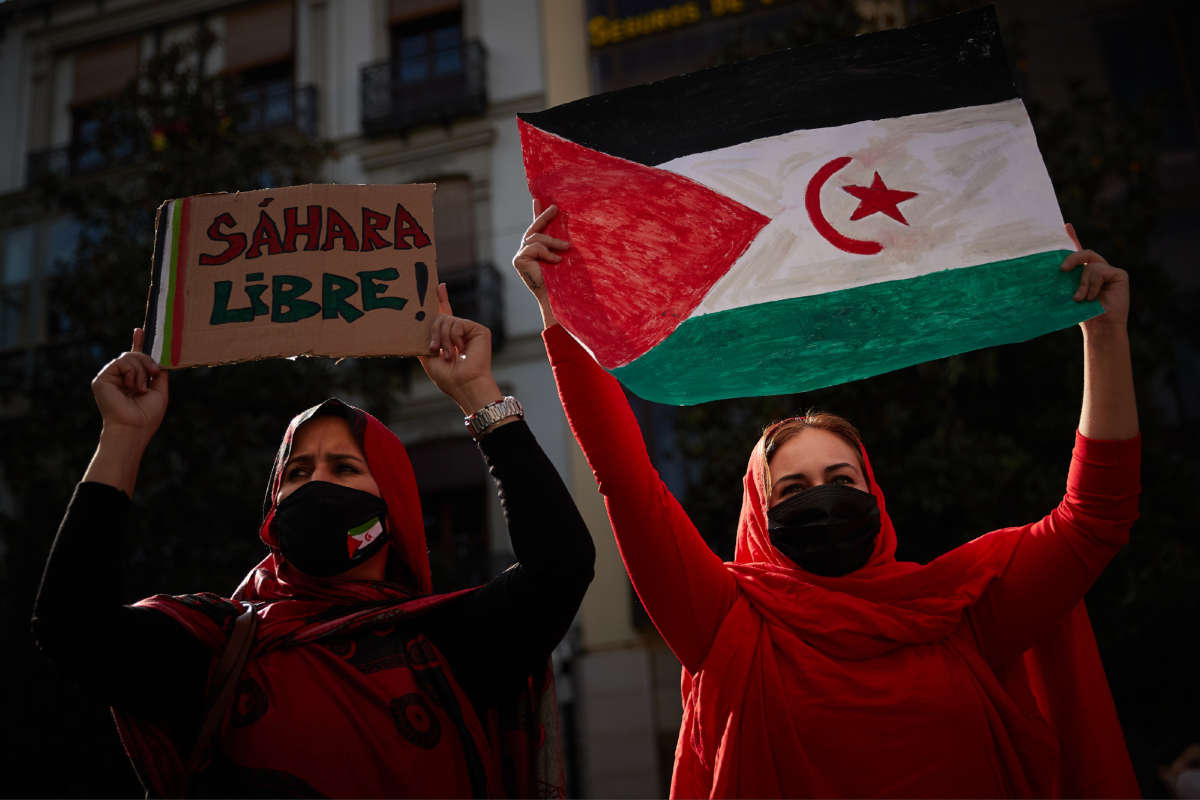
Women wearing face masks carry a Saharan flag and a placard that says Free Sahara during a demonstration to demand the end of Morocco's occupation in Western Sahara on November 21, 2020, in Granada.FERMIN RODRIGUEZ / NURPHOTO VIA GETTY IMAGES

PUBLISHED December 11, 2020

On December 10, the United States became the only major country to formally recognize Morocco’s illegal annexation of Western Sahara, the former Spanish colony forcibly seized by Moroccan forces in 1975. Trump’s proclamation is directly counter to a series of UN Security Council resolutions and a landmark World Court ruling calling for self-determination.

Trump’s decision was a quid pro quo: a reward for Morocco’s formal recognition of Israel, a country which is also an occupying power. Trump had previously broken precedent by recognizing Israel’s illegal annexation of Syria’s Golan Heights and greater Jerusalem. The U.S. recognition of the annexation of an entire country, which has been recognized as an independent state by no less than 80 countries, is a particularly dangerous precedent. As with his earlier recognition of Israel’s conquests, Trump is effectively renouncing longstanding international legal principles in favor of the right of conquest.


And, since Western Sahara is a full member state of the African Union, Trump is essentially endorsing the conquest of one recognized African state by another. It was the prohibition of such territorial conquests enshrined in the UN Charter which the United States insisted had to be upheld by launching the Gulf War in 1991, reversing Iraq’s conquest of Kuwait. Now, the United States is essentially saying that an Arab country invading and annexing its small southern neighbor is OK after all.

Trump cites Morocco’s “autonomy plan” for the territory as “serious, credible, and realistic” and “the ONLY basis for a just and lasting solution” even though it falls far short of the international legal definition of “autonomy” and in effect would simply continue the occupation. Human Rights Watch, Amnesty International and other human right groups have documented the Moroccan occupation forces’ widespread suppression of peaceful advocates of independence, raising serious questions about what “autonomy” under the kingdom would actually look like.

Western Sahara is a sparsely populated territory about the size of Colorado, located on the Atlantic coast in northwestern Africa just south of Morocco. Traditionally inhabited by nomadic Arab tribes, collectively known as Sahrawis, and famous for their long history of resistance to outside domination, their dialect, dress and customs are distinct from most Moroccans. Spain occupied the territory beginning in the late 1800s and maintained its rule until the mid-1970s, well over a decade after most African countries had achieved their freedom from European colonialism.

In 1973, the nationalist Polisario Front launched an armed independence struggle against Spain and Madrid eventually promised the people of what was then still known as the Spanish Sahara a referendum on the fate of the territory by the end of 1975. Irredentist claims by Morocco and Mauritania were brought before the International Court of Justice, which ruled in October of 1975 that — despite pledges of fealty to the Moroccan sultan back in the 19th century by some tribal leaders bordering the territory and close ethnic ties between some Sahrawi and Mauritanian tribes — the right of self-determination was paramount. A special Visiting Mission from the United Nations engaged in an investigation on the situation in the territory that same year and reported that the vast majority of Sahrawis supported independence under the leadership of the Polisario, not integration with Morocco or Mauritania.Within hours of Trump’s December 10 announcement, word came of a U.S. decision to sell at least four sophisticated large aerial drones to Morocco.


During this same period, Morocco was threatening war with Spain over the territory. Though the Spaniards had a much stronger military, they were at that time dealing with the terminal illness of their longtime dictator Generalissimo Francisco Franco as well as increasing pressure from the United States, which wanted to back its Moroccan ally King Hassan II and did not want to see the leftist Polisario come to power. As a result, despite its earlier pledge to hold a referendum with the assumption that power would soon thereafter be handed over to the Polisario, Spain instead agreed in November 1975 to grant administrative control of the territory to Morocco (and, for a time, Mauritania) pending an act of self-determination. It never happened, however.

As Moroccan forces moved into Western Sahara, close to half the population fled the country into neighboring Algeria, which was supportive of the independence struggle against its historic rival. Morocco rejected a series of unanimous UN Security Council resolutions calling for the withdrawal of foreign forces and recognition of the Sahrawis’ right of self-determination. The United States and France, meanwhile, despite voting in favor of these resolutions, blocked the United Nations from enforcing them.

The Moroccan government, through generous housing subsidies, tax breaks, and other benefits, successfully encouraged tens of thousands of Moroccan settlers to move into the parts of Western Sahara under the kingdom’s control. These Moroccan settlers now outnumber the remaining Sahrawis indigenous to the territory by a ratio of more than 3:1. The Moroccan government also invested heavily in infrastructure development along with internal security to suppress pro-independence activists.Trump’s insistence that the Golan Heights, greater Jerusalem, and Western Sahara are no longer negotiable codifies what the occupying powers had been saying for decades.

While rarely able to penetrate into Moroccan-controlled territory, the Polisario continued regular assaults against Moroccan occupation forces stationed along the wall until 1991, when the United Nations ordered a ceasefire to be monitored by a UN peacekeeping force known as MINURSO. The agreement included provisions for a return of Sahrawi refugees to Western Sahara followed by a UN-supervised referendum on the fate of the territory, with the Sahrawis native to Western Sahara being given the choice of voting in favor of either independence or integration with Morocco. Neither the repatriation nor the referendum took place, however, due to the Moroccan insistence that Moroccan settlers and other Moroccan citizens whom it claimed had tribal links to the Western Sahara also be allowed to vote.

A compromise referendum plan put forward by the United Nations in 2003 under the secretary general’s special envoy James Baker was accepted by the Polisario but rejected by Morocco, which has instead put forward its controversial plan for limited autonomy for the region. Though the Bush and Obama administrations expressed a willingness to seriously consider Morocco’s proposal, they did not see it as the only option nor did they formally withdraw their support for a referendum.

After waiting 29 years for a referendum that never came and following a series of Moroccan ceasefire violations and other provocations, the Polisario resumed its armed struggle just last month.

Disturbingly, within hours of Trump’s December 10 announcement, word came of a U.S. decision to sell at least four sophisticated large aerial drones to Morocco. U.S. laws prohibit such weapons sales to invading armies. However, with the U.S. recognizing Moroccan sovereignty over Western Sahara, including the Polisario-controlled segments of the territory, the occupation has become, in the eyes of Washington, a civil war between a recognized government and a secessionist movement, which could also pave the way for further U.S. intervention.

In both the Israeli and Moroccan occupations, there has been bipartisan support for the occupiers — perhaps an unsurprising reality given the U.S.’s own status as a colonial entity. But previous administrations recognized the dangerous legal precedent of formal recognition. Trump, in both Palestine and Western Sahara, has essentially made official what was essentially U.S. policy anyway. For decades, both Republican and Democratic administrations have insisted that neither Morocco nor Israel was obligated to withdraw their occupying forces, instead allowing the occupying powers to engage in an endless “peace process” with those under occupation who have no leverage to change the equation. In this way, the U.S. has allowed both occupiers to continue colonizing their occupied territories and consolidating their control.

As a result, Trump’s insistence that the Golan Heights, greater Jerusalem and Western Sahara are no longer negotiable simply codifies what the occupying powers had been saying for decades, while receiving no pressure from the United States to do otherwise.Americans must once again pressure our government to cease supporting brutal occupations.

Once he becomes president, Biden could reverse Trump’s recognition of the Moroccan annexation. However, since this would probably mean that Morocco would then renounce its recognition of Israel, Biden will likely find himself under considerable pressure not to do so.

Trump’s dangerous act of recognition highlights the fact that there are two major occupations in the Arab world. The Sahrawis, like the Palestinians, deserve their freedom. Given the critical role the United States is playing in making these occupations possible, Americans have a special obligation to force a change of policy. Such activism in the 1990s played a key role in ending U.S. support for Indonesia’s occupation of East Timor. Americans must once again pressure our government to cease supporting brutal occupations.

SCOTUS Should Spurn Latest Texas Push to Flip Election. Will It?
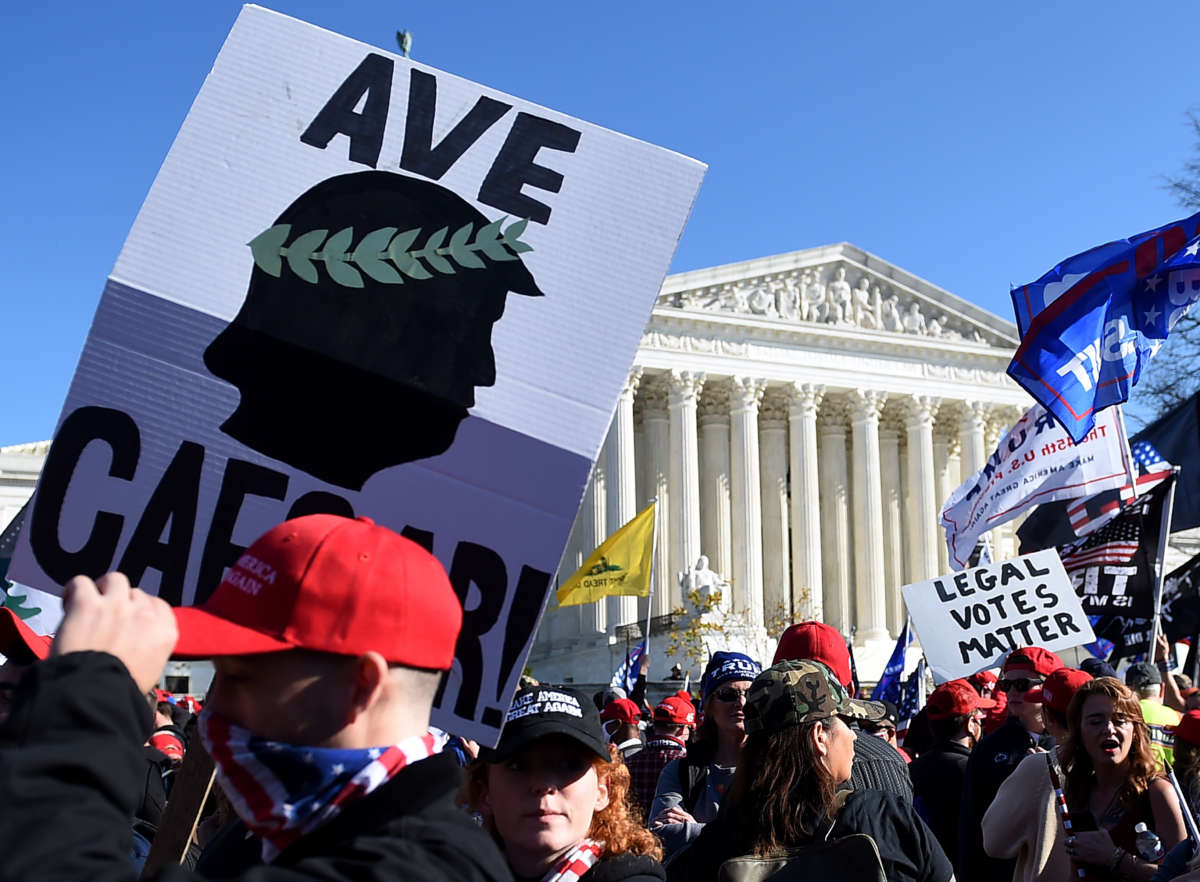
Supporters of President Trump rally at the Supreme Court in Washington, D.C., on November 14, 2020.OLIVIER DOULIERY / AFP VIA GETTY IMAGES

PUBLISHED December 10, 2020

If this whole grinding post-election drama is all just an elaborate troll on Donald Trump’s part, a fundraiser aimed at fleecing his base even as he “owns the libs” by keeping everyone constantly on edge, it is already a bleak masterpiece. The judiciary to date has served as guard rails for his nonsense quest to overturn the 2020 presidential election. Now that the 6-3 conservative Supreme Court has been roped into the affair for the second time in a week, however, we are all of a sudden playing with live ammunition and it ain’t so silly no more.

At about the same time as that court was swatting Pennsylvania’s ludicrous election-flip argument out of the building, the attorney general of Texas was serving up a new legal complaint so freighted with inadequacies that it bends the very light. AG Ken Paxton — himself under indictment — has brought directly to the high court a suit against the election results in Michigan, Pennsylvania, Wisconsin and Georgia, claiming that measures taken by these pivotal battleground states to allow voting during a pandemic invalidates the entire enterprise.

Mull that one a tick. A president whose crashing incompetence, negligence, vanity and fear allowed the COVID-19 pandemic to eat the country now has a minion arguing that the very basic and entirely legal steps taken to defend democracy against the calamity he caused are, in fact, illegal. More to the point, a “states rights” Texas Republican is asking that court to meddle in the most fundamental duties of the four named states.

Benjamin Ginsberg, the Darth Vader of Republican election lawyers, whose heavy hand held sway during the 2000 election recount fiasco, finds the entire premise almost unspeakably absurd. “I can’t imagine something that is less faithful to the principle of states’ rights than a Texas attorney general trying to tell other states how to run their elections,” he told CNN.

Paxton’s little SCOTUS enterprise is marred with flaws before you even open the complaint. No other court — state or federal — has been afforded a say on Paxton’s “arguments.” To accept the case on the merits, the justices would have to agree that the issues being presented cannot be resolved by any lower courts.

To say this is a leap is to call the Grand Canyon a pothole. “There’s nothing unique about Texas’ claims here, most of which have already been brought in other suits against the same four states,” University of Texas Law School professor Steve Vladeck informed CNN.

These are not the only logs in Trump’s road to the Supreme Court. As of today, all 50 states have certified the results of their votes from the 2020 presidential election. Those results now reside in a legal “safe harbor” which protects them from rogue states — and yes, we are now using that phrase to describe 17 different parts of this very country — attempting to overturn the will of the people. Now that this deadline has passed, it would be extraordinary and unprecedented for any court to intervene.

Not to be deterred by quaint legal notions like precedent and, well, bedrock legal principle, Republican governors from some 17 states — Alabama, Arkansas, Florida, Indiana, Kansas, Louisiana, Mississippi, Missouri, Montana, Nebraska, North Dakota, Oklahoma, South Carolina, South Dakota, Tennessee, Utah and West Virginia — have dogpiled Paxton’s petition. More importantly, Donald Trump has hitched his wagon to Paxton’s bleary star. On Wednesday, he asserted that Paxton’s case was “the big one” that “everyone has been waiting for.”The justices threw back his Pennsylvania petition this week without even deigning to comment, and a vast plurality of legal experts agree that something similar will take place with this Texas case.

In this, Trump is correct: Everyone is waiting to see what the high court will do. The justices threw back his Pennsylvania petition this week without even deigning to comment, and a vast plurality of legal experts agree that something similar will take place with this Texas case, the crowd of co-sponsors notwithstanding. It is a Hail Mary legal argument, lofted on a wing and a prayer in hopes that someone in the Supreme Court chamber will come down with the ball.

Thirty-six years ago nearly to the day, I was watching college football in a bad mood. Ronald Reagan had just been re-elected in a punishing landslide, and even in my youth I knew it was grim tidings. My household needed a smile, and the game that day gave us one: Boston College vs. Miami, the Hurricanes heavily favored over itty little BC and its bitty little quarterback, Doug Flutie.

It ended with Flutie dropping a towering last-second Hail Mary pass — “55 Flood Tip” was the play call — into the waiting arms of his roommate, Gerard Phelan, in one of the more preposterous endings in the history of organized sport. I lived a few blocks away from the BC campus, and when Phelan came down with that ball, the whole neighborhood — cars, trees, houses, sidewalks — leaped three feet into the air. It was a gloriously impossible ending that will live forever in college football lore.

This moment was special because Hail Mary passes only rarely work, and upon failure come to represent the desperation of the pass-tossing losing team in its defeat. Paxton, Trump and those 17 states have chucked up the mother of all Hail Mary passes toward the Supreme Court’s end zone. It seems highly implausible that the court will even agree to hear the case, much less choose to support the petition.

Here’s the thing, though: Phelan came down with the goddamn ball. Amid a forest of defending arms and in defiance of physics he came down with it and Boston College walked off the field that night a winner.

Trump has called a 55 Flood Tip, the ball is in the air, and if it all wasn’t strange enough already, Ted Cruz of all people has been tasked to go catch it. By all that is normal and true, this last-gasp pass should bounce harmlessly away, but 2020 has taught us a great deal about the power of the horrifically impossible to become flesh-and-bone real. We may hear the court’s decision as soon as tomorrow. Stay tuned, and stout hearts.


Today, police and Trans Mountain contractors arrived at the Holmes Creek camp in the Brunette River in Burnaby.

Armed private security destroyed the camp that has been standing strong since August, and logging crews are preparing to cut magnificent cottonwood trees next to a salmon stream full of eggs waiting to hatch.

Trans Mountain vice president David Safari swore under oath that the company could not cut trees in this area at this time of year because of the risk to fish.

But here they are. Bulldozing unceded Indigenous land and threatening sacred salmon rivers. And for what? To build a carbon bomb of a pipeline experts are lining up to say is no longer needed. And they’re doing it with billions of our tax dollars. Tell them to stop.

It’s hard to write this. I actually had something different planned for you today: an update about a raft of encouraging new reports — including from the Liberal government’s own agencies — that fatally undermine our opponents’ arguments for building this pipeline:

Trans Mountain is not needed: there is more than enough pipeline capacity without Trans Mountain or Keystone XL. [1]

Trans Mountain is not viable: the project will lose money for taxpayers under every realistic scenario [2], and will even lose money for oil companies. [3]

It’s official: Trudeau has to choose between climate action and building Trans Mountain. We’ve been saying this for years, but now it’s the Canada Energy Regulator delivering the news — the same agency that recommended Trudeau approve the project. [4]

These reports aren’t gathering dust in some dark corner of the internet — they’re making headlines. When top Globe and Mail columnists are saying the ‘pipeline era is over’ and calling Trans Mountain ‘Canada’s white elephant,’ you know alarm bells are ringing for Liberal strategists in Ottawa.

The Liberal government is being forced to face some hard truths. Make sure they can’t look away: send a message now and tell them to cancel Trans Mountain.

I would be devastated about what happened today in the Brunette River whether Trans Mountain was going to make money for Big Oil and the Canadian government or not. But even economic arguments for the project are in the toilet, and the fact that our government is wilfully ignoring clear evidence of this as it tramples Indigenous rights, and destroys our shared home and future, has me humming with rage.

What to do with that anger? The case to cancel this project has never been stronger, so send the federal government a message right now. You can also follow land defenders on social media for the latest updates and how you can help. And stay ready for more action alerts from us — now is our moment to put this project on ice.

With rage and hope,

Alexandra

[1] https://www.policyalternatives.ca/publications/reports/reassessment-need-trans-mountain-pipeline-expansion-project
[2] https://www.pbo-dpb.gc.ca/en/blog/news/RP-2021-035-S--trans-mountain-pipeline-financial-economic-considerations-update--pipeline-trans-mountain-considerations-financieres-economiques-mise-jour
[3] https://www.policyalternatives.ca/publications/reports/reassessment-need-trans-mountain-pipeline-expansion-project
[4] https://www.thestar.com/news/canada/2020/11/24/canada-energy-regulator-projects-there-may-be-no-need-for-trans-mountain-expansion.html


Thanks for all you do,

The No Tankers team
If you like what we do and are able to help, please donate! We're grateful to you.

https://dogwoodbc.ca/donat
e


We Need Five Days’ Pay for Four Days’ Work
AND A FOUR DAY WEEK


DEC 9,2020

Working time reduction has always been used as a way of distributing available work and reducing unemployment. In our era of crisis, we need to fight for a four-day week.
Working time reduction has always been used as a way of distributing available work and reducing unemployment. (Adrien Olichon / Unsplash)

This week, at their annual conference, the Scottish National Party overwhelmingly backed a reduction to working hours. The motion, which passed by 1,136 votes to 70, called on the Scottish government to launch a review of working practices in Scotland, including the “possibility of a four-day week.”

The SNP’s motion is the latest bright spot – but promising moves are not confined to the UK. Unilever in New Zealand put their employees on a trial four-day week this week, with no reduction in pay, and last week, in Spain, the center-left party Más País put forward proposals for the Spanish Finance Ministry to consider providing financial aid to companies that cut the working week to thirty-two hours, with no loss of pay, as part of its 2021 budget.

The German metalworking union IG Metall have also announced plans to campaign for a four-day week in order to prevent mass layoffs in the New Year — just two years after they won a 4.3 percent pay rise and the right to reduce their working week to twenty-eight hours. And last month, a group of politicians and union officials from across Europe, including Unite’s Len McCluskey, the Green Party’s Caroline Lucas, and Die Linke’s coleader Katja Kipping, argued that a four-day week would help economies recover from the pandemic.

The New Economics Foundation’s new book makes the case that shorter working time should be at the heart of a post-pandemic recovery. Critics argue that a reduction in working time is exactly the wrong thing to do during a crisis — but over the last century, the most rapid reductions in working time came in the immediate aftermath of world wars, and during periods of economic crisis. Working time reduction has always been used as a way of distributing available work and reducing unemployment, most famously during the Great Depression.

There are important economic reasons for reducing working time without reducing wages. The UK economy relies heavily on domestic wages and spending power, which intuitively makes sense: a functioning economy is dependent on the constant circulation of money, and the more people earn, the more they spend.

Increasing leisure time while protecting pay can be expected to increase spending in the economy overall. The measure could be especially pertinent for industries like arts and culture, and domestic tourism, which have suffered due to COVID-19 and depend on people having both money and the time to spend.

As we attempt to move toward recovery, workers and their unions should feel emboldened knowing that they are owed a significant reduction in working time after four decades of stagnation: the working week has barely decreased since the 1980s.

They should also feel confident in the knowledge that countries who work fewer hours are likely to be more productive. Germany, the Netherlands, and all of Scandinavia work far fewer hours than in the UK, and yet have much higher levels of productivity. Workers are happier, less stressed, and healthier, too.

Shorter working time is a way of future-proofing our economy and ensuring that the impact of automation is one that benefits workers. Unions are already campaigning on this and winning. The Communication Workers Union (CWU) have agreed with Royal Mail to shorten the working week from thirty-nine to thirty-five hours for 134,000 postal workers, a concession which was a direct response to the impact of automation: postal workers, it was argued, should benefit from the mechanization of the parcel packaging process in the form of shorter hours.

Despite these pockets of change, we can’t sit back and wait for a shorter working week to arrive. We know that working time doesn’t reduce by itself. Instead, the four-day week must be fought for, alongside demands for better pay and more secure work.

In the early days of this crisis, there was hope that we could emerge from it with a new determination to build a better world. Since then, claps for key workers have been converted into a public sector pay freeze, the government has doled out billions of pounds to incompetent and exploitative contractors like Serco and G4S rather than investing in a public health system, and a huge death toll — accompanied by social and economic hardship — has grown out of the mismanagement of the virus.

But the hope that we had for a fundamental shift in our relationship to work has persisted. Now, hope is leading normal people to demand permanent change in the form of a reduction in working time. And that change would give us something that we understand the importance of in 2020 more than ever: time to do the things we want with the people we love


ABOUT THE AUTHOR

Aidan Harper is a researcher at New Economics Foundation.

Why the Contemporary Right Loves Nietzsche (and Heidegger and Schmitt)

BYMATT MCMANUS

Today’s right-wing thinkers look to Nietzsche and other German reactionaries to ground their elitist politics — and to do battle with leftists' project of universal emancipation
.
Detail of Edvard Munch, Portrait of Friedrich Nietzsche, 1906


In his excellent new book, Conservatism: The Fight for a Tradition, Edmund Fawcett asks a fair question: If the Left is so smart, how come we’re not in charge? Since John Stuart Mill’s lacerating characterization of conservatives as the “stupid” party, many opponents of right-wing politics have delighted in simply mocking the vulgarity and dogmatic prejudices of their foes. But time has shown that we do so at our own peril. Lobbing grenades without understanding our adversaries is a foolhardy endeavor.

On today’s political right, three late German thinkers loom large: Friedrich Nietzsche, Martin Heidegger, and Carl Schmitt. All three wrote their most important works between 1850 and 1950, a time of transformative rise and Luciferian fall in Germany, and despite major differences, all three expressed profound discomfort with the egalitarianism and libertinism of modernity.

For stalwart defenders of capitalist hierarchy like Jordan Peterson, illiberals like Adrian Vermeule, and of course the alt-right, Nietzsche, Heidegger, and Schmitt furnish the intellectual armor to do battle with the Left. Ironically, the reactionary trio has also had their fair share of left-leaning fans and interpreters — which makes examining and critiquing their work all the more important for leftists today.

Nihilism and Hierarchy in Nietzsche


Every elevation of the type “man,” has hitherto been the work of an aristocratic society and so it will always be — a society believing in a long scale of gradations of rank and differences of worth among human beings, and requiring slavery in some form or other. Without the pathos of distance, such as grows out of the incarnated difference of classes, out of the constant out-looking and down-looking of the ruling caste on subordinates and instruments, and out of their equally constant practice of obeying and commanding, of keeping down and keeping at a distance — that other more mysterious pathos could never have arisen, the longing for an ever new widening of distance within the soul itself, the formation of ever higher, rarer, further, more extended, more comprehensive states, in short, just the elevation of the type “man,” the continued “self-surmounting of man,” to use a moral formula in a supermoral sense.

—Friedrich Nietzsche, Beyond Good and Evil

Nietzsche is far and away the most influential of the three, both because of the powerful effect his ideas had on Heidegger and Schmitt, and his immense impact on culture as a whole. He is also a rarity among German philosophers: reading him is a pleasure. Nietzsche had a genuine sense of humor and loved nothing more than to drop in counterintuitive turns of phrase.

Through the years, many ostensible left-wing thinkers and movements — from countercultural artists to post-structuralists and feminists like Michel Foucault and Judith Butler — have drawn on Nietzsche, too. This would have likely surprised the Antichrist, who prophesized an end to the egalitarian “slave morality” of Christianity (along with its progeny, liberalism, and socialism) and the emergence of the noble and aristocratic supermen in their place. As Malcolm Bull puts it in Anti-Nietzsche, “equality has no fiercer critic than Nietzsche, whose ‘fundamental insight with respect to the geneaology of morals’ is that social inequality is the source of our value concepts, and the necessary condition of value itself.”Some leftists have looked favorably upon Nietzsche’s anti-Christian animus, seeing it as an emancipatory weapon against oppressive moralism. But Nietzsche had something far different in mind.

At the heart of Nietzsche’s outlook is a concern for the problem of nihilism. In his mind, nihilism was the inevitable consequence of a fall from the honorable, fierce aristocracies of yore and their replacement by Christianity, which postured as a religion of compassion and pity for the weak, poor, and humble. Far from being based on love, Nietzsche argued, Christianity was a kind of Platonism for the people, giving voice to their resentful belief that the real world was so filled with evil and suffering that it could only be justified if an eternal world existed above and below.

In this eternal world, the suffering inflicted by the aristocrats, the wealthy, and the violent would be meted out against those who had been powerful and arrogant in their mortal lives. It’s no accident that in The Genealogy of Morals, Nietzsche pays great attention to Tertullian’s comment that one of the great joys in heaven will be witnessing the suffering of the damned in hell. Unable to achieve revenge in this life, the weak will get to enjoy it eternally in the next one.

Some leftists have looked favorably upon Nietzsche’s anti-Christian animus, seeing it as an emancipatory weapon against oppressive moralism. But Nietzsche had something far different in mind. He felt that the desire for emancipation and equality was simply the continuation of the Christian theological project under a new, secularized guise.

Since the French Revolution — the “continuation of Christianity,” as Nietzsche put it in his notes for The Will to Power — the leveling impetus of the slave morality was more universalized than ever, bringing with it the decay of institutions and noble individuals who alone could provide a sense of meaning in a nihilistic post-God world. This was true of liberalism, and especially socialism, which held that the weak, sickly, and unworthy should unite and take over the world to end exploitation and dominion. For these doctrines, Nietzsche had nothing but contempt:

Whom do I hate most heartily among the rabbles of today? The rabble of Socialists, the apostles to the Chandala, who undermine the workingman’s instincts, his pleasure, his feeling of contentment with his petty existence — who make him envious and teach him revenge. . . . Wrong never lies in unequal rights; it lies in the assertion of “equal” rights. . . . What is bad? But I have already answered: all that proceeds from weakness, from envy, from revenge. — The anarchist and the Christian have the same ancestry. . .”

Only an unequal system, Nietzsche argued, could produce truly creative souls with life-affirming values. These values could not be judged morally in a nihilistic world, but only according to the one metric left after the death of God: aesthetically. For Nietzsche, the great-souled man will inevitably use others as his clay in tremendous and often terrifyingly violent projects — indifferent to, if not directly hostile toward, the mostly worthless masses whose primary value is being put to use by the coming superman. The inferior masses, Nietzsche was saying, should simply accept their exploitation by their betters.
Schmitt and Heidegger on Modernity

It would be too much to call Nietzsche a proto-Nazi. While he has profoundly influenced fascist and far-right movements, Nietzsche’s disdain for nationalism, antisemitism, and strident individualism resist the caricature of him as a Nazi thinker advanced, among others, by his own sister.

The same can’t be said for Schmitt and Heidegger. Both were active members of the Nazi party, and both played a significant role in legitimating it. Ironically, despite accusations by figures like Jordan Peterson that any defense of Marx or Marxism is virtually an apology for mass slaughter, Schmitt’s and Heidegger’s political commitments haven’t kept them from influencing the contemporary 
right.
Martin Heidegger. (Wikimedia Commons)

At the center of Schmitt and Heidegger’s reactionary politics is a critique of modernity. This takes a number of forms: skepticism of humanism, anxiety about relativistic individualism’s privileged place in modern morality, alarm at the rise of the chattering classes and “idle talk” in liberal representative democracy, and, above all, contempt for the declining commitment to existential struggles that generate authenticity and meaning.

Like Nietzsche, Schmitt and Heidegger are committed to the idea that overcoming the limitations of modernity means supplanting the two great modernist doctrines of liberalism and socialism with a new kind of total nationalist politics directed by the leader figure or, more vaguely, the “spiritual mission of the German people.”

Neither, then, had much good to say about liberalism or socialism. For Heidegger, writing in the Introduction to Metaphysics, they were both “metaphysically the same” in their materialism and egalitarian concern for human welfare. When you boiled it down, the so-called great debates between liberals and socialists were ultimately technical disputes over how to build and distribute better refrigerators.
Carl Schmitt. (Wikimedia Commons)

Schmitt, while more nuanced, would have largely agreed with Heidegger. For Schmitt, political struggle was and should be at the core of human life since it provides a grandiose, homogenizing sense of meaning for groups of people. Politics binds us together by constructing an ultimately theological view of how the world should be and contrasting it with one’s political enemies. It was in part through the (frequently violent) struggle against political adversaries that a shared identity was forged.

According to Schmitt, the great error of liberalism was supposing that politics could be overcome through talk in representative institutions, which made it both hypocritical and weak. Marxist socialism was little better since it emphasized the historical significance of class struggle as an engine of meaning. But in the long run socialists also wanted an end to meaning-giving political struggle, which would be transcended — along with alienation — in the economic democracy to come.

Schmitt ridiculed this life as one of managed, bureaucratic hedonism where state officials would assume the role of caretakers and stifle the grander, frequently violent impulses of humankind.

Reactionaries, Liberals, and Socialists


Unpacking the German reactionaries’ writings — among the most profound and disturbing arguments for right-wing politics available — serves a purpose beyond critique. It can also help sharpen our understanding of left politics.The triumvirate blossom evergreen because they will always appeal to those who see the drive for more democracy as a danger to be confronted and defeated.

Recently, I’ve argued that liberalism and socialism have important intellectual affinities, even if they represent distinct political traditions. Both view human beings as moral equals and, as opponents of traditional hierarchies, advocate as much freedom as possible. Liberalism falters in blanching at the thoroughgoing pursuit of not just political but economic democracy.

But both doctrines stand in stark contrast to the reactionary views of Nietzsche, Heidegger, and Schmitt. For all its differences, the trio was united in holding that the modernist project is a fundamental danger precisely because it permits too much equality and freedom. Existence can only be meaningful with the presence of hierarchy, whether between individuals (Nietzsche) or with the withering away of nihilistic liberal democracies in the face of more spiritually attuned nationalist, unified polities (Heidegger and Schmitt). This could only be achieved by eliminating dissident enemies within and without, along with uniform subordination to the “spiritual mission” that reactionary intellectuals laid out.

We’ve seen the horrifying consequences of this project over the twentieth century, which almost buried the reputations of Nietzsche, Heidegger, and Schmitt with them. But the triumvirate blossom evergreen because they will always appeal to those who see the drive for more democracy as a danger to be confronted and defeated. Grappling with their ideas and appeal is vital to countering their efforts — and advancing the humanistic project of securing equality and freedom for all.

ABOUT THE AUTHOR

Matt McManus is a visiting professor of politics at Whitman College. He is the author of The Rise of Post-Modern Conservatism and Myth and the coauthor of Mayhem: A Leftist Critique of Jordan Peterson.


Our new issue, “Failure Is an Option,” is out now. We discuss why the United States’ institutional breakdown won’t stop after Trump leaves office and what can be done to improve things for working people. 


The CIA’s Secret Global War Against the Left
Branko Marcetic

We’re Celebrating Our 10th Anniversary. Help Us Stick Around for Many More.
Bhaskar Sunkara

Bernie Sanders’s Five-Year War
Matt Karp

Are You Reading Propaganda Right Now?
Liza Featherstone