It’s possible that I shall make an ass of myself. But in that case one can always get out of it with a little dialectic. I have, of course, so worded my proposition as to be right either way (K.Marx, Letter to F.Engels on the Indian Mutiny)
Italy refuses to allow entry of migrants rescued by NGO vessels
Daniel Stewart - News 360
The Italian authorities have again expressed their refusal to allow the entry of migrants rescued by vessels of various NGOs in the Mediterranean and have requested that it is precisely the countries whose flags these vessels fly that should take in the migrants in question.
Migrants rescued by Doctors Without Borders on board the ship 'Geo Barents'.
- FILIPPO TADDEI / MSF
"We cannot bring in migrants who are rescued at sea by foreign ships operating without any coordination with the authorities," Interior Minister Matteo Piantedosi has asserted, as reported by 'Corriere della Sera' newspaper.
Piantedosi has indicated that migrants arriving in the country after being rescued by these vessels account for 16 percent of the arrivals, although the government deals with the other 84 percent that reach Italian shores in boats that are assisted by the authorities. "Italy will not abandon its duty to rescue people at sea, but European solidarity has to become a reality," he said.
Thus, he has called for greater "solidarity" on the part of Europe and has insisted that it is the countries whose flags carry these ships that accept these migrants now that about a thousand of them are on board the ships 'Humanity 1', 'Geo Barents' and 'Ocean Viking' waiting to reach a safe harbor near the Italian coast.
The 'Humanity 1' is German-flagged and the other two are Norwegian-flagged. NGOs have warned of bad weather conditions, which are worsening. MORE THAN 500 MIGRANTS STILL ABOARD THE 'GEO BARENTS'
The NGO Médecins Sans Frontières (MSF) has warned that the 'Geo Barents' is waiting for a safe port to dock with 572 people on board, including three pregnant women and more than 60 minors.
The organization has warned that despite the fact that all rescues have taken place in Maltese waters, the government has not issued rescue instructions or responded to requests for a safe harbor, which "contradicts international law." MSF has also asked to disembark in Italy on three other occasions.
"We have 572 people on board with 572 different stories," explained Riccardo Gatti, head of the MSF search and rescue team on board the 'Geo Barents'. "On board is a child who is determined to go to Germany. There is his mother, terminally ill with cancer. He wants to see her one last time before she leaves," he said.
The migration agreement reached between Italy and Libya is due to be renewed this Wednesday and will be in force for another three years. The pact, sponsored by the European Union, has involved millions of euros in financial and technical assistance to the Libyan Coast Guard, which has intercepted more than 100,000 people at sea since it was first signed in 2017.
However, the NGO has denounced the "cycle of violence funded by this agreement" and has repeatedly stated that Libya "is not a safe place for migrants to be returned."
Opinion: Elite women athletes aren't safe. What does that mean for us mere mortals?
Opinion by Amy Bass - CNN
News last week that a Russian court upheld Phoenix Mercury star Brittney Griner’s sentence of nine years in a penal colony for drug smuggling surprised no one. While Jake Sullivan, President Joe Biden’s national security adviser, deemed the appeal “another sham judicial proceeding” and asked that Griner “be released immediately,” the outcome continues to hang in the air as her legal team considers next steps.
Amy Bass -
Griner’s plight raises tough questions regarding women in sports. Would public reaction to her situation or her fate itself be different, for example, if she were an NBA, not WNBA, star? Does anyone challenge the reality that Griner never would have been in Russia, where she receives a star’s salary to play for UMMC Yekaterinburg, in the first place apart from her gender and the pay gap that goes along with it?
Griner’s continued Russian imprisonment sits among a barrage of headlines regarding dangerous situations for female athletes. While circumstances may be vastly different, one thing remains the same: in different ways, in different places, female athletes are not safe. And if sports cannot protect the women who play, how can we ever expect society at large to do it?
Despite foggy detail and little evidence, for example, when stories emerged that Iranian rock climber Elnaz Rekabi had gone missing after competing in the Asian Continental Climbing Championships in Seoul without wearing a hijab, many believed them, with much speculation about her passport, her cell phone and her whereabouts.
The climber posted to Instagram that she had made a mistake in a rush to compete and didn’t mean to climb without her hijab. After she returned home several days later, her head covered by both a baseball hat and hood, cheering crowds greeted her and the team.
But her fate remains a question mark amongst the surge of anti-government protests – “Woman, Life, Freedom” – led by women and girls (and increasingly a number of men) in the wake of the death of 22-year-old Mahsa Amini, who had been arrested by the Iran’s morality police for violation of hijab protocol. Some say as of last week that Rekabi is under house arrest; others contend that authorities forced her apology, noting subtle changes in her reasons for climbing without her hijab.
Rekabi’s story and its many unknowns are eerily familiar. Just last year, Chinese tennis star Peng Shuai disappeared from public view after she posted sexual misconduct allegations against former Vice Premier Zhang Gaoli to China’s Twitter-like platform, Weibo.
Peng then denied making those allegations, once in an interview conducted with her in the presence of Wang Kan, the Chinese Olympic Committee chief of staff. After pressure from the United Nations Human Rights office and an embargo by the Women’s Tennis Association, she re-emerged, making an appearance at an event at the Beijing Winter Olympic Games alongside IOC President Thomas Bach.
Reactions to Rekabi and Peng demonstrate how we – global society – are so quick to understand how women, especially those who live under oppressive regimes that threaten their lives and liberties on a daily basis – are not safe. Even in situations where they eventually appear to be safe for, well, appearance’s sake, many of us remain unsure. Why? Because we have reason to be wary.
We see evidence time and again that instead of looking to dismantle misogynist systems, society, far too often, asks women to bear the burden of responsibility for the violence that falls upon them. That sends a chilling message: You know this world isn’t safe, and you didn’t do everything you could to protect yourself.
The danger, of course, does not merely lie with the individual athlete, but can be found in the systems that organize and govern sport as well. Last year, reporting on the National Women’s Soccer League in The Athletic by Meg Linehan alongside the brave testimonials of players Mana Shim and Sinead Farrelly led to the termination of Portland Thorns’ coach Paul Riley and the resignation of NWSL commissioner Lisa Baird.
But those consequences were not enough to undo the abuses revealed in devastating detail by the recently released 173-page Yates Report on the NWSL, a document commissioned by US Soccer in the wake of Riley’s firing and completed by former acting attorney general of the United States Sally Yates on behalf of law firm King & Spalding.
From its very first pages – the Table of Contents is even difficult to stomach with headers that include “systemic abuse,” “there was no way out,” “emotional manipulation,” and “yet another monster” – the report, based on over 200 interviews, demonstrates that there has been little, if any, accountability or workplace protection for professional women’s soccer players.
One of the critical conclusions of the report is that regardless of what was exposed, when, and by whom, what was needed to happen to make it stop, and (even better) guarantee it never happened again, did not happen. Instead of creating even the most basic workplace protections, a “culture of protecting ‘open secrets’” endured, a culture similar to the one uncovered in US gymnastics regarding the predatory – and criminal – behavior of Dr. Larry Nassar, who now serves a life sentence. His longstanding lack of accountability was laid bare in congressional testimony of athletes that included stars Simone Biles and Aly Raisman.
These stories – as wide-ranging and different as they are – speak to a deeper point. Sport is one of the most controlled arenas in society. There are rules, officials, managers, owners, organizing bodies, coaches, and fans all watching, all observing, every move an athlete makes.
There are helmets and pads for protection; drug tests to ensure fair play. And there are consequences for dangerous behaviors – heightened punishments for fouls deemed flagrant in the form of free throws, penalty kicks and power plays. A slide tackle in soccer with cleats up? Here’s a red card, don’t do it again. Throw an elbow into someone’s face on the basketball court? Take a seat.
In the United States, Title IX, which just observed its 50th anniversary, tried to legislate gender equality in education and, in doing so, in sports. But while enormous strides have occurred, the seemingly endless examples indicate that the rules of the game, however fair and just they might seem, do not protect these athletes. “We know sports is a hostile space for women, generally,” journalist Jessica Luther, author of “Unsportsmanlike Conduct: College Football and the Politics of Rape,” told me. “That their very existence within sports is always political because sports, in most ways, was not set up to include them.”
The lack of accountability is well known to women but needs to take up more space, prompt more action, in society writ large. It is part of why so many of us cannot look away from what might lie ahead for an Iranian rock climber, a US basketball star, a professional soccer player, and so many others. If these elite athletes – the owners of these bodies who fly and soar, slam and hit, climb and jump, who work in a world filled with rules and judges and spectators – are not safe, then what can the rest of us mere mortals expect?
We can and should expect change, a revolution that leads to safe space for not just female athletes, but all women. As the Portland Thorns beat the Kansas City Current for its historic third NWSL title on Saturday, fans at Audi Field held signs that read “Support the Players,” a mantra that applies both on and off the field.
Shim, for one, who has already done so much in this effort, says she is up to the challenge. “For far too long, leaders across the soccer ecosystem – including at US Soccer – have not taken responsibility for protecting players,” she stated when she announced her new position as chair of the newly formed Participant Safety Taskforce at US Soccer. “But I believe in the capacity for change….We need to find the root causes of our sport’s systemic failures and take action at every level – from the youth game to the professional game.”
IMMIGRANTS ARE NOT CHEAP LABOUR
Ambitious immigration targets could help with Albertan labour shortage: Report
Stephanie Swensrude -
The federal government is planning a massive increase in the number of immigrants allowed to enter Canada, and some groups in Alberta think it will help businesses experiencing labour shortages.
The plan, announced by immigration minister Sean Fraser Tuesday, envisions a flood of new arrivals from outside the country: 465,000 people in 2023 — rising to 500,000 in 2025 — with a heavy emphasis on admitting people based on work skills or experience.
To make sure the new Canadians can actually help with the labour shortage, Alberta groups want lighter restrictions on immigrants taking lower-wage jobs and for the government to support agencies that help resettle the newcomers.
“Immigration is so important to addressing the talent shortage that every business is facing across the country, whether you're in the service sector, the tech sector, the energy sector, the health care sector, everybody's looking for that last unit of labor,” said executive director Deborah Yedlin.
While she welcomes the announcement, she proposes the focus shift to include lower wage workers and more than just skilled professionals who are technically trained.
“(With) something like the Alberta Opportunity Stream … there's a bit of a catch-22 because you need prior work experience, you need language skills, and it means that these programs are only available to a select number of immigrants,” said Yedlin.
“We need to figure out how to make sure that the ability to come and work is offered as an opportunity for a broader sector of the immigrant population than it already is.”
Edmonton Centre MP Randy Boissonault said the cheaper cost of living in Alberta can help attract people.
“Edmonton and Calgary are top of the list of affordable housing across the country because, not just those cities, but all cities in Alberta have been very good at continuing to build housing,” said Boissonault.
He hopes the hundreds of thousands of newcomers will be able to fill shortages in the tech sector.
“When I was meeting with the Alberta Machine Institute in downtown Edmonton, they were saying that a lot of their partners are looking for the computer scientists and the math experts that are going to really push the frontiers of artificial intelligence, the machine learning,” he said.
Edmonton labour shortage as employers struggle to fill hundreds of jobs
The provincial government runs a program with a goal of expediting processing of foreign workers employed at Alberta tech companies.
Yedlin said companies are having to lean on immigration because Alberta workers don’t always have the skills necessary for the job.
“I look at Calgary and I think about all the tech jobs that have been empty — they've been posted and waiting for it to be filled for quite a while.
"What that tells me is that we still are not necessarily focused also on the right programs within post-secondary."
The Edmonton Mennonite Centre for Newcomers (EMCN) helps settle newcomers in the capital region and senior manager of settlement services Rispah Tremblay said the announcement introduces some challenges for other agencies.
“With increasing numbers, that also needs additional resources,” said Tremblay.
Tremblay said EMCN would need more funding to pay staff who manage cases, help find housing and teach languages to clients.
Without these staff members helping newcomers settle, they might not be able to transition into the Canadian labour force.
“It's really important that as soon as they land here, there's additional support for them to settle and get the right training or the right support that they need so that they're able to integrate and start working immediately,” she said.
Tremblay is also concerned that the housing supply may start to dry up with the influx of people moving here. She hasn’t heard anything from the federal government in terms of cash to support scaling up services, but thinks those conversations will start in the spring.
FRAMED
Edmonton police deny statue vandalism charge an attempt to 'discredit a critic'
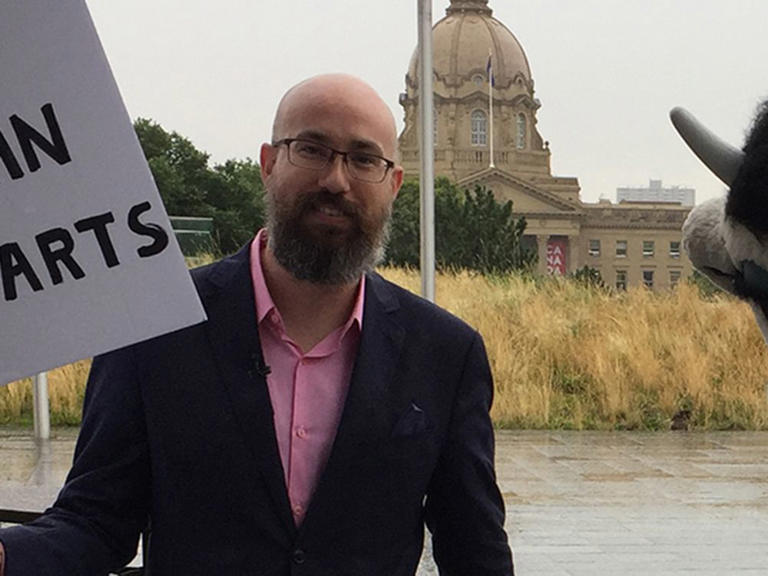
On Monday, Progress Report writer Duncan Kinney addressed the mischief charge laid against him Oct. 14, claiming it “appears to be an attempt by the EPS to silence and discredit a critic.”
Police responded to Kinney’s claim Tuesday.
“The Edmonton Police Service sees this as a serious allegation,” spokeswoman Cheryl Sheppard said in an email.
“(EPS’s) general counsel and head of professional standards branch has reached out to Mr. Kinney through (Tom Engel, Kinney’s lawyer) asking for information about Mr. Kinney’s conspiracy allegation,” she said, referring to the branch of the service that investigates misconduct allegations.
“Unfortunately, they are refusing to provide any information or clarification to substantiate this accusation,” Sheppard said. “We do note that EPS did consult with the Alberta Crown Prosecution (Service) prior to laying the charge against Mr. Kinney.”
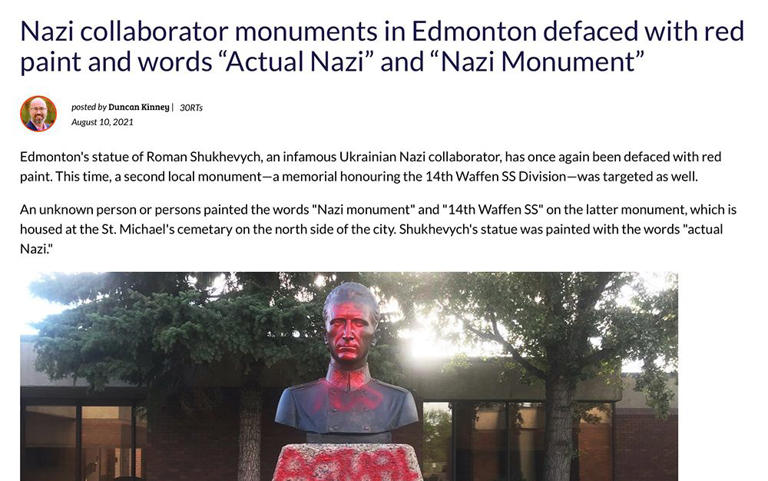
The charge relates to vandalism of the Ukrainian Youth Unity Centre’s statue of Roman Shukhevych, which in August 2021 was painted with the words “Actual Nazi,” a reference to the nationalist figure’s collaboration with Nazi Germany during the Second World War.
Kinney wrote about the statue before and after the vandalism, claiming in a story on the Progress Report that an “ unknown person or persons” had defaced the monument.
Engel confirmed he had been contacted by EPS’s lawyers. “I simply said that he would not be commenting.”
“I’m not sure why they’re characterizing this as a conspiracy,” he added. “But in relation to Mr. Kinney’s comment, all I can say would be ‘stay tuned.'”
Kinney said Tuesday that Engel is still waiting to receive full evidence disclosure from the Crown. He said he could not discuss specifics of the case but vowed to “ mount a vigorous defence, if it comes to that.”
Kinney’s first court date is Nov. 10.
Progress Report describes itself as an “independent and proudly left-wing media project produced by Progress Alberta.” Edmonton police revoked the site’s media accreditation in February.
Edmonton journalist accused of vandalizing statue vows ‘vigorous defence’
Jonny Wakefield - Monday
The operator of a left-wing news website charged with vandalizing a statue of a Ukrainian Nazi collaborator has broken his silence for the first time since his arrest.
On Monday, Duncan Kinney said he intends to plead not guilty to the charge of mischief under $5,000 police laid against him Oct. 14, claiming in a post on the Progress Report news site that the charge “appears to be an attempt by the EPS to silence and discredit a critic.”
“However, the advice from my lawyer on this is clear,” Kinney said. “I (cannot) talk about the substance of the case. But I can promise you that I will mount a vigorous defence, if it comes to that.” Related
In August 2021, a statue of Roman Shukhevych outside the Ukrainian Youth Unity Complex in north Edmonton was marked in red paint with the words “Actual Nazi.” Shukhevych, a Ukrainian who fought alongside Nazi Germany, has been implicated in massacres of Jews and Poles but has been reclaimed in some circles as a heroic nationalist figure for his resistance to the Soviet Union.
Local Ukrainian groups have dismissed criticism of Shukhevych as Russian misinformation. A memorial at St. Michael’s cemetery to Ukrainian soldiers who fought in the Second World War was also painted with the words “Nazi Monument 14th Waffen SS,” though no one has been charged in that incident.
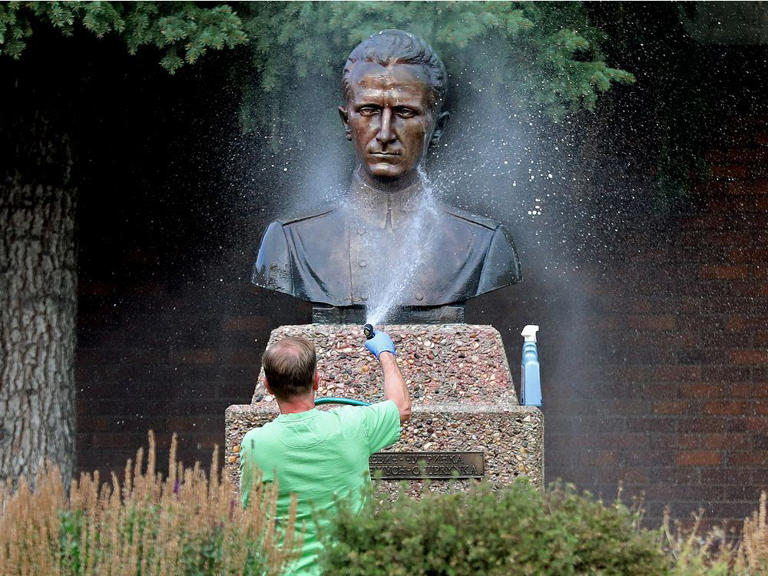
A volunteer washes spray paint off the Roman Shukhevych statue at the Ukrainian Youth Unity Complex, 9615 153 Ave., in Edmonton on Aug. 10, 2021.
David Bloom/Postmedia
Kinney, a writer and editor with Progress Alberta, wrote about the Shukhevych statue both before and after the 2021 vandalism, writing in an Aug. 10, 2021, post that “an unknown person or persons” painted the statue. He added, “It’s unclear when this happened but pictures of both defaced monuments were sent to the Progress Report on Aug. 10, 2021.”
Kinney has since wrangled with the Edmonton Police Service over Progress Report’s media accreditation, which was revoked in February. Kinney claimed the move was in response to critical reporting on the service.
Kinney interviewed by police for half-hour
In his statement Monday, Kinney said he was arrested outside his office around 9 a.m. by a constable with the EPS hate crimes and violent extremism unit. He said he was handcuffed, placed in an unmarked police vehicle and taken to police headquarters where he was “interrogated” by another officer for around a half-hour.
Kinney said he refused to answer any questions and was released on an undertaking. He said his Nov. 10 court date is a “purely administrative event” because his lawyer has not yet been given evidence disclosure by the police.
In a statement last week, Edmonton police spokeswoman Cheryl Voordenhout said EPS consulted with the Alberta Crown Prosecution Service before laying the charge, an extra step which only occurs in some cases. EPS did not immediately respond to a request for comment Monday.
Stone Age child's grave site in Finland reveals surprises
Ashley Strickland - CNN
The burial site of a young child who lived 8,000 years ago has been discovered in Eastern Finland, providing a rare glimpse into how Stone Age humans treated their deceased.
The Majoonsuo grave first drew the attention of researchers in 1992 in the municipality of Outokumpu when bright red ocher, a clay rich in iron, was spotted on the surface of a new service trail in the forest. Red ocher has been associated with rock art as well as ornamentation and burials.
The Finnish Heritage Agency began excavating the spot in 2018 due to concerns over erosion and motor traffic.
Little was found in the grave, but the surrounding soil revealed its secrets in a recent microscopic analysis published in September in the journal PLOS One.
Bright red ocher marked the spot of the grave, uncovered on a service road in a forest in Eastern Finland. - Kristiina Mannermaa
Finland’s Stone Age societies buried their dead in pits in the ground. The soil is so acidic in Finland that little remains preserved after thousands of years, which means traces of archaeological evidence are extremely rare.
The teeth of a child were found in the grave, as well as fragments of bird feathers, plant fibers and canine hair strands after an analysis using a painstaking protocol to uncover the microscopic evidence.
Together, these clues paint a portrait of the deceased.
Researchers determined that the teeth belonged to a child between 3 and 10 years old. Two quartz arrowheads and two other quartz objects, thought to be grave goods, were also recovered.
About 24 tiny feather fragments were found, and seven of them were associated with waterfowl. They represent the oldest feather fragments ever found in Finland. It’s possible that the child was laid to rest on a bed of down feathers, or the child was wrapped in clothing made from waterfowl, like an ancient parka or anorak.
A falcon’s feather was also found in the grave, thought to be part of an arrow likely once attached to an arrowhead, or used as decoration on the child’s clothing.
Fine hairs found at the child’s feet belonged to either a dog or a wolf. It’s possible that one was buried at the child’s feet, or the child was wearing shoes made from the fur of a dog or wolf.
“Dogs buried with the deceased have been found in, for example, Skateholm, a famous burial site in southern Sweden dating back some 7,000 years,” said study coauthor Kristiina Mannermaa, researcher and associate professor in the University of Helsinki’s department of cultures, in a statement.
“The discovery in Majoonsuo is sensational, even though there is nothing but hairs left of the animal or animals — not even teeth. We don’t even know whether it’s a dog or a wolf. The method used, demonstrates that traces of fur and feathers can be found even in graves several thousands of years old, including in Finland.”
Lead study author Tuija Kirkinen, a postdoctoral researcher in the University of Helsinki’s department of cultures, carried out the analysis of the plant- and animal-based materials within the soil.
The team collected 60 bags of soil samples and carefully separated organic matter from the soil using water. Three laboratories were used to search the samples for microparticles, fatty acids and carry out an analysis of the soil. The soil, stained by the red ocher, had to be gently sieved and was closely studied using electron microscopes and high-resolution images.
She works on the Animals Make Identities project, led by Mannermaa. The research group studies “social links between humans and animals in hunter-gatherer burial sites” in Northeast Europe. These links can unlock more insights into the deceased, who lived between 7,500 and 9,000 years ago. Kirkinen’s work is focused on developing methods to search for the minute remnants that help share ancient stories.
Kirkinen also found plant fibers that likely came from willows or nettles, which may have been used to make fishing nets, cords used to attach clothing or string bundles. The protocol she developed to search for fibers and fragments in the soil takes time, but it produced results.
“The work is really slow and it really made my heart jump when I found minuscule fragments of past garments and grave furnishings, especially in Finland, where all unburnt bones tend to decompose,” she said.
“This all gives us a very valuable insight about burial habits in the Stone Age, indicating how people had prepared the child for the journey after death.”
A Stone Age child buried with bird feathers, plant fibers and fur
IMAGE: AN ARTIST’S IMPRESSION OF THE CHILD BURIED IN MAJOONSUO DURING THEIR LIFEview more
CREDIT: TOM BJORKLUND
The exceptional excavation of a Stone Age burial site was carried out in Majoonsuo, situated in the municipality of Outokumpu in Eastern Finland. The excavation produced microscopically small fragments of bird feathers, canine and small mammalian hairs, and plant fibres. The findings gained through soil analysis are unique, as organic matter is poorly preserved in Finland’s acidic soil. The study, led by Archaeologist Tuija Kirkinen, was aimed at investigating how these highly degraded plant- and animal-based materials could be traced through soil analysis.
During the Stone Age in Finland, the deceased were interred mainly in pits in the ground. Little of the organic matter from human-made objects have been preserved in Stone Age graves in Finland, but it is known, on the basis of burial sites in the surrounding regions, that objects made of bones, teeth and horns as well as furs and feathers were placed in the graves.
Teeth and arrowheads found in the red ochre grave
The Trial Excavation Team of the Finnish Heritage Agency examined the site in 2018, as it was considered to be at risk of destruction. The burial place was located under a gravelly sand road in a forest, with the top of the grave partially exposed. The site was originally given away by the intense colour of its red ochre. Red ochre, or iron-rich clay soil, has been used not only in burials but also in rock art around the world.
In the archaeological dig at the burial site, only a few teeth were found of the deceased, on the basis of which they are known to have been a child between 3 and 10 years of age. In addition, two transverse arrowheads made of quartz and two other possible quartz objects were found in the grave. Based on the shape of the arrowheads and shore-level dating, the burial can be estimated to have taken place in the Mesolithic period of the Stone Age, roughly 6,000 years before the Common Era.
What made the excavation exceptional was the near-complete preservation of the soil originating in the grave. A total of 65 soil sample bags weighing between 0.6 and 3.4 kilograms were collected, also comparison samples were taken from outside the grave. The soil was analyzed in the archaeology laboratory of the University of Helsinki. Organic matter was separated from the samples using water. This way, the exposed fibres and hairs were identified with the help of transmitted-light and electron microscopy.
Oldest feather fragments found in Finland
From the soil samples, a total of 24 microscopic (0.2–1.4 mm) fragments of bird feathers were identified, most of which originated in down. Seven feather fragments were identified as coming from the down of a waterfowl (Anseriformes). These are the oldest feather fragments ever found in Finland. Although the origin of the down is impossible to state with certainty, it may come from clothing made of waterfowl skins, such as a parka or an anorak. It is also possible that the child was laid on a down bed.
In addition to the waterfowl down, one falcon (Falconidae) feather fragment was identified. It may have originally been part of the fletching of the arrows attached to the arrowheads, or, for example, from feathers used to decorate the garment.
Dog or wolf hairs?
Besides the feathers, 24 fragments of mammalian hair were identified, ranging from 0.5 to 9.5 mm in length. Most of the hairs were badly degraded, making identification no longer possible. The finest discoveries were the three hairs of a canine, possibly a predator, found at the bottom of the grave. The hairs may also originate, for example, in footwear made of wolf or dog skin. It is also possible a dog was laid at the child’s feet.
“Dogs buried with the deceased have been found in, for example, Skateholm, a famous burial site in southern Sweden dating back some 7,000 years,” says Professor Kristiina Mannermaa, University of Helsinki.
“The discovery in Majoonsuo is sensational, even though there is nothing but hairs left of the animal or animals – not even teeth. We don’t even know whether it’s a dog or a wolf,” she says, adding: “The method used, demonstrates that traces of fur and feathers can be found even in graves several thousands of years old, including in Finland.”
“This all gives us a very valuable insight about burial habits in the Stone Age, indicating how people had prepared the child for the journey after death”, says Kirkinen.
The soil is full of information
Also found were three fragments of plant fibres, which are preserved particularly poorly in the acidic Finnish soil. The fibres were what are known as bast fibres, meaning that they come from, for example, willows or nettles. At the time, the object they were part of may have been a net used for fishing, a cord used to attach clothes, or a bundle of strings. For the time being, only one other bast fibre discovery dating back to the Mesolithic Stone Age is known in Finland: the famed Antrea Net on display in the National Museum of Finland, laced with willow bast fibres.
A fibre separation technique was developed in the study, and is already being applied in subsequent studies. The project has demonstrated the great information value of soil extracted from archaeological sites.
The study was published in the PlosONE series. In addition to Kirkinen and Mannermaa, contributing to the study were Olalla López-Costas and Antonio Martínez Cortizas from the EcoPast research group at the University of Santiago de Compostela, Sanna P. Sihvo, Hanna Ruhanen and Reijo Käkelä from the Helsinki University Lipidomics Unit (HiLIPID), Marja Ahola and Johanna Roiha from the discipline of archaeology at the University of Helsinki, Jan-Erik Nyman, Esa Mikkola and Janne Rantanen from the Archaeological Field Services unit of the Finnish Heritage Agency and Esa Hertell from the museums of the City of Lappeenranta.
Preservation of microscopic fur, feather, and bast fibers in the Mesolithic ochre grave of Majoonsuo, Eastern Finland
QUEBECOIS WHITE SUPREMACY
Cree and Inuit voters concerned with Quebec electoral system that shuts them out
Quebec woke up after the October 3 provincial election to find a resounding endorsement of the status quo. While François Legault’s Coalition Avenir Québec (CAQ) coasted to its second majority with 90 of 125 seats, the story behind the headlines had many analysts calling for election reform.
The CAQ won 72% of seats with only 41% of the popular vote, while four other parties garnered similar size votes with wildly different results. The Liberals remained official opposition with 21 seats despite fewer votes than the Parti Québécois (3 seats) and Québec Solidaire (11 seats), which had 15.4% of the popular vote compared to the Liberals’ 14.4%. The Conservatives, less than two percentage points behind the Liberals, got no seats.
While the CAQ dominated most of the province, it took only two of 27 seats on the islad of Montreal, where voters largely rejected its legislation impacting religious and linguistic minorities. In the Duplessis riding, Kateri Champagne Jourdain, an Innu woman originally from Uashat Mak Mani-Utenam, made history as the first Indigenous woman to become a Member of the National Assembly.
CAQ MNA Denis Lamothe retained his seat in the Ungava riding, which once again had the lowest voter turnout in the province. He told the Nation his record was good, referencing school construction projects in Wemindji and Chisasibi, new housing for health workers and infrastructure in Chibougamau.
One of Lamothe’s top priorities for his next mandate is improving mobile phone coverage, particularly in isolated areas of the Billy Diamond Highway. He blamed the pandemic for travelling little throughout the region and defended his statement regarding the suspension of the moose sports hunt in Zone 17, which was criticized by Grand Chief Mandy Gull-Masty for his lack of consultation.
“I respect what Mrs. Mandy Gull said but at the end we were June 30, hunters were waiting,” said Lamothe. “I just mentioned the decision that was taken – hunters were calling us [saying] we have to take vacation. Since elected, we haven’t had communication yet but I’m planning to travel at the end of the month to meet (Cree) leaders. I strongly believe in good communication.”
Lamothe received 36.3% of the 8,633 votes cast out of over 29,000 eligible voters, for a more decisive victory than in 2018 when he won by just 46 votes after a recount. He was followed by Maïtée Labrecque-Saganash (Québec Solidaire) with 24.2% and Tunu Napartuk (Liberal) with 18.2%.
The results renewed calls for better representation of Indigenous and northern voters, which Napartuk suggested could be accomplished by creating separate ridings in Nunavik and Eeyou Istchee. Both regions have at least the same population as the Magdalen Islands, which has its own riding.
“One of the purposes of ridings is to properly represent the voters, to have a voice for a specific group of people at the National Assembly,” asserted Napartuk. “[Nunavik] would have the same argument as similar ridings – I’d say it’s even more critical for Eeyou Istchee as it has a much bigger population than we have.”
The two-time mayor of Kuujjuaq believed that Nunavik Inuk and Cree Eeyou voices were not considered in the wider campaign and was disappointed that the CAQ seemed only concerned with Quebec’s white francophone majority. During the campaign, Legault suggested increasing immigration would be “suicidal” and many anglophones felt targeted by his updated language law.
“The CAQ machine worked very well on its niche voters,” Napartuk told the Nation. “It provided a message they need to look after themselves and did not even try to convince other groups of society or cultures. The entire Native voice and the challenges and realities we have in the whole province was a non-issue.”
While some have suggested that neither Indigenous candidate was elected because the Indigenous vote in Ungava was split, Napartuk responded that the more choices there are, the better. He maintained that low voter turnout was the bigger obstacle to electing an Indigenous candidate and often says that the young populations aged 18 to 35 in Nunavik and Eeyou Istchee “can literally decide who gets voted in.”
However, many who did come out to vote reported being turned away when their names weren’t on the voter list. Unlike in federal elections, people cannot be added on election day by swearing an oath, producing two pieces of identification and proof of address.
“In most of our 14 Nunavik communities, there were complaints about names not being on the list,” confirmed Napartuk. “Elections Quebec needs to do much better preparation to ensure every voter understands the process, not just a couple of weeks before the election date.”
With even people who showed up for advance polling and took necessary steps unable to vote, Napartuk said there needs to be someone from the region to coordinate and make last-minute adjustments in consideration of the region’s isolation and remoteness.
According to Elections Quebec, it is the responsibility of the voter to ensure their information is correct and they are on the voter list. A spokesperson said they made voting and revision information available in eight Indigenous languages, including Cree and Inuktitut. There was advance voting by mail in remote regions and revision teams were sent to 23 Indigenous communities during the last week of September.
In Eeyou Istchee, even some people who received their voter card in the mail with their correct name and address couldn’t vote. Some who had lived for many years at the same address and voted provincially without incident in the past either didn’t receive voting cards in the mail or received cards without their name on it.
“This is the first time we couldn’t vote,” Chisasibi’s Gracie Chiskamish Sealhunter told the CBC. “I always vote. We didn’t have problems before.”
“Many Crees and Inuit were denied voting at the polls, even if they were previously on the provincial list,” tweeted Labrecque-Saganash. “Since the first day of campaign I’ve tried to raise awareness on the challenges to access democracy in Nunavik and Eeyou Istchee, but no one listened.”
Waswanipi’s Labrecque-Saganash mobilized many voters with her passionate advocacy for Northern issues like improving infrastructure, accessible housing and healthcare reform. The Cree Nation Government thanked her “for a very courageous first run that had us on the edge of our seats all evening.”
“Mista mikwetc for daring and hoping to make a difference by bringing our voice to the National Assembly,” the CNG tweeted. “We hope that your campaign inspired others to contribute to shaping the political and social landscape of Eeyou Istchee.”
Patrick Quinn, Local Journalism Initiative Reporter, The Nation
Suncor Fort Hills deal hints at new strategy for Canada oil sands mine replacement
(Reuters) - Suncor Energy's acquisition of a larger stake in the Fort Hills oil sands project is a sign that Canada's second-largest oil company is looking for alternatives to extending the life of its biggest mine, which has run into political obstacles, industry observers said.
The purchase indicates Suncor is looking to acquire new bitumen supply to replace production from its Base Mine instead of, or in addition to, developing its own oil sands leases, energy consultancy Wood Mackenzie said, raising expectations of more deals. Suncor's Base Mine is a key part of the company's operations in northern Alberta, producing around 200,000 barrels per day (bpd) of bitumen used to feed upgraders at its oil sands base plant that produce higher-value synthetic crude. The open pit mine, operating since 1967, is expected to run out of bitumen by the mid-2030s.
The company proposed the Base Mine Extension project, an expansion of the existing mine to produce 225,000 bpd from around 2030, but the federal government said in April that the mine would not pass an environmental review because projected emissions are too high..
Canada's oil sands hold the world's third-largest crude reserves and the long-life projects can produce for decades. However, carbon-intensive new mines are difficult to square with Ottawa's goal of reaching net-zero emissions by 2050, making it important to keep existing ones running.
Last week Suncor agreed to buy Teck Resources' Fort Hills stake for about C$1 billion ($737 million) in cash as "part of our Base Plant mine replacement strategy". The deal increases Suncor interest in the project to 75.4%, giving it higher share of bitumen output. "This is the first time Suncor has hinted at the risk that (Base Mine Extension) may not be going ahead," said Mark Oberstoetter, Wood Mackenzie's head of Upstream Americas.
Oberstoetter said the extension is likely still Suncor's base-case scenario, but interim CEO Kris Smith's comments around Fort Hills suggested the company was looking at alternatives.
Suncor did not respond to requests for comment. It releases quarterly results on Wednesday.
Other acquisition targets could include French major TotalEnergies' stake in Fort Hills and its 50% share of the Surmont thermal oil sands project, Oberstoetter added.
Last month TotalEnergies said it plans to spin off its Canadian oil sands assets into a separate company.
Jamie Bonham, director of corporate engagement at NEI Investments, a Suncor shareholder, said for oil companies, consolidation seemed a safer bet than developing new assets that may have cost overruns or become stranded assets if oil demand wanes faster than expected during a transition away from fossil fuels.
"This doesn't increase the overall number of barrels being added, (so) it could be aligned with a low-carbon transition path," Bonham said.
The Fort Hills deal is the latest move by Calgary-based Suncor to focus on its core oil sands business. Earlier this year the company sold its wind and solar assets and Norwegian oil assets.
It is unusual for companies to make big acquisitions while under an interim CEO, but prioritising core assets was a key demand of activist firm Elliott Investment Management, which disclosed a Suncor stake in April.
Suncor's previous CEO Mark Little resigned in July after a string of fatalities at Suncor sites.
(Reporting by Nia Williams; Editing by Cynthia Osterman)
Ripple effect: As global freshwater basins dry up, the threat to ecosystems and communities grows
Xander Huggins,
PhD Candidate in the Department of Civil Engineering (University of Victoria)
and the Global Institute for Water Security (University of Saskatchewan)
Developments in computer models and satellites have fostered a new understanding of how freshwater is being redistributed around the planet and have made clear the central role that people play in this change. This human impact is so significant that organizations like the United States Geological Survey are redrawing their water cycle diagram to include the impacts of human actions.
Equally important to understanding how people affect freshwater availability, is understanding how people and ecosystems will respond to amplified freshwater challenges including drought, water stress and groundwater depletion. While these challenges impact localized sites, their impacts are scattered across the world. To address this global water crisis, global action is urgently needed.
In our recent study, we identified the basins of the world that are most likely to be impacted by two central and interrelated aspects of water scarcity: freshwater stress, which occurs when the consumption of water surpasses renewable water supply, and freshwater storage loss, which is the depletion of freshwater in reservoirs or in groundwater bodies due to persistent overuse. Global basins impacted by water scarcity
We identified 168 basins across the world that are the most likely to experience social and ecological impacts due to insufficient freshwater availability. These hotspot basins are found on every continent — a clear indication of the widespread, global nature of these challenges.
The hotspot basins are most vulnerable largely because they are likely to experience social and ecological impacts at the same time. People and societies depend on freshwater ecosystems for drinking water, irrigation water, water filtration, erosion control, as cultural sites and for recreation. This means that ecological impacts of freshwater stress and storage loss double as social impacts through degraded ecosystem services.
Managing vulnerable basins
Hotspot basins are vulnerable as they are likely to face impacts such as low streamflow that harms aquatic biodiversity, reduced food security as agriculture is heavily reliant on freshwater supply, wells running dry and higher potential for social unrest.
Reducing vulnerability in intertwined societal and environmental systems requires improved policy and management integration across sectors. Integrated Water Resources Management considers and balances social, ecological and hydrological sustainability goals by co-ordinating management across water, land and other related resources. Its inclusion in the United Nations Sustainable Development Goal framework highlights its importance.
Our research found that countries including Afghanistan, Algeria, Argentina, Egypt, India, Iraq, Kazakhstan, Mexico, Somalia, Ukraine, Uzbekistan and Yemen have hotspot basins yet low implementation levels of much-needed integrated management practices. Prioritizing hotspot basins
The location of hotspot basins across the world emphasizes the need for global and urgent action. Prioritizing regions based on their potential to experience social and ecological impacts can improve the effectiveness of global freshwater sustainability initiatives.
Our study calculated how vulnerable all the basins in the world were to the social and ecological impacts of freshwater stress and storage loss. We identified the most vulnerable basins as hotspots for global prioritization. However, while we focus on the identified hotspot basins, this does not mean that impacts cannot occur in basins with lower vulnerabilities.
A dry section of the Cowichan River on Vancouver Island, B.C.
While our study took a global focus, the approach of mapping vulnerability to guide priority setting can be applied at other geographical scales. For instance, this analysis could be refined and applied to Canada or specific provinces or cities using globally unavailable data that may be available for these jurisdictions.
While global studies, such as ours, are helpful at systematically highlighting regions for prioritization, they do not — and should not — provide explicit solutions. Rather, in such intricate social and ecological environments, actions to reduce impacts need to be attuned to place-based social norms, cultural values, hydrological conditions and local knowledge systems.
Our hotspot basins can help guide such community-driven local action to help conserve freshwater resources that are most under threat and mitigate the ripple effects of these threats on people and ecosystems. This article is republished from The Conversation, a nonprofit news site dedicated to sharing ideas from academic experts.
Metal detectorist stumbles across Viking treasure hoard in Norway
JoAnna Wendel
Many people dream of finding buried treasure, but very few people actually do. For one man in central Norway that dream became a reality just before Christmas last year, when he took his metal detector for a stroll in a field near his home and unearthed a hoard of silver fragments from the Viking Age.
At first, Pawel Bednarski wasn't sure of the value of the fragments he'd found buried under just a couple of inches of soil. There were a pair of rings, what looked like chopped-up Arabic coins and fragments of a silver bracelet, among other pieces. But when he reached out to local historians and archaeologists, the truth became clear: This was a significant find.
"It's been many years since such a large Viking treasure was found in Norway," Birgit Maixner, an archaeologist at Norway's University of Science and Technology (NTNU) in Trondheim, said in a statement.
The silver fragments date back around 1,100 years to the eighth and ninth centuries — during the Viking Age, which lasted for about 200 years between the ninth and 11th centuries. The fragmentation of the objects suggests that these pieces were not just personal belongings but were also used as money. Vikings operated under a so-called bullion economy rather than a bartering economy, which means that rather than trading good-for-good, such as a sheep for a cow, they traded pieces of precious metals at set weights for goods. Minted coins were not commonly used in Norway until the late ninth century.
The weight system "was in use in the transition between the barter economy and the coin economy," Maixner said.
The 46 silver fragments weigh 1.5 ounces (42 grams), or about the weight of a golf ball. Maixner said that based on what we now understand of the Vikings' value system, the silver was worth a little more than half a cow — quite valuable for a time when owning five cows was about average for a medium-size farm.
While the silver fragments may have once been used by Vikings, Maixner isn't sure how the treasures ended up in Norway. The Arabic coins, which was the main source of silver in Scandinavia during the Viking Age, are older than what is usually found in Norway. Archaeologists usually find Arabic coins from the ninth and 10th centuries in Norse treasure, but these coins are from the eighth century. And the silver bracelet looks more like jewelry that's typically found in Denmark.
"The fact that this person had access to an entire broad banded bracelet, which was primarily a Danish item, might suggest that the owner had been to Denmark before traveling to this area in mid-Norway," Maixner said.
As for why or how the treasure ended up in the field, no one can say, Maixner said. Perhaps the owner was stashing it to retrieve later, or was leaving it as an offering to the gods.
World’s largest container shipping firm Maersk, a barometer for global trade, warns of 'dark clouds on the horizon'
Elliot Smith - 16h ago
The Danish giant, widely seen as a barometer for global trade, reported earnings before interest, taxes, depreciation and amortization (EBITDA) of $10.9 billion for the quarter.
CEO Soren Skou said the "exceptional results" were driven by a continued rise in ocean freight rates, but said it was clear that these have peaked and will begin to normalize in the fourth quarter.
Maersk, the world's largest container shipping firm, on Wednesday posted record profit for the third quarter on the back of high ocean freight rates, but noted a slowdown in demand.
The Danish giant, widely seen as a barometer for global trade, reported earnings before interest, taxes, depreciation and amortization (EBITDA) of $10.9 billion for the quarter, above consensus analyst projections of $9.8 billion and up around 60% from the same period a year ago.
The company confirmed its full-year guidance for underlying EBITDA of $37 billion and free cash flow above $24 billion.
CEO Soren Skou said the "exceptional results" this year were driven by a continued rise in ocean freight rates, but said it was clear that these have peaked and will begin to normalize in the fourth quarter amid falling demand and an easing of supply chain congestion. Skou flagged that earnings in Maersk's ocean operations will come down in the coming months.
"With the war in Ukraine, an energy crisis in Europe, high inflation, and a looming global recession there are plenty of dark clouds on the horizon," Skou said in a statement Wednesday.
"This weighs on consumer purchasing power which in turn impacts global transportation and logistics demand. While we expect a slow-down of the global economy to lead to a softer market in Ocean, we will continue to pursue the growth opportunities within our Logistics business."
In its second-quarter report, Maersk flagged an impending slowdown in global shipping container demand amid weakening consumer confidence and supply chain congestion.
The company said Wednesday that global container demand is expected to contract between 2% and 4% in 2022, down from a previous projection of +1% to -1%, noting that freight and charter rates declined in the third quarter as demand moderated and Chinese Covid-19 restrictions diminished.
Maersk shares were down 6% during early trading in Europe