It’s possible that I shall make an ass of myself. But in that case one can always get out of it with a little dialectic. I have, of course, so worded my proposition as to be right either way (K.Marx, Letter to F.Engels on the Indian Mutiny)
Sunday, June 07, 2026
Starve, Strangle, Invade: How Washington’s Siege of Cuba is Pushing a Nation to the Brink
For more than six decades, Washington has tried to force Cuba to its knees. Today, according to peace activist Medea Benjamin, that campaign has reached a new and dangerous stage. Fuel shipments have been blocked, foreign companies threatened, humanitarian aid obstructed and military rhetoric intensified, creating what Benjamin describes as a modern-day siege designed to break the Cuban economy and the Cuban people alike.
In this wide-ranging conversation with Dr. Margaret Flowers, Benjamin argues that the crisis unfolding on the island is not the result of natural disaster or governmental incompetence, but of deliberate U.S. policy. She details how shortages of fuel have crippled transportation, disrupted hospitals, spoiled food supplies and contributed to worsening public health conditions. The goal, she says, remains largely unchanged from the earliest days of the Cold War: create enough hardship that Cubans turn against their government.
But the discussion goes beyond Cuba. Benjamin places the escalating pressure on Havana within a broader pattern of U.S. foreign policy — one that relies on sanctions, coercion and military power to maintain global influence even as that influence declines. From Venezuela and Iran to Palestine and beyond, she argues that economic warfare has become a preferred tool of empire, inflicting immense humanitarian costs while remaining largely invisible to the American public.
At a moment when reports of possible military action against Cuba are once again circulating, Benjamin issues a stark warning: what is happening in Cuba today is not simply a foreign policy dispute. It is a test of whether the United States will continue down a path of punishment, intervention and regime change, or whether ordinary people can build enough pressure to choose diplomacy, solidarity and peace instead.
For more than sixty years, the United States has sought to isolate, punish and ultimately reshape Cuba through economic warfare. Yet according to longtime peace activist and CODEPINK co-founder Medea Benjamin, what is happening today goes far beyond the familiar story of sanctions and diplomatic hostility. Speaking with Margaret Flowers on Clearing the FOG, Benjamin described a rapidly escalating campaign that she says has pushed Cuba into a humanitarian emergency while raising fears that Washington could be laying the groundwork for direct military intervention.
Benjamin did not mince words when describing current U.S. policy.
“I struggle to find the correct adjective,” she said. “It is so horrific that there’s almost no words.” What began decades ago as an attempt to create economic pressure on Cuba has, in her view, evolved into something far more extreme: a policy designed to systematically cut off every possible source of fuel, trade, investment and survival.
The consequences are visible throughout Cuban society.
According to Benjamin, the island is facing severe fuel shortages that have crippled transportation, disrupted industrial production and created rolling blackouts that affect nearly every aspect of daily life. Hospitals struggle to maintain services. Refrigerators stop working, causing food to spoil. Public transportation becomes unreliable or nonexistent. Families living in apartment buildings face interruptions in water supplies because pumps cannot operate consistently without electricity.
Perhaps most alarming, Benjamin pointed to rising infant mortality rates as evidence of a public health crisis that she believes is directly connected to the tightening blockade. Cuba once boasted one of the lowest infant mortality rates in the Western Hemisphere, often outperforming wealthier nations including the United States. That achievement, she warned, is now being undermined by shortages of medicine, medical equipment and basic necessities.
What makes the situation particularly tragic, Benjamin argued, is Cuba’s long history of providing medical assistance to the world. She recalled being treated by Cuban doctors while working in Africa and noted that Cuba has trained physicians and deployed medical missions across dozens of countries. Even under severe economic constraints, Cuba has maintained a reputation for international medical solidarity that far exceeds what might be expected from a small island nation.
Yet today, she says, the country that has helped save lives around the globe is struggling to obtain the fuel and medical supplies needed to care for its own people.
At the center of the crisis is oil.
Benjamin explained that the Trump administration has effectively declared that “not one drop of oil” should reach Cuba. Since January, she said, only a single Russian tanker has successfully delivered oil to the island, while other shipments have reportedly been pressured, delayed or canceled. Countries that might normally assist Cuba have faced threats of sanctions, tariffs or other forms of retaliation from Washington.
The blockade’s reach extends beyond governments. New sanctions target foreign companies operating in key Cuban sectors such as energy and mining. Benjamin cited the example of a Canadian company that had worked in Cuba for decades but is now severing ties under mounting U.S. pressure. The strategy, she argued, is designed not merely to isolate Cuba economically but to make normal commerce virtually impossible.
China has attempted to provide assistance, sending rice and helping construct solar energy projects, while solidarity groups continue delivering humanitarian aid. But Benjamin stressed that food aid alone cannot solve the crisis. Without sufficient fuel, transportation networks collapse, power grids remain unstable and basic economic activity becomes impossible.
The contradiction at the heart of U.S. policy became especially clear when Flowers asked about Washington’s proposal to provide roughly $100 million in assistance to Cuba through selected organizations.
Benjamin called the offer deeply hypocritical.
The economic damage caused by sanctions, she argued, amounts to billions of dollars annually. Offering a fraction of that amount while continuing the policies responsible for the suffering is akin to creating a crisis and then presenting oneself as the rescuer. She noted that Cuban officials estimated the proposed aid represented only a tiny portion of what sanctions cost the country.
While humanitarian groups continue delivering food and medicine under limited exemptions to U.S. sanctions, Benjamin warned that aid alone cannot address the scale of the crisis. Organizations including CODEPINK, Global Exchange, Global Health Partners and others have mobilized delegations and donations, but they are attempting to fill a gap created by a policy that deliberately restricts Cuba’s access to international trade and finance.
More troubling still is the growing discussion of military action.
Benjamin pointed to reports that U.S. military assets have been repositioned in the Caribbean and that officials connected to Southern Command have indicated preparations exist for a possible operation against Cuba. While she acknowledged uncertainty about whether Washington intends a full-scale invasion, targeted regime-change operation or continued economic strangulation, she argued that the rhetoric itself creates instability and fear.
She believes advocates of regime change are hoping that worsening conditions will eventually provoke unrest and political upheaval on the island.
The recent U.S. indictment of Raul Castro, now 94 years old, further fuels those concerns. Benjamin argued that reviving a decades-old case involving the “Brothers to the Rescue” aircraft serves less as a legal action than as a political pretext. She compared it to earlier efforts to criminalize leaders in other targeted countries before pursuing broader interventionist objectives.
The larger issue, however, extends far beyond Cuba.
Throughout the interview, Benjamin repeatedly returned to a theme that has defined much of her activism: the connection between U.S. foreign policy and domestic inequality.
America’s military spending, she argued, continues to grow even as political leaders claim there is insufficient money for healthcare, affordable housing, education and other public needs. She pointed to a Pentagon budget that now exceeds one trillion dollars annually and questioned why basic social investments remain politically impossible while military expenditures expand almost without debate.
Benjamin also linked foreign intervention to migration, surveillance, policing and the erosion of civil liberties at home. The consequences of empire, she suggested, do not remain overseas. They eventually return to shape life inside the United States itself.
Yet despite her grim assessment of current events, Benjamin ended on a note of cautious optimism.
She argued that the global balance of power is shifting. Countries across the Global South are developing alternatives to U.S. dominance through new economic partnerships and institutions. China, BRICS nations and other emerging centers of influence are creating a world that is increasingly multipolar, reducing Washington’s ability to dictate outcomes unilaterally.
At home, Benjamin believes ordinary people must build new forms of solidarity and political engagement. She highlighted the “Summer of Peace and Love” initiative, which seeks to create community spaces for organizing, education, mutual aid and antiwar activism. Drawing inspiration from movements such as Occupy Wall Street, she argued that people need opportunities not only to protest existing systems but to model alternatives rooted in cooperation and democracy.
As the interview concluded, Benjamin delivered a straightforward message: Americans who oppose military escalation should pressure Congress to support measures that would block any invasion of Cuba and reject another chapter of interventionist foreign policy.
Whether one agrees with her analysis or not, the warning she offers is unmistakable. Cuba is not simply facing another round of sanctions. According to Benjamin, the island is confronting a coordinated campaign of economic suffocation whose human costs are already being measured in shortages, blackouts, deteriorating health conditions and growing uncertainty about what comes next. In a world already scarred by war and confrontation, she argues that the last thing the Caribbean needs is another conflict manufactured in Washington.
This article was originally published by Scheerpost; please consider supporting the original publication, and read the original version at the link above.
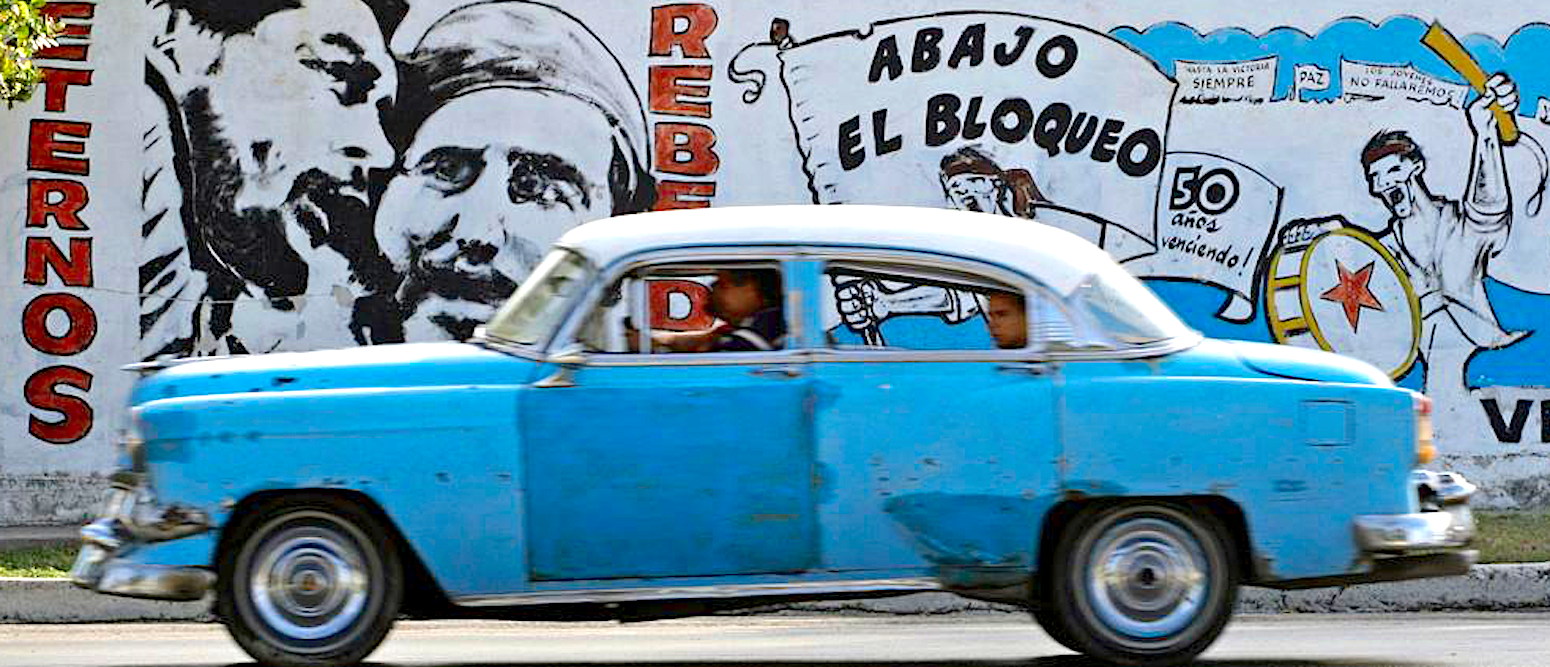
Motorist passing a mural in Havana in undated photo. “Abajo el bloque,” or “Down with the blockade.” (Desmond Boylan, CC-BY, Flickr)
Last week, the Cuban Center for Molecular Immunology (CIM) announced a major health breakthrough with VAXIRA, a vaccine treatment for lung cancer. This is a remarkable achievement, made only more impressive by the fact that this is Cuba’s second lung cancer vaccine.
The vaccine stops the progression of cancer by developing the patient’s immune system to fight off cancer cells. This has proven to significantly prolong people’s survival. Since 2013, the vaccine has been monitored, trialled, and tested on more than 1,300 patients. Over a ten-year period, patients survived a median of 76.6 months, with 20% of all patients who were given VAXIRA experiencing unexpected long-term survival. Last year, VAXIRA was awarded the Technological Innovation Prize in Cuba for its contribution to healthcare in Cuba. This is an incredible feat for humanity and the battle against cancer – and it is being done by a country facing the longest and most severe blockade in history.
In 2011, Cuba developed CIMAvax, which remains the world’s only approved lung cancer vaccine. This vaccine works to induce the immune system to stop the growth of cancer cells and slow the progression of tumors. This vaccine has already treated more than 5,000 people across the world and many more thousands in Cuba itself. Given the immense significance of the vaccine, the United States agreed to a special arrangement to trial the vaccine in the US. The Roswell Park Cancer Institute in New York has been running clinical trials with CIM since 2018. They have run the first clinical trials of CIMAvax in the United States. The very same nation that is imposing a genocidal blockade on Cuba is also benefiting from the historic breakthroughs in healthcare.
These major developments in medicine to treat cancer are not Cuba’s only awe-inspiring health achievements.
During the COVID-19 pandemic, Cuba produced five vaccines: Ablada, Soberana 01, Soberana 02, Soberana Plus, and Mambisa. Cuba had one of the lowest COVID deaths in the Western Hemisphere – and by 2021, Cuba’s fatality rate was just 0.59% compared to the 2.2% worldwide average. The vaccines were produced without the need for specialist refrigeration, which meant they could be easily transported and also distributed across the world to places where accessing such infrastructure would be impossible. Quickly, Venezuela, Iran, Vietnam, Saint Vincent and the Grenadines, and Mexico all picked up the vaccine to protect their population.
By 2023, Cuba had the third-highest rate of vaccinations per 100,000 people. Despite the fact that the U.S. banned the country from importing the syringes necessary to immunize its own population. In this context, Cuba was the first country in the world to vaccinate toddlers and children, as part of their push to reopen schools safely.
Cuba, like the United States, offered its COVID vaccines to the world. While Cuba donated vaccines to St Vincent and the Grenadines and sold them as cheaply as they could, the U.S. bullied countries into putting up their assets, like embassy buildings and military bases, in order to access vaccines. This was to “protect” against future legal challenges that vaccine recipients might file against the manufacturer of the vaccine. This profit motive was a major cause for the vaccine apartheid in the distribution of COVID protection across the world. As of August 2024, in high-income countries, more than 222 doses had been distributed per 100 people. While in low-income countries, this was less than 46. In 2021, US pharmaceutical companies that produced COVID vaccines (Moderna, Pfizer, Johnson & Johnson) collected an eye-watering revenue of $31 billion. The concept that companies and shareholders should make money from a pandemic should be utterly outrageous.
Biotechnology
Cuba leads the world in its vaccine breakthroughs. But, how is this all possible? It is not by accident that Cuba is able to develop world-leading health breakthroughs in medicine. Cuba has developed a world-class biotechnological sector that is state-owned and operates in the interests of the people, not profit. There are no profit motives to producing vaccines; research and development are for the collective benefit, and resources are shared to better the process of scientific development. This is quite the opposite situation in capitalist countries, where biotechnology is a major competition dominated by pharmaceutical companies motivated entirely by profits, which often means that when there are major developments in health, they are not accessible to people.
In 1981, Cuba opened the Biological Research Center, despite the blockade stopping the entry of equipment, materials, access to research journals, and medicines. In the first 9 years, the Center produced three products. Between 1990 and 2000, it produced 18, and between 2001 and 2010, it produced more than 40. Today, that figure continues to grow. The Center flourished into a world-class biotechnological sector that has made major health breakthroughs. Cuba produced the world’s first human vaccine to contain a synthetic antigen for Haemophilus influenzae type B.
In 1989, Cuba produced the world’s first Meningitis B vaccine during a severe outbreak of the disease in the country. This was the first ever vaccine produced to protect against Meningitis B and was exported to protect people in countries across Latin America. The U.S. approved its first vaccine for Meningitis B in 2014.
The following year, Cuba produced a vaccine for Hepatitis B. They joined just five other countries as a manufacturer of Hep B vaccines: France, South Korea, the United States, Indonesia, and Britain. As the US blockade made it virtually impossible and far too expensive to import the vaccine, Cuba produced their own and eliminated Hepatitis B in under 15 years.
In 2006, Cuba developed Heberprot-P, the only medicine in the world to reduce the amputation rate of patients with diabetic foot ulcers by 75%. Within 10 years, it was used in 23 countries. It has treated more than 400,000 people with foot ulcers. In 2024, the United States even broke its own blockade and approved it for trials and use. The very thought that Americans who suffer from diabetes might be treated by Cuban medicine while being fed propaganda against Cuba and funding a war against the very Cuban researchers and scientists helping them reveals how inhumane this blockade is.
By 2015, Cuba became the first country in the world to eliminate mother-to-child transmission of HIV and syphilis. Cuba managed this because of its socialist model, which is the same reason why it is not celebrated in mainstream media and looked to as a center for health advances in the U.S. This world historical achievement came as a result of Cuba’s universal health system that integrated maternal and child health programs with HIV and STI treatment. Cuba has one of the lowest rates of AIDS in the world and the lowest in the Americas, thanks to the free provision of antiretroviral treatment it has been distributing since 2001. Its vaccination programs have eradicated diseases that continue to cause death and suffering around the world, including diphtheria in 1979, measles in 1993, whooping cough in 1994, and rubella in 1995. Cuba has also developed the highest control of blood pressure in the world.
The same principles that led Cuba to produce world-leading medical breakthroughs are similar to its success in eliminating diseases. Cuba’s vaccination model is motivated by protecting its people. The National Immunization Program, which began in 1962, has saved the lives of at least 560,000 children who would have otherwise contracted diseases if it weren’t for the program. This is motivated by four directives: equity of vaccine distribution; integration of vaccination in primary healthcare; the inclusion of active community participation; and providing vaccines free of charge. These guiding principles indicate how central the health of all society is, not corporate interests or greed.
Cuba’s approach to providing healthcare is indicative of the nature of the revolution: to serve Cubans and the oppressed across the world. Before the revolution in 1959, 300 children were paralyzed by polio each year. One of the first measures by the revolutionary government was immunization for Cuban society. In 1962, the polio campaign launched through mobilizing 100,000 members of newly founded revolutionary committees to conduct a population census and vaccinate all children. Within months, polio was eradicated in Cuba, making it one of the first countries in the world to do so. Polio is still a leading cause of paralysis and death across the world.
These health achievements have massively benefited people across the world through access to new treatments and cures, affordable and accessible vaccines and medicines, and models for healthcare. But another awe-inspiring element of Cuba’s healthcare is its international solidarity.
Cuba has restored the eyesight for more than four million people with its joint program with Venezuela, Operation Miracle. They have sent more than 600,000 health workers on medical missions to 160 countries in response to pandemics, epidemics, natural disasters, and other crises where no other country would act. They have and continue to train doctors from the Global South for free so they go back to their home countries to practice medicine.
Cuba makes these miraculous achievements for humanity while facing a blockade that causes shortages of medicines in pharmacies across Cuba, blocks researchers from accessing health journals, and prevents the entry of equipment, spare parts, and laboratory materials that could make it easier and faster to conduct research. The U.S. blockade should be seen as an attack on humanity itself. This is a genocidal act of war against a population that exports doctors across the world by an empire that exports bombs, fighter jets, and invading soldiers.
Cuba once had among the lowest rates of infant mortality in the world. But since 2019, with the increase of more than 250 additional sanctions on Cuba, the rates of infant mortality have risen by 148%. It is estimated that this has cost 1,800 lives of infants. This is the material result of a blockade that intends to kill, punish, and destroy a country for asserting its own sovereignty. Yet, even still, Cuba’s infant mortality rate is lower than that in the United States. The U.S. enforces its blockade on Cuba so that it can try to claim Cuba is a “failed state”, which also means its universal, free healthcare system “fails”; all so it can maintain its abysmal healthcare system that operates purely for profit, despite the level of death, bankruptcy, and suffering it causes to poor Americans.
The truth is that even with this genocidal blockade, Cuba maintains the principles of its revolution and the motivation to better the world.
Like Fidel Castro said in 2003: “Our country does not drop bombs on other peoples, nor does it send thousands of planes to bomb cities; our country does not possess nuclear weapons, chemical weapons, or biological weapons. Our country’s tens of thousands of scientists and doctors have been educated in the idea of saving lives. It would absolutely contradict this concept to put a scientist or a doctor to work to produce substances, bacteria or viruses to kill other human beings.”Email
Nuvpreet Kalra is CODEPINK’s Digital Content Producer. She completed a Bachelor’s in Politics & Sociology at the University of Cambridge, and an MA in Internet Equalities at the University of the Arts London. As a student, she was part of movements to divest and decolonize, as well as anti-racist and anti-imperialist groups. Nuvpreet joined CODEPINK as an intern in 2023, and now produces digital and social media content. In England, she organizes with groups for Palestinian liberation, abolition and anti-imperialism.
” a libertarian foreign policy program for America must be to call upon the United States to abandon its policy of global interventionism: to withdraw immediately and completely, militarily and politically, from Asia, Europe, Latin America, the Middle East, from everywhere…the United States should dismantle its bases, withdraw its troops, stop its incessant political meddling, and abolish the CIA. It should also end all foreign aid—which is simply a device to coerce the American taxpayer into subsidizing American exports and favored foreign States, all in the name of “helping the starving peoples of the world.”
-Murray Rothbard
“I ask only one thing: Leave us in peace to better our country’s economic situation, to put our planning into effect, to educate our young compañeros. This doesn’t mean we do not feel solidarity toward nations that are struggling and suffering… But it is up to those nations to decide what they want, and if they choose other regimes than ours, that isn’t our business… I ask nothing: neither dollars, nor assistance, nor diplomats, nor bankers, nor military men—nothing but peace, and to be accepted as we are! We are socialists, the United States is a capitalist nation, the Latin American countries will choose what they want. All the same, at a time when the United States is selling wheat to the Russians, Canada is trading with China, de Gaulle respects Ben Bella, why should it be impossible to make the Americans understand that socialism leads, not to hostility toward them, but to coexistence?”
-Fidel Castro
The shit is going down in Cuba and it’s going down fast and hard; blackouts, fires, crowds in the streets; the whole shebang. In some respects, this isn’t unusual. The shit has gone down in Cuba before. In fact, this isn’t even the first time the communist island nation has found itself isolated and surrounded by enemies on all sides. Predicting Cuba’s supposedly imminent collapse has become something of a cottage industry among the think tank wonks of the Western news-sphere, going back to the untimely demise of the regime’s one-time benefactors in the Soviet Union.
But this time feels different because this time is different. Cuba has faced economic catastrophe and the threat of impending American invasion before, but never from a Washington Caesar even more desperate than they are.
While America’s now ancient embargo tightens into a downright medieval siege and the grid goes black for weeks on end from Havana to Santiago, Donald Trump is on the losing end of an epic war binge and in desperate need of a relatively cheap win. In a way, his decision to lash out at Cuba takes this rampage full circle. Much of Cuba’s current predicament was precipitated by Trump’s Blitzkrieg helicopter coup against its largest trading partners in Maduro’s Venezuela. But since that suspiciously easy victory, our own dear leader has blown multiple limbs off his own regime with his Zionist provoked clusterfuck in Iran.
This has left Donald Trump a grievously wounded animal in desperate need of a headline that doesn’t include the words ‘Fucked to Death Dumpster Fire’ and Little Havana’s own private Secretary of State, Marco Rubio, seems to have convinced the rabid beast he calls boss that another easy headline-grabbing Latin American victory awaits him on the firelit streets of a Cuban regime in freefall. This could very well be true, but it would also be quite tragic.
I know what you’re probably thinking. Why the fuck should I care, right? I left communism behind over a decade ago for a decidedly free market-oriented take on post-left anarchism while somewhat uncoincidentally coming to terms with a gender identity that Fidel’s macho regime would have had me committed to a sanitorium for until a relatively recent change of heart.
I do indeed know plenty of ancaps and libertarians who seem to be having a ball at Cuba’s expense, celebrating the carnage as more proof that communism has once again been revealed to be a house of mirrors crowded with empty promises. But I can’t celebrate with them. In fact, I find their glib opportunism to be downright repulsive.
Some of my readers will chalk this position up to groovy contrarianism or even latent Soviet nostalgia, and they won’t be totally wrong. However, what truly inspires me to kick my fellow anarchists in the teeth when they spit on Cuba’s grave is a simple matter of historical context that I can largely break down into two pretty simple points.
The first point is that what Cuba is going through right now isn’t a communist crisis. If that were true, then Vietnam would be in the dark with them right now rather than picking up momentum as a market socialist powerhouse. No, the source of Cuba’s economic woes is and always has been purely imperialist in nature. Cuba’s grid didn’t go dark until America took its largest trading partners in Caracas hostage, but this was only the latest blow in one of the longest shadow wars of the last century.
Cuba has been existing beneath the weight of one of the most suffocating blockades in modern memory for over 66 years now. All part of a much larger and more violent campaign launched by the United States of America, not in the name of democracy but in the name of bringing Cuba back under our thumb, where it belongs.
After nabbing Cuba from a collapsing Spanish Empire around the turn of the twentieth century, America reigned over that island for over fifty years, using a mix of fascist strongmen and direct military occupation. The last bastard we propped up there was a bloodthirsty thug named Fulgencio Batista who is believed to be responsible for as many as 20,000 deaths in less than a decade. None of which seemed to bother the opportunistic democracy enthusiasts back in Washington and Wall Street, not so long as Batista gave them free access to Cuba’s sugar, tobacco, and railroads, that is.
It was only after Fidel Castro kicked Batista out of Havana in 1959 and made it clear that Cuba’s resources no longer belonged to Yankee conquistadors that America began its long war for “democracy” in Cuba and it was a war defined by what can only be described as craven acts of barely covert terrorism.
This included not only the infamous CIA-coordinated Bay of Pigs Invasion in 1961, but a far nastier campaign launched after its failure, known as Operation Mongoose, which involved a spree of strategic mayhem that included burning crops, bombing industrial sites, derailing trains, and sabotaging power plants, amongst other dirty tricks.
It was ultimately this chapter of the shadow war that would nearly inspire a nuclear apocalypse with the Cuban Missile Crisis, but the Joint Chiefs of Staff under Kennedy actually wanted to take it much farther with the thankfully preemptively aborted Operation Northwoods that proposed American agents facilitating false flag attacks against American civilians in order to provide the popular context for a full-blown American military invasion of the island.
The campaign never really stopped either. America just farmed it out to semi-private terrorist organizations in Havana’s Cuban exile community, and we continued to provide these men with training and cover for their attacks on the civilian infrastructure back in their supposedly beloved homeland for decades. This included the men who bombed a Cuban commercial airliner in 1976, killing all 73 passengers on board. This included the men responsible for as many as 638 assassination attempts against Fidel Castro. And this included the men who Donald Trump recently indicted Fidel’s brother Raul for shooting out of the sky in 1996.
Before making 25 violations into Cuban airspace with private planes in less than two years, Jose Basulto, the man who led this reckless campaign of leaflet bombing under the name Brothers to the Rescue, was trained in torture techniques by America’s infamous School of the Americas and participated in the offshore shelling of a Havana hotel in 1962.
Any form of centralized government would crack under the pressure of decades of relentless terrorist attacks and economic isolation, and Cuba’s embrace of Soviet-style communism was one of the ways it broke, which brings me to the second historical fact inconvenient to the rabid kneejerk anticommunism of my fellow libertarians.
The Cuban Revolution was not a communist revolution. It was a populist revolution beholden to no single ideology above liberation from imperial rule. Fidel Castro was actually far closer to a left-wing Peronist than to an orthodox Marxist-Leninist before the United States began its campaign against his openly democratic 26th of July Movement, and driving this operation toward despotism was a key part of Washington’s strategy.
In documents released through the Freedom of Information Act, one of the expressed objectives of the JFK-approved Operation Mongoose was to force the barely formed Cuban Government to “introduce intrusive civil measures and divert precious resources to protect its citizens” in an attempt to weaken Fidel Castro’s then soaring popularity along with his grip on power. But Castro was never the true target of America’s 66-year terrorist plot in the Caribbean; he was merely the result of it.
The real target was and still is the Cuban Revolution itself, a popular grassroots uprising that challenged the supremacy of the burgeoning American Empire in its own backyard and, against all odds, won with zero outside funding or interference.
A popular uprising that actually included Cuba’s indigenous anarcho-syndicalists, who were a major driving force in their nation’s long resistance against foreign rule before Fidel was even old enough to grow a beard. Cuba was driven into the arms of strongmen and their thieving “allies” back in Moscow specifically to derail the Cuban Revolution before it could reach its natural conclusion and that conspiracy is also ongoing.
During the so-called Cuban Thaw, when Barack Obama attempted to rehabilitate his blood-spattered legacy by normalizing relations with the regime during the last years of his presidency, there was a small but vibrant revival of openly anarchist organizations like the Alfredo Lopez Liberation Workshop in Havana and the Anarchist Federation of Central America and the Caribbean in Santiago.
These groups would go on to play an active role in the post-COVID economic unrest of 2021, using the opportunity to lash out against both the Cuban government and the US Embargo, which they used to justify its continued existence.
Those voices and others like them will be lost in the maelstrom of an American invasion, which will once again force the Cuban Revolution to return to the barracks of its first objective to protect its people from imperial intervention, and this is quite possibly the most tragic thing about that revolution, the only thing more tragic than its betrayal at the hands of opportunistic caudillos like the Castro brothers.
The Cuban Revolution was never given the opportunity to move beyond this first objective and, unless America ends its long, dark war against the Cuban people, I fear it never will.
I implore you, all of you anti-imperialists, don’t throw the Cuban Revolution out with the bay water just to spite a pig’s face. I know for a fact that Murray Rothbard raised you better than that.
Nicky Reid is an agoraphobic anarcho-genderqueer gonzo blogger from Central Pennsylvania and assistant editor for Attack the System. You can find her online at Exile in Happy Valley.



No comments:
Post a Comment