Gaza Catastrophe
Gaza Catastrophe is a highly-researched analytical document of the ongoing Israel’s Genocide of Gaza that had begun on October 2023. It is a timely publication by Gilbert Achcar. He argues that not only is the current Genocide exceeding the 1948 catastrophe—Nakba for Palestinians who lost their homeland. But the Genocide also represents the conclusion of Israel’s far-right systemic policies against Gaza over the last few decades. The intense brutality of the neofascist/neo-Nazi coalition government of Israel and the scope of the onslaught have been implemented with US participation and the full support of several European countries—the UK, France, Germany, and Italy—and some non-European countries—India.
This review seeks to clarify Achcar’s goals, critique, and reflections. He explores three goals: analyzing Israel’s assaults on Gaza since 2007, when Hamas won the parliamentary elections to rule the Strip; putting the Genocide in historical perspective; and reflecting on and fleshing out the various strands of the tragedy locally, regionally, and globally. The goals also include critique of: Hamas’ Islamically inspired struggle; Israel’s shift to the far-right; and Western liberalism and its failure.
The Organizational Plan
Gaza Catastrophe comprises 3 parts. Part I, “Reflections on the Gaza Genocide and its World-Historical Significance” introduces the book. Part II, “Background to the Catastrophe,” contextualizes the Hamas attack on Israel after the highly-secured border between Israel and Gaza was breached by Hamas fighters. It is a collection of essays regarding the Genocide that the author penned since 1994. Part III, “Gaza, Nakba, Genocide,” collects articles written by the author from October 7, 2023, through the first year of the Genocide. The book concludes with an Epilogue, titled, “Enter Trump,” written in February 2025. An Appendix, a “Statement on Antisemitism and the Question of Palestine,” is a letter-statement initiated and drafted by Achcar with Raef Zreik. Titled “Palestinian Rights and the IHRA Definition of Antisemitism,” the letter is signed by 122 signatories, which was first published in The Guardian on November 29, 2020.
Discussion
Achcar does not mince words as he narrates the three parts of the book. He describes the Israeli far-right as neo-fascist and the current Israeli coalition government as neo-Nazi. He rightly affirms that at inception, as stated by the father of political Zionism Theodor Herzl, there was an inherent contradiction between the claim of establishing an egalitarian state for Jews in Palestine on a land already inhabited by Palestinians. The spuriousness of that claim became more apparent when David Ben-Gurion, the founding father of Israel, declared the establishment of the “Jewish State,” on May 14, 1948, a state that would presumably “ensure complete equality of social and political rights to all its inhabitants irrespective of religion, race or sex.” While ensuring the Ingathering of the [Jewish] exiles, Ben Gurion forbade the return of the displaced Palestinians—about 750,000 people— to their homeland (85). Next, Achcar rightly links the US global hegemony and Israel’s so-called security vis-à-vis Iran with the policies of the G. W. Bush administration, after September 11, 2001. The success of the election of Hamas was perceived as a slap in the face, especially that the rivalry between Hamas and the Palestine Authority (PA), who towed the line of the Israel-US dictate, divided the Palestinians, isolating Hamas. The Gaza Strip has been separated from the West Bank since 1991, suffering an intense blockade by Israel since 2007.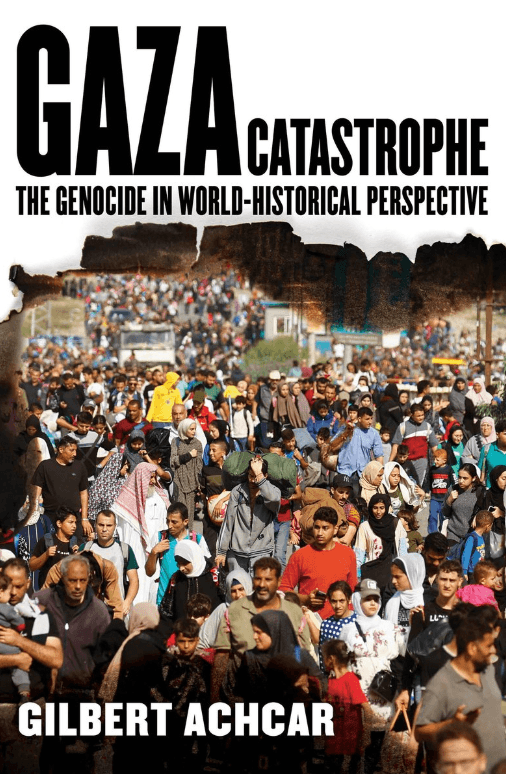
Achkar’s critique is insightful regarding the US policy in the Middle East, role of the US-Israel “special relations,” and the ideology of western liberalism. The Genocide, he suggests, lays bare the demise of what he dubs “the Atlanticist liberalism” (1)[2]. Since its inception, Israel’s goal has been to ethnically cleanse Palestinians, Achcar asserts. In 2009, he predicted that a new Nakba is looming with the coalition of the right-wing Likud with ultraright extremists Itamar Ben-Gvir and Bezalel Smotrich, one that “will inevitably be much worse in terms of killing and destruction than the first, the 1948 Nakba” (19). More than a decade later, we are live-streaming a Genocide that demonstrates the fulfillment of Achcar’s predictions.
Equally on target is the author’s critique of the so-called “peace process.” Achcar reveals that the peace process was not only a tactical strategy to derail Palestinian resistance. In reality, it was also a trap into which the PA fell, under Yasser Arafat, when he “publicly and shamefully declar[ed], ‘We totally and absolutely renounce all forms of terrorism’ in order to meet Washington’s condition for that purpose” (15). The peace process culminated in the signing of the Oslo Accords in 1993, which nominally recognized Arafat as the representative of the Palestinian people, but it did not mention Palestinian self-determination or the right of return of refugees. Thus, Oslo was an agreement between governments, underscoring the victor’s conditions (103).
Although presented as the most “spectacular event,” only a few critics were well aware that the Accords were “an updated version of the Allon Plan” (90-94). Devised by Yigal Allon, in July 1967, the Allon Plan was thus a “plan of colonization and partial annexation,…” (92). After Israel occupied the remaining land of Palestine—the Palestinian Occupied Territories (OPT), Achcar exposes Israel’s obsession with Iran when he suggests that Israeli attacks on Iran’s proxies, Hamas and Hezbollah, are mere pretexts (133). The current US-Israel war on Iran proves Achcar’s insight to be viable.
We also learn about the rift between Fatah and Hamas, and the Israeli subjugation of the PA under Mahmoud Abbas. Achcar does not shy away from chiding the Arab Gulf states for normalizing relations with Israel by signing the Abraham Accords in 2020, nor does he refrain from deriding Jordan for promoting sentiments toward the possibility of regaining the OPT. Likewise, Achcar’s predictions about the consequences of Israeli attacks on Gaza are on target, should Hamas continue shooting rockets at Israel, which it did.
Limitation of Achcar’s Critique
One of Achcar’s critiques did not sit well with this reviewer. And that is the critique of Hamas’ religious faith, against the back drop of “Weber’s ‘ethic of conviction’ in which practical rationality is usurped by faith” (21). Although the author grants Hamas the sincerity of religious beliefs claiming that he is not being condescending, he, nonetheless, asserts that the attack reflects an impractical, irrational mystical vision. Why impose western theory on Palestinian experience and on what’s happening on the ground? Who says acts of resistance are rational? And why focus the argument on the theatrics and religiosity? Had Achcar focused on Hamas’ actions as resistance to occupation, blockade, colonialization, racism, and dehumanization, his argument would have been more empathetic regarding this desperate act against violence and power. The Palestinian condition should not be governed by theoretical dogma, let alone western one, but by the facts on the ground and their ramifications.
Conclusion
Gaza Catastrophe is a valuable documentary about the ongoing Genocide of Gaza. It narrates the various stages of the political developments of the Palestine-Israel conflict, traces the conflict between, and within, the two polities of Palestine and Israel, and considers the regional and Global domains. It would be useful to politicians, scholars, and students of Middle East history, international politics, Palestine and war studies, and peace and conflict resolution studies.
NOTES
1. Gilbert Achcar, Gaza Catastrophe: The Genocide in World-Historical Perspective (University of California Press, 2025) ↑
2. Achcar proposes that the liberal mask of the Atlanticist ideology, which had claimed liberal ideology against fascism and genocide after 1945 and that was the basis of the United Nations Charter, has fallen. As we observe the collusion of the West with Israel, we are live-streaming the Genocide and abuse of Palestinians on the ground in the West Bank and those in Israeli prisons. See Gilbert Achcar, “Anti-Fascism and the Fall of Atlanticist Liberalism,” August 8, 2024, https://gilbert-achcar.net/anti-fascism-and-atlanticist-liberalism.↑
Gaza: A Meditation on Spirit and Survival
Photograph by Nathaniel St. Clair
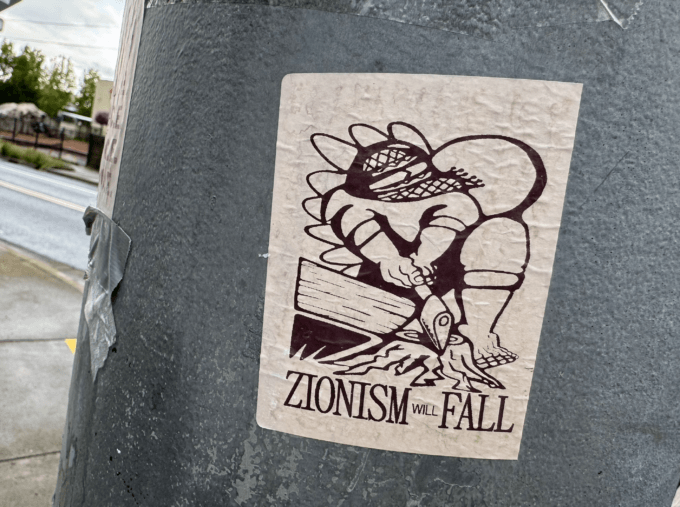
The images that have emerged from Gaza reveal the anatomy of a desolate landscape that defies human comprehension. Nothing can prepare the conscience for the sheer suffocating scale of a seemingly endless treeless terrain overwhelmed with millions of tons of concrete and rebar.
There is a distinct agonizing geometry to the destruction of buildings folded upon themselves. The angles, lines and shapes of neighborhoods have been completely warped, creating a jarring unnatural landscape of ruins, where once familiar streets, blocks and landmarks are now unrecognizable. The steel and mortar that once housed generations of families, communal memories, bustling markets, and schools full of children eager to learn, have been leveled into a desolate sea of gray.
The human spirit cannot comprehend the reality of tens of thousands of Palestinians entombed beneath mountains of pulverized concrete. The very air of Gaza carries the heavy toxic dust of war and of extinguished lives.
To gaze upon the ruins, is to confront not only its physical erasure, but the malign systematic campaign of the Israeli regime to wholly erase Palestinian ethnic, cultural and national identity—the very definition of genocide.
Systematic and indiscriminate aerial campaigns have decimated entire family units across multiple generations, erasing entire family lineages. These attacks not only erase collective histories, they inflict profound trauma and deep psychological scars upon survivors.
The level of death, destruction and scale of human suffering is unparalleled in modern history. Survivors of this holocaust must navigate a daily visceral reality. Each day is a battle for survival against Israeli atrocities, extreme spatial restrictions and the distress of living among the collapsed skeletons of their destroyed homes and memories.
Because the oppressive realities of daily life rarely break through the filter of the legacy media, the public remains largely insulated from the true scale of the catastrophe. They are shielded from knowing, for example, that the widespread destruction of municipal water and sanitation infrastructure has resulted in raw untreated sewage flooding makeshift tents and displacement camps across Gaza. And that sweltering heat, piles of uncollected trash, and disease spread by rodents and insects have led to a public health crisis; made worse by Israel’s blockage of crucial medical supplies and other crucial aid.
Tel Aviv’s aim is to make life completely unlivable, to create unbearable conditions that do not allow for survival and dignity. Israeli defense minister, Israel Katz, said as much when he unveiled Israel’s plan for the mass expulsion of Palestinians from Gaza; a forced deportation ethnic cleansing scheme he described, in true Orwellian manner, as “voluntary migration.”
Since the so-called October 2025 ceasefire, violated by Israel 2,400 times, Gazans have been forced into an ever-shrinking sliver of their enclave. As Israel seeks to completely occupy Gaza, it has unilaterally expanded its concocted “yellow demarcation line,” effectively bringing some 64 percent under its control.
Earthen barriers and military bases constructed along the shifting yellow line, have walled off Palestinians from accessing their land and most of the strip. Those Gazans who come near the Israeli designated “no-go” zones are killed.
Israel continues to push deeper into Gaza, corralling two million Palestinians into 56 square miles of makeshift camps along the coast. Recently, Israeli prime minister and war criminal, Benjamin Netanyahu, ordered the military to seize 70 percent of Gaza, with 100 percent as the final objective.
Faced with a ruined landscape and realities that defy comprehension, Palestinians continue to demonstrate a spirit of defiance and unwavering hope. Proving that the human spirit cannot be crushed, they are actively trying to rebuild their lives.
Although Israel has tightly restricted the entry of essential construction material and heavy equipment, Gazans are repurposing rubble, crushing concrete and scrap metal to clear routes and to pave areas for tents and community kitchens. They use whatever they can find (iron, window and door frames) to make partially damaged structures habitable.
While agencies such as the United Nations Development Program estimate that clearing the debris will take years, true reconstruction must also address the monumental task of rebuilding the human spirit.
However, extolling Palestinian strength in coping with incredible hardships should not overshadow the cruelty of the conditions Israel has forced them to navigate and the horrendous injustice of their circumstances. Exhausted and terrified, they have no other choice but to live through and resist Israeli violence. Endurance—the very act of surviving—becomes an act of fierce resistance.
To comprehend the enormity of this 21st century tragedy, it is important to look beyond today’s stark ruins to the rich enduring legacy of Gaza’s more than 5,000 year history.
Since antiquity, Gaza has been a vital Mediterranean coastal hub, a rich oasis and crucial political crossroads connecting Africa and West Asia. This historical crossroads of civilization, positioned squarely on ancient trade routes, was repeatedly conquered and reshaped by successive empires, from the Romans, Persians to the Ottomans. To this day, it remains the key to war and peace in the region.
Gaza became part of the British empire, under the Mandate of Palestine, following World War I. Its administration passed to Egypt at the end of the Arab-Israel War in 1948.
Israel gained control over the strip as a result of the 1967 Arab-Israeli War, establishing civilian “settlements” in the territory. After 38 years of occupation, it ended its physical presence, evacuating settlements and withdrawing its military in 2005. However, by maintaining dominance over Gaza’s airspace, coastline and borders, Tel Aviv continued de facto control. In 2021, the barrier, dubbed the “iron wall,” constructed to surround Gaza, was officially completed, converting the strip into an “open-air prison.”
Since declaring statehood in 1948, Israel has waged 15 wars against the Palestinians in Gaza. The current unprecedented bombardment and siege is by far the longest and deadliest.
In addition, for more than three months, Tel Aviv and Washington have been engaged in a war to silence the Islamic Republic of Iran, a nation that has consistently answered the Palestinian call for justice, freedom and self-determination.
Israel’s prolonged, relentless war on Gaza is a testament to the moral failure of the international community, and an indictment of the American-led global order.
Recovery transcends physical reconstruction. It insists upon restoring human agency, guaranteeing fundamental rights, and honoring the inherent dignity of the Palestinian people.
The Palestine Industry: The Rats of Gaza and the Opportunists among Us
Image by Ash Hayes.
It all started with a call to my family in a displacement camp in northern Gaza.
Since internet lines rarely stay connected, I managed to send a message to the widow of my cousin—who was killed along with all of his sons during the ongoing Gaza genocide. I asked her a simple question: what do Gazans want?
My purpose was to gather raw testimonies from her neighbors to weave into a letter to a European official whose country is active in pursuing justice for Palestinians. I chose this approach to bypass clichéd political discourse and avoid the pitfall of speaking on behalf of those enduring genocide and famine. Palestinians in Gaza are entirely capable of speaking for themselves.
The responses, however, reframed my entire approach. While I am deeply tied to my community in Gaza, I had anticipated a direct focus on macro-political language—on statehood, rights, and global justice. Instead, I was met with the visceral reality of immediate physical survival.
“We want a life… we want a dignified life,” she said. “A dignified life with food, water, and even the ability to breathe. One feels so suffocated. We need so many things… so, so many things. We need psychological support, financial support, and moral support.”
Another neighbor said: “They (Israel) fight us with everything, absolutely everything; even when we are sleeping in our beds .. the mosquitoes drain us. Insects and rats are all around us, fleas, and the heat is killing us. There are no fans and there is no electricity.”
Yes, many spoke about Karameh (dignity), hurriye (freedom), and Haq al-Awda (the Right of Return), but these broad political and social rights were almost always tied directly to the everyday struggle for education, for water, for basic medical care, and—against rats.
The rats. This is the recurring nightmare in the minds of Gazan parents who find themselves unable to protect their children even from rodents. Nearly two million Palestinians remain displaced in horrific conditions, trapped in barely 40 percent of an already tiny, besieged Strip.
I spent the day trying to process the pain, grief, and humble expectations of these proud people.
Yet later that evening, a seemingly separate matter came to my attention. I learned of two characters—Aziz Abu Sarah, a Palestinian from the 1948 areas, and Maoz Inon, an Israeli—who have been touring for months, promoting what they call their ‘The Future Is Peace’ tour.
These two individuals have achieved global celebrity status, sitting down with the likes of famed US comedian Jon Stewart on The Daily Show and ultimately meeting with Pope Francis himself.
To the unexamined eye, the two are peddling a message of ‘peace’ and ‘forgiveness’, routinely staging a display where they forgive each other at the end of their talks. All of this serves as a promotional springboard for their week-long ‘peace tour’ inside Israel, sold commercially at the competitive price of $4,200 per person, air tickets excluded.
The sad truth is that this corporate approach to ‘peacebuilding’ is not unique; it is a symptom of a broader trend exploiting Palestine. Even more tragically, many individual Palestinians have capitalized on the well-intentioned but often misunderstood concept of ‘centering Palestinian voices’ to accumulate personal wealth, status, and prestige, while their own brethren cannot find drinkable water and teeter on the brink of starvation.
The Arabic maxim, famous in Palestine for generations, has long contended that “the revolution is a tree watered by the blood of the martyrs, and its fruits are plucked by the opportunists and the cowards.”
Shouldn’t mass extermination be a moral threshold that stops opportunists from feeding their pathological greed?
Desperate for solidarity, Palestinians in Gaza continue to hope that global efforts will eventually aid their raw struggle for freedom, dignity, clean water, and relief from the rats. And millions worldwide are indeed well-meaning; they care about Gaza in ways that no social media post can ever capture.
The crisis is that the balance between genuine solidarity and outright exploitation at times risks tipping in favor of the exploiters. We are witnessing the rise of a lucrative cult of personality, built on high speaker fees and business-class tickets, circumnavigating the globe under the guise of advocacy. There are those who have experienced a literal ‘rags to riches’ transformation since October 7, becoming overnight celebrities and acting like heroic figures surrounded by adoring fans, simply for doing their basic jobs or taking a public moral position.
There are organizations amassing massive budgets, hosting events costing up to $200,000 over a single weekend, simply to regurgitate the same old stances without strategy, slogans without action plans, and claims of stupendous ‘victories’ while Gazans die of thirst and hunger.
On the other hand, Palestinian officials and those who tout the official line continue to turn their backs on the reality of Gaza while reaping the immense benefits of global solidarity: the prestige of diplomatic recognition, the red carpets rolled out for bureaucrats, and the standing ovations at international conferences.
The circle of exploitation grows wider, while the actual messages filtering out from the displacement camps grow more tragic by the day:
“I want my family back — the family Israel took from me.”
“I want to bury my children who are still under the rubble.”
“I want my father released from prison. We have no one else but him.”
“The rats, the rats, brother. They are eating the flesh of our children.”
As I reflected on the horror of those parents helpless to protect their children, the word “rats” took on a heavier meaning.
The struggle for Palestinian freedom must remain anchored in the soil of Gaza. The global solidarity movement must not be permitted to mutate into a careerist industry for self-seeking individuals masquerading as saviors.
This creeping opportunism must be fought with the exact same urgency as the literal rats of Gaza.

No comments:
Post a Comment