Sunday, January 19, 2025

Romania’s Darkness at Dawn


JANUARY 17, 2025
Facebook

This is the ninth part in a series about riding night trains across Europe and the Near East to Armenia — to spend some time in worlds beyond the pathological obsessions of President-elect Donald Trump. (This week Trump has been wagging the dog over the annexation of Greenland and busy filling up his cabinet’s clown car with what MAD Magazine would call “the usual gang of idiots.”)
pasted-image.jpeg

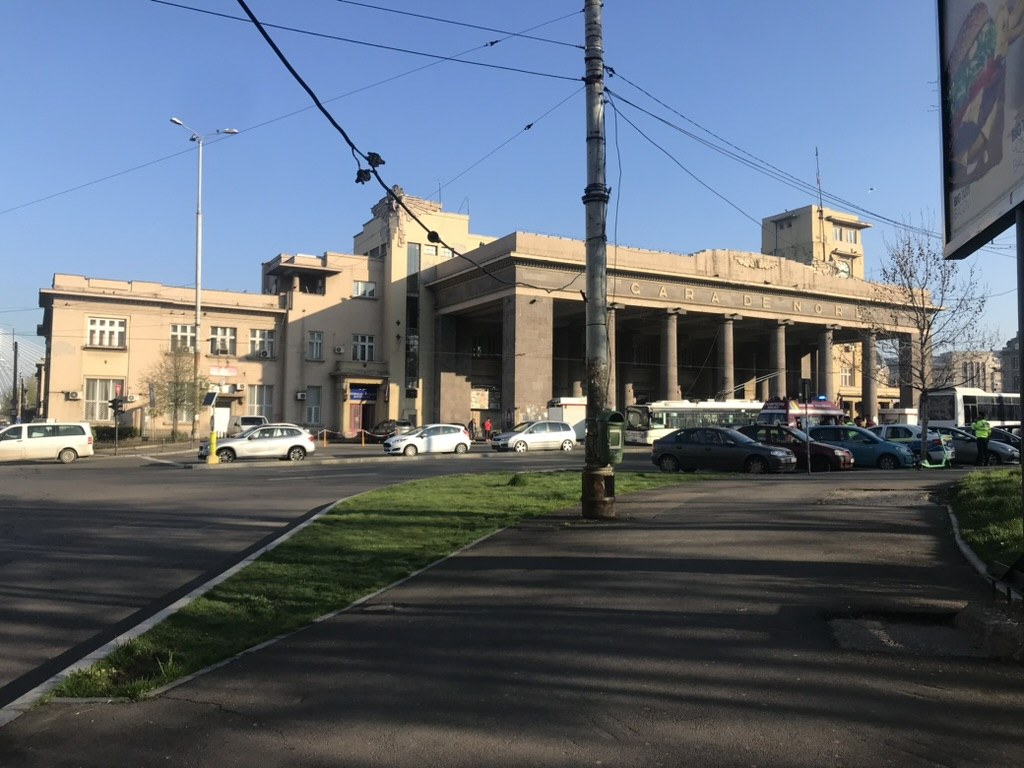
Gara du Nord, the main passenger station in Bucharest. Photo by Matthew Stevenson.

In the late afternoon, when I was back from Bánffy Castle and had inspected a 1990s memorial dedicated to those killed in the anti-Communist movement (many East European cities have one), I retreated to my empty hostel to pass time before dinner.

I had thought of riding out to the Ethnographic Park Romulus Vuia, a collection of old Transylvanian wooden houses (many with thatched roofs that would have thrilled my wife), but by the time I was ready to head there, it had begun to rain and the cobblestones were even more treacherous than before.

Instead, I read my Kindle until I could go to dinner. The best time to visit Cluj-Napoca is in the summer, as the city is full of outdoor restaurants and terraces, but still I found a good place to eat indoors, even though the waitress wasn’t thrilled to see me lugging my folded bicycle to the table. (I try to avoid locking it outside.)

Unlike Western Europe, Eastern Europe—and especially Romania—remains a bargain, and dinner out or a berth on an overnight train can be found for less than $100 (unlike Amtrak, which charges about $600 for many overnight compartments, some of them the size of coffins).

Politically, much of Eastern Europe has never been integrated into the West. Yes, many countries, including Romania, are members of the European Union and NATO, but on the ground they remain a world apart, and the big hole in the donut is former Yugoslavia; few of those republics are EU members, and all are outsiders, as would be Ukraine if admitted into the EU.

+++

The sleeper to Bucharest did not leave until 22:15. A few minutes before departing, the long train pulled into the Cluj-Napoca station. There was no indication on the platform where each numbered car would be stopping.

On the advice of a station officer, I lined up at one end of the platform, only to discover that my sleeping car was at the other end of the arriving train. With only two minutes to get aboard and not wanting to lug the folded bicycle the length of the fourteen-car train, I unfolded it, mounted my bags, and pedaled the length of the train in less than a minute.

I am sure I violated a few rules of Romanian station etiquette, but no sooner had I loaded my bicycle and bags onto the vestibule than the engine whistled and the train rolled into the night.

+++

My first visit to Romania, also on a night train, was in spring 1975, when my father and sister visited me—a student in Vienna—and together we traveled to Budapest and Bucharest. (Actually we went all the way to Constanza, a workers’ paradise of high-rise summer apartments on the Black Sea.)

On the overnight train from Budapest to Bucharest, we made up a bed for my sister (then thirteen) on the floor of the compartment rather than let her sleep alone in her assigned compartment.

That night train left Budapest around 10 p.m., and while waiting for it to back into Keleti station my father taught my sister and me the rudiments of boarding a moving train (we practiced on a few slow-moving locals backing along platforms).

A child of the American Depression, my father had acquired the skill in college, when he got around the United States by “riding the blind,” a perch behind the coal tender of steam engines and in front of the “blind” baggage car at the front of the train.

“Riding the blind” (sometimes also called “riding the blinds”) was a step up from hopping freights, which to bindlestiffs and other itinerants in the 1930s were known as “side-door Pullmans”.

After graduating from Columbia in 1940, my father and his close friend Bob Lubar (later managing editor of Fortune and my godfather) rode “the blind” from New York to Los Angeles for $40.

+++

As I had eaten dinner, there was little for me to do on board the night train other than to lock the door and go to sleep. The porter explained that we would arrive in Bucharest around 6:30 a.m., provided the train was on time, and that he would bring breakfast at 6:00 a.m.

On most night trains in Europe—even on some of the newer Austrian trains—breakfast is yogurt, a prepackaged croissant, and lukewarm coffee, which is what I was served at dawn’s early light.

Then, perfectly on time, the train pulled into Bucharest’s Gara du Nord, which both in name and spirit echoes a terminal from Paris in the 1930s.

On only one of my trips to Romania have I come by air. All the others have begun at this station, which has a stately exterior but inside exhibits the jumbled air of a flea-market with trains running out the back.

+++

Rather than spend the night in Bucharest, I had decided to fly later that day directly to Ankara, Turkey.

To be faithful to my plan of taking night trains all the way from Geneva to Armenia, I originally thought of catching a sleeper from Bucharest to Istanbul, and then the high-speed Turkish train to Ankara.

But when I gamed out the connection from Bucharest to Istanbul, I discovered that it would involve three changes at small intermediate stations in Romania and Bulgaria, as the through service—once a mainstay of the historic Orient Express—was no more.

In summer, the train schedule might have been more forgiving with a direct couchette, but in autumn, I was looking at twenty hours on Balkan day coaches and there was no guarantee that I would make all of my connections. So reluctantly I decided to fly.

+++

With the morning free in Bucharest, I assembled the bicycle and went for a city ride. I only had about an hour before I needed to catch a train to the airport, but I decided it would be enough time to make a loop through the downtown.

I began at the Palace of Parliament, by some reckoning one of the largest buildings in the world, conceived as a monument to its spiritual architect, President Nicolae Ceaușescu, whose ego would have been the only thing that might have filled all 365,000 square meters.

The president, however, was tried and executed in 1989, eight years before the building was finished. Twenty-five years later, it remains an endless ballroom in search of dancers.

Nominally, the Romanian parliament meets there, but there are still acres of empty marble rooms sufficient to display 480 chandeliers, not to mention the 1,409 ceiling lights and mirrors that found homes there, thanks to the labors of 700 architects.

Think of Versailles but without all the modesty. Perhaps its best use came in 1992 when the pop singer Michael Jackson put on a concert with the facade as a backdrop. On stage, Michael greeted the audience by shouting: “Hello Budapest, I’m so glad to be here.”

+++

From the Palace of Parliament, I weaved through traffic (it was rush hour on the larger boulevards, but fine to ride on some of the back streets) to the Athénée Palace Hotel, which is located in the city center on Revolution Square.

Down the road were various ministerial offices, which explained why, in the 1989 revolution, protesters tore apart the square and some of the hotel facade as symbols of repression.

I liked riding by the hotel (now part of the InterContinental chain), as that’s where we stayed in March 1975, when I was in Bucharest with my father and younger sister.

While at the hotel, we were joined by a close family friend and my sister’s godmother, whom we called Aunt Marge. She was then in her sixties and had spent a productive life as a social worker, with much of her career spent abroad in places like China and Japan.

She had warmed to the idea of a family trip behind the Iron Curtain to Romania, and had booked herself to London and Bucharest on various airlines. But something went awry when the airport taxi stopped in front of the hotel (then the best in town but still a little shabby).

I was waiting by the front door to greet her, but when the taxi arrived she flew out the rear car door, shouting at the driver and leaving her luggage untouched.

In waiting to get paid, the driver (who spoke no English) had used some gesture, which she interpreted to mean than he would accept payment in a more emotional currency, and she wanted nothing to do with such means of production.

I think part of the problem, lost in transaction, is that in those days the Romanian currency was called the lei.

+++

On this occasion, I ended my bike ride around Bucharest in front of the Museum of the History of the Romanian Jewish Community, which is located in the former United Holy Temple. It was only open between 10:00 and 15:00, but I didn’t need to go inside as I had been there on a recent visit and the display cases (of a vanished Romanian civilization caught in the vice of World War II) were fresh in my mind.

Later, in wanting to know more of this Holocaust story, I downloaded to my Kindle Paul Kenyon’s excellent Children of the NightThe Strange and Epic Story of Modern Romania.

Kenyon is a celebrated broadcast and magazine foreign correspondent who has covered conflicts around the world, and he married into a Romanian family, which is the reason he wrote this history of Romania in the 20th century (the book ends with Ceaușescu and his wife Elena up against the wall of a firing squad in the city of Targoviste).

Of the internal war waged against the Jews Kenyon writes:

It was only in the months and years that followed that the full enormity of Romania’s Holocaust emerged. More Jews were killed by Romania than any other Axis state, aside from Germany itself. According to the International Commission on the Holocaust in Romania, the number of Romanian and Ukrainian Jews who perished in territories under Romanian control was between 280,000 and 380,000. Between 120,000 and 180,000 of them died as a result of deportation to Transnistria.

Part of the reason that the fascist leader of Romania, Ion Antonescu, threw in his lot with Hitler’s Nazis is because he hoped that such an alliance might bring back to Romania in a postwar settlement the lost paradise of Transylvania.

+++

Romania joined the Tripartite Alliance with Germany, Italy, and Japan in November 1940 (foreign correspondent Derek Patmore tells the the story of this treachery in his memoir, Balkan Correspondent, which I recommend to anyone who wants to wallow, as I often do, in the politics of betrayal).

Kenyon describes how in the early 20th century nativist anti-Semitism—plus fears of Jews emigrating from Russia and the nearby Pale of Settlement in what is now Ukraine and Moldova—produced toxic nationalism in Romania, no matter whether the leader was a king, a fascist, or a republican.

Of the late 1930s, Kenyon writes: “Jews were barred from marrying Christians and, no matter how long their family had lived in the country, could never acquire the status ‘Romanian by blood’, a term that was written on the official papers of all non-Jews. The policies of hate and discrimination were designed to flatter Hitler into keeping Hungarian hands off Transylvania.”

It all came to naught, however, when Hitler awarded Northern Transylvania (including Cluj) to Hungary in August 1940. After that, Romania could only prove its bona fides to Hitler by being more ruthless against the Jews than even some Germans.

It is not lost in modern European politics that in 1941 Romanian troops spearheaded the Nazi invasions of southern Ukraine, notably Odessa, where atrocities followed them.


Matthew Stevenson is the author of many books, including Reading the RailsAppalachia Spring, andThe Revolution as a Dinner Party, about China throughout its turbulent twentieth century. His most recent books are Biking with Bismarck and Our Man in Iran. Out now: Donald Trump’s Circus Maximus and Joe Biden’s Excellent Adventure, about the 2016 and 2020 elections.


One Memorable Day in Panama 


 January 17, 2025


Facebook

I traveled from tourist-infested Taboga Island, Panama to Panama City yesterday. I walked the 5-10 minutes from my basic but adequate room down to the island’s principal waterfront, and took the passenger boat to the mainland, and then got a free ride to my Panama City hotel. Free because on the boat I fell into conversation with a very colorful American guy who goes by the name of Skinner, a pseudonym. I had seen and heard Skinner speaking English with a waitress in a Taboga place where I had eaten 2-3 times, and he knew the waitress by name. He had a kind of expat, island-life look to him, so I thought he might live on the island, and that’s why I struck up a conversation with him, to see whether I could learn a thing or two about the local scene.

As soon as Skinner sat down on the boat, he called out to one of the young men working on the boat, and said something like, “The usual,” and soon a can of cold beer appeared – and it proved to be the first of two that Skinner would consume on the 45-minute ride – at 10:15 in the morning.

Skinner said he was a mechanic and he fixes ships, and, as I would have guessed many times over, he has no shortage of business, here in what is perhaps the world’s greatest crossroads and chokepoint of commercial shipping – the Panama Canal. In fact Skinner complained that his phone never stops ringing, and I believe it. No phone of his rang once during our conversation and journey, but for all I know he has an office and secretary somewhere. Besides, he was busy drinking his breakfast.

Indeed, he had the complexion of a man who drinks his breakfast. And lunch. And dinner. Ruddy scarcely begins to describe it. In fact, his cheeks sported at least one Grand Canyon-like scar, and he looked like he hadn’t had a proper shave in years.

There is a lot to tell of what he said in those 45 minutes. He said he’d been living on the island for 20 years and loved it (though I don’t think I would). He said he was an independent contractor and earned something like $2,500 a day, but had quite considerable expenses, such as tools and administrative help. He said he’d kind of like to retire but couldn’t afford it, even at $2,500 an hour and living in the relatively cheap Latin American tropics. I don’t know how old he was – it’s hard to tell with seaside expat heavy drinkers.

But Skinner also hinted that he didn’t want to stop working, because he had nothing else to do.

He knew all the boat workers by name. I asked him whether the maybe 20 or so boats waiting to enter the canal was a high number, and he said no, that it sometimes gets up to 70, or even more. That surprised me, given recent reports in the U.S. media to the effect that canal traffic was backing up because of a lack of freshwater needed to run the canal – a result of the considerable drought that has been slamming Panama, and more specifically Lake Gatún, which supplies the canal’s freshwater needs (and under which my maternal great-grandmother is buried).

But Skinner said no, no, the backup wasn’t caused by that – it was caused by ships not wanting to go through the new, bigger and more expensive canal.

I don’t know that that is in fact true, but that’s what Skinner said, and he presumably knows one hell of a lot more about the canal than I do.

I asked Skinner about Trump’s recent threats to take back the canal, and he said that was nonsense, that Trump was just throwing red meat to his base, and that it would never happen. He said there’s no reason for it to happen, there is no advantage to it for the U.S., that it wouldn’t reduce the cost of maintaining the canal, and thus wouldn’t reduce the cost of, or charges to, individual ships traversing the canal. And he called Trump a fool, or something of that nature.

Skinner also said there was a backlog because ships over a certain weight can’t traverse the canal, so the area outside the canal entrance was populated, at least somewhat, by Chinese vessels in the process of lightening their loads by dumping some of their heavy, highly polluting, tar-infested fuel straight into the Pacific so they could meet the canal’s weight restrictions.

I asked Skinner whether such considerable pollution wasn’t policed, and he kind of threw up his hands and smiled. In other words, no. “We aren’t the only place (where this kind of thing happens),” he said.

Then our conversation turned to the very tall and quite impressive skyscrapers that have sprung up all over Panama City, like so many massive mushrooms, since I was last here a number of years ago LINK ITT PIECE.

Skinner said most of the skyscrapers are nominally condo buildings, but are mostly uninhabited and were built for the sole purpose of laundering money, principally drug money, principally from Colombia, but from elsewhere as well. He said that many of the buildings have shops, offices and storage areas in the first few floors, but are then vacant all the way to the top. He said one can look at the building at night and see lights only on the first few floors and then nothing but darkness all the way to the top.

Skinner said rent for the condos runs about $80,000 a month – for one condo. Do the math. Not that it is necessarily a money-laundering operation, but Panama City’s tallest building, the JW Marriott building, a hotel-condo operation, is 70 floors, with, according to Wikipedia, 2,710,000 square feet and 997 units. If condos do in fact rent for $80,000 a month, that could launder one hell of a lot of Colombia pesos.

Opened in 2011, The JW Marriott was at one point the tallest building in Latin America, before it was supplanted by the Gran Torre in Santiago, Chile, and it is still the tallest in Central America.

The building has an interesting history.

According to Wikipedia, Ivanka Trump at least used to claim that her father built the building, but in fact he merely sold his name to it, for a punky $1 million. But since then his profit from the building has somehow risen to $30 million.

After my memorable boat ride with Skinner, he gave me a free chauffeur-driven ride to my hotel, and later that day, two taxistas more or less confirmed to me that Panama City’s ubiquitous skyscraper towers are indeed largely unoccupied and may in fact be vehicles for laundering money, and even drug money. But both cabbies downplayed this a bit, in what seemed to be an effort to salvage some of their country’s image and reputation. “This kind of thing happens everywhere,” one of them said. “Even in the United States. This money didn’t come from feeding drug use in Panama, a country of four and half million.”

No doubt.

Lawrence Reichard lives in Belfast, Maine, and can be reached at thedeftpen@gmail.com

Austria
Government of the far right on the horizon


Saturday 18 January 2025, by Austrian correspondents


In the Austrian parliamentary elections on 29 September, the far-right Freedom Party of Austria (FPÖ), led by Herbert Kickl, emerged as the strongest party with 28.85%, just ahead of the right-wing conservative Austrian People’s Party (ÖVP) with 26.27%. The Social Democrats came in third with 21.1 per cent. Since the Social Democrats ruled out a coalition with the FPÖ at the federal level from the outset, the conservatives could choose whether they would rather govern with Kickl or with the Social Democrats.

Negotiations with the Social Democrats and the liberal Neos for a governing coalition were ended by the Neos and the conservatives. Neither was even willing to negotiate the participation of the rich and super-rich in the necessary budget restructuring (reintroduction of an inheritance or wealth tax), so great was the pressure on both bourgeois parties from capital. The Social Democrats also proposed alternatives such as a bank levy – all of which was dismissed out of hand. Conservative Chancellor Karl Nehammer, who had made it clear during the election campaign that he would not under any circumstances be a stepping stone for Kickl to the Chancellery, resigned as Chancellor and as party leader on 4 January.

Since then, the conservatives have agreed to form a government with the far-right under a Chancellor Kickl. Kickl has successfully lobbied by promising the capital associations that he would implement the economic programme of the conservatives if he could take over the chancellery and important ministries. The pressure of capital on conservatives and liberals was apparently so overwhelming that the negotiations with the Social Democrats were brought to failure, who had demanded a fairer distribution of the burdens from the necessary budget reorganisation, thus a modest capital tax.
A policy against the working class

The FPÖ and ÖVP know that the implementation of this massive redistribution from bottom to top, which corresponds to the ÖVP’s economic programme, will lead to a change in public opinion.

The destruction or at least a significant weakening of the health system (20% cut in the hospital sector alone and further privatisation); attacks on public sector workers (freezing the salaries of teachers, nurses and police officers) and on pensioners (freezing pensions and raising the statutory retirement age); a ‘labour market reform’, i.e. cutting benefits and tightening employment conditions; and increasing mass taxes. It is to be expected that people will soon turn away from the ÖVP and the FPÖ in response to such measures.

For this reason, and because of the ongoing proceedings against leading representatives of the ÖVP and FPÖ, both parties are interested in weakening democratic controls and the rule of law. For example, the independence of public television and radio is to be weakened or eliminated, and massive influence is to be exerted on the most important print media (including advertising corruption).

The weakening of the ‘Chamber of Labour’ (which has its origins in the 1918/19 revolution) or even its destruction by reducing or abolishing membership fees for this chamber is a further starting point.

The same applies to the independence of the judiciary (termination of proceedings, prevention of investigations and the initiation of new proceedings), the Court of Auditors, the Austrian Institute of Public Statistics and even the public administration: the appointment of political secretaries-general in all ministries under the Sebastian Kurz government gives an indication of the direction to be taken. Sebastian Kurz, a provocative young politician, had already served 17 months as chancellor of a so-called ‘turquoise-blue’ coalition (ÖVP-FPÖ) in 2018/19, but at that time the conservatives were still a little stronger than the far right...
Racism and reaction at the heart of the programme

The aim of further tightening xenophobic and anti-minority measures is to divert discontent onto supposed scapegoats (refugees, migrants, the unemployed, welfare recipients, LGBTIQ+ people or even socially critical artists).

Furthermore, the FPÖ and ÖVP advocate everything that feeds the climate crisis and advocate abandoning climate targets.

Broad alliances to defend democratic and social rights and against ‘Orbanisation’ are now the order of the day. The success of these defence actions will depend on whether the social democracy and the trade unions participate in the defence with all their might (organisations to the left of social democracy play only a very small role in Austria). This will be a very big challenge in view of the decades of social partnership, in which the average strike times were measured in minutes, if not even in seconds per person and year (!).

At the same time, we have to develop an offensive left-wing programme and debunk not only the right-wing populism of the FPÖ, but also the neoliberal ideology of the ‘Neos’.

In the medium and long term, it will only be possible to stop the shift to the right if a strong, radical social and political left emerges in Austria that can stand up to blue-black populism.

15 January 2025

Translated for International Viewpoint from ISO website.

P.S.
If you like this article or have found it useful, please consider donating towards the work of International Viewpoint. Simply follow this link: Donate then enter an amount of your choice. One-off donations are very welcome

Attached documentsgovernment-of-the-far-right-on-the-horizon_a8822.pdf (PDF - 907.9 KiB)
Extraction PDF [->article8822]

Austria
National elections in Austria: A disaster for democracy and the welfare state – and for the left
Stalin Handed Hundreds of Communists Over to Hitler
Austria’s far right tries to surf on popular anger
Germany and Austria: the good European pupils of the Covid-19 crisis?
Life in the Century’s Midnight
Far Right
Looking back at the American election: the oligarchic consensus and its contradictions
The vile beast is not dead!
Political Review of 2024 - a view from Britain
Gender and sexualities: the reactionary offensive of the far right
‘It’s crucial to fight the far right in Pakistan and the region’

Austrian correspondents


International Viewpoint is published under the responsibility of the Bureau of the Fourth International. Signed articles do not necessarily reflect editorial policy. Articles can be reprinted with acknowledgement, and a live link if possible.

Trump tariffs will be met with ‘retaliations across the globe,’ strategist says


By Jordan Fleguel
January 16, 2025 
BNNBLOOMBERG

Jeff Hull, senior financial advisor of Manulife Wealth and Brian Gardner, chief Washington strategist of Stifel, talk about the relationship between Canada and

As Ottawa prepares its trade response to U.S. president-elect Donald Trump’s threat of placing sweeping tariffs on Canadian goods, one expert says retaliation from Canada or any other nation Trump targets should come as no surprise to the incoming administration.

“I think that should be expected on the American side. I think all of the proposals that the Trump administration is likely to roll out in the coming weeks when it takes office are going to be met with retaliations across the globe,” said Brian Gardner, chief Washington strategist at Stifel.

“Whether it’s Canada, whether it’s China, whether it’s the EU (European Union), I think it’s part of the negotiating process on reaching new trade deals and new accommodations on trade around the globe – Canada’s not going to be any different than that.”

Gardner made the comments in an interview with BNN Bloomberg on Thursday, a day after Bloomberg News reported that Canada has created a preliminary list of $150 billion of U.S.-manufactured products it will hit with tariffs if Trump makes good on his tariff threats.

Trump has threatened to place a 25 per cent tariff on Canadian imports on his first day in office. He’s set to be inaugurated on Monday.


Since Trump first made the threats last year following his election in November, there’s been near-constant speculation about how seriously they should be taken, as some experts have suggested Trump is mainly using them as a negotiation tactic.
The information you need to know, sent directly to you: Download the BNN Bloomberg App

Gardner argued that Trump’s rhetoric around trade with Canada comes with “a significant amount of bluster,” as making “big, bold, audacious” statements has always been a part of his political brand.

“But you should take him seriously. During his first term, there was a lot of bluster, but he followed through on a lot as well,” he said.

“I think it’s an opening bid in a series of negotiations with various trading partners and so this is something that should be taken seriously.”
‘Conflict within’ Trump’s administration

Gardner said that while Canada and other countries should prepare for Trump to rollout tariffs as promised, it’s still unclear what exactly Trump will do on the trade file once he returns to the White House next week.

“There’s not a lot of intel, firm intel, to talk about what exactly they’re going to roll out. There have been a series of news reports out that it’s going to be a gradual process of ramping up tariffs, phasing them in over time,” he explained.

“Part of that has to do with (the fact that) there is a split within his incoming administration and the Republican party. There are plenty of Republicans who continue to (support) free trade, they don’t like the tariff threats, and a lot of those people are in his administration.”

Gardner said that there are also plenty of people within Trump’s economic team that support the idea of levying broad tariffs on imported goods, which has created a “conflict within the administration” that has yet to be resolved.

In its attempt to fight back against proposed tariffs, Gardner said Canada may be able to leverage its “enormous trading relationship” with the U.S. – a relationship many Americans, including Trump supporters, rely on and benefit from.


“I do think it gives Canada a tool in the negotiations going forward. When you look at what parts of the U.S. are going to be particularly hit with Canadian tariffs and price increases on Canadian goods, it’s going to hit Americans that are kind of part of that Trump base,” he said.

“I think he is somewhat sensitive to that.”

With files from Bloomberg News

Jordan Fleguel

Journalist, BNNBloomberg.ca
WORKERS CAPITAL

OTPP facing lawsuit over improper due diligence in ‘ill-fated’ FTX investments


January 16, 2025 
BNN Bloomberg


A member of the Ontario Teachers’ Pension Plan (OTPP) has filed a lawsuit against the pension plan alleging that the board did not conduct proper due diligence when investing US$95 million in the now defunct FTX crypto exchange.


According to a statement of claim filed with the Ontario Superior Court of Justice and obtained by BNNBloomberg.ca, the action came out of two “ill-fated investments” in FTX, the owner and operator of the cryptocurrency exchange. The lawsuit seeks to recover the losses from the investment, which according to the document were caused by a “breach of its fiduciary duty.”

“During its due diligence and investment approval process, the Board failed to obtain adequate and reliable information about the FTX Entities’ internal controls in the critical areas of management and governance, finance and accounting, as well as digital asset management, information security and cybersecurity,” the document reads.
Sign up for breaking news alerts from BNN Bloomberg, right at your fingertips

In a statement to BNNBloomberg.ca Thursday, a spokesperson for OTPP said it is aware of the statement of claim that was filed.

“We believe that the claim is without merit and intend to defend ourselves. We take our responsibility for the investment of plan assets seriously and have strong investment risk management processes, including robust due diligence on all private investments,” the statement said.

“Given the matter is before the courts, we have no further comment at this time.”

The allegations against OTPP have not been proven in court.

While selecting the investments, the plaintiff alleges the OTPP board “failed to comply with the Plan’s SIPP,” which mandates it to “weigh relevant risks” related to governance factors and OTPP’s responsible investing guidelines.

The document notes that a year after the OTPP’s first investment, FTX filed for bankruptcy.

“A U.S. bankruptcy filing indicated that, as a result of their poor internal control environment, the FTX Entities had misappropriated billions of dollars in customer deposits,” the statement said adding the board later moved to write down its entire investment to zero.

The document alleges the OTPP board “breached its obligations” to meet requirements by the plan’s administrator like standard of care, diligence and skill.

“As such, the Board breached its fiduciary duty to Class Members as beneficiaries of the Plan,” the lawsuit reads.

In October 2021, the Teachers’ pension plan invested US$75 million in FTX International, and a U.S. entity named FTX.US. Following that initial stake, the fund invested an additional US$20 million the following January. FTX collapsed later that year and by November, the Teachers’ pension plan had written down the value of its FTX stake to $0.

OTPP said the investments comprised under 0.05 per cent of its total net assets and equated to ownership of 0.4 per cent of FTX International and 0.5 per cent of FTX.US.

A statement from OTPP from November 2022 said the investments were made through the Teachers’ Venture Growth (TVG) platform, seeking small-scale exposure to an “emerging area in the financial technology sector.”

“Recent reports suggest potential fraud conducted at FTX which is deeply concerning for all parties. We fully support the efforts of regulators and others to review the risks and causes of failure for this business,” the statement said.


Daniel Johnson
Journalist, BNNBloomberg.ca

Freeland announces she will be running for Liberal leadership
January 17, 2025

Chrystia Freeland is running to be leader of the Liberal Party and Prime Minister of Canada.

In a social media post, Freeland confirmed her bid, announcing she’s “running to fight for Canada.” The former deputy prime minister and finance minister will be officially launching her campaign on Sunday.


Freeland has long been looked at as a potential successor to Prime Minister Justin Trudeau, and that speculation ramped up considerably in December, after she quit his cabinet in a dramatic fashion, posting a scathing resignation letter citing disagreement with Trudeau on several policies.

Former finance minister Chrystia Freeland announces her bid for Liberal leadership in a social media post.

A source close to Freeland told CTV News earlier this week that the former senior cabinet minister will make scrapping the consumer carbon tax one of her campaign policy planks, after standing by the policy and its accompanying carbon rebate, for years.

She is also expected to focus her bid considerably on the her ability to manage the Canada-U.S. relationship. With U.S. president-elect Donald Trump’s 25 per cent tariff threat looming, Freeland’s Sunday launch – one day before Trump’s inauguration – is expected to include her revealing her first policy plank and dollar-for-dollar retaliatory tariffs.

In a new op-ed published Friday in the Toronto Star, Freeland sent a message to Trump: “We won’t back down.”

“Our counterpunch… must be precisely and painfully targeted,” Freeland writes. “If pushed, our response will be the single largest trade blow the U.S. economy has ever endured.”

As part of Freeland’s Friday soft-launch of her leadership bid – one day after perceived fellow front-runner Mark Carney launched his campaign – her team debuted a new website and social media account. Called “FreelandHQ” it is styled similarly to the “KamalaHQ” accounts active during Democrat Kamala Harris' ultimately unsuccessful U.S. presidential election bid.

The “X” account features Trump’s tweet about her resignation as the banner image.

“The Great State of Canada is stunned as the Finance Minister resigns, or was fired, from her position by Governor Justin Trudeau. Her behaviour was totally toxic, and not at all conductive to making deals which are good for the very unhappy citizens of Canada. She will not be missed!!!” is the post Freeland’s team has opted to highlight, a potential indication she’s ready to take her personal clashes with Trump head-on.

Cabinet ministers Mark Holland and Diane Lebouthillier are endorsing Freeland, along with several MPs including Anthony Housefather, Ben Carr, Rob Oliphant and Randy Boissonnault.

Freeland, who formerly worked as a journalist, was first elected to parliament in 2013 in a byelection to replace Bob Rae in the riding of Toronto Centre. In the 2015 federal election, she won the University-Rosedale riding for the Liberals and was appointed to Trudeau’s cabinet. She held multiple portfolios in the Trudeau government, including international trade, foreign affairs, intergovernmental affairs and finance. Trudeau also appointed her as deputy prime minister after the 2019 general election.

Freeland also has extensive experience in trade dealings with Trump. During the president-elect’s first term in office, Freeland led Canada’s renegotiation of the North American Free Trade Agreement, which later became the Canada-United States-Mexico Agreement.

BMO withdraws from banking climate alliance ahead of Trump inauguration

By The Canadian Press
January 17, 2025 
The Bank of Montreal (BMO) building is pictured in Ottawa on June 3, 2024.
 THE CANADIAN PRESS/Sean Kilpatrick

TORONTO — Bank of Montreal and National Bank have withdrawn from the UN-backed Net-Zero Banking Alliance that aims to accelerate climate action among financial institutions.

The Friday departures follow withdrawals by the six largest banks in the U.S. in recent weeks from the alliance ahead of the presidential inauguration of Donald Trump.

Financial institutions are pulling back following sustained criticism from U.S. Republicans on various climate alliances and the very concept of factoring in environmental risks in their business operations.

On Friday, the U.S. Federal Reserve Board said it had withdrawn from the Network of Central Banks and Supervisors for Greening the Financial System.

BlackRock, the world's largest asset manager, left the Net Zero Asset Managers Initiative earlier this month in a move that led the group to suspend activities and launch a review of the initiative, citing "recent developments in the U.S."


BMO did not say why it had left the banking alliance but said it had the capabilities to go it alone.

"We are fully committed to our climate strategy and supporting our clients as their lead partner in the transition to a net zero world," said spokesman Jeff Roman in a statement.

"We have robust internal capabilities to implement relevant international standards, supporting our climate strategy and meeting regulatory requirements."

The news comes after BMO chief executive Darryl White hinted at a conference earlier in January that the bank's days in the alliance were numbered.

At the same conference, RBC chief executive Dave McKay said the alliance was in flux and questioned whether it was the right mechanism to reduce emissions.


National Bank said it left the alliance as it streamlines how it reports on its plans and progress.

"We will continue to have a pragmatic approach and work with companies across all sectors, including large emitters and renewable energy providers, to promote impactful decarbonization strategies," said spokesman Alexandre Guay in a statement.

"We will continue to play an important role in implementing a responsible environmental, social and economic transition.”

The withdrawal of banks from the alliance shows the need for government to step in, said Greenpeace senior energy strategist Keith Stewart.


“To call this a craven act of cowardice on climate would be too kind," said Stewart in a statement.

"It does, however, demonstrate that if we want to avoid more communities being burned or flooded in climate-fuelled disasters by moving big money out of fossil fuels and into climate solutions, then we need governments to regulate banks the same way they do smokestacks and tailpipes.”

As of late Friday afternoon, RBC, TD, CIBC, Scotiabank and credit unions including Vancity and Coast Capital were still listed as members.

This report by The Canadian Press was first published Jan. 17, 2025.

Companies in this story: (TSX:BMO; TSX:RY)

Ian Bickis, The Canadian Press
Bank of Canada could have been clearer about pandemic measures: review

By Craig Wong, The Canadian Press
January 17, 2025 

Bank of Canada signage is shown in Ottawa on Monday, Oct. 21, 2024.
 THE CANADIAN PRESS/Sean Kilpatrick

OTTAWA — Extraordinary measures taken by the Bank of Canada during the pandemic could have been communicated more clearly, an internal review has found, including an explanation of how the actions would be wound down after the crisis.

The report Friday also noted the bank significantly underestimated the strength and persistence of inflation in 2021 and early 2022, something governor Tiff Macklem had previously acknowledged.

Macklem said the review will help the central bank be better prepared and more effective should Canada face another similar economic crisis.

“The Bank of Canada is a learning institution, and we must take on board the lessons from this unprecedented experience,” Macklem said in a news release.

In addition to slashing its key interest rate to 0.25 per cent in the early days of the pandemic, the Bank of Canada bought billions worth of bonds. At first, the purchases were designed to keep financial markets functioning. Later, the purpose was to provide monetary stimulus.

The review said the bank could be clearer about the limited circumstances under which it would make such large-scale asset purchases and better distinguish between when it is intended to restore market functioning and when it’s a stimulus measure.

In response to the review, the central bank said it should also clearly communicate the conditions under which it would end significant forward guidance on the path for interest rates.

Derek Holt, head of capital markets economics at Scotiabank, said the central bank’s assurance that the bar for using these exceptional monetary policy tools should remain very high was a consistent one.

He noted that the merits of using quantitative easing in the pandemic were hotly debated.

“They have a lot of policy tools at their disposal and it’s unclear to me that QE was a useful experiment in Canada relative to the distortions and management time that was spent on it,” Holt wrote in an email.

Pedro Antunes, chief economist at the Conference Board of Canada, said the central bank’s actions during the pandemic came as the economy was essentially shutting down.

“I think the bank did very well to put in place a lot of programs that encouraged, essentially, and made capital as cheap as possible so that we wouldn’t seize up the economy,” he said.

However, Antunes noted the review did not address how low interest rates affected the housing market as mortgage rates fell at a time when people had few other outlets for spending and home prices took flight.

“I think the fact that we allowed home prices to increase by so much so quickly had repercussions at the time and certainly had many repercussions down the road in terms of affordability,” he said.

The Bank of Canada’s review said several factors contributed to runaway inflation in 2021 and 2022, including unique impacts related to the pandemic, Russia’s invasion of Ukraine, changes in consumer spending patterns and higher-than-usual pass-through of costs to prices.

The bank did not fully anticipate the speed of the rebound in demand relative to supply, the report said.

“With strong demand and limited supply, firms may have been less concerned about losing customers, leading to greater pass-through of costs,” the report said.

However, the bank said its analysis indicated that its policy actions on their own did not push inflation significantly above two per cent.

An external review of the bank’s report by a panel of experts including former Bank of Spain governor Pablo Hernandez de Cos, professor Kristin Forbes of MIT’s Sloan School of Management and University of Calgary professor Trevor Tombe agreed on the need to improve communication and transparency, particularly around the use of unconventional tools.

“All in all, there are a number of ways by which the bank could continue to refine and explore accessible methods to communicate its policy decisions,” the external review said.

“This is particularly important for the new and unconventional tools which were introduced in exceptional circumstances, but which may need to be relied upon again.”

This report by The Canadian Press was first published Jan. 17, 2025.