Tuesday, April 15, 2025

CRIMINAL CAPITALI$M

World Bank Under Scrutiny Over Tajikistan Hydropower Project

  • The World Bank is facing a formal complaint regarding its financing of the Rogun Dam project in Tajikistan, with allegations of inadequate assessment of environmental and socio-economic risks.

  • Environmental organizations and concerned citizens argue that the Rogun Dam poses a significant threat to regional stability and water resources, particularly the Amu Darya River.

  • Calls have been made for an immediate halt to the dam's construction and a suspension of funding until a comprehensive and transparent investigation is conducted.

The World Bank is under fire over allegations of impropriety in financing the Rogun Dam project in Tajikistan. Specifically, bank officials are facing accusations that they failed to comply with procedures to account for potential environmental and socio-economic harms associated with the project.

statement issued April 8 by the World Bank’s Inspection Panel, an independent investigative body, announced the registration of a formal Request for Inspection, in effect a complaint, concerning the bank’s involvement in the Rogun hydropower project (HPP). Bank officials now have three weeks to respond to the allegations raised in the complaint. At that point, the Inspection Panel will decide whether or not to conduct a formal investigation.

The complaint was initiated in February by two concerned citizens in Turkmenistan and Uzbekistan with the assistance of a Kazakhstan-based environmental organization, Rivers without Boundaries.

“The Rogun HPP project in its current, unfinished form poses a colossal threat to environmental stability and the well-being of millions of people in Central Asia,” said a statement issued by Rivers without Boundaries. “The applicants argue that the decision to finance the construction of the Rogun HPP was made by the World Bank's Board of Directors despite an incomplete and outdated Environmental and Social Impact Assessment (ESIA), which does not adequately reflect the transboundary risks and cumulative impacts of the project on vulnerable ecosystems and people in the Amu Darya River basin.”

The complaint characterized the Rogun project, which currently has a price tag exceeding $8 billion, as among the “most expensive and time-consuming false solutions” to address electricity shortages in Tajikistan and reduce carbon emissions. A study published by Rivers without Boundaries in late 2024 alleged that Rogun is a white elephant in the making, and is likely to be outmoded as an efficient and profitable generator of electricity before it becomes fully operational.

The World Bank approved a $350 million grant in December to be used to help complete the dam’s first phase of construction. If built to its present specifications, Rogun would be the world’s tallest dam, capable of producing 3,600 megawatts of power per year. Bank officials have described the project as a “transformative clean energy project that will improve domestic and regional welfare and contribute to the decarbonization of regional power grids in Central Asia.”

Initial due diligence conducted by the Inspection Panel found that the complaint was “not frivolous, absurd, or anonymous.”

The complaint alleges that World Bank officials relied on faulty and outdated data to evaluate the environmental impact of the dam’s operation. It goes on to assert the reservoir needed to generate electricity would reduce the flow of the already-stressed Amu Darya River by at least 25 percent, causing a “progressive catastrophe” adversely impacting the lives of up to 10 million people living downstream.

Perhaps the harshest allegation leveled against the World Bank’s approval process is that “the Project’s safeguard documents were not disclosed to impacted persons and communities in Tajikistan and in the riparian countries [Turkmenistan and Uzbekistan] and that meaningful consultations were not held,” according to the Inspection Panel statement.

Even before the Inspection Panel makes a determination on whether to proceed with a full investigation, environmental activists are seeking an immediate halt to Rogun’s construction. 

The Rivers without Borders statement “calls on the World Bank and other financial institutions involved in the Rogun HPP construction project in Tajikistan to suspend funding until a comprehensive, independent and transparent investigation of all issues raised in the request is conducted, and adequate measures are developed to prevent and mitigate the negative consequences of the project.”

By Eurasianet.org


Colombia’s Oil Industry is Rocked by Another Scandal

  • Colombia's national oil company, Ecopetrol, is facing accusations of failing to report and rectify oil spills, leading to significant environmental damage and scrutiny.

  • A whistleblower has come forward with evidence suggesting Ecopetrol concealed hundreds of environmentally damaging incidents and failed to report a fifth of known oil spills.

  • The history of Colombia's oil industry is marked by violence, corruption, and a lack of transparency, which has allowed environmental issues to persist and go unaddressed.

Colombia's oil industry is being rocked by another scandal focused on environmental misdoings, human rights violations, and unreported oil spills. For decades, a "drill at all costs" mentality dominated Colombia’s domestic politics, allowing energy companies, especially national oil company Ecopetrol, to operate with impunity. While that permitted Colombia to become a leading regional oil producer, it led to severe environmental harm and civil conflict. Industry insiders and environmental activists allege Ecopetrol is systematically failing to report and rectify oil spills, which are polluting waterbodies, grasslands, and forests. Critics argue that for decades, Colombia’s national government in the capital, Bogota, tacitly permitted Ecopetrol to operate in such a manner.

Since the late-1990s, allegations have frequently emerged that there is little to no transparency around the reporting, monitoring and remediation of environmentally damaging incidents caused by Colombia’s hydrocarbon sector. Environmental activists and private think tanks regularly accuse Colombia’s national government of failing to ensure the existence of a robust reporting system capable of effectively tracking oil spills and their remediation. A 2022 article from non-profit environmental publisher Mongabay alleged there were significant deficiencies (Spanish) in the government system used to report, track, and monitor oil spills, particularly the prompt clean-up of such incidents. 

To understand what is responsible for the alleged systemic failure to monitor oil spills, Mongabay analyzed industry data sourced from Colombia’s environmental watchdog the National Environmental Licensing Authority (ANLA). This data showed Ecopetrol, which is 88.49% owned by Colombia’s government, was responsible for 67% of all environmentally damaging incidents reported between 2015 and 2022. The second largest polluter, guilty of 10% of recorded oil spills, is Mansarovar Energy Colombia, an equal joint venture between Beijing-controlled Sinopec and ONGC Videsh, an arm of India’s national oil company ONGC.

A key issue identified by Mongabay is the inconsistent reporting of oil spills. Specifically, there was a sharp increase in environmentally damaging events recorded between 2016 and 2021. Data indicates that only 37 incidents were registered with ANLA in 2016, which is considerably lower than the 437 events documented during 2021. This discrepancy raises concerns about whether energy companies are adequately reporting and rectifying spills as well as other environmentally damaging incidents. More worrying are signs the environmental watchdog is not effectively tracking ecologically damaging incidents to ensure proper clean-up and remediation.

ANLA assured stakeholders that the discrepancies arose because of the implementation of stricter monitoring standards due to the introduction of Resolution 1767 of 2016 (Spanish) by the Ministry of Environment and Sustainable Development. Colombia’s top environmental authority required stricter monitoring of oil industry operations with the resolution obligating ANLA to enhance the reporting, recording, and supervision of oil spills. Colombia’s environmental watchdog claimed this was responsible for the spike in incidents recorded after 2016, although serious doubts about the credibility of oil spill reporting in Colombia remain.

According to prominent environmental activist Óscar Sampayo, who directs the Extractive and Environmental Studies Group of the Middle Magdalena, there are significant problems with the monitoring system. The political scientist was quoted by Mongabay as saying:

"The official information on spills, incidents and operational failures in Colombia raises several questions. First, if there is an underreporting of the information. Second, if the oil companies provide truthful and timely information about the spills. And third, if the institutions and environmental authorities have the tools to verify or corroborate the information provided by the oil companies,"  

The latest explosive developments indicate Mongabay’s findings are not an isolated example but part of a broader industry-wide systemic issue. Late last month, the UK’s national broadcaster, the British Broadcasting Corporation (BBC) released a documentary where a former Ecopetrol employee turned whistleblower accused the state-controlled energy company of serious pollution. Andrés Olarte joined Ecopetrol in 2017, working until 2019 as an adviser to then CEO Felipe Bayó,n who left the company in 2023. Olarte alleges Colombia’s national oil company knowingly polluted hundreds of operational sites and failed to report a fifth of known oil spills to the authorities.

According to the BBC, Olarte provided data from January 2019, confirmed to be from an Ecopetrol server, that identified 839 unresolved incidents with noted environmental impacts. The whistleblower claimed that this demonstrates that Ecopetrol failed to adequately rectify and decontaminate those sites with high levels of hydrocarbon contamination still present in the soil and/or water at those locations. Many of those incidents are clustered around the city of Barrancabermeja, home to Colombia’s largest oil refinery. Olarte claims Ecopetrol is concealing spills with at least a fifth not reported to Colombian authorities. These developments imply the state-controlled energy company is covering up spills to avoid costly fines and remediation.

Olarte’s allegations come after Colombian environmental activists, for at least a decade, have alleged a myriad of oil spills in the country are being concealed and left unrectified for years or even decades. There are signs that oil spills and other ecologically damaging incidents are inadequately or only partially cleaned up, leaving significant hydrocarbon contamination at impacted sites. This is highlighted by a March 2018 oil spill which affected 24 km of the Lizama River, killing 2,400 animals and seriously impacting the health of 70 families. The severity of the incident was blamed on botched emergency planning by Ecopetrol (Spanish), with concerns voiced by Colombia’s Minister of the Environment that Ecopetrol could have concealed information about the spill. 

Along with the locations disclosed by Olarte, there are a multitude of other such places scattered across Colombia, with many concentrated in the Middle Magdalena Valley, a region long at the epicenter of the oil industry. The region’s key municipality, Barrancabermeja, situated on Colombia’s largest waterway, the Magdalena River, has long been recognized as the capital of the Andean country’s oil industry. It is here at the dawn of the twentieth century in the Middle Magdalena Valley that Colombia’s oil boom began. The pivotal moment was the 1916 founding of Tropical Oil, which was awarded the De Mares concession situated near Barrancabermej,a where the company hit pay dirt with the 1918 discovery of oil at the La Cira-Infantas field. 

This event attracted considerable interest from U.S. oil barons. Consequently, in January 1920, Tropical Oil and its 2 million acres around the city of Barrancabermeja was acquired by International Petroleum Company, a subsidiary of John D. Rockefeller’s Standard Oil, for $40 million. That acreage, where Colombia’s largest oil refinery was eventually built, became a modern, humming U.S.-style city while a haphazard settlement riddled with violence, crime and poverty grew up around the high wire fence. In 1952, when Standard Oil’s lucrative Colombian concession expired, Bogota nationalized the operation, which was assumed by then national oil company Empresa Colombiana de Petróleos, Ecopetrol’s predecessor. 

The discovery of La Cira-Infantas was followed by a swathe of major oil discoveries over the next century, establishing Colombia as a top oil producer in Latin America. By the late 1970s, leftist guerrillas were targeting petroleum infrastructure as part of their fight against the state, which relied on oil revenues, and ideological aversion to foreign exploitation of Colombia’s natural resources. By the 1980s, the Revolutionary Armed Forces of Colombia (FARC) and the National Liberation Army (ELN) found that extorting money from energy companies provided a lucrative source of income. Barrancabermeja's central role in Colombia’s oil industry, combined with the city’s severe poverty, which created an ideal recruiting ground for the guerrillas, led to the FARC and ELN forming strongholds in the area. 

The growing importance of the oil industry as a significant driver of economic growth for Colombia during the 1990s prompted Bogota to deploy the military to battle the guerrillas and seize complete control of Barrancabermeja and its hinterlands. Colombia’s armed forces found they were incapable of fully securing the Andean country’s oil heartland against the socialist insurgents. This resulted in Barrancabermeja being rocked for years by chronic violence as security forces, leftist guerrillas, and eventually right-wing paramilitaries clashed for control of the economically crucial city. 

As the bloodshed intensified, serious allegations emerged about Colombia’s domestic intelligence agency (known by its Spanish initials as the DAS) and armed forces, along with Ecopetrol cooperating with and arming rightwing death squads. Those events triggered a campaign, which many insiders claim was sponsored by the DAS, the military, and Ecopetrol, to persecute any person thought to possess socially progressive and leftist tendencies. Upon arriving in Barrancabermeja, government-backed paramilitary forces initiated a campaign of social cleansing that saw labor leaders, environmentalists, journalists, and lawyers targeted for kidnapping, forced displacement and even assassination.

Those bloodthirsty events forged an atmosphere of fear, allowing Ecopetrol and Colombia’s oil industry to operate with a sense of impunity regardless of any environmental or social damage caused by operations. For these reasons, energy companies were able to get away with failing to report and rectify costly, environmentally damaging incidents for decades. While violence has plummeted over the last 20 years, especially after the dismantling of paramilitary organizations, a sense of fear pervades Colombia, which is the world's most dangerous country for environmental defenders. Recent Ecopetrol whistleblower Andrés Olarte and his family were subjected to such serious death threats that he fled the country into exile.

By Matthew Smith for Oilprice.com


U.S. Eyes Central Asia’s Mineral Riches

  • The US has finalized contracts with Uzbekistan for mineral exploration and extraction, as well as the provision of advanced technologies and training.

  • Washington's focus on critical minerals and nuclear energy in Central Asia has led to deepened diplomatic and economic ties with Uzbekistan.

  • While the US strengthens its mineral and nuclear partnerships, Uzbekistan is also expanding its renewable energy collaborations with China.


It appears that the Trump administration’s single-minded pursuit of critical minerals is starting to bear fruit in Central Asia.

According to an Uzbek government statement April 9, meetings in Washington involving Uzbek Investment Ministry officials and US business executives yielded several agreements covering the exploration, extraction and processing of minerals in the Central Asian state. The deals also reportedly cover the provision of innovative US technologies to Tashkent, and the training of Uzbek specialists.

“The agreements were formalized by contracts,” the statement adds. “A manager was assigned to each project.”

Neither US nor Uzbek officials to date have revealed the value of the contracts signed, or the entities involved.

The announcement occurred amid a flurry of diplomatic contacts in Washington between the United States and Uzbekistan, including an April 9 meeting between Secretary of State Marco Rubio and his Uzbek counterpart, Bakhtiyor Saidov. In summarizing the discussions, State Department spokeswoman Tammy Bruce lauded bilateral cooperation in the “critical minerals and other sectors,” adding that the US will also work with Tashkent “on the modernization of safe nuclear technologies.”  

The spokeswoman’s comments reinforce the notion that the United States may gain a role in the development of nuclear power in Uzbekistan. Tashkent already has an agreement in place with the Russian nuclear entity Rosatom to help build the country’s first nuclear plant. But Uzbek officials have stated publicly that they are interested in diversifying the country’s nuclear energy sector.

On April 7, US Deputy Secretary of State Christopher Landau met with the deputy chair of the Uzbek National Security Council, Abdulaziz Kamilov, who previously served as foreign minister. Those talks likewise focused on mining and nuclear power. Landau additionally “expressed gratitude to Uzbekistan for its continued cooperation on illegal immigration and counterterrorism,” according to a State Department press release.

Since coming to power in January, the Trump administration’s foreign policy toward Central Asia has fixated on critical minerals and nuclear energy. As an incentive to deepen cooperation in those sectors, the United States has expressed willingness to back Uzbek efforts to gain membership in the World Trade Organization.

The recent advances made by the United States in Uzbekistan’s mining and nuclear power sectors coincide with Tashkent’s deepening cooperation with China in the development of renewable energy capacity. Two Chinese companies recently signed contracts to build a solar and a wind farm in Uzbekistan with a total generating capacity of 1.5 gigawatts. A statement issued by the Uzbek Investment Ministry indicates China is also helping to finance the projects.

The US quest for rare earths in Central Asia is far from limited to Uzbekistan. Speaking at a mining conference in Astana, the top US diplomat in Kazakhstan, Deborah Robinson, reaffirmed “US support for private and public sector cooperation in the critical minerals sector,” according to a statement posted on Twitter, now called X. “We are committed to cooperating with Kazakhstan in this vital sector to facilitate investment, apply advanced technology, and strengthen economic and strategic ties.”

By Eurasianet.org


Asia-Pacific Climate Change Impact Assessed in UN Economic Survey

  • The United Nations Economic and Social Survey of Asia and the Pacific 2025 indicates that the South Caucasus region currently experiences moderate impacts from climate change compared to other Asia-Pacific countries.
  • While the South Caucasus demonstrates lower than average estimated annual losses due to climate factors, the UN study identifies weaknesses in institutional capacity and financial development to address future challenges.
  • The UN report recommends enhancing climate resilience through improved public finance management, social welfare safety nets, and green fiscal stimulus measures, emphasizing the need for new policy approaches to address climate change impacts.

Compared to nations in the rest of the Asia-Pacific region, the impact of climate change is moderate so far for the countries of the South Caucasus, according to an expansive study published by the United Nations measuring the impact of global warming on economic development.

The UN report, titled Economic and Social Survey of Asia and the Pacific 2025: Understanding the Macroeconomic Implications of Climate Change, sheds light on the “macroeconomic and climate change nexus” that will shape economic development in the coming decades.

“As the world experiences more climate disasters and steps up climate action, there will be significant implications on societies, economies and macroeconomic outcomes,” the report notes. “Understanding the complex and evolving macroeconomic and climate change nexus is thus necessary for macroeconomic policymakers to achieve their traditional goals and targets while effectively supporting national climate action.”

Armenia, Azerbaijan and Georgia are comparatively well positioned at present to confront future challenges, data contained in the report suggests. For instance, the estimated average annual loss, in terms of percentage of GDP, caused by “climate factors” is 4.8 percent for all 30 countries covered in the UN report. But the estimated losses for the South Caucasus states are all below average, with Azerbaijan having the lowest rate at about 3 percent.

The estimated losses to South Caucasus states’ agriculture output production value due to climate change are also well below the Asia-Pacific average, the study notes. 

The study asserts that global warming and policy responses in such sectors as agriculture, energy and trade will exacerbate inflationary pressure across the Asia-Pacific region. It goes on to predict an average 1 basis point increase across the Asia-Pacific in the consumer price index due to expected climate change by mid-century. Armenia, Azerbaijan and Georgia are all projected to have warming-related increases below the average rate.

“These estimated inflation effects are based on countries’ price index vulnerabilities to temperature and precipitation extremes, and stem from disruptions to agriculture, energy production and supply chains, as well as damage to infrastructure and industrial facilities caused by climate change,” the report states.

The South Caucasus states are fortunate that their exposure to climate change-related development risks is relatively moderate. The UN study does not give the region high marks for institutional capacity to address climate challenges. A “coping capacity analysis” published in the study shows that Armenia, Azerbaijan and Georgia are all worse than average in the categories of “strength of banking sector” and “financial development index.” Armenia and Azerbaijan are likewise deemed below average in “climate finance mobilization” and “use of green financial policymaking.”

“While some countries have made strides in enhancing their fiscal and financial resilience, significant gaps remain, particularly in countries with limited resources and structural dependencies on climate-sensitive sectors,” says the report. “In moving forward, regional cooperation, targeted policy interventions and increased investment in climate adaptation will be essential to bridge these gaps.”

The UN recommends identifies a variety of ways to “enhance resilience,” including improving public finance management systems, augmenting social welfare safety nets, expanding the tax base and more efficient tax-collection systems, developing green fiscal stimulus measures and fostering a higher level of joint action to address challenges.

“There is a need for new thinking on policy tools and approaches. Since coping with and responding to climate change are not traditional macroeconomic goals, the effectiveness of traditional policies and approaches may be questioned,” the report cautions

“Policymakers should be mindful of unintended adverse social impacts of climate-aligned macroeconomic policies. For example, carbon-pricing schemes that do not use part of additional government revenue to support people affected by higher energy prices can raise poverty and widen income inequality,” it adds.

By Eurasianet.org


Trump Tariffs Could Hit the Battery Storage Sector Hard

  • Trump's new tariffs, especially on Chinese lithium-ion batteries, threaten the planned 18.2 GW battery storage deployment in 2025.

  • The tariffs, which reach up to 82% on Chinese grid batteries by 2026, could force US energy companies to reconsider spending decisions.

  • While tariffs aim to boost US manufacturing, they also raise construction costs for battery producers like Lyten, potentially delaying domestic expansion.

The United States utility-scale battery storage sector has been projected to grow dramatically in 2025, as renewable energy companies look for ways to make their clean energy operations more stable and reliable. However, the recent introduction of tariffs on countries worldwide by the Trump administration, with particularly high tariffs on China, is expected to have a knock-on effect on the energy sector. It could delay the deployment of batteries as companies reconsider spending decisions in the face of higher prices. 

The U.S. Energy Information Organization (EIA) said in February that it expects the U.S. to add 63 gigawatts (GW) of new utility-scale electric-generating capacity to be added to the grid in 2025. This is 30 percent higherthan the 48.6 GW of capacity added in 2024, which was the best year for capacity installation since 2002. Solar and battery storage are expected to account for 81 percent of this year’s capacity increase. However, the Trump administration’s introduction of sweeping tariffs on the import of foreign goods on 3rd April could halt clean energy progress amid economic uncertainty. 

Certain U.S. states, such as Texas and Arizona, have been rapidly developing their battery-storage sectors, by installing multiple lithium-ion cells the size of shipping containers, to support renewable energy projects and reduce the reliance on fossil fuels for power during high-demand hours. However, most U.S. states are only just beginning to develop their battery storage capacity, with plans to import huge volumes of batteries to improve the grid over the coming years. 

Around 69 percent of U.S. lithium-ion battery imports came from China in 2024, where Trump has imposed some of the highest tariffs. When combined with previous trade decisions, the Trump administration is imposing a 64.5 percent tax on grid batteries from China, a figure that is set to increase to 82 percent in 2026. The vice president of policy and strategy at the battery developer GridStor, Jason Burwen, said “This will throttle U.S. energy storage deployment.”

The recent tariff rollout has brought the average U.S. tariff up to 23 percent, the highest rate since the 1930s. Trump also introduced high tariffs on several Southeast Asian countries, including Vietnam at 46 percent, Thailand at 36 percent, Taiwan at 32 percent, Cambodia at 49 percent, Malaysia at 24 percent, and Indonesia at 32 percent. 

Energy companies across the U.S. were expected to install 18.2 GW of grid battery capacity in 2025. This move was supposed to help make clean energy operations, such as wind and solar power, more reliable, helping to balance out the production and delivery of clean energy 24 hours a day. It would also help reduce reliance on natural gas for power during peak demand and non-production hours, as well as help to ensure the uninterrupted delivery of power if power plant equipment were to fail. 

The price of lithium-ion technology has fallen sharply in recent years, making utility-scale battery installation more financially viable. However, the recent introduction of tariffs could make them more expensive and deter companies from investing in storage solutions. The head of trade and supply chains at BloombergNEF, Antoine Vagneur-Jones, explained, “Batteries are the only major cleantech sector where imports still overwhelmingly come from China… So, the impacts of these tariffs are going to be a lot bigger for batteries than they are for other technologies.” 

The tariffs are expected to help revive the U.S. manufacturing sector, making it more competitive to produce goods domestically. However, several U.S. battery producers have voiced concern over the tariffs. The San Francisco-based lithium-sulphur battery producer Lyten sources over 80 percent of its core components domestically, meaning that it does not have to be worried about the rising cost of imported components. The company has plans to commence production at the old Northvolt facility this year, with plans for a larger gigafactory in Reno, Nevada in 2027. However, scaling operations will depend heavily on the cost of construction materials, which will be affected by Trump’s tariffs. 

Lyten’s Chief Sustainability Officer Keith Norman explained, Lyten is “a hard tech company that needs to build a lot of infrastructure… The building of physical factories, those materials, the infrastructure to do that, the equipment to do that, a lot of that is coming through international trade.” Norman added, “The reality is the energy transition is a manufacturing transition… There’s nothing in the energy transition that doesn’t require pretty significant investments in manufacturing and build out.” This means that the Trump administration’s tariffs will likely make the expansion of U.S. manufacturing operations more expensive and complicated. 

While the high costs of imports could encourage U.S. companies to expand their lithium-ion battery production capacity, the high costs associated with construction and other sectors could also deter companies from increasing their manufacturing capacity. Meanwhile, many energy companies are likely to pause imports of battery storage units as they assess the spending increase required to achieve their grid plans. 

By Felicity Bradstock for Oilprice.com


Oil and Gas Industry Navigates Emission Reduction Challenges

  • Many oil and gas companies have set 2025 as a key year for interim emission reduction targets, but the standardization and verification of these targets vary significantly across the industry.

  • Rystad Energy's analysis of 120 major oil and gas companies reveals a wide range of progress in emission reduction, with some companies already surpassing their targets while others are seeing emissions increase.

  • Regional factors and operational environments greatly influence emission reduction outcomes, as evidenced by the disparities between European and Russian NOCs, as well as the leading performance of US and European majors.


Decarbonization in the oil and gas sector has long been a pressing and highly debated topic among stakeholders. With 2025 being a milestone year for emissions targets, the question remains: will it mark a period of downward revisions, a continuation of the current trajectory, or a moment for companies to intensify their efforts? The direction and scale of change will ultimately determine whether these companies can achieve their intermediate emission targets and make meaningful progress towards broader net-zero commitments.

This year will be pivotal for measuring the oil and gas industry’s environmental progress, as several corporations have set 2025 as a benchmark for achieving interim reductions in Scope 1, 2 and 3 emissions.

But the reality is that not all companies' targets and data measurement methodologies are standardized and verified by third-party organizations. Furthermore, the complexity of these metrics — and the variability of reduction measures — can raise questions about the credibility and comparability of the targets.

Rystad Energy analyzes 120 key oil and gas companies, each of which has its own strategy for reducing emissions. These companies’ upstream operations collectively emitted more than 630 million tonnes of greenhouse gas emissions in 2024, representing around 58% of the industry’s  total emissions last year.

The pressure to decarbonize has reshaped oil and gas company strategies in recent years, and most — from international majors to national oil companies (NOC) and regional players ­— publicly outlining their strategies and committing to various decarbonization pathways. This year will be a milestone for many: in our analysis, more than 20 companies have interim emission-reduction targets for 2025, especially in Scope 1 and 2. Several companies, based on the progress they reported, already achieved their intermediate 2025 targets back in 2023. For example, BP, France’s TotalEnergies and US gas independent Expand Energy had already surpassed their targets as of 2023. BP, in particular, had reduced its absolute emissions by 41% that year, well above the targeted 20%, while Expand exceeded its target by 14%.  At the same time, for the second consecutive year, BP’s absolute Scope 1 and 2 emissions have increased on a year-on-year basis. In 2024 Compared to 2023, emissions rose by 5%. The company attributes this increase primarily to the ramp-up or commencement of several projects in 2024, which begs the question of how long this reverse trend will continue, as the company is no longer planning to reduce its hydrocarbon output.

While target-setting is an important part of oil and gas company strategic plans, the starting points, actual performance, and understanding of how these reductions were achieved should be an essential part of their overall strategic decision-making process

Olga Savenkova, Head of Oil and Gas Sustainability Research

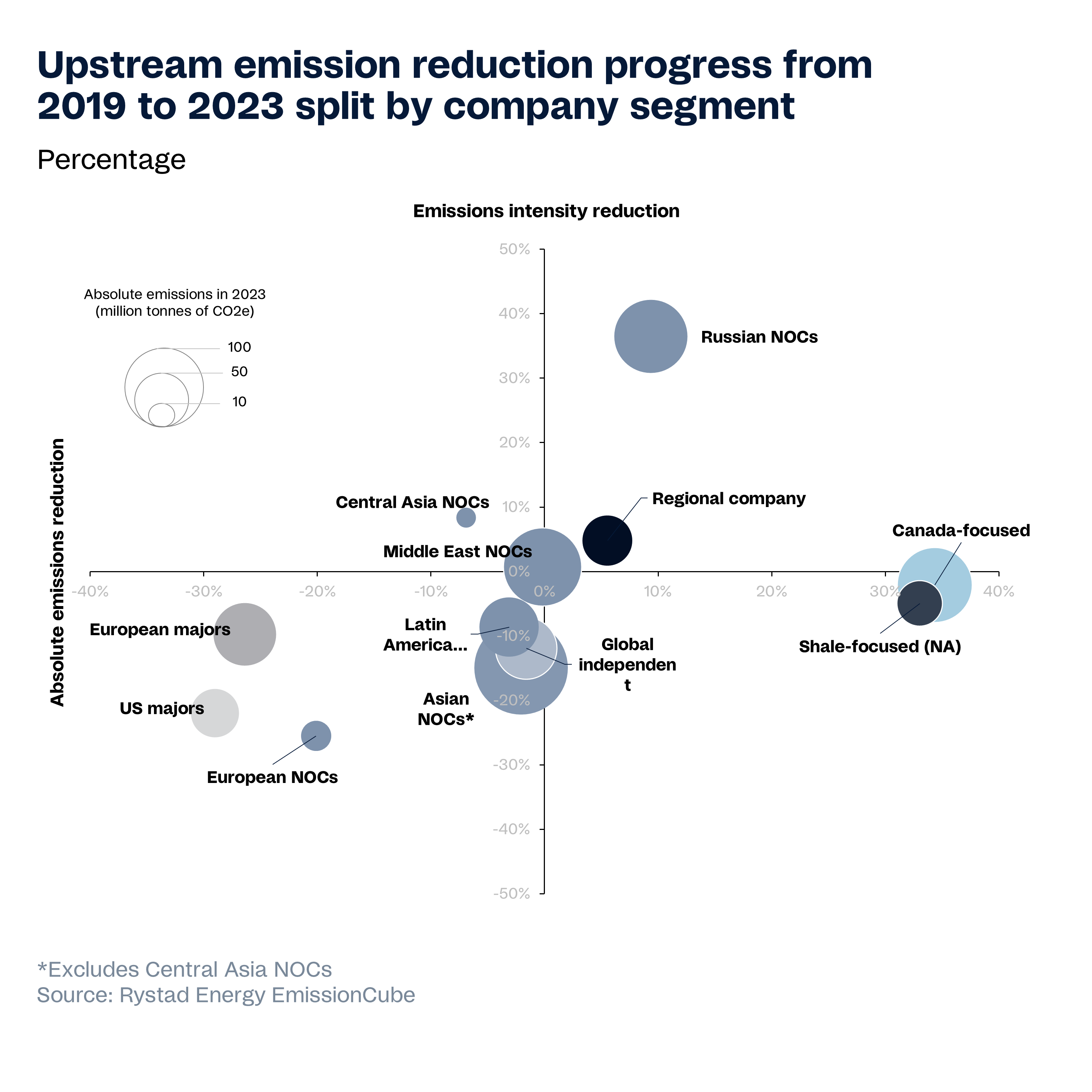
The chart below shows how different peer groups have managed to reduce their absolute and upstream emissions intensity since 2019.

Among the 120 key oil and gas companies selected, distinct segments can be categorized to assess their progress in reducing emissions over the last five years. We analyzed upstream CO? emissions and reduction trends from 2019 to 2023 across major company categories. For example, within the NOC/INOC group, European companies such as Equinor, OMV and MOL have substantially reduced their absolute emissions and lowered their emissions intensity. In contrast, Russian NOCs such as Gazprom and Rosneft have increased their emissions in both metrics since 2019. Similar disparities are observed in the regional company and global independent segments, illustrating how regional factors and operational environments influence emission-reduction outcomes.

The US and European majors segment stands out as the best-performing group. Highly scrutinized for their decarbonization efforts, these companies have implemented various strategies, including divestments, operational efficiency improvements, electrification, flaring reduction and methane emissions control. TotalEnergies, for example, has reduced emissions through combined-cycle gas turbine (CCGT) phase-outs, electrification, and eliminating routine flaring at assets such as OML 100 in Nigeria.

Decarbonization in the oil and gas sector has long been a pressing and highly debated topic among stakeholders. With 2025 being a milestone year for emissions targets, the question remains: will it mark a period of downward revisions, a continuation of the current trajectory, or a moment for companies to intensify their efforts? The direction and scale of change will ultimately determine whether these companies can achieve their intermediate emission targets and make meaningful progress towards broader net-zero commitments.

By Olga Savenkova Head of Oil and Gas Sustainability Research at Rystad Energy