Tuesday, January 06, 2026


U.S. Coast Guard Rescues Nine From Grounded Fishing Vessel in Bering Sea

A Coast Guard helicopter arrives in St. Paul, delivering the survivors (USCG)

Published Jan 6, 2026 3:16 PM by The Maritime Executive


On Monday, a U.S. Coast Guard helicopter aircrew rescued nine crewmembers from a crab boat that grounded off the coast of St. George Island, a tiny outpost in the Bering Sea just southeast of St. Paul. 

The Arctic Sea was under way and laden with crab when she lost power off St. George, operator Erik Deakin told Anchorage Daily News. In 50-knot winds and 10-foot waves - not unusual for the Bering in January - the vessel drifted and grounded on the island's northern side, near the island's sole settlement.

Deakin first learned of the vessel's situation at about 0400 hours on Monday, he told ADN, and he first contacted the crab boat North Sea to divert and assist. North Sea maintained comms via Starlink throughout the response, he said. 

The Arctic Sea was taking on water and the situation on board was worsening. A U.S. Coast Guard station received a VHF mayday call from the Arctic Sea's crew and dispatched a helicopter aircrew out of Cold Bay to assist. The cutter Alex Haley and an HC-130 Hercules long range SAR aircraft also got under way. 

Surface conditions on scene were not favorable for approaching the stricken crab boat, nor for abandoning ship into a raft. However, the crew made preparations to use their raft if required, according to ADN. Before the Arctic Sea's crew had to evacuate, the helicopter aircrew arrived on scene, hoisted the survivors aboard and delivered them safely to St. Paul. No injuries were reported. 

"The crew of the Arctic Sea had effective communication and survival equipment onboard allowing them to quickly alert the Coast Guard of their distress and pre-stage items for a potential evacuation. This emergency preparedness greatly increased their chances of survival," said Capt. Vincent Jansen, Chief of Incident Management at the Arctic District, in a statement Monday. 


US and Canadian Coast Guard Ice Breaking Underway for Great Lakes Shipping

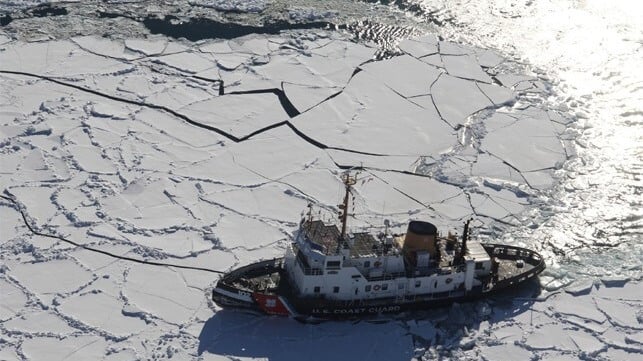
USCG ice breaker on Great Lakes
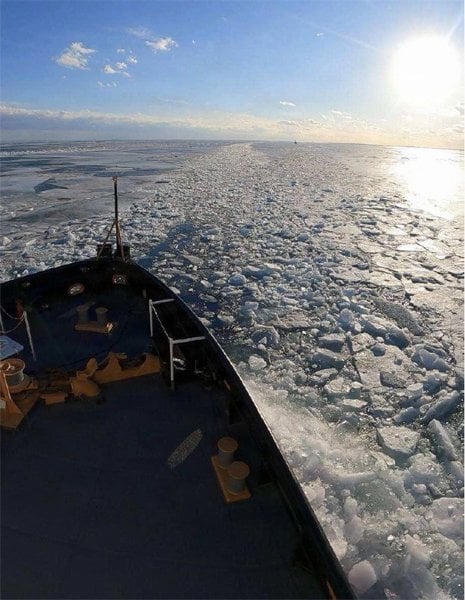
USCG has two operations underway for ice breaking to maintain Great Lakes shipping (USCG)

Published Jan 6, 2026 3:43 PM by The Maritime Executive


An early onset of the cold and harsh winter conditions is playing havoc on shipping across the Great Lakes region. The U.S. Coast Guard reported it started its second icebreaker effort from the Detroit region, but shippers are saying operations are being impacted, including a delay in the annual closing of the St. Lawrence Seaway.

The U.S. Coast Guard announced that its annual Operation Coal Shovel, managed by the Detroit Sector, was commencing on January 2 for the 2026 winter season. It focuses on the region ranging from southern Lake Huron to the St. Clair-Detroit River and into Lake Erie and Lake Ontario. It includes portions of the St. Lawrence Seaway with the goal of opening channels to icebound communities and for vessels carrying critical supplies such as food and heating oil.

Operation Coal Shovel is the second annual effort in the region. In mid-December, the U.S. Coast Guard launched Operation Taconite, which focuses on Lake Michigan and Lake Superior. The U.S. Coast Guard works in conjunction with the Canadian Coast Guard to maintain shipping during the season.


Annual Operation Coal Shovel began last week managed from Detroit (USCG)


Shippers, however, report that the harsh conditions began earlier in December, and in recent days the ice coverage has increased. For example, Lake Erie’s coverage went from 24 percent to over 31 percent last weekend. Similar issues have been experienced elsewhere, including at the locks on the St. Lawrence Seaway.

Ice is slowing shipping, and there are reports of congestion and groups of ships waiting for relief. WWNY says there are seven ships waiting near the locks on the St. Lawrence Seaway with ice forming around the ships. They are rushing to clear the area to reach Montreal before the St. Lawrence Seaway closes.

The St. Lawrence Seaway Management Corporation had reported on December 22 that the Canadian Coast Guard was providing ice breaking services. It said the Montreal-Lake Ontario section would close between January 4 and 5, while the Welland Canal was scheduled to close between January 9 and 10. WWNY, however, reported today that the ice is preventing the Seaway from closing on schedule.

The Lake Carriers’ Association expressed concern to Cleveland.com, asserting that the U.S. Coast Guard is falling behind. They report the USCG has nine ships that can break ice, but two are used for buoys, and it has experienced mechanical problems in the fleet. The Canadian Coast Guard has two vessels, but it is reported to be preoccupied with ice along the St. Lawrence Seaway east of Lake Ontario.

The association says shipments have been delayed over the past two weeks, and it does not expect relief despite warming temperatures this week. It notes that carriers are rushing to get ore shipments to the Cleveland-Cliffs plant to continue steel operations over the winter. They highlight the challenge is the pending scheduled closure of the Soo Locks between Lake Superior and Lake  Huron, scheduled for January 15.


LA REVUE GAUCHE - Left Comment: Search results for NAVVIES

Opinion

Labour's Britain: Conditional citizenship is forcing minorities to have a Plan B

From citizenship stripping to hostile environment policies, the UK is reminding minorities their belonging can be revoked at any time, writes Fatima Rajina.

Perspectives
Fatima Rajina
06 Jan, 2026


Protesters wave Union Jack and St George's England flags during the "Unite The Kingdom" rally on Westminster Bridge by the Houses of Parliament on September 13, 2025 in London, England. [GETTY]


Growing up, I would hear stories of my family sending money back home to Bangladesh to build a house in the bari or the city. Every bit of remittance sent to make this house was meant to stand as proof that leaving had been worth it. But, on a more strategic level, it was also a way to keep a home away from home should we be forced to leave Britain.

The idea baffled me as a child because Britain was home for me. Not Bangladesh.

But as the years progress, and I witness the political direction Britain is taking, I’m beginning to see why my family sent money back home and built that house in the bari.

Last month, Reprieve and the Runnymede Trust released the report ‘Stripped: The Citizenship Divide’, stating that approximately 9 million people are at risk of losing their British citizenship because they may qualify for other citizenship through their parents.

These reports are normally ignored by the mainstream press, but for the outlets that did cover the issue, the commentary attached was all too familiar: "Should I have a backup plan?"


It’s also a current that has run through a lot of my research as an academic in post-Brexit Britain. Alongside my colleague Dr. Victoria Redclift, this question has been raised regularly whilst we’ve interviewed Bangladeshi families across Luton, London and Birmingham.

Some participants spoke about visiting Bangladesh as a holiday destination, and to visit relatives who are still around. Others raised concerns that they needed to reconsider their relationship with Bangladesh and better look after their parents' assets, including houses and land.

The generational divide over whether one belonged to Britain, however, was particularly stark.

As I conducted interviews with parents and children (over the age of 18) sitting side by side, it was interesting to watch their reactions to each other. Whilst parents had come to terms with Britain as their home, the children – who spoke more concretely about the impact of Brexit – had other ideas.

The children realised that they had to reconsider their relationship to Britain despite being part of it. They spoke about reinvesting their time and energy into the houses their parents built, as a way to secure a Plan B should things ‘go wrong’ here.

When we presented the findings, we had some Boomer Bangladeshis scoffing at this and claiming the children were being hyperbolic about the political climate and that they had lived through the 1970s’ racism, so this too, will pass.
Conditional belonging

This research was conducted before Shamima Begum had her citizenship revoked in 2019 by Sajid Javid, the then Home Secretary. Indeed, her revocation rocked the British Bangladeshi Muslim community, as many rightly panicked about their place in this country, previously unaware that such citizenship stripping was even possible.

In reality, it wasn’t just Begum’s story that raised awareness about changes in immigration law that jeopardise the citizenship of British people with ethnic minority heritage/parents, the Windrush scandal had also sparked fears and debates.

Here we saw Caribbean communities given differential treatment because they ‘acquired citizenship through a colony rather than through British ancestry following decolonisation in the 1960s, and the dilution of the right of citizenship by birth in the UK.’

Certainly, the citizenship report does not bring forth a new debate as such for ethnic minority communities, but it does remind them that their place in this society and country is conditional, and dependent on the political climate and those in power.

This continuous targeting of ethnic minority communities intensifies a dangerous climate of racism, within which the discourse of not belonging is already ingrained. The government’s hostile environment immigration policies are also re-entrenching the idea promulgated by the far-right, that the nation is ‘overflowing’ with non-white bodies who must be purged.

As the report identifies: ‘legislation and government practice have created a fundamentally racist, two-tier citizenship regime that undermines community strength and is at odds with the foundational British principle of equality before the law’.

Many policies in immigration debates have been further fuelled by Shabana Mahmood, the current Home Secretary, who has laid out plans to make asylum seekers wait 30 years before they can apply for British citizenship.

She has also asserted that the Labour government will use Denmark’s model of withholding refugees’ gold when they arrive in the UK, pandering to the far-right framing of immigration being ‘out of control’.

The anxieties that ethnic minorities have held about how they are treated as second-class citizens are undoubtedly legitimate. But the question is whether the rest of the population is ready to ring the alarm and challenge the state over its regressive, racist policies. The reemergence of Shamima Begum’s case, now before the EHRC, will spark further discussion on citizenship.

Sadly, I have little faith in Britain’s readiness to reckon with this reality. But that doesn’t mean we sit back and do nothing. It is necessary that we collectively organise better, in much larger numbers, and that we learn how to fight back when the state targets a single one of us. This is especially urgent in the face of the rising far-right that seems obsessed with peddling a toxic rhetoric regarding migrants and the repatriation of ethnic minorities.

What we can be confident about is that we have a generation that will not sit quietly; young people will fight back against an oppressive status quo.


Dr Fatima Rajina is a sociologist based at the Stephen Lawrence Research Centre at De Montfort University. Her work looks at British Muslim communities with a specific focus on the British Bangladeshi Muslim communities.

Follow Fatima on X: @DrFrajina

Opinions expressed in this article remain those of the author and do not necessarily represent those of The New Arab, its editorial board or staff.


Saudi watchdog warns of possible health risk from Nestle baby formula


The Saudi Food and Drug Authority (SFDA) on Tuesday warned against consuming selected Nestle infant formula products after the company issued a voluntary recall over potential contamination. (Al-Muhaidib/File Photo)


Arab News
January 06, 2026

Company voluntarily recalls its Nan, Alfamino, S-26 Gold and S-26 Ultima products over concerns they might be contaminated with cereulide, a toxin produced by bacteria
Saudi Food and Drug Authority says recall is precautionary and no related illnesses have been reported, but advises consumers to dispose of recalled products immediately

RIYADH: The Saudi Food and Drug Authority on Tuesday warned the public not to consume certain Nestle infant formula products, after the company issued a voluntary recall over concerns about possible contamination.

The advisory covers products marketed under the Nan, Alfamino, S-26 Gold and S-26 Ultima brands. They might be contaminated with cereulide, a toxin produced by the Bacillus cereus bacteria, which can pose a risk to infant health, the Saudi Press Agency reported.

The Saudi authority said the recall was a precautionary measure and no related illnesses have been reported. Possible symptoms of exposure can include nausea, repeated vomiting and abdominal pain.

It advised consumers to dispose of the recalled products immediately, and said it was coordinating with Nestle to ensure they are removed from stores and is monitoring the process.

Full details of the affected products, including batch numbers, are available at the Saudi Food and Drug Authority website. The organization said consumers can report any food safety concerns by calling 19999.
Opinion

With Maduro abduction US addiction to regime change is now farce

Maduro’s arrest revives a familiar US fantasy: that removing a strongman brings stability. From Iraq to Afghanistan, history suggests otherwise.

THE NEW ARAB


Regime change has rarely delivered orderly political outcomes. More often, it has laid the groundwork for long-term instability. There is little reason to believe Venezuela will be different, write al-Marashi & Goudsouzian. 


Images of Nicolás Maduro taken into US custody early on 3 January were greeted in some quarters with celebration, in others with criticism, and in many with a familiar sense of déjà vu. They recall earlier moments once framed as turning points: Saddam Hussein pulled from a hole in the ground, Manuel Noriega photographed under arrest, and Salvador Allende, clutching a weapon shortly before his alleged suicide.

Then, as now, the images seemed to promise resolution. Remove the strongman, cut off the head of the snake and a nation’s problems would finally unravel.

That same confidence resurfaced when President Donald Trump suggested that the US would effectively “run” Venezuela following Maduro’s capture, not unlike the post-2003 assumption that Washington could manage Iraq after Saddam’s ouster.

In Iraq, military success was quickly mistaken for political victory. The fall of Baghdad was followed by civil war and an insurgency led in part by Saddam loyalists and Al-Qaeda affiliates, creating the conditions for the rise of ISIS after U.S. forces withdrew.

Supporters of the Venezuelan intervention have pointed to its efficiency – not a single American life was lost. Yet bloodless intervention offers little reassurance that rebuilding a society hollowed out by two decades of authoritarian rule will be any easier. Trump’s promise of a “safe, proper and judicious transition” rings familiar.

From Cold War coups to Iraq, Afghanistan and Syria, regime change has rarely delivered orderly political outcomes. More often, it has laid the groundwork for long-term instability. There is little reason to believe Venezuela will be different.


An old imperial pattern


This instinct to equate the removal of a ruler with the resolution of a society’s problems long predates the US. In 1839, Britain seized the port of Aden in southern Yemen, displacing the local authority of the Lahej Sultanate and imposing an external political order designed to serve imperial interests. The immediate objective of gaining control of a strategic chokepoint was achieved with relative ease.

The long-term consequences were far messier: fragmented governance, weakened local legitimacy and a political landscape shaped by outsiders rather than rooted institutions.

The pattern hardened in the early Cold War. In Egypt in 1952, the CIA backed the Free Officers’ coup against King Farouk I, viewing Britain as an overextended colonial power whose presence was fuelling Arab nationalism and opening the door to Soviet influence.

By overthrowing Farouk, British influence was curtailed and Washington convinced itself it had nudged history in the right direction. What followed instead was decades of entrenched military rule and a political system hollowed of meaningful civilian life.

The 1956 nationalisation of the Suez Canal and the subsequent Suez Crisis, followed by the 1967 war, underscored how regional and international conflicts were inseparable from the instability created by externally influenced regime change. The lesson went unlearned.

A blueprint that backfired


A year later in Iran, the US helped overthrow Mohammad Mossadegh, a democratically elected prime minister who had nationalised the Anglo-Persian Oil Company. Whether Mossadegh in 1953 or Maduro decades later, leaders who sought to wrest control of national resources from foreign corporations faced the wrath of the US.

The short-term payoff came at the cost of long-term legitimacy, paving the way for authoritarian repression by a pro-American shah and, eventually, the 1979 Islamic Revolution.

The same arc would later unfold in Iraq and Afghanistan: initial control, followed by insurgency, radicalisation and collapse. Regime change did not eliminate instability; it postponed it (some would say created it) and allowed grievances to accumulate until they erupted.

Afghanistan stands as perhaps the most comprehensive refutation of the logic of regime change. In 1979, the Soviet Union toppled the existing government and installed a friendly regime, only to trigger a prolonged war that eventually collapsed under its own weight.

Decades later, the US repeated the formula: in 2001, the Taliban were removed swiftly, and a new political order was imposed with foreign backing and vast resources. Yet the outcome was strikingly similar to the Soviet experience: twenty years of conflict, dependence on external support and a rapid collapse once that support was withdrawn.

Two superpowers, opposing ideologies, identical failure. Afghanistan demonstrates that regime change does not fail because of insufficient time or effort; it fails because legitimacy cannot be imported and authority imposed from outside cannot substitute for local political foundations.

Instant coffee, instant democracy?


Closer to home, the US’ record in Latin America offers an unflattering prelude to its later adventures in the Middle East. From Guatemala to Chile, Nicaragua to Panama in 1989, Washington repeatedly engineered swift victories followed by shallow reforms and fragile institutions. Across continents and decades, US-backed regime change has often destroyed what little order existed, leaving behind chaos under the guise of triumph.

Emboldened by Iran, Washington treated Guatemala in 1954 as a low-risk rehearsal. Operation PBSUCCESS removed President Jacobo Árbenz under the assumption that once a troublesome leader who tried to wrest control of the banana industry from the U.S. United Fruit Company (the precursor to Dole Fruit) was gone, and democracy would naturally reassert itself.

Instead, the coup ushered in decades of military dictatorship, civil war and mass repression against the native Mayan population that claimed hundreds of thousands of lives, giving us the term “banana republic.

A government elected at the ballot box was replaced in the name of freedom, only to extinguish it. Democracy was treated as a deliverable, something that could be installed after the fact, rather than a fragile process requiring legitimacy, institutions and time.

In Panama, US forces removed Manuel Noriega quickly, on the same charges levelled against Maduro: drug trafficking. Yet, the political order remained brittle and dependent on outside support, as well as vulnerable to corruption.

This pattern resurfaced in Iraq in 2003, when Saddam Hussein was toppled with ease, only for institutions to collapse and militias and extremist groups to fill the vacuum.


“Anyone but the dictator”

The central irony is that removing or weakening a dictator did not produce security or stability. In many areas, it made conditions far worse.

Maduro is in custody and Donald Trump is now in charge. If there is a plan for the days and weeks ahead, it seems to be a closely held secret. It is an understatement to say this is dangerous, if not existential, especially for the people of Venezuela who woke up without lights, without a governing authority and only vague promises of a better life proclaimed from Mar-a-Lago.


A worse-case scenario envisions that banks will not open, ATMs will not work, shops will not accept Venezuelan currency and hard-line security forces and local paramilitaries will brutally insert themselves into the vacuum. If so, expect US boots on the ground to follow.

From Aden to Cairo, Tehran to Kabul, Baghdad to Damascus, and now Caracas, the same enduring fantasy that uprooting a leader is equivalent to creating legitimacy is repeating itself in the vague promises of the US policy for a post-Maduro Venezuela.

When President Trump was asked who would execute the policy of a democratic transition, he made a vague reference to “these guys”. It is certainly the case that these guys have their work cut out for them, and history is not on their side.

Ibrahim al-Marashi is associate professor of Middle East history, visiting faculty at The American College of the Mediterranean, and the Department of International Relations at Central European University. His publications include Iraq’s Armed Forces: An Analytical History (2008), The Modern History of Iraq (2017), and A Concise History of the Middle East (2024).

Tanya Goudsouzian is a Canadian journalist who has covered Afghanistan and the Middle East for over two decades. She has held senior editorial roles at major international media outlets, including serving as Opinion Editor at Al Jazeera English.


Follow Ibrahim on X: @ialmarashi

Follow Tanya on X: @tgoudsouzian

Have questions or comments? Email us at: editorial-english@newarab.com

Opinions expressed in this article remain those of the author and do not necessarily represent those of The New Arab, its editorial board or staff.


Foreign media group slams Israel for refusing to lift Gaza press ban


Palestinians walk amid buildings destroyed by Israeli air and ground operations in Gaza City. (AP)

AFP
January 06, 202608:22

Foreign Press Association expresses 'profound disappointment' with Israeli government’s response to a Supreme Court appeal

Israel has barred foreign journalists from independently entering the devastated territory since the war started


JERUSALEM: An international media association on Tuesday criticized the Israeli government for maintaining its ban on unrestricted media access to Gaza, calling the move disappointing.

The government had told the Supreme Court in a submission late Sunday that the ban should remain in place, citing security risks in the Gaza Strip.

The submission was in response to a petition filed by the Foreign Press Association (FPA) — which represents hundreds of journalists in Israel and Palestinian territories — seeking immediate and unrestricted access for foreign journalists to the Gaza Strip.

“The Foreign Press Association expresses its profound disappointment with the Israeli government’s latest response to our appeal for full and free access to the Gaza Strip,” the association said on Tuesday.

“Instead of presenting a plan for allowing journalists into Gaza independently and letting us work alongside our brave Palestinian colleagues, the government has decided once again to lock us out” despite the ceasefire in the territory, it added.

Since the outbreak of the Gaza war in October 2023, triggered by an attack on Israel by the Palestinian militant group Hamas, the government has barred foreign journalists from independently entering the devastated territory.

Instead, Israel has allowed only a limited number of reporters to enter Gaza on a case-by-case basis, embedded with its military inside the blockaded Palestinian territory.

The FPA filed its petition in 2024, after which the court granted the government several extensions to submit its response.

Last month, however, the court set January 4 as a final deadline for the government to present a plan for allowing media access to Gaza.

In its submission, the government maintained that the ban should remain in place.

“This is for security reasons, based on the position of the defense establishment, which maintains that a security risk associated with such entry still exists,” the government submission said.

The government also said that the search for the remains of the last hostage held in Gaza was ongoing, suggesting that allowing journalists in at this stage could hinder the operation.

The remains of Ran Gvili, whose body was taken to Gaza after he was killed during Hamas’s 2023 attack, have still not been recovered despite the ceasefire.

The FPA said it planned to submit a “robust response” to the court, and expressed hope the “judges will put an end to this charade.”

“The FPA is confident that the court will provide justice in light of the continuous infringement of the fundamental principles of freedom of speech, the public’s right to know and free press,” the association added.

The Supreme Court is expected to issue a ruling on the matter, though it is unclear when a decision will be handed down.

An AFP journalist sits on the board of the FPA.


Israel says ban on Gaza media access should stay: court document


Israeli authorities have told the Supreme Court that a ban on international media access to Gaza should remain in place, arguing it is necessary for security reasons. (AFP)

AFP
January 05, 2026

Israeli authorities have told the Supreme Court that a ban on international media access to Gaza should remain in place, arguing it is necessary for security reasons


JERUSALEM: Israeli authorities have told the Supreme Court that a ban on international media access to Gaza should remain in place, arguing it is necessary for security reasons, according to a government submission filed by the public prosecutor.

Since the outbreak of the Gaza war in October 2023, Israeli authorities have barred foreign journalists from independently entering the devastated territory.

Instead, Israel has allowed only a limited number of reporters to enter Gaza on a case-by-case basis, embedded with its military forces inside the blockaded territory.

The Foreign Press Association (FPA), which represents hundreds of foreign journalists working in Israel and the Palestinian territories, filed a petition with the Supreme Court in 2024 seeking immediate and unrestricted access for international media to the Gaza Strip.

Since then the court has given several extensions to the Israeli authorities to come up with a plan, but at a hearing last month it set January 4 as a final deadline.

Late on Sunday, the Israeli authorities filed their response with the court, a copy of which was obtained by AFP.

In the submission, the government said the ban on media access to Gaza should continue, citing security risks in the territory.

“Even at this time, entry of journalists into the Gaza Strip without escort, as requested in the petition, should not be permitted,” said the government submission.

“This is for security reasons, based on the position of the defense establishment, which maintains that a security risk associated with such entry still exists.”

The Israeli authorities said the ceasefire in Gaza, which came into effect on October 10, continues to face regular threats.

At least 420 Palestinians have been killed in Gaza by Israeli forces since the ceasefire took effect, according to Gaza’s health ministry.

The Israeli military said three of its soldiers have also been killed by militants during the same period.

The Israeli authorities said in their submission that the search for the remains of the last hostage held in Gaza is ongoing, suggesting that allowing journalists into the territory at this stage could hinder the operation.

The remains of Ran Gvili, whose body was taken to Gaza after he was killed during the Hamas attack on October 7, 2023, have still not been recovered despite the ceasefire.

All other 250 hostages seized on that day — both the living and the deceased — have been returned to Israel.

The Supreme Court is expected to issue a ruling on the matter, though it is unclear when a decision will be handed down.

An AFP journalist sits on the board of the FPA.

Swiss court rules Ali Abunimah detention was illegal

ELECTRONIC INTAFADA
6 January 2026


People in Zurich, Switzerland, demonstrate against the Israeli genocide in Gaza, 29 July 2025. (kritisches fotografiekollektiv)

I’m delighted that the Administrative Court of the Canton of Zurich ruled on 19 December 2025 that my arrest and detention by Zurich police last year was unlawful and violated the Swiss constitution and the European Convention on Human Rights.

This decision, received on 5 January, totally vindicates my position that there was no legal basis whatsoever for me to be abducted off the street by plainclothes officers on 25 January 2025, while I was on my way to speak at an event focused on the Israeli genocide in Gaza.

I was thrown in a cell for three days, without being allowed to contact my family or communicate with the outside world, and then forcibly deported.

These illegal actions ensured that I was unable to participate in public or media events aimed at informing people in Switzerland about the genocide in Gaza and the complicity of Swiss institutions in these ongoing crimes.

The court confirmed that Zurich police violated Swiss law and fundamental constitutional guarantees as well as Article 5, Paragraph 2, of the European Convention on Human Rights – because there was no lawful basis for my detention, no lawful order was ever issued for my detention and I was never provided with valid reasons for my imprisonment or information on how long it would last.
The court has ordered the Canton of Zurich to pay my legal costs for this appeal, and in line with Swiss procedure, I intend to apply for compensation for my unlawful and unconstitutional detention. I will donate any compensation I receive to the direct benefit of survivors and victims of the Israeli genocide.

This clear legal victory concerns only one of the appeals I have filed seeking accountability for these unlawful acts – whose wider purpose, I believe, is silencing and deterring any public discussion of Israel’s crimes against the Palestinian people.

I currently have two more appeals pending before Switzerland’s Federal Administrative Court – one against the entry ban imposed after I arrived in the country legally and another against the expulsion order which was subsequently issued.

I have also filed criminal complaints in connection with this matter.

In November, a Swiss parliamentary committee concluded that there was a series of irregularities surrounding my arrest, and evidence of improper interference by Nicoletta della Valle, a senior federal police official with close ties to Israel.

I thank my lawyers for their diligent pursuit of accountability on my behalf. I thank countless people in Switzerland and all over the world for their support, especially all my colleagues at The Electronic Intifada.

Up to this point, my pursuit of accountability has been supported entirely by donations from the public through a crowdfunding campaign, so I want to thank each and every person who contributed to make this important initial victory possible.

In these days of cowardice and complicity by governments in the face of shocking and monstrous crimes, it is more important than ever that citizens everywhere speak out. It is therefore vital that we fight back fiercely when our right to speak is attacked by government repression.
KURDISTAN
Five dead in clashes between Syria govt and Kurdish forces in Aleppo

Syria's state news agency blamed the SDF for the clashes, while the SDF blamed groups affiliated with the government.


The New Arab Staff & Agencies
06 January, 2026


Clashes between the Syrian government and SDF have occurred several times since December 2024 [Hisam Hac Omer/Anadolu via Getty Images]

Clashes between government personnel and Kurdish-led forces in the north Syrian city of Aleppo killed five people on Tuesday, with both sides trading blame over who started the fighting.

Progress has stalled on implementing a March deal to merge the Kurds' semi-autonomous administration and military into Syria's new government, and tensions have occasionally erupted into clashes, particularly in Aleppo, which has two Kurdish-majority neighbourhoods.

State news agency SANA reported that the Kurdish-led Syrian Democratic Forces had "targeted the area near the Shihan roundabout, resulting in the death of one defence ministry member".

It later said "three civilians, including two women" were killed in "SDF bombing of residential buildings in Aleppo city's Al-Midan neighbourhood".

The SDF, in a statement issued before the state media reports, said groups affiliated with the government "targeted the Sheikh Maqsoud neighbourhood with a reconnaissance drone", resulting in "the death of one resident and the wounding of two others".

Aleppo's Kurdish-majority Sheikh Maqsoud and Ashrafiyeh neighbourhoods have remained under the control of Kurdish units linked to the SDF, despite Kurdish fighters agreeing to withdraw from the areas in April.

Separately, the SDF accused factions affiliated with Syria's army of attacking the town of Deir Hafer, around 50 kilometres (30 miles) east of Aleppo, and near the strategic Tishreen Dam to the city's northeast.

The Kurdish-led force affirmed its right to "respond legitimately to these attacks".

The SDF controls large swathes of Syria's oil-rich north and northeast, and with the support of a US-led international coalition, was integral to the territorial defeat of the Islamic State group in Syria in 2019.

Its integration into the state following the ouster of longtime ruler Bashar al-Assad a year ago has proven complicated, and the original March agreement was supposed to be implemented by the end of 2025.

On Sunday, SDF chief Mazloum Abdi held further talks with officials in Damascus on integrating the Kurdish-led forces, but state media said no tangible results were achieved.

The Kurds have repeated calls for decentralisation - which Syria's new Islamist authorities have rejected.

Last month in Aleppo, deadly clashes killed five people, in violence that came after Foreign Minister Hakan Fidan of Turkey - a close ally of the new authorities - urged the SDF during a visit to Damascus not to be an obstacle to Syria's stability.
Trump poses wearing 'Make Iran Great Again' hat following Maduro kidnap


Posing alongside US Senator Lindsey Graham, Trump held the hat amid concerns Iran could be the next target after Maduro's 'capture'


The New Arab Staff
06 January, 2026

US President Donald Trump was photographed on Monday holding a hat reading "Make Iran Great Again", fuelling concerns that Iran could be the next US target following the abduction of Venezuela's president.

The photograph, shared on social media by US Senator Lindsey Graham, shows Trump smiling alongside the senator while holding the hat. Graham praised Trump as the president "who has brought America back, stronger than ever, at home and abroad".

"God bless and protect the brave people of Iran who are standing up to tyranny," Graham added, referring to the protests in Iran, which have now entered their 10th day.

The slogan, a play on Trump's "Make America Great Again" campaign, appeared to signal support for regime change in Iran, as the president continues to issue threats against Tehran following the kidnapping of Venezuelan President Nicolas Maduro, a close Iranian ally.

Graham, a long-time Trump ally, has openly called for the Iranian government to be overthrown, saying the US president "has not turned his back on the people of Iran".


At least 35 people have been killed and more than 1,200 detained during the protests, which erupted over spiralling living costs amid a sharp economic decline driven by US and UN sanctions and the recent 12-day war involving Israel, later joined by the United States.

In response to the unrest, Trump warned Iran on Sunday that it would be "hit very hard" if further protesters were killed. Iran’s Supreme Leader Ali Khamenei responded that Tehran "will not give in to the enemy".

Israeli media have meanwhile reported that the US is weighing "some intervention" in Iran in response to the protests.

Following the capture of Maduro, Iran condemned the move as "illegal" and said its relations with Venezuela remain unchanged, calling for the deposed leader's immediate release.

After months of threats and pressure, the US bombed Venezuela and abducted Maduro and his wife on alleged drug trafficking charges. Trump later said Washington would "run" the country and gain access to its vast oil reserves.

Alongside Iran and Venezuela, Trump has also threatened to annex Greenland, insisting the US must take control of the territory for "security reasons". Six European countries, including the UK and France, have publicly backed Denmark in response to the warnings.


Opinion

Netanyahu is pushing for another U.S. intervention in Iran. Will Trump take the bait?

Days after his meeting with Benjamin Netanyahu, Donald Trump threatened to intervene in Iran if the country killed any protesters. Analyst Sina Toossi breaks down recent events and whether another US-Israeli aggression on Iran may be on the horizon.
 January 2, 2026 
MONDOWEISS

Benjamin Netanyahu with Donald Trump at the Ben Gurion airport in May 2017. (Photo: Amos Ben Gershom GPO)


Earlier this week, Prime Minister Benjamin Netanyahu met with President Donald Trump in Mar-a-Lago.

During the meeting, the Israeli leader reportedly pushed the Trump administration to back a second round of strikes on Iran.

In a press conference after the meeting, Trump expressed support for the potential attacks.

“I hope they’re not trying to build up again, because if they are, we’re going to have no choice but very quickly, to eradicate that build up,” said Trump, referring to the alleged expansion of Iran’s ballistic missile program.

“We’ll knock them down,” he added. “We’ll knock the hell out of them.”

Days after the meeting, alluding to the recent domestic protests in Iran, Trump threatened to attack Iran if any protesters were killed.

“If Iran shoots and violently kills peaceful protesters, which is their custom, the United States of America will come to their rescue,” he wrote on Truth Social. “We are locked and loaded and ready to go. Thank you for your attention to this matter!”

“Trump should know that U.S. interference in this internal matter would mean destabilizing the entire region and destroying America’s interests,” tweeted Ali Larijani, Secretary of Iran’s Supreme National Security Council, shortly after. “The American people should know — Trump started this adventurism. They should be mindful of their soldiers’ safety.”

Mondoweiss U.S. correspondent Michael Arria spoke with Center for International Policy Senior Fellow Sina Toossi about these recent events, and whether they signal another potential U.S.-Israeli aggression on Iran on the horizon.

Mondoweiss: What did you make of Trump’s comments on Iran coming out of the meeting with Netanyahu? He seemed ready to back another round of Israeli strikes on Iran.

I think Netanyahu really came to this meeting with multiple demands. It wasn’t just about Iran, but also Gaza, the second phase of the Gaza ceasefire, the situation in Syria, with Lebanon, the issue of continued U.S. aid, and getting a good aid package for Israel in 2026. All of these issues.

On these issues, there are signs of some tension and some differences. We’ll have to see in the coming days and weeks exactly what areas they’re aligned on.

For example, in the second phase of the Gaza ceasefire. If you read the Israeli press, many figures and analysts close to the Netanyahu government are saying they want to have as much freedom of action as possible. They begrudgingly accepted the ceasefire. They don’t want Turkish involvement in the post-war governance. They want a very limited form of post-war governance.

So there are all these differences. Trump, for example, is more supportive of Turkish involvement, and in the meeting, Trump doubled down on supportive comments for [Turkish President Recep Tayyip] Erdogan. There are all these transactions at play.

Now on the issue of Iran, it seems like, at least rhetorically, Trump made it seem like there’s no daylight between the U.S. and Israel on the issue. Even on missiles, Trump said if they try to reconstitute their missile program, we’ll hit them. If they try to reconstitute their nuclear program, we’ll hit them fast.

So there’s seemingly a harder line on nuclear than missiles, if we’re just going based off the rhetoric. For what it’s worth, there’s a report from Barak Ravid at Axios, where he discusses the differences between the U.S. and Israeli views on what constitutes a reconstitution and the kind of threshold for reconstitution of the nuclear program that would necessitate U.S. support for more strikes.

I would say that Netanyahu’s strategy and his endgame are to have regime change in Iran and for the U.S. to pay the high costs for that, both in terms of defending Israel and supporting offensive strikes against Iran. I think if Israel can get American boots on the ground, it wants them because these issues like destroying the nuclear program, destroying the missile program, they’re not really possible through airstrikes alone.

These places are heavily fortified, they’re dispersed around the country, and they’re often buried underground. You can’t verify the damage you’ve really done.

Netanyahu is now explicitly citing missiles as a pretext for America to go to war with Iran. Centering that is new. I think that’s largely because, politically, Trump has won for himself. He’s told everyone, “I am tough. I destroyed the nuclear program.”

To say the U.S. is going to war six months later? That doesn’t politically play well for Trump and it can get a lot more ugly in the next round.

The ultimate goal is regime change and regime collapse, and getting the U.S. involved in more and more wars against Iran and supporting efforts to destabilize Iran.

That’s the context. I think that we’ll have to see if Trump ultimately gave the green light for renewed strikes at this meeting. It certainly seems like at least a yellow light, if not a green light.

On the other hand, what gives me caution in that regard is that Trump’s preference is to really break Iran while minimizing the U.S. costs. They want to support protests, support unrest, and destabilize the country. I view some of the administration’s rhetoric as more aimed at that.

These protests have broken out in Iran now, and Trump is saying, “We are locked and loaded and ready to go.” I’m not sure this necessarily indicates imminent U.S. intervention. I would say that this is more aimed at further destabilizing the Iranian economy, which is in a state of uncertainty. There’s a lot of economic volatility there.

Trump’s aim is to further destabilize the situation and try to bolster the morale of some of these protesters who may want that support. Although I think the critical mass of Iranians and the social movements it will take to topple the Islamic Republic, don’t want that support.

We know Trump thinks in terms of deals and agreements, and he’s touted this postwar plan for Gaza. How does Iran factor into that vision or potentially impede it?


Since the 90s, Iran’s played the role as a potential spoiler for U.S. and Israeli aims vis-a-vis the Palestinian issue.

Consider the Oslo Accords or the Madrid Conference of 1991. Iran was excluded from these negotiated settlements and acted as a spoiler to increase the cost of its exclusion.

Currently, Iran’s main ally, Hamas, is greatly weakened, as is Hezbollah, but to act like Iran is vulnerable misunderstands the advantage that Iran has in this regard to these conflicts.

At the end of the day, Hamas and Hezbollah were both guerrilla organizations that were entrenched in the local population and boosted by legitimate grievances. Whether people like it or not, these groups have garnered a significant degree of public support.

The reality is, as long as that population is aggrieved and the occupations continue, there will always be support for resistance, and there will always be fertile ground for an outside actor like Iran, Turkey, or Egypt to support these groups.

So you could say, Iran has less influence in Gaza because Hamas has been weakened, or in Lebanon because Hezbollah’s seemingly on the back foot. However, in the longer term picture, there’s going to be more iterations of Palestinian resistance in Gaza, of Shia Lebanese and other forms of resistance in Lebanon.

Iran is doubling down on this kind of resistance access strategy. They’re viewing the fact that Hamas and Hezbollah were weakened, and the fall of Assad, as part of what led to an attack on them. That attack validated their view of strategic depth. They’re not letting up on trying to counterbalance Israel.

I think Israel’s strategic picture is actually much more dire in many ways than it was a couple of years ago. If we talk about before October 7, they were seemingly on the cusp of a grand strategic victory in terms of regional integration with U.S. partners in the Arab world with the Abraham Accords, and they were thinking the Palestinian issue was totally neutered and cast aside. They were moving ahead with their annexation aims.

Since then, yes, they’ve had these tactical military victories, but opposition to Israel is much stronger. The factors behind opposition to Israel in those areas is, if anything, much more strong. When these guerrilla organizations are not given a seat at a table, when the population’s grievances are not taken into account, when the overall structural reasons for these guerrilla organizations existing remains in tact, they are going to remain and gain strength.

Now, contrary to the pre-October 7th reality, normalization with Saudi Arabia seems further than it has been in recent years. Turkey is a much more strategic challenge. Egypt and the Arab world are reacting in ways towards Israel that they haven’t for decades. The prospect of Israeli integration with U.S. partners in the Arab world seems more distant in key ways.

So the picture is not so rosy for the Israelis, I would argue.

Could you discuss the current state of the Iranian leadership? We hear that they’re vulnerable, but we also have people like Netanyahu insisting they’re powerful enough to threaten Israel on some level. How would you assess the current government’s standing on the international stage?

I believe the most significant factor contributing to the instability of the government is the economic situation.

That is the result of, first and foremost, U.S. sanctions. The economic siege has locked Iran out of the international financial monetary system. It can’t repatriate the funds it gets from oil exports as cash reserves for itself.

These protests that broke out last Sunday in parts of the Tehran Bazaar were partially triggered by the economic reality and the depreciation of the currency. There’s also about 40 to 50 percent year-to-year inflation since last year. So there’s the context of more deep-seated and widespread discontent with the government that goes back decades, but there’s definitely an economic spark.

As I mentioned earlier, for something to seriously challenge the Islamic Republic and its political system, I believe a broad, inclusive social movement would be necessary, one that could mobilize a critical mass of Iranians into the streets. These protests have not been that way so far. They began in Tehran, again, with some of the bazaar and certain merchant sectors.

Over the past couple of days, it has largely fizzled out in Tehran, and the government has been repressing the protests. There have been many arrests. In the more rural areas, there have been clashes, violent crackdowns, and a number of deaths.

These protests have ebbed and flowed. To me, what’s more interesting is the evolution of governance styles in Iran, but there’s no doubt that people are aggrieved. These protests are real.

What about those Trump tweets saying the U.S. would come to the protesters’ rescue?

Netanyahu and Trump obviously want to exploit the protests maximum degree possible for their own geopolitical ends.

I think, as your readers would probably agree, this has nothing to do with democracy or human rights or what’s good for the Iranian people. Iran is simply a geopolitical adversary that they want to knock out. I think Trump wants to further destabilize the economic situation.

People can obviously just look at the background. Consider the United States’ “humanitarian intervention” in Libya in 2011. You have a whole class of people in Washington and Israel who cry out for the people of Iran, the people of Libya, the people of Syria, the people of Venezuela, but then, after the geopolitical mission is accomplished, and these “troublesome” governments are knocked out, nobody cares, they move on, they’re not doing anything to help these societies or help them rebuild or unite them.

NATO, led by the United States, intervened in Libya and the country is still in a state of civil war. There’s been war for 15 years. And in Iran, interestingly, you see that the forces that the U.S. and Israel more or less overtly support,

In Iran, you have a diverse cast of characters that are kind of at odds with each other. You have the “nationalists”, the ex-monarchists of the ex-Shah government who have their own view of Iranian nationalism, which is rooted in limited rights for ethnic minorities in Iran.


So I could easily imagine a situation where if the central government in Iran is weakened or collapses, the whole country kind of falls into a state of disarray, instability, and civil war. We’ve seen that playbook elsewhere in the region, but for now, I don’t see any indication that we’re heading in that direction or that Iran is on the verge of such a collapse.

The government is still there. It’s entrenched. They have their base of social support despite the widespread discontent.

I think Trump and Netanyahu’s goal with these kind of threats at this juncture is, again, to destabilize the situation, create unrest and create cover for potential more military escalation within the next weeks to months.


Israel, US seen as top threats to Arab security, Arab Opinion Index shows

The Arab Opinion Index 2024–25 finds that Israel and the US are widely viewed as the greatest threats to Arab security


The New Arab Staff
06 January, 2026


The findings were presented at the Doha-based Arab Center for Research and Policy Studies on Tuesday [The New Arab/Hussien Beydoun]


Israel and the US are viewed as the greatest threats to Arab security, according to a major public opinion survey that found deep concern across the West Asia and North Africa region over stability, war, and foreign intervention.

The Arab Opinion Index 2024–25, released by the Doha-based Arab Center for Research and Policy Studies on Tuesday, reveals that 44 percent of respondents across the Arab world identified Israel as the main threat to security in the region, while 21 percent pointed to the United States. Iran ranked a distant third at six percent, followed by other global and regional powers.

The findings, which were presented on Tuesday, were based on face-to-face interviews with 40,130 respondents across 15 Arab states, conducted between October 2024 and August 2025. The survey, the ninth in a series launched in 2011, is the largest of its kind in the region, with an overall margin of error of plus or minus two to three percent.

Beyond naming specific states, the poll found near consensus that Israeli and US policies pose a direct threat to regional stability. Some 84 percent of respondents said Israeli policies threaten the security and stability of the Arab region, while 77 percent said the same of US policies. A smaller majority also viewed Iranian, Russian and French policies as destabilising.

Despite these security concerns, the survey recorded a general sense of cautious optimism about domestic trajectories. Overall, 57 percent of respondents said their countries were "headed in the right direction", compared with 37 percent who said they were heading in "the wrong direction".


Economic pressure, however, remains widespread, as 41 percent of respondents said their household income covered basic needs but had left no room for savings, while 28 percent said their income did not cover necessities at all. Only a small minority reported being able to save, a pattern that was far more common in Gulf states than in the Mashreq (Palestine, Lebanon, Jordan, Iraq and Syria) and Nile Valley (Egypt and Sudan).


Economic hardship drives public frustration

Among those who said their countries were on the wrong path, 40 percent blamed economic conditions, while others cited political instability, weak governance, and poor state management. Those expressing optimism most often pointed to improved living conditions, security, and governance, with smaller numbers citing economic improvement or political stability.

Assessments of political conditions varied sharply by region, with 55 percent of respondents across the Arab world describing the political situation in their countries as "good", this figure rose to 86 percent in Gulf states and fell to just 37 percent in the Mashreq.

Confidence in state institutions followed clear patterns across the region, with respondents expressing the highest levels of trust in the military, public security forces and the judiciary, while executive and legislative bodies lagged behind.

Parliaments recorded the lowest levels of confidence, with just over half of respondents saying they trusted them.

Perceptions of corruption remain deeply entrenched across the region, with 84 percent of respondents saying financial and administrative corruption is prevalent in their countries, a figure that has changed little since the survey series began more than a decade ago.

Respondents in the Mashreq were the most likely to view corruption as widespread, while those in Gulf countries were the least likely.

Democracy preferred, but participation remains limited

On governance, the survey found strong and consistent support for democracy alongside widespread political disengagement. Nearly seven in 10 respondents said they support a democratic system, and two-thirds said democracy is the most suitable form of governance for their country.

Most were able to define democracy in substantive terms, including political freedoms, separation of powers and accountability.

Yet respondents rated the level of democracy in their countries at just 6.2 out of 10. Ratings dropped further when assessing their ability to criticise governments freely.


Formal political participation remains limited, with only six percent of respondents reporting membership in political parties and around half saying they do not intend to vote in upcoming elections.

War shapes daily life in the Mashreq

The index also devoted special sections to countries affected by war and conflict. In Gaza, a field survey conducted in March 2025 found that 93 percent of respondents had been displaced at least once during the war.

Severe shortages were reported across basic services, with the vast majority lacking reliable access to electricity, medicine, food and clean water.
Most respondents said they or a family member had experienced hunger, and many reported witnessing people forced to beg for food or water.

In Lebanon, 76 percent of respondents in areas targeted by Israeli attacks said they were forced to flee their homes. While most said the communities they fled to were welcoming, many reported difficulty accessing food, healthcare and medicine.

In Sudan, nearly half of respondents said they had been displaced since the outbreak of fighting in April 2023, with many reporting theft, home raids, and lack of access to healthcare and essential services.

In Syria, surveyed for the first time after the fall of Bashar al-Assad's regime, most respondents expressed relief and hope, tempered by anxiety, economic hardship and weak access to basic services.
Related


The Palestinian cause remains a collective Arab cause

On Palestine, the survey found Arab public opinion remains firmly aligned, with 80 percent of respondents saying the Palestinian cause was a collective Arab cause, not solely a Palestinian issue.

Opposition to recognising Israel was overwhelming, at 87 percent, with respondents citing Israel's occupation, expansionism and treatment of Palestinians rather than cultural or religious reasons.

Asked about international responses to the war on Gaza, respondents ranked South Africa as having taken the most positive stance, followed by Spain and Iran.

More than 80 percent said South Africa's genocide case against Israel at the International Court of Justice boosted their morale.