Tuesday, April 28, 2026

What former PM Trudeau says of the risks of U.S. economic coercion
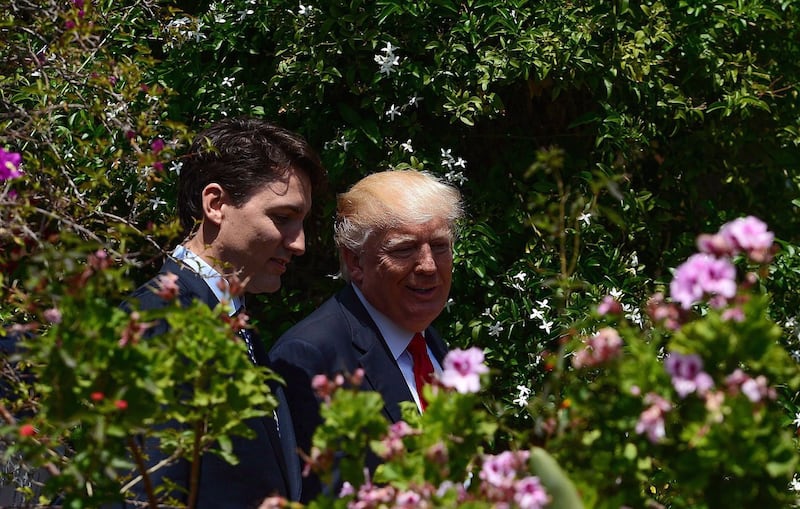
Prime Minister Justin Trudeau and U.S. President Donald Trump walk together during the G7 Summit in Taormina, Italy on Saturday, May 27, 2017. THE CANADIAN PRESS/Sean Kilpatrick


Updated: 


OTTAWA — Former prime minister Justin Trudeau is warning that American tariffs threaten to drive Canada closer to China in the auto sector.

Speaking at a CNBC event in Singapore on Thursday, Trudeau said “economic pressures and coercion” nearly drove Canadian aerospace company Bombardier “into China’s arms” almost a decade ago.

Trudeau said that when Bombardier began building its C-Series jets, both American aircraft maker Boeing and Dutch manufacturer Airbus did “everything they could” to keep Bombardier sales grounded.

“They were talking to all their customers, ‘Don’t you dare put in an order for the C-Series! Don’t you dare, don’t you dare!’ And finally, Bombardier started really struggling,” he said.

“So what happens? China comes knocking on Bombardier’s door and pulls up a dump truck full of money … So Boeing and Airbus, that were busy trying to put out Bombardier out of business … almost drove us into China’s arms.”

Trudeau said he raised the issue at the 2017 G7 summit in Italy with U.S. President Donald Trump, French President Emmanuel Macron and now former German chancellor Angela Merkel.

After that meeting, Trudeau said, Airbus began purchasing Bombardier’s C-Series jets -- a move he attributed to the talks at the G7.

Trudeau said a similar scenario is playing out now, with U.S. President Donald Trump’s tariffs on Canada’s automakers pushing it to explore closer auto sector ties with China.


In 2024, Canada imposed 100 per cent tariffs on Chinese-made electric vehicles, matching a U.S. move, and citing unfair trade practices.

In 2025, Trump imposed punishing duties on the Canadian auto sector.

In January, after a meeting with Chinese President Xi Jinping, Prime Minister Mark Carney secured tariff relief for Canadian agricultural sectors in exchange for allowing up to 49,000 Chinese EVs into the country at a reduced tariff rate of 6.1 per cent.

Trudeau said the episode with Bombardier shows that bad-faith competition between nations that are supposed to share values only gives an advantage to countries that don’t share those values.

“We’re seeing a similar thing happen right now with President Trump. Threatening the Canadian auto industry, where we’re now having to look at working with China because the American industry doesn’t want to work with us anymore,” Trudeau said.

This report by The Canadian Press was first published April 23, 2026.

David Baxter, The Canadian Press

PM Carney points to trade irritants with U.S.: ‘Those are violations of our trade deal’


By Rachel Aiello
Updated: April 23, 2026 


OTTAWA -- As top U.S. trade officials revive talk of Canadian trade irritants — such as provincial booze bans — Prime Minister Mark Carney says Canada has its own issues with the Americans, which he wants to see addressed.

“Look, you know what’s an irritant? A 50 per cent tariff on steel, 50 per cent tariff on aluminum, 25 per cent tariff on automobiles, all the tariffs on forest products,” Carney said Thursday, at a housing announcement in Ottawa.Live updates: PM Carney says U.S. trade irritants ‘right there in front of us.’

“Those are more than irritants,” he said. “Those are violations of our trade deal.” Carney pointing to these specific U.S. trade actions against Canada comes amid ramped-up gripes by U.S. President Donald Trump’s team that several provinces continue to prohibit the sale of American alcohol on liquor store shelves, and questions about whether that may be a barrier to successful trade talks.

These bans on U.S.-made booze are also a contravention of the two countries’ trade agreement, in the eyes of the Americans. But when asked Thursday if he intends to lean on provincial leaders — namely Ontario Premier Doug Ford — to ease off, the prime minister pushed back.

“Surprise, surprise, the premier of Ontario is influential with the LCBO, okay, but he’s the client,” Carney said. “He’s also the duly elected premier of Ontario. He’s got a majority, and he’s taking a view which, you know, by most indications, is supported by the vast majority of the population.”


“What we want to do is make progress as the whole,” he added. “These issues, issues such as decisions on which alcohol to put on the shelves, we can make progress very quickly on that, with progress in other areas.”

Carney continued, saying he is looking to negotiate something that is “mutually agreeable,” and that there “will be adjustments,” but that “when we make progress,” it’ll be up to the provinces with such policies in place to make a call.

During an interview with CNN on Thursday morning, Ford was asked to respond to U.S. Commerce Secretary Howard Lutnick, recently calling the ongoing boycott of U.S. alcohol “insulting and disrespectful to America.”

“I guess what is disrespectful is we never started this tariff war and I don’t believe the American people did. It was Secretary Lutnick followed by President Trump as well that attacked our joint economies,” Ford said Thursday.

Ford has previously said that Ontario will not lift its ban on U.S. alcohol at provincial liquor stores until all new tariffs on Canadian goods are removed.
PM Carney slaps down ‘entry fee’ talk

And, amid reporting from a few major outlets suggesting the Americans are angling for some form of so-called Canadian “entry fee” — or immediate concession — to begin trade talks, Carney says he’s at a loss where that suggestion may be coming from.

“I don’t know where the talk of a ‘entry fee’ is from, certainly not coming from me. It’s not language I’ve ever used, and it’s not language I’ve ever heard from the president of the United States,” Carney said. “It’s a negotiation,” he added. “These things have their own rhythm, and they also have what’s happening above the surface and what’s happening below the surface, and we’ll see in the fullness of time.”

“Our work is… to be prepared on all of the issues to provide our perspective,” Carney said. “We’re also ready to wait. If that’s what has to happen.”

The trilateral trade deal between Canada, the U.S. and Mexico, known as CUSMA, is imminently up for review by July 1. At that point, officials can decide to renew the deal for a 16-year period, or to agree to an annual review process.

On Parliament Hill on Thursday, Conservative Leader Pierre Poilievre noted Carney’s comments dismissing any suggestion of an “entry fee,” and when asked if he thinks Canada should put U.S. wine, beer and liquor back on store shelves, Poilievre said “no.”

Poilievre said that Carney has already “squandered all of our leverage” and he doesn’t think Canada should “squander any more.”

“I don’t think we need to spend three or four days debating whether we should drink bourbon or not. I think we should discuss whether 2.6 million Canadians are going to have their jobs, and the way to get those jobs secured is to get a tariff-free trade deal with the U.S.,” he said.
Americans want concessions

The Americans have long made clear — dating back to last December and reiterated earlier this month — that they will be looking for Canada to make concessions in the CUSMA review process.

U.S. Trade Representative Jamieson Greer, speaking to the U.S. House Ways and Means Committee on Wednesday, repeated a position he’s laid out before, that the U.S. doesn’t “want to rubber-stamp it,” without addressing specific issues.

Beyond booze, another issue the Americans have said they’ll be pushing Canadian officials on, is expanding access to this country’s supply managed dairy market.

Canada allows a limited amount of U.S. dairy to enter tariff-free under CUSMA, but Greer doesn’t think that’s enough.

Canada-U.S. Trade Minister Dominic LeBlanc has already said publicly that dairy supply management concessions are off the table, a position Carney reiterated Thursday.

Greer has also cited Canada’s Online Streaming Act, which he’s said “discriminates against U.S. tech and media firms,” and the Online News Act, as irritants. Both Justin Trudeau-era laws bring streaming and digital news platforms under Canadian cultural and broadcasting rules.

“We’ve been very clear on supply management, on our cultural rights,” Carney said, going on to state Canada will be “defending” those elements.


Rachel AielloOpens in new window


National Correspondent, CTV News

Anand argues pursuit of new trade ties not coming at expense of aid, human rights

ByThe Canadian Press
Updated: April 23, 2026 


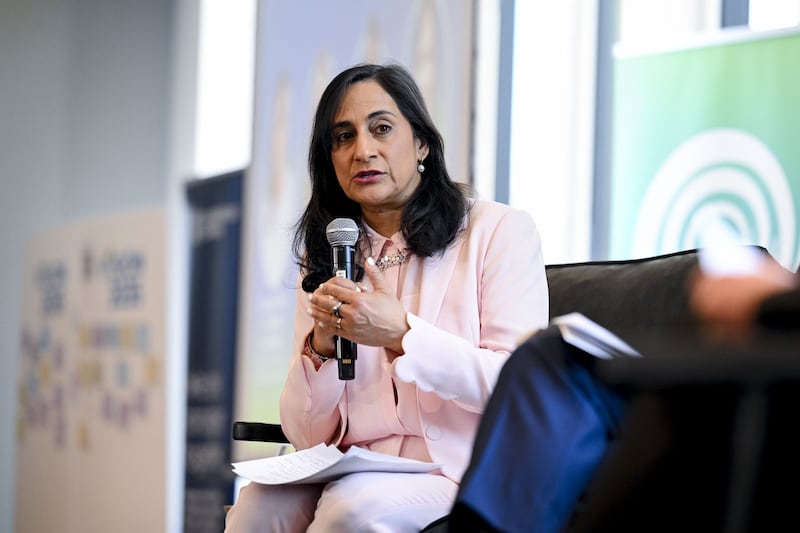
Minister of Foreign Affairs Anita Anand delivers remarks at the inaugural Ottawa Civic Space Summit in Ottawa on Thursday, April 23, 2026. THE CANADIAN PRESS/Spencer Colby


OTTAWA — Foreign Affairs Minister Anita Anand is rejecting claims that her government is prioritizing trade over humanitarian aid and human rights.

The federal government under Prime Minister Mark Carney has been criticized for cutting foreign aid, signing economic deals with autocracies and avoiding openly criticizing American actions against multilateral institutions.

But Anand told the Ottawa Civic Space Summit on Thursday that Canada’s values are “deeply integrated” into its economic and defence interests.

“I want to gently push back against the idea that civic space is somehow different from our objectives relating to economic growth and defence and security,” Anand said.


“In order for a country to be strong, in order for institutions to thrive, citizens themselves must feel safe and protected and they must have the economic means to survive.”


Anand gave the example of Canada’s push to restore shipping through the Strait of Hormuz disrupted by the U.S.-Israeli war on Iran.

She said the push to restore freedom of navigation is about both easing the costs Canadians face and ensuring poorer countries can access the fertilizer they need to feed their populations.

“Global supply chains for key survival mechanisms are absolutely also cut off,” she said. “It’s not just the fact that fertilizer isn’t able to flow. It’s that the food supply chain, the nutritional supply chain, is under threat.”

The conference focuses on the work of human rights defenders globally and how Canadian organizations can support them and Indigenous Peoples in Canada in the face of rising autocracy worldwide.

It is sponsored by the organization Resilient Societies and Co-operation Canada, which represents dozens of Canadian non-profits working in international assistance.

The conference comes as human rights activists and former Liberal ministers such as Lloyd Axworthy castigate the Carney government for signing economic deals with Beijing and Gulf nations while avoiding direct criticism of their human rights records.

The critics have noted allies such as France have been more vocal about actions Washington has taken that contradict multilateralism and international law, such as sanctioning International Criminal Court judges, blockading Cuba’s access to oil and capturing the Venezuelan president by force.

The conference also heard Thursday from a Global Affairs Canada official overseeing a newly branded “economic growth” division in the department’s international development branch.

Sacha Levasseur said the shift echoes changes made by the former Canadian International Development Agency before it was merged into GAC.

After the 2008 economic crisis, the organization shifted its focus from environmental sustainability to promoting more private investment and employment in developing countries.


Then the Trudeau government shifted the focus again, this time toward inclusive economic growth and a feminist foreign policy that supports the most vulnerable.

“We’ve been asked quite recently to revamp our approach to economic growth, when we do international assistance,” Levasseur said.

“The way things are shaping up, we’re kind of back to 2010, where we were looking at that from more of a private sector lens, and in the way we’re talking … that financial lingo and de-risking.”

De-risking refers to Global Affairs Canada backing projects in which companies and philanthropists are more likely to invest, resulting in a reduced need for federal spending.

Critics have argued the private sector can help with projects that boost living standards in developing countries, but can’t provide core services like water and education to the world’s poorest.

Paulina Ibarra is the head of the Multitudes Foundation in Chile, which advocates for transparency and accountability. She said Canadian funding for civic society spurs economic growth by cutting down on corruption and ending policies that block women and minorities from economic success.

“Canada’s feminist international assistance policy and the democratic resilience and human rights program, from our perspective, are not just aid programs. They are Canada’s, I would say, greatest economic security asset,” she told the conference.

“They allow us to build a technical capacity to fight back. By protecting the women, environmental and human rights defenders who act as watchdogs, Canada is protecting the integrity of an entire sector.”

Earlier during her remarks, Anand said Canada’s diplomacy is not conducted through social media.

“In order to be effective diplomats, we should not be utilizing social media as the primary tool of diplomacy. Diplomacy is nuanced. Diplomacy is complex,” she said. “We have to be strategic about how we push the necessary messages.”

Anand did not reference a 2018 Global Affairs Canada tweet calling for the release of women’s rights activists that sparked a years-long diplomatic spat with Saudi Arabia.

This report by The Canadian Press was first published April 23, 2026.

Dylan Robertson, The Canadian Press

O’Toole says China not a replacement for U.S., disagrees with PM Carney on EV deal


Updated: 


Erin O'Toole, former Conservative Party of Canada leader, is seen in Ottawa,

Former Conservative leader Erin O’Toole is cautioning the prime minister that despite the need to diversify trade, China is not a substitute for the United States.

O’Toole has been tapped to join Prime Minister Mark Carney’s 24-member Canada-U.S. Advisory Committee, unveiled this week as a formal review of the countries’ trilateral trade deal with Mexico fast approaches.

More than a year into a protracted trade war with the United States, meanwhile, Carney is once again emphasizing a shift in the relationship with Canada’s closest neighbour, describing Canada’s ties to the U.S. as a “weakness” in a social media video last Sunday.

Through several international trips in the last year, Carney has also moved to deepen ties with other allies, specifically in Europe. And, despite previously fraught relationships, Carney has moved to reset relations with both China and India with the goal of boosting trade.

On a trip to China in January, Carney inked a deal with Chinese President Xi Jinping to allow up to 49,000 Chinese electric vehicles (EVs) into the Canadian market in exchange for a reduction in tariffs on agricultural products. Chinese EVs previously faced 100 per cent tariffs in Canada, in a move by then-prime minister Justin Trudeau in 2024 that was meant to align with the United States.

“I have been publicly critical of that part of the prime minister’s trip,” O’Toole told CTV Question Period host Vassy Kapelos in an interview airing Sunday, when asked about Carney’s decision to allow some Chinese EVs into Canada. “I thought it was good that (Carney) went to China. It’s critical for our agricultural exports and Western Canada, and they needed to see that.”

“But the substitute for a great American partner is not China,” he also said, adding Canada should be aligned with the U.S. when it comes to China as part of a unified North American front.

“We have to be very cautious with China,” he said.

In a speech back in February, Conservative Leader Pierre Poilievre also said China is “no substitute” for the United States.

O’Toole prepared to push back in advisory council discussions

As the July 1 deadline to launch a review of the Canada-U.S. Mexico Agreement (CUSMA) approaches, American officials this week took aim at Canada.

U.S. Trade Representative Jamieson Greer said there is a gap between the Canada and U.S. administrations’ trade philosophies, and threatened enforcement action on the ongoing booze ban in several provinces.

And U.S. Commerce Secretary Howard Lutnick said Canada treats the U.S. unfairly “at every margin they possibly can.”

In his new capacity on the advisory committee, O’Toole said he’s prepared to push back in the discussions, and that he believes it’s “part of the reason” he was asked to join the group.

He said he’s committed to bringing a conservative voice to the council so it can be a true “best effort Team Canada,” and he’s been assured it “is a substantive, serious exercise.”

“I think I’m going to be disagreeing with some of their policies, and I think that’s what they want,” he said, adding a “diversity of voices and viewpoints” will strengthen Canada’s negotiating team.

Support for Poilievre as Conservative leader

Kapelos also asked O’Toole about Poilievre and recent questions surrounding his leadership.

Despite languishing in the polls on the preferred prime minister question and losing four MPs to the Liberals since last November, Poilievre has insisted he’s staying on at the helm of the party.

Asked if he has O’Toole’s support, the former leader didn’t hesitate: “Yes.”

“He’s got remarkable support within the party, and has set the policy agenda,” O’Toole said.

“I think the stability of a majority (government) will actually, I think, be helpful for Pierre to build up (and) repair,” he added. “The role of the Opposition is to hold the government to account. I want them to hold them to account.”

You can watch former Conservative Leader Erin O’Toole’s full interview on CTV Question Period Sunday at 11 a.m. ET.

Spencer Van Dyk

Spencer Van Dyk

Opens in new window

Writer & Producer, Ottawa News Bureau, CTV News

‘A lot of rhetoric being thrown around’ as CUSMA review looms: professor


Published: 


Prime Minister Mark Carney’s Advisory Committee on Canada-U.S. Economic Relations was set to meet for the first time on Monday as contentious trade negotiations between the two countries are expected to resume in the coming months.

Drew Fagan, professor at the Munk School of Global Affairs & Public Policy at the University of Toronto, says similar advisory councils were created prior to the signing of previous trade deals, including the current Canada-United States-Mexico Agreement (CUSMA).

“This is typical,” he told BNN Bloomberg in an interview Monday morning.

“Canadian negotiating stances are complicated (given that) it’s a regional economy, the power of the provinces and our federal structure.”

Monday’s meeting comes ahead of a July 1 deadline to review CUSMA, which was signed in 2018 by Canada, Mexico and the United States during U.S. President Donald Trump’s first term in office.

Canada’s chief trade negotiator Janice Charette said during a Canadian Chamber of Commerce summit in Ottawa last week that the deadline “is kind of a checkpoint — it’s not a cliff,” suggesting negotiations may still be ongoing at that time.

“There’s sort of a deadline of July 1, the language in the original agreement isn’t very clear on the review,” said Fagan.

“It’s unlikely that there will be an agreement by then, given the timing; we’re already at the end of April, and the complicated structure of negotiations among the three countries… right now the U.S. and Mexico are talking more than the U.S. and Canada are talking.”

Official high-level trade negotiations between Ottawa and Washington have been stalled since the fall, however representatives and officials from both sides have made numerous comments in recent months regarding future talks.

Last week, U.S. Commerce Secretary Howard Lutnick criticized Canada’s approach to trade negotiations in response to a report quoting a former Canadian official who said that time was on Canada’s side, given the pressures on the U.S. economy.

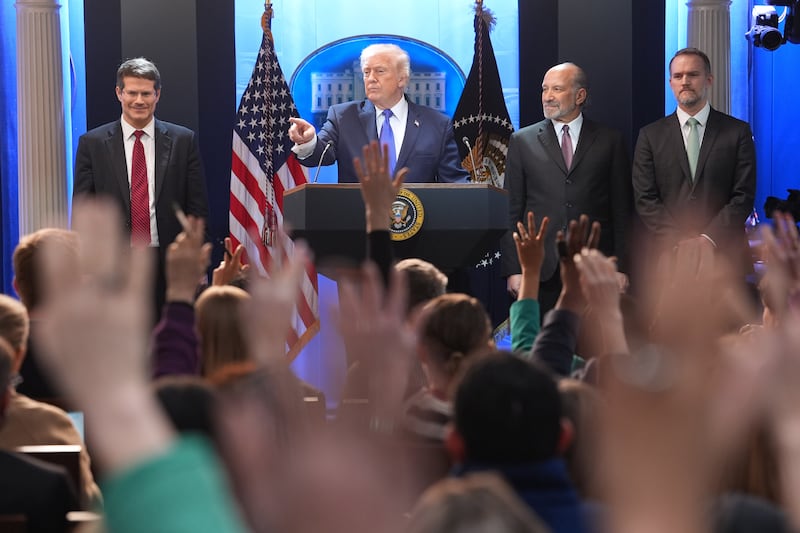
U.S. President Donald Trump speaks during a press briefing at the White House, Friday, Feb. 20, 2026, in Washington. From left are Solicitor General John Sauer, Trump, Commerce Secretary Howard Lutnick and Trade Representative Jamieson Greer. (AP Photo/Evan Vucci)

“That is, like, the worst strategy I’ve ever heard,” Lutnick said at a conference hosted by the media outlet Semafor.

“They suck, they — look, we are a $30-trillion economy, right?”

Despite those types of comments from the Trump administration, Fagan said both sides are likely to come together some time between now and the summer to iron out the details of a future agreement.

“There’s a lot of rhetoric being thrown around, particularly from the White House… so the Canadian side is trying to hold back a little bit, but reports are that the engagement is now increasing,” he said.

“I would expect later in the summer, there’ll have to be some sort of statement by July 1, but later in the summer, into the early fall, we’ll have a better sense of what an agreement, assuming there is one – and I think there likely will be – is going to look like.”

With files from The Canadian Press

Jordan Fleguel

Jordan Fleguel

Opens in new window

Journalist, CTVNews.ca