Monday, May 18, 2026

Wars Destroy Lives and the Climate. Why Aren’t We Counting Military Emissions?

Source: The Conversation

When delegates gathered for COP30 in Belém, Brazil in November 2025, they scrutinized various sectors of the global economy for their contributions to rising greenhouse gases. Agriculture, aviation, steel, cement — all were on the table. One topic not discussed was war.

This isn’t a minor oversight. Militaries are significant contributors to greenhouse gas emissions. Russia’s invasion of Ukraine has generated an estimated 311 million tonnes of what’s known as CO₂ equivalent, comparable to the combined annual emissions of Belgium, New Zealand, Austria and Portugal. CO₂ equivalent is the metric used to compare the warming impact of various greenhouse gases to carbon dioxide.

Recently published research calculated that the first 15 months of Israel’s war in Gaza generated more than 33 million tonnes of CO₂ equivalent, comparable to the combined 2023 annual emissions of Costa Rica and Slovenia.

In February 2026, Israel and the United States launched a war against Iran, joining a long list of other conflicts where emissions go uncounted in global inventories.

These are massive emissions, and they are generated with no formal mechanism to record, report or attribute them, and no accountability for the climate costs that affect people in conflict zones and far beyond.

A recent article by Neta Crawford, a researcher with the Cost of War project at Brown University, highlights how armed forces, militarization and war fuel climate change. She argues that military emissions and conflict-related emissions remain undercounted, even though they undermine efforts to mitigate climate change.

The military emissions gap

Estimates suggest militaries and their supply chains account for approximately 5.5 per cent of global greenhouse gas emissions, which is enough to make them the world’s fourth largest emitter if counted as a country. And that figure only covers peacetime.

This is what researchers call the military emissions gap: the difference in emissions between what governments report and what their armed forces actually emit.

The problem starts with the rules. Under the United Nations Framework Convention on Climate Change (UNFCCC), countries have been exempt from fully reporting military emissions since the Kyoto Protocol negotiations in the 1990s. The United States successfully lobbied for the exclusion on national security grounds.

The 2015 Paris Agreement introduced voluntary reporting. However, as a 2025 briefing from the Conflict and Environment Observatory and Griffith University made clear, the result is a system that is “patchy, incomplete or missing altogether.”

The top three military spenders — the U.S., China and Russia — either submit no data or incomplete, non-disaggregated figures. This is a structural blind spot that excludes one of the most carbon-intensive sectors from meaningful accountability.

What wars cost the climate

A recent study on Gaza provides a comprehensive account of the war’s full carbon cycle. It found that direct combat emissions — jets, rockets, artillery, military vehicles — account for just 1.3 million of the 33.2 million tonnes of CO₂ equivalent.

The vast majority, more than 31 million tonnes, are projected to come from the reconstruction of destroyed infrastructure: nearly 450,000 apartments, over 3,000 kilometres of roads, schools, hospitals and water systems. Rebuilding what war destroys is, climatically speaking, the biggest act of war of all.

A report on Russia’s invasion of Ukraine by the Initiative on GHG Accounting of War found that direct combat emissions constitute 37 per cent out of total emissions between February 2022 and 2026. The war has ignited thousands of fires in forests and wetlands, accounting for 23 per cent of its total carbon footprint.

Russia’s attacks on electrical infrastructure have further released sulphur hexafluoride, a greenhouse gas 24,000 times more potent than CO₂, from high-voltage switching gear. And the rerouting of civilian aircraft around Ukrainian and Russian airspace has added an estimated 20 million extra tonnes of CO₂ equivalent compared to pre-invasion flight paths.

In Iran, it is estimated that the U.S.-Israel war has unleashed over five million tonnes of CO₂ equivalent — largely from infrastructure destruction and energy-related impacts.

None of this appears in any country’s reports on emissions to the UNFCCC.

What needs to change

In July 2025, the International Court of Justice (ICJ) delivered an advisory opinion establishing that states have binding obligations to assess, report and mitigate harms to the climate system. In a separate declaration, ICJ judge Sarah Cleveland stated that those obligations extend to harms resulting from armed conflicts and other military activities.

The UN General Assembly has called for Russia to compensate Ukraine for all damages resulting from its invasion. When wars of aggression are launched, the emissions generated in fighting them, surviving them and rebuilding belong on the aggressor’s carbon ledger. When Russia invaded Ukraine, it generated a climate debt on behalf of the entire planet. The same can be said of other aggressors.

The Intergovernmental Panel on Climate Change (IPCC) is the UN body responsible for assessing the science related to climate change. The IPCC is currently in its seventh assessment cycle, with reports expected in late 2029.

This assessment cycle must include a dedicated report for conflict emissions covering infrastructure destruction, fighting and post-conflict reconstruction. The UNFCCC must make reporting military emissions mandatory and develop a framework for attributing conflict emissions under its Enhanced Transparency Framework.

Civil society and academia have already done the hard work of showing it can be done. Organizations like the Conflict and Environment Observatory have built methodologies from scratch, using open-source data. The science exists. What’s lacking is the political will to enshrine it in global climate governance.

The richest countries spend roughly 30 times more on their armed forces than they contribute in climate finance to developing countries. Global military spending has reached a record $2.7 trillion. This is more than the total $2.2 trillion invested globally in clean energy in 2025.

As conflicts proliferate, the world is committing to an ever-larger unaccounted carbon liability. The climate finance gap is also likely to get worse as countries cut international development aid to direct funds to higher military spending.

Every degree of warming we are trying to avoid is undermined by wars. Accounting for conflict emissions is a vital way to make climate science whole.

This article was co-authored by researchers who are part of the Accelerating Community Energy Transformation initiative: Curran Crawford, Basma Majerbi, Madeleine McPherson (University of Victoria) and Samaneh Shahgaldi (Université du Québec à Trois-Rivières).

This article was originally published by The Conversation; please consider supporting the original publication, and read the original version at the link above.

Slashing Climate, Weather and Ocean Research to Pay for 32 Hours of Iran War

Source: FAIR

The recently proposed budget from the Trump administration includes a $1.6 billion cut to the National Oceanic and Atmospheric Administration. The reduction would eliminate NOAA climate, weather and ocean research labs; zero out grants aimed at improving rainfall and flood prediction; and cut the Integrated Ocean Observing System, which monitors what’s happening in the ocean, where hurricanes strengthen and where coastal flooding begins. This comes on top of the 2025 DOGE layoffs of some 880 people from the agency.

Some lawmakers are pushing back, either because they don’t think climate change is fake news, or they’re from flood-prone regions. But a detail being missed, as noted by Emily Atkin at Heated (5/7/26), is that while these cuts would substantially harm the agency’s work, the proposed “savings” of $1.6 billion is equivalent to the cost of 1.3 days of the war on Iran—which Popular Information estimated to have cost $72 billion in its first 60 days.

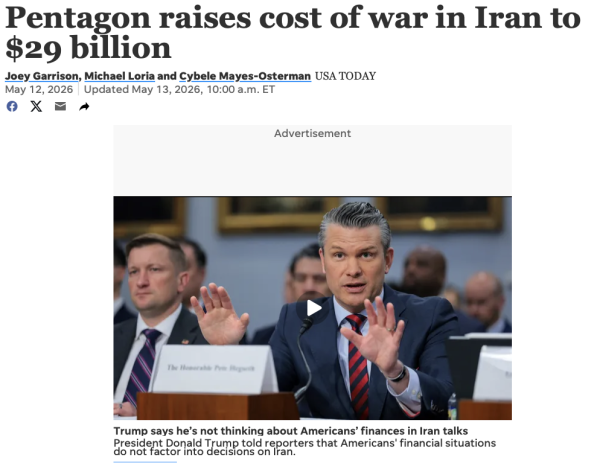
That figure is much higher than the one you will likely have heard in the news. The acting Pentagon comptroller put the figure at $25 billion when talking to Congress at the end of April, and he raised that number to $29 billion in widely covered hearings this week (USA Today, 5/12/26). CNN (4/29/26) said anonymous officials suggested the $25 billion figure was actually closer to $50 billion, once repairs to US bases in the region were included.

You’re likely to see lowball estimates of the true cost of the Iran war in corporate media (USA Today, 5/12/26).

But Popular Information (5/6/26) did a cost estimate of the Iran War based on officials’ statements, military procurement and operations data, and reporting on deployments and armament use. It considered direct war costs—expenses for military operations, munitions and the like—but not indirect costs, including broader economic impacts, interest on the national debt and longer-term expenses like veterans’ care. It also corrected the flawed Pentagon method for tracking munition expenditures, which reflects historical costs rather than the much higher replenishment costs.

Harvard public policy expert Linda Bilmes (Fortune, 4/15/26) estimated that once indirect costs like lifetime disability benefits to US troops are included, the costs will run far higher: “I am certain we will spend $1 trillion for the Iran War.” 

You can find Popular Info‘s methodology on their Substack, and Bilmes’s detailed interview on Harvard’s website. But in the meantime, you can question lowball estimates of the costs of this illegal, reckless war.

This article was originally published by FAIR; please consider supporting the original publication, and read the original version at the link above.

The US and the Greentech Revolution

Source: STRIKE!

What we today call renewable energy was once America’s only energy. From the start of European settlement of America to the late 19th century, firewood and waterpower were the predominant sources of energy. The work of animals, workers, and slaves likewise embodied “renewable energy.” Coal surpassed wood around 1885. Petroleum surpassed coal in 1950. Natural gas surpassed coal in 1958. Fossil fuels—coal, petroleum, and natural gas—dominated US energy for more than a century and a half, accounting for nearly 83% of total U.S. energy consumption in 2023. Renewable and nuclear energy supplied most of the remaining 17%.

Fossil fuels radically increased the amount of energy available for all purposes. Fossil fuel energy became entwined with every aspect of American life, from homes to transportation to manufacturing to agriculture. Indeed, it was largely the basis for the “American way of life.” Fossil fuels also largely shaped America’s relations with the rest of the world, as the US exported massive quantities of coal, oil, and gas, dominated much of the world’s fossil fuel markets, and fought wars in fossil fuel-rich regions of the world that led to further control of global fossil fuel resources. Fossil fuel industries, and businesses, workers, and communities dependent on them, became a powerful force in shaping American politics, society, and daily life.

In the second half of the 20th century, new forms of renewable energy began to emerge in the margins. The earliest roots of the “Greentech revolution” in the US could be traced to the first practical silicon photovoltaic cells in the 1950s; the first rechargeable lithium-metal batteries in the 1970s; and the world’s first wind farm around the same time. Jimmy Carter installed solar panels on the White House in 1979. But the power of the fossil fuel industry and its allies blocked attempts to develop fossil free alternatives. The 2001 Cheney report projected that renewable energy other than waterpower would account for less than 3% percent of total electricity generation by 2020. (The actual proportion by 2020 was six times higher.) On the consumption side, energy conservation was largely the realm of hobbyists; gas guzzlers remained the order of the day.

Doubling Down on Fossil Fuels

Starting with the 1970s energy crisis, the US spent billions of dollars to promote domestic fossil fuel energy supply chains, mostly for natural gas. In 1976 it established the Gas Research Institute (GRI), a public–private partnership with an annual budget of $200 million. The GRI followed a “whole supply chain” approach. It funded research on enhanced oil recovery, gas transportation, household appliances, and building systems. It also directly funded “drilling experiments, the development of household appliances, and marketing campaigns.”

It was not only the government that invested in fossil rather than renewable energy. While Chinese industrial policy was focusing on electric vehicle production, US auto companies expanded their investments in high-emission trucks and SUVs. They opposed higher standards for fuel economy and carbon emissions. Until 1996 the Big Three did not produce a single commercial electric vehicle – allowing Tesla to corner the market for EVs.

In 2008, rising gas prices and the Great Recession devasted the Big Three’s carefully cultivated market for gas guzzlers. GM and Chrysler went into bankruptcy, and an $81 billion bailout left the US government as the majority owner of GM and the UAW and Fiat as the principal owners of Chrysler.

Under the Obama administration’s rescue plan, the auto companies were supposed to “green” their products. But in fact they continued to oppose climate protection policies and to promote high-pollution, low-mileage trucks and SUVs. Indeed, as recently as July 2023 the auto industry’s largest lobbying organization came out against the Biden administration’s proposed rule to ensure that two-thirds of new passenger cars sold in the United States are all-electric by 2032.

Biden’s Industrial Policy

Late in 2018 the youth climate Sunrise Movement occupied the office of likely Democratic House Majority Leader Nancy Pelosi; newly elected Rep. Alexandria Ocasio-Cortez joined them to propose a resolution for a Green New Deal. It called for “a new national, social, industrial, and economic mobilization on a scale not seen since World War II and the New Deal.” The Green New Deal would produce jobs and strengthen America’s economy by accelerating the transition from fossil fuels to clean, renewable energy. It would generate 100% of the nation’s electricity from clean, renewable sources within the next 10 years; upgrade the nation’s energy grid, buildings, and transportation infrastructure; increase energy efficiency; invest in green technology research and development; and provide training for jobs in the new green economy. A poll shortly after found that 40% of registered voters “strongly support” and 41% “somewhat support” the concepts behind a Green New Deal.

Faced with the overwhelming support for the Green New Deal, the presidential campaign of Joe Biden proposed a “Build Back Better” program that initially incorporated much of the program of the Green New Deal. It explicitly eschewed the principles of neoliberalism and advocated instead the long-disparaged idea of “industrial policy” – essentially, government selection of economic sectors to encourage with subsidies and technical support. While its programs were touted as means of climate protection, when it was implemented some of the sectors most heavily subsidized, such as carbon capture, hydrogen production, and nuclear energy, are questionable to say the least as means to protect the climate.

Biden’s three major economic bills, the American Rescue, Bipartisan Infrastructure, and Inflation Reduction Acts, proposed to provide trillions of dollars over a decade to incentivize domestic production in targeted industries, notably the auto industry. Rather than restructuring the industry like the Obama program, these plans were largely limited to providing subsidies to auto companies to expand EV production. They were justified in part as stimulus to the creation of a “green” economy that would reduce GHG pollution, but in large part as a means of containing the challenge of Chinese Greentech advances.

US auto companies were happy to accept these federal subsidies, but they were also happy to evade their carbon-reduction purposes. Auto companies gave surface compliance to federal pressure to reduce carbon pollution, but in reality they continued to promote highly profitable but high-carbon SUVs and light trucks and drag their feet on shifting to EVs. The Biden administration policies stimulated an expansion of EV and battery production in the US. But the new plants and infrastructure were not primarily created by US companies but were rather the product of joint ventures with foreign (mostly Asian) companies with far superior technology.

The Greentech Cold War

Many of these Greentech investments and joint ventures were in fact Chinese. Indeed, according to a 2025 database, the US had more than $14 billion in Chinese pledged overseas green manufacturing investment, the fourth highest country in the world. Many of China’s leading solar manufacturers set up assembly factories in the United States. In 2024, for example, Illuminate USA – a joint venture between China’s LONGi and Invenergy, the largest private renewables developer in the United States – began assembling panels at its 5GW factory in Ohio. On one count, Chinese-owned factories would have 20GW of capacity in 2025 – enough to meet about half of annual US demand. Battery manufacturing also attracted sizeable Chinese investments. For example, a joint venture called Amplify Cell Technologies featuring EVE Energy, China’s third-largest battery maker, broke ground on a US$2–3 billion factory for electric truck batteries in Mississippi.

The Biden administration tried to halt the “threats” of Chinese advances in solar and EV technology. In May 2024, it announced tariffs specifically targeting green products, including lithium-ion batteries, critical minerals, and solar cells. It quadrupled duties on electric vehicles to 100%. It also released a “Foreign Entity of Concern” ruling preventing vehicle manufacturers from getting IRA tax credits if any company in their battery supply chain has 25 percent or more of its equity, voting rights, or board seats owned by a Chinese government-linked company.

This was no simple trade war between two countries, however. As an article on “The Great Green Wall” in Phenomenal World put it, “the business model of the entire industry is shifting.” Firms are “no longer competing for dominance on the level of vehicle technology,” but for “the entire ecosystem.” As a result of globalization, these “ecosystems” are normally transnational. So rather than classic economic nationalist protection of national industries, this “trade war” became an attempt by both sides to control fragmented global economic networks. As “The Great Green Wall” put it,

“Biden’s intention is to stave off the Chinese and stimulate a domestic and friendshored buildout of the EV supply chain, stretching from mines to the factory floor. Side deals with friendly governments have been made; Canada and Australia have both been deemed eligible for Defense Production Act support for their battery metals. After their howls of outrage, Europeans, Japanese, and Koreans received a leased vehicle exemption meaning that the “made in America” rules don’t apply to them, and their firms’ vehicles could still qualify for subsidies if they were leased rather than bought.”

After the exemption was finalized in December 2022, EV imports from Korea, Japan, and Germany surged.

US EV and battery production have been based on acquiring non-US technology through joint ventures, most of them in the US South. Foreign direct investment included Hyundai and Rivian in Georgia, Toyota in North Carolina, Tesla in Texas, BMW in South Carolina, and Mercedes-Benz in Alabama. Indeed, US automakers were even licensing superior EV technology from Chinese firms like BYD and CATL.

“Ford (in Michigan) and Tesla (in Nevada) are partnering with CATL to make batteries. CATL says that it has structured its licensing deal with Ford so that it is compliant with “foreign entity of concern” rules. For its part, Tesla already uses BYD cells in Germany; Ford and GM use BYD batteries.”

Just as the impact of climate change was becoming devastating and ubiquitous, climate policy was being turned into a weapon of geopolitical struggle. This was made clear in an interview with John Podesta, senior adviser to Joe Biden on international climate policy. Podesta praised the huge expansion of US oil and gas production: “The US is now the number one producer of oil and gas in the world, the number one exporter of natural gas, and that’s a good thing.” He thereupon added, “The science is clear, we’ve got to transition away and begin to replace those resources with both zero carbon electricity and renewable resources.” If George Orwell came back to earth, he might say, “Fossil fuels are climate protection.”

Podesta also illustrated the way production of “green goods” was being redefined as an issue of national security. The US had recently slapped a 100% tariff on electric vehicles and other “green” products from China. After accusing China of deliberately overproducing green goods, Podesta said:

“The economic security of the US and [its commitments to cut emissions] rely on the need to have an economy that is not overly dependent on a single source of supply, for critical minerals, for batteries, for other upstream green technologies. We need to diversify that supply. We’re witnessing a renaissance of manufacturing in the US in the green technology space and will resist unfair trade practices that are going to undermine that investment.”

Above all, the Biden administration eschewed anything that would reduce the overall production and consumption of fossil fuels. Despite lip service to climate protection, they regarded it as a “good thing” that the US was “the number one producer of oil and gas in the world” and “the number one exporter of natural gas.”

The Greentech Revolution Infiltrates America

Biden’s industrial policies had contradictory effects on the rise of Greentech in the US. On the one hand, the IRA and other economic legislation significantly increased production of fossil free energy, EVs, and other GHG-reducing technologies. But the Biden administration oversaw a historic growth in fossil fuel extraction and strove to protect the US and its supply chains from foreign and especially Chinese Greentech.

Nonetheless, by the end of the Biden years the global Greentech Revolution was well on its way to transforming US energy production and consumption, threatening to leave fossil fuel industries as “stranded assets.” In early 2025, just as the Trump administration was coming into office, the US hit a new record low for fossil fuels in the electricity mix as solar and wind reached a record high. In March 2025, for the first time ever, fossil fuels accounted for less than half of electricity generated in the US. The impact on climate-destroying GHG emissions was clear: Since coal generation peaked in 2007, there had been a 68% fall in coal emissions and a 32% reduction in total power sector emissions.

In the one year between March 2024 and March 2025, US solar power increased a “staggering” 37%. Wind power increased by 12%. Over that year fossil fuel generation fell by 2.5%.

The impending transformation was clear in consumption as well as production. In 2024, electrified vehicles made up 20% of all new car sales, with fully electric vehicles comprising 9%. Heat pumps rose to 57% of new space heating installations.

The Greentech Revolution opened the possibility for a “Greentech New Deal.” It made climate-protecting production and consumption far cheaper than continued fossil fuel use. It made possible the rapid reduction of greenhouse gas emissions and thereby the significant slowing down of climate change. It opened the way to good green jobs for all. And it undermined the wealth and power of fossil fuel companies and countries, shifting the balance of power worldwide toward democratic governance.

Enter Donald Trump.

This article was originally published by STRIKE!; please consider supporting the original publication, and read the original version at the link above.Email
avatar

Jeremy Brecher is a historian, author, and co-founder of the Labor Network for Sustainability. He has been active in peace, labor, environmental, and other social movements for more than half a century. Brecher is the author of more than a dozen books on labor and social movements, including Strike! and Global Village or Global Pillage and the winner of five regional Emmy awards for his documentary movie work.

How Environmental Destruction is Built Into Corporate Design

Source: Resilience

A century ago, Henry Ford attempted to lower the price of the Model T and pay his workers better, famously saying:

“My ambition is to employ still more men, to spread the benefits of this industrial system to the greatest possible number, to help them build up their lives and their homes. To do this, we are putting the greatest share of our profits back into the business.”

The Dodge brothers, minority shareholders, sued. They demanded that Ford stop lowering prices and instead distribute the surplus as dividends. The court ruled in their favor, cementing the idea that a business is carried on primarily for the profit of the stockholders.

That logic hasn’t disappeared; it has instead been absorbed into the everyday mechanics of the market, punishing strategic decisions that fail to maximize shareholder value faster than any court could ever rule. In the cold logic of traditional US corporate law, a CEO who spends the company’s money without a clear business case is seen as a thief stealing from the shareholders’ wealth.

Fast forward today, and we find ourselves at a breaking point: the climate is heating up, “forever chemicals” like PFAS and BPA are being found in the soil, even in areas as remote as Antarctica, and the ocean has become a plastic soup. Just 100 companies are responsible for 70% of global emissions, while a mere 20 corporations account for over half of the world’s single-use plastic waste. 

How is it possible for organizations to operate in total defiance of the basic values we instill in our children: to clean up after ourselves and to care for the world around us? What creates such a distance between the values we hold at home and the boardroom decisions that drive environmental destruction?

To understand this, we have to look at the systems that govern corporations and their leaders alike: the CEOs of publicly traded global corporations. While they represent only a fraction of businesses worldwide, their sheer scale gives them a disproportionate impact on our global ecology.

The dictatorship of shareholder primacy and the externalization of costs

In the United States, the epicenter of the shareholder philosophy, representing about 40% of the global market capitalization, a CEO is legally and fiduciarily bound to their shareholders. Their primary mandate is simple: drive the stock price up. 

CEOs operate under a structural pressure to justify decisions in terms of long-term shareholder value, meaning that if they choose, for example, an environmentally friendly alternative that isn’t legally required but causes the stock price to drop significantly, they risk being ousted or sued by their shareholders.

In Delaware, a US state known for its business-friendly policies and where many global firms are incorporated, a central concept in economics becomes visible: externalization. In this system, if plastic bottles are cheaper to produce and logistically more efficient than glass deposit systems, the shift to plastic is treated as a competitive necessity. A company reaps the profits from the efficiency of a product, while the subsequent costs (waste management, health issues, ecosystem collapse) fall on local communities.

The absurdity of this system is perfectly illustrated by the Deepwater Horizon disaster: while BP calculated the total cost of the oil catastrophe at $62 billion, tax effects and write-offs effectively slashed that bill to $44 billion — in the end, the public essentially subsidized a significant portion of the reparations for a self-inflicted environmental nightmare.

An example closer to us as consumers: fast fashion companies can sell cheap garments, while discarded textile waste from massive overproduction accumulates in the Atacama Desert in Chile, washes up on beaches in Ghana, or burns in dumps just outside Karachi or Nairobi. 

But the pressure does not come only from legal duties or market discipline; it is reinforced by the physical and economic structures in which corporations are already embedded. Even a new CEO or one with a sudden change of heart faces the daunting wall of a company locked into its existing investments and established infrastructure.

The psychology of the machine

If the legal and economic structures are the bones of the problem, psychology is the muscle, leaving us with a haunting question: How do decent people live with the catastrophic results of their collective labor? 

Within a massive organization, we see a diffusion of responsibility. The larger the company, the more silos exist: The logistics manager focuses on cutting transport costs. The marketing manager focuses on the brand image. The CEO focuses on the quarterly earnings report. The actual ecological impact — even within the company environment — disappears in the division of labor. It doesn’t show up directly in any corporate spreadsheet. No one person feels responsible for the whole.

This is often accompanied by cognitive dissonance,a frequent reality for many executives. To make tough decisions, leaders develop a high capacity for self-immunization. If a CEO views corporate survival as the top priority, the brain automatically treats ecological concerns as secondary. To live with themselves, executives often pivot the blame. They say they are “creating jobs” or that the “responsibility lies with the consumer” for buying the product or failing to recycle the waste.

Finally, we must acknowledge that capital is fluid while laws are often static. Companies frequently act most recklessly where the guardrails are the lowest. In regions with strict environmental laws, corporations invest in sustainability to avoid fines. But in regions with weak regulation or political instability, they follow the path of least financial resistance.

Redesigning the architecture: from destruction by design to restoration by rule

If we accept that the destruction of our planet is not a result of individual malice but a systemic output, then the solution cannot lie in moral appeals alone. We cannot simply wait for better people to occupy the corner offices; good people are already sitting there, often with their hands tied by the very structures they serve. Instead, we must redesign the legal, economic, and psychological frameworks that govern corporate behavior worldwide.

To flip the switch from a system that rewards extraction to one that mandates restoration, the first priority is dismantling the absolute reign of shareholder primacy. We need a legal evolution where a corporation’s duty is tied to a triple bottom line of profit, people, and planet. This shift moves environmental responsibility from a niche certification to a global mandate, ensuring directors are legally protected — and required — to prioritize ecological health even when it impacts short-term dividends. Once true cost accounting is integrated into tax law, the era of externalization ends. If the price of a plastic bottle reflects the actual cost of its removal from the ocean, the supposed efficiency of plastic vanishes, and the commons is no longer a free dumping ground.

Breaking the efficiency trap further requires a radical shift in what a company actually sells. By transitioning to product-as-a-service models — where firms sell lighting instead of bulbs or mobility instead of cars — the incentive structure reverses. Durability and repairability become profit centers, while planned obsolescence becomes a direct financial liability for the manufacturer. This structural change must be reinforced by radical transparency. Just as every cent is tracked in real-time by a CFO, ecological footprints must be integrated into departmental dashboards. When environmental impact becomes a hard metric in performance reviews rather than an abstract externality, the executive psychology shifts from self-immunization to genuine innovation.

Is that really all there is to systems change?

The honest answer is no. These steps address the mechanics of the corporate machine, but they do not necessarily change the engine. If we remain grounded in reality, we have to acknowledge three deeper systemic layers that are often omitted from green discourse. First, even a world full of benefit corporations operates within a financial system based on interest and compound interest, which mandates exponential growth. On a finite planet, the concept of infinite growth — even if labeled green — is a physical impossibility. True systemic change would require decoupling societal success from GDP and moving toward a steady-state economy, a transition for which we currently have no clear global political precedent.

Second, systems are designed to protect themselves through power dynamics and regulatory capture. Corporations frequently use their profits to influence the very rules meant to govern them. As long as it remains more profitable to lobby against a regulation than to comply with it, the invisible architect will continue to fight for the status quo. Redesigning the architecture, therefore, requires breaking the link between concentrated capital and political decision-making. 

Finally, we must confront the capital engine itself. CEOs are often just the pilots; the true architects are the algorithms of investment funds and the demands of pension schemes. As long as the retirement savings of millions are tied to the short-term performance of extractive industries, the entire system remains in a state of mutual hostage-taking. We would need to rewrite not just corporate law, but the fundamental ways in which global capital is valued and deployed.

This article was originally published by Resilience; please consider supporting the original publication, and read the original version at the link above.Email

Saskia Karges, PhD is a Chemist, a Corporate Strategist for Fortune 500 companies and a Solarpunk author. She specializes in bridging the gap between industrial operations and radical visions for a resilient future. Her work focuses on dismantling systemic failures and identifying anthropogenic mines within global waste streams. Her latest novel, AMATEA – Memoirs of the Last City (2026), explores the boundary between sustainable utopia and eco-fascist dystopia.