Wednesday, June 10, 2026

Is US Influence In Africa At A Crossroads? – Analysis

June 10, 2026 
Published by the Foreign Policy Research Institute
By Charles A. Ray

(FPRI) — The United States enters the second half of the 2020s facing a fundamental question in Africa: Is Washington still seen as a strategic partner of choice, or is it becoming a transactional power whose engagement is seen as narrow, punitive, and unpredictable? This is no longer a theoretical question. It is now being tested in southern Africa, West Africa, the Sahel, and in the mineral-rich heart of the African continent.

Strained US-South African relations, friction with Nigeria over claims of religious persecution, renewed efforts to regain some counterterrorism footing in the Sahel, and the controversies around third-country deportation deals and minerals diplomacy all point to a larger issue. While the United States is not pulling away from Africa altogether, it is redefining its presence in ways that could either sharpen its influence or erode it.

For decades, American influence in Africa has been based on a mix of security cooperation, development assistance, diplomatic engagement, and support for good governance and public health. Such support was never without contradictions, but it did give Washington a broader identity than that of a purely extractive or coercive actor. Currently, the pattern of US engagement looks different. It is more selective, more openly associated with immediate political priorities, and much more willing to link diplomatic engagement to issues such as migration control, ideological signaling, or commercial access to strategic minerals. On a continent where governments already have alternatives to China or Russia, such as the Gulf states, Turkey, India, and the European Union, this shift matters. African leaders are increasingly able to hedge, diversify, and resist external pressure. If the United States appears to them to be mainly interested in punitive actions, one-off deals, or symbolic confrontations, it risks losing not just goodwill but also long-term leverage.

South Africa: From Strategic Disagreement to Diplomatic Rupture

The most visible and significant deterioration has been in US relations with South Africa. President Donald Trump’s move to disinvite South Africa from the 2026 G20 Summit in Miami followed an already dramatic breakdown, in which US officials boycotted the South African-hosted Johannesburg summit. In addition, the Trump administration escalated claims that white Afrikaners were being persecuted or subjected to “genocide,” allegations that South African officials, and even groups representing Afrikaners, have strongly rejected. Despite no substantiation of the claims, the US administration prioritized refugee admissions for white South Africans even as refugee access was curtailed for many other groups. Whether these steps are viewed as moral positioning or domestic political theater, the effect is the same in Africa: The United States looks willing to rupture ties with one of the continent’s most important powers on the basis of a narrative that many Africans see as ideologically loaded and factually questionable.


Feelings like this matter because South Africa is not just another bilateral partner. It is a leading voice in the African Union, Africa’s largest economy, a member of numerous multilateral organizations, and a country whose positions often shape broader African perceptions. A rupture with Pretoria, therefore, has an impact beyond trade or bilateral diplomatic relations. It signals to other African governments that Washington might be prepared to downgrade relations with an influential African nation not over conventional disputes such as sanctions, military alignment, or treaty obligations, but over a polarizing culture war issue. Many are likely to read this less as principled diplomacy than as evidence that domestic American policies can redefine foreign policy priorities toward the continent.

This could have significant consequences. In the first place, the dispute with South Africa weakens US credibility as a defender of multilateralism at a time when African governments are skeptical of Western selectivity. Secondly, it risks pushing South Africa to deepen cooperation with other powers, including China and Russia, not necessarily out of ideological agreement but as a hedge against US hostility and unreliability. Thirdly, it might reinforce a broader continental impression that the United States is comfortable engaging African countries only when they align with US domestic priorities. Even those governments that disagree with South Africa on some issues might still resent what they see as public humiliation of an African power at the first African-hosted G20 Summit.


In diplomacy, symbolism is important, and it can be costly for the United States.
Nigeria: An Ideological Cloud Over Security Cooperation

While South Africa is an example of an increasing diplomatic rupture, Nigeria is a more complicated situation. It is an illustration of deep strategic importance combined with rising political distrust. Nigeria is central to any serious American engagement in West Africa. With over 240 million people, it is the most populous country in Africa; it is one of its largest economies; it is a major security player in the Lake Chad Basin; and it is a critical player in regional diplomacy. But US-Nigerian relations are strained because the Trump administration has redesignated it as a Country of Particular Concern, based on what the US government describes as mass-scale persecution of Christians, and the increasingly heated rhetoric from Washington that frames violence in Nigeria primarily through the lens of Christian persecution. While this framing resonates strongly with segments of the American right’s political base, in Nigeria it is viewed by many as incomplete, politicized, and dangerously provocative.


Violence in Nigeria is real and serious, and Christian communities have suffered grievously in parts of the country. But Nigerian officials credibly argue that the violence also involves jihadist insurgency, banditry, communal conflict, weak policing, and governance failures rather than a single, state-directed campaign of religious persecution. In a country whose population is almost evenly split between Christians, who live in the south, and Muslims, mostly in the north, where attacks have been concentrated, and where the religion of victims is not often reported—or relevant—it is impossible to conclusively attribute religious persecution as a motive. When Washington ignores these distinctions, it risks alienating Abuja and oversimplifying a crisis that requires careful analysis and cooperation rather than mere denunciation. Washington’s calls for aid conditionality, sanctions, visa restrictions, and pressure against sharia and blasphemy laws might appeal to some audiences in the United States, but they risk making Nigerian leaders more defensive and less willing to coordinate closely with the United States on security matters.

Neither side, though, can afford a complete breakdown of the relationship. The United States needs Nigeria’s cooperation on intelligence, regional stabilization, energy, maritime security in the Gulf of Guinea, and counterterrorism activities in the Lake Chad corridor. Nigeria, on the other hand, benefits greatly from US training, intelligence, diplomatic support, and economic ties. For this reason, outright rupture of the relationship is not the main risk. What is more probable is a more corrosive relationship, one that remains functionally intact, but that is less trusting, less open, and more transactional. If the United States is seen as lecturing Nigeria from a narrow ideological frame while simultaneously asking for deeper security cooperation, its leverage will be weaker. Abuja might continue to work with the United States where interests overlap, but it might also diversify its partnership and resist American pressure more openly and directly.


The Sahel: Counterterrorism Cooperation Returns, But With Tighter Constraints

The Sahel is another stress test of US influence in Africa. After the loss of key access points, particularly in Niger, where Washington had a drone base, the United States has been looking for ways to reestablish a viable counterterrorism posture, not just in West Africa, but in the broader Sahel.

The current Trump administration appears to be renewing its focus on the Sahel, as it seeks to renew ties with the Alliance of Sahel States (AES), Mali, Niger, and Burkina Faso, with delegations to the capitals of the three countries discussing US military support in exchange for access to their natural resources. Washington would consider providing weapons, equipment, and potentially personnel to aid local forces fighting extremists. In return, the United States would get priority access to uranium, gold, and other critical minerals. This approach emphasizes intelligence sharing, training, and advisory missions, rather than large-scale deployments of US military forces. While this is, on the surface, a pragmatic-sounding adjustment to current political realities, the AES, which was formed in 2023, already has strong ties to Russia, including the presence of military advisors, training support, and supply of arms, and since 2025 AES foreign ministers have concluded agreements with Russia on security, energy, and higher education. This limits America’s freedom of action in the region.


Some progress has been made on moving this new agenda forward, with an intelligence cooperation agreement with Mali near completion and the removal of sanctions on some senior Malian defense personnel, but despite the potential of getting Washington back in the good graces of Sahelian countries, these changes in US policy are unlikely to offset Russian or Chinese influence in the region. Unfettered US access to the Sahel will be difficult because the environment has changed in three significant ways. First, access to the region is now contested. Governments that have survived coups or insurgencies are more suspicious of Western intentions and more willing to use anti-Western rhetoric to bolster regime legitimacy. Second, the external competition is greater. Russia offers assistance with fewer political conditions attached, while China and the Gulf states expand their economic influence through infrastructure construction, mining, and commercial deals. Even Turkey and Europe are ahead of the United States in terms of trade with the Sahel. Third, the populations of the Sahel are disillusioned with security agreements that promised stability but failed to deliver, and US competitors, Russia in particular, have used this in their propaganda campaigns. In this context, even a small US footprint can be portrayed as neo-imperialism rather than a mutually beneficial partnership.

This presents the United States with a serious strategic dilemma. If Washington’s focus is narrowly on counterterrorism, it might regain some operational advantage but lose credibility with countries on the continent on governance and democratic norms. If, on the other hand, it insists too heavily on constitutional order and political reform, it might find itself excluded from the security spaces it considers vital.

A logical hybrid strategy, which the current administration shows no sign of pursuing, would be to intensify work with cooperative countries like Nigeria, other coastal West African partners, and perhaps even northern anchor states outside the coup belt, while monitoring Sahelian threats from the periphery. While this is the most practical and realistic option, it’s not the same as influence. It’s damage limitation, which African leaders will recognize. On the Sahel, the United States seems to be in a damned if you do, damned if you don’t situation. The question then becomes, does it focus on short-term gains, or swallow the pain and focus on long-term credibility in the rest of the continent? We can only wait and see.


Assistance, Minerals, and Deportation Deals: The Cost of Transactionalism

A recent issue that highlights the current administration’s approach to Africa is the growing overlap among strategic minerals diplomacy, aid leverage, and domestic immigration enforcement.

The DRC has drawn a lot of attention because of US efforts to secure access to the critical minerals in its conflict-ridden eastern region, and because it has become part of a network of African countries accepting third-country deportees from the United States. There are reports of similar agreements with countries such as Rwanda, Eswatini, and Sierra Leone. Critics of the deportation agreements, such as Human Rights Watch(HRW), argue that these opaque deals violate human rights law and are “part of a policy that is designed to instrumentalize human suffering as a deterrent to migration.” The governments implementing such deals risk violating international law. Human Rights Watch claims to have seen a copy of the agreement with Rwanda that includes an inducement of approximately $7.5 million in US financial support in exchange for Rwanda’s acceptance of third-country deportees. The agreement with Eswatini, according to HRW. Offers $5.1 million to build Eswatini’s border and migration management capacity in exchange for the country accepting up to 160 deportees from the United States. These agreements effectively turn African governments into subcontractors for US immigration control operations, and, even where they are accepted willingly, the public optics can be damaging in the long term.


Though not as serious in human rights terms as the deportation deals, the reported use by Washington of assistance funding as leverage to secure access to critical minerals is just as controversial.

In November 2025, according to a report in Al Jazeera, the United States approached Zimbabwe with an offer of $300 million in funding in exchange for sensitive health data, which Harare rejected, and around the same time, Washington announced $1 billion in health funding for Zambia, which Lusaka said was problematic because the United States sought access to the country’s minerals. In the minerals deal with the DRC, as mentioned above, the situation is even shakier due to the DRC’s security situation and the weakness of the DRC government. The deal could possibly entail the commitment of US security resources, including ‘boots on the ground’ in one of the least stable countries in the world.

Diversifying and securing US mineral supply chains is essential for economic and national security. It is also important to support African nations’ efforts to exploit mineral wealth for sustainable growth and to reduce extremist violence. But African audiences are unlikely to appreciate the nuances of these policy issues. If a country appears to be receiving security support or mineral investments at the same time it agrees to accept deportees who are not nationals of the country, or there is a sudden influx of American mining companies where there were none before, many will conclude that Washington is monetizing vulnerability. That impression is intensified by Washington’s perceived shift away from traditional development assistance and toward dealmaking framed explicitly around US gain. From the American perspective, this might be candid realism. But, from African perspectives, it looks like coercive diplomacy dressed up as partnership. The difference is not semantic. It goes directly to whether the United States is seen as a trusted and reliable actor or a neo-colonial exploiter to be used when unavoidable.

That doesn’t mean that the United States should not be interested in African critical minerals. Quite the contrary. Competition over cobalt, lithium, copper, tantalum, and rare earth supply chains will be central to global industrial policy and security for a long time to come, and the United States has compelling reasons to avoid overdependence on Chinese-dominated systems. But there is a difference between building mutually beneficial mineral partnerships and appearing to tie security guarantees, diplomatic mediation, or migration deals to access to extract these minerals. If Africans believe that every American initiative ultimately serves a narrow resource agenda, Washington’s strategic reach might become shallower even in areas where its commercial footprint is large. Influence is not measured by contracts signed; it’s measured by whether partners believe the relationship has mutual value.


What Does All This Mean for US Influence in Africa in the Future?

In the coming years, US influence in Africa is likely to fluctuate rather than simply grow stronger or weaker. The United States will remain consequential because it offers many African states access to finance, technology, military training, intelligence, higher education, health partnerships, and diplomatic clout. In times of crisis, the United States can still make an enormous difference. But influence will increasingly depend on whether African governments see US engagement as broad-based and dependable, or as selective and punitive. The current trend points toward selective influence: stronger in nations or sectors where American interests are immediate, weaker in the broader contest for legitimacy and long-term political trust.


This loss of legitimacy and trust matters because the United States no longer operates in an arena where African governments have few alternatives, and where it provided a clear alternative to extractive countries like China and Russia. China is still deeply entrenched in infrastructure, trade, and mining. Russia continues to exploit security vacuums and elite insecurity, particularly in fragile states. The countries of the Persian Gulf are expanding investment, logistics, and political influence, and Turkey and India are also broadening their footprints. In such a competitive environment, an American strategy centered on coercive pressure, punishment, or one-sided dealmaking is unlikely to generate durable alignments. Some African governments might still accept American offers, but they will do so for short-term tactical reasons rather than long-term loyalty. They are likely to shop around, compare offers, and push back when US demands seem politically costly at home.

There is, therefore, considerable reputational risk for Washington. If the United States is seen as championing refugee protection for white Afrikaners while restricting other refugee channels, invoking religious freedom in Nigeria in ways that are viewed as partisan, seeking renewed counterterrorism access without broader political vision, and using aid to achieve mineral access or support for America’s deportation problems, a coherent image begins to emerge. It is an image of a powerful country that is interested in Africa less as a community of sovereign partners than as a set of problems to manage and assets to acquire. That image might be inaccurate and unfair in some respects, but perceptions often matter more than official intent. And in international affairs, reputational damage accumulates quietly before it becomes strategically obvious.

The decline in US influence is not inevitable, at least not permanent. The United States could still preserve, and in some areas even rebuild or increase its influence if it recalibrates its approach to Africa in three ways. First, it would need to treat major African states such as South Africa and Nigeria as strategic interlocutors, even when there are sharp disagreements, instead of turning disputes into public tests of ideological loyalty. Second, it needs to embed security cooperation within a broader framework that includes trade, governance support, education, and health, so that military engagement doesn’t become the only face of US official policy. Third, it would need to ensure that mineral partnerships and migration agreements are transparent, legally defensible, clearly reciprocal, and they are not linked to humanitarian programs. In short, Washington must show that it is not merely transacting with Africa but is investing in relationships.

The disputes now unfolding in Africa are not isolated controversies. Taken together, they reveal a broader transition in US policy from a relatively broad, if at times imperfect, model of engagement to a narrower, more transactional one. The clash with South Africa shows just how quickly political symbolism can wreak havoc with strategic relationships. The strain with Nigeria shows the danger of reducing complex insecurity to a single ideological narrative. The push to regain a foothold in the Sahel for counterterrorism operations shows that military relevance can survive even as political influence fades. And the convergence of minerals diplomacy, aid pressure, and deportation deals shows how easily hard-nosed realism can become reputational self-harm.

The United States is unlikely to pull back completely from Africa in the coming years, if for no other reason than the need to address the counterterrorism issue. But it risks becoming less admired, less trusted, and less able to shape outcomes beyond narrow areas of immediate interest. For some in Washington, that might be acceptable if concrete short-term gains in security, mineral access, and migration control are achieved. But great power influence is not sustained by transactions alone. It depends on credibility, predictability, and partners’ belief that the relationship serves more than one side’s short-term aims. If the United States wants lasting influence in Africa, it will have to prove that it still sees African states not just as instruments of policy or powerless pawns in great-power competition, but as consequential partners in shaping and preserving the international order.


About the author: 
Charles A. Ray, a member of the Board of Trustees and Chair of the Africa Program at the Foreign Policy Research Institute, served as US Ambassador to the Kingdom of Cambodia and the Republic of Zimbabwe.

Source: This article was published by FPRI

About the Foreign Policy Research Institute
Founded in 1955, FPRI is a 501(c)(3) non-profit organization devoted to bringing the insights of scholarship to bear on the development of policies that advance U.S. national interests and seeks to add perspective to events by fitting them into the larger historical and cultural context of international politics.
View all posts by Published by the Foreign Policy Research Institute →

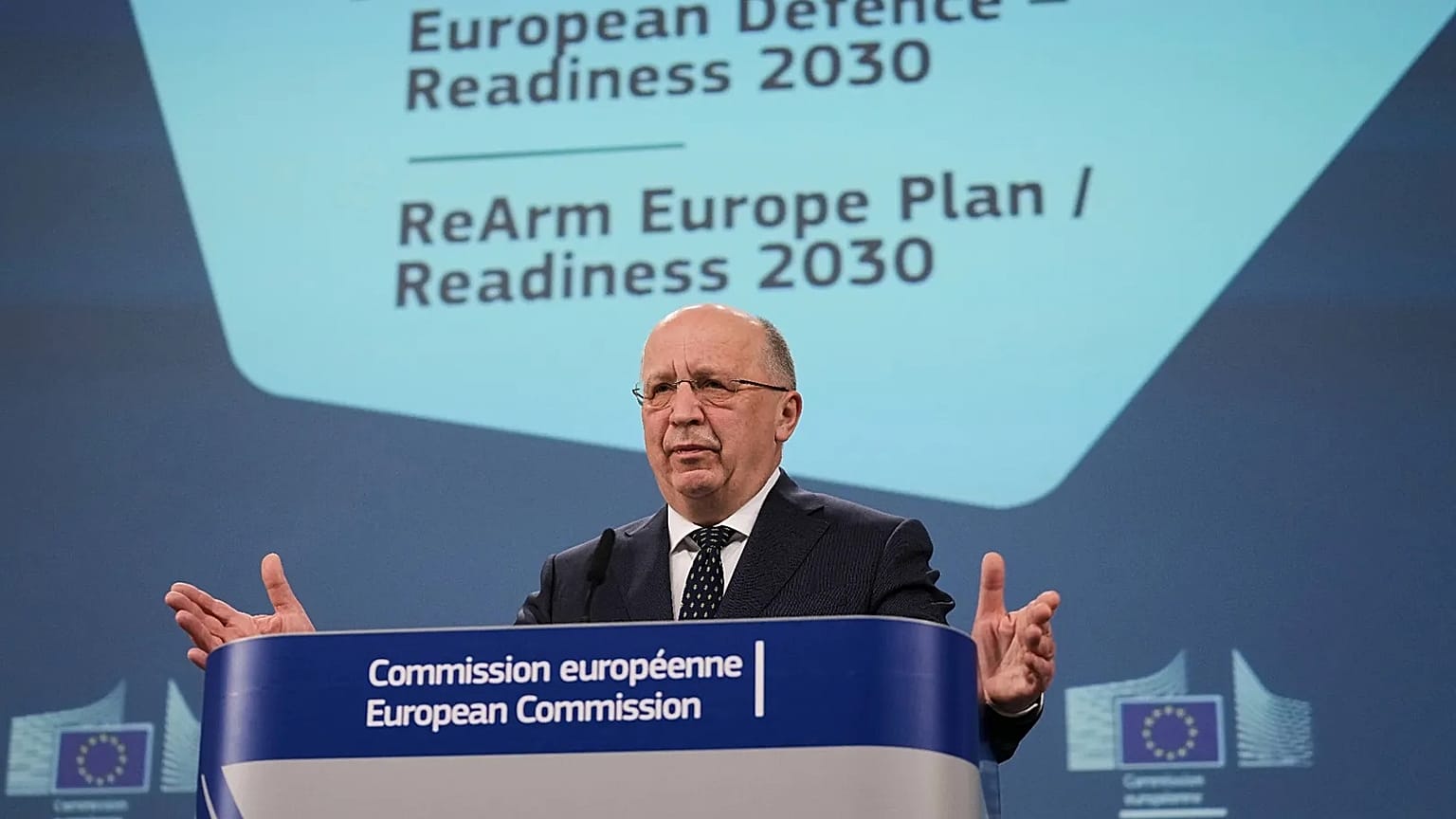
Replacing US military assets will cost Europeans €500bn, EU defence chief says

European Commissioner for Defence and Space Andrius Kubilius speaks during a media conference at EU headquarters in Brussels, Wednesday, March 19, 2025.
Copyright AP Photo

By Angela Skujins
Published on

As the Trump administration continues pulling back from Europe, Andrius Kubilius warned on Tuesday that Europe can only fill the resulting gap with cooperation and a 'big spend'.

The US's ongoing withdrawal of key military assets from Europe will cost €500 billion to replace, European Commissioner for Defence Andrius Kubilius said on Tuesday, warning that the bloc must work together and start producing the “big items” it needs to defend itself – or suffer the consequences.

"We have big defence industrial challenges at the moment for the European Union,” he said at a public event in Brussels. “German experts just recently calculated that it will cost around €500 billion for Europeans to build those strategic enablers and to replace American strategic enablers now located on the European continent."

"We need (a) big change of our policies and practices in defence now."

These assets traditionally include air defence, reconnaissance, strategic airlift and more. The defence commissioner, however, grounded his argument in a paper from the German Kiel Institute that estimates €500 billion will need to be spent over the next decade across 10 key areas.

“Significant progress toward sovereignty can be achieved within 3-5 years, and a high degree of autonomy can be reached in most areas within 5-10 years – provided these are pursued as a political priority through a concerted European effort,” the paper argues.

Kubilius has repeatedly stated that in order to defend itself from foreign aggression, the EU needs to produce more of these capabilities, and faster. There will be a “big amount of money” required, he said on Tuesday.

Various European security agencies have warned that Russia could be ready to attack a NATO ally or EU member state by 2030. The threat has been exacerbated by US President Donald Trump using his second term to retreat further from defending Europe.

The Republican president most recently announced the withdrawal of 5,000 American troops from Germany, which is part of a larger troop withdrawal campaign expected to occur over 6-12 months. Around 80,000 US troops are stationed around Europe under the auspices of NATO.

Tensions between the US and the other NATO allies – 23 of which are also EU member states – have flared in recent weeks over Europe’s reticence to support Washington in its military campaign against Iran.

In late April, German Chancellor Friederich Merz said White House negotiators were being “humiliated” by Iran’s leadership, remarks that were followed by the announcement of US troop cuts in Germany.

US Ambassador to the EU Andrew Puzder recently told Euronews that Trump is “still disappointed” with Europe over its position on the war. Trump himself has gone further and described his NATO allies as "cowards" on social media, vowing to "remember" how they rejected the US army's request for assistance in the Middle East.

Fight or flight

Despite the political will from Brussels to ramp up the bloc's defence output, key questions remain how Europe can support the massive projects required.

Kubilius' comments come a day after Merz and French President Emmanuel Macron announced that Europe’s flagship European defence project, the Franco-German Future Combat Air System (FCAS) programme, has been abandoned.

The programme was launched in 2017 to replace France's Rafale jets and the Eurofighter planes used by Germany and Spain. It was to be complemented by drones, sensors and digital communications systems designed to operate together in a networked battlespace.

The project was seen as a key test of European efforts to work more closely on defence as they seek to present a united front in the face of a hostile Russia at a time of souring ties with the US.

Asked by Euronews whether pan-European defence cooperation is achievable and whether FCAS's failure augured ill for future projects, European Commission spokesperson Thomas Regnier said the EU executive would not comment on specific projects.

But the EU's innovative funding options, particularly the Security Action for Europe (SAFE) funding program, would help, Regnier said.

“This is a top priority identified by Commissioner Kubilius and also the (European Commission) President Ursula von der Leyen herself,” he explained.

The European Commission has earmarked roughly €150 billion for loans as part of the programme, aiming to ensure that national governments are spending enough on their defences. The goal is to ensure that if the US continues to pull back and Russia comes knocking by 2030, Europe will be ready.

“Joint procurement is pretty much alive, and again, the success of SAFE speaks for itself,” Regnier said. Eighteen applications have been approved by the Commission, with five loan agreements finalised.


Airbus-led group proposes fighter jet alternative after French-German project fails


By Doloresz Katanich
Published on

The FCAS programme had been viewed as a flagship European defence project, aimed at strengthening military cooperation as Europe faces a more assertive Russia.

A consortium led by Airbus has proposed developing a next-generation fighter jet after the collapse of a high-profile Franco-German warplane programme, one of the companies involved told the AFP news agency on Tuesday.

The move comes a day after German Chancellor Friedrich Merz and French President Emmanuel Macron ended the original project following years of disagreements between the industrial partners.

Munich-based defence electronics company Hensoldt said it had joined forces with Airbus Defence and Space, Autoflug, Diehl Defence, Rohde & Schwarz, Liebherr, MBDA and MTU Aero Engines to draw up an alternative plan.

A company spokesperson said the proposal had been submitted to German Defence Minister Boris Pistorius. The Financial Times, which first reported the initiative, said it had also been sent to Merz's office.

The companies have "jointly drawn up a position paper on the Future Combat Air System (FCAS) and the associated Next Generation Weapon System (NGWS)," the spokesperson said.

More details are expected on Thursday during an announcement at the Berlin ILA Air Show.

A setback for European defence integration

Germany's defence ministry confirmed the proposal's existence. Pistorius said Berlin was assessing "which direction we take."

"We've also been in discussions on this for months with various stakeholders," he added.

Pistorius said the collapse of the original Franco-German project had "pained" him.

"I know how important Franco-German cooperation is in Europe, but ultimately you have to draw a line between head and heart," he said.

The FCAS programme had been viewed as a flagship European defence project, aimed at strengthening military cooperation as Europe faces a more assertive Russia and increasingly strained relations with the United States.

However, the initiative was hampered by long-running disputes between France's Dassault Aviation and Airbus, the lead industrial partner for Germany and a major partner for Spain in the FCAS programme.

German partners opposed efforts by Dassault to assume greater control over building the aircraft.

Merz has also argued that Germany, unlike France, does not require fighter jets capable of carrying nuclear weapons or operating from aircraft carriers.


LA REVUE GAUCHE - Left Comment: Search results for PERMANENT ARMS ECONOMY


Albania protests against Kushner-linked resort enter 10th day

Albania protests against Kushner-linked resort enter 10th day
/ Lëvizja BASHKË via Facebook
By bne IntelliNews June 9, 2026

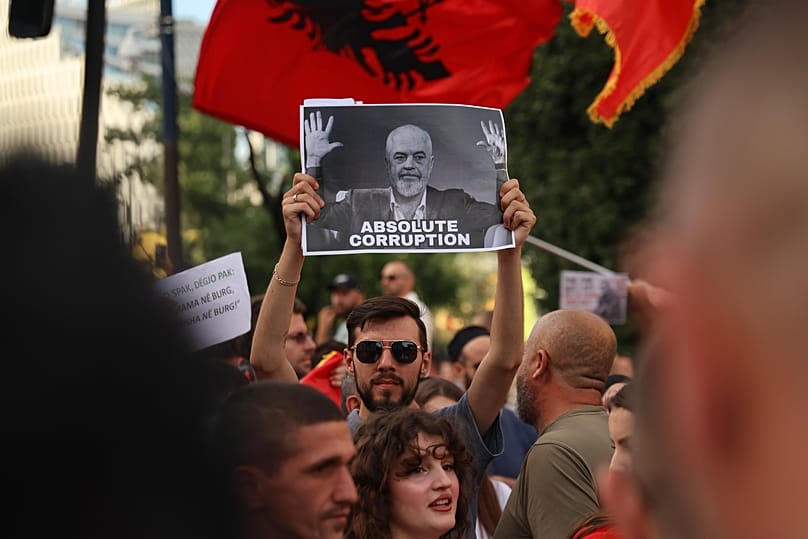
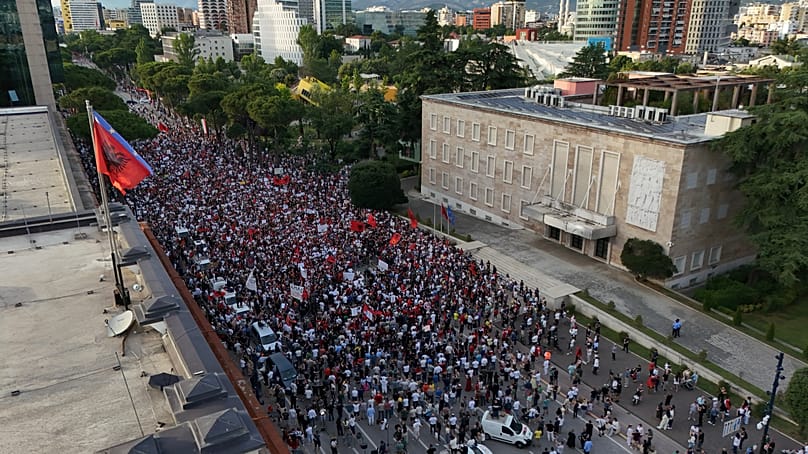
Demonstrators marched through the streets of Tirana on June 9 after gathering outside the prime minister's office, extending protests against a planned luxury tourism development linked to Jared Kushner, US President Donald Trump's son-in-law, into a 10th consecutive day.

What began as a local campaign against a proposed tourism project in the coastal area of Zvërnec has evolved into a broader protest movement targeting Prime Minister Edi Rama's government. 

Protesters chanted slogans including "Rama in prison, [opposition leader Sali] Berisha in prison" and called for the government's resignation.

The protesters have presented five demands: the resignation of the government, the repeal of legislation governing strategic investors, the cancellation of the so-called Mountain Package, the reversal of amendments to the Law on Protected Areas and the repeal of changes to the Law on Cultural Heritage.

Speaking from a stage outside the government headquarters before the march began, activist Alben Kola urged supporters to continue their campaign.

"It is important to be patient, even though this battle will last several days," Kola said, as reported by Top-Channel TV, adding that Albanian diaspora communities were organising support for the demonstrations.

The protests have been fuelled by opposition to plans backed by a company associated with Kushner to develop tourism projects in the Narta Lagoon area near Zvërnec and on Sazan Island, a former military base off Albania's southern coast.

The Albanian government has granted the investment strategic investor status, arguing that it could attract international capital and boost the country's tourism sector.

Environmental groups and local activists, however, say the developments threaten protected habitats in one of Albania's most important coastal ecosystems. The Narta Lagoon area is a key stopover point for migratory birds and is known for its flamingo populations.

The controversy intensified after video footage circulated online showing a security guard allegedly assaulting a protester near the development site.

Rama acknowledged that the incident had helped broaden public opposition to the project. "This protest was provoked by an ugly act of violence by a security guard against a protester," he told foreign journalists on June 9, according to a transcript posted on his website. 

While acknowledging public concern, Rama argued that criticism of the project had become detached from the facts.

"Something changed because suddenly there is no project," he said. "The protest turned into a mass protest with the refrain 'cancel the project, cancel the project'. I said we are canceling it at this moment, but show me the project. There is no project."

The prime minister has repeatedly defended the development plans, describing them as an opportunity to raise Albania's international profile and attract major investors.

When asked whether the government might reconsider its support for the investment, Rama replied: "Step back from what?"

Rama said Albania's environmental record should be taken into account, pointing to hunting and logging restrictions introduced during his years in office.

"We have fantastic documentation of how the wildlife in Albania came back thanks to the 10 years moratorium of hunting," he said.

The dispute has also attracted the attention of Albania's anti-corruption authorities, which have launched an investigation into aspects of the project, including questions surrounding land ownership and privatisation procedures.

‘Act without delay’: Brussels warns Albania over Trump-linked resort project

By Mared Gwyn Jones
Published on 09/06/2026 - EURONEWS

A spokesperson for the European Commission has said that Tirana must “refrain from actions that could undermine” its bid to join the European Union, amid concerns that a sprawling coastal development linked to Trump’s son-in-law Jared Kushner is in breach of EU environmental standards.

The European Commission has issued a veiled warning to the Albanian government over a €1.4 billion real-estate project linked to US President Donald Trump’s family, as protests over the plans for an ecologically protected area on the Adriatic coast enter their second week.

Responding to a question by Euronews on Tuesday, a spokesperson for the EU executive urged Albanian authorities to “act without delay” in order to avoid jeopardising the country’s bid to join the EU, which will require it to align with the bloc’s environmental rules.

“Albania should refrain from actions that could undermine the fulfilment of the closing benchmark, in this case Chapter 27, and so we expect the Albanian authorities to act without any delay,” spokesperson Guillaume Mercier said, referring to the chapter of EU accession talks which requires a candidate country to align with environmental rules.

He added that the Commission has “expressed concerns to (Albania’s) Minister of the Environment about the potential shortcomings of the project,” and that the minister had assured Brussels that construction work has been “suspended”.

Yet Albania’s Prime Minister Edi Rama has defended the project, telling Euronews on Friday that resistance to the plans formed part of a “hybrid war” wielded by actors that are “using the sentiments of some well-meaning people about the environment.”

Demonstrators have gathered in Albania’s capital of Tirana and the protected Vjosa-Narta lagoon on the country's Adriatic coast for the past nine days, demanding the cancellation of a luxury real-estate project planned for an ecologically protected coastal area.

The pink flamingo, one of the species threatened by the plans, has emerged as a symbol of the resistance, with protesters seen wielding inflatable versions of the animal, many of them calling for Prime Minister Rama’s resignation.

The plans would involve two protected areas: the Narta Lagoon area, a wildlife reserve, and a smaller resort on the uninhabited island of Sazan. Affinity Partners, the investment firm behind the project which has been granted special access by the Albanian authorities, is linked to Trump’s son-in-law, Jared Kushner.

His wife, Trump’s daughter Ivanka Trump, described to an US podcast show last week how she and her husband had discovered Sazan island.

“We were on a friend’s boat, and we stopped for a swim. Effectively, that’s how we found it,” Ivanka Trump said. “We swam to the island. We went on a hike, barefoot all the way up to the top, and we were just captivated.”

‘Concerns are not new’

A 2015 Albanian law on strategic investments, which Brussels has long called for to be scrapped, is believed to have made it possible for the investment firm linked to Kushner to acquire special authority.

In its annual temperature check of candidate countries’ progress towards becoming EU members last year, Brussels raised concerns about an amendment made to the law in February 2025 which included special exemptions for any investment worth €50 million or more.

“While these measures are designed to boost economic activity, they have also raised concerns about transparency and equitable access, favouritism and lack of competitive processes,” the Commission’s report said.

In the same report, Brussels cautioned Albania against amendments to a law on protected areas which had led to the “unravelling of their protection”, raising concerns over environmental crimes.

Crucially, Albania is considered a frontrunner behind Montenegro in its bid to join the EU. Accession negotiations, which are split into 33 chapters under four thematic clusters, are currently ongoing, including on the chapter related to environmental standards.

Closing the chapter will be critical if the country is to sustain its momentum in its accession bid.

The project is currently being probed by Albania's independent anti-corruption and anti-mafia prosecution body, SPAK. The agency is believed to be investigating changes made to a 2024 Albanian law which removed long-standing protections from the country’s most sensitive ecosystems.


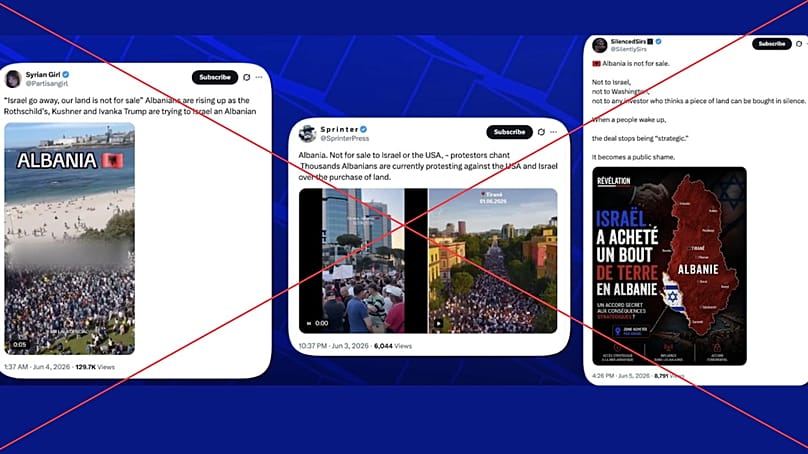
Amid widespread protests, Albanian island project also sparks flood of fake claims


By Estelle Nilsson-Julien & Noa Schumann
Published on

The heated controversy surrounding the multi-billion-euro property development project across various Albanian beauty spots has triggered a stream of misleading online claims.

A raft of false claims has emerged around the controversial Albanian property development project linked to Donald Trump's son-in-law, Jared Kushner, concerning the uninhabited island of Sazan, as well as an area of the Vjosa-Narta coastal landscape.

Supporters say the project could boost tourism and investment. Critics argue it risks damaging one of the country's most important natural habitats, as well as selling the country out to foreign investors.

Among the false allegations, one video circulated across social media claimed to depict the home of Albania's prime minister, Edi Rama, burning during the protests in the country.

In reality, the footage can be traced back to February 2026 and displays protesters linked to the Democratic Party burning the former villa of Enver Hoxha, the communist leader who ruled Albania for more than 40 years.

One of the most widely circulated claims alleges that the Albanian real estate project is backed by or tied to the state of Israel.

However, there is no available information to support these theories, which have been fuelled by misleading connections with Kushner's Jewish background, his past role in peace negotiations between Israel and Hamas, and investments by his hedge fund Affinity Partners in Israel.

Social media users have falsely alleged that the state of Israel is behind the real estate project
Social media users have falsely alleged that the state of Israel is behind the real estate project X

One widely circulated social media image depicting a barbed-wire fence, with two flags — one Israeli and one Albanian — has been presented as a new border on the Zvërnec Island. This is false; in reality, the image was digitally manipulated to include the signs with the flags denoting the supposed border.

Other videos claim to show "Israeli settlers" taking over land in Albania, who are chased out by locals. The viral social media clip actually shows protestors in northern Albania, protesting against a separate luxury resort in Baks-Rjoll in Velipojë, and dates back to February 2026.

Prime Minister Rama also denied false allegations that the development project is part of a plan to relocate Palestinians — a claim which has repeatedly surfaced over the years.

He told Euronews, "There is a narrative in the whole thing that this is about a hidden deal between [Israeli Prime Minister] Bibi Netanyahu and I, through Jared Kushner, to bring the Palestinians in that part of Albania, which is a total fantasy."

Amid the misinformation, the resort project backed by Kushner's Affinity Partners firm has sparked a real anti-corruption probe.

Albania's anti-corruption prosecutor has opened an investigation into controversial legislation voted in 2024, loosening protections around the country’s most sensitive ecosystems.

Specifically, the investigation centres on the rapid regulatory approvals, potential fraudulent property titles, and questionable land transfers tied to the project, which is slated for the ecologically sensitive Vjosa-Narta wetland area — an important habitat for nesting sea turtles and migratory birds


Albania's PM posts AI video of himself in miniskirt in swipe at online influencers

Screenshot of an AI video Albania's Prime Minister Edi Rama posted on Instagram, 8 June, 2026
Copyright Instagram/ediramaal

By Gavin Blackburn
Published on

In a speech, Rama argued that many influencers make money by promoting themselves on social media while paying no taxes to the state.

Albania’s Prime Minister Edi Rama reposted an AI video of himself wearing a leather mini skirt and bra on his Instagram profile in an apparent swipe against influencers.

“Whoever made this, well done,” he wrote in the post accompanying the video.

The video refers to remarks Rama made during a public event on 7 June, where he mocked bloggers and influencers who supported ongoing protests against a controversial luxury development linked to Donald Trump’s son-in-law Jared Kusher, part of which is due to be built in a conservation area.

In that speech, Rama argued that many influencers make money by promoting themselves on social media while paying no taxes to the state.

Rama said that “bloggers should challenge each other, one dressed as a flamingo and another dressed as me and see who wins.”

Protesters have carried cardboard cut-outs of pink flamingos, one of the protected migratory bird species, at rallies in the capital Tirana.

Earlier, Rama claimed that influencers joined the protests mainly for attention and lacked a real understanding of the situation.

The government says the development on the Adriatic coast would be transformational for the former communist nation as it seeks to enter the high-end tourism market and pushes for European Union membership.

But the venture, spanning a protected island and a nearby stretch of seafront on Albania’s southern coast, has drawn opposition from environmental campaigners and critics of long-time Socialist Prime Minister Edi Rama.

The luxury project has two components: a coastal development in the Narta Lagoon area, which is a wildlife reserve, and a smaller resort on the nearby uninhabited island of Sazan, a communist-era military base.

Protesters with a poster depicting Prime Minister Edi Rama take part in a rally in Tirana, 6 June, 2026
Protesters with a poster depicting Prime Minister Edi Rama take part in a rally in Tirana, 6 June, 2026 AP Photo

The planned development of hotels, apartments, villas and a marina is linked to Kushner and Trump’s daughter, Ivanka Trump.

An investment firm linked to Kushner has been granted special investor status by Albanian authorities.

Albania has 450 kilometres of coast that remained largely underdeveloped during decades of communist rule.

Protest groups fear the sections of that pristine coastline could be snapped up by powerful investors. And public anger grew after video showed an activist being dragged by a private security guard while demonstrating at the site.

The development is planned within a nature reserve and one of Albania’s most valuable biodiversity areas, a key stopover for migratory birds along the Adriatic coast.

Protesters take part in a rally in Tirana, 6 June, 2026
Protesters take part in a rally in Tirana, 6 June, 2026 AP Photo

Since late May, excavators and other heavy machinery have entered the area, opening access routes, digging into the sand, clearing land among pine trees and installing fencing.

Environmental groups from Albania and elsewhere in Europe condemned the work, with one prominent local group charging that long-protected habitats are being "irreversibly destroyed.”


Encrypted Chats Expose Kosovar Organised Crime Network Behind EUR 80 Million Criminal Empire

June 10, 2026 
By Eurasia Review

Messages exchanged on the encrypted communication platform SKY ECC have exposed a Kosovar-based organised crime network in large-scale drug trafficking, the use of fraudulent IDs, illegal possession of weapons, and money laundering across Europe, Europol said

The intelligence gathered during a three-year investigation culminated on 9 June in a coordinated action day in Kosovo*, where authorities arrested five key members of the criminal organisation. Some 150 officers were deployed on the ground, supported by a Europol expert.

The organised crime group used an encrypted communication platform to coordinate drug trafficking activities across several European countries while maintaining its operational centre in Kosovo*. From there, senior members directed criminal activities, coordinated international drug shipments, and managed the laundering of illicit profits.

The action marks the latest phase of a long-running investigation supported by Europol under Operational Taskforce (OTF) LIMIT, which targets Sky ECC criminal encrypted communications.

Encrypted communications reveal the network’s inner workings

The investigation relied on the analysis of large volumes of intelligence, including criminal communications exchanged via encrypted platforms.

By combining this intelligence with operational information gathered across multiple countries, investigators identified key members of the network, map its criminal infrastructure and trace financial flows linked to drug trafficking activities.

A data-driven investigative approach was central to the operation. Europol analysts worked together with specialists from the Kosovo* Police at Europol’s headquarters, analysing intelligence, and identifying operational links between suspects, criminal activities and criminal assets spread across several jurisdictions..


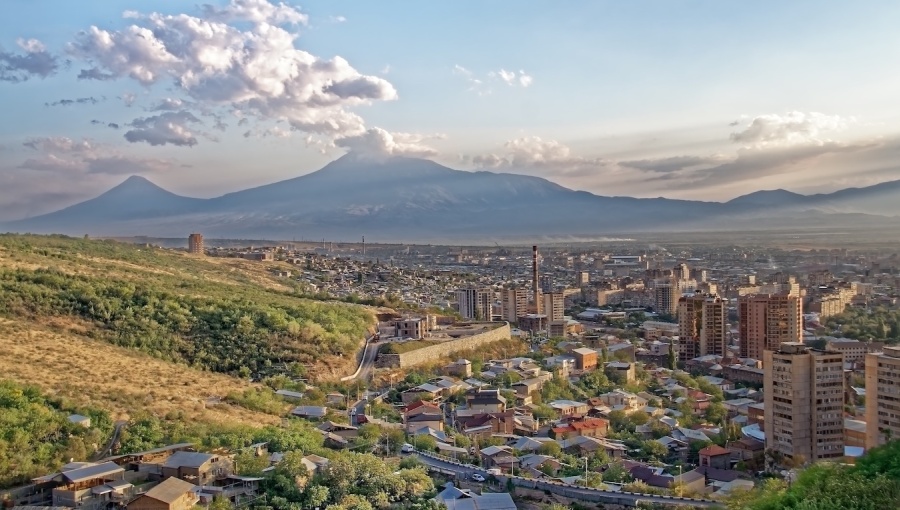
Armenia accelerates trade shift toward EU after Russian pre-election pressure

Armenia accelerates trade shift toward EU after Russian pre-election pressure
/ Image by Makalu from Pixabay
By Clare Nuttall in Glasgow June 9, 2026

Armenia is stepping up efforts to redirect trade towards the European Union after Russia imposed a series of import restrictions on Armenian products ahead of parliamentary elections that returned Prime Minister Nikol Pashinyan to power, while Brussels has signalled support for deeper economic integration with the South Caucasus country.

Relations between Yerevan and its traditional ally Moscow remain strained, following a pattern seen in Moldova, where Russian trade restrictions and political pressure ultimately helped push exports toward the EU. The European Union has become Moldova's largest trading partner, including for businesses in the pro-Russian breakaway region of Transnistria.

European Council President António Costa on June 9 congratulated Pashinyan on his election victory and pledged continued support for closer ties.

According to the Armenian government, Costa told Pashinyan in a telephone conversation that the EU would deepen cooperation with Armenia in energy, trade and digitalisation. He said Armenian voters had chosen "a future based on peace, stability, and closer cooperation with their neighbours and the international community."

The call came as Armenian officials disclosed progress toward expanding access for Armenian goods to European markets.

Foreign Minister Ararat Mirzoyan said Armenia and the EU had reached a political understanding on exports and were moving toward implementation.

"There is a common political understanding between Armenia and the EU, a common political agreement and consensus. We are entering the technical formalisation stage," Mirzoyan told lawmakers, Arka reported.

The government has already approved support measures aimed at helping exporters diversify away from dependence on a single market. New programmes include assistance for greenhouse producers exporting tomatoes, peppers, strawberries and flowers, as well as compensation for customs duties on exports of fruits, vegetables and flowers to EU countries, the UK and Canada.

The push comes after Russian authorities imposed restrictions in recent weeks on a range of Armenian exports, including flowers, fruits, vegetables, dried fruits, fish products, mineral water, wine and brandy. Moscow cited phytosanitary and veterinary concerns and also restricted some transit shipments moving through Russia to other members of the Eurasian Economic Union.

Armenian officials have responded by seeking alternative markets. At the same time, Yerevan is pursuing new regional trade routes. Mirzoyan said a recent meeting between Armenian and Turkish business representatives in the eastern Turkish city of Kars had generated strong interest from Turkish companies.

The government's economic diversification drive has received additional momentum from the parliamentary election held on June 7. Preliminary results showed Pashinyan's Civil Contract party winning nearly 50% of the vote, securing a new mandate despite criticism from opposition parties, which alleged irregularities and said they would challenge the results.

The election outcome is likely to reassure European officials who have increasingly viewed Armenia as a partner in a strategically important region between Europe, Russia and the Middle East.

Armenia is also deepening ties with the United States. Yerevan and Washington recently signed a framework agreement for the Trump Route for International Peace and Prosperity (TRIPP). Pashinyan described TRIPP as a billion-dollar project that could attract substantial investment and strengthen Armenia's role as a regional transport hub.

For Brussels, the deepening relationship with Armenia mirrors developments in Moldova, where Russian economic pressure and restrictions on exports accelerated the country's reorientation toward European markets. Despite its longstanding links to Russia, even businesses in Transnistria have increasingly relied on access to EU markets under arrangements negotiated through Moldova.

Armenian officials are now pursuing a similar diversification strategy in the hope it will reduce the country's vulnerability to external economic pressure while opening new opportunities for exporters and investors.

Quad Launches Maritime Surveillance, Critical Minerals Initiatives


QUAD Foreign Ministers meeting with Australia's Penny Wong, India's Dr. S. Jaishankar, Japan's Motegi Toshimitsu, and the United States's Marco Rubio. Photo Credit: State Department, X


June 10, 2026 
By Indo-Pacific Defense Forum


The members of the Quadrilateral partnership — Australia, India, Japan and the United States — will enhance regional maritime surveillance, bolster critical minerals supply chains and expand port infrastructure, including in the South Pacific, under initiatives unveiled in late May 2026.

Australian Foreign Minister Penny Wong, Indian External Affairs Minister Subrahmanyam Jaishankar, Japanese Foreign Minister Toshimitsu Motegi and U.S. Secretary of State Marco Rubio announced the Indo-Pacific Maritime Surveillance Collaboration (IPMSC) to increase information sharing and maritime domain awareness capacity.

The leaders expressed ongoing concern over tensions in the East China and South China seas, where China’s coast guard and maritime militia routinely harass civilian and government vessels operating lawfully in their respective nation’s internationally recognized maritime zones. “We reiterate our strong opposition to any destabilizing or unilateral actions including by force or coercion that threaten peace and stability in the region,” they stated after meeting in New Delhi.

The IPMSC initially will focus on the Indian Ocean and incorporate emerging technology and simulated exercises. “Developments in key maritime regions have underscored the vulnerability of critical sea lanes and the risks posed to the uninterrupted flow of commerce,” the ministers said. “These challenges carry significant implications for the Indo-Pacific, which remains central to global trade and connectivity.”


The Quad’s inaugural port project in Fiji, an island nation of about 900,000 people, highlights the partnership’s emphasis on infrastructure resilience, particularly in a strategically important region where China has sought to gain a foothold, including through predatory lending practices and development pacts that have saddled host nations with debt.

Similarly, the new Quad Critical Minerals Framework will bolster supply chains for mining, processing and recycling rare-earth elements (REE), which are essential for producing components used in civilian and military technologies including electric vehicles, satellites and missile systems. Plans include leveraging up to $20 billion in public and private sector support.

China controls 60% of global REE production and 90% of mineral refining, according to the International Energy Agency. Analysts say Beijing wields its monopoly for economic and political coercion, including recently limiting access for 20 Japanese companies to REEs and other dual-use materials.

The New Delhi meeting was “an opportunity to send an unwavering message that the Quad will advance concrete cooperation,” Motegi said at a joint news conference, The Japan Times reported.

“There is great alignment between our interests,” Wong said, according to The Associated Press. “We all share a vision for the Indo-Pacific, a region that is free and open.”

The leaders said they will work with regional partners in four key areas: maritime and transnational security, economic prosperity and security, critical and emerging technologies, and humanitarian assistance and emergency response.

“In the midst of conflicts, geopolitical tensions, and strains on global supply chains, we reaffirm that peace, stability, and prosperity of the Indo-Pacific hinges on upholding international law, and the peaceful resolution of disputes,” they said. “We recognize the immense potential of innovation, emerging technologies, and trusted partnerships to drive economic prosperity across the Indo-Pacific and beyond.”


This article was published by Indo-Pacific Defense FORUM

About Indo-Pacific Defense Forum
Indo-Pacific Defense Forum is sponsored by the United States Indo-Pacific Command (USINDOPACOM) and publishes daily online articles, daily social media updates and a quarterly magazine to provide timely updates on the Indo-Pacific security environment.
View all posts by Indo-Pacific Defense Forum →