Monday 15 June 2026, by David Finkel
THE SADISTIC SAVAGERY of the Trump regime’s starvation-and-regime-change assault on Cuba comes into relief when you look at the surrounding circumstances and context.
The controversies within the left over the character of the Cuban government and state are irrelevant to the brutality that the United States is practicing. It’s the U.S. imperialist state and government that need to be on trial.
That’s the state and Trump regime that brags of blowing up more than 50 boats in the Caribbean and eastern Pacific, on the lying pretext that they were “running drugs,” killing close to 200 people including victims of “double-tap” bombings — probably fishing vessels in most cases — without a shred of evidence, let alone judicial process.
That same regime has now indicted Cuban former president and defense minister Raul Castro in the shootdown of Cuban exile “Brothers to the Rescue” planes three decades ago.
It’s nothing to do with justice or any national security threat, but raw imperial power exercised under the “Donroe Doctrine” of a floundering U.S. presidency, combined with the zealotry of Marco Rubio’s savior-complex obsession over “rescuing Cuba from communism.”
That arrogance was on full display with the kidnapping of Venezuelan ex-ruler Maduro. Trump expected to duplicate that triumph in Iran — overlooking the detail that Tehran had the capacity to fight back. (Admittedly, those of us who knew that Trump’s tariff idiocies and tax cuts would damage the U.S. economy underestimated his potential to crash the whole world economy.)
Hemispheric Ruin
More broadly, the U.S. assault on Cuba is an intended warning to any present or future progressive movements or governments in Latin America. Today, the lives of Cuban children, women in pregnancy and those needing health care, dying from the lack of electricity and medical supplies are human sacrifices on the altar of imperial rapacity and ideology.
There was a time when post-revolutionary Cuba presented some kind of radical challenge to U.S. hegemony, or at least what was called Cuba’s “threat of a good example” with its advanced educational and public health achievements. In all honesty, such a “threat” ended long ago with the defeat of the 1980s Central American revolutions and then the 1991 dissolution of the Soviet Union.
The ensuing 35 years, beginning with the early 1990s “special period” of austerity and hardship, have seen a struggle to preserve Cuba’s independence and economic viability under conditions of constant menace, as well as waves of emigration. The events of the shootdown of the exile-flown planes in 1996 occurred in that context.
Those Brothers to the Rescue flights, whatever humanitarian assistance they may have provided to refugee boats in the early 1990s, were also deliberate provocations against Cuba’s sovereignty. They had murky connections with the CIA and FBI, some of which were revealed by Cuban government operatives who infiltrated the group.
By 1996, entering Cuban airspace and dropping leaflets over Havana, they were engaging in a game of Chicken that ended tragically.
Did that justify the Cuban air force blowing small civilian planes out of the sky? In my own opinion, clearly not — whatever malicious mischief or performative defiance they may have intended, those flights were no imminent security or military threat.
Cuba certainly had non-lethal methods of intercepting them. And the political impact was destructive, resulting in even tighter anti-Cuba sanctions by “bipartisan” agreement of the Clinton administration and Republican congressional leadership
Was the shootdown perhaps worthy of an independent investigation? Maybe so — in a different world with a body competent to perform it. In the real world, the United States government and judicial system are no such entity, and have no right to prosecute Cuba or its officials for this or any other case. U.S. imperialism should be the defendant.
There are Cuban exiles, and not only extreme right-wingers, who think that Trump and Rubio will “liberate” the island. They ought to have a look at Venezuela, where Maduro’s post-Chavista police-state regime remains in place under new Washington-client leadership and the miserable conditions of life persist.
The intention of the assault on Cuba is part and parcel of the effort to subjugate all of Latin America to multinational and especially U.S. corporate domination and privatization, democracy be damned. It is a fast-track road to hemispheric ruin, which makes the stakes especially high.
28 May 2026
Source: Solidarity webzine.
David Finkel
David Finkel is an editor of Against the Current, published by the US socialist organization Solidarity (www.solidarity-us.org)
.png)
Visiting Cuba 2026 — A Critical Point
Monday 15 June 2026, by Robert Bartlett
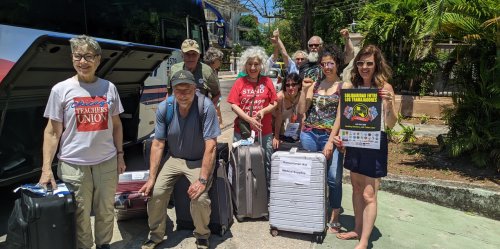
I VISITED CUBA over the 2026 May Day week with a delegation from Building Relations with Cuban Labor. The effects of the 65+ year U.S. embargo and recent blockade of oil were everywhere to be seen. [1]
The airport was practically empty with only one terminal open and another closed due to the lack of aviation fuel necessary to refuel planes, other than those who could carry enough fuel to do a round-trip visit. Canada was one of many countries whose airlines cancelled travel to Cuba, curtailing tourism and its income. Other countries are similarly affected.
The Cuban Revolution is today under the most serious threat since the Bay of Pigs invasion of 1961. That was defeated, but the U.S. intention to overthrow or cripple the Cuban government has never ended, no matter whether Democrats or Republicans are in power. Today the economic pressure exerted against the entire country is reaching a critical point with military action a real possibility.
The tourist industry is practically shut down. This has dramatically decreased one of the main sources of foreign currency needed to buy products on the international market.
Along with the embargo on oil shipments the Trump administration has escalated the pressure by threatening sanctions on companies who continue to invest in Cuba and now have pressured the bank that was processing Visa and Mastercard transactions in Cuba to cease operations.
Two Spanish resort chains Iberostar and Melia, which operated 12 and 15 hotels respectively, just announced they are withdrawing from their partnership with GAESA, a Cuban governmental institution. Blue Diamond, a Canadian company which according to the New York Times ran dozens of hotels, is also leaving.
On the streets of Viejo Havana, a tourism magnet of colonial buildings and maze of restaurants and hotels, was practically deserted. The people who would drive visitors around in their 1950 vintage cars were mostly absent, and restaurants that would normally be open were closed along with music clubs that cater to tourists.
It had the feeling of a ghost town, but one in which the population was still present.
Due to the blockade on Venezuelan oil, traffic was sparse and electric vehicles and motorcycles were more numerous than gas ones. On the major highway traversing the island there were few cars, fewer buses and trucks. The oil shortage has wreaked havoc on the necessary mechanisms to move people and goods.
Power Outages and Daily Life
Power outages are regular in all areas of the island and probably longer in rural areas. In the town of Viñales, which we visited, power might be on for less than half the day and people will charge electric vehicles and batteries while they can. I saw no gas stations that were open during a ten-day period.
Some people, a minority, who have been fortunate enough to have solar panels, use them to supply their houses in the day and store energy in batteries for the periods when power is out.
Prices have risen, and the exchange rate for access to U.S. dollars has climbed to over 500 pesos to a dollar on the informal market. Access to dollar stores which supplement the basic food supplies that are available in monthly rations are reduced accordingly.
The average base salary according to people we talked to is roughly 3000 to 4000 Cuban pesos (between $6 to $8 a month), which doesn’t go far. This has led many people we talked with to have to work three or even four jobs to survive. This has amplified the effects of this long policy of economic starvation.
What Do People Think?
First, there is no hesitancy to speak freely about the difficulties that they are facing individually and what they would like their lives to be like. During our trip we met with artists, workers in the privately owned restaurant industry, medical people and leaders of various institutions across health, biotechnology, education and farmers, as well as our host families in Viñales.
Not being fluent but able to have limited conversations in Spanish, and longer ones with people whose English was better than my Spanish, along with conversations that other members of our delegation shared, gave a similar picture.
People have dreams of a better life, but confront a daily reality where they think their dreams could probably more likely be achieved in other countries. Younger people wished to be able to travel and believed that their lives could be better in another country, Europe being a destination mentioned frequently.
Austerity and Migration
An urban planner who gave our delegation a history of Cuba from Colonial days to the present gave some context when he talked about the effects of the collapse of the Soviet Union in 1990 on the economy, and the beginning of the first “special period” and significant emigration from Cuba.
He stated that 65% of the migrants over the past ten years are from Havana and most are well educated. That is striking and alarming as some of the best educated people don’t see a future under the present conditions of austerity.
This is a reality, and people’s expressions of what to do range from those who don’t see life improving in the foreseeable future and thus want to leave, to those who just want the suffering to stop no matter how.
In one extended conversation I had with a university-educated server in a restaurant, he stated that he was not supportive of the United States but critical of what he said were inequalities within the Cuban system where those with resources have ways of gaming the system. He was dismissive when I brought up some of the achievements of the revolution in terms of education, literacy and health care.
It is unwise to generalize from a small sample of society, but I have the impression that the economic impact of the last 35 years has been one of erosion of the major gains of the revolution in bringing a country from subservience, illiteracy and exploitation by foreign ownership, an economy that was dominated by sugar production and the unsavory mob influence in Havana.
Socialism in One Country?
Being in Cuba reminded me of visiting Nicaragua before and during the U.S.-funded-and-directed Contra war. Two years before the counter-revolutionary war began, investments were being made in schools, clinics and other social services that had only previously been available to a small slice of society.
After the war started, the effect of having to divert resources to defending the revolution was evident from what was attempted in 1980 through 1982.
The effects that I could see in Cuba are due to the lack of access to resources available on the world market and denied either directly by the United States or indirectly through Washington’s economic and political threats to other countries willing to trade with Cuba.
All small, underdeveloped countries face daunting challenges in trying to compete with larger countries whose industrial capacity and economies of scale are more efficient than what any small country can muster.
This makes them dependent on trade and purchase of goods which can’t be manufactured locally. This leaves any small country, socialist or not, subject to market pressures and the inequality of selling low while buying high for value-added products.
An example is the Biotechnology research center. Cuba is rightfully proud of being able to develop medicines and vaccines, but limited access to the international scientific community through conferences, and the inability to afford the latest technologies – like automated gene sequencing, reverse transcription technology, the restriction enzymes used to produce the new RNA vaccines — makes developing new medicines slower.
These are products difficult to manufacture and expensive to buy. While using dated technology is still effective, it also hobbles production and incentivizes scientists to pursue other options like emigration.
Compromises to Survive
The challenges that Cuba faces in the face of an economic blockade are many and have led to coping mechanisms to withstand the pressure. A basic divide in Cuban society is between those who have access to either the tourist industry or remittances from relatives who live outside Cuba, and those who don’t.
Many people have family who have emigrated and send money back to Cuba, while fewer have a direct connection to the now diminished tourist economy where daily tips at a restaurant or hotel can equal the monthly salary of school teachers or doctors. Those with dollars can supplement their diet through access to dollar stores, while those without are even more dependent on auxiliary income through multiple jobs.
The economy since the collapse of the Soviet Union has evolved into parallel state and private sectors. While the private one based upon tourism injects significant money into salaries and helps the state sector continue to subsidize basic food allowances, healthcare and education, it is vulnerable to the pressure of U.S. actions and also can lead to resentments over the inequality present with the dual systems.
Ending the economic blockade would allow the Island to restore sources of hard currency like tourism and even barter arrangements where doctors could provide health care in other countries so that oil and other products in short supply in Cuba could be purchased. That would restore public transit, which is needed for many to go to work.
It is hard to assess just how soon real access to materials would begin to restore production and alleviate some of the most grievous effects the population is suffering. On the long term a continued conversion of the energy sources from oil to solar and other renewables will take a long time and most easily achieved by purchases from China, thus once again reliant on hard currency.
Agriculture is an industry that faces challenges as well. Life on a farm is demanding in every country and people can have easier lives in cities, yet dependence on agricultural imports should be minimized.
The too-long dependence on sugar sold or bartered on the world market delayed addressing self-dependence for food. In the rural town we visited, our host now goes to their field via a horse cart, not a car.
Lack of fuel renders much machinery useless and makes it difficult to get to a market. In the long run sustainable agriculture, renewable energy production and the further development of a balanced economy are essential goals; they will not be advanced by any surrender to U.S. economic and possible military actions.
Cubans want solutions to this dilemma and short of international counter-pressure and willingness to break the blockade, an internal dialogue among all Cubans on the future of the revolution needs to be part of a solution. And for us, of course, the urgency of stopping this strangulation of Cuba is critical.
May 2026
Source: Against the Current.
Footnotes
[1] Photo: The Building Relations with Cuban Labor delegation brought medical supplies collected by Not Just Tourists.
Robert Bartlett
Robert Bartlett was a science teacher who taught in the Chicago suburbs. He is an associate member of the Caucus of Rank and File Educators. Since his retirement in 2018 he has been part of a Solidarity Squad to help teachers preparing to strike.