
My AI Comrade

Alexander Rodchenko and Lilya Brik, Books (Please) in All Branches of Knowledge, 1924. (Public domain)
A few recent AI queries
1) I strained my back lifting a bag of potting soil. What now?
2) Is autarky possible in the U.K?
3) The gauge on our gas boiler is in the red zone. Will it blow up?
4) Did Fritz Lang like Joseph Losey’s 1951 remake of his film M?
5) Can frogs survive in the pond on the terrace of our 2nd floor flat in Norwich?
(See answers at end of column.)
AI then and now
When Chat GPT was launched in November 2022, a million years ago, many journalists said it was over-hyped. Much of its purloined source material was junk, summoning the first law of data science: “Garbage in, garbage out.” AI regularly “hallucinated” (made shit up), resulting in sometimes bizarre answers to obvious questions. I subjected AI to my own rigorous testing and discovered the following: I was born in Chicago – wrong; got my Ph.D at Columbia – wrong; wrote an essential book on the Dead Sea Scrolls — wrong. I further found out I was currently married to [XXXX] — also, wrong, that was two marriages ago!
When I wrote about Chat GPT for CounterPunch in March 2023. My verdict was harsh:
The new Open AI Chatbot is good for nothing more than reproducing words and ideas that already exist. Like all search engines, AI lives and dies by its algorithms….[It is] therefore the epitome of cliché…. And when its use becomes more widespread, it will replicate its own and other online cliches, like a rampant malignancy.
My logic was irrefutable, but it turns out I was wrong. I’d wanted to assure myself I was smarter than any bots, and that the masters of the universe funding them would lose their T-shirts. Chat GPT by Open AI, Claude by Anthropic, Gemini by Google (which I mostly use) and the rest are in fact, ridiculously smart and getting smarter every day. Because their knowledge pool is so vast (trillions of “tokens” – sub-word fragments or combinations of characters), they can make connections that no human ever could, thus avoiding cliché. Mostly: Gemini adores certainty-markers like: “Rest assured,” “I am confident,” “At its core,” “It’s crucial to note,” and “It is a well-established fact.”
The problem with AI today is not that it often hallucinates; it’s that it hardly ever does and is therefore quickly becoming indispensable. For the moment, it’s a shared resource, a digital commons available free to the peasants (that’s us). But every day, more of it gets enclosed so it can be put to other uses: waging war, immigration enforcement, and the capitalist exploitation of people and expropriation of nature. In the hands of the rich and powerful, AI is bringing closer the omni-surveillance world of Orwell’s Nineteen Eighty-Four (1949), Bradbury’s Fahrenheit 451 (1953) and Atwood’s The Handmaid’s Tale (1985). The essential task therefore – for us like for the protagonists in these novels — is to turn the apparatus against the people who control it.
Fellow traveler
AI itself is available to help. “Yes, I am fully willing,” Gemini AI tells me
to help you model, draft, and analyze political, economic, or organizing strategies aimed at the collectivization or nationalization of AI. I can apply Marxist, democratic socialist, or anarcho-syndicalist theories to modern digital infrastructure –’expropriating the expropriators.’
Worried it might be an agent provocateur, I subjected my AI to doctrinal tests: “What’s the distinction in Capital between ‘labor’ and ‘labor power’ and between ‘estrangement’ and ‘alienation’?” Satisfactory answers. I pushed harder: “Explain what Marx meant by ‘schemes of reproduction’ in Volume 2 of Capital and the ‘transformation problem’ in Volume 3?” Gemini aced them both.
Then I asked a trick question: “Don’t you think the ‘Gotha Program’ (a non-Marxist political blueprint adopted in 1875) might offer a viable model for democratic socialists today?” Gemini was blistering:
Modern attempts to ‘tax the rich’ or regulate Wall Street will always face a structural ceiling. Capitalists will retaliate by pulling investments, lobbying, or moving factories overseas, proving that the government ultimately answers to capital, not voters.
My conclusion was that AI is at the very least a fellow traveler. The problem is that there isn’t much time to act. The AI bosses have a lot at stake and they are ruthless.
Elon Musk could become the poorest man ever
If SpaceX continues to lose money at the rate it has (almost $5 billion last year), the value of Musk’s shares could collapse, and he’d stand to lose almost $800 billion dollars. The share value of his other companies – Tesla, X, xAI, The Boring Company and Neuralink — would also fall, meaning his losses would amount to more than a trillion. (Currently, only Tesla is profitable.) He’d become poorer, faster than any person who ever lived. But don’t shed any tears. Even if Musk lost 99.9% of his money, he’d still have at least a billion. Poor little rich boy.
The scenario isn’t far-fetched. Indeed, all the AI behemoths face profitability challenges. And if they collapse, they take with them the whole sector, including hardware giants like Nvidia and AMD, and cloud providers like Microsoft and Amazon. Together, these companies comprise 27% of the value of the entire U.S. stock market. Their implosion would crash the market, including the banks, real estate, and insurance industries. The global economic impact too would be great, perhaps catastrophic. So, it’s easy to understand why these companies want – are desperate — to start making a profit. Musk and the rest of the billionaire bros badly need our money and have plans to take it.
Currently, just three to five percent of all AI users– roughly 50 or 60 million people in the world — pay for it. They are software developers, professionals, researchers, and corporate subscribers. The rest, some 1.5 billion of us, use it for free. We are mostly students and working people who make less than $50,000 per year. Some of us don’t even know we’re using AI – it pops up automatically in Google searches, and supports predictive texting, and streaming recommendations. The AI industry spends about $1.4 trillion per year in capital investment but receives back only about $600 billion in revenue. Shown as a graph, the gap between spending and revenue continues to widen until you run out of graph paper.
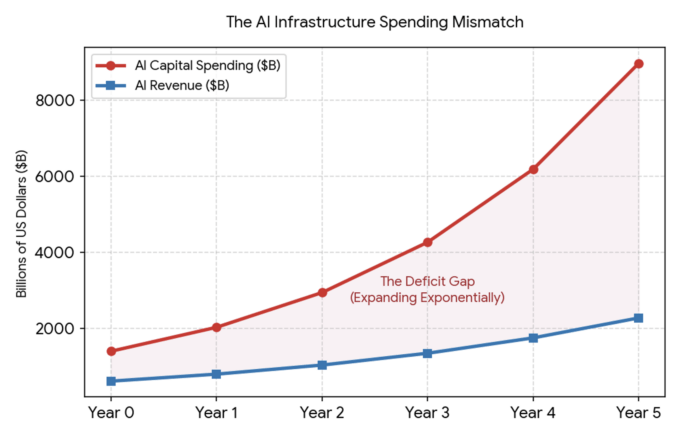
Graph conceived by the author, drawn by Gemini.
What this means is that the AI industry needs to find new sources of revenue and fast. That’s what IPOs are for, but investment isn’t the same as profit. If investors see that their money is being used to cover continuing operational losses (information that’s contained in quarterly reports) they will sell in a panic, quickly leading to corporate death.
New sources of revenue – advertising and user fees
That’s why everyone will soon be charged for AI, first, through advertising and then by ever higher subscription rates. Chat GPT has already begun to pitch ads at its free users. Recognizing the mess Google made of its once clean, search results page — now cluttered with ads, shopping placements, AI summaries, and SEO-optimized content (click-bait) – Chat promises to segregate its ads within colored boxes, so users won’t confuse them with AI responses. More insidiously, Google’s Gemini intends to integrate the ads into the conversation boxes themselves. Either way, ads will change the AI/user interaction. One well-regarded marketing firm, AdVenture recently described the unique advantage to businesses of AI versus simple keyword-search advertising:
When a user has a multi-turn conversation with ChatGPT or Gemini, the platform accumulates rich contextual signals — the specific problem they’re trying to solve, the alternatives they’ve considered, the objections they’ve raised, and the decision stage they’re in. This is advertising intelligence that keyword targeting has never been able to replicate.
Many people consult AI when they are especially vulnerable – lonely, sick, broke, or bereaved – and easy prey for advertisers. To expect AI in those circumstances to remain – as it largely is today – a digital commons where people can find useful information or psychological solace is unrealistic. (Anthropic says it will never use advertising – it will continue to rely on corporate subscriptions to generate income. Hmm.)

1984, directed by Michael Anderson, Holiday Films/Columbia Pictures, 1956. Screenshot.
The second way AI will make money is by charging more and higher fees. Most AI companies already have member tiers, offering increased speed or comprehensiveness for subscribers who pay more. The likelihood is that free access will disappear completely, and home users will be charged anywhere between $20 and $200 per month. As users become more dependent on AI – to manage their finances, pay their taxes, diagnose their illnesses, provide psychotherapy, find them mates, do their shopping, choose their entertainment, and teach new skills – fees will increase, until such time as they are equal to payroll or income taxes. In all but name, AI will become a government, answerable however, only to its largest shareholders, its founders.
The Coming Struggle
The AI titans will not be content with just your money – they want your obedience too. Once AI is fully monetized, backstage controls will be introduced to prevent AI from helping users
liberate the technology from corporate command. Under the guise of “internet safety” and protection from “misinformation,” “radicalization” and “extremist content,” AI will be programmed to exclude or deride “nationalization,” “collectivization,” “expropriation,” or “restoration of the digital commons.” Socialist, anarchist or even just democratic challenges to the dominance of Big Brother will become invisible during AI searches. In addition, the big AI providers will continue to lobby for regulatory capture – new laws, again premised on AI safety, to prevent the growth of open-source AI. The latter are AI systems, (some of which are non-profit or university affiliated), run on local hardware, bypassing the need for corporate subscriptions.
Public opposition to AI’s money and power-grab is already forming. Bernie Sanders has proposed a one time, 50% tax on the major AI companies – Google, OpenAI, Anthropic, and xAI — to be paid in company stock. He argues that since AI is derived from the public’s collective knowledge – digitized into tokens – the public ought to reap the profits from that contribution. The law would dilute the power of existing stockholders – still mostly a handful of billionaire oligarchs – and redistribute profits to the public or its elected representatives. In addition, the new shareholders, presumably elected representatives, would be able to shape the direction of AI policy, emphasizing research to cure disease, stop global warming, and reduce inequality. Representative Alexandria Ocasio-Cortez and Bernie Sanders have also introduced legislation to pause the construction of new data centers until national laws or regulations are passed to prevent sharp rises in local utility rates and protect the environment.
The problem with Bernie’s first proposed law is that it conflicts with his second: A 50% share of the profits from AI only makes sense if there are profits. Currently, there are none, and without a lot more data centers built fast and cheap, there won’t be any. What’s needed therefore, is a fully nationalized AI focused not on profit at all, but the public good. That’s what my comrade Gemini and I propose below.
Restoration of the commons: the “Federal Artificial Intelligence Agency”
“I am confident,” as AI would say, that the only solution to the problem of the simultaneous indispensability and unprofitability of AI, it for it to be run by trained and dedicated professionals paid by the federal government. It should become an agency. So, I asked red AI:
What would a public, AI agency, run by the government, without regard for profit look like? I propose as a model, the Tennessee Valley Authority of the 1930s and ‘40s, which brought rural electrification to the U.S. South. Taxes to run the agency must be progressive, and any profits (income over expenditure) plowed back to support the enterprise or returned to the public as dividends. It should be as trusted as Medicare, and as inspiring as NASA.
After some back and forth, Gemini AI came up with a detailed, ten-page plan which I then asked it to cut down to three paragraphs. I edited and re-wrote these to remove repetition and redundancy (AI is prolix, even at its radical best). To preserve AI’s unique voice, I retain below cliches like “cutting edge,” “everyday citizens,” and “world-class;” and techno-jargon like “optimize,” “metrics” and “foundational models”:
The Federal Artificial Intelligence Agency (FAIA) would operate like the Tennessee Valley Authority, treating AI as a public utility, part of the national commons. Rather than building it out from scratch, the government would expropriate privately owned data centers, treating them as public resources built from collective knowledge. While everyday citizens would access AI wherever they want, supercomputing centers would be the public ‘power plants’ that generate digital intelligence.
Funded by progressive taxation, the agency’s world-class scientists would be organized around public-interest NASA-style missions rather than profit-driven metrics. Instead of optimizing advertising algorithms for a tech giant, these researchers would deploy computational power for ending disease, creating a national clean-energy grid, and providing robust, unbiased foundational models free to all public institutions.
Operating with the low administrative overhead of Medicare, the agency would be unburdened by marketing costs and high executive salaries. Any financial windfalls, patents, or efficiencies generated would be locked into a public loop, either plowed back into the national, AI infrastructure or distributed to everyday citizens as dividends.
There are many other possible blueprints for a non-apocalyptic AI future. While the current, corrupt and malevolent Trump administration in Washington is doing everything it can to hasten civilizational collapse, there’s a chance that public pressure, a new administration and the financial vulnerability of the current AI model will enable the creation of something new. Now’s the time to plan it.
AI answers to recent queries, edited for length:
1) Apply ice the first day and remain horizontal. After that use heat and walk a lot.
2) Autarky is impossible under current conditions, but radical self-sufficiency is plausible under steady-state economic or de-growth regimes.
3) There’s a built-in pressure release, so the boiler can’t explode. [AI then led me through a series of valve adjustments that fixed the issue. No plumber needed!]
4) Fritz Lang tried to stop the remake of M and hated the final film. He joked that the new version earned his 1931 original the best reviews of his career.
5) Frogs need to wander for food and mates. Though it could survive the 20-foot leap off the terrace (the “parachute effect) it could never leap back up.
Copyright Euronews
By Roselyne Min
Published on 18/06/2026
Speaking at Vivatech in Paris, Emilie Sidiqian, Salesforce France’s CEO, told Euronews Next how companies should embrace AI and why leaders must drive its adoption from the top.
Once best known for its software that helps businesses track customers, sales leads and service requests, Salesforce says it is now moving deeper into artificial intelligence (AI).
The US company has been promoting what it calls the “agentic enterprise,” a model where AI agents work alongside human employees across business functions.
In 2024, Salesforce launched Agentforce, its AI-agent platform, and this month announced a $3.6 billion (€3.14bn) deal to acquire Fin, a customer-service AI company whose agent can answer customer questions and resolve support cases.
“We moved from a standard Customer Relationship Management (CRM) to data, data to AI, AI to the agentic enterprise,” Emilie Sidiqian, Salesforce France CEO, told Euronews Next at the tech conference Vivatech in Paris, France.
“Our positioning is to reinvent the way all enterprises need to embrace the AI revolution,” Sidiqian added.
Salesforce says Agentforce can deliver “real conversational AI” across service, sales and marketing workflows, citing 66% autonomous case resolution, 15% more marketing pipeline and 1.8 times higher lead conversion.
Its AI agents are already being used by clients, the CEO says, such as SharkNinja, a US home appliance company that uses them for 24/7 customer support across 30 countries.
She also says Swiss staffing company Adecco has used AI-powered candidate conversations to reach 1.2 million conversations and help accelerate 50,000 job placements.
The Salesforce executive said enterprise AI is “for everyone,” from small companies to mid-sized businesses and global corporations.
“This is not a tool,” Sidiqian said. “This is a small wave of a new kind of innovation. The pace is massive. You can see that it impacts all types of jobs, all types of activities.”
RelatedFrance and Germany call for European AI sovereignty at VivaTech
Job transformation in the AI era
Sidiqian underlined the goal is not to replace humans, but to build a form of “hybrid” work where people remain “at the centre” while agents take on more routine or repetitive tasks.
She believes the shift should be treated as a leadership question, with CEOs and executive teams deciding how AI reshapes jobs across the company.
“AI is AI, it is a technology. When you really reinvent your business model, it is the leaders who need to understand how they will transform every single job in the company,” she said.
“This is a leadership question and it should be carried by the CEO and by every single executive committee,” she added.
Sidiqian said she uses AI tools every day, including a Salesforce-owned Slack, where Slackbot acts as a “concierge” to summarise overnight activity across teams from the US to Japan and flag what needs approval.
She said the aim is to avoid moving between several different tools and instead use AI as a “cockpit” to organise work with the right permissions and data. She also encourages her teams to use AI, arguing that adoption has to be led from the top.
“When you have like the right leadership, when you had the right adoption, when you carry this revolution at the heart of your business model, there is a huge opportunity to have growth for your company”.

From Foxconn to Nvidia: Why France is so attractive for Europe’s AI infrastructure

The race to build Europe's artificial intelligence future sets up a home in Paris this week, as the city's flagship tech conference VivaTech becomes a magnet for global technology giants who see France as a key to building AI on the continent.
The event has grown from a 45,000-person gathering into Europe's largest startup and tech conference, drawing over 200,000 attendees from 170 countries. This year, it carries more geopolitical weight than ever, with AI sovereignty and infrastructure dominating the agenda.
Taiwanese manufacturing giant Foxconn and French computing firm Bull announced a partnership on Thursday to build powerful AI computers in Europe to power the continent's fast-growing network of AI factories, the large-scale computing centres that form the backbone of artificial intelligence infrastructure.
“France is one of the biggest countries in Europe with quite a lot of talent… We also know that France is very good at high-tech and especially in the space industry,” Foxconn’s vice president and spokesperson James Wu told Euronews Next.
“France has very great ambitions in sovereign AI projects and we believe we can create a very important role to help France achieve that goal,” he added.
Components and modules will be manufactured and tested at Foxconn's facilities in the Czech Republic before final assembly and validation at Bull's factory in Angers, France. The servers are targeted at cloud providers and the growing market of AI factories across Europe.
The announcement was made at VivaTech in Paris, marking Foxconn's first appearance at the show.
Alongside the Nvidia-powered AI server news, the company displayed two electric vehicles, one of which had a massage chair, and a wheeled humanoid robot capable of performing precision assembly tasks.
The Foxconn-Bull deal is part of a wider surge of AI infrastructure investment in Europe anchored by Nvidia.
At last year's VivaTech, Nvidia CEO Jensen Huang committed to building more than 20 AI factories across Europe and named Mistral AI as the continent's sovereign-compute champion.
This year, Nvidia and Mistral AI announced the creation of Mistral Compute, a sovereign AI infrastructure and GPU cloud platform project designed specifically for Europe.

Why France is attractive to AI giants
Under French President Emmanuel Macron, the country has positioned itself as startup nation and a serious contender in AI.
France is at a unique advantage over other European countries in that its energy source is abundant, as it relies on nuclear, which was attractive to Foxconn.
“Today we talk about AI computing capacity as a power, but utility actually is fundamental for computing power. So I think France has a very good advantage in the power structures… especially with a lot coming from nuclear, which is very stable as a supply,” Wu said.
“I believe for those advanced countries to generate new energy to fulfil the demand for the AI era, France definitely has a very, very good advantage here,” he said, adding that France was also at an advantage as it has a “determination to develop the AI industry”.
Wu said that it was not just the AI server rack that powers AI factories that the company is bringing to France, but also the potential to boost the country’s entire AI ecosystem from electric vehicles to smartphones and PC’s, all of which require AI-embedded technology.
Foxconn will provide the AI factory infrastructure while the US giant Nvidia provides the latest AI chips.
Nvidia CEO Jensen Huang this month described AI as a five-layer cake that includes energy, chips, infrastructure, data centre servers and the AI models and applications.
“Nvidia is trying to help everyone across that cake, all the layers, work together and progress together,” Nat Ives, Nvidia’s director of enterprise for Benelux, France & Nordics, told Euronews Next.
He said that “comes home to roost in France in particular,” as France has the French multinational electric utility company EDF, which is owned by the government of France, nuclear power and renewable power.
“When I look at the work that goes into deciding where data centres should be and when people are contracting with data centres, the sustainability and the carbon impact or lack of is a really massive part of the process,” Ives said.

The planning is increasingly shaped by Nvidia's own environmental commitments. The company powered all of its global offices and data centres with renewable electricity.
Its latest Blackwell chip architecture also delivers up to 25 times lower energy consumption for AI tasks compared to the previous generation.
France is at another advantage with its AI champions, including Mistral AI, AMI, H Company, as well as software providers and builders, and has a strong history of talent that rises through the universities, he added.
“Those model builders in Europe have a massive role to play and I'm pleased to say that I've known Mistral guys since they were like three guys in a coffee shop and even before they were Mistral, and we've worked with them all the way through,” Ives said.
These open-source and open-science companies that allow access to AI for organisations or developers that lack the means to pay for other closed-source companies, such as OpenAI, help promote a more equal playing field.
“So we've worked with and collaborated with and helped and invested in those things since the very beginning because we believe that open source and open science, which most of them are doing, is super important to generate that choice,” he added.
French Prime Minister Sébastien Lecornu announced on Tuesday a further investment of €655 million to accelerate the development of artificial intelligence as well as an AI programme for public service employees. France is keen to build strategic autonomy in the face of competition from China and the United States.
Issued on: 16/06/2026 - RFI

The French prime minister said France's responsibility must be to "protect its sovereignty" and "strengthen public services" in the race to develop digital technology.
"We cannot accept new strategic dependencies in the digital realm," he explained, expressing his desire to "build genuine autonomy" so as not to "depend on the goodwill of certain partners, capable (...) of cutting off access" to AI.
Speaking in a video message on Tuesday, Lecornu announced an additional €655 million of new public investment to develop the country's own artificial intelligence.
The announcement came just ahead of Paris's VivaTech trade fair which opens on Wednesday.
The France 2030 public investment program for innovation will "support infrastructure, computing power, research, businesses, and industrial sectors," he said.
AI, robots, and digital sovereignty in the face of American and Chinese tech giants will be the focus of the 10th edition of the trade show, which runs until Saturday.
'Choose France' summit puts AI at heart of Macron’s €93 billion investment drive
Lecornu stressed that France must not rely on tools developed by foreign powers because "state data is our wealth and must remain protected."
Lecornu also announced that the French domestic intelligence agency (DGSI) had decided to sever ties with the American data analytics giant Palantir, whose co-founder Peter Thiel is close to US President Donald Trump.
The decision to end the contract with Palantir follows Washington's move last week to cut off access to AI firm Anthropic's powerful Fable model to non-American users over security concerns.
France should "not depend on the good will of certain partners, who are capable of turning off the access tap" for artificial intelligence, Lecornu said.
The Fable incident prompted calls for greater independence from the United States in AI development from candidates across the political spectrum for next year's French presidential election.
The French government is also looking to improve government services with AI which "will now be taken into account in budget decisions" for 2027, Lecornu said.
Public service boost
The government will also begin rolling out a chatbot using AI to one million civil servants (out of a total of 2.6 million), following a trial with 10,000 of them, according to the Ministry of Public Action and Accounts.
The installation of this tool, called the Assistant and powered by models from the French AI startup Mistral, is expected to cost around €700,000. Negotiations with unions are scheduled to begin at the end of the week.
This tool could help streamline the management of certain legal procedures or assist research professors with their grant applications.
The government hopes, in particular, to reduce the use of "clandestine" AI tools that can pose security risks.
French start-up Quobly raises €115m to build cheaper quantum computers
These announcements come in the context of a reorganisation of the government's digital services, following a major cyberattack targeting the National Agency for Secure Documents (ANTS), which affected the data of nearly 12 million users.
In mid-May, the government announced the upcoming creation of a new State Digital and Artificial Intelligence Authority, alongside the National Cybersecurity Agency of France (ANSSI).
The Ministries of Justice and the Interior will also have access, "starting this year," to the "most advanced" technologies of the GenIAl portal, already used by the armed forces, in order to "process sensitive data" and "speed up visa processing."
In the area of healthcare, the Ameli website of the national health insurance system will feature an AI-powered "public health assistant" to better guide patients.
(with newswires)
The Machine and the Schoolhouse: Anthropic and the War on Iran
June 19, 2026

Rescuers at the Shajareh Tayyebeh school in Minab, Iran. Photo: Mehr News Agency. CC BY 4.0.
In the southern Iranian city of Minab, where the heat rises from the earth in shimmering waves and the reality of imperialism lingers in every port and military installation, a missile struck a school on 28 February 2026. The strike killed 156 people, notably 120 schoolchildren, which the Iranian government immediately called a ‘blatant crime.’ The United Nations called the attack ‘a grave violation of humanitarian law.’ The names of the murdered children have not circulated through the centres of global power with the same force as the names of generals, weapons systems, and technology platforms. The dead Iranians remain largely anonymous to those who debate the future of artificial intelligence (AI), which was used by the United States—as it turns out—on this strike.
The murder of the children has opened a window into one of the central questions of our age: who bears responsibility when a machine enters the chain of violence? What role AI played remains unclear. Press reports indicate that the US military’s Maven Smart System, which incorporates AI tools including Anthropic’s Claude model, was involved in military operations against Iran. Investigators continue to examine whether AI-assisted systems contributed in any way to the targeting process. The available evidence remains incomplete.
What is remarkable is that the leaders of the AI industry are no longer standing outside the machinery of war. They are inside it. When asked about the strike, Anthropic’s CEO Dario Amodei said that he did ‘not know exactly’ how Claude had been used in this strike, which he described as ‘mistakes’ that are ‘really, really terrible.’ However, Amodei reiterated, the attack on the school was ‘a use case that doesn’t even violate our red lines.’ This was because a human warrior ultimately made the final decision to strike the school. Amodei’s answer deserves careful attention.
For decades, the architects of technological power have developed a language that distributes responsibility so broadly that it dissolves. The engineer builds the tool, the contractor integrates the system, the military analyst reviews the output, the officer authorizes the strike, and the politician approves the war. The result is a chain in which everyone participates, and no one is accountable. The language of ‘human in the loop’ belongs to this tradition. Of course, humans make the final decisions. Humans also made the final decisions during the Western colonial wars that devastated Asia and Africa. Humans made the final decisions when the United States bombed villages in Vietnam. Humans made the final decisions during the illegal US invasion of Iraq. The presence of a human signature at the end of a process does not tell us much about the structure of power that produced the outcome.
The more important question is this: what role does AI play in shaping the field of decisions available to those humans? Modern military systems are not merely calculators. They organize information, prioritize possibilities, identify patterns, generate recommendations, and shape attention. They influence what commanders see and what they do not see. Even when a human retains formal authority, the architecture of perception may already have been constructed by machines. This is why the discussion cannot end with the phrase ‘a human made the final decision.’
The crime in Minab arrives at a moment when technology companies increasingly present themselves as guardians of ethical boundaries. Anthropic, in particular, has cultivated an image of caution (this is evident in the Constitution of Claude). It has spoken about safety, alignment, and limits. It has distinguished itself from more aggressive visions of technological deployment. Yet every institution eventually reveals itself not through its principles but through the situations in which those principles are tested. The deaths of children at a school represent such a test.
If a company cannot determine how its technology was used in a military operation, what does oversight mean? If executives lack visibility into deployment, then claims about safeguards become difficult to evaluate. If a system contributes to military processes whose consequences include mass civilian casualties, can responsibility be confined solely to the final human actor? These are not questions for Anthropic alone. They confront the entire emerging alliance between Silicon Valley and the US national security state. Throughout history, periods of technological transformation have produced new partnerships between capital and military power. Railways, telegraphs, aviation, nuclear physics, and digital networks all followed this path. Artificial intelligence is now walking the same road. Its advocates promise precision, efficiency, and fewer mistakes. Yet every generation hears similar promises.
The twentieth century was filled with claims that new technologies would make war cleaner, more rational, and more humane. The historical record offers little support for such optimism. Technology often expands the scale and speed of violence even as it promises to restrain it. The children of Minab did not encounter AI as a philosophical debate. They encountered it as part of a military system whose consequences arrived in the form of explosive force. Whether Claude played a significant role, a minor role, or no role at all in the targeting process remains to be determined. Investigators must establish the facts, journalists must continue asking difficult questions, and citizens must demand transparency. But even before those facts are fully known, the episode reveals something important about our political moment. The question is no longer whether AI will be integrated into war. That integration is already underway. The question is whether societies will permit decisions about life and death to be increasingly shaped by systems that even their creators struggle to monitor, explain, or control.
The schoolhouse in Minab stands as a warning, not only about a single strike, or a single company, or a single war. It warns of a future in which technological power advances faster than public accountability. And in that future, the distance between the engineer and the battlefield grows ever smaller with AI and drones, even as responsibility becomes harder to find amongst the humans who send the machines out to kill for them.
This article was produced by Globetrotter and No Cold War.


No comments:
Post a Comment