Trump, the Democrats and the Courage To End a Failed War
Reprinted with permission from Trita Parsi’s Substack.
I have spent years fighting against Trump’s push toward war with Iran, and I have the scars to prove it. When Trump withdrew from the JCPOA in 2018, I warned that it would eventually bring us to this moment. Ever since, I have consistently argued against the confrontational path he set the United States on. That record speaks for itself, which is why I can say what follows without any throat-clearing.
Given the circumstances, President Trump’s decision to strike a deal with Tehran and bring this costly, unnecessary war to an end is the right one. It deserves support, not partisan second-guessing. As Rob Malley – a key member of Barack Obama’s team that negotiated the nuclear deal and later Joe Biden’s lead negotiator with Iran – noted on X, comparing Trump’s memorandum of understanding to Obama’s JCPOA misses the point. What matters is not how the agreement stacks up against past diplomatic achievements, but how it compares to the alternatives before us. And on that score, Malley argued, the MOU is “far preferable to any of the alternatives on offer. Period.”
I would go further. To examine the Memorandum of Understanding and ask “Was the war worth it?” is nonsensical.
Of course it wasn’t. How could it have been? The premise itself is deeply flawed: that a failed war of choice would somehow strengthen Washington’s hand at the negotiating table and produce more favorable terms. History offers little support for such a proposition.
The question is also flawed in another, more consequential way. It implies that a war should not be brought to an end until it has produced better terms – even when the war itself is failing.
Taken seriously, that logic leads to a dangerous conclusion: that a failed war must continue until the battlefield fortunes somehow improve and a more favorable outcome becomes attainable. Perhaps that day will come. Perhaps it never will. In the meantime, the costs – in lives, treasure, regional stability, and strategic credibility – are treated as secondary considerations.
This is how endless wars are born.
Wars become interminable when leaders convince themselves that ending them without victory is politically more costly than continuing them without hope. Once that trap is sprung, every setback becomes an argument for one more deployment, one more escalation, one more year. The objective shifts from achieving a realistic political outcome to avoiding the admission that the original objectives were unattainable.
American history offers more than a few examples. Presidents inherit wars they did not start, recognize they cannot be won on the promised terms, yet lack the political space to end them. So they postpone the reckoning. They kick the can down the road, handing the burden to their successor, who does the same. The result is a cycle of strategic drift in which the costs accumulate while the prospects for success steadily recede.
When victory is nowhere in sight, prolonging a conflict in the hope that reality will eventually conform to political rhetoric is not resolve. It is denial.
Remember Afghanistan. For years, American officials lied to the public that victory was just around the corner—six months away, perhaps a year at most. Yet the Afghanistan Papers later revealed that these officials privately understood that victory was nowhere in sight. They knew the war was adrift, but feared the political consequences of admitting it.
So the war continued. By the time the United States finally withdrew, nearly two decades had passed, and more than $2 trillion had been spent.
And what was the end result? After twenty years of war, thousands of American and allied lives lost, and hundreds of thousands of Afghan casualties, the United States arrived back where it had begun: it had replaced the Taliban with the Taliban.
That is the curse of endless war. The refusal to accept an unfavorable reality today merely guarantees a higher bill tomorrow.
Some credit must be given to Trump for breaking this pattern, even as he should be blamed for having started this war in the first place. Political leaders should be judged not only for the mistakes they make, but also for whether they have the courage to correct them.
Trump could have followed the well-worn path of his predecessors. He could have prolonged the conflict, spent more money, sacrificed more lives, destabilized more economies, and further depleted American power – all while insisting that victory remained just over the horizon. Recall the countless times he declared that the war had been won.
Indeed, the political costs of continuing the war would likely have been lower than the costs he is paying today for ending it. In American politics, there is often greater punishment for acknowledging failure than for perpetuating it.
That perverse incentive has trapped presidents for decades. In his testimony on the Vietnam War before the Senate Foreign Relations Committee in 1966, George Kennan stated the following: “There is more respect to be won in the opinion of the world by a resolute and courageous liquidation of unsound policies than by the most stubborn pursuit of extravagant or unpromising objectives.”
The criticism coming from some Democrats is particularly disappointing because it echoes the same bad-faith tactics Republicans deployed against the JCPOA in 2015. To be sure, Trump has invited some of this treatment. He spent years attacking Obama’s agreement with a barrage of misleading arguments and exaggerated claims.
But that does not make it wise for Democrats to return the favor.
Trump currently owns this failed war, but if the Democrats help torpedo the MOU and war resumes, then they will co-own the next war. Trump’s disaster will become theirs as well.
This isn’t rocket science. Several Democratic lawmakers have managed to criticize the war, hold Trump accountable for it, yet avoid attack lines that could sabotage the MOU. Their criticisms are primarily over Trump having started this war in the first place, rather than the terms for ending it.
Rather than attacking the terms of the MOU, Democrats should pressure the administration to protect it from those who are determined to see it fail. The main external threat is the Israeli government and Benjamin Netanyahu’s obsession with sabotaging any opportunity for Iran and the United States to bury the hatchet.
Instead of relying solely on angry phone calls and public rebukes of Netanyahu, supporters of ending the war should press Trump to act now: suspend military aid to Israel and curtail military and intelligence cooperation. Such measures would limit Israel’s ability to reignite the conflict and dispel any notion in Tel Aviv that Washington will automatically follow Israel into another war. If Israeli leaders understand that the United States will not be drawn into a future conflict on their behalf, their incentive to start one in the first place will be significantly reduced.
The task now is not to reward Trump politically, nor to excuse the recklessness that produced this war. It is to prevent the war from returning. Democrats can condemn the decision to start it without sabotaging the agreement that ends it. They can hold Trump accountable without helping Netanyahu drag the United States back into conflict. The choice before them is not between opposing Trump and supporting peace. It is between learning from America’s endless wars and repeating them.
Trita Parsi is the Executive VP of the Quincy Institute for Responsible Statecraft and an award-winning author. Washingtonian Magazine has named him one of the 25 most influential voices on foreign policy. Noam Chomsky calls him “one of the most distinguished scholars on Iran”
Visit Trita Paris’s Substack and subscribe.
Hey, POTUS, The Point of the War Was What Again?
Indeed, had the 76-day shutdown of the world’s energy and commodities mother lode been prolonged much longer it would have also brought unspeakable worldwide economic disruption and carnage. So you can at least give the Donald this much: When push came-to-shove, he blinked. And just in the nick of time, as the global oil stocks graph below strongly suggests.
Currently, stocks are at a record low of 76 days of worldwide use. That’s damn near the bottom of the barrel – the point where working inventories give way to disruption and breakdown of the intricate and opaque supply chains through which 108 mb/d of crude oil, refined products, petro-chemical feedstock, LPGs and commodity by-products like sulfur, helium, needle coke and countless more pass through the arteries of global commerce.
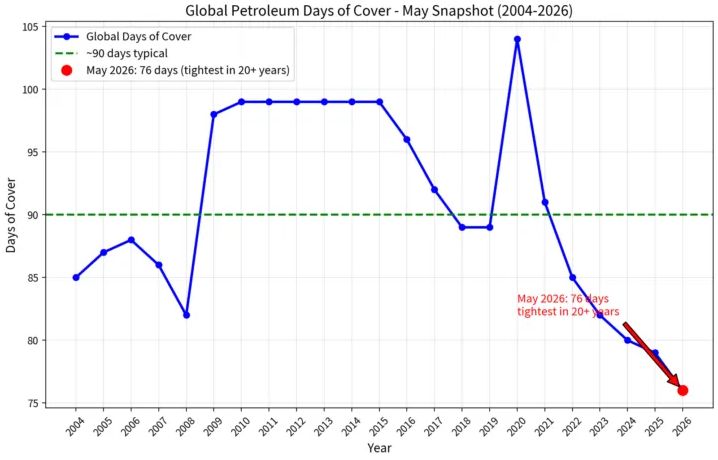
As usual, however, the Donald has seen fit – obviously in conjunction with the Roman-style “games” put on for his 80th birthday – to triumphantly describe Sunday’s announcement as the equivalent of “peace in our time”. But it is no such thing. It’s more the opposite – a google calendar invite to meet and attempt yet again to negotiate the long-standing issues that stood on February 27th.
Well, at least some of them. And the “some” part is crucial to grasping the absolute insanity of the February 28 military attack on Iran in the first place.
Self-evidently, the reason for the attack is not that Iran was days, weeks or months away from a nuke: Even the Donald’s own former DNI, Tulsi Gabbard, had recently affirmed in Congressional testimony that the long-standing assessment of the US intelligence agencies that Iran had ceased all research and activities designed to weaponize HEUs was still the case, and with a high degree of confidence.
Likewise, the January 2026 street uprisings throughout Iran, which had been the catalyst for war that Netanyahu had peddled to the SUCKER he finally found in the Oval Office, has long since become a moot point. Not only has no uprising occurred upon the Donald’s explicit invitation of February 28th, but the “deal” actually says the opposite.
For instance, here is the predicate for war offered by Trump on February 28th:
“Finally, to the great proud people of Iran, I say tonight that the hour of your freedom is at hand… When we are finished, take over your government… No president was willing to do what I am willing to do tonight.
America is backing you with overwhelming strength and devastating force. Now is the time to seize control of your destiny and to unleash the prosperous and glorious future that is close within your reach.”
If that wasn’t a clarion call to regime change, the word has no meaning. Accordingly, Item #3 of the MOU sticks out like a sore thumb. Contrary to the promised liberation from the tyranny of the mullahs, Iranian dissidents and patriots are self-evidently scheduled for the George HW Bush treatment.
That is to say, for complete and total abandonment similar to that which was notoriously accorded to the Iraqi Shiite uprising at the end of the first Gulf War. After being spurred into action by CIA operatives and Voice of America propaganda, the Iraqi Shiites were abandoned to be brutally liquidated by a vengeful Saddam – even as Washington conveniently became amnesiac about the guns and money it had promised to provide.
Here again, therefore, there will be no further Washington instigated regime change activities but, instead, full respect for Iran’s own sovereignty and benighted form of internal governance. To be sure, that is a good thing: Washington should never ever pretend to be the hall monitor for the 193 sovereign states of the planet in the first place.
Still, what the hell was the reason for going to war on February 28th when there was no bomb and, self-evidently, no prospect of a regime change uprising, as MOU item #3 makes clear as a bell?
Then again, this so-called betrayal actually represents a silver lining. Owing to his stumbling, bumbling handling of the entire matter, the Donald by inadvertence or otherwise has put the CIA, NED, the USIA and the rest of the Deep State operations out of business when it comes to the Regime Change file in Iran. And that’s hopefully a strong precedent for the future.
3. The US commitment to non-interference in Iran’s internal affairs and respect for the sovereignty of the Islamic Republic of Iran.
Next we needs go back to the reasons why the Donald shit-canned the JCPOA way back in April 2018 at the instigation of the neocon/Bibi Fifth Column in Washington. One of the latter’s red hot claims was that the JCPOA did nothing about the alleged Iranian network of proxies and terrorist states around the middle east, especially Hezbollah, the Houthis and the former regime of Assad in Syria.
You might well have expected, therefore, that high on the list of items that the parties would be obligated to discuss and resolve pursuant to the Meeting Invite would be the matter of Iran reining in its purportedly terrorist allies.
Alas, we appear to have another case of mistaken identities. The only “allies” tasked with new obligations by the MOU are not the axis of resistance associates of Iran, but the Gulf States allies of the US!
That’s right. The former are apparently to be assessed upwards of $300 billion to rebuild the massive damage caused by US/ Israeli missiles and bombs on the Iranian side of the Persian Gulf.
#7: The necessity for the US and its allies to present reconstruction plans for Iran amounting to at least $300 billion.
Again, this item constitutes yet another silver lining – even if it is ass-backwards with respect to the ostensible reasons for the war in the first place. To wit, the Bibi/Donnie War was actually such a severe existential threat to the economic prosperity of the Sunni states ringing the Persian Gulf that they have actually agreed to hoover-up $300 billion to get the Donald to call off the dogs of war in their own backyard.
Alas, awhile back Crown Prince Mohammed bin Salman (MBS) was understandably vexed by the Donald’s boast about the basis on which his principle Gulf state ally was cooperating. But now, it appears, he is expected to plant a great big wet one upon the Donald ample posterior in the form of diverting the massive funding needed for MBS’ grand ambition for Vision 2030 for Saudi Arabia into what VP Vance is already fatuously describing as “investment” in his rival across the Gulf.
“He [MBS] didn’t think this was going to happen… he didn’t think he’d be kissing my ass… He really didn’t. He thought he’d be just another American president that was a loser… but now he has to be nice to me.”
To be sure, the Wall Street pea-shuffler pretending to be the US Secretary of the Treasury will likely come up with some financial engineering scheme to sweeten the financial castor oil being shoved down the throats of the Washington’s once and former Persian Gulf allies. That is, some abuse of the Overseas Private Investment Corporation’s guarantee authority designed to hold these “allies” harmless for losses.
The point is, the Donald backed himself into the Mother of all Corners. So he is now being forced to swallow an inverted Versailles treaty obligation: To wit, he claims to have won the stupidest war every waged by Washington – and there is plenty of competition for that honor – but will now be paying massive reparations to the loser!
There is not a snowball’s chance in the hot place, of course, that he could ever get Iranian Reparations payments funded on Capitol Hill. So what is being cooked up at this very moment is some cockamamie “Persian Gulf Investment Authority” that will be fronted by the Persian Gulf allies, but, as usual, ultimately down deep in the plumbing there will be recourse to the hard-pressed taxpayers of Flyover America.
Then again, not a word is said in the MOU about the other Bibi Bugaboo that became a talking point against the JCPOA. Back in 2015 when Bibi came to the US Congress and denounced the agreement, among many complaints was his instance that the deal failed because it did not eliminate Iran’s missiles.
Well, for crying out loud. That was was risibly rich because Israel had upwards of 100 nukes – none of which had ever been declared, inspected by the IAEA or sanctioned by the UN or any other body. Yet Iran was now officially giving up any prospect of having even one bomb for deterrence purposes – even as the neocon/Bibi Fifth Column demanded that it strip itself of missile defenses, as well, thereby even further exposing itself to the kind intentions of Bibi Netanyahu, who had made a 30 year career in Israeli politics centered on demonizing the “far enemy” in Tehran.
So rather than finally stripping Iran of even its missile defense—another ostensible aim of the war – the MOU is completely silent.
Of course, the deal does include an Iranian pledge not to seek a nuclear bomb – but that surely gives gilding the lily a wholly new definition.
Iran was already committed to “no nukes” as a signatory of the nuclear non-proliferation treaty; had re-committed to that status in the 2015 JCPOA; and has maintained an internal policy of not seeking nuclear weapons since at least 2003. The latter, in fact, was confirmed in the 2007 NIE and reinforced by the 2015 IAEA findings in conjunction with the implementation of the JCPOA and subsequent US intelligence agency findings.
So what the MOU does, at the end of the day, is essentially establish at 60 day cease fire window in which an attempt is to be made to put the Humpty-Dumpty of the JCPOA back together again. In Part 2 we will amplify why the prospects of success on that front lie somewhere between slim and none.
But here it is will to consider what the JCPOA actually did and why the Donald’s reckless shit-canning of the deal in May 2018 probably was one of the greatest mistakes of American foreign policy in the entire history of the nation.
So to begin, the Joint Comprehensive Plan of Action (JCPOA), finalized on July 14, 2015, represented one of the most technically detailed and intrusive non-proliferation agreements in history. Negotiated between Iran and the P5+1 (United States, United Kingdom, France, Russia, China, and Germany, plus the European Union), it aimed to sharply extend the theoretical breakout time to a nuclear weapon – well beyond the physics and manufacturing hurdles that existed in their own right.
The deal achieved this through layered restrictions on enrichment capacity, elimination of the plutonium pathway entirely, and an unprecedented verification regime.
Needless to say, the negotiations were protracted. Secret U.S.-Iran talks began in 2013 in Oman, followed by the interim Joint Plan of Action in November 2013. Intensive multilateral negotiations produced a framework in April 2015 and the final 159-page agreement (including five detailed annexes and appendices) on July 14, 2015.
Thus, from the ramp-up of serious talks to finalization, the process spanned roughly 18 to 22 months of complex bargaining over technical, legal, and political details. The document itself is exceptionally long for an international accord – often described as the longest multilateral agreement since World War II – because its annexes contain highly specific implementation schedules, technical specifications, monitoring protocols, and dispute-resolution mechanisms.
Enrichment Capacity Reductions: The JCPOA imposed strict, time-bound limits on Iran’s uranium enrichment program to prevent rapid accumulation of weapons-usable material. To this end, Iran was required to reduce its operating centrifuges dramatically. At Natanz, it could operate no more than 5,060 first-generation IR-1 centrifuges in 30 cascades for the first 10 years.
The total number of installed old and slow first generation IR-1 machines was capped at 6,104 (including those at Fordow). All excess centrifuges – more than 13,000 – had to be dismantled and placed under continuous IAEA monitoring in storage.
Iran was also prohibited from producing additional IR-1 centrifuges for 10 years and from installing or testing any advanced centrifuges at all (IR-2m, IR-4, IR-6, IR-8) that would increase enrichment capacity beyond specified limits during the early years.
Enrichment level and location: For 15 years, uranium enrichment was capped at 3.67 percent U-235 (low-enriched uranium suitable for civilian power reactors but far below weapons-grade approximately 90 percent). Enrichment activities were confined exclusively to the Natanz Fuel Enrichment Plant.
By contrast, the Fordow facility was converted into a nuclear, physics, and technology research center with no uranium enrichment permitted for 15 years; only 1,044 IR-1 centrifuges could remain installed there, mostly for stable isotope production in cooperation with Russia, and most cascades stayed idle.
These measures collectively slashed Iran’s enrichment capacity by roughly two-thirds and prevented rapid scaling with more efficient advanced machines.
Elimination of the Plutonium Route: A major achievement of the JCPOA was closing Iran’s potential plutonium pathway to a bomb. The Arak heavy-water research reactor (IR-40) was originally designed to produce significant quantities of weapons-grade plutonium in its spent fuel.
Under the JCPOA, however, the original reactor core was removed and rendered inoperable (filled with concrete). Iran agreed to redesign and rebuild the reactor with international assistance (primarily from China and others) so that it would produce far less plutonium – comparable to a modern light-water research reactor. All spent fuel from Arak had to be shipped out of Iran for the reactor’s lifetime.
Iran also committed not to build any new heavy-water reactors or a reprocessing facility capable of separating plutonium for at least 15 years. These steps effectively eliminated Arak as a viable source of weapons-usable plutonium.
Inspection and Surveillance Regime: The JCPOA established the most robust IAEA verification system ever applied to a state with an advanced nuclear program. Key elements included implementation of Iran’s Additional Protocol to its safeguards agreement, allowing broader access and information.
There was continuous IAEA monitoring at declared nuclear sites (Natanz, Fordow, Arak, Esfahan, etc.), including real-time camera surveillance, seals, and sensors on centrifuges, uranium flows, and storage. Daily IAEA access upon request to enrichment facilities was provided, along with monitoring of centrifuge production, assembly, and storage facilities.
A mechanism also existed for IAEA access to undeclared sites suspected of nuclear-related activities. If Iran objected, a 24-day process involving the Joint Commission could compel access. Verification of uranium mines, mills, and ore concentrate production was included, as well as long-term presence of IAEA inspectors and enhanced reporting requirements.
In all, the JCPOA regime provided “anytime, anywhere access” in practice for most practical purposes and created multiple layers of detection for covert activities
IAEA-Verified Compliance: On Implementation Day (January 16, 2016), the IAEA certified that Iran had completed all required initial steps. Crucially, Iran had reduced its stockpile of enriched uranium from roughly 7,000 to 10,000 kg (various enrichment levels) to under 300 kg of uranium enriched to no more than 3.67 percent – a reduction of well over 90 percent.
It also converted or shipped out nearly all of its stockpile of 20 percent enriched uranium (previously about 400 kilograms, used for medical isotope production in the Tehran Research Reactor),while a small remainder was fabricated into fuel or diluted.
As indicated, the IAEA also confirmed that Iran disabled the core at Fordow and removed associated infrastructure, and disabled the Arak reactor core and had begin redesign work. It also confirmed that Iran had dismantled and stored excess centrifuges under IAEA seal. Subsequent IAEA quarterly reports (2016 through early 2018) repeatedly confirmed Iran’s compliance with all of these nuclear-related commitments.
As it happened, Iran enriched uranium stockpile remained well below the 300 kg cap, and that material that was enriched stayed at or below 3.67 percent. No prohibited activities were detected at declared sites. The IAEA also verified the physical removal and disabling of key equipment at Fordow and Arak.
In short, the JCPOA’s intricate provisions – centrifuge caps and modernization bans, enrichment-level and location restrictions, plutonium pathway elimination via Arak redesign, and an exceptionally intrusive IAEA verification system – created multiple overlapping barriers. Even a modern day Houdini could not have escaped its barriers to a nuke, which the Iranians weren’t pursuing in any event.
At the end of the day, the whole case against the JCPOA was a crock – another Big Lie by Netanyahu that the Donald embraced lock, stock and barrel. And now he’s trying to put it back together under circumstances that are not remotely suitable for purpose, as we will essay in Part 2.
David Stockman was a two-term Congressman from Michigan. He was also the Director of the Office of Management and Budget under President Ronald Reagan. After leaving the White House, Stockman had a 20-year career on Wall Street. He’s the author of three books, The Triumph of Politics: Why the Reagan Revolution Failed, The Great Deformation: The Corruption of Capitalism in America, TRUMPED! A Nation on the Brink of Ruin… And How to Bring It Back, and the recently released Great Money Bubble: Protect Yourself From The Coming Inflation Storm. He also is founder of David Stockman’s Contra Corner and David Stockman’s Bubble Finance Trader.

No comments:
Post a Comment